A Busy Month Ahead

Back when my days were filled with home visiting, classes, multiple museums, tutoring sessions and volunteer events*, I found the joys of color-coding my schedule. Color-coding was my way of making sure I didn’t find myself driving half an hour east when I should have been driving an hour west. There are times I miss that version of an eighty hour work week that tossed me in bed with pneumonia one November.

This November, though not the same kind of busy, is going to be a busy one. I’m rather looking forward to this….

  • November 5th – The Peddler’s Market – I was so hoping to earn a space at this event. But, it seems no one  has dropped out yet. With two days to go, I will be surprised if I get the phone call. Instead, I will be going as a buyer. This is a nice, often packed, selling event where bargains are to be had at the end of the NY antiquing season. I have a short list of things others are looking for. (This happens to be a year that the Symposium and Peddler’s Market are not on the same weekend.)
  • November 11th – I’ll be heading to my Favorite arts and crafts sale – Granger Homestead’s ChristKindle Market. The front yard of this historic house museum in Canandaigua, is filled with huge tents and decked for Christmas. Inside the tents are smaller tents, each with local artists and craftsman, ranging from painters to wood-workers, doll makers to potters. I am on a quest for a certain item for a gift.
  • November 12th – Is the Genesee Country Village and Museum’s Domestic Skills Symposium. This year’s presenters will be discussing Outer Wear, Funeral Food, Early American Cosmetics, Coverlets and the History of Bitters. Could there be a more information packed day? Oh, and there will be food – “Traditional Mourning Food.”
  • November 13th – Is Millinery in Miniature, my workshop at the Symposium. I will spend the day showing others how to work with straw, while making a doll size hat.
  • November 19th – I will be back out at GCV for Preparing for the Holidays. Making Christmas gifts will be the theme of the day for those of us in Foster Tuffs, on the Village Square. I have several gift ideas in mind to work on while there. I do need to find a bottle, or tin if lacking, in the house for taking the emery in.
  • November 20th to 27th – Immediately following Preparing for the Holidays, I am going to roll into a writing lock down. The week of my Thanksgiving recess I will be finishing the writing and formatting of a new Winter Hood Pattern. (I am also hoping to get the car’s exhaust worked on as well. Our presence is a little too well announced at present.)
  • Weekly – I need to make at least one winter bonnet and one gift item for the Christmas Holiday Shop in my Etsy Shop. I am going to try to have that ready on the 20th as well. 
  • November 30th – All details must be in place for a December 1st launch of the new Winter Hood Pattern.


——-

  • My “day job” consisted of home visits in 6 school districts for at-risk families in a literacy program. On the weekends, I managed the gallery, then by a different name, at GCVM. In the evenings, I ran a tutoring center. I was also averaging 10-13 reenacting/living history events a year. I added morning school tours for Mills Mansion. Oh, there was an archeological dig in there too.
Published in: on November 1, 2016 at 6:00 pm  Leave a Comment  
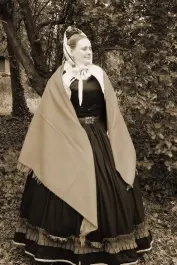
Tonight’s Millinery 

​For my purple lovers! 

This plaid is so very pretty and makes a sweet winter bonnet. Inside is soft wool and a silk lining. 

Made directly from an original in my collection, this bonnet is entirely hand sewn . 

100% silk taffeta 

Local, hand combed wool 

100% silk 

Cotton sateen ribbon

Published in: on October 27, 2016 at 7:06 pm  Comments (4)  

The Importance of Personal Linens

Have you ever looked at photo of a great dress, a truly great dress, but there was just something missing? For me, that is often the collar and cuffs. Be it a beautiful fashionable dress or a basic utilitarian dress, women protected their clothing from perspiration with personal linens in the form of collars, fichus and cuffs. Including these simple cotton pieces can really make or advance an outfit.  Skipping this finishing component can really set your image back.

Here a sampling of women at work domestically from Lilly Martin Spencer.

examples

Collars, cuffs and fichus varied and somewhat evolved as years and decades went on. You will want to study your particular years of focus to determine the shape, width and treatment that is appropriate for you.

In general, each will take a minimum of material; a fat quarter of fine muslin, lawn or organdy can make nice collar and cuff options. I suggest starting simply, with a hand rolled hem and bias binding for the collar and a simple, hemmed and folded cuff. The fichu directions below can be made a half yard of fabric. Having a few of these on hand is very handy. 😉


Resources:

Published in: on October 26, 2016 at 6:20 am  Leave a Comment  

Tonight’s Millinery 

​Here is a blue and black check silk taffeta winter bonnet trimmed with black silk taffeta ruche. Lightly hand quilted with local wool so it is soft and warm. Inside is black polished cotton. 

Made directly from an original in my collection, this bonnet is entirely hand sewn . 

100% silk taffeta 

Local, hand combed wool 

100% cotton, polished cotton 

Cotton sateen ribbon

Published in: on October 23, 2016 at 4:44 pm  Comments (1)  

Tonight’s Millinery 

Tonight I have a brick red and brown check silk taffeta hand quilted with a pretty design. It is filled a super soft local wool and lined with black polished cotton. The brim is a little deeper than the other recent winter bonnets I have offered. 

Find it in my shop

Published in: on October 20, 2016 at 7:42 pm  Leave a Comment  

Fall Project List

Okay, technically this is more a a belated fall and early winter project list.

Projects you will see in the shop:

  • Check silk winter bonnets, Plaid silk winter bonnets, Solid silk winter bonnets (three patterns this season)
  • New Winter Bonnet Pattern
  • A couple more Shaker style sewing boxes to line
  • A sewing box to line and make a tray for.
  • TLC a nice slope for someone
  • A few pin cushions tbd
  • Christmas items tbd
  • Try new Doll scale idea (surprise)
  • Finish S’s set before the workshop (So I can send her the growing box of things)

Projects for me, gifts, etc:

  •  Evergreens at Twilight
  • Research Pence Jugs for a crochet project. Possibly swap silk threads for this.
  • Crochet new wool muffetts for work
  • Finish the slippers (well, maybe, as I have lost interest in this project)
  • Make Clara a cute Christmas dress based on her halter vest.
  • Finish Cali’s dress that was started last spring
  • I am considering making myself a modern fleece version of one of my winter bonnet patterns.
Published in: on October 20, 2016 at 6:04 am  Leave a Comment  

Today’s Millinery 

Tonight’s winter bonnet is a black silk taffeta trimmed in a ruched plaid silk taffeta, hand quilted with local wool batting and a polished cotton lining.


Also… a Shaker style sewing box. 

Published in: on October 16, 2016 at 6:16 pm  Leave a Comment  

The Pumpkin Bonnet – A Wadded Winter Bonnet

A quick post about wadded bonnets – This is abbreviated because I have a larger publication in mind.

What is a Pumpkin Bonnet?

A “Pumpkin” bonnet is a wadded bonnet, most commonly made of silk on the exterior and polished cotton, cotton or silk on the interior. Wide, full channels are filled to a full loft with wool batting either lightly or densely. The channels are separated by smaller channels, single or multiple, that are drawn in by cord or ribbon. The front brim may or may not have a decorative ruffle, attached or tucked from the base exterior fabric. These usually have a petite to moderate bavolet either lightly filled with batting or without batting.

Some other terms that seem to apply: Wadded bonnet/hood, “Ugly”, a “Kiss-me-quick”.

How early were these worn?

Most museums seem to start their dating of wadded, pumpkin style bonnets to the 1840s. Some do push earlier, as far as the late 1700s/early 1800s, such as this example from the Boston Museum of Fine Arts.

As domestically made winter bonnets were a utilitarian garment rather than a fashionable one, their appearances in fashion literature is limited. I see one set of passages referencing a wadded bonnet, drawn in, worn close to the face that may help us give wadded bonnets drawn close to the latter 1830s:

In the Ladies Pocket Magazine, of 1838, London, we see a mention of wadded bonnets as a fashionable item. Of English fashions – “Wadded bonnets which before were very much in vogue, are now almost the only ones adopted in promenade dress, and it must be confessed nothing could be better calculated for the season, particularly when they are worn, as in often the case, over a blond morning cap of the demi-cornette form.” (In this passage, wadded pelisses and wadded mantles are also mentioned.) Of Paris fashions “Winter has set in with all its rigour, but that is of little consequence to our elegantes, who, occupied with the grand dinners, balls, and fetes that are always given in the commencement of winter, have deserted the promenades. Novelty in out-door costume is consequently out of the question, velvet or satin mantles, which are trimmed and sometimes lined in fur, that their busts are defended by a large fur palatine, their hands doubly shielded by fur cuffs, and a muff, and their pretty faces guarded by a large wadded bonnet, which completely meets under the chin, we have said all that can be said of out-door dress.”  The year prior, the same publication tells us: “We may cite with confidence, among the new bonnets will be very fashionable, the capotes a conlisse ouatees, or wadded drawn bonnets; the are a most comfortable head-dress, composed of satin or pou de soie, lightly wadded, and simply trimmed with ribbon. They differ a little in shape from the other bonnets, sitting closer round the face.” This may or may not be the beginning point of the wadded, pumpkin style bonnet. Neither publication includes an illustration of this practical winter wear in the midst of the popular large bonnets of the era.

In that same time period, we see wadded and quilted bonnets constructed for children in The Workwoman’s Guide. The illustrations suggest the quilted versions have larger crowns that are volumous in some cases. It is important to note the difference between this shape and the Pumpkin shape. I believe this is the construction that evolves through the rest of the century as the quilted bonnet.

Blackwood‘s suggested I should look at “quilted wadded capotes” as well as “bonnets” and “hoods”. Though, this February and March 1843 Peterson‘s suggest capotes were quilted, rather than wadded with loft.

One of only photographs clearly depicting a wadded “pumpkin” style bonnet/hood is a bit of tease. While taken in 1897, the photograph does not show contemporary/current wear, rather historical costume wear. This photograph is held by Deerfield.

Were they worn during the Civil War?

The 1860 painting, School Girls, by George Augustus Baker, shows the girl on the left in what could be a red silk wadded pumpkin bonnet. The artist did several studies for this painting, including  Little Girl in a Red Bonnet, which is undated.

Museum examples:

Published in: on October 13, 2016 at 6:22 am  Leave a Comment  

Today’s Millinery 

I’ve just added an incredibly soft quilted bonnet to my shop. The local, hand combed, wool batt was nearly two inches thick. So soft, with such loft. 

The black silk taffeta bonnet is lightly hand quilted and entirely hand sewn. Inside is a polished cotton lining and cotton sateen ribbon ties. It is trimmed in a gold silk taffeta cut on my antique pinking machine. 

Published in: on October 10, 2016 at 2:59 pm  Leave a Comment  

Today’s Millinery – Berry & Tan Pumpkin Bonnet 

Looking for a snuggly warm pumpkin bonnet? 

This one is made with a deep berry and tan mini check silk taffeta, local wool batting and polished cotton. (I didn’t realize I had the one lining piece polished side in until I was stuffing the batting. So, price cut.) 

Waiting for you in my shop. 

Published in: on October 8, 2016 at 10:22 am  Leave a Comment