Bees and the Covenant

Back in February I shared a couple posts on the Ladies’ National Covenant and the Women’s Patriotic association for Diminishing the use of Imported Luxuries. Elizabeth Topping shared this clip from MMe. Demorest’s Mirror of Fashion, September 1864 regarding the bee being worn in connection with the Covenant.

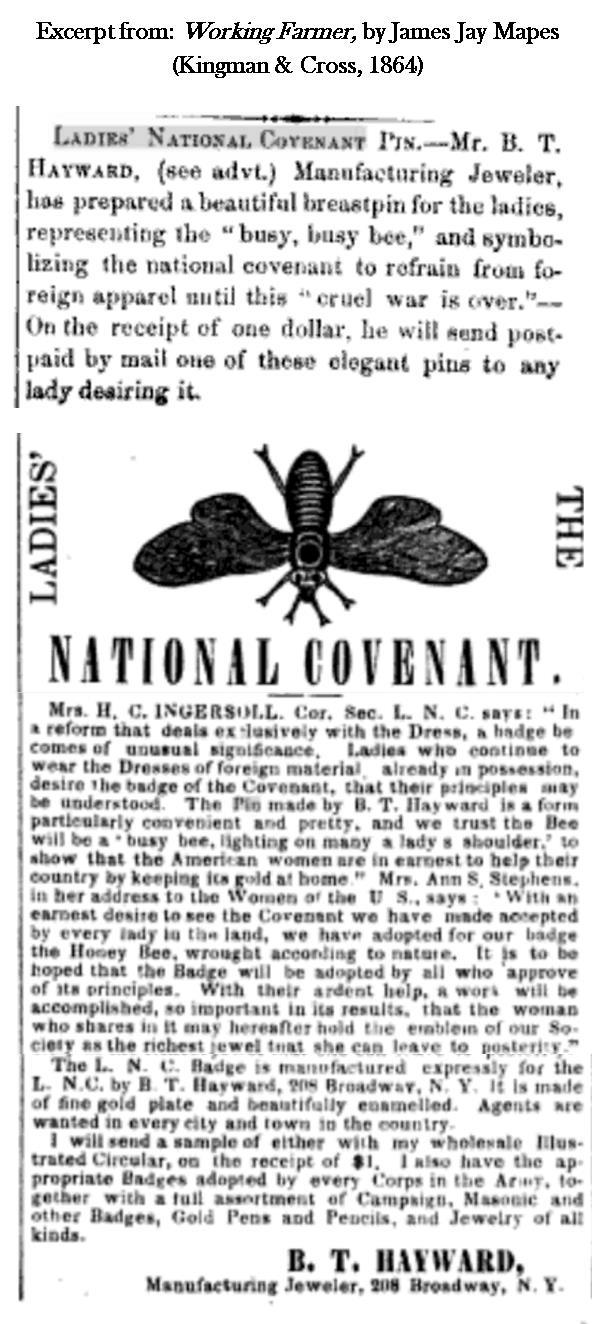
Bee clip“With an earnest desire to see the Covenant we have made accepted by every lady in the land, we have adopted for our Badge the Honey Bee, wrought according to nature.”

Looking further into this bee, we see it discussed:

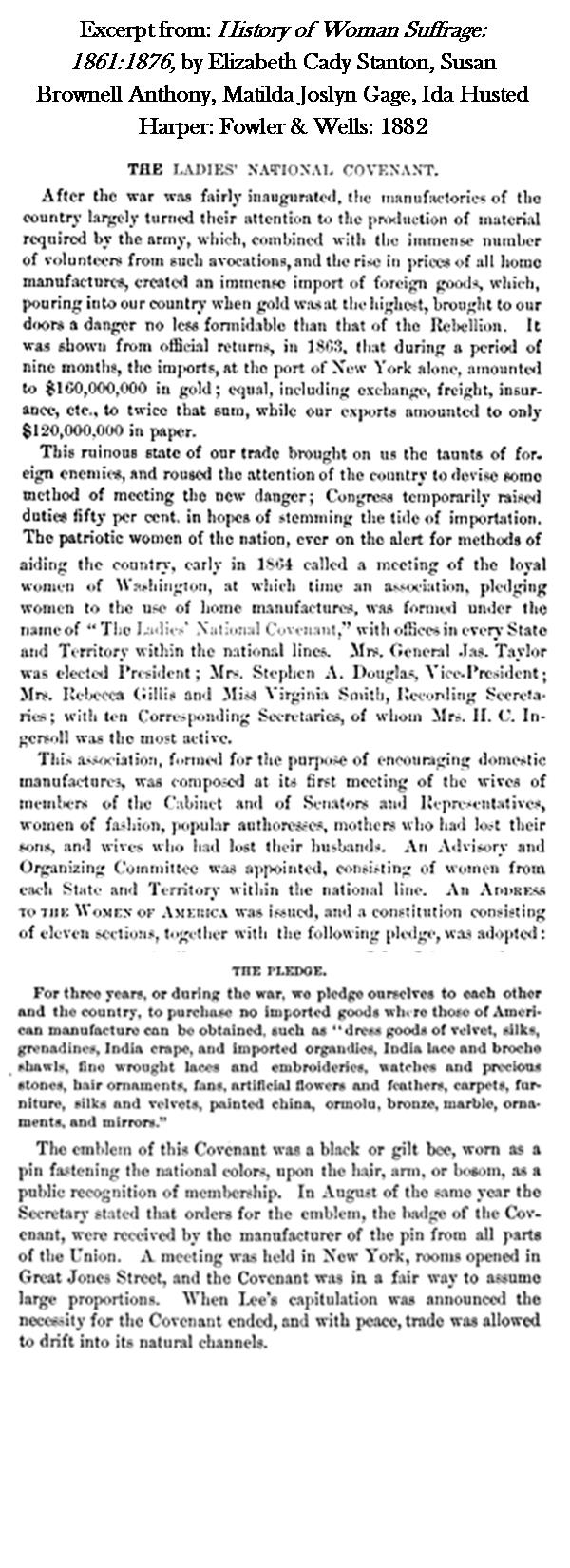
Ladies Cov clip 4“The emblem of this Covenant was a black or gilt bee, worn as a pin fastening the national colors, upon the hair, arm, or bosom, as a public recognition of membership. ”

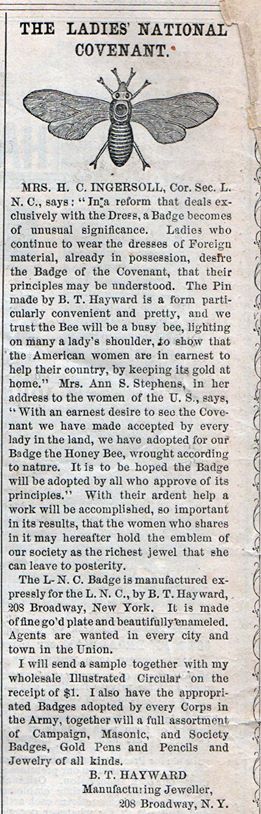
This rural/farming newspaper had a short article and advertisement:

Ladies Cov clip 5

EDITED ADDITION:

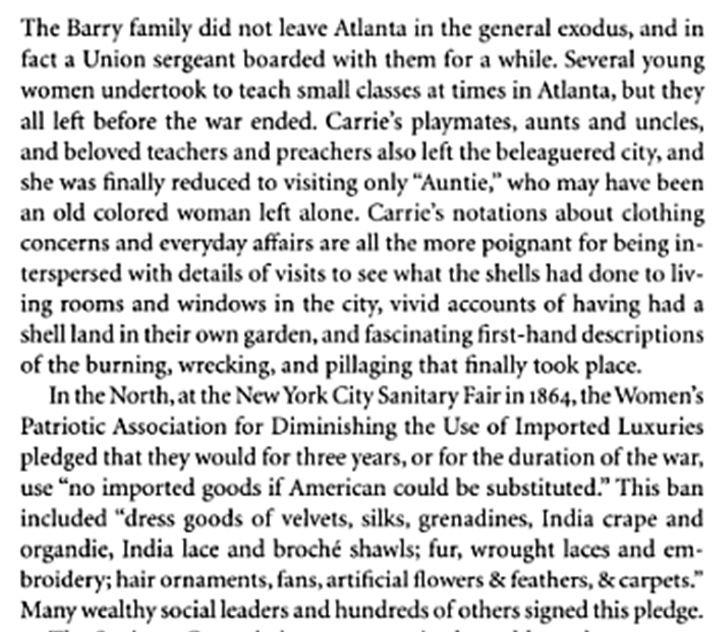
From Dressed for the Photographer

Ladies Cov clip 6  Dressed for the Photographer

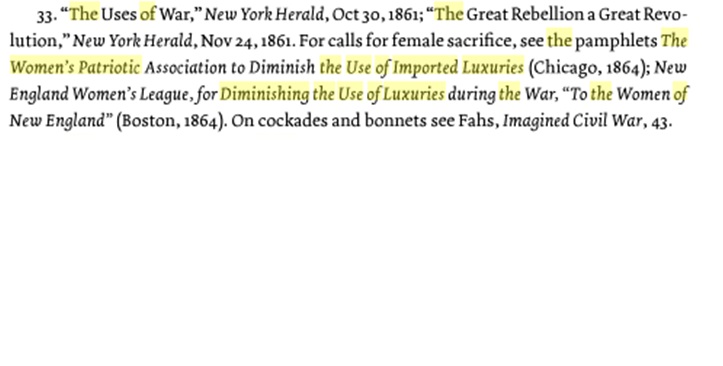
This citation/endnote in Buying Power, by Glickman :

Ladies Cov clip 7  citation lead

Leads us to look for New England Women’s League, for Diminishing the Use of Luxuries during the War , which also gives us Resolutions with Pledge  and To the Women of New England: In a War Like Ours, which Involves the Life and Prosperity of a Whole Nation, Every Patriotic Citizen Owes to the Country the Greatest Possible Amount of Service.

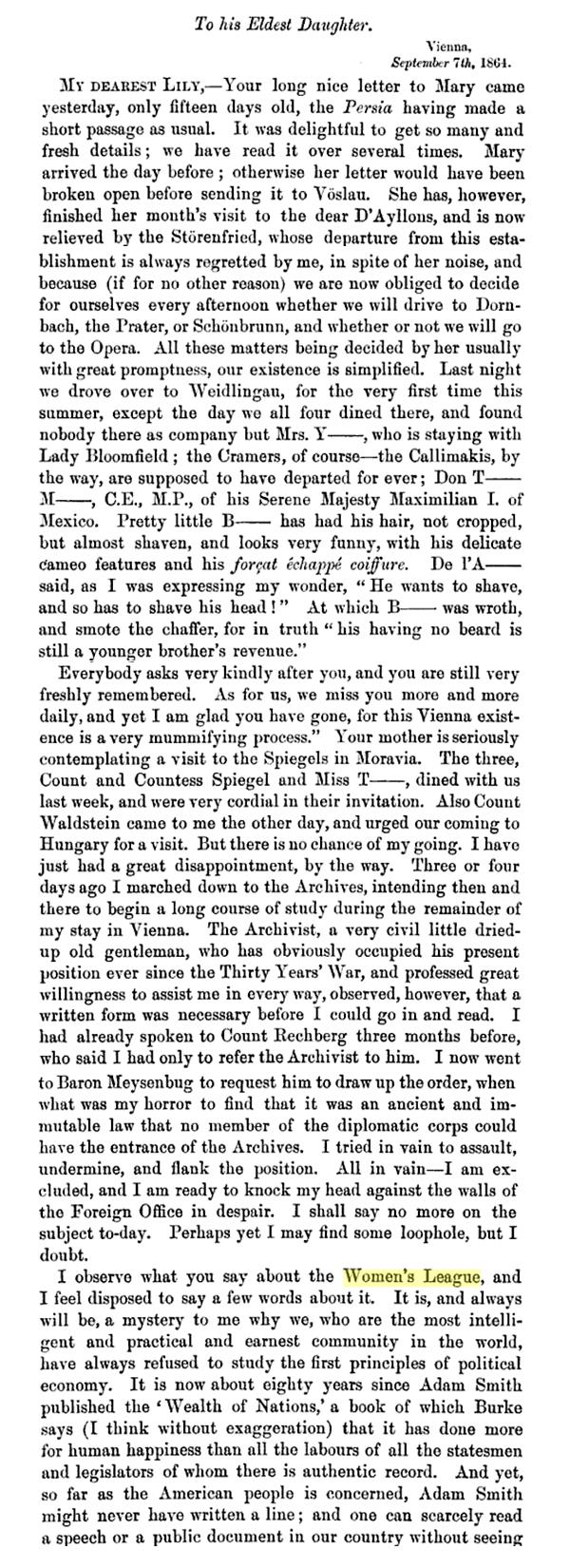
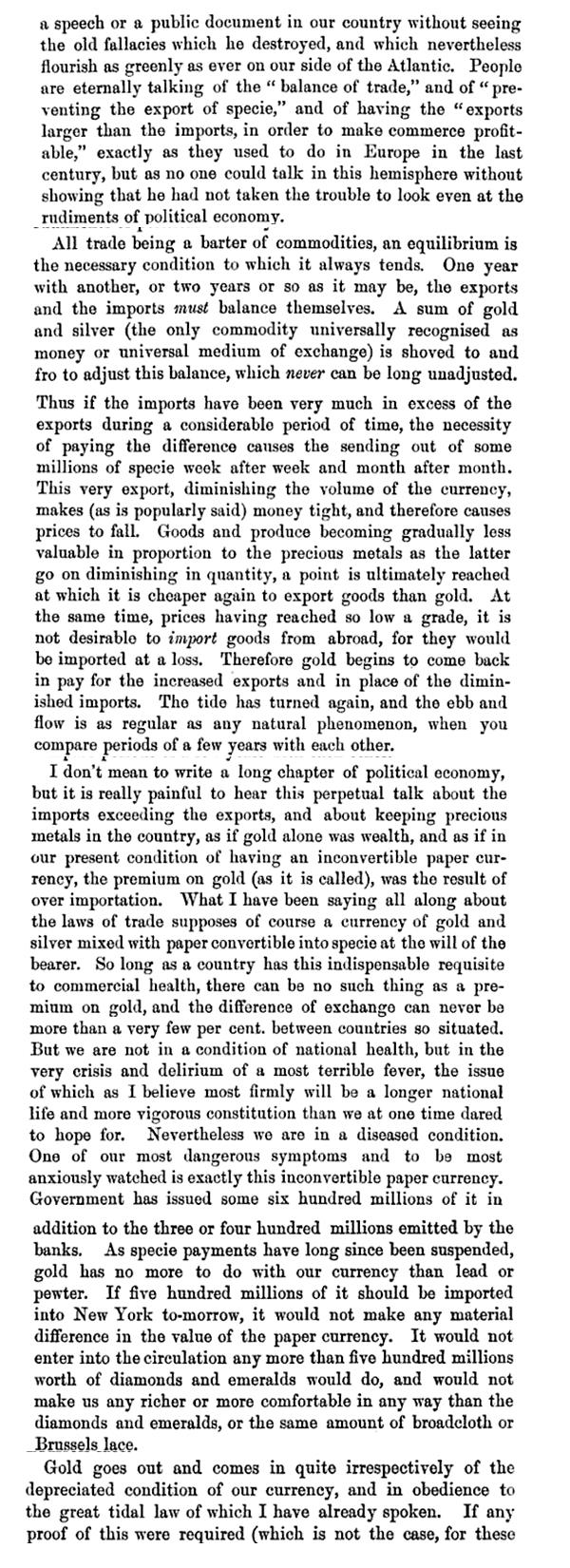
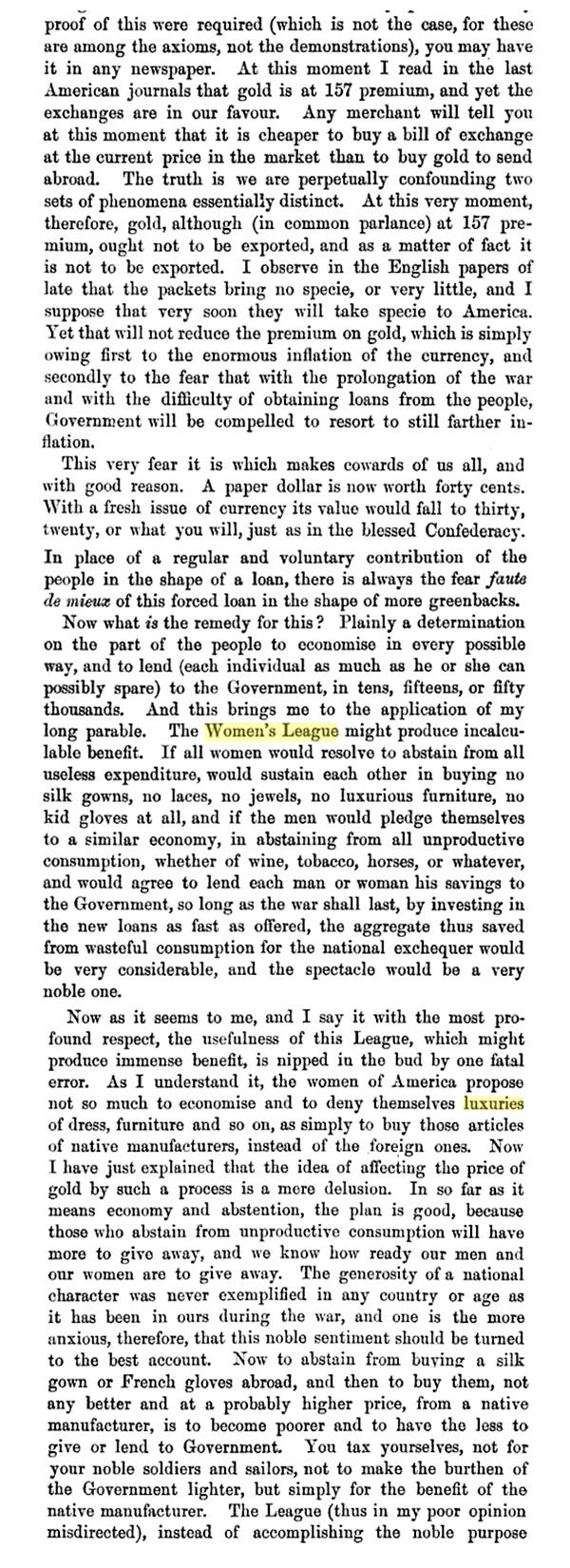
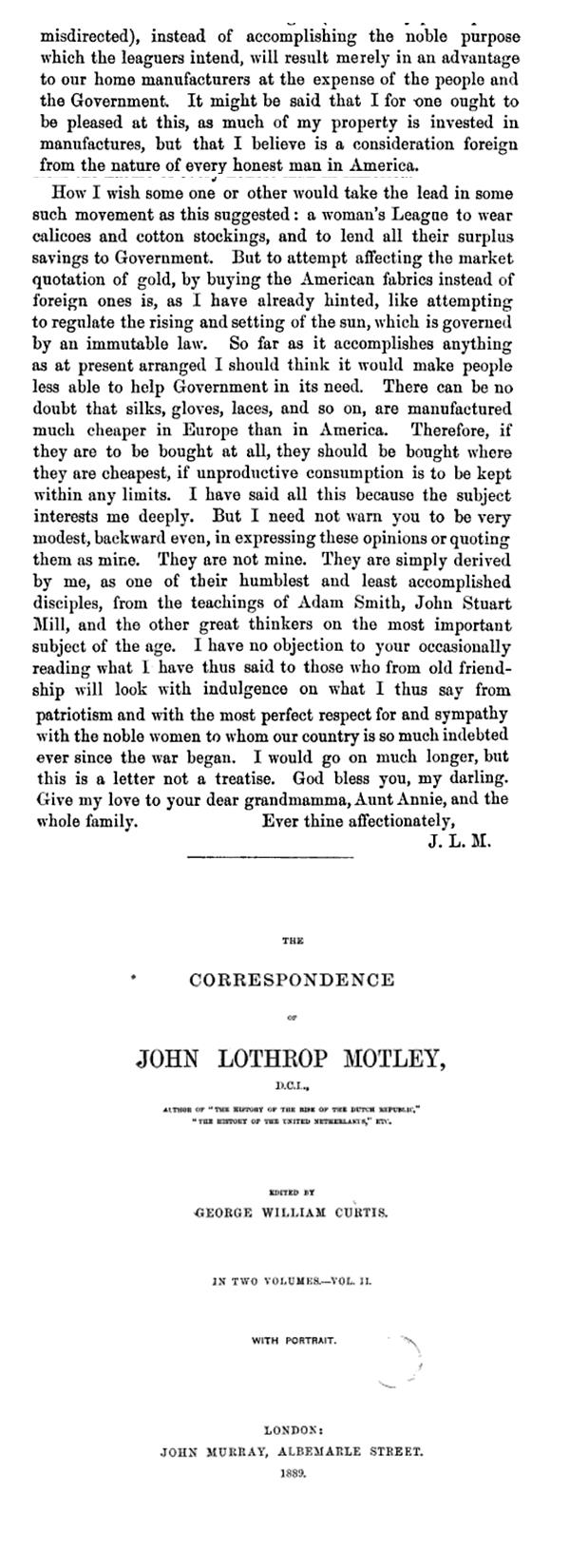
A letter to his sister, Lily, from John Loathrop Motley discussing his thoughts on the League.

Ladies Cov Clip 8 a Ladies Cov Clip 8 b Ladies Cov Clip 8 c Ladies Cov Clip 8 d

Ack, a lead snag, potential headache, or what a difference 30 years makes. There is another NY/NE Women’s League that appears in the 1890s. This muddles up searching.

**For those considering wearing a bee pin as part of their impression, I would like to emphasize the late war dates surrounding it. The Covenant was established in May of 1864, leaving a year (or two “reenacting seasons”) suitable for its wear.


Published in: on April 7, 2014 at 2:09 pm  Comments (2)  

Readings for Rural Life – Young Women and Soldiers

From Moore’s Rural New-Yorker in Rochester, NY

April 2nd, 1864

Young Women and Soldiers.

The Testimony of a Soldier

Eds. Rural New-Yorker: – Not withstanding a long acquaintance with your paper has taught me that it is now opened to local complaints or derogatory personalities, I am here at your sanctum asking for space in the Rural to enter a complaint against an individual. The fact is, I have been misused, – yes, misused, neglected, – to be explicit, and that, too, by a young lady.

I found an advertisement lately in the Waverly Magazine, inserted by a young lady, soliciting correspondents in the army. This young lady deeply regretting the custom that debarred her from “sharing the hardships of the camp and field,” was “willing to do anything that would lighten the burdens of the noble ones who went so readily to the rescue of our dear country,” and proposed to do “what little her contracted sphere” would admit of, by corresponding with “the brave soldiers of the Union.”

Now, I had always looked upon this practice of advertising for correspondents as having a rather dubious tendency. But having an ardent admiration, and, as I venture to believe, a pretty good appreciation of the spirit of patriotism- whether exhibited by the sons or daughters  of our excellent country – I could not but encourage it wherever I saw its manifestations. Accordingly I sent this patriotic young lady my compliments, with the assurance that, in my opinion, there could be no more laudable motive to action than patriotism, and that America had great reason to be proud of her daughters. “And as for your commiseration for the soldier’s lonely lot,” I wrote, “it is, indeed, noble and philanthropic.” I then attempt to inspire her with a conception of the great measure of happiness that I derived from anticipating the reception of a letter from her. As her object was declared to be “mutual pleasure and improvement,” I proposed as the subject of her first letter one of the following: – Woman’s sphere – her duties, etc. The relationship of the sexes. The origin and destiny of man. The operations and organic laws of the human mind. A criticism on Edward’s Philosophy of the Will; or, if she did not incline to any of these, to take some ordinary subject likely to be fraught with interest to a soldier, shut out as he is from the society of the good and learned. Then, having closed with an earnest appeal to her not to disappoint me, nor keep me long in suspense, I inclosed [sic] this in an envelope and directed it according to instructions, and marking it “Soldier’s Letter,” dropped it into the mail box and went about my duties “rejoicing.”

Now I have waited these five weeks for an answer, and lo! It cometh not! And I say it is really too bad for this young lady to treat me so. But can any one, male or female, phrenologist or moral philosopher, bachelor or “matrimonially inclined” widower, tell my why it is that I have been so used? –if so, let him now speak of for ever hold his peace.

Some hair-brained fellow may presume to insinuate that to have insured the “consummation I so devoutly wished” I should, at least, have paid the postage on the letter I sent, if not inclosed [sic] a stamp to pay return postage. But such a suggestion would be in very good keeping with the reputation of its author.

Such a course would manifest a depreciation of the young lady’s patriotism. It would evince a lack of faith in her modest and praiseworthy pretensions, and would, therefore, be as unkind as it would be unprofitable. No, no! it cannot bet his, for I have no doubt that she would willingly pay postage both ways as an evidence of her devotion to – her country! But oh! I fear the Fates are against me.

But of this enough. I wish now to say a few words seriously to the noble and patriotic daughters of America who read the Rural. This practice of advertising for correspondents in the army is indeed dangerous. I have no doubt that many well meaning and really worthy young women are caught in this snare, by the belief that they are rendering the brave soldiers and important service in that way. But let me tell you that you are egregiously mistaken. I am a soldier, and write what I know to be so. Whatever may be the spirit thrown into the letter the soldier writes, he does not write in good faith, nor does he look upon you as virtuous women, worthy of his respect. And this is the very reason why he pledges so freely his fidelity and his honor, while he seeks to lead you on step by step. That there may be exceptions to this I will not deny, but this is the general rule. I could not desire to say anything to lower the esteem of our brave boys in the army; there are many of America’s noblest sones in the ranks; but it is not the young men of worth that insert, or reply to, advertisements of this character. The soldier’s life is indeed a hard one. Its many privations and exposures make it quite a contrast to the lives we were leading at our pleasant home are to crest of old Mars cast its ominous shadow upon our land, and it is the earnest wish of every true soldier that “when this cruel was is over” he may receive every acknowledgement of respect and appreciation to which his worthy deeds shall entitle him, from the fathers and mothers, and, most of all, their virtuous and patriotic daughters. But don’t think us any the better now for being soldiers, for when we do our best we are only doing our duty.

If you really want to relieve our sufferings, there are many ways in which it can be done; but don’t deceive yourselves with the belief that you are doing any good by advertising yourselves as correspondents of soldiers, or by replying to any of the many advertisements inserted by them in the columns of some of the unprincipled papers. So far is it from being a benefit, that it is directly the reverse – an actual injury. It is a temptation to the soldier to try experiments, while it exposes you to any insults his unhallowed purpose my recommend; for, I repeat, her does not respect you as a woman “safe in her virtues.”

The monotony and idleness of camp life, with the consequent restlessness, beget much mischief within the soldier’s mind. Add to this the love of adventure that the life begets, and you will have the prive secret of the looseness of morality in the army. Go to New York, Elmira or Washington, and behold the thousands of soldier’s wives (I) there, and take warning, and be discreet.

Does my writing thus plainly deserve and apology? I would not have you think, fair daughters of America, that I look upon your virtues as being all in jeopardy. But this evil is already wide-spread, and has set on foor a work of woe and despair. This eivil is a monster “who stole the livery of the Court of Heaven to serve the devil in,” and is, therefore, doubly to be guarded against.

Stockade Camp, Va, March, 1864. Max Kipp.


Published in: on April 2, 2014 at 6:00 am  Comments (2)  
Tags:

Readings for Rural Life – The Hoop Skirt

From Moore’s Rural New-Yorker in Rochester, NY

March 26th, 1864

The Hoop Skirt

Fashion kills more women than toll and sorrow. [Scalpel.]

It is a wonder that men and women endowed with the noble faculty of reason, have so little gratitude for the good gift, that they can carry it a willing sacrifice to their worse than heathen goddess. Better might they hide it in the ground, than give it to support the wanton destroyer of their race.

I feel “moved” to speak a contradictory opinion to that of the editor of the Scalpel, expressed in an article recently published in the Rural, on the benign blessings of the modern hooped skirt. But I do not intend to apply to him all I have written above, in retaliation of saying “No sensible person can fail to appreciate its benefit to the young girl or woman.”

If I am entitled to the doubtful compliment, I will bear the honor meekly, but it shall not restrain me from confessing that I do fail to see what he has so happily discovered. ‘Perhaps it is all in consequence of not seeing the matter in a “professional” light; but mine is the “light of experience” which is quite sufficient to enable me to judge of its health-giving properties to my own satisfaction. Of its artistic ones, it is hard telling who is able to judge. The word artistic applied to woman’s dress, has such and India-rubber signification, that it may be one thing, or its opposite, according as it is looked upon by persons who consider the consistency of adaptation to natural requirements, or by those who merely take a fancy to the article, or the lady who wears it. Fashion so changes out aesthetic taste into prejudicial notions, that it is nearly impossible for us to tell whether we judge from the true or an artificial standard. However it may be with myself, evidently it is not fashion that has formed my notions in regard to the hoop skirt, one of which is, that God designed for woman a “skeleton,” and I cannot rid myself of the idea that He must have considered it quite sufficient for her needs; and we might reasonably expect it to be an “admirably artistic and health-giving device,” but Fashion and her devotees have denied it the former property, and after sacrificing the latter through persevering ages, to make some appearances of it possession, til, discouraged of ever arriving at any permanently satisfactory result, they have at last compromised the difficulty with the Devine Artistic, by doing the best they can with shaping a portion of His production so as not to shock too severely the refined sensibilities of humanity, and have disguised the remainder of it by hiding it within a new device, modeled after the most artistic designs of a cooper’s shop.

After such a nice adjustment of things, gentlemen who are intensely susceptible to the influences of the beautiful in nature and art, may be well distressed at any indications of the abandonment of their perfected ideal, which is doubtless appreciated not only because it embodies the most symmetrical proportions in its passive state, but is capable of changing into ever-varying artistic figures: such as those assumed in ascending high places and descending to lower ones, in entering carriages, sitting down in arm chairs, and especially in arising therefrom, in walking in the dew, dust, mud, rain and snow – in short, in being comformable to the demands of any emergency.

Women, without her second skeleton, has no more dignity than a wilted cabbage leaf. It gives her an air of majestic stiffness, so fascinating in a moving object; enabling her to rival the gracefulness of the mud-turtle; besides, it increases her capacity to carry fantastic adornments, which is such a commendable way of disposing of wealth in a country over-burdened with prosperity and comfort.

In regards to health, the editor merits the thanks of woman for his candid and instructive reasoning, but he makes compromises with her follies and weaknesses, instead of advising her to forsake them altogether, that she may secure the fullest measure of the blessings of health. He first inscribes himself within a circle whose circumference he dare not, or will not, over-step, and then does the best lie can within his limits. If he had taken for his theorem, The hoop skirt is injurious, and ought to be abandoned, he would have had some excellent arguments for a demonstration.

I was not aware that “its end is to insure the unrestricted use of the limbs in walking” (why not add in skating also.) If it has such pretensions it is a decided humbug, for everybody has learned that that liberty is not attainable while there is one within sight; and most especially is it true of the person whose every step is measured by a boundary which suggest, “thus far shalt thou go and no farther.” If it is meant to insure that use of them to itself, it is a very pertinent remark, and included both hands, of course. Its “benefit to the young girl” in climbing trees and fences, and doing all other necessary romping, has, probably, some signification not at first apparent.

It is thought to be more healthful than the old style of wearing heavy skirts, but I have heard eminent physicians pronounce it even more injurious; confining a body of cold air about the lower portions of the body, causing unequal circulation, and consequent congestions of the organs in the upper portion. But it is not so very light a load for delicate woman to carry thirty metal hoops, and as many yards of cloth, for a genteel covering, which must be so long as not to expose the feet, or it is offensive to good taste, suggesting a lack in the accomplishment of an intended deception. It is more pleasing to fashionable taste to drag it a few inches or more.

Really, I don’t see how a physician, or any other “sensible person,” can fail to see that crinoline, with its train of evils, is injurious to health, to temper, to the free development of mind as well as body, and a monstrous distortion of the beauty of the human form.

There is a demand for earnest discussion in regard to the momentous question, wherewithal shall we be clothed? and we are always obliged to gentlemen for taking an interest in our welfare; but it will be better, if they will please remember in their advice, that what would be poison to them is not likely to be healthful food for us; and they need not fear to speak contrary to the mandates of Fashion, for potent as she is with our vain sex, their admiration is ten times more so. Faith Wayne. Barre, Orleans Co., N.Y., 1864.


Resources for Life

It is not polite to invite persons to your house, when you do not desire to see them.

It is not polite to have foul teeth. A brush should be used after every meal.

It is not polite to question others, in idle curiosity, respecting that with which you have no concern.

It is not polite to utter the ideas of another as your own, and thus attempt to shine in borrowed plumage.

It is not polite to take down a book, or any article, in a store or dwelling-house and not return it to its proper place.

It is not polite to stand at the corners of the streets to stare at those who pass, or to make improper remarks.

It is not polite to wear a peculiar dress, or pursue any irregular course for the sake of oddity or notoriety.

It is not polite to speak unadvisedly to another, or to thrust your opinion, unsolicited, upon a neighbor.  

It is not polite to vote for yourself as a candidate for office, or to solicit the votes of your friends.

It is not polite, if you insist on wearing mourning on the death of a friend to wear that mourning garb for too long a period. When we see ladies persist in wearing sable, we are reminded of the reply a young widow made to her mother: “Don’t you see,” said she, “it saves me the expense of advertising for a husband.”

It is not polite for ladies to wear dresses so long that people are continually stepping upon them.   

Hints of Common Politeness (Boston: 1867)

https://archive.org/stream/hintsoncommonpol00cole#page/n107/mode/2up

Published in: on March 20, 2014 at 1:38 am  Leave a Comment  
Tags:

Readings for Rural Life – The Unprotected Female

From Moore’s Rural New-Yorker in Rochester, NY

March 19th, 1864

The Unprotected Female

Editors Rural New-Yorker: – Here are a few thoughts, suggested by reading a part of a letter in the fourth number of the Rural, signed M.J.C. She says: – “The unprotected female, sitting among her boxes and bundles in some bustling depot, is, or ought to always to be, the subject of interest. Made up as she is, of nerves, inefficiencies, headaches, cold feet, anxiety and skepticism, she has a title clear, my dear sir, to you candid opinion, as to whether the cars are moving east or due west, or even to express her conviction that they are stationary and surrounding objects are marching on.”

“The unprotected female!” Will M.J.C. please tell us why a female, unprotected, should demand any more interest or sympathy than an unprotected male? Has not her Creator endowed her with the same instinct for self-protection, and given her reason to guide it? Has He not bestowed upon her the same number of limbs for purposes of locomotion, and given her two hands with which to provide for her wants, and protect herself, the same as he has the male?

“Sitting among her boxes and bundles.” What business has a woman to load herself, or any one else, with such rubbish? It is that she may keep two or three men standing, while she has the satisfaction of seeing said boxes and bundles occupying the seats which, by right, if not by custom, belongs to them? I agree that a woman thus situated ought always to be the subject of kindly interest, – so had a man who carries with him such an unmistakable evidences of an unsound mind. Who can look at woman through the clear glasses of reason, instead of the colored ones of fashion, and not see that she is deficient in either education or independence. Her appearance clearly denotes hat she is an object slave, who is either ignorant of the fact, or considers it an honor that she is such, and is unwilling to appear, at least before strangers, unless surrounded by unmistakable evidences of her servitude. If she goes from home for a visit of a few days, she needs a baggage wagon to carry what she deems necessary for the display of her master’s power.

If she is compelled to carry anything in her hands she is really to be pitied, for women, clothed as this class are, have not even one hand that they can properly claim for any use except to guard their badges from injury. They are arrayed in a manner that makes it actually unsafe for them to enter or leave a car or carriage, unless they have both hands free to prevent their skirts from being caught by one of the projections that seem made expressly to torment poor women – or being entangled by the feet of their fellow travelers. Why, unless they are proud of their servitude, will they consent to be thus shackled, while men go about unencumbered? Their hands are free, never being required to keep their clothes from dragging on the dirt, or being trodden upon by the feet of their companions. Their “boxes and bundles,” even for a long journey, are all stowed in one satchel or valise which they can easily carry in one hand, thus leaving the other free to grab the hand of a friend, or assist some unprotected female who has ventured from home to spend a few days, but is already wishing she was back again; for how is she to change all this baggage from the depot to the cars without breaking her neck or tearing her dress?

“Made up as she is, of nerves, headaches, cold feet, anxiety and skepticism.” Poor things! How much suffering is combined in this sentence. Yet who of the sufferers will allow even their best friends to tell them why they are thus made? I will write [sic] although I will admit that I have not a friend who suffers from these afflictions that I should dare to speak my mind freely to, lest they should consider me an enemy to right, because they consider these an affliction of Providence which it would be sacrilegious to see to escape.

Women have no more “nerves” than men, and they would be no more nervous, where their bodies as healthy, and their nerves a little less taxed by petty cares and little accidents. As to “inefficiencies,” supposed you try the experiment of dressing a strong man in trailing skirts, well extended by hoops! Pin his waist so tight as to prevent his stooping with ease, and only allowing him the use of the upper portion of his lungs. Then oblige him to look after the many boxed and bundles that we unprotected females are required, by fashion, to be encumbered with, and see who is the most inefficient! I would pronounce him a model of patience if he did not swear at the many hindrances and annoyances that he would be subjected to on account of his change of clothing, and consequent baggage.

“Headaches and cold feet” are two severe afflictions; the former generally caused by the latter by imporoper dress in the majority of cases. I have never seen a woman yet, who had not broken out of fashion’s train entirely, that did not dress her feet and lower limbs too thin, her hips too warm, her waist too tight, and carry suspended from her waist, weights, varying according to the season and the caprices of the wearer, from two to fifteen pounds. All these things aid in destroying the circulation of the blood, and the action of all the organs of the body.

That the present suffering of women is a punishment for their sin, I fully believe; but it appears to me that nothing but genuine stubbornness can prompt a continuation of the sins which we know have brought upon us such just suffering. Men, being clothed in substantial goods, made in a manner that allows them the free use of their bodies, and protects them from the cold, do not suffer these many severe afflictions, that are the bane of our lives; except such as they inherit. It would seem that after any class of beings, endowed with reason, had become so enfeebled as the women of the present have, that they would strive in every way possible, to regain their natural powers of body and mind. To do this, the first step should be to adopt a dress that would give perfect freedom to mind and body, instead of one that cripples and deforms the latter, while it exhausts the former to keep it in a condition that will be considered by the rulers as acceptable.

“Anxiety and skepticism” are but attendant evils that will vanish when their causes are removed, which will be when women are not ashamed to be clothed in a manner that will insure them warmth and freedom. I do not believe that there is a woman living in the United States who has reached her sixteenth year, and dressed for the last three years with the least regard to the dictates of fashion, that, when dressed, even loosely, can draw a natural breath at the first trial.

Will women ever learn to consider their bodies as only the dwelling place of their souls, where they are to be fitted for the world to come? If they ever do, we shall cease to hear so much prating about the inferiority of women, and her need of protection. She will then be safe travel anywhere among Christian people unprotected, and will not need “your candid opinion, my dear sir, as to whether the cars are moving east or due west,” and as to “expressing her conviction that they are stationary and surrounding objects marching on,” she will be no more apt to make such expressions then than men will. I have heard many, who call themselves ladies, make remarks that were quite as sensible as that would be; but I consider that their greatest ignorance consisted in no knowing that it is a disgrace for even a lady to be ignorant. Amanda Roberts Keyser. Pekin, February, 1864
 

Readings for Rural Life – How to Buy

From Moore’s Rural New-Yorker in Rochester, NY

March 12th, 1864

How to Buy

There is a right time to purchase. That time is when goods are low. Goods are low, as a general rule, when there is the least demand for them. Winter goods are low in the spring and summer. Summer goods are low in the fall and winter. The merchant will sell his winter stock in the spring at first cost. His summer stock in the fall at cost. He commonly sells his goods at least twenty-five per cent above the first cost. If, then, you buy his winter goods in the spring, and his summer goods in the fall, you save the per centage, and get your goods at wholesale, or just as low as the merchant bought them by the quantity. If your family requires one hundred dollars yearly in these goods, the savings will be twenty-five dollars, by buying at the proper time. When winter renders navigation and transportation difficult, groceries and heavy goods are generally higher. Sugar is generally high in fruit and “preserving time.” Watch the markets. When the goods you need are below an average price lay in a supply for some time ahead. Buy your goods by the quantity. Let the market be what it will, you can generally buy a quantity at less figures, proportionately, than small amounts. Sugar will cost you a cent on a pound less; tea, ten cents or a shilling; heavy cloths one t two shillings per yard, and so on to the end of the catalogue. Another consideration is not to be forgotten. A good article is much cheaper in the long run, than a poor one at a much less price. Better pay more for a thoroughly made serviceable article, than buy an inferior one, poorly made, at any price. Ready cash is always better than any man’s credit. A dealer, who understands his business, can and will sell for cheaper for ready money than he will for the best man’s credit. A handsome yearly savings may be made, in any family, depending in amount on the number in the family and the quantity of goods used, by buying at the right   time – buying by the large quantity – buying “good goods,” and paying ready cash. If you have not got the cash, live a little closer, cut off all unnecessary expenses, until you get a little ready money ahead, and are thus ready to take advantage of the markets. The saving that can thus be made in providing for the household, if carefully husbanded, will provide for a “rainy day,” or a competence to make old age comfortable. L.L. Fairchild. Rolling Prarie, Wis., January, 1864.


Published in: on March 12, 2014 at 6:01 am  Comments (1)  
Tags:

Resources for Life

With regard to the mode of destroying the traffic in liquor in the several villages and cities, it has been substantially the same everywhere.

1. Preparatory prayer in the closet and church, in some instances lasting for two of three weeks, before any effort was made openly by the women to persuade men to quit the business.

2. Circulating the personal pledge of total abstinence; also, for druggists, grocers, real estate owners, lawyers, and physicians.

3. Going out in small companies of two or three, and quietly conversing with dealers, with or without prayer.

4. Increasing the party to five or ten, and praying either vocally or silently in each place visited.

5. Visiting in large bodies daily the several saloons in the town and singing and praying in them, or, if refused access, in front on the pavement or in the street.

In many place in Ohio guards have been assigned to watch the saloons when not invested by the praying-band. These ladies usually took down names of visitors, and sometimes exhorted and plead with them to sign the pledge. This last course was a very unpopular one the saloon keepers.

Pledges

The following pledges, with slight verbal variations, have been used in the campaign:

Citizens’ Pledge

We, the undersigned, severally pledge ourselves, upon our integrity and honor, to abstain from the use as a beverage of all spirituous liquors, wine, beer, and ale; and that we will not give away or offer in any way the same to others to be so used, or use the same in cooking of for table purposes.

Property-Holders’ Pledge

We, the undersigned property-holders, pledge ourselves not to let or lease our premises (or  premises for which we are agents) in this city or permit them to be used or occupied, for the sale or dispensing in any way of spirituous liquors, wine, beer, or ale.

Dealers’ Pledge

We hereby severally pledge ourselves not to sell, furnish, or give away or allow to be sold or given away by any agent or employee of ours, either by retail or wholesale, any spirituous liquors, wine, beer, or ale.

Physicians’ Pledge

We, the undersigned, upon our honor as professional me, promise here-by not to prescribe the use of spirituous liquors, wine, beer, or ale, only in case of absolute necessity.

Druggist’s Pledge

We, the undersigned druggists, hereby pledge ourselves, upon our honor as business men, that from this date we will under no circumstances sell or give away, or allow to be sold or given away by any of our agents or employees, any alcoholic or intoxicating liquors, wine, beer, or ale, except upon the prescription of a reputable practicing physician, said prescription to be filled but once.

Grocers’ Pledge

We, the undersigned grocers, do hereby promise and agree that we will not hereafter sell, or allow to be sold in our stores, intoxicating liquor to any person; and that we will heartily, and in good faith, perform this obligation.


The Woman’s Temperance Movement, by Rev. W.C. Steel (New York, 1874)

Published in: on March 6, 2014 at 1:35 am  Leave a Comment  
Tags:

Readings for Rural Life – To Color Black

From Moore’s Rural New-Yorker in Rochester, NY

March 5th, 1864

To Color Black

Eds. Rural: – Seeing an inquiry for a recipe for coloring black, I send you mine. Take four ounces extract of logwood, put in an iron kettle over which pour ten quarts of soft water; let it boil. Stir often, take off the scum, wash the goods in soap suds, put them in the dye, let them boil about half an hour, take out, air well. Add one teaspoonful copperas, one-third do. vitriol, put in the goods, scald about 15 minutes, take out, dry, then dip in sweet milk to set the color, wash in good soap suds, iron while damp and you have as handsome black as you could desire. – From a Subscriber’s Wife.

Another – One pound of logwood; three pounds of yarn; one-fourth a pound of copperas put in three gallons of water; when it boils skim off all the scum, put in the yarn, boil one hour, let it cool sufficient to ring, cover the yarn to prevent it from drying, then boil the logwood in the same water; dip and air three times; dry before washing. – Emily Skeer.

Eds. Rural: – Having noticed in the Feb. 6th No. of the Rural an inquiry for coloring black that will not fade, mother proposes to send you hers, which she has used for a number of years, and knows to be an excellent recipe: – Take one pound of logwood chips, and half an ounce of copperas. This will color two pounds of cloth or yarn, silk or woolen. Put your logwood into sufficient quantity of soft water to cover your cloth, and place it on the stove to soak; then put your copperas into a similar quantity of water; stir till dissolved; then put in your cloth and let it simmer for an hour; take out and hang out to dry. When dry, rinse through two or three waters, and put into the dye. Let it boil very slowly for an hour, then dry and rinse, and you have a black that will neither crock nor fade. It must be stirred frequently while in both copperas water and the dye, to prevent its spotting. – A Rural Reader, Milan, Ohio, 1864.


Published in: on March 5, 2014 at 6:00 am  Leave a Comment  
Tags:

Readings for Rural Life – How to make an omlette

From Moore’s Rural New-Yorker in Rochester, NY

(Given my newer found liking of omelets, I was delighted to see them show up in this publication a good number of times. Granted, I like mine with whites and lots of veggies.)

February 27th, 1864

How to Make an Omelet

Seeing and inquiry from “A Young Housekeeper” how to make an “omelet,” I send mine, which I call good: Twelve eggs, well beaten; one cup of sweet cream, and a little salt. Butter your dish, pour in this mixture, set over a slow fire, and stir occasionally until done. – Fannie R., Pavillion, N.Y. 1864

By another correspondent: – Six eggs, well beaten, with one teaspoonful of flour, one teacupful of milk, with one teaspoonful of salt; beat this well; put the milk with the eggs just before you put it in to fry. You must have some melted butter, just enough to fry it in. Run a knife under the edge as it is beginning to fry. – E.M., Wayne, N.Y., 1864.


Published in: on February 27, 2014 at 6:03 am  Leave a Comment  
Tags:

Resources for Life

 There are many different theories concerning the moral purposes of this world in which we dwell, considered, I mean, in reference to us, its human inhabitants; for some regard it merely as a state of transition between two conditions of existence, a past and a future; others as being worthless in itself, except as a probation or preparation for a better and a higher life; while others, absorbed or saddened by the monstrous evils and sorrows around them, have really come to regard it as a place of punishment or penance for sins committed in a former state of existence. But I think that the best definition, – the best, at least, for our present purpose, – is that of Shakespeare: he calls it, with his usual felicity of expression, “this working-day world;” and it is truly this: it is a place where work is to be done, – work which must be done, – work which it is good to do; – a place in which labor of one kind or another is at once the condition of existence and the condition of happiness.

Well, then, in this working-day world of ours we must all work. The only question is, what shall we do?

To few it is granted to choose their work. Indeed, all work worth doing seems to leave us no choice. We are called to it. Sometimes the voice so calling us is from within, sometimes from without; but in any case it is what we term expressively our vocation, and in either case the harmony and happiness of life in man or woman consists in finding our vocation the employment of our highest faculties, and of as many of them as can be brought into action.

And work is of various kinds: there are works of necessity and works of mercy; – head work, hand work; man’s work, woman’s work; and on the distribution of this work in accordance with the divine law, and what Milton calls the “faultless proprieties of nature,” depends the well-being of the whole community, not less than that of each individual.

Sisters of Charity, Catholic and Protestant. And the Communion of Labor, by Mrs. Anna Jameson. (Boston (1857) https://archive.org/stream/sistersofcharity00jame#page/n3/mode/2up

I must say that while reading the paragraphs following these on the work of men and the work of women, I have an urge to make charts of “men’s work” and “women’s work” at various times in our history. I think it would be interesting (and quite telling) to see how the individual tasks move from one to the other.

Published in: on February 26, 2014 at 1:34 am  Comments (1)  
Tags: