Book Notice: Wearable Prints, 1760-1860

It is here! Well, it isn’t here with me…. yet. So, here are KittyCalash’s thoughts on the arrival of Susan Greene’s book we’ve been waiting for Wearable Prints, 1760-1860.
Remember, the Greene collection is now housed at the Genesee Country Village in Mumford, NY.

Hmmm….. Now, I’m picturing a “Greene” Swap for the Fall. Wouldn’t it be fun to find fabrics similar to those Susan talks about?

Kitty Calash

This just in, literally, from the mail carrier: Susan W. Greene’s long-awaited book,Wearable Prints, 1760-1860. It’s discounted (and out of stock) at Amazon, but should be shipping soon, since I have one right here on my desk.

It’s fair to call this book lavishly illustrated (1600 full-color images in almost 600 pages), and while I have access to a copy at work, I am seriously thinking of buying my own copy, based solely on about 10 minutes skimming the book. There are images not just of fabric samples but also of garments, paper dolls and illustrations that help put the fabrics into context. Images of garments from collections I can’t get into? Delicious! Information to help me understand how to use a printed cotton? Even better.

The book is organized in three main sections: Overview, Colors, and Mechanics. Appendices include timelines, prohibitions, price comparisons, print characteristics, and more…

View original post 186 more words

Resources for Life – A weekend extra


Dress as a Fine Art, by Mrs. Mary Philadelphia Merrifield (Boston: 1854)

We violate the laws of nature when we seek to repair the ravages of time on our complexions by paint, when we substitute false hair for that which age has thinned or blanched, or conceal the change by dyeing our own gray hair; when we pad our dress to conceal that one shoulder is larger than the other. To do either is not only in bad taste, but is a positive breach of sincerity. It is bad taste, because the means we have resorted to are contrary to the laws of nature. The application of paint to the skin produces an effect so different from the bloom of youth, that it can only deceive an unpracticed eye. It is the same with hair: there is such a want of harmony between false hair and the face which it surrounds, especially when that face bears the marks of age, and the color of the hair denotes youth, that the effect is unpleasing in the extreme. Deception of this kind, therefore, does not answer the end which it had in view; it deceives nobody but the unfortunate perpetrator of would-be deceit. It is about as senseless a proceeding as that of the goose in the story, who, when pursued by the fox, thrust her head into a hedge, and thought that, because she could no longer see the fox, the fox could not see her. But in a moral point of view it is worse than silly; it is adopted with a view to deceive; it is acting a lie to all intents and purposes, and it ought to be held in the same kind of detestation as falsehood with the tongue. Zimmerman has an aphorism which is applicable to this case – “Those who conceal their age do not conceal their folly.” (p12-13)

The immediate objects of dress are twofold – namely, decency and warmth; but so many minor considerations are suffered to influence us in choosing our habiliments, that these primary objects are too frequently kept out of sight. Dress should be not only adapted to the climate, it should be also light in weight, should yield to the movements of the body, and should be easily put on or removed. It should also be adapted to the station in society, and to the age, of the individual. These are the essential conditions, yet in practice how frequently are they overlooked; in fact, how seldom are they observed! Next in importance are general elegance of form, harmony in the arrangement and selection of the colors, and special adaptation in form and color to the person of the individual. To these objects we purpose directing the attention of the reader. (p16)

Had the Bloomer costume, which has obtained so much notoriety, been introduced by a tall and graceful scion of the aristocracy, either of rank or talent, instead of being at first adopted by the middle ranks, it might have met with better success. We have seen that Jenny Lind could introduce a new fashion of wearing the hair, and a new form of hat or bonnet, and Mme. Sontag a cap which bears her name. But it was against all precedent to admit and follow a fashion, let its merits be every so great, that emanated from the stronghold of democracy. We are content to adopt the greatest absurdities in dress when they are brought from Paris, or recommendation by a French name; but American fashions have no chance of success in aristocratic England. It is beginning at the wrong end.


Published in: on January 24, 2014 at 6:06 pm  Leave a Comment  
Tags:

Resources for Life

A TRIFLE.

 A quart of cream.
 A quarter of a pound of loaf sugar, powdered.
  Half a pint of white wine and Half a gill of brandy mixed.
  Eight maccaroons, or more if you choose.
  Four small sponge-cakes or Naples biscuit.
  Two ounces of blanched sweet almonds, pounded in a mortar.
  One ounce of blanched bitter almonds or peach-kernels.
  The juice and grated peel of two lemons.
  A nutmeg, grated.
  A glass of noyau.
  A pint of rich baked custard, made of the yolks of eggs.

 Pound the sweet and bitter almonds to a smooth paste, adding a little rose-water as you pound them.

 Grate the yellow peels of the lemons, and squeeze the juice into a saucer.

 Break the sponge cake and maccaroons into small pieces, mix them with the almonds, and lay them in the bottom of a large glass bowl. Grate a nutmeg over them, and the juice and peel of the lemons. Add the wine and brandy, and let the mixture remain untouched, till the cakes are dissolved in the liquor. Then stir it a little.

 Mix the cream and sugar with a glass of noyau, and beat it with a whisk or rods, till it stands alone.

 As the froth rises, take it off with a spoon, and lay it on a sieve (with a large dish under it) to drain. The cream, that drains into the dish, must be poured back into the pan with the rest, and beaten over again. When the cream is finished, set it in a cool place.

 When the custard is cold, poor it into the glass bowl upon the dissolved cakes, &c. and when the cream is ready, fill up the bowl with it, heaping it high in the middle. You may ornament it with nonpareils.

 If you choose, you can put in, between the custard and the frothed cream, a layer of fruit jelly, or small fruit preserved.


Seventy-Five Receipts for Pastry Cakes, and Sweetmeat (Philadelphia, 1832) is one of Miss Leslie’s earlier culinary/cooking works. https://archive.org/details/seventyfiverecei06677gut (For those unfamiliar with Project Gutenberg, I do suggest browsing for a while. The vast majority of their texts have been transcribed into plain text, while several are read aloud.) She includes easy to follow ingredient lists and directions. I happen to think there are very tasty sounding dishes in this book.

You may also enjoy some of her other cookery books:

Miss Leslie’s New Receipts for Cooking, 1874 https://archive.org/details/misslesliesnewre02lesl

Miss Leslies’ New Cookery Book, 1857 https://archive.org/details/misslesliesnewco00lesl

Miss Leslie’s Complete Cookery, 1853 https://archive.org/details/misslesliescompcol00lesl

Published in: on January 23, 2014 at 6:00 am  Comments (3)  
Tags:

Resources for Life

It is said that soon after the publication of Nicholas Nickleby, not fewer than six Yourkshire schoolmasters (or rather six principals of Yorkshire institutes) took journeys to London, with the express purpose of presecuting Dickens for libels – “each one and severally” considering himself shown up to the world as Mr. Squeers of Dotheboys Hall.

Now, if Dickens had drawn as graphic a picture of Dothegirls Hall, we firmly believe that none of the lady pricipals of similar institutes would have committed themselves by evincing so little tact, and adopting such impoltic proceedings. They would wisely have held back from all appropriation of the obnoxious character, a passed it over unnoticed; as if it could not possibly have the slightest reference to them.

Therefore we wish that those of our fair readers whom certain hints in the following pages may awaken to the consciousness of a few habitual misbehavements, (of which they were not previously aware,) should pause, and reflect, before they allow themselves to “take umbrage too much.” Let them keep in mind that the purpose of the writier is to amend, and not offend; to improve her young country-women, and to to annyoy them. It is whith this view only that she has been induced to “set down in a note-book” wuch lapses from les bienseances as she has remarked during a long course of observation, and on a very diversified field.

She trusts that her readers will peruse this book in as friend a spirit as it was written. ~Eliza Leslie.

 This is the preface from Eliza Leslie’s The Ladies’ Guide to True Politeness and Perfect Manners; or, Miss Leslie’s Behaviour Book (Philadelphia, 1864) https://archive.org/stream/ladiesguidetotru00lesl#page/n3/mode/2up  Her guidance not only covers individual behaviour, but also how to prepare the room or home for different occasions. This includes a suggestion of opening the window sashes in the summer for tea.

Published in: on January 16, 2014 at 1:08 am  Leave a Comment  
Tags:

Resources for Life

The second new series for the year will appear on Thursdays where we will look at Resources for Life. Each post will include a short passage that I think will be helpful for life in the 19th century as well as information on the resource it came from. This will be a text only series because I want to encourage people to read and go read some more. My hope is this will spur some new research directions or give those of you who are heavy researchers a moment to take a mental breath. (I will do my best to keep this series going as millinery season then summer arrive.)

To start off….

Anyone who has read my blog or articles for a time knows I am a big fan of Eliza Leslie’s writings. She covers numerous topics including cooking, domestic care and personal/societal behavior. As she is a favorite who is very easy to follow, we shall start with her.

To Iron Silk – Silk cannot be ironed smoothly so as to press out all creases, without first sprinkling it with water and rolling it up tightly in a towel – letting it rest for an hour or two. If the iron is the least too hot it will injure the colour, and it should first be tried on an old piece of the same silk.

Bright coloured silks or ribbons, such as pinks, blues, yellows, greens, &c., always change colour on the application of an iron. Blacks, browns, olives, gray, &c., generally look very well after ironing.

Silks should always be ironed on the wrong side.

To Shrink New Flannel – New Flannel should always be shrunk or washed before it is made up, that may be cut out more accurately, and that the grease which is used in manufacturing it may be extracted. First, cut off the list along the selvage edges of the whole piece. Then put it into warm (but not boiling) water, without soap. Begin at one end of the piece, and rub it with both hands till you come to the other end. This is to get out the grease, and the blue with which new white flannel is always tinged. Then do the same through another water. Rinse it rinse it through a clean lukewarm water; wring it lengthways, and stretch it well. In hanging it out on a line do not suspend it in festoons, but spread it along the line straight and lengthways. If dried in festoons, the edges will be in great scollops, making it very difficult to cut out. IT must be dried in the sun. When dry, let it be stretched even, clapped with the hands, and rolled up tight and smoothly, till wanted.

Miss Leslie’s Lady’s House-book; A  Manual of Domestic Economy, Philadelphia, 1850. https://archive.org/stream/missleslieslady00leslgoog#page/n5/mode/2up

This book is packed full of information on how to care for and clean around the house as well as how to care for the ill and carve at the table. You will see slight variations of this book.

Published in: on January 9, 2014 at 1:03 am  Leave a Comment  
Tags:

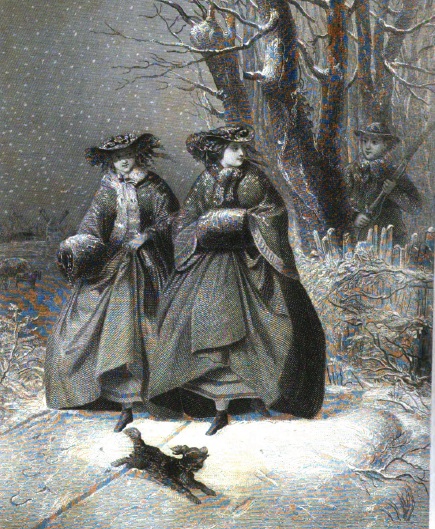
Dressing For Winter – A Visual pt 2

More examples to expand on yesterday. This set includes several from Canada. Keep that in mind.

Winter 08

This is a painting I don’t have the title for worth looking at: Painting by Mari ten Kate

A German painting: Painting by Johannes (Hans) Gabriel Jentzsch

Be sure to see this blog as well.

Here is some information on the artist that follows: Blog page: Life in snowy North America

Winter 06 Winter 09 Winter 10 Winter 11

Published in: on November 22, 2013 at 6:00 am  Comments (2)  

Cold Weather Prep – ReBlogs

For today’s “Reblog”, I’m continuing with the cold weather theme and combining two previous post on prepping for the cold weather. Both are from 2011, which, as you can tell, was a year when the weather turned much earlier than this year. Right now, we have chilly mornings in the upper 30s and low 40s with “warmer” afternoons in the upper 60s or low 70s even. But, with the trees almost at peek, we know the cold, cold weather isn’t far behind.

Are You Ready for Your Cold Weather Events?

For those of us in the northern states of the country we usually see the onset of fall as the ‘end of the season’. But, many of us have cold weather activities ahead of us. This could be ceremonies for Veteran’s Day and Rememberance Day, Yuletide and Christmas events for our living history sites or even festive caroling in our communities.

For each of these events, the weather can get down-right Cold!


Keep in mind – Layers are the Key to Warmth. This means your 1) Underpinnings 2) Dress 3) Outerwear and 4) Accessories.

Here is a list of items that can help you keep warm:

For your dress, consider:

For outerwear, think beyond the cape that will let cold air in and encumber you arms. Consider:

Accessories help keep your hands and head warm. Consider these:

An Evening Chill in the Air

Have you noticed the chill in the air as evening sets in? I know it is still August. But, it is definitely there. While it may feel refreshing to fall asleep in this fresh cool air after many hot and humid nights, we all know this means even colder nights aren’t far behind. I’ll admit, this year I am particularly not looking forward to the colder weather coming in since I don’t exactly have my own home with my own favorite creature comforts. I am big, really big on my creature comforts, most of which come from what I’ve learned about how people kept warm in the 19th century. But, I digress.

With cold weather imminent, now is the time to make sure you are ready. After all, you don’t want to be left out in the cold without your cold weather wear.

Layers are the Key to Warmth. This means your 1) Underpinnings 2) Dress 3) Outerwear and 4) Accessories.

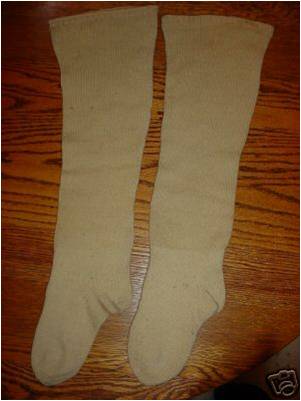
For your underpinnings, consider these:

For your dress, consider:

For outerwear, think beyond the cape that will let cold air in and encumber you arms. Consider:

Accessories help keep your hands and head warm. Consider these:

Published in: on October 11, 2013 at 4:00 pm  Leave a Comment  

Photo Chat

I stumbled across a file of CDVs and other photos I forgot about. (I’ve been so focused on my Shawls CDVs for the upcoming book.) Some of these photos need to be shared and chatted about. I’ll start of with this one of a who we assume would be mom and two sons:

Image29

Published in: on September 27, 2013 at 5:06 pm  Comments (1)  

Fabric Swatch Swap – An Idea for Group Meetings

As I started receiving my envelops of fabric during our recent FanU Fabric Swap, I couldn’t help but think swapping would be a great way to build or expand a swatch reference. The more I thought about it, I realized a swatch swap in person would be fun for reenacting groups to do at a meeting.

Here is my thought process. (You are welcome to steal this idea.)

  • Each person attending chooses a fabric s/he has documentation for. This could include the dating, type of print, colors, an example of how/where a similar fabric was worn, etc. The fabric may or may not be an actual reproduction.
  • Each person brings several (according to the size of the group) 3″ swatches of the fabric. The size of the fabric swatch depends on what the group decides with guidance from the fabric. (Smaller groups of people may wish to have each person bring more than one sample of fabric.)
  • Each swatch should be accompanied by the documentation. This can be pre-printed on a cards to which the fabric swatch is pinned or a single larger card from which people can copy the information. (determined by the group.)
  • The members of the group exchange swatches and documentation.
  • This will start a swatch reference book for each of the members.

*Note – Tech friendly groups could try a digital approach for those swatches not requiring feel. Each member brings a larger sample, say 10″x10″ and a large print card with the documentation. The fabrics are all layed out in a well lighted with their card sitting on the fabric in the lower right corner. Members then use the cameras or phones to take photos of the swatches with cards creating a digital swatch.

Swatch Cards and Books

There are several ways you can approach your swatch book.

  1. A pre-bound book can be used for handwritten notes. This format allows the keeper the freedom to write whatever she wants about a particular fabric. The fabrics can be pinned or handstitched onto the pages. The downside is pages can not be rearranged or sections added to.
  2. Three ring binder as those which are half-size can nicely hold punched swatch cards. Cards can be pre-formatted with fill-in areas about the fabric. These lines work well as prompts to remind the keeper to include particular information. (This can be helpful for those just starting.) Swatches can be pinned or sewn to the cards. Loose cards can be sewn through a sewing machine. Cards can easily be rearranged as catagory needs change.
  3. Card boxes are another way of holding cards. An advantage is the cards can easily be pulled out and looked at in different groups.

Each person will want different information on their swatch cards. Here are the swatch cards I did a few years back. For new swatch cards, I would want to include information on the print (block, roller, etc), colors/dye, finish and dating as well as how a fabric might be used. That could look more like 2013 Swatch Card.

Published in: on July 29, 2013 at 5:11 pm  Comments (1)  

Around the House – Soap

Recipe for Making Good Hard Soap – Eds Genesee Farmer: – In the May number of the Farmer, among the “Inquiries and Answers,” I find that C. A. Chase, of Ohio, is desirous of obtaining a recipe for making good hard soap. If he will be very particular and attend fully to the following recipe, he will possess as good, and as pure a chemical soap as he ought to desire. But let me warn him, just here, that if he deviates from the principles laid down here – which are simple and comprehensive – the chemical process will thereby be destroyed. I know this to be so from experience.

PURE CHEMICAL SOAP  – Pore 12 quarts of soft boiling water upon 5 lbs. of unslaked lime. Then dissolve 5 lbs. of washing soda in 12 quarts of soft boiling water. Then mix the above together, and let the mixture remain together from 12 to 24 hours for the purpose of chemicalizing. Now pour off all the clear liquid – being careful not to disturb the sediment. Add to the above 3 ½ lbs of clarified grease, and from 3 to 4 oz of rosin. Boil this compound together one hour; pour off to cool’ cut up into bars for use, and you are in the possession of a superior chemical soap.

The cost of this superior article is about 3 ½ cents per lb. (The Genesee Farmer, June 1860)


To Make Hard Soap – One of your correspondents – C. A. Chase, Ohio – wishes a recipe for making hard soap. I think if he will try this one he will be pleased with it. Take six pounds of soda, seven pounds of grease, three pounds of unslaked lime, and four gallons of water. Put the soda, lime and water in a pot, and boil until they are dissolved; let the dregs settle; pour off the liquid and throw away the dregs; add the grease to the liquid and boil until it is the consistency of honey; then pour it off to cool; set it in a dry place and in a few days it will be dry enough for use. (The Genesee Farmer, July 1860)

Totally random photo:
image

Published in: on July 20, 2013 at 7:48 am  Leave a Comment  
Tags: