A Springy New Series – Another Look at Millinery

As we move into spring, Oh, Happy Spring, my Saturday posts are going to move from travel to millinery. Don’t worry, I am continueing my travel research. The forthcoming millinery posts will primarily focus on theories, ideas, trends and storys revolving around millinery rather than just straight fashion.

To start, here is a passage from “Aesthetics of Dress” from Blackwood’s Edinburgh Magazine,  1845. It takes a different look at bonnets than we are accustom.

Bonnets, however, have more to do with women than with men; and we defy our fair friend to prove that these articles of dress, about which they are always so anxious (a woman – a regular genuine woman, reader – will sacrifice a great deal for a bonnet), are either useful or ornamental. And first, for their use; if they were good for anything, they would protect the head from the cold, wet, and sunshine. Now, as far as cold is concerned, they do so to certain degree, but not a tenth part so well as something else we shall talk of by and by: as for wet – what woman ever trusted her bonnet in a shower of rain? What woman does not either pop up her parasol, or green cotton umbrella; of if she had not these female arms, ties over it her pocket-handkerchief, in a vain attempt to keep off the pluvious god? Women are more frightened at spoiling their bonnets than any other article of dress; let them but once get their bonnets under the dripping eaves of and umbrella, and, like ostriches sticking their heads under ground, they think their whole persons safe – we appeal to any man who has walked down Cheapside with his eyes open, on a rainy day, whether this be not true. And then for the sun – who among the ladies trusts to her bonnet for keeping her face from freckling? Else why all the paraphernalia of parasols? why  all these endless patents for sylphides and sunscreens of every kind, form, and colour? why can you never meet a lady in a summer-walk without one of these elegant little contrivances in her hand? Comfort, we apprehend, does not reside in a bonnet: look at a lady travelling, whether in a carriage or a railroad diligence – she cannot for a moment lean back into one of the nice pillowed corners of the vehicle, without running imminent risk of crushing her bonnet: her head can never repose; she has no travelling-cap, like a man, to put on while she stows away her bonnet in some convenient place; the stiffened gauze, or canvass, or paper, of which its inner frame-work is composed, rustles and crackles with every attempt at compression; and a pound’s worth or two of damage may be done by a gentle tap or squeeze. Women, if candid, would allow that their bonnets gave them much more trouble than comfort, and that they have remained in use solely as conventional objects of dress – we will not allow, of ornament. The only position in which a bonnet is becoming – and even then is only the modern class of bonnets – is, when they are viewed full front; further, as we observed before, they make a nice encadrement for the face; and, with their endless adjuncts of lace, ribands, and flowers, they commonly set off advantage. But it is only the present kind of bonnet that does so; the old-fashioned, poking, flaunting, square-cornered bonnet never became any female physiognomy; it is only the small, tight, come-and-kiss-me style of bonnet now worn by ladies, that is at all tolerable. All this refers, however, only to that portion of the fairer half of the human race which is in the bloom of vigour of youth and womanhood; those that are still in childhood, or are sinking into the vale of years, cannot have a more inappropriate, more useless, covering for the head than what they now wear, at least in England. Simplicity, which should be the attribute of youth, and dignity, which should belong to age cannot be compatible with a modern bonnet: fifty inventions might be made of coverings more suitable to these two stages of life.  

I also want to add – Isn’t it interesting what we find inspiring or what spurs ideas for us? This particular passage takes a very different look at bonnets than we are used to. Within it is a basic notion that has been bugging me for some time now in my research. The way this gentleman phrases this concept has planted an idea, more like framework, in my head. Yes, I am being vague on purpose. This framework could either become a facinating conference presentation or blog series. Which is tbd.


“The Three Traveling-Bags” part 2

Continued….

  “The Three Traveling-Bags” (The Continental Monethly, 1862)

Chapter III

When the train stopped at Camden, four gentlemen got off, and walked, arm-in-arm, rapidly and silently, up one of the by-streets, and struck off into a foot-path leading to a secluded grove outside the town. Of the first two, one was our military friend in a blue coat, apparently the leader of the party. Of the second two, one was a smiling, rosy little man, carrying a black valise. Their respective companions walked hasty, irregular strides, were abstracted, and apparently ill at ease.

The party stopped.

“This is the place,” said Captain Jones.

“Yes,” said Doctor Smith”

The Captain and the Doctor conferred together. The other two studiously kept apart.

“Very, well. I’ll measure the ground, and do you place your man.”

It was done.

“Now, for the pistols,” whispered the Captain to his fellow-second.

“They are all ready, in the valise,” replied the Doctor.

The principals were placed, ten paces apart, and wearing that decidedly uncomfortable air a man has who is in momentary expectation of being shot.

“You will fire, gentlemen, simultaneously, when I give the word,” said the Captain. Then, in an undertone, to the Doctor, “Quick, the pistols.”

The Doctor, stooping over and fumbling at the valise, appeared to find something that surprised him.

“Why, what the devil –“

“What’s the matter?” asked the Captain, striding up. “Can’t you find the caps?”

“Deuce a pistol or a cap, but this!”

He held up – a lady’s night-cap!

“Look here – and here – and here!” holding up successively a hair-brush, a long white night-gown, a cologne-bottle, and a comb.

They were greeted with a long whistle by the Captain, and a blank stare by the two principals.

“Confound the luck!” ejaculated the Captain; “if we haven’t made a mistake, and brought the wrong valise!”

The principals looked at the seconds. The seconds looked at the principals. Nobody volunteered a suggestion. At last the Doctor inquired.

“Well, what’s to be done?”

“D—d unlucky!” again ejaculated the Captain. “The duel can’t go on.”

“Evidently not,” responded the Doctor, “unless they brain each other with the hairbrush, or take a pop at each other with the cologne-bottle.

“You are quite sure there are no pistols in the valise?” said on of the principals, with suppressed eagerness, and drawing a long breath of evident relief.

“We might go over to the city and get pistols,” proposed the Captain.

“And by that time it will be dark,” said the Doctor.

“D—d unlucky,” said the Captain again.

“We shall be the laughing-stock of the town,” consolingly remarked the Doctor, “if this gets wind.”

“One work with you, Doctor,” here interposed his principal.

They conferred.

At the end of the conference with his principal, the Doctor, advancing to the Captain, conferred with him. Then the Captain conferred with his principal. Then the seconds conferred with each other. Finally, it was formally agreed between the contending parties that a statement should be drawn up in writing, whereby Principal No. 1 tendered the assurance that the offensive words “You are a liar” were not used by him in any personal sense, but solely as an abstract proposition, in a general way, in regard to the matter of fact dispute. To which Principal No 2 appended his statement of his high gratification at this candid and honorable explanation, and unqualifiedly withdrew the offensive words “You are a scoundrel.” They having been used by him under a misapprehension in the intent and purpose of the remark which preceded them.

There being no longer a cause of quarrel, the duel was of course ended. The principals shook hands, first with each other, and next with the seconds,  and were evidently very glad to get out of it.

“And now that it is so happily settled,” said the Doctor, chuckling and rubbing his hands, “it proves to have been a lucky mistake, after all, that we brought the wrong valise. Wonder what the lady that owns it will say when she opens ours and finds the pistols.”

“Very well for you to laugh about,” growled the Captain; “but it’s no joke for me to lose my pistols. Hair triggers – best English make, and gold mounted. There aren’t a finer pair in America.”

“Oh, we’ll find’em. We’ll go on a pilgrimage from house to house, asking if any lady there has lost a night-cap and found a pair of dueling-pistols.


Chapter IV

In very goo d spirits, the party crossed the river, and inquired at the baggage-room in reference to each and all black leather traveling-bags arrived that day, took notes of where they were sent, and set out to follow them up. In due time they reached the Continental, and, as luck would have it, met the unhappy bridal pair just coming down the stairs in charge of the policeman.

“What’s all this?” inquired the Captain.

“Oh, a couple of burglars, caught with a valise full of stolen property.

“A valise! What kind of valise?”

“A black leather valise. That’s it, there.”

“Here! – Stop! – Hallo! – Policeman! – Landlord! It’s all right. It’s all a mistake. They got changed at the depot. This lady and gentleman are innocent. Here’s their valise, with her nightcap in it.”

Great was the laughter, multifarious the comments, and deep the interest of the crowd in all this dialogue, which they appeared to regard as a delightful entertainment, got up expressly for their amusement.

“Then you say this ‘ere is yourn?” said the policeman, relaxing his hold on the bridegroom, and confronting the Captain.

“Yes, it’s mine.”

“And how did you come by the spoons?”

“Spoons, you jackanapes!” said the Captain. “Pistols! – dueling-pistols!”

“Do you call these pistols?” said the policeman, holding up one of the silver spoons marked ‘T.B.”

The Captain, astounded, gasped “It’s the wrong valise again, after all!”

“Stop! Not so fast!” said the police functionary, now invested with the great dignity by the importance of the affair he found himself engaged in. “IF so be as how you’ve got this ‘cre lady’s valise, she’s all right, and can go. But, in that case, this is yourn,  and it comes on you to account fro them ‘are stole spoons. Have to take you in charge, all four of ye.”

“Why, you impudent scoundrel!” roared the Captain; “I’ll see you in-. I wish I had my pistols here; I’d teach you to insult gentlemen!” shaking his fist.

The dispute waxed fast and furious. The outsiders began to take part in it, and there is no telling how it would have ended, had not an explosion, followed by a heavy fall and a scream of pain, been heard in an adjoining room.

The crowd rushed to the scene of the new attraction.

The door was fast. It was soon burst open, and the mystery explained. The thief, who carried off the Captain’s valise by mistake for his own, had taken it up to his room, and opened it to gloat over the booty he supposed it to contain, thrusting his hand in after the spoons. In so doing he had touched one of the hair triggers, and the pistol had gone off, the bullet making a round hole through the side of the valise, and a corresponding round hole in the calf of his leg. The wounded rascal was taken in charge, first by the policeman, and then by the doctor; and the duelists and the wedded pair struck up a friendship on the score of their mutual mishaps, which culminated in a supper, where the fun was abundant, and where it would be hard to say which was in the best spirits, – the Captain for recovering his pistols, the bride for getting her night-cap, the bridegroom for escaping the station-house, or the duelists for escaping each other. All resolved to ‘mark the day with a white stone,’ and henceforth to mark their names on their black traveling-bags, in white letters.


Published in: on March 16, 2013 at 7:00 am  Leave a Comment  
Tags: ,

“The Three Traveling-Bags”

Lately, I’ve really been enjoying lost or mixed-up baggage stories. This story, “The Three Traveling-Bags” is from The Continental Monethly  of 1862.

Chapter 1

There were three of them, all of shining black leather; one on top of the pile of trunks; one on the  ground; one in the owner’s hand; all going to Philadelphia; all waiting to be checked.

The last bell rang. The baggageman bustled, fuming, from one pile of baggage to another, dispensing chalk to the trunks, checks to the passagengers, and curses to the porters, in approved railway style.

“Mine! – Philadelphia” cried a stout military-looking man, with enormous whiskers and a red face, crowding forward, as the baggageman laid his hand on the first bag.

“Won’t you please to give me a check for this, now?” entreated a pale, slender, carefully-dressed young man, for the ninth time, holding out bag No. 2. “I have a lady to look after.”

“Say! be you agoin’ to give me a check for that ‘are, or not?” growled the proprietor of bag No. 3, a short, pockmarked fellow, in a shabby over coat.

“All right, gen’l’men. Here you are,’ says the functionary, rapidly distributing the three checks. “Philadelfy, this? Yes, sir, -1092-1740.11-1020. All right.”

“All aboard!” shouted the conductor.

“Whoo-whew!” responded the locomotive; and the train moved slowly out of the station-house.

The baggageman meditatively watched it, as it sped away in the distance, and then, as if a thought suddenly struck him, slapping his thigh, he exclaimed,

“Blest if I don’t believe – “

“What?” inquired the switchman.

“That I’ve gone and guv them three last fellers the wrong checks! The cussed little black things was all alike, and they bothered me.”

“Telegraph,” suggested the switchman.

“Never you mind,’ replied the baggageman. “They was all going to Philadelfy. They’ll find it out when they get there.”

They did.

Chapter II

The scene shifts to the Continental Hotel, Philadelphia. – Front parlor, up stairs. – Occupants, the young gentleman alluded to in Chapter I, and a young lady. In accordance with the fast usages of the times, the twain had been made one in holy matrimony at 7.30 a.m.; duly kissed and congratulated till 8.15; put aboard the express train at 8.45, and deposited at the Continental, bag and baggage, by 12.58.

They were seated on the sofa, the black broadcloth coat-sleeve encircling the slender waist of the gray traveling-dress, and the jetty moustache in equally affectionate proximity to the glossy curls.

“Are you tired, dearest?”

“No, love, not much. But you are, arn’t you?”

“No, darling.”

Kiss, and a pause.

“Don’t it seem funny?” said the lady.

“What, love?”

“That we should be married.”

“Yes, darling.”

“Won’t they be glad to see us at George’s?”

“Of course they will.”

“I’m sure I shall enjoy it so much. Shall we get there to-night?”

“Yes, love, if – “

Rap-rap-rap, at the door.

A  hasty separation took place between man and wife – to opposite ends of the sofa; and  then –

“Come in.”

“Av you plaze, sur, it’s an M.P. is waiting to see yez.”

“To see me! A policeman?”

“Yis, sur.”

“There must be some mistake.”

“No sur, it’s yourself; and he’s waiting in the hall, beyant.”

“Well, I’ll go to – No, tell him to come here.”

“Sorry to disturb you, sir,” said the M.P., with a huge brass star on his breast, appearing with great alacrity at the waiter’s elbow. B’lieve this is your black valise?”

“Yes, that is ours, certainly. It has Julia’s – the lady’s things in it.”

“Suspicious sarcumstances about that ‘ere valise, sir. Telegraph come this morning that a burglar started on the 8.45 Philadelphia train, with a lot of stolen spoons, in a black valise. – spoons marked T. B. – Watched at the Ferry. Saw the black valise. – Followed it up here. – Took a peek inside. Sure enough, there was the spoons. Marked T. B., too. Said it was yours. Shall have to take you in charge.”

“Take me in charge!” echoed the dismayed bridegroom. “But I assure you, my dear sir, there is some strange mistake. It’s all a mistake.”

“S’pose you’ll be able to account for the spoons being in your valise, then?”

“Why, I – I – it isn’t mine. It must be somebody else’s. Somebody’s put them there. It is some villainous conspiracy.”

“Hope you’ll be able to tell a straighter story before the magistrate, young man; ‘cause if you don’t, you stand a smart chance of being sent up for six months.”

“Oh, Charles! This is horrid. Do send him away. Oh dear! I wish I was home,” sobbed the little bride.

“I tell you, sir,” said the bridegroom, bristling up with indignation, “this is all a vile plot. What would I be doing with your paltry spoon? I was married this morning, in Fifth Avenue, and I am on my wedding tour. I have high connections in New York. You’ll repent it, sir, if you dare arrest me.”

“Oh , come, now,” said the incredulous official, “I’ve been hearn stories like that before. This ain’t the first time swindlers has traveled in couples. Do you s’pose I don’t know nothin’? ‘Tan’t no use; you’ve just got to come along to the station-house. Might as well go peaceably, ‘cause you’ll have to.”

“Charles, this is perfectly dreadful! Our wedding night in the station-house! Do send for somebody. Send for the landlord to explain it.”

The landlord was sent for, and came; the porters were sent for, and came; the waiters, and chambermaids, and bar-room loungers came, without being sent for, and filled the room and the adjoining hall, some to laugh, some to say they wouldn’t have believed it, but nearly all to exult that the unhappy pair had been ‘found out.’ Now explanation could be given; and the upshot was, that, in spite of tears, threats, entreaties, rage, and expostulations, the unfortunate newly-married pair were taken in charge by the relentless policeman, and marched down stairs, en rout for the police office.

And here let the curtain drop on the melancholy scene, while we follow the fortunes of black valise No. 2.

 Continued…..

Published in: on March 16, 2013 at 7:00 am  Leave a Comment  
Tags: ,

“Where’s My Trunk?” part 2

And so it really was. At the head of the pier at Newport, there is a  shed with seats within where people wait for the ferry-boats;and there, perdu beneath a form, lay the enchanted trunk, having been so disposed, in the bustle of unloading,  by means which nobody could pretend to understand. The guard, with a half frightened look approached the awful object, and soon placed it with other things on board the ferry boat.

On our landing at Dundee pier, the proprietor of the trunk saw so well after it himself, tat it was evident no accident was for this time to be expected. However, it appeared that this was only a lull to our attention. The tall gentleman was to go on to Aberdeen by a coach then just about to start from Merchant’s Inn; while I, for my part, was to proceed by another coach which was about to proceed from the same place to Perth. A great bustle took place in the narrow street at the inn door, and some of my late fellow travelers were getting into the one coach, and some into the other. The Aberdeen coach was soonest prepared to start, and just as the guard cried ‘all’s right,’ the long figure devolved from the window, and said, in an anxious tone of a voice –

“Guard, have you got my trunk?”

“Your trunk, sir!” cried the man; “what like is your trunk? – we have nothing here but bags and baskets.”

“Heaven preserve me!” exclaimed the unfortunate gentleman, and burst out of the coach.

It immediately appeared that the trunk had been deposited by mistake in the Perth, instead of the Aberdeen coach; and unless the owner had spoken, it would have been, in less than an hour, half way up the Carse of Gourie. A transfer was immediately made, to the no small amusement of myself and one or two other persons in both coaches who had witnesses its previous misadventures on the road through Fife. Seeing a friend on the Aberdeen vehicle, I took an opportunity of privately requesting that he would, on arriving at his destination, send me an account by post of all further mistakes and dangers which were to befall the trunk in the course of the journey. To this he agreed, and, about a week after, I received the following letter:

“Dear ——,

“All went well with myself, my fellow-travellers and the Trunk, till we got a few miles on this side of Stonehaven, when just as we were passing one of the boggiest parts of that boggy road, an unfortunate lurch threw us over upon one side, and the exterior passengers, along with several heavy articles of luggage, were all projected several yards off into the morass. As the place was rather soft, nobody was much hurt; but, after everything had again been put to rights, the tall man put some two thirds of himself through the coach window, in his usual manner, and asked the guard if he was sure his trunk was safe in the boot.

““Oh, Lord, sir!” cried the guard, as if a desperate idea had at that moment rushed into his mind, “the trunk was on the top. Has nobody seen it laying about any where?”

““If it be a trunk ye’re looking after,” cried a rustic, very coolly, “I saw it sink into that wellee a quarter of an hour sync.”

““Good God!” exclaimed the distracted owner, “my trunk is gone for ever. Oh my poor dear trunk! – where is the place – show me where it disappeared.”

“The place being pointed out, he rushed madly up to it, and seemed as if he would have plunged into the watery profound to search for his lost property, or die in the attempt. Being informed that the bogs in this part of the country were perfectly bottomless, he soon saw how vain every endeavour of that kind would be; and so he was with difficulty induced to resume his place in the coach, loudly threatening, however, to make the proprietors of the vehicle pay sweetly for his loss.

“What was in the trunk. I have not been able to learn. Perhaps the title deeds of an estate were among the contents; perhaps it was only filled with bricks and rags, in order to impose upon the innkeepers. In all likelihood, the mysterious object is still descending and descending, down the boundless abyss, in which its contents will probably be revealed till a great many things of more importance and equal mystery are made plain.”

Published in: on March 9, 2013 at 8:00 pm  Comments (1)  
Tags: , ,

“Where’s My Trunk?”

How many of us have experienced lost or mis-directed luggage? I certainly have. Here is a fun story of a mysterious black trunk traveling by coach and steam ferry, which saw mishap upon mishap…..

“Where’s My Trunk?” The Monthly Traveller, or, Spirit of the Periodical Press. Badger & Porter, Boston: 1833.
It is well know in Scotland that the road from Edinburgh to Dundee, only forty-three miles in extent, is rendered tedious and troublesome by the interposition of two arms of the sea, namely, the Firths of Forth and Tay, one of which is seven, and the other three miles across. Several rapid and well conducted stage coaches travel upon this road; but, from the frequent loading and unloading at the ferries, there is not only considerable delay to the traveler, but also rather more than the usual risk of damage and loss to their luggage. On one occasion it happened that the common chances against the safety of a traveller’s integuments were multiplied in a mysterious, but most amusing manner – as the following little narrative will show: –
The gentleman in question was an inside passenger – a very tall man, which was so much the worse for him in that situation – and it appeared that his whole baggage consisted of a single black trunk – one of medium size, and now way remarkable in appearance. On our leaving Edinburgh, this trunk had been deposited in the boot of the coach, amidst a great variety of other trunks, bundles, and carpet bags, belonging to the rest of the passengers.
Having arrived at Newhaven, the luggage was brought forth from the coach, and disposed upon a barrow, in order that it might be taken down to the steam boat which was to convey us across. – Just as the barrow was moving off, the tall gentleman said –
“Guard, have you got my trunk?”
“Oh, yes, sir,” answered the guard; “you may be sure it’s there.”
“Not so sure of that,” quoth the tall gentleman; “whereabouts is it?”
The guard poked into the barrow, and looked in vain among the numberless articles for the trunk. At length, after he had noozled about for two or three minutes through all the holes and corners of the mass of integuments, he drew out his head, like a terrier tired of earthing a badger, and seemed a little nonplused.
“Why, here it is in the boot!” exclaimed the passenger, “snug at the bottom, where it might have remained, I suppose, for you, till safely returned to the coach yard, in Edinburgh.”
The guard made an awkward apology, put the trunk upon the barrow, and away we all went to the steam boat.
Nothing further occurred till we were all standing beside the coach at Pettycur, ready to proceed on the principal terraqueous part of our journey through Fife.
Every thing seemed to have been stowed into the coach, and most of the passengers had taken their proper places, when the tall gentleman cried out –
“Guard, where is my trunk?”
“In the boot, sir,” answered the guard; “you may depend upon that.”
“I have not seen it put in,” said the passenger, “and I don’t believe it is there.”
“Oh, sir,” said the guard, quite distressed, “there can surely be no doubt about the trunk now.”
“There! I declare – there!” cried the owner of the missing property; “my trunk is still lying down yonder upon the sands. Don’t you see it? The sea, I declare, is just about reaching it. What a careless set of porters! I protest I was never so treated on any journey before.”
The trunk was instantly rescued from it somewhat perilous situation, and, all having been at length put to rights, we went on our way to Cupar.
Here the coach stopped a few minutes at the inn, and there is generally a particular discharge of passengers. As some individuals, on the present occasion, had to leave the coach, there was a slight discomposure of the luggage, and various trunks and bundles were presently seen departing on the backs of porters, after the gentlemen to whom they belonged. After all seemed to have been again put to rights, the tall gentleman made his wonted inquiry respecting his trunk.
“The trunk, sir,” said the guard, rather pettishly, “is in the boot.”
“Not a bit of it,” said its owner; who in the meantime had been peering about. “There it lies in the lobby of the inn!”
The guard now began to think that this trunk was in some way bewitched, and possessed a power, unenjoyed by other earthly trunks, of removing itself or staying behind, according to its own good pleasure.
“The Lord have a care o’ us!” cried the astonished custodier of baggage, who, to do him justice seemed and exceedingly sober and attentive person. “The Lord have a care o’ us, sir! The trunks no canny.”
“It’s canny enough, you fool,” said the gentleman sharply; “but only you don’t pay proper attention to it.”
The fact was, that the trunk had been taken out of the coach and placed in the lobby, in order to allow of certain other articles being got at which lay beneath. It was now once more stowed away, and we set forward upon the remaining part of our journey, hoping that there would be no more disturbance about this pestilent member of the community of trunks. All was right till we came to the lonely inn of St Michael’s, where a side road turns off to St Andrew’s, and where it happened that a passenger had to leave us to walk to that seat of learning, a servant having been in waiting to carry his luggage.
The tall gentleman, hearing a bustle about the boot, projected his immensely long slender body through the coach window, in order, like the lady in the fairy tale, to see what he could see.
“Hello, fellow!” cried he to the servant following the gentleman down the St Andrew’s road; “is that not my trunk? Come back, if you please, and let me inspect it.”
“The trunk, sir,” interposed the guard, in a sententious manner, “is that gemman’s trunk, and not yours: yours is in the book.”
“We’ll make sure of that, Mr Guard, if you please. Come back, my good fellow, and let me see the trunk you have got with you.”
The trunk was accordingly brought back, and, to the confession of the guard, who had thought himself fairly infallible for this time, it was the tall man’s property, as clear as brass nails could make it.
The trunk was now the universal subject of talk, both inside and outside, and every body said he would be surprised if it got to its journey’s end in safety. All agreed that it manifested a most extraordinary disposition to be lost, stolen, or strayed, but yet every one thought that there was a kind of special providence about it, which kept it on the right road after all; and, therefore, it became a fair subject of debate, whether the chances against, or the chances for, were likely to prevail.
Before we arrived at Newport, where we had to go on board the ferry steam boat for Dundee, the conversation had gone into other channels, and each being engaged about his own concerns, no one thought any more about the trunk, till just as the barrow was descending along the pier, the eternal long man cried out –
“Guard, have you got my trunk?”
“Oh, yes,” cried the guard very promptly, “I’ve taken care of it now. There it is on the top of all.”
“It’s no such thing,” cried the gentleman who had come into the coach at Cupar; “that’s my trunk.’
Every body then looked about for the enchanted trunk; the guard ran back, and once more searched the boot, which he knew to have been searched to the bottom before; and the tall gentleman gazed over land, water, and sky, in quest of his precious encumbrance.
“Well, guard,” cried he at length, “what a pretty fellow you are! There, don’t you see? – there’s my trunk thrust into the shed, like a piece of lumber!”
My Apologies – On to part 2

Published in: on March 9, 2013 at 9:00 am  Comments (1)  
Tags:

“Two Heads…..”

How much fluff can there be in one person’s head?
I now know the answer….. A full bag.

With my recent revival in millinery fascination, it is time for new model heads. (Okay, the part where I can’t get to my bonnet stands from Dad, nudged this along.)

Tonight, I made a pair of red and blue striped heads to hold my bonnets. The pattern I used  by Lynn McMasters (here) was easy to follow. I used a heavier canvas weight fabric I picked up at Bits & Pieces. Good choice. Inside each is a full back of poly-fill. Really. The base is a thick piece of wood my tech friends cut for me.

image

These will be nice for working on my bonnets. I can pin right through the bonnet. (I do have a third cut & pieced, awaiting fill and a base.)
A few numbers to add – Just under 1 yard of 44″ fabric made 3 heads. I only paid $.60 at Bits & Pieces. Regularly, figure $5-8 with a Joann’s coupon. The wood was cut for me at no cost. The fiber-fill I also had on hand. I think it was $4.99 a bag. If bought from scratch with one of Joann’s sales and coupons, 3 heads would cost about $12.50 to $23. Not bad.


Mid-Winter Millinery

I should say this is millinery worked on in the midst of winter looking forward to spring.
Here are the two other of the four bonnets I started last week during recess. Both of these are made from bits and pieces in my sewing case pile. It was such a fun challenge to try to piece the fabric together to make a bonnet. While working on these, I thought about when an original cast milliner may have tried to piece together what she had in her supply drawers to make inventory to sell, whether she was low on funds or had a delay in the delivery of materials. I also thought about the techniques a woman might have used to remake her existing bonnet(s) for the next season when she couldn’t get a new bonnet. Sadly, such remakes are likely not the ones to survive over a hundred and fifty years for us curious sorts to examine extensively.
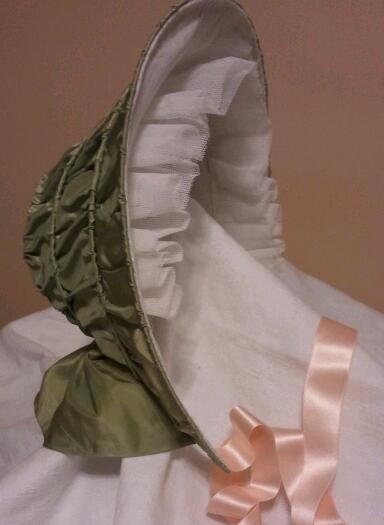
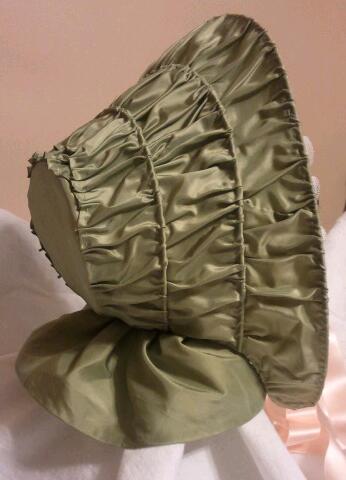
This is the seafoam green that will be my little sister’s. I love this color. The gathering on the cane brings out the color in my opinion.

image

image

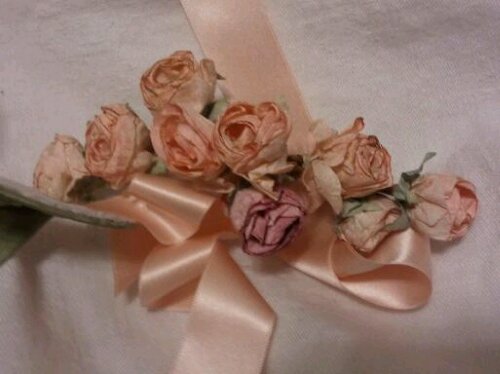
The seafoam green calls for pink, a pretty pale pink. Here are some of the flowers it will get. There needs to some additional green and maybe some white accents. I also need to get the wider ribbon either in a satin weave or a moire.

image

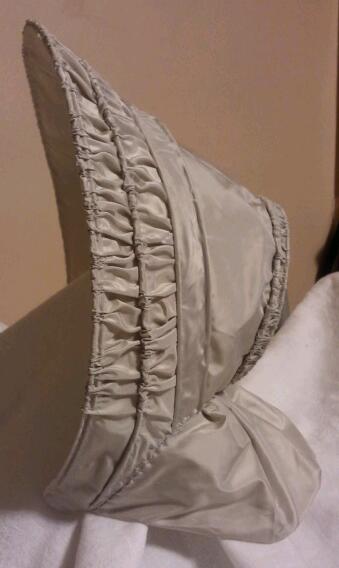
This is the fourth bonnet. I was going to do a shot brown & blue, but there wasn’t enough. So, this pearl color it was. I’m convinced the color changed as I worked, adding this silvery tone.

image

I’ve not yet decided what this one will get decorated with. I still need to find the rest of my ribbons.

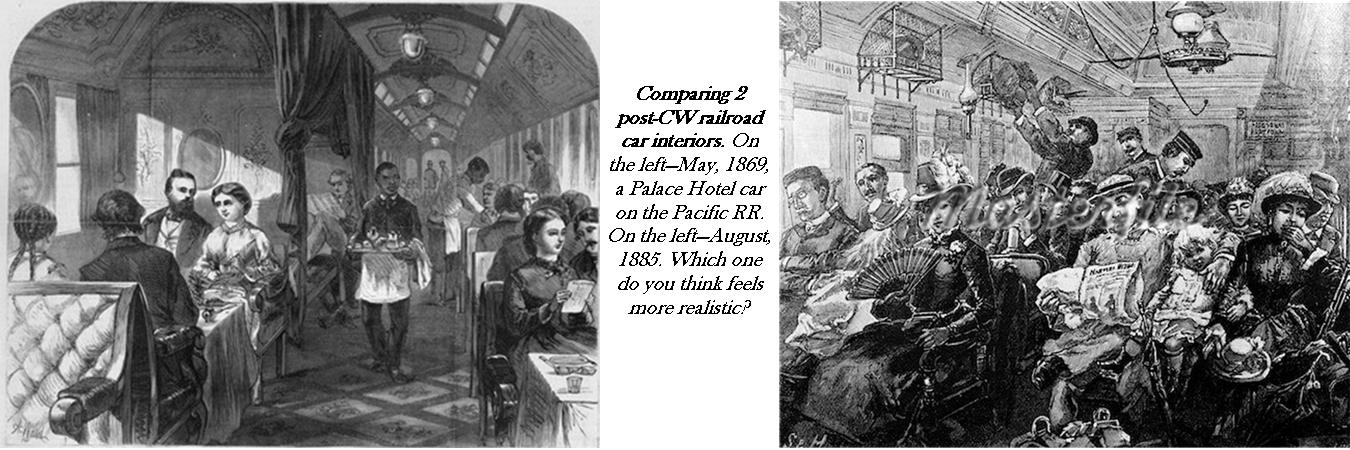
Looking inside a Railroad Car

Publication1

Published in: on March 3, 2013 at 7:38 am  Comments (4)  

A Millinery Mood

If you recall my Planning for Recess post, I started the week off thinking I would tackle a few pieces on my travel impression list. Well, as the week rolled on… it seems I as much more in a millinery mood.
Monday and Tuesday were all about getting the sewing room together. (Check out my Updates blog for before and after photos.) While there is still a long way to go, the space finally has space to move in. Yeah!  Rather excited finally to have some personal decorative items out including Grandma’s “Tip-Toeing Through the Tulips” and the quilt from my NM friends. Soon, new shelves will be purchased & in place, and my trunks, okay some of my trunks, will be moved in.
Now on to the sewing ….
After the lifting & moving, a nice simple, calming project was a must. A nice piece of silk gauze had been waiting almost a year to become a veil. This was just the relaxing, quick project I needed. (I do still have to find either the narrow silk ribbon or cord to attach it to a bonnet with.)

image

underneath the veil is what held my attention next. I had been thinking about bonnets the week prior. So, I was happy to find some straw to work with. This is the first straw bonnet I’ve made in years. Too many years.

image

I had also been thinking about a drawn bonnet. But, I had no buckram. It was time to appease a curiosity. I sized a fabric I bought while in NM. I was quite happy with how it stiffened up. It was an incredibly light weight frame. Since the silk I was going to use is too soft to give the volume I wanted, I peeked at my sewing case pieces. I happened to have enough of this slate grey silk.

image

I rather like how it came out. This week, it will get trimmed with this ribbon & flowers.

image

I have two other frames to finish up tonight. On will be a sea foam green drawn silk for Lily. The other will either be a chocolate silk or a shot brown silk or a bright sunset orange shot…. Not sure which.

Trunk Inventories – What was carried for travel

While other inventories have come to mind, I hadn’t previously thought of looking at court records for travel information until I stumbled across a court case regarding lost luggage which included the values for the trunk’s (or 2 trunks’) contents. The trunks, owned by a Mrs. Frances Davis, were lost on a steamship leaving New Orleans for Indianola in August of 1853. It appears one of the trunks were later discovered and returned while the other was not top be found. One of the trunks contained the following:

1 gold locket, $20
1 gold bracelet, $18
1 gold ring, $2
1 gold cuff pin, $2
2 silk dresses, $25
5 muslin dresses, $25
silk velvet cloak, $25
lace mantel, $12
silk sacque, $5
1 dozen handkerchiefs, $12
Laces and ribbons, $15
Underclothing, $15
Fan, $2
Parasol, $3
Corset, $5
Shoes, $4
Music, $7
Books, $5
Sundries, thread, thimbles, etc, $1
Work-box, $3
Trunk, $20
Port-folio, stationary, etc. $5
Total $231


The notes on the case continue discussing another trunk. I am not certain if this is a second trunk or the trunk found:
Note by the clerk, in the transcript, as follows: “No citations to be found among the papers.” March 19th, 1855, amended petition alleging “that the trunk mentioned in the original petition contained a large amount of valuable wearing apparel and divers other articles, a bill of particulars containing a schedule of the same, together with the value thereof, is herewith filed marked Z, which is made of a part of his amendment; and she states that the value of said trunk was $437.75, etc.; damages laid at $800. Schedule Z was as follows:

Forbes, master, and the owners of the steamship Perseverance, To Frances Davis, Dr. [reformatted list for easier reading]

1 fine sheet iron traveling trunk, $40;
1 fine Velvet cloak, $40;
 1 fine silk sacque, $10;
1 fine silk dress, $25;
1 fine tissue dress $18;
1 fine tissue dress $15
3 white Swiss dresses, at $10, $9, $8, $27;
1 organdy dress, $12;
5 lawn dresses at $5, $25;
1 fine pocket-hdkf. $8;
2 fine pocket-hdkf. At $5, $10;
8 plain pocket-hdkf at 50 cts. $4;
18 pieces under-clothing $25;
1 fine parasol $6;
1 fine fan $4;
1 work-box and contents $12;
1 fine lace mantle, $15;
1 fine lace veil, $3;
1 fine lace chemisette $5;
1 fine French chemisette;
3 common chemissets at $1.25, $3.75;
3 pieces India ribbon $5;
2 fine French collars at $3, $6;
1 fine lace collar at $5;
5 yds. Velencia lace $5;
5 French work-bands at $1 each, $5;
1 fine gold locket $200; [this does say $200 in the text. I don’t know if this is correct since above the locket is $20.]
1 fine gold bracelet $18;
1 fine gold ring $2;
1 pair cuff pins $2;
2 fine long net gloves at $1.50.
Published in: on February 23, 2013 at 9:37 am  Comments (2)