Drawn Bonnets (the less ubber-quick version)

When talking about drawn bonnets, we should start with a little vocabulary and “how it is done”.

Drawn – Drawn is when the fabric, most often but not exclusively silk, is sewn with channels into which cane or wire is inserted. The fabric is then bunched, or drawn, up along the length of the cane/wire to create a gathered effect. The drawn cane/wire is attached to the bonnet form.

Shirred – Shirred is when a fabric, often silk, is gathered without additional structure. This can be flat or with flounces.

A single bonnet can have either drawn or shirred techniques, or it may have both.

Construction can be done with individual strips of fabric or larger pieces with multiple sections of drawing or shirring. These were done on both wire only frames and frames with light foundation. Drawn and shirred sections are seen on the brim, on the brim and crown, evenly spaced, unevenly spaced, edged with a different material and even running front to back in some cases.

Now, let us look at some examples. (My apologies for the flash in the images.)

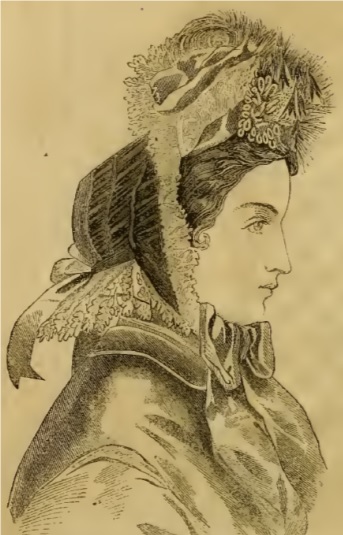
In this fashion illustration and description, the bonnet is directly referred to as “drawn”. This bonnet would have the crepe gathered on cane or wires passing over the bonnet. This bonnet could have been made with two drawn sections, one for the brim and one for the crown.
2

The bonnet of drawn cuir-colored crepe, trimmed on the front with a fanchon of white lace, loops of green ribbon, and Scotch feathers. The inside trimming is of bright flowers, of the
Scotch colors. The cape is covered with a fall of white blonde. (Godey’s, May 1864)

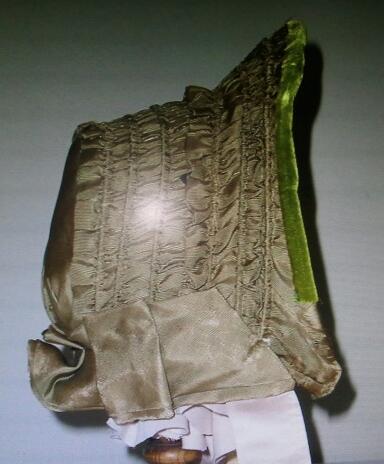
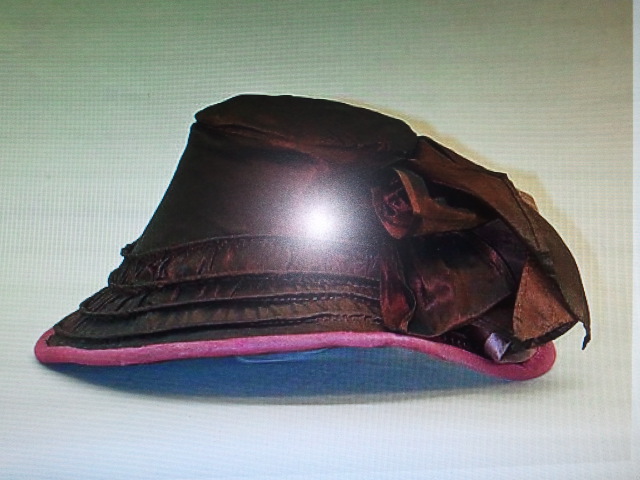
This bonnet, from the MET, has very easy to see canes which the silk is drawn on. 4 canes draw a single piece of silk onto the brim, while a separate piece is set smoothly over the crown and tip. These canes are on the thicker/larger size, being round. (the widest cane channels I’ve seen in an image are on this Henry Ford Museum corduroy bonnet.)
wpid-mntsdcardDCIMCamera2014-06-12-14.52.09.jpg.jpg

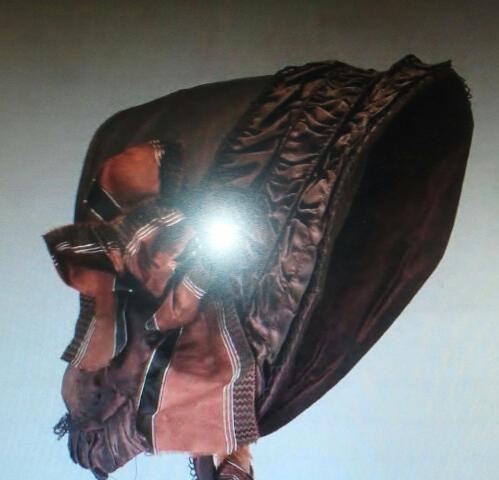
This bonnet also has the drawn sections on the brim while the crown is smooth. It appears to differ from the previous bonnet in that the canes are drawn on separately in strips. The very edge of the brim is covered with one strip. Three strips are drawn onto canes. These are applied from the back to front, with the front most strip being drawn onto 2 canes, creating a little flounce just behind the front edge.
wpid-mntsdcardDCIMCamera2014-06-12-14.51.36-1.jpg.jpg

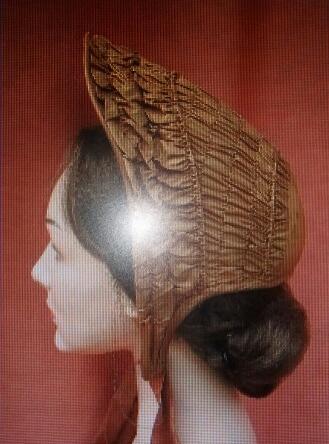
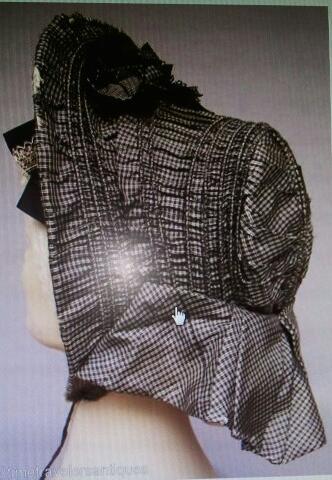
The next several bonnets show drawn silk on the brim and crown. Notice the variety of spacing used. Some are set snuggly, while other are set with quite a bit of space. The green bonnet has fairly evenly spaced drawn canes/wires.  The blue and white pairs the drawn canes together.  Flounces drawn on cane or wire are tucked in as well. The black and white one has a flounce just where the crown meets the brim. The brown bonnet highlights the angles and overlapping that was done on some bonnets. This helps add to the curvy movement to some bonnets.
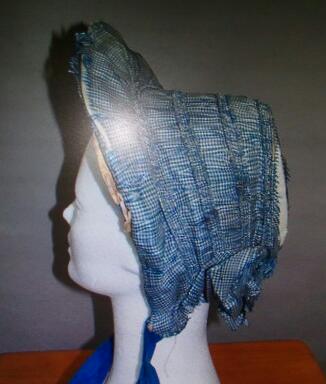
wpid-mntsdcardDCIMCamera2014-06-12-14.50.42-1.jpg.jpgwpid-mntsdcardDCIMCamera2014-06-12-14.50.51-1.jpg.jpgwpid-mntsdcardDCIMCamera2014-06-12-14.51.48-1.jpg.jpgwpid-mntsdcardDCIMCamera2014-06-12-14.52.35-1.jpg.jpg

This example shows that gathered sections can be worked vertically, over the back of the tip. This may or may not be drawn. A better example, where the canes can be seen, showing it is truly a drawn bonnet can be seen HERE
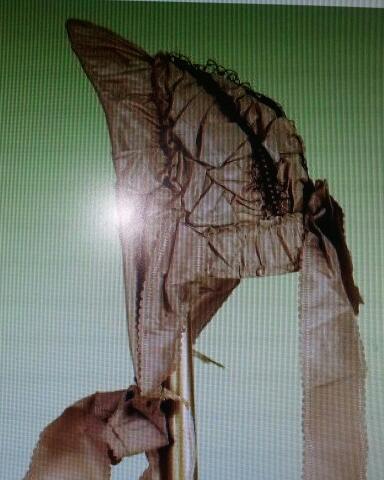
wpid-mntsdcardDCIMCamera2014-06-12-14.51.19-1.jpg.jpg

This last illustration show that a drawn brim can be done with a soft crown. (A tempting idea for this summer. Maybe I’ll make one.)

1

This bonnet has a front of drawn green silk. The graceful soft crown is of white silk. The trimming consists of a tuft of meadow grass and field flowers, also loops of white silk placed directly over the crown. The inside trimmings is of white and black lace and field flowers. (Godey’s, May 1864)


This is my pin board of 1840s through 1860s drawn bonnets. (I’m splitting drawn and buckram. Bare with me.)

 

Published in: on June 13, 2014 at 6:00 am  Comments (2)  

How They Wore Their Bonnets

A few days ago we looked at how some original women wore their bonnets perched on the backs of their heads as well as how we can also do so. If you missed it, the post was called Got Perch?

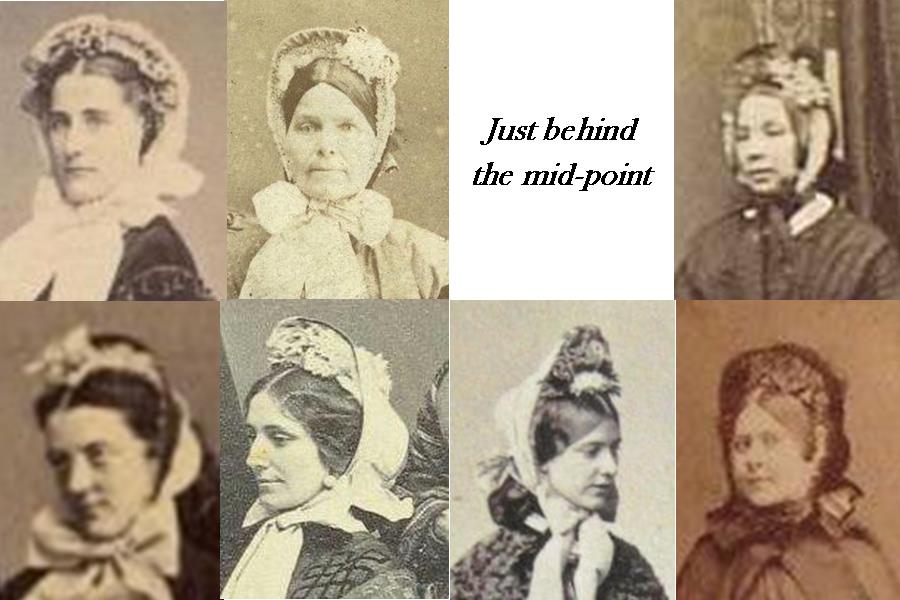
This was only one of several ways women wore their bonnets. Today, I would like to look further at how mid-century women wore their bonnets. Let us start with more examples of the bonnet being worn behind the mid-point of the head.

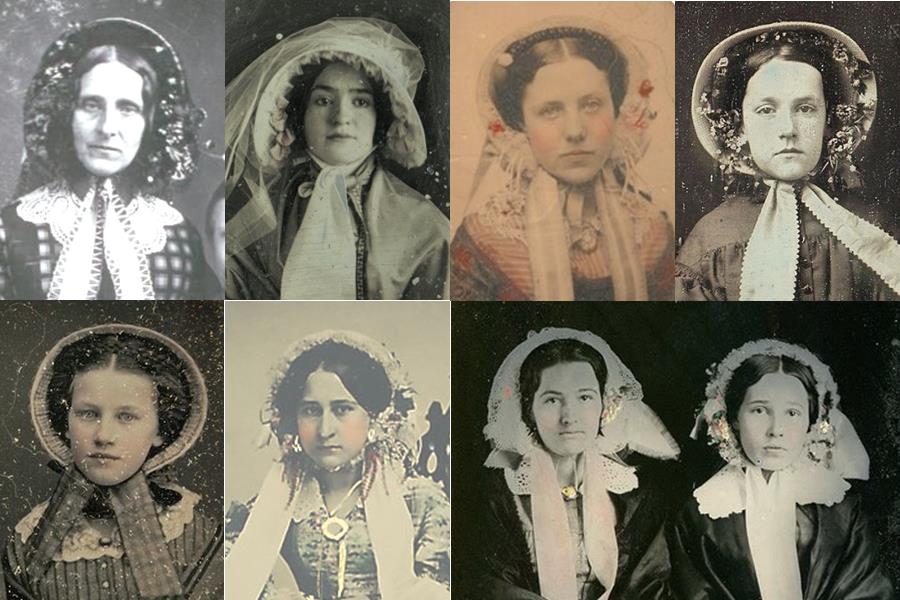
How did they close ups backYou will notice some variation in how far back the bonnet is worn. The two women on the lower left appear to have their bonnet furthest back among the group. These two also happen to have their bonnets angled more than the others. From the views/positions we have, the third woman from the left on the bottom row appears to have a nearly vertical position to the brim and tip. We can not say for certain with the other women; though I suspect the top left may also be nearly vertical. We can also see that most of these women have their flowers reaching further forward than the brim edge of the bonnet. The position of these flowers may help hold the bonnet in place. In the lower right, the flowers can be seen cupping the top of her head. Take a particularly close look at the woman on the lower left. There is a piece photographing white sitting below the flowers/decoration. This may or may not be a stay.

This next group of women are wearing their bonnets at or just forward of their mid-point.

How did they close ups mid forward 2

We see greater variety in the angle of which these bonnets are worn, seeing them worn nearly vertical, angled slightly forward and angled slightly backward. The bottom right and bottom left images show the further forward reach of the spoon bonnet while displaying noticeable difference in the depth, angle and shaping of the crown and tip. In the top left and top right images, we can see how the frill aids in holding the bonnet on.  Again, the flowers are aiding in securing the bonnet to the head. In the bottom row, third from the left, you can see the woman’s flowers reaching down over the hair line. (The lower right image could be considered as wearing her bonnet quite forward.)

In this next group, we see the bonnet worn quite forward of the mid-point.

How did they close ups full forward

Many will notice these women each look more mature. I do not know if this is a coincidence or if there is truly a connection between age and mode yet. I will look further into this. While these bonnets are worn further forward and a couple are rounder, the fashionable spoon shape is present. The bonnet with the daisies, second on the bottom row, demonstrates well how the flowers can hug the top of the head. In several cases, the flowers sit forward enough to reach to or even beyond the hair line. If there is a connection between age and this mode of wearing, there could be further speculation that this positioning of flowers could conceal a thinning part.

The following group was collected as I was looking at untied or partially tied bonnets. These are late 1840s through early 1850s examples. Each either has the ribbons simply looped over each other without a bow or completely untied. Many, if not most, of the women above would have worn their bonnets in this style ten to twenty years previous.

How did they close ups 40 50 not tied

Published in: on June 11, 2014 at 6:00 am  Comments (4)  

A Year in Millinery Fashion – 1864

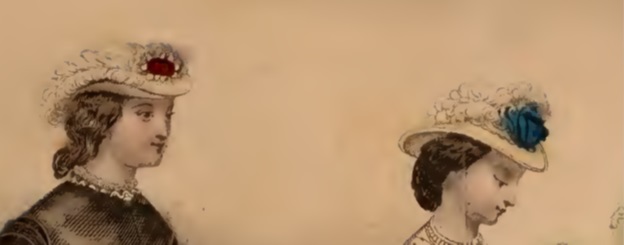
Straw hat, with a brim lined and turned up with mauve velvet. The trimming consists of a long white plume, scarlet flowers and a short mauve plume. (Godey’s, June 1864)

1

Post-War Transitional in White

I’ve been having so much fun sharing the millinery pieces from this spring with you, I decided to share this little bonnet. This really has been a forgotten about bonnet. It made it as far as some so-so photos for Etsy, then got tucked away to the back of the display table.

white 2In the middle of the 1860s we see a transition from the fashionable spoon and cottage bonnet shapes to the hat and smaller bonnet shapes. There were a speckling of styles that show the transition from one millinery era to the next. My bonnet pulls mostly from this first example. The crown drastically shrinks, flattening out, while the cheektabs try various positions framing the sides of the face rather than coming down to the jaw line.

From the National Trust Collection

From Augusta Auctions

Still tracking down the originAs you can see, the decorations and ribbon tend to encircle the crown and fall down along the remains of the cheektab.

white 3white 1I used the last of my hemp plait for this bonnet over the winter. The box pleating encircling the crown is a silk ribbon slightly narrower than the silk ribbon used for the ties. Just under the brim is a frill of fine net.

white 4

My Blue Scallops

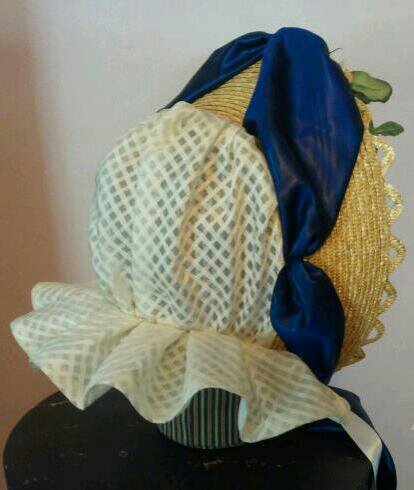
I finally finished my scallop brim straw bonnet. I’m rather pleased with how it came out.

image

The straw is the French straw plait with that beautiful golden straw. This is the first scallop edge I did. There have been several since then with a more refined, smooth connection. The shaped and scalloped straw edges from the 1850s and 60s are quite decorative, often with very fine straw. This is the simplest of scallop. I look forward to creating more.

image

The soft crown is a white and ivory windowpane check silk organza (This is the left overs from the drawn organza I share a week ago. This gives you an idea of how long I was working on each of these.) The bavolet is lined with cotton English net.

image

The ribbon is a dark blue German moire.

image

The flowers are ivory velvet roses and smaller, light blue fabric roses. I rather like the little rosebuds because they dangle nicely.

image

image

Published in: on June 3, 2014 at 6:00 am  Leave a Comment  
Tags:

A Year in Millinery Fashion – 1864

(Wedding reception attire)
Bonnet of white crepe, trimmed with very light feathers and point lace. A fall
of the latter drops over the brim in the Marie Stuart style. The inside
trimming is of tulle and cerise flowers.

1

1850s French Straw with Clouded Stripe Ribbon

This is the bonnet that made me squeel this morning as the new owner put it on. It fit her so beautifully, I really did squeel.
2014-05-19 17.59.11-1
I enjoyed making this bonnet so much. I love the 1850s to begin with. When I came across this ribbon, it just had to be her’s. While it is grey and white, it is also a bluey-purple. It was wonderful to work with. The bias bavolet plays with the clouded stripes wonderfully.
I am so glad we picked these blue and white flowers because they work beautifully with her complextion. They frame her face just right.
2014-05-19 17.59.39-1
This bonnet is made with the French straw plait I enjoy working with. I opted to line this straw bonnet because I know it will be work frequently. (While most original straws show they were not lined, lining can protect the straw.) The frill is silk organza. She has both silk functional ties and the fabulous ribbons.
2014-05-19 17.59.52-1

2014-05-19 18.00.53-1

Published in: on June 1, 2014 at 5:08 pm  Leave a Comment  
Tags:

Just the Right Blues

It looks like many of you enjoyed the Green Velvet Straw Hat I shared on Tuesday. Thank you. (Be sure not to miss “Violets in Early Spring” a sheer organza bonnet)

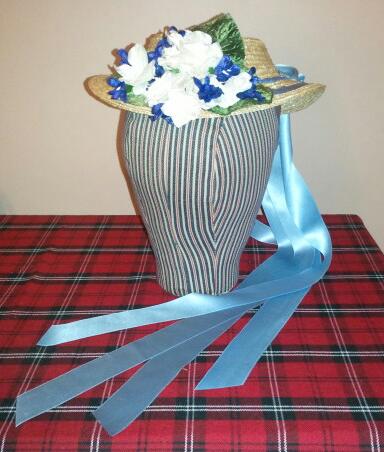
Here is another hat I finished just prior to that one. This one is all about the right blues and right greys. To find just the right blue and grey, I requested a swatch of every blue and grey silk my fabulous ribbon supplier had. I know it is hard to see, but the tails of this hat show the blue and grey we picked.

2014-03-29 17.46.55-1

For the ribbon on the brim, I looked to several original straw hats for inspiration and technique. This one in particular, I like. The Vs in the front and back help allow the green velvet ribbon to lay flat. One of the keys is a narrow ribbon. Since we were only able to get the blue and grey colors in slightly wider ribbons, I needed to fold the ribbon to get the right width. I rather like the softness a folded ribbon give.

2014-03-29 17.47.54-1

2014-03-29 17.48.12-1The flowers are all velvet. I just love the texture of velvet against straw.

2014-03-29 17.48.23-1

A Perfect Green & a Perfect Fit

I was beyond excited when the photos of the new owner of this hat came through just moments ago. Between the perfect fit or the perfectly happy smile on her face, I am estatic.

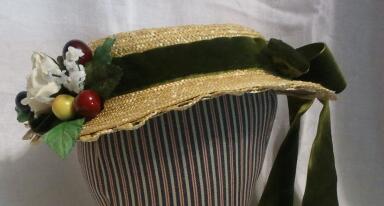
This shape hat just called for a scallop edge. The dip and curve of the brim are highlighted with the scallops.

The client had the incredible satin back velvet ribbon and the beautiful berries. It was amazing how well the two went together, playing with each other and bringing out the gold of the straw. The ribbon feels awesome too. (Check out my post from last week, “why green”, for more information on green.)
2014-05-22 16.36.06-2

2014-05-22 16.36.11-1

2014-05-22 16.37.34-1-1

2014-05-22 16.37.38-1

2014-05-22 16.38.13-1
I just loved making this hat. I am so glad the new owner enjoys it.

Published in: on May 27, 2014 at 4:10 pm  Comments (2)  
Tags:

A Year in Millinery Fashion 1864

It is said that, as regards to invention, one milliner does more in a month than the world architects in a score of years. We are forcibly reminded of this while walking, lately, through the show rooms of Mme. N. Tilman, of 143 East Ninth Street, New York. At this establishment we are constantly surprised with novelties; nothing pretty or new appears in Europe in the millinery line, but is to beyond at the Maison Tilman.

An entire novelty consists of straw guipure, equal in appearance to the finest lace. Straw ribbons are also something quite new, and just introduced on the new spring bonnets. Mother of pearl, of which we have already spoken as being worn on coiffures and ball dresses, is now adopted for bonnets, and, in contrast with trimmings of rich velvet, produces an admirable effect. We are able now to speak with certainty of the spring style bonnets, as announced by the most distinguished artistes.

Scotch plaid, in silk and velvet, is very much in vogue; but we notice that Mme. Tilman uses is sparingly, and only in the finest and choicest patterns and combinations. The following will serve as examples. –

A rich wrought Neapolitan, the braids an inch apart, and each displaying a fine cord-like edge of blue, green, and crimson plaid. The curtain was composed of a shell of plaid silk upon blonde, also in a shell pattern. A puff of ribbon and meadow grass, tipped with dew, constituted the decoration, which was placed high on one side of the brim.

Trimming of all kinds is used very moderately, but it must be of the very best, whether in flowers, lace, or ribbon. It is no longer masses on the top of the brim, but is arranged on the top or side of the crown, or across the side of the brim from its tip to the crown. The shape is perfect, neither too large nor too small, but serving as a modest frame for a fair face. It is still rather high in the front, very much compressed at the sides, and slopes low behind to the base of the crown, which is wider than formerly, in order to allow for the present style of coiffure.

A charming novelty imported by Mme. Tilman consists of fine white and black Neapolitans embroidered in flowers and trailing branches in a fine jet. The design is so delicate and graceful, the workmanship so exquisite, that there is nothing of the ordinary appearance which is frequently objected to in embroidered bonnets. On the contrary, in black upon white, and black upon black, we have rarely seen anything so elegantly effective. Very little trimming, in addition to the cape of velvet or lace, and the decorations of the interior, is required for these bonnets.

Fringes of crystal and jet now replace the feather fringes, and are arranged to fall over the front of the bonnet and shade the interior. (Godey’s, May 1864)