I know several groups are looking at depicting displays of patriotism this season be it individually or an organized festivity. This trio of images comes from Godey’s 1863.
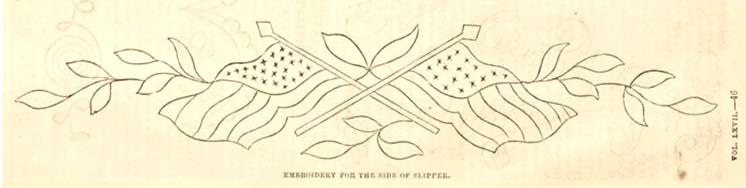
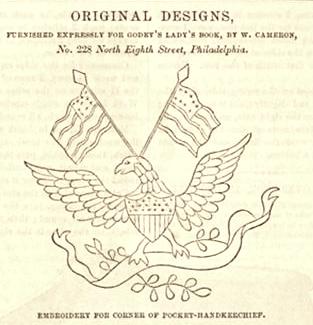
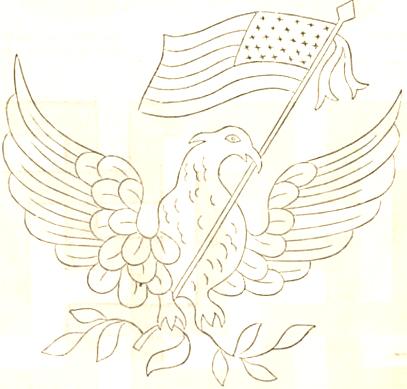
I know several groups are looking at depicting displays of patriotism this season be it individually or an organized festivity. This trio of images comes from Godey’s 1863.

It seems getting time to take measurements from my husband when we have dead opposite schedules is nearly impossible. The hour I see him each night is just enough for him to eat and get ready; not enough to have him stand still for the measuring tape.
So, alas, a delay in sewing for the Netherfield Ball. I am determined I to work on his clothing next rather than dive into my dress. This is because I’m worried I’ll have my clothes done and his not started. Not good. I am also determined with the upcoming week break from school to get his measurements. Then I will get them on to paper. (I also have to get my giant roll of newsprint out of mom’s storage.)
In the meantime, I am happily enjoying making straw bonnets. I have a lovely 50s bonnet I am making for a west coast friend. I love the shape of 50s bonnets. The straw lines up so well, creating great lines along the top of the crown and around the brim. (I am such a millinery nerd.) I’ve also been toying with an 80’s shape. I’ll have a blocking/sizing night soon. I love that part. There are several shapes calling to me right now.
This passage from Twelve Letters to a Young Milliner says a good deal about the mindset of women in terms of fashion and shopping. The passage comes from an 1883 advice manual for new milliners set in the form of letters.
“With this general idea of the quality of your stock the next question that will confront you will be this, “Where shall I buy?” If it were a stock of soap or of sugar, of boots of of bedsteads, the place they came from would be of little consequence. If the soap took out the dirt, the sugar sweetened the tea, the books kept out the water, and the bedsteads did not fall to pieces, it would matter but little to the customer whether they came originally from New York or from New Orleans, from Boston of from Buffalo; but when it comes to articles of wearing apparel into whos manufacture taste and fashion enter, the customer does wich to know wheterh they are bough in th ewoods or in the center of civiliazation. In articles of Millinery, in which fashion is so large an element, it is of the highest importance that they come from the center of fashion. Present to your customers two Hats, both of the same style and quality; mark the one, New York; the other, Smithville, which will be sold first? There is but one answer to the question. Even the woman that buys a Hat but once in five years, if one ther be, will choose the Hat marked New York. Now, you buy your goods to sell; therefore, buy goods that will sell. You have neither the time nor the money, nor is it your duty to teach a benighted generation that Smitheville goods are superior or equal to New York goods. A Milliner’s life is too short for any such Quitotic enterprise. This prejudice is favore of New York Millinery may be without foundation, may be unfair, but it exists; and a beginner in the trade, if she desires success, must yeild to that which is useless to resist. If it becomes noised abroad, in the beginning of your business career, that your goods are out of date, that they are old style, in a word unfashionable, you may as well dispose of your stock at acution and go into the book-peddling business. Let your neighbors see that your boxes and bundles have the New York mark upont them and your reputation for being in the height of fashion will be estableished. That such reputation is neede for success, you will not deny.”
The same guide continues… A millinery saleswoman – “She will know the names of the braids used in Hats where and how they are made. She will inform herself about the reputation for taste acquired by different manufacturers and wholesale dealers. Her knowledge of artificial flowers, the materials used, mode of manufacture, will be as extensive as her reading can make it. It is said that the female nature has a large share of curiosity in its make-up. Some customers desire to know all these things. If they find your assistant able to give them this information in a pleasant and an agreeable manner they feel sure that you understand the business and that what you say is so and not guessed at.
Again, this knowledge of the goods enables the assistant to set forth their advantages in a stronger manner than she would otherwsie be able to do. This inspires confidence in the buyer, and the occasional buyer soon becomes a regular customer through the influence of your intelligent assistant.
Today we have a longer story looking at travel: “Railway Photographs” published in The Continental Monthly, 1862.
Click the title for the PDF, Please.
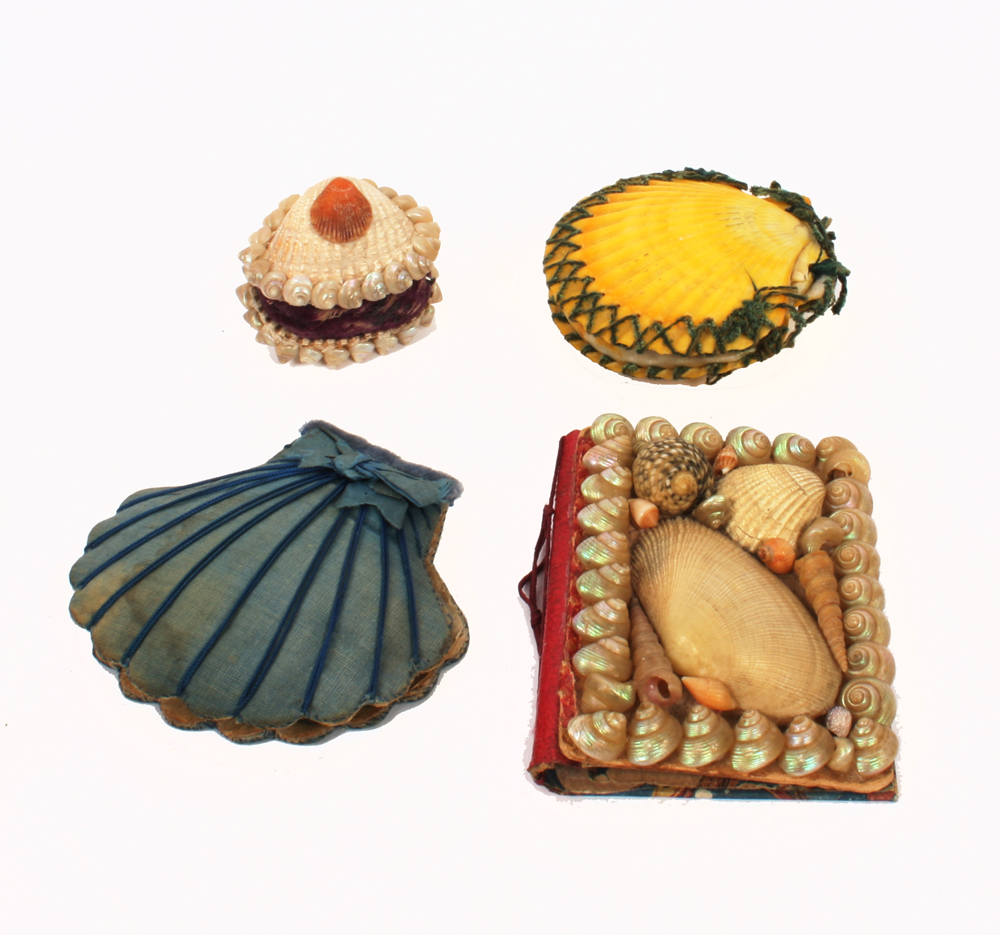
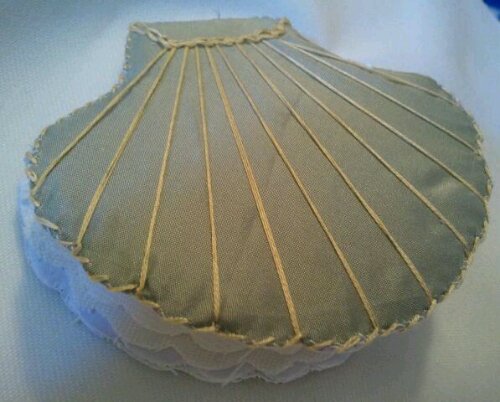
In celebration of Spring, I have a new, Free, template for is post is for all my Fanciful Utility readers out there. Seashells were a very popular shape for needle-books and pin cushions through the nineteenth century. This sweet, silk seashell is based on a beautiful original needle-book done in blues. The original shell was constructed in a now faded dark blue silk, trimmed in a deep blue embriodery and similarly colored ribbon.
My interpretation uses a soft, pale green that remindes me of the seaside and a spring-like gold for the embroidery. I opted for a chain stitch at the top to tie it together until I find the perfect color silk ribbon.
With your copy of Fanciful Utility in hand, you can make this lovely needle-book using this Free Template (in PDF). 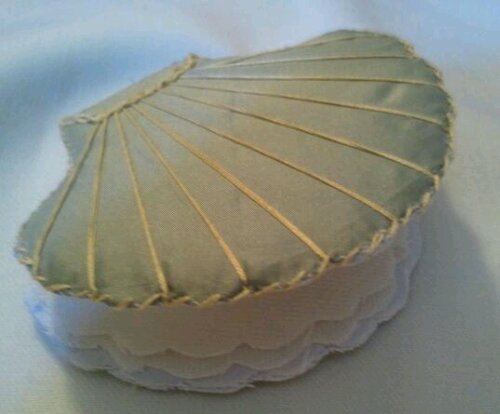
Don’t own Fanciful Utility: Victorian Sewing Cases and Needle-Books yet? Order yours by visiting ESC Publishing.
I had picked this sterioview up last summer with the thought it would find its way into my new shawl book. Since then, I’ve found a far, far better image, bumbing this from the publication list. This means I can share it here and we can play a game of “what do you see”
Take a look at the image and comment below on what you see.
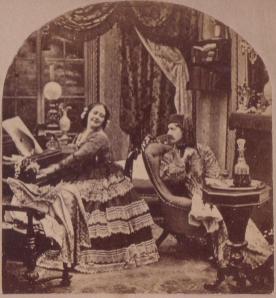
Of course, I see the shawl draped on the arm of the chair to our left. This looks to have a wide border, possibly on opposite ends.
I finished my shift/chemise, stays and bodiced petticoat last night. The last button-hole was finished as bedtime settled in. As soon as I was home from work today, I was able to try everything on. 🙂 This evening is test night to make sure everything fits and is comfortable. I really wanted to share photos. But, as soon as I got my chemise and stays on, my phone’s battery died. So, a summary instead. Everything is quite comfortable. There isn’t much I can say about the chemise, other than it draws up quite nicely. The stays are a comfort level that may just threaten my mid-century clothes to banishment. Really. This one is that comfortable even with the “shelf.” I figure I’m giving them quite the wearing test as I’m curled up on the couch. It is so nice to have this support without having a large underwire digging into my side. I don’t have as much “separate” as I know is ideal. I’ll be more able to achieve that with a transitional pair for my next set. Yes, I’ve already decided there will be more of this clothing. (see below) Now, the bodiced petti…. can we say “C.O.M.F.Y.”? I did a gored skirt with a 84″ hem. LOVE it. This skirt is so very comfortable.
Adjustments:
– I still need to solve the lacing problem. I couldn’t get the 1/4″ round cord through. Right now I have crochet cotton laced in with a bodkin. Either, I need to find a strong, narrow lace I can use with the bodkin or I need to make the holes bigger. – The waist of the bodiced petti needs to come in about an inch, maybe two, to fit more snuggly. I don’t think it should be loose. I need to decide between a drawstring, darts in the bodice front or taking it out of the sides. So, the question would be – Did they use darts?Next steps:
– Decide between drafting and draping my bodice. With the duct tape dummy oops, this is a looming decision. – Drape or draft a toile of my bodice. – Get Dan’s measurements and do some rough sketches of his clothing.You know how I mentioned more clothes above? Well, I keep dreaming up dress ideas for the uber-awesome white and green sheer a truely lovely someone sent me. I also started thinking up clothes for Lily.
Ooops. This wasn’t supposed to post until this weekend. But given the weather I am about to venture out into, I’ll leave it.
From Eliza Leslie’s House Book, (Philadelphia, 1844)
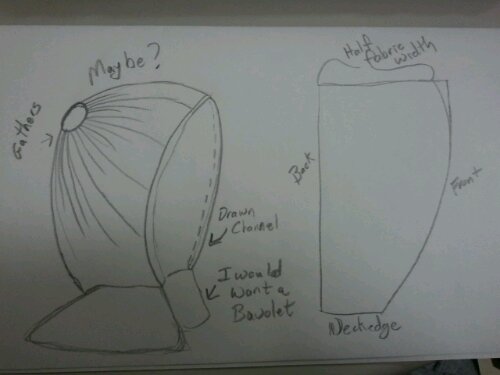
A BONNET-COVER – When travelling in dry weather on a road that is likely to be dusty, you may effectually protect your bonnet from injury, by taking with you a cover for it. To make this cover, get a yard of white glazed cambric muslin, and cut it into the form of a large straight hood; gathering it close at the back of the head upon a small circular piece about the size of a half-dollar. Slope it away at the sides of the neck, and put a case with a drawing-string of fine tape along the edges of the front: the string to tie at the side.
If you commence your journey by water, you can roll up this bonnet-cover, and keep it in your reticule while in the steam-boat; putting it over your bonnet, and drawing round your face, just before you get into the vehicle in which you are to ride. You will find when you take it off, that it has effectually screen your bonnet and its ribbons from the dust and sun. It must, of course, be made very large and loose, that it may not flatten or discompose the trimming.
We have seen bonnet-covers of green silk; but, if it chances to get wet, the green dye will run down and stain the bonnet. This same thing may happen, if the cover is of coloured muslin. White is undoubtedly the best for this purpose; and when soiled, it can be easily washed.
After being out in the damp, do not immediately put away your bonnet; but wipe the front and crown with a clean handkerchief, and put some wadding or tissue paper into the bows, to keep them from losing their shape: taking it out, however, as soon as the ribbon is perfectly dry. Also, never put away a shawl or cloak while it is in the least damp. Do not always fold a shawl on the same creases, lest it wear out along the wire edges of the folds. When you take off a veil, stretch it evenly on the bed, and let it remain there an hour or two, in case there should be any dampness about it.
When ever the atmosphere is cloudy or humid, it is well to take the feathers out of your bonnet before you go out, lest they loose their curl, or their whiteness.
EDIT TO ADD: Deanna asked for a sketch of my interpretation. This is what I picture from Eliza Leslie’s description. I would want a bavolet/curtain to cover that part of my bonnet as well. I would think the gathers of the light weight fabric allow for the least amount of weight on the bonnet decorations underneith. I’m not sure how well this bonnet cover would do in any amount of wind or moisture. Honestly, I am still bothered by the recommendations of traveling caps for men but bonnet covers for women. I’ve been looking at paintings of travel scenes trying to determine what each woman has on her head. A traveling hood seems far, far more practical then a delicate fashion bonnet.
Okay, this post is less about what I’m up to and more about what Mom and Lily are up to. This week their kitchen will be filled with maple cooking as they get their entries ready for the “Cooking With Maple” Contest at the Genesee Country Village.

Some of last year’s Maple baked goods recipies
This contest is part of their Maple Fest taking place last weekend and this weekend. Guest can walk through the woods to see the tapped maple tree, visit maple camp where they will learn about boiling down turning the maple trees’ sap into syrup and sugar as well as visit with village craftsman to see how the tools, buckets, troughs are made. There will be tastings too.
I know mom has something interesting she’ll be entering as she bought a most interesting ingredient yesterday. Of course, both mom’s and Lily’s entries are a secret until after the contest.
EDIT : Lily won first place! Check out GCV’s Blog for photos and the winners.





 If I Had My Own Blue Box: