Revisiting – Why This is Good

Some time has passed since this post. I know how useful some people found it. So, I thought it would be a good time to revisit it.

“Why This is Good…. Looking at Clothing”

There are two files – A smaller printable version and a larger Power Point. Each are attached in as PDFs for easy viewing. (Though it looks like the notes for the PP are not visible.)

FB_IMG_1502391959068

Why This is Good Impression Visual Extended Power Point 

You will notice in the smaller file there are specific types of impressions I want to add when I have the right images.

Why This is a Good Impression – Printable Version


If you submitted an image you do not see, this doesn’t necessarily mean it wasn’t up to par. More likely I either haven’t done those slides yet or it duplicates something I’ve already covered. It does seem the more I cover, the more I still need to cover.

If you are in an image you did not submit, feel flattered because someone thought you had a really great impression. If you want it removed, let me know.

Published in: on July 22, 2014 at 1:00 pm  Leave a Comment  

New Millinery Folio

This is a little better than the version a couple weeks ago.

PDF of Anna's Millinery Work

Published in: on July 22, 2014 at 8:00 am  Leave a Comment  
Tags:

Yellow Silk Soft Crown Bonnet

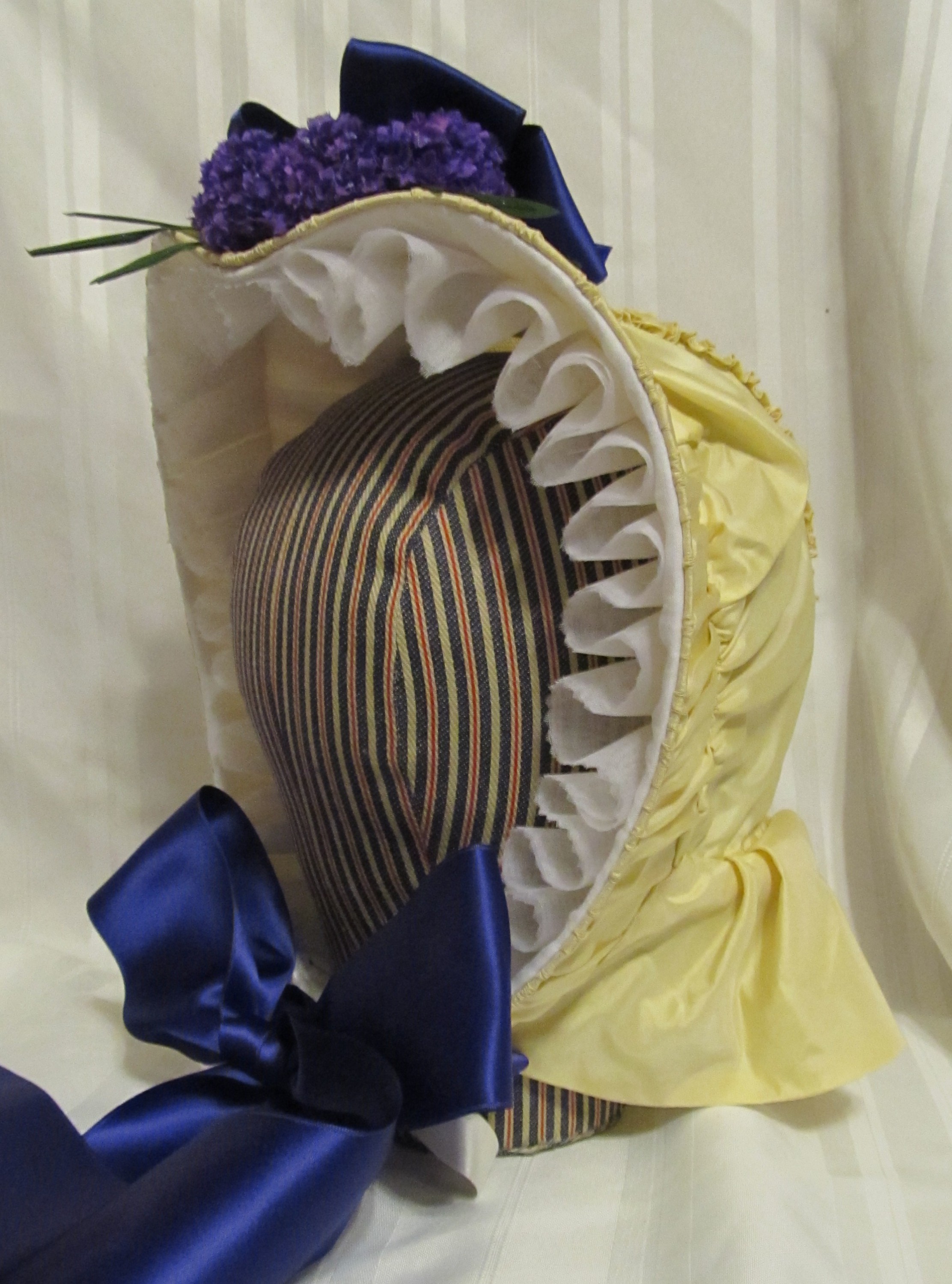
???????????????????????????????When this silk arrived, it really wanted to be made up … It didn’t want to wait. So, I obliged.  This pale shade of yellow reminds me of the soft yellow of some blossoms, very light and delicate. ???????????????????????????????The brim is drawn on cane over buckram in the fashionable Marie Stuart shape, while the crown is soft draped over net with the center drawn on canes vertically. Inside the brim is a full organza frill that can be fluffed out as desired.  The decorative ties are wide regal blue satin while the functional ties are a white silk taffeta. ??????????????????????????????? Atop the brim, in the Marie Stuart dip is a cluster of purple flowers and a bow of the same ribbon as the ties, just in a narrower width. ??????????????????????????????? This bonnet had a new home even before it was finished. I understand it will meet the world at a special occasion.

Published in: on July 21, 2014 at 5:45 pm  Leave a Comment  
Tags:

GCV’s Civil War Event – Late War Millinery

IMG_4587This was my second year in the Dressmaker’s Shop at the Genesee Country Village for their Civil War Encampment. As you can see Saturday morning was pleasant and sunny. You can also see the soldiers struck camp right up to my back door. While I was thinking this might make for some fun interaction, after-all I was prepared to say all my firewood was stollen as well as my wooden head forms. But, in the end, they kept to themselves. Well, except for eating all the beautiful black raspberries I was eyeing the night before.

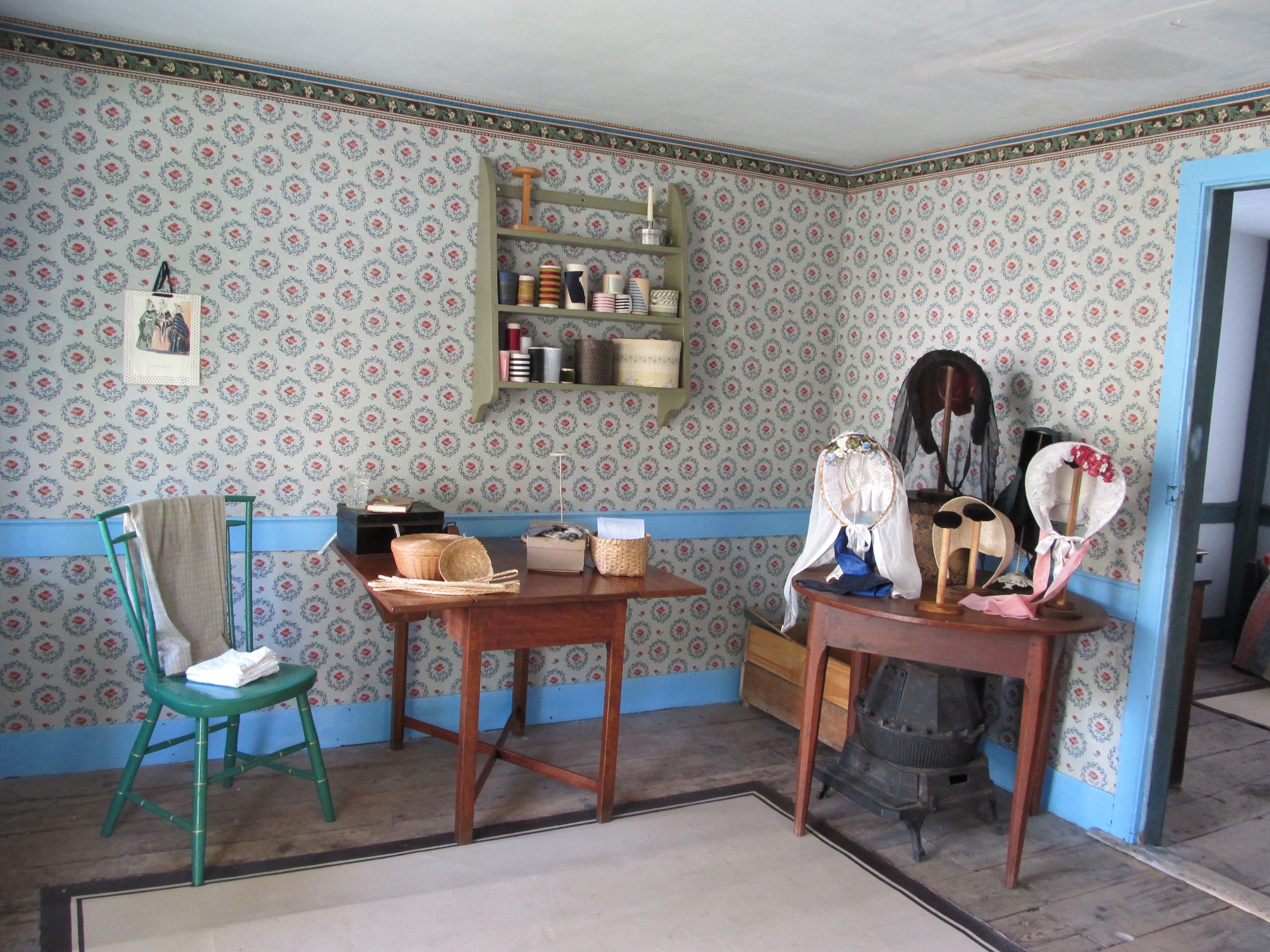
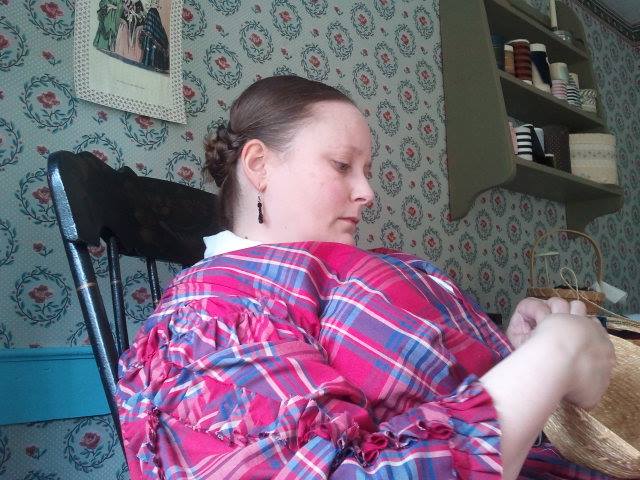
Rather than interpreting the pretty pink building as a dressmaker’s shop, I dressed it as a Millinery. The blue and rose print interior makes for such a pleasant place to work in. You can see the working table and display table. (Yes, we did put it right over the stove. No firewood, no need for a stove.)


IMG_4577

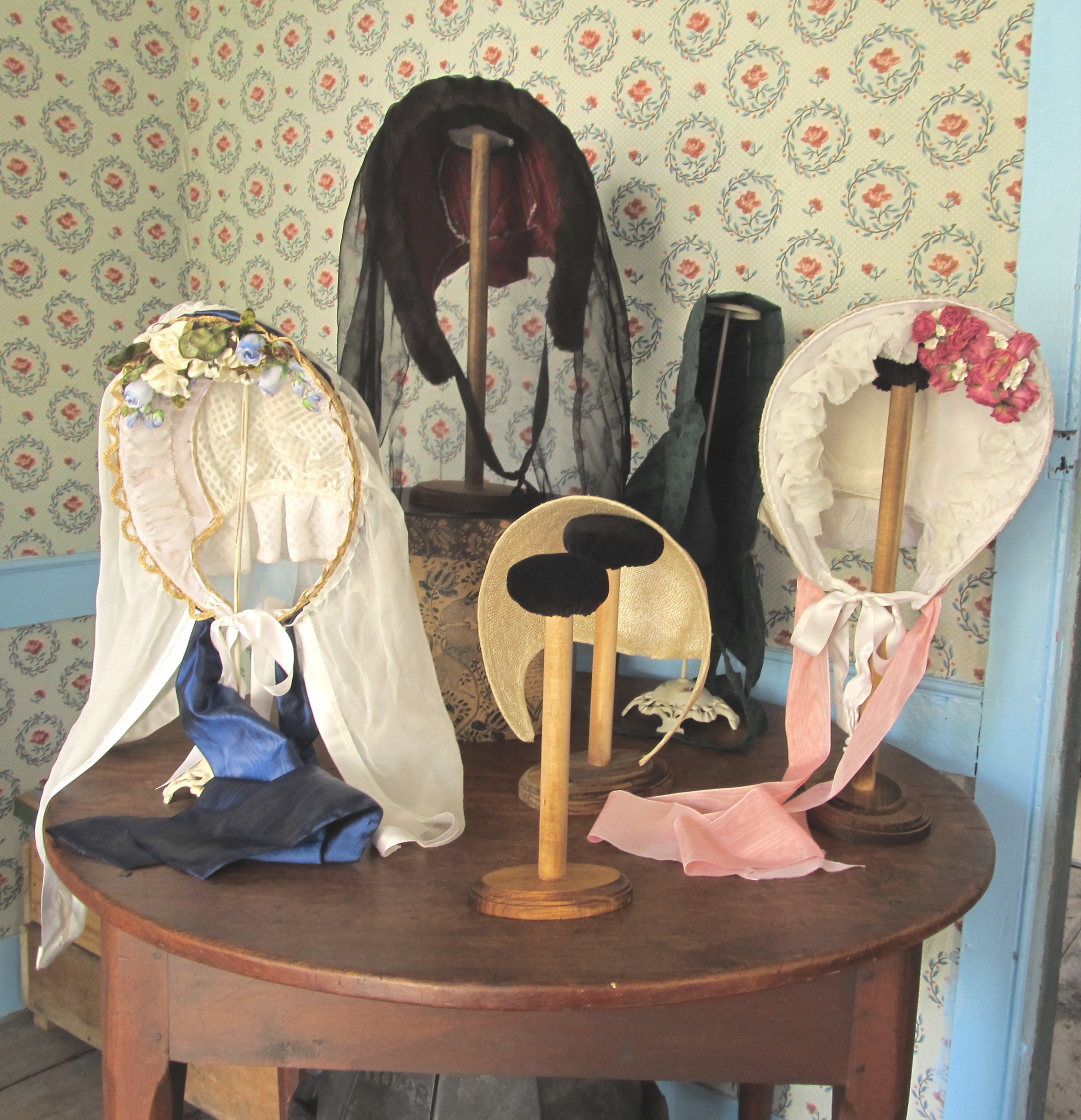
I wanted to bring a basic sampling of bonnets to show visitors. As I was working on a straw plait form, I would compare that to the woven straw in the middle, Vivian Murphy’s work. Then I would discuss the two finished fashion bonnets, left and right. We would also talk about the winter bonnet in the back and the sun bonnet just below. Many people asked about the veils. This was a good teaching point to explain the differences in the mourning veils and every day veils. (An interesting set-up/interpretation note – There was notably more touching this year than with with last year’s set up. This is good to know for determining what display pieces to bring and place where. The pink and grey was the most touched followed by Lily’s green when it sat on the empty stand.) Oh. Those wooden stands are the ones I made on Wed/Thursday last week. I’m rather pleased.

???????????????????????????????

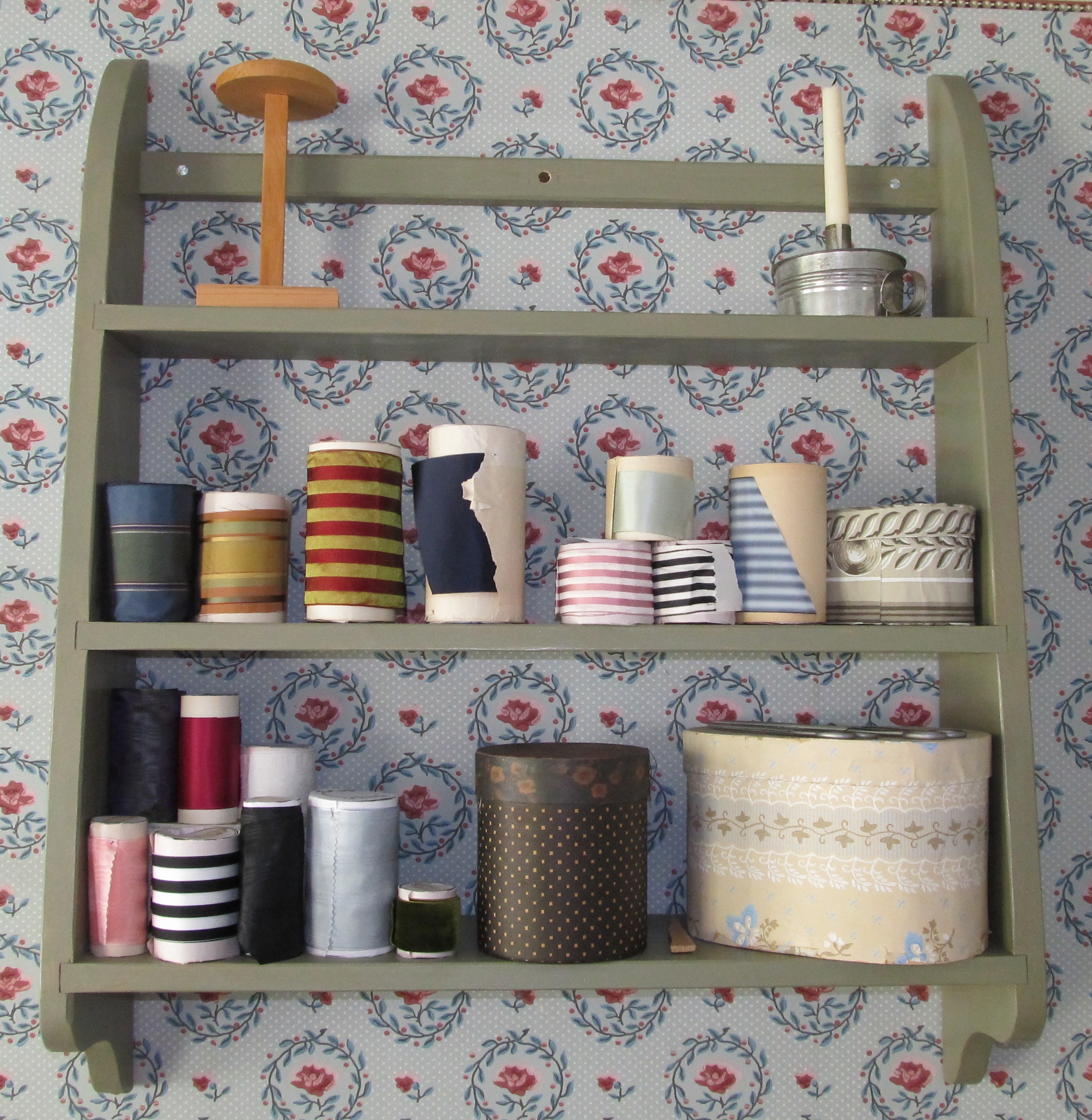
Here are the faux spools of ribbon I have been working on. I was excited to see them on the shelf. They aren’t quiet where I want them look-wise. I need to come up with a better way of doing the ends with the labels. That is why they are all up on end. Each roll is faked by using only a short piece of ribbon, usually 5-6″ but as short as a 3″ trapezoid, around a roll of original or mocked paper. I’m also planning to take my original ribbons, reproduced on white silk ribbon via the printer and make faux rolls out of those. In the works as well are sample cards. I started a set, but was not happy with the look… at all. So, back to the drawing board on those.
Faux Rolls of Ribbon

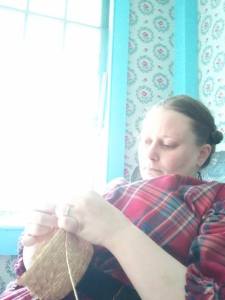
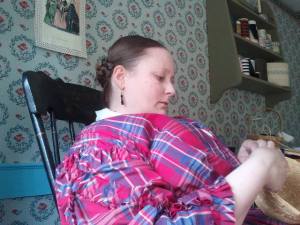
This was the “home” area for the weekend. The little day bed is napping suitable. The large cabinet is truly ideal. It reminds me a lot of the cabinet Dad had stripped for me when I was little. Those cabinets hold everything. It made storing food, supplies, etc very easy. It was okay if visitors opened the top because everything was period containers. We really didn’t need to have food out on the table at all. It did help as a reminder to actually eat though. IMG_4581I am utterly lacking in actual impression photos, worse than usual. All I have of myself are these “selfies” I played around with while it was raining in the morning. The bonnet is a coarse straw, meant to represent those made cheaply, worn by poorer women or those institutionalized. This can also be the “last remnants” straw of late war.

10489660_10153049758302846_2229377948184184845_n10540635_10153049758642846_4402057427875164636_n

A Year in Millinery Fashion – 1864

Fig. 5 is an elegant bonnet of white silk edged with blue silk, and having a curtain and strings of the same. At the top, rather towards the left side, is a cockade of blue satin, with a mother of pearl centre and a few short white feathers. Blonde cap, having at the top a few bows of blue ribbon, with a rose and some buds. (Godey’s, July, 1864)

2

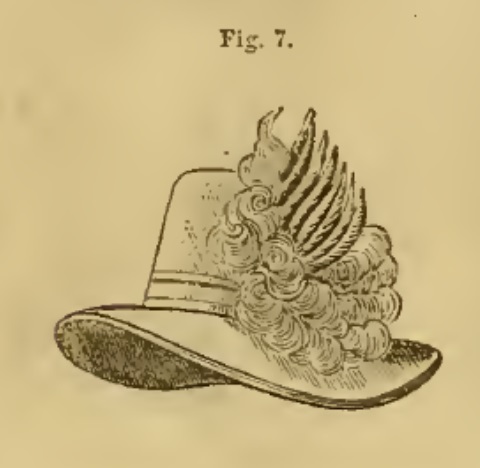
 Fig. 7 is a Mousquetaire hat drab straw, trimmed by two narrow bands of scarlet velvet, and having in front a plume of black and red feathers, and one large ostrich feather. (Godey’s, July, 1864)

1

Readings for Rural Life

From Moore’s Rural New-Yorker in Rochester, NY

July 16th, 1864

Woman’s Work Enlarged by the War.

The social condition of woman is being influenced by our civil, war, to a larger extent than is generally supposed. Silently and imperceptibly, and also rapidly and surely, a revolution is being effected which seems destined to accomplish the work of years in a few months, and produce an important and lasting change in all the relations of society. The withdrawal during the last three years of a million and a half of men from industrial pursuits, has produced a deficiency in the labor market which for some time past, has been opened to them which have been hitherto closed. The change is also hastened by the various trades combinations and the increase of wages, which makes it the interest of employers to seek other sources to supply the demand for laborers.


Published in: on July 16, 2014 at 6:00 am  Leave a Comment  
Tags:

A Year in Millinery Fashion – 1864

Buff and salmon are very much used for the trimming of both bonnets and hats. On many of the bonnets a single flower is arranged on the outside. For instance, a water-lily, the leaves glistening with dew-drops. Or the bright tinted tulip. Of the latter flower we have seen many elegant specimens. Feathery, silvery, pearl, and silk grasses enter largely into the composition of moutures for bonents and headdresses. Upon examining the elegant, wavering grasses, we found the hundreds of little spikelets to be formed of mother-of-pearl and steel; but so tiny and delicate, that the least breath would set them in motion; and the various lights thrown on them caused them to glitter almost like jewels.

Large, fancy wheat ears in salmon or buff crepe, with long silky beards, form a very stylish trimming for a black horse-hair bonnet.

Much artistic skill is displayed in the arrangement of headdresses, though there is but little change in the style; nor will there be, until there is a decided change in the arrangement of the hair.

Sprays of pink coral, scarcely to be detected from the real article, arranged with grasses and shells, form a charming coiffure. Marie Antoinette tufts of the rarest flowers, and of the most graceful coloring, are to be found at Mme. Tilman’s. Of the tufts and half wreaths of which we have spoken in a previous article, we shall shortly give illustrations. Many other beautiful fantasies we could mention; but we must also speak of children’s hats.

For information we visited Mr. Genin’s establishment, 513 Broadway, New York. Among the newest and most becoming styles, are Arion, Casquet, and Armenia. The former has the crown tapering in front, and rounding at the back. The brim is narrow in front, runs to a point behind, and the edges are curled. The Casquet resembles the Arion, only that the brim is narrower and not curled. The Armenia has a high straight crown, narrow brim, which forms a curve both front and back, the sides being perfectly straight. In some of the models, the brim at the side consists merely of a tiny of velvet.

Besides the above mentioned styles there are many others; but the three we have named seem to be the favorites, and are to be had in all sizes from ladies to infants.

Some of the dress hats have a brim entirely covered with velvet. The principal timmings for ladies and misses are feathers and velvet. All kinds of feathers are brought to requisition – peacock’s, heron, king fisher’s, cock’s, and even eagle plumes.

For children, silk flowers, shells, wheat ears, and ribbons, are the accepted trimmings. Straw ribbons and tassels arranged with high colored velvets, are very dressy.

For school hats, the different shades of gray or cuir, and the mixed straws, are the most suitable both for misses and boys. The turban and Scotch styles, though old, are very much adopted, and with the mask veil and the hair arranged en Grecque, present quite a jaunty and pretty appearance. They are suitable, however, only for misses.

Where ribbon is used, it generally terminates in long streamers at the back. Frequently, however, narrow ribbon velvet is laid in deep points round the crown fastening underneath, a tuft of feathers or flowers in front.

A drawn rosette of salmon-colored crepe lisse, with a scarf of the same, edged with a delicate straw fringe, forms a very light and pretty trimming for a hat.

For little boys, there are numerous; some have a round crown, with rolled brim. These are generally of a plain colored straw, trimmed with a band of blue or brown ribbon, fastened at the side with a pearl clasp. More fanciful shapes are trimmed with an aigrette, consisting of a small rosette of peacock’s feathers, from which spring three straight feathers or a wing. The sailor-shaped hat is also fashionable.

Infants’ hats are generally of white straw, bound with velvet, either a bright blue, lilac, or cherry. Narrow bands of the same encircle the crown, and, in front, a short white plume is caught with a bow of white ribbon. For a boy the plume passes over the crown, for a girl it falls at the side. (Godey’s, July, 1864)

Testing Shutterfly’s Photo Folios

Rather than creating each volume of folio twice, once for on the blog and once to be printed, I am trying to see if I can link the Shutterfly versions. I want it to be smooth and pretty, no hoops for people to jump through.

Millinery Folio Edition 1 (2013-1014)

Click here to view this photo book larger

You’ll love award-winning Shutterfly photo books. Start your own today.

Millinery Folio Edition 2 (2014)

Click here to view this photo book larger

Shutterfly offers exclusive layouts and designs so you can make your book just the way you want.
EDIT: Okay, so not anywhere near what I wanted. I wanted the album to be an image on the blog to click on with the whole thing popping up, easy to see. Scrapping this idea.
Published in: on July 13, 2014 at 8:31 pm  Leave a Comment  

A Year in Millinery Fashion – 1864

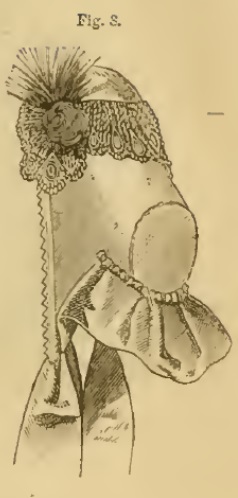
Fig. 3 is a bonnet of white crape, with curtain and strings of green silk. At the top of front is an ornament, composed of a piece of green silk edged with broad black lace, and having on the left side a tuft of black feathers. (Godey’s, July, 1864)

                         1

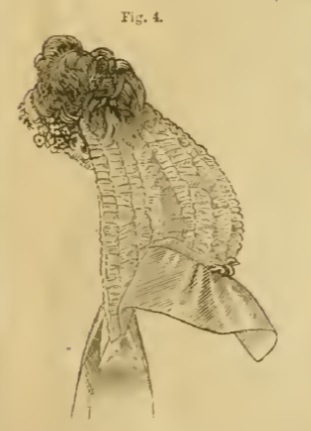
Fig. 4 is a bonnet composed entirely of fullings of white tulle. The curtain and strings are of violet silk. At the top of front is a group of violet feathers, and in the cap are some bows of violet ribbon and a few violet flowers. (Godey’s, July, 1864)

2

Hats have high crowns, and the feathers are mostly arranged in tufts in front instead of round the border or brim; peacock’s, heron’s, and kingfisher’s, indeed, every variety of feather, is brought into requisition for these hats; but in Paris a decided preference is shown for the eagle’s plume for this purpose. (Peterson’s, July 1864)

The mention of the eagle’s plume makes me wonder how many of the fashionable millinery feathers came from now endangered birds.

Readings for Rural Life

From Moore’s Rural New-Yorker in Rochester, NY

July 2nd, 1864

Advantages of Crying

A French physician is out in a long dissertation on the advantages of groaning and crying in general, and especially during surgical operations. He contends that groaning and crying are the two grand operations by which nature allays anguish; that those patients who give way to their natural feelings more speedily recover from accidents and operations than those who suppose it unworthy a man to betray such symptoms of cowardice as either to groan or to cry. He tells a man who reduced his pulse from one hundred and twenty-six to sixty in the course of two hours, by giving full vent to his emotions. If people are at all unhappy about anything, let them go into their rooms and comfort themselves with a loud boohoo, and they will feel a hundred per cent better afterwards.

In accordance with the above, the crying of children should not be too greatly discouraged. If it is systematically repressed, the result may be St. Vitae’s dance, epileptic fits, or some other disease of the nervous system. What is natural is nearly always useful, and nothing can be more natural than the crying of children when any thing occurs to them either physical or mental pain.

Probably most persons have felt the effect of tears in relieving great sorrow. It is even curious how the feelings are allayed by their free indulgence in groans and sighs. Then let parents and friends show more indulgence to noisy bursts of grief, on the part of children as well as older persons, and regard the eyes and the mouth as the safety-valves through which nature discharges her surplus steam.


Published in: on July 2, 2014 at 6:06 am  Leave a Comment  
Tags: