A few years ago we looked at how some original women wore their bonnets perched on the backs of their heads as well as how we can also do so. If you missed it, the post was called Got Perch?
This was only one of several ways women wore their bonnets. Today, I would like to look further at how mid-century women wore their bonnets. Let us start with more examples of the bonnet being worn behind the mid-point of the head.
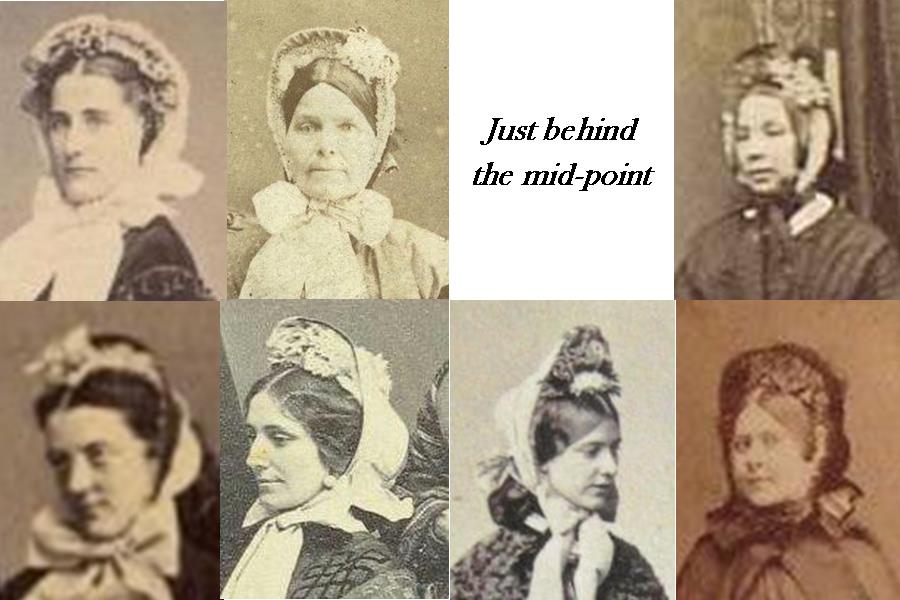 You will notice some variation in how far back the bonnet is worn. The two women on the lower left appear to have their bonnet furthest back among the group. These two also happen to have their bonnets angled more than the others. From the views/positions we have, the third woman from the left on the bottom row appears to have a nearly vertical position to the brim and tip. We can not say for certain with the other women; though I suspect the top left may also be nearly vertical. We can also see that most of these women have their flowers reaching further forward than the brim edge of the bonnet. The position of these flowers may help hold the bonnet in place. In the lower right, the flowers can be seen cupping the top of her head. Take a particularly close look at the woman on the lower left. There is a piece photographing white sitting below the flowers/decoration. This may or may not be a stay.
This next group of women are wearing their bonnets at or just forward of their mid-point.

We see greater variety in the angle of which these bonnets are worn, seeing them worn nearly vertical, angled slightly forward and angled slightly backward. The bottom right and bottom left images show the further forward reach of the spoon bonnet while displaying noticeable difference in the depth, angle and shaping of the crown and tip. In the top left and top right images, we can see how the frill aids in holding the bonnet on. Again, the flowers are aiding in securing the bonnet to the head. In the bottom row, third from the left, you can see the woman’s flowers reaching down over the hair line. (The lower right image could be considered as wearing her bonnet quite forward.)
In this next group, we see the bonnet worn quite forward of the mid-point.

Many will notice these women each look more mature. I do not know if this is a coincidence or if there is truly a connection between age and mode yet. I will look further into this. While these bonnets are worn further forward and a couple are rounder, the fashionable spoon shape is present. The bonnet with the daisies, second on the bottom row, demonstrates well how the flowers can hug the top of the head. In several cases, the flowers sit forward enough to reach to or even beyond the hair line. If there is a connection between age and this mode of wearing, there could be further speculation that this positioning of flowers could conceal a thinning part.
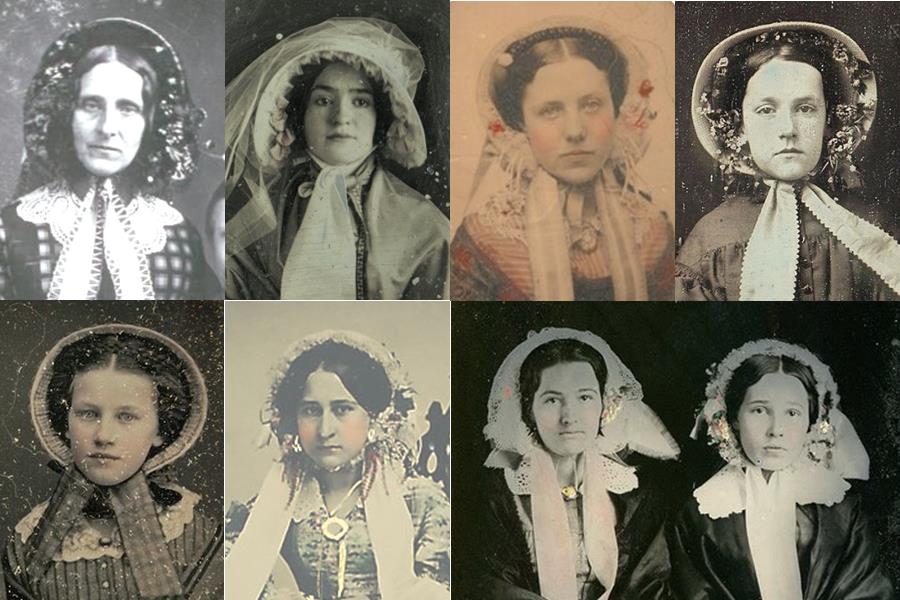
The following group was collected as I was looking at untied or partially tied bonnets. These are late 1840s through early 1850s examples. Each either has the ribbons simply looped over each other without a bow or completely untied. Many, if not most, of the women above would have worn their bonnets in this style ten to twenty years previous.




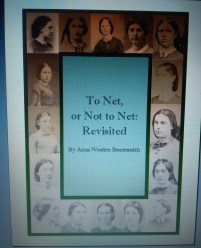
 I’ve spent most of this month wrapped up in snuggly warm blankets and plucking away at my laptop. I’ve been editing and re-editing To Net or Not to Net: Revisited. As I started the first round of editing the re-write, I decided I just wasn’t going to be happy without the illustrations from fashion columns. To appease myself about image rights, I tracked down original Godey’s Lady’s Book for 1860, 1861, 1862, 1863, and 1864. And bought them. I sorta oopsed on 1865 because I was distracted editing photos. I am now discovering just how long media mail can take.
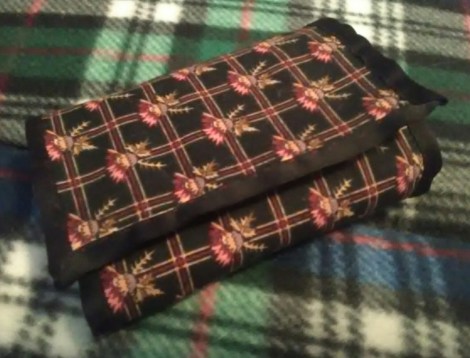
 hopefully keep the sewing box a little more manageable. I do love these rolled cases for keeping various things. I can’t tell you how often the one in my desk draw at work has been brought out as the keeper of needful things. I should do a write up on that version, for just that use.
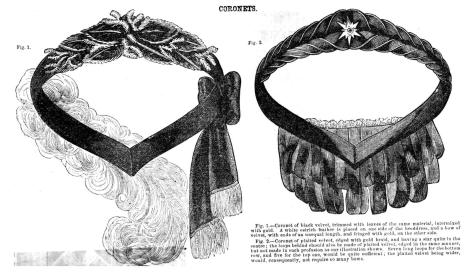
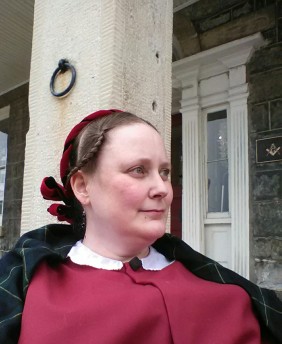
 I’ve made a few bandeau headdresses. I enjoy this light sewing. Light in that it is easy on the hands and easy on the mess. Velvet ribbon takes up far less space and ‘stuff’ than straw plait.
 I made one small doll hat from a short bit of rosy plait that came my way. It did not please me the way it usually does in the midst of winter. Don’t despair. Eventually, the straw will come out to play. Eventually.
 I almost forgot one thing. When it really, really cold earlier this month, I finally did something I’ve been joking about for a while. I made up one of my hood patterns with fleece. Yup. Let me tell you how soft and warm this thing is.


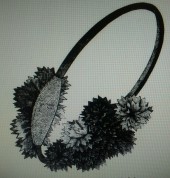 This first example, from 1862 Godey’s, show a simple band with two millinette pads/ovals to which flowers are stitched. “This coiffure is very simple, and generally becoming. The rosettes are formed of pieces of bias silk about an inch and a half in width; the edges are cut out in point, and the silk box plaited and formed into a rosette, then sewed on to stiff net; the band can be formed into a rosette, then sewed on to stiff net; the band can be of velvet of silk, and a bow of ribbon to match the silk is often placed on one side of the band. One of more colors can be used; rose sublime and black make a good contrast.” This particular headdress is just calling to be made with the aide of one of my pinking machines.
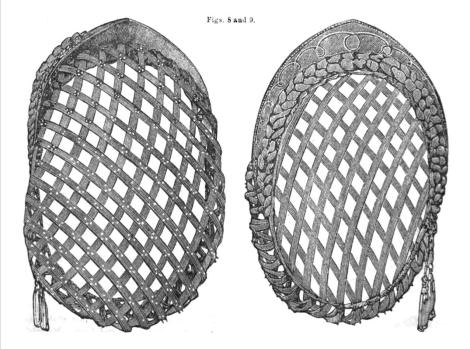
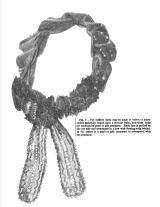 This “Coiffure Zelia” head-dress loops heavy ribbon or velvet around the wired base, a “circular frame.” The heavy ribbon allows for fuller body. This season, I am looking forward to seeing pearls paired with velvet. I may even add turquoise as one description calls for.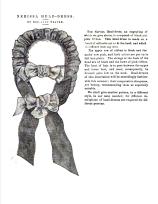













 If I Had My Own Blue Box: