I’ve been watching the various videos of Irving Finkel, a curator at the British Museum, because he is delightful to listen to. His programs make for excellent background sanity keeping. Today, I learned about his Great Diary Project. Needless to say, I want to jump on a plane and go spend the next year reading diaries. Check out the Great Diary Project.

Here is the video that popped up in the feed, catching my attention: https://youtu.be/X0hi2Q3TAK8

Published in: on February 25, 2021 at 8:34 am  Comments (3)  

Whimsy Wednesday: Woven Ribbon Pin Cushion Day2

The first 5 or so minutes of today’s video is my car drama. Then, I share the next steps for our woven ribbon pin cushions. There was a video oops as my dinner alarm went off. Oh, this was recorded Tuesday.

Please take a moment to read my thoughts on One Year Later.

Published in: on February 24, 2021 at 1:04 am  Leave a Comment  

Millinery Monday

To wrap up this stretch of Millinery Monday looking at winter hoods, I thought it would be fun to look back at the pieces I unboxed this past year or so. Starting next week, Millinery Monday will be looking forward to spring.

I opened several additions to my winter bonnet and hood collection over the past year. While it is nice to have pristine or exceptional examples, I prefer pieces that allow me to explore how they were made, the details of construction. Some pieces show piecing or little make-dos. Others show wear patterns. Fractured silk can allow a look inside. While some are fairly clear puzzle pieces falling into place, others are little oddities, offering more questions than answers…..

Plaid silk wadded

Lots tbd..

Black silk

Plaid wool hood

Doll size wadded silk hood

Quilted silk hood/bonnet

From the Winter Millinery series I started but got distracted from:

Black silk quilked hood

Published in: on February 22, 2021 at 1:05 am  Leave a Comment  

Whimsy Wednesday: Woven Pin Cushion

Today we start making a woven pin cushion. I also show you Clara’s bird and my birthday gift to myself.

Materials for woven pin cushion:

  • 4″×4″ lining fabric – muslin, scrap print
  • 2 3″×4″ backing fabrics – silk, pretty print
  • Ribbon 1/4″ to 3/4″ would be best. The narrower the ribbon, the more you will need. For 1/2″ ribbon, 1 yard of 2 different colors will work.
  • Wadding/batting or cut up cabbage
  • Needle and thread

In the next video, we will tack down the loose ends and attach the backing.

Published in: on February 17, 2021 at 10:28 am  Leave a Comment  

Millinery Monday

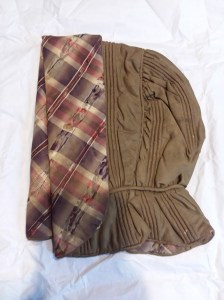
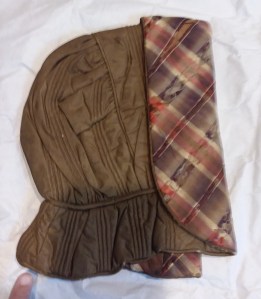
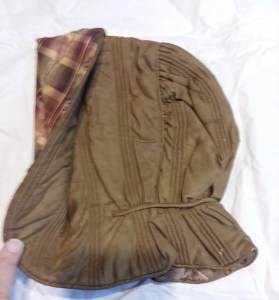
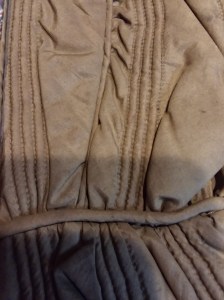
Today’s winter hood is a child’s size, ca 1840s-1880s. The exterior is a solid brown wool. The exterior is quilted with sets of three narrow rows. These narrow channels may have cording in them, tbd. The seam between the crown and brim is piped. The seam connecting the crown and bavolet may have the cord applied on top. I need to look closer. The brim folds back to show a plaid which is constructed from ribbon.

This may also be made from two pieces – a single brim and bavolet, with a crown piece. I need to look closer to see if I can find a seam connecting the bavolet to the brim, because I did not see one at first looks.

Notice there is no easily visable seam along the bavolet area. It may be skillfully hidden in the quilting. Or, there may not be one.

The interior is made with two solid fabrics, tbd. The whole of the brim and bavolet are lined with the pieced plaid silk ribbon.

I am pointing to the only seam along the bavolet I’ve found. This is nearly center back. (there is a bias piecing seam towards the front.)

Published in: on February 15, 2021 at 1:11 am  Leave a Comment  

Whimsy Wednesday: Pocket Challenge, De-stink, Doll

Today’s video is a little scattered with a scattering of tidbits.

Published in: on February 10, 2021 at 5:12 pm  Leave a Comment  

Pockets Challenge

This March, I challenge you to make a Pocket. Your pocket can be seperate or attached to any garment. It can be from any era, to meet the needs of your impression and region.

How to participate:

Join the Facebook Group: 2021 Pockets Challenge. There will be questions to answer so I know you are a real person.

We will begin discussion officially January 1st.

What to do:

Make a pocket and share you progress. Your pocket can be seperate or attached to a garment. It can be from any era and any region.

Share your progress. This can include: pattern, directions, or inspiration piece, your material choices, and steps as you sew.

Rules:

This is for fun. Each person will choose their own goals for this project. I ask that we support each other in those goals. Participants may choose to do any era, region, and size pocket. I also welcome those who wish to make doll scale.

Published in: on February 9, 2021 at 4:39 pm  Comments (3)  

Millinery Monday

Today’s piece is an adult size hood.  The exterior fashion fabric is a black taffeta with a satin weave dot. It was received with the brim folded back. Black lace is attached to the edge of the brim. I will examine this process closer. Notice how the pieces for this and its overall shape differ from the previous two, making it a winter hood as apposed to bonnet.

The exterior appears to be constructed of two pieces – a single brim, crown, and sides of the bavolet, with a trapazoidal piece for the back of the bavolet. I will look closer at this when I sit down with the piece. The back is gathered where the bavolet meets the crown.

Close-up of the fabric:

Close-up of the lace:

The interior uses a shot silk and a polished cotton. The silk has shaed of gold, green, and purple depending on how the light hits it and where the soiling is. The diamond quilting is only through the silk and batting. The rectangle placed on the lower part of the brim may be a patch as the opposite side has a different shaped piece of polished cotton.

Published in: on February 8, 2021 at 1:11 am  Comments (1)  

When Lunch is Dry…

There are times I wish my brain would simply see things for what they are and not a myriad of connections.

Today is one of those days. I have straw waiting to be sewn and later decorated. If I could just see the straw as straw, the ribbon as ribbon, the flowers as flowers, and feathers as feathers, things would be much simpler, much easier. But, no. When I am working with any of these millinery materials, my mind wanders, spinning around what each is, how it came to be, what it represents.

Straw, to me, is many things, so very many things. It is a way for women and children to make money for their families. It is a story of transition from cottage industry to factory. It is a winding of shape and movement. It is a beautiful golden plant that has an extra extraordinary glow when the sun is at just the right angle in the late summer. It is texture and smell and comfort. It is the earthly and ethereal plant engraved on my Grandpa’s coffin.

And, somehow, with all that, straw is the lightest of the materials that weigh on my mind at times.

Feathers, oh feathers, stunning combinations of air and light and color, that have a unique ability to defy gravity. They have this incredible beauty that can truly stop a person in the tracks or thought. Yet, with all
that beauty, vibrance, and color comes true horror.

I struggle with each feather purchase. I can not bring myself to purchase commercial new. I prefer pre-owned and vintage, as well as a speckling of feathers from birds I know by name.

When vintage feathers arrive or when I pick one to use on a hat, I can not help but wonder about its history. Did it previously adorn a hat or bonnet? Has it been sitting in a box for decades? Who did it come from? Was it taken by plume hunters? Did it suffer before its death? Was it a blinded or wounded bait bird? Did it have young who withered away when mom did not return?

I have this thing about petting the feathers. They seem prettier when they are petted smooth and loved up a bit. They deserve a little thank you after all.

You may have heard about my fascination with the depiction of hands ever since Davinci’s renditions caught my attention.

Flowers are more about hands for me. Millinery flowers have become part of that. There is a physicality to flowers that is much like straw in that there is a feeling of the movement of hands making them, each part in a rhythm , be it the folding and crossing of strand upon strand forming plait, or the layering and wrapping and glueing that becomes the bloom. But, they diverge. While straw plait is work up and sewn in the country cottage with the hearth fire going, cow clanking around in its hay, and birds singing, flowers feel like they are being made in the cold and dark and hard of the city, the smells of farm and wheat are replaced by dank and sewer. Much of this is mystery to me filled in by guesses and assumptions around numbers; numbers of production, numbers of illness.

There are a couple current videos of a particular flower making company who still uses traditional, early 20th century, techniques. I find watching the adult women’s hands layering on, growing each flower, petal by petal, so calming. It is like seeing what my mind and hands have imagined for so long, coming to life. There is extra sweetness in seeing they are smiling and warm.

And so my mind wanders as I work, or as I ponder work or as I poke at dry rice for lunch. I hope you don’t mind such an adventure through my thought process, or one of them. I promise, they are not all so dire or dark or drear.

Here is an older video of me sewing straw to cheer you:

Published in: on February 5, 2021 at 11:45 am  Comments (1)  

Whimsy Wednesday

Running a bit late today.

Here is one edition of the book narrated by a straw hat I mentioned in the video.

Published in: on February 3, 2021 at 6:20 pm  Leave a Comment