Their Life, Their Words….. Revisited.

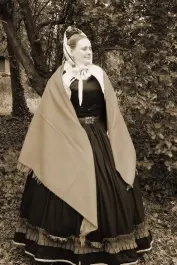
One of my favorite blog series from over the years also happens to be one of the most under read. Maybe it is because it is just that: lots to read.

When I first came across the digitized Moore’s Rural New Yorker at the Rochester Public Library, I was was delighted to find the publication to be well rounded with sections for farmers alongside gardeners, and the whole family. As I continued to read, I was captivated by a column of letters and responses, often from an Aunt Betsey. These volleys primarily dealt with the domestic life of women, what work was like, what was best to wear while working, how to raise daughters, etc.. I was eager to share what I was reading, quite convinced others would be just as captivated.

Well, not so much according to my stats.

Here we are, some years later. I will link here the tag I had given these transcriptions:

Their Life, Their Words

Published in: on April 5, 2022 at 10:35 am  Leave a Comment  

Where Can I Wear That Hat?

Recently, with my focus on hats, I have been asked a several times “where can I wear that hat?”

This is an excellent question. I love that people are asking. It means they are thinking about when and where they can appropriately wear a particular hat. It also means I don’t have to worry as much about one of my hats appearing in an inappropriate scenario. (Yes, I worry about such things.)

I want to cover the background to the answer(s) rather than just the answer.

First, where do we look to find out what situations are appropriate for different types of hats? We need to look at visual references for context. This will include context based photographs (cdvs, sterioviews), illustrations and paintings. This will show us the scene, the type of hat, the wearer and the clothing it accompanies. We should also include textual references, keeping in mind the written descriptions can misinterpreted due to various reasons.

Second, we need to keep in mind the chronology and geography of references. What was common in the 50s may not have been common in the 60s. What may have been common in an urban area may not have been common in a rural area. What may have been common in New England may not have been common on the Gulf coast.

Let’s look at some images. (Just as start. I’ll try to come back and add more.)
2016-03-04-08.09.29-1.jpg.jpeg

2016-03-04-08.09.29-2.jpg.jpeg

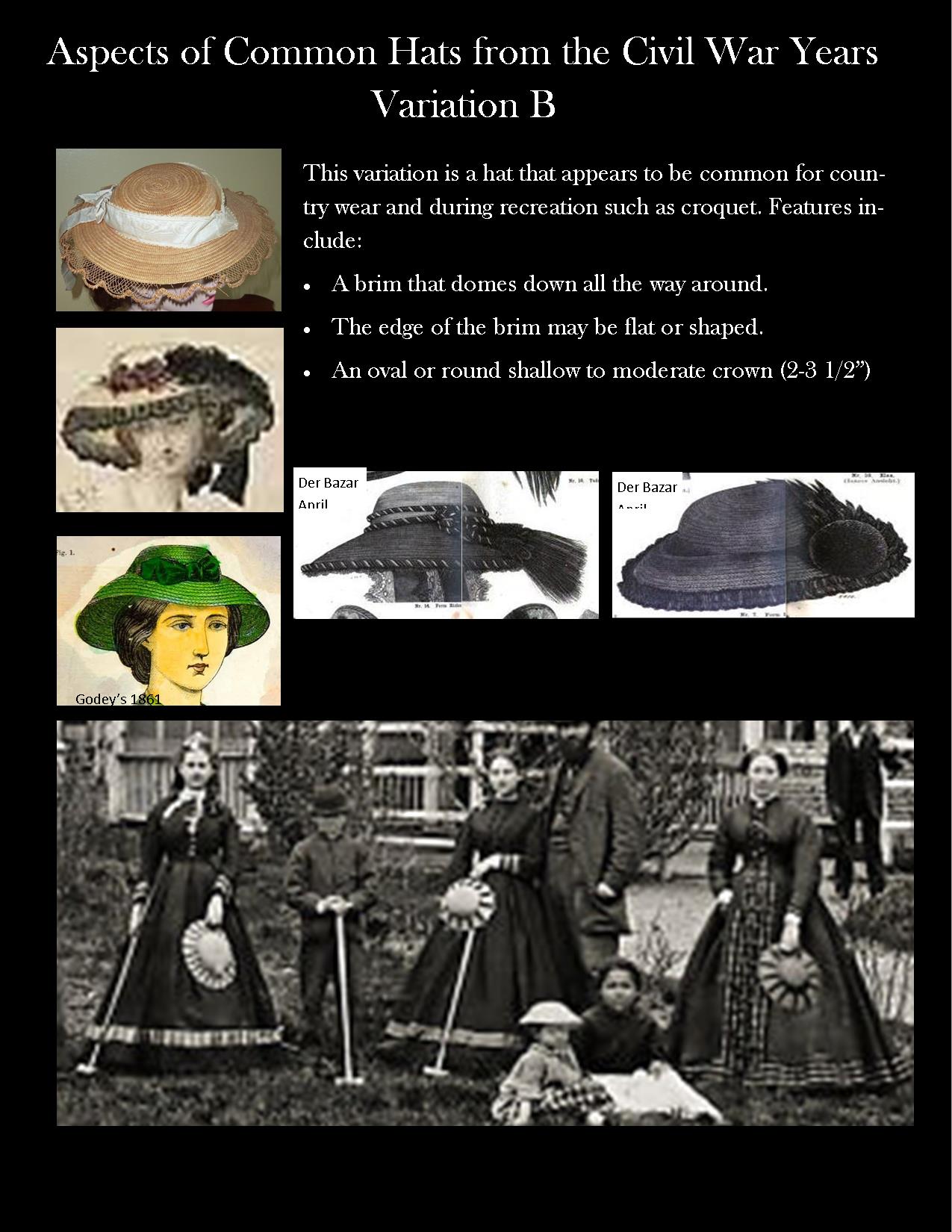
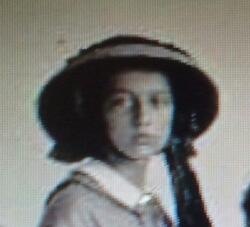
This pair of images I recently found after completing the violet velvet hat. These women are from a family photo that I lack citation details on. The daughter is holding a croquet mallet, indicating a recreational situation. Both women are wearing straw hats with brims that curve down all the way around, providing some sun protection. The hats appear to be simply decorated with ribbon. The clothing suggests a date between 1860 and 1863/4.(the link provided does not agree, estimating the photo is just post-war.) I estimate the girl to be in her young to mid teens, the mother in her 40s.
Straw Garden hat clip 2

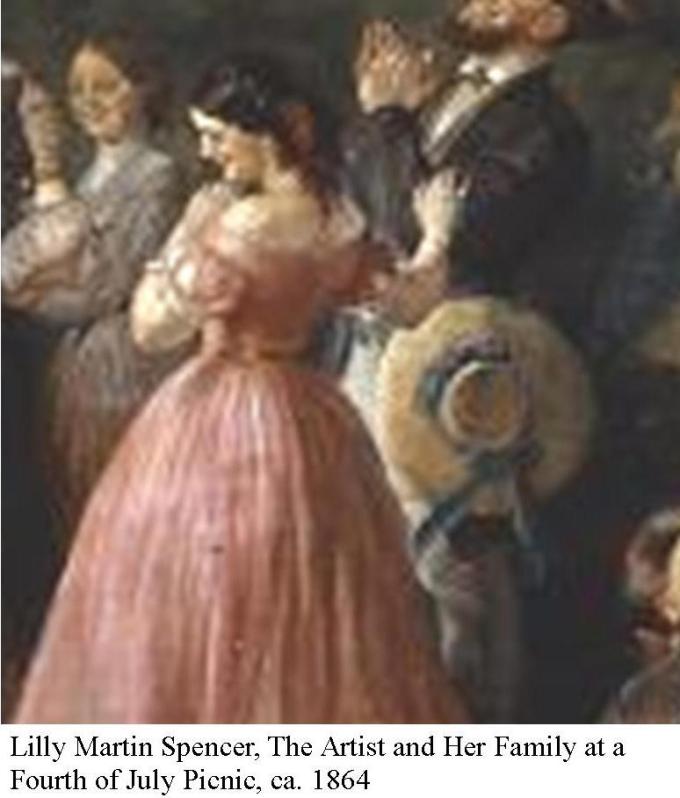
Continuing with the recreational scenario, this shot from a Lily Martin Spencer painting depicts a picnic on the 4th of July. The hat is a larger hat. It has a wide brim that would shade the face. The crown is shallow, maybe 2″ high. It is simply decorated with a ribbon and possibly a ribbon or flower arrangement in the front, bow in the back.
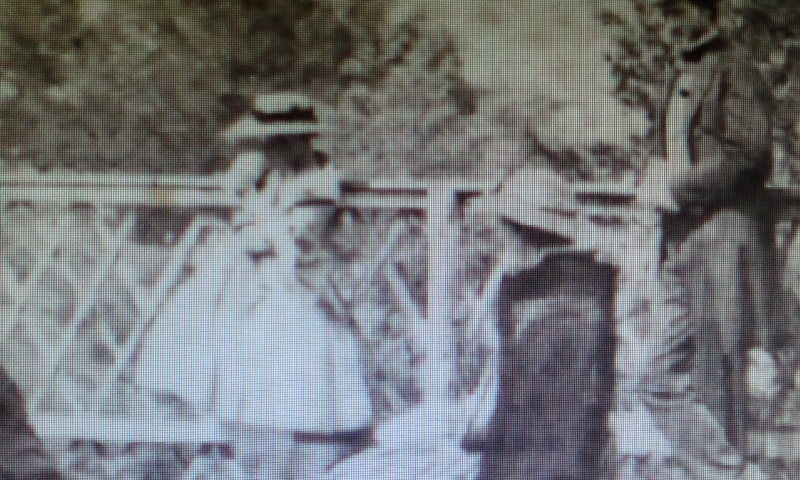
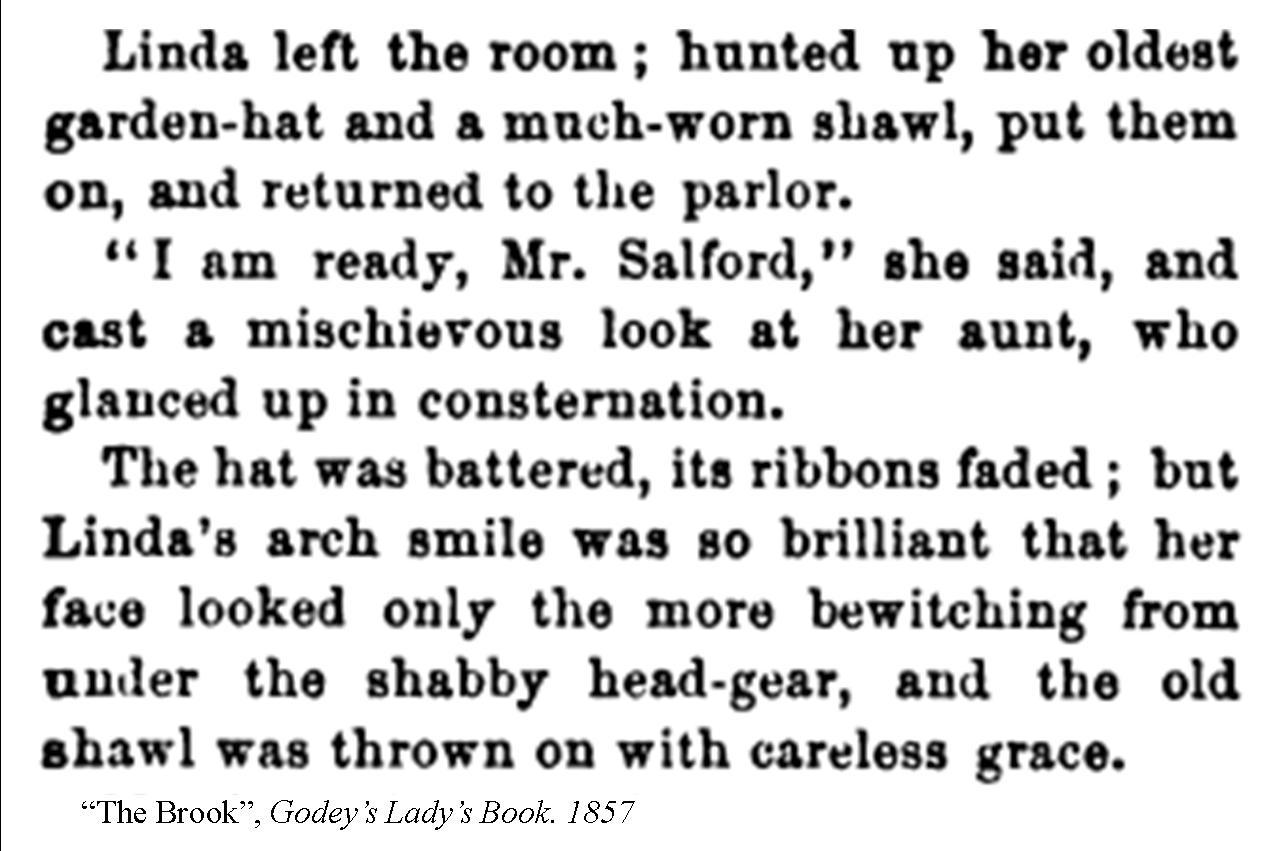
2016-03-16-13.21.13.jpg.jpegThis stereoview, A Charming spot for a Country Home,  shows what appears to be a small town or rural garden of a comfortable family. Dated 1865, this image is from New Jersey. We can see a woman seated in the chair with her back to us, wearing what appears to be an undecorated straw hat (with little blocking in my opinion.) This hat reminds me of this description of a well worn, favorite garden hat. Near the fence is a pre-teen girl in a wide brim, low-ish crown hat with a simple bow. Hats to do seem to fairly common in photos of people in the yards or gardens (upper working class, leisure class homes.)
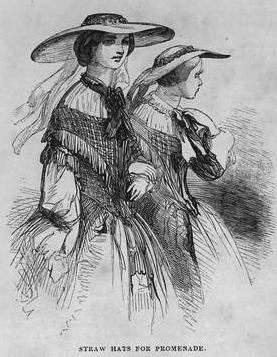
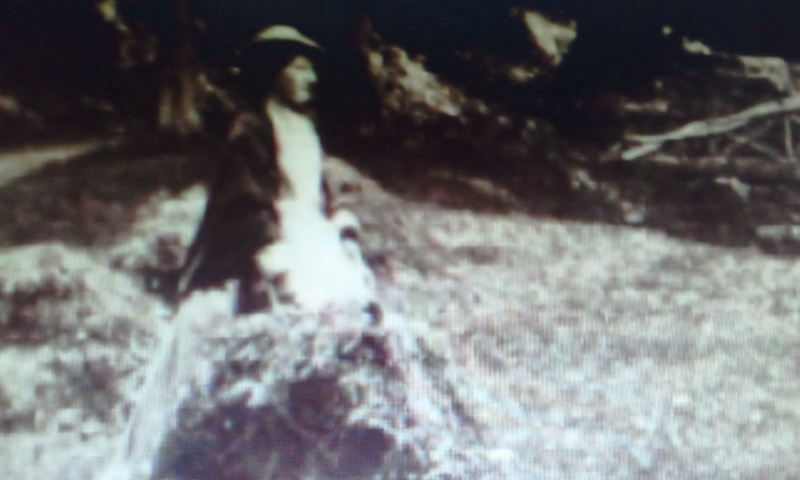
Harpers Monthly June 18502016-03-16-13.23.13.jpg.jpegThis next stereoview, View of grounds at Newport, is estimated to be 1860, taken in Herkimer, NY. This can also be considered a recreational image as the woman stands in a field alongside a haystack. Her hat is smaller, with a very shallow crown and brim that reaches just about the depth of her face. (meaning the brim comes about as far forward as her nose.) This is a fashionable shape for a hat that I believe would be appropriate for a walk in a village as well. Compare it to the hats to the right from June of 1850, which have significantly larger brims.

Seaside hats from Charles Wynne Nicholls

One can not mention recreation without touching on seaside. I don’t think many of us truely get to do impressions that spend time seaside. I think large, shady hats often come to mind when thinking seaside recreation. But, as we see in these late and post war paintings (English), smaller hats were worn seaside.
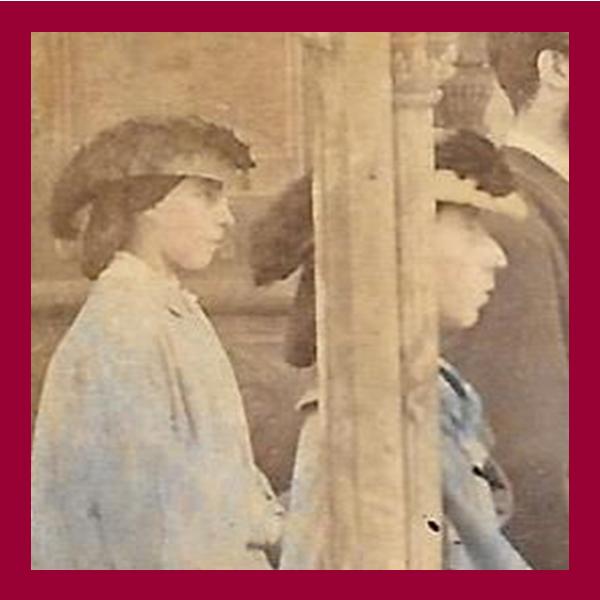
Close ups of how to wear a hat Stereoview The Baptisim


As a general rule of thumb, formal occasions were not appropriate for fashionable or casual hats. This includes church. This stereoview clip suggest there were some exceptions, in this case a baptism. (I’ll see if I have the whole scan saved elsewhere.)


Scenario Specific Hats (I really ought to find time to write more about):

  • Coarse hats
  • Southern made hats
  • Reform hats
  • Riding hats
  • Sporting hats (archery)
  • Resort/Watercure hats
  • TBD

More hats in context:

Published in: on April 4, 2022 at 4:05 am  Leave a Comment  

Things Must Get Done!

It is 5 weeks to Opening & Mother’s Day Weekend…. Aka my first event of the season.

This means Things Must Get Done!

Normally, this is smooth sailing. But, this year I feel about a month behind. Between school/work and life and weather and a germy 5 day sleep, I am definitely feeling behind.

Here is the list:

  • 4 fully decorated millinery pieces. (12-16 hours)
  • The kerchief doll needs a body and a name. I also need to order a second kerchief. Then I need to drape her bodice and plan out cutting the kerchief. (?5 hours?)
  • I need to finish my wool dress, which means I need to start my wool dress. (?12 hours)
  • Prep “Tools of the Trade” for the second event of the season later in May. (no idea)
  • I must get some pieces made for the shop. This is an absolute budget must. (10×10 hours)
  • A new collaborative project with a local friend that isn’t technically 19th century, though it is 19th century inspired and on the same time line of to-do. (5ish hours)

A certain feline must have known I need to get a move on. She woke me up far earlier than I wanted to wake up. Since then, I have fed her (the feline priority) and cut & pressed 4 linings, 4 bavolet nets, 4 facings, and 4 frills. That stack of bonnets is ready to get dressed.

Is it super weird that I’ve been keeping the extra hat/bonnet stands in the car because I ran out of room? I only have the antique ones plus one pink inside.

I think I am going to work on this black bonnet to the point where it needs to be blocked. Then on to linings. I may cut out a doll body first.

Published in: on April 2, 2022 at 9:20 am  Leave a Comment  

March Reflections

In like a lion, out like a lamb? Well, maybe. That is if in with a roar of plans and out with a sigh counts. While I planned for the month to be packed full of Mousquetaire hat, miniature millinery, and some other goodies, much of the month was full of math.

I managed to get about half the March millinery done that I had in mind.

I enjoyed participating in the “History in Her Hands” challange by sharing an original item in my collection (nearly) each day of the month. I fizzled put at the end of the month when I caught a germ and basically slept for four and a half days.

Looking ahead, April will be a dash to finish a several pieces and get them to their homes. Then it is one to events in May.

Published in: on March 31, 2022 at 5:37 pm  Leave a Comment  

Comfort

In comfort we find connection.

In connection we find comfort.

On this 30th day of #historyinherhands , I offer this thought. When I first brought strawberry emeries make, I did not expect the stong connection visitors had with the strawberries. They shared their stories, their memories, of these fabric fruits, each filled with a tone of comfort.

This leaves the question: How to develop connection with discomfort.

Published in: on March 30, 2022 at 5:05 am  Comments (1)  

Purple

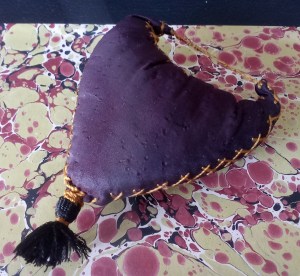
For this 29th day of #historyinherhands , I offer this heart pin cushion in purple silk. This useful heart is made from a pair of triangles under the guidance of the children’s book An American Girl’s Book, by Eliza Leslie. Like many young girl’s projects, pin cushions such as these could be made of materials from the scrap bag and embellished to show the maker’s skill.

Published in: on March 29, 2022 at 5:05 am  Leave a Comment  

Fiber

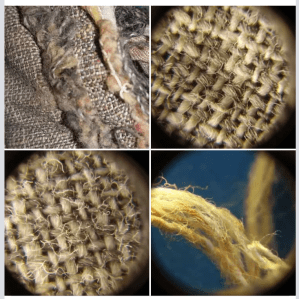
For this 28th day of #historyinherhands , I offer these images of fiber.

Published in: on March 28, 2022 at 6:05 am  Leave a Comment  

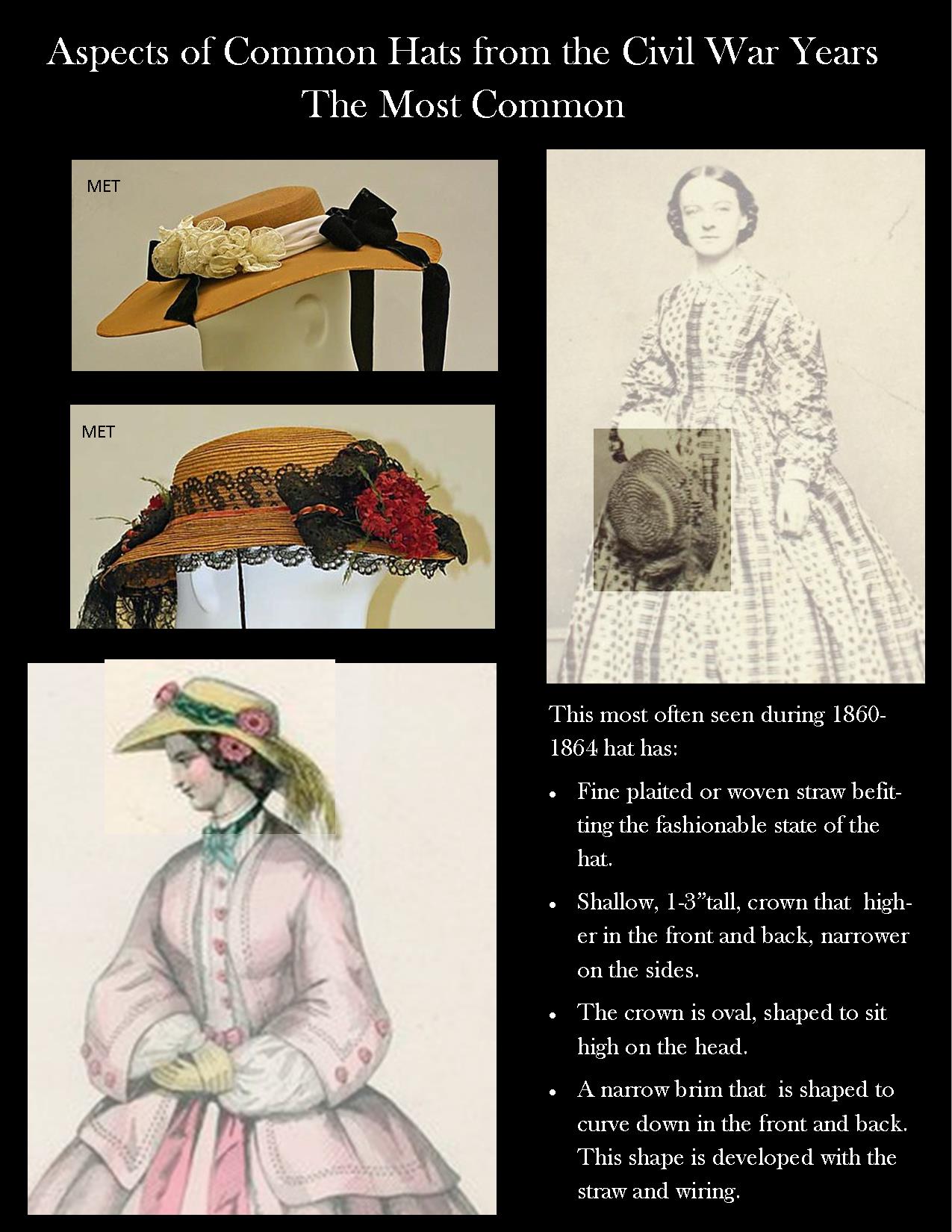
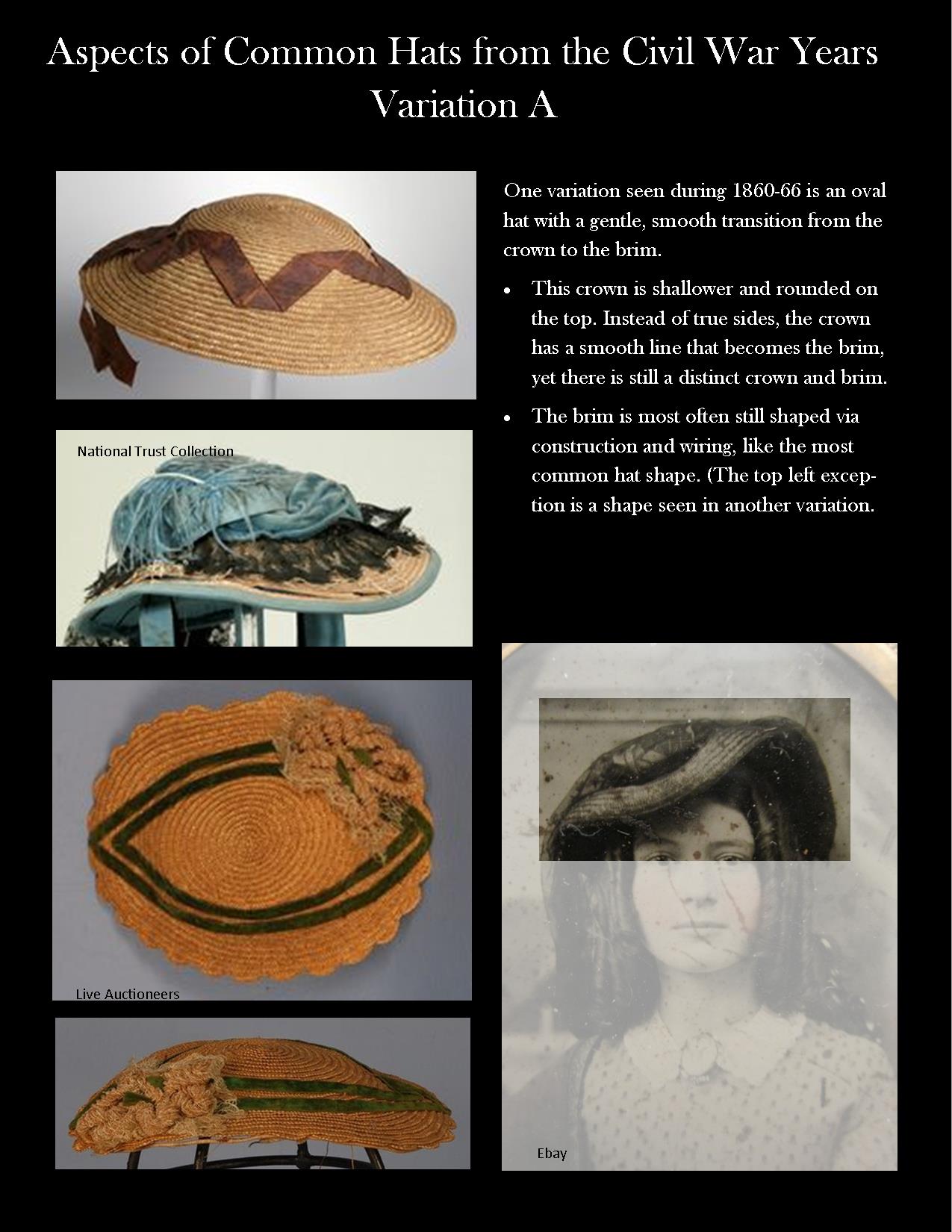
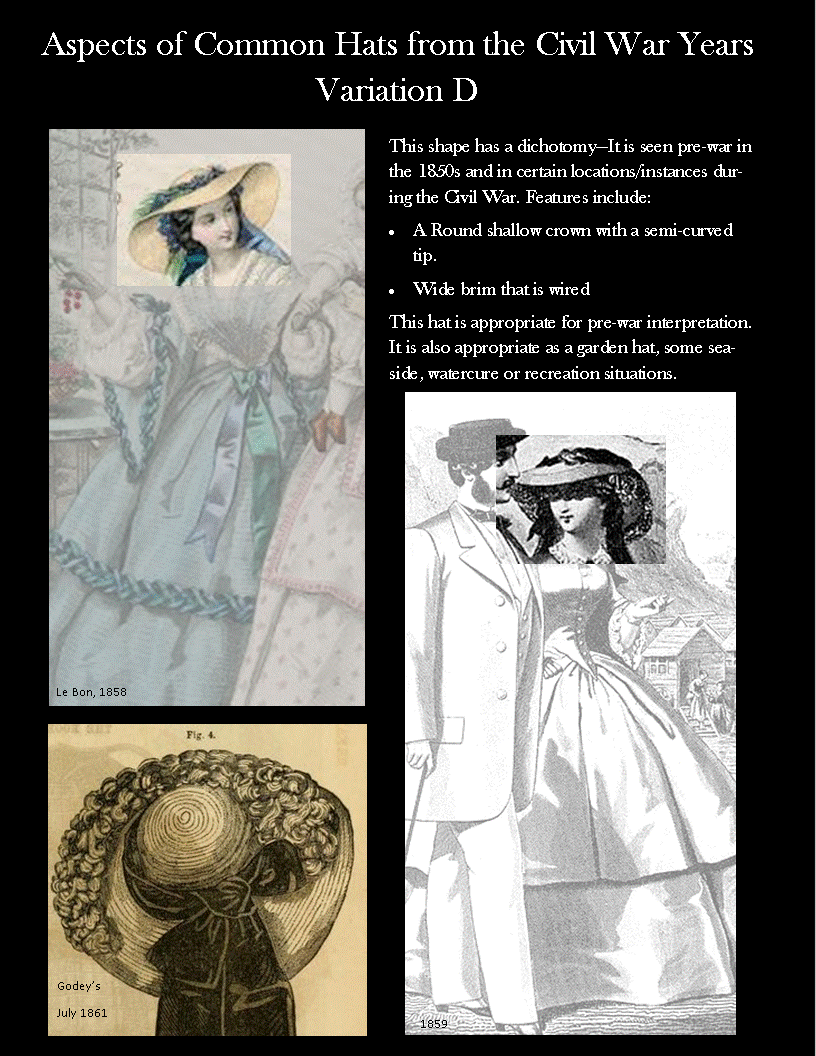
Common Hat Styles (1860-65)

Common hat shapes during the American Civil War era.

There are 2 main componants to a hat from this era: the crown and the brim. Both thd crown and brim were particularly shaped to reflect the styles of the time.

When selecting hat for an 1860-1865 impression, please keep in mind the situation you are in as well as your impression. In many cases hats had specific purposes and places. These include those for the seaside, watercures, the garden*, and recreation. There are seperate posts for these. I welcome you to explore these. There are also hats appropriate to those of poorer situations, institutionalized or previously so situations, and blockaded situations. (*note: a garden hat is different than one for gardening.)

common 1

common 2

common 3

common 4

This next style is called a “Mousquetaire” hat or a “Postilion” hat.
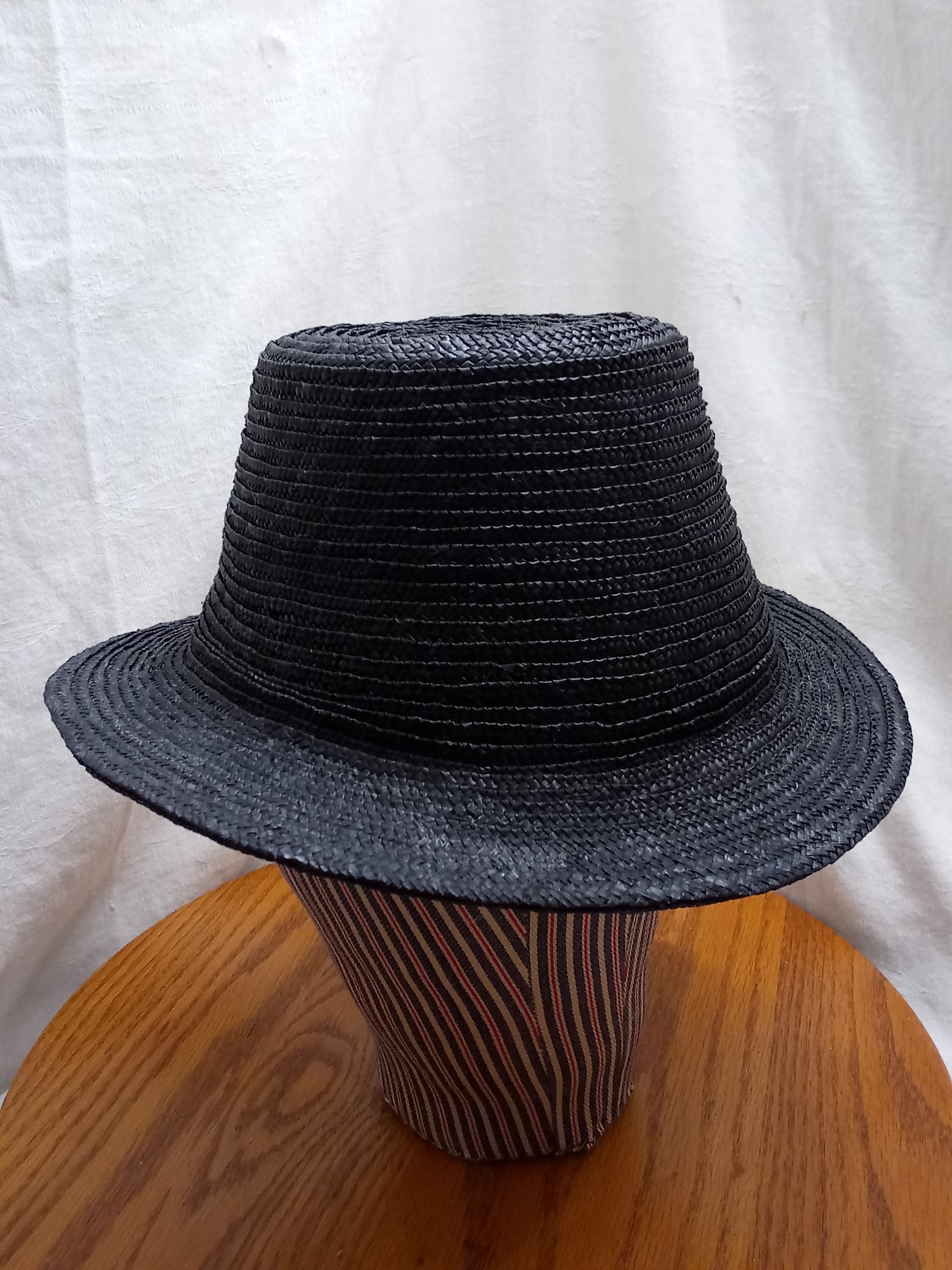
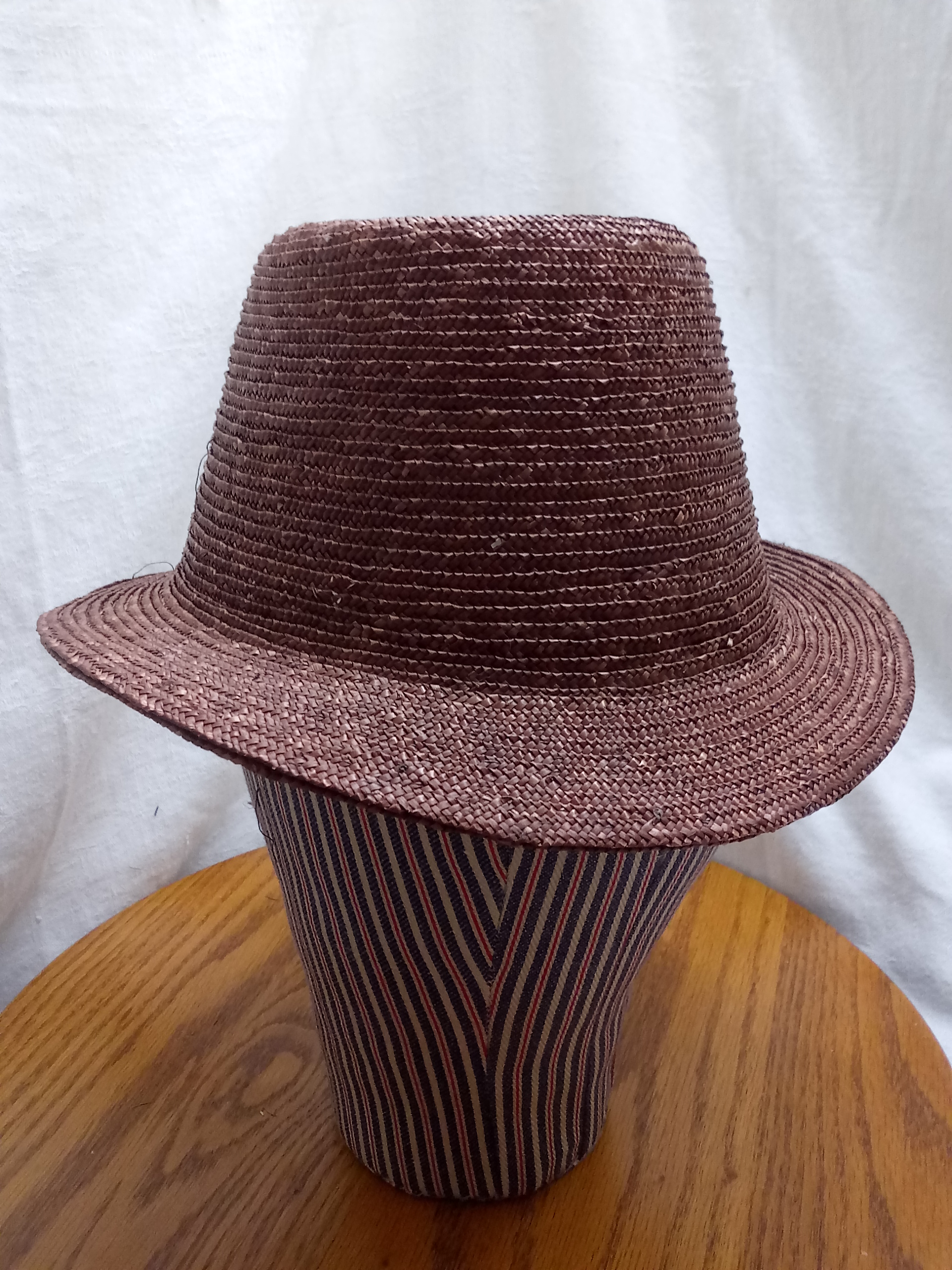
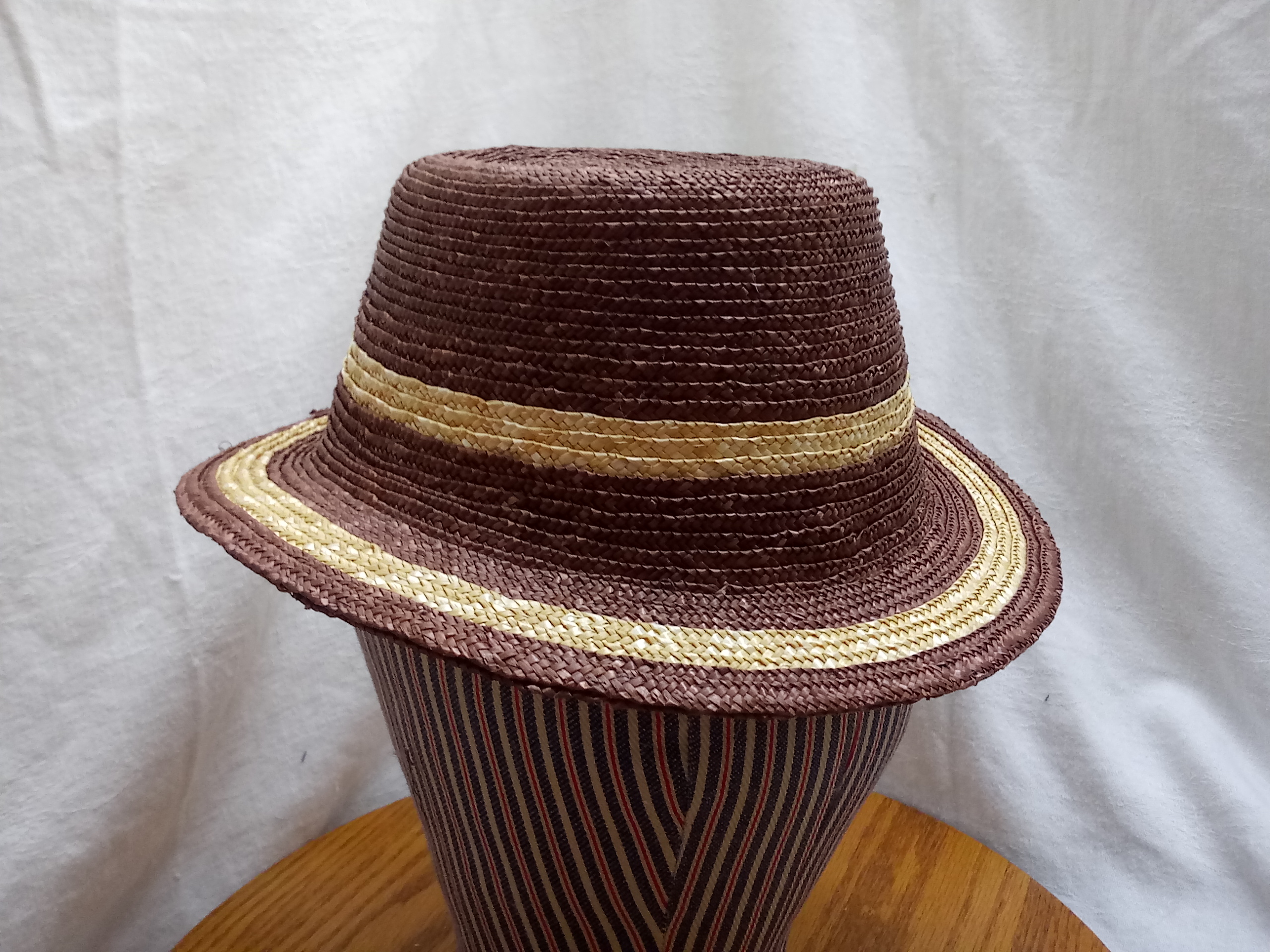
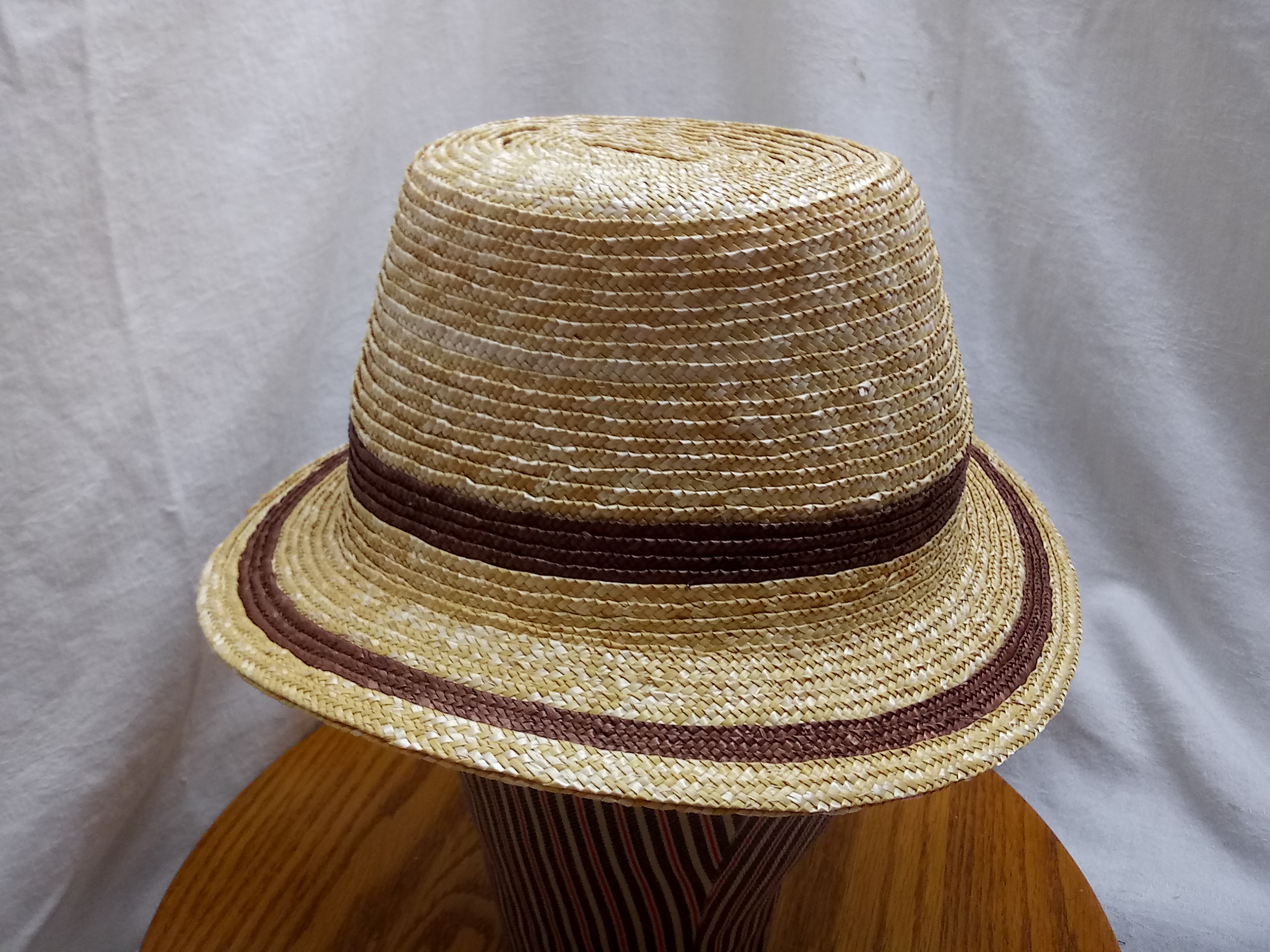
Mousquetaire hats have tapered crowns that rise about four to five inches, not quite double the height of other fashion hats of the early 1860s. The brim is shaped, with a curve dipping front and back. This brim is narrow, only a few inches wide. The decorations are primarily at the center front, reaching the height of the crown. A ribbon may or may not circle the crown with a bow or arrangement in the back.

Additional variations (I have yet to make graphics for):

  • Smaller hats including Torque and porkpie
Published in: on March 28, 2022 at 4:05 am  Leave a Comment  

Utility

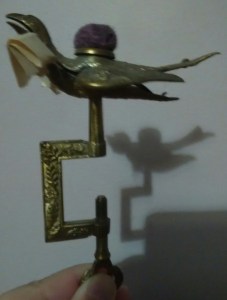
For this day of #historyinherhands , I offer this sewing bird. This charming bird currently holds its history in it’s mouth. 150+ years ago, it held the work of its owner as an anchor while she worked. Items of utility such as this made daily tasks easier.

Published in: on March 27, 2022 at 5:05 am  Leave a Comment  

Iron

For this 23rd day of #historyinherhands , I offer this sad iron in miniature.

Published in: on March 23, 2022 at 6:05 am  Leave a Comment