This seemed like an appropriate post to revist for Fancy Work Fridays.
Squishing filling into a pin cushion one day, I started to wonder what a fun game it would be to stuff a bunch of pin cushions with different fillings and see if people could guess which was which.
As weird thoughts go, this one kept rolling round in my head… Over the years, then and now, what all have people tried to stuff their pin cushions with? How did each one act? What worked? What didn’t? What really didn’t? …. This rolling became a “must try this.” I had a bunch of pin cushion circles left from the workshops didn’t? Yep….
Let’s first look at the history:
What did “they” fill their cushions with? I have seen a few materials inside pin cushions and sewing cases. There are others I not experienced in person but know to have been used. These include:
- bran
- raw wool
- scraps of wool threads such as those pulled from fabrics
- straw or flax
- sawdust and wood shavings
- emery
For the ‘experiment’, I used both materials that would have been used in the 19th century and modern use ones. I thought it would be an interesting comparison. Factors I looked at included easy of stick-ability, weight, compression and effects on pins over time. Each of the cushions are made with quilt weight cotton and crochet cotton. The crochet cotton helps determine how the filling compacts.
What I stuffed with:
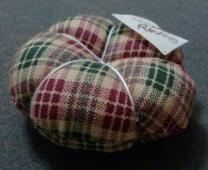
Wool batting/roving – This seems to provide the softest/squishiest of the wool fillings. It is firmer than the poly-fil. While it compacts, it does so evenly with a moderate amount of pull on the string.
The cushion is fairly light weight. Pins stick easily with a slight depression before going through the fabric. As wool roving and batting are easily available, this is an inexpensive and accessible, period correct option.

Raw, cleaned wool – This seems to provide the densest, least squishy of the wool fillings. The raw wool I used was fairly tightly wound to itself in clumps. I think this made stuffing the cushion easier. I can feel some of those twists inside. It compacts consistently with a little more pull on the string than the roving did. Some areas do feel less dense than others. The pins stick easily with a slight depression before breaking through the fabric.
The natural lanolin in the wool is said to be good for the needles. Raw wool may be easily available for some but not others. If available, this is an inexpensive period correct option.

Wool scraps – The scraps for this cushion were threads pulled from about 8-9 square inches of heavy weight wool that had been washed and lightly felted. This cushion compacts consistently and evenly. It is not as dense as the raw wool. The pins stick easily with a slight depression before breaking through the fabric.
If someone regularly works with wool, this is a free stuffing option as scraps would abound. It does take some time to pull the threads apart.
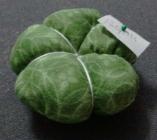
Poly-fill – This is the softest and lightest of the cushions I have here. It is also the squishiest of the bunch. I found this cushion to compact unevenly and inconsistently. You can see this in the segments in the photo that are misshapen. (I did make a second cushion to recheck my process.) This cushion takes compression before the pin will break through the fabric.
This is an inexpensive option for filling a modern pincushion. I would like to note, this fill made my eyes burn.

Walnut hulls with lavender – This cushion is filled with a commercial product for making pin cushions. It is ground hulls with lavender inside. The hulls are about the size of coarse salt on soft pretzels, maybe a little bigger. This filling was easy to fill with, though a bit messy (each hull could be picked up by hand.) The cushion is one of the heavier of this batch. It will not roll or slide. This would be a good option for a weight. There compression is even and consistent. Pins go right in with a rather pleasing ‘crunch’ feel.
The bag I have cost about $5. I expect it will make a half dozen pin cushions this size. I need to investigate the authenticity of this option.
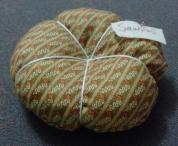
Sawdust – The sawdust I used was somewhere between dust and shavings, some was little, soft curls of wood. This made a weighty cushion that is quite as heavy as the walnut hulls. Pins go into this cushion nicely without much depression. The cushion compressed consistently but with some uneven areas.
If you have a wood shop, this is a free option for filling that is period correct. Be sure to pick clean, dry shavings. I do not know if any particular woods would be better or worse, or if any would turn corrosive over time.
Cat Fur (No Photo Currently) – Out of curiosity, I filled a pin cushion with Clara fur. Clara has two types of fur: a long, straight hair and a soft, shorter fur. The latter compacts densely quite like fulled wool. It is very difficult to seperate the hairs though. I found the pin cushion was densely squishy similar to wool but with less spring back. I also found the longer hairs started to stick out through the cotton.
Those I still need to do:
Sand – Need to get some
Emery – It is here, somewhere….
Cotton batting –Yawn
Bran – Need to get some
Rice – Need to just make it
Human Hair – Not sure I’m going to do this or not.
Those I did not try:
Silica beads – Though several websites say silica makes a nice pin cushion, I am skeptical and hesitant. I think of silica in connection with moisture control, that the packets attract moisture. I really don’t want a pin cushion that attracts moisture. All I can picture is the damp-rid bins we use in storage – ewy-goowy messes. I have started saving the little packets several times, but have yet to make this sample.
Graphite – How I laughed at this one. I do not want any additional ground or powdered graphite in my house. Husband tracks enough home on a daily basis. *In all seriousness, I simply can not picture a graphite filled cushion going will when working with white silk.
Others also mentioned on various sites and discussion boards…. pencil shavings, rock salt, small pet bedding, vase filler , foam wrapped in batting,
What do we like in our pincushions?
Liz Clark – “The one in my little FanU sewing box is filled with wool roving, and it’s my favorite. I don’t sew with pins on the machine, but I do sometimes use a few for handsewing and the wool keeps them nicely!”
Gail Kellogg Hope – “I have sevearl. My least favorite is the modern tomato. Not enough weight & I chase it across the floor a lot. My Fat Lady, who is larger, weighted and filled with polyfill. My great-grandmother’s woven, which is filled with sawdust fo some kind…. I like the weight. Weighted is important to me. That way I’m not knocking it across the room when all I want to do is put a pin in it. It shouldn’t take two hands to put it in.”
Eileen Hook – ” I have 1. a sand filled pin cushion (one of those pin cushions with a bag attached for little bits of thread), 2. a poly filled one, and 3. a wool raveling filled one. The sand filled one is good because it’s solid and heavy enough that it doesn’t slid across the table. Poly fill is light and easy to find in qntitty, but it is pretty light and the cushions aren’t as ‘solid.’ The wool ravelings are period appropriate and I used them for my period pin cushions. I can stuff quite a lot of wool into a pin cushion!! It feels more substantial than the poly fill.”
Carolann Schmitt – “I use a magnet pin cushion on my sewing machine, ironing board and cutting table. I use a fabric pin cushion stuffed with wool batting when I’m hand-sewing. The wool batting helps prohibit rust and moisture building up on the pins. And I always have an emery bag at hand to remove the protein buildup on pins and needles.”
Others Talking about Stuffing:
- Buzzing and Bumbling: Stuffing a Pin Cushion – She assembled a list of options that includes many more than I tried.
- Mab’s Creations: Pincushion fillings –
















 If I Had My Own Blue Box: