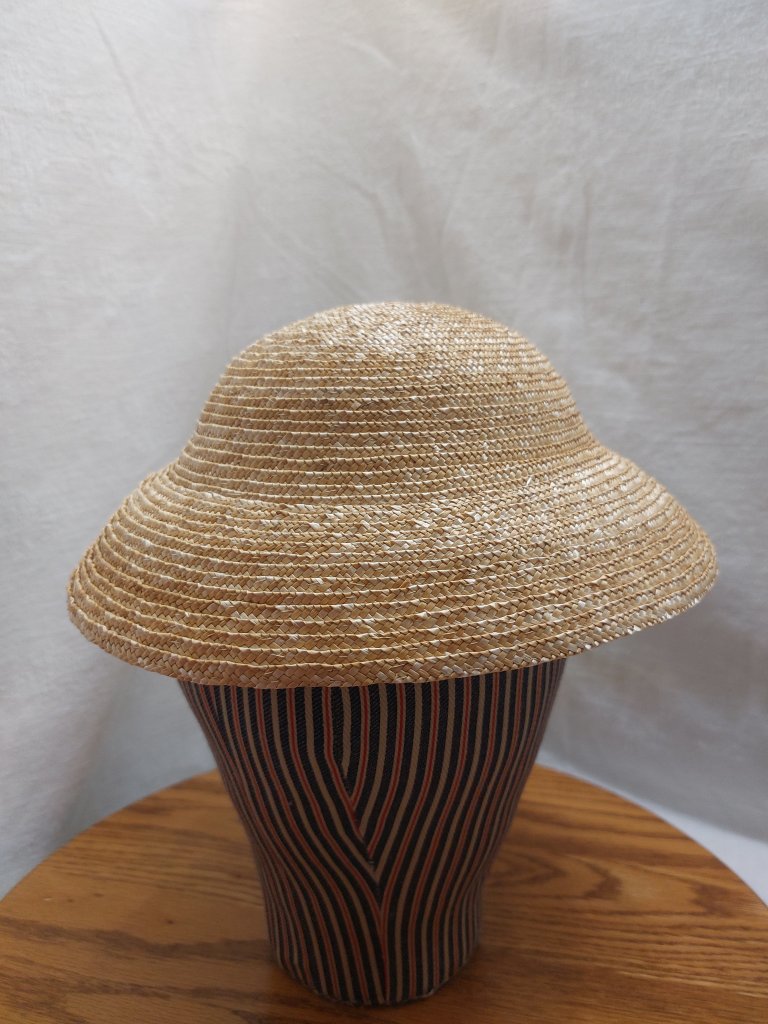
It has been far too long since I made this style hat. The Chapeau Cloche is a country or sea-side hat featured in Godey’s Lady’s Book, in 1862. This a low crown and dome curved brim, made of straw or leghorn.
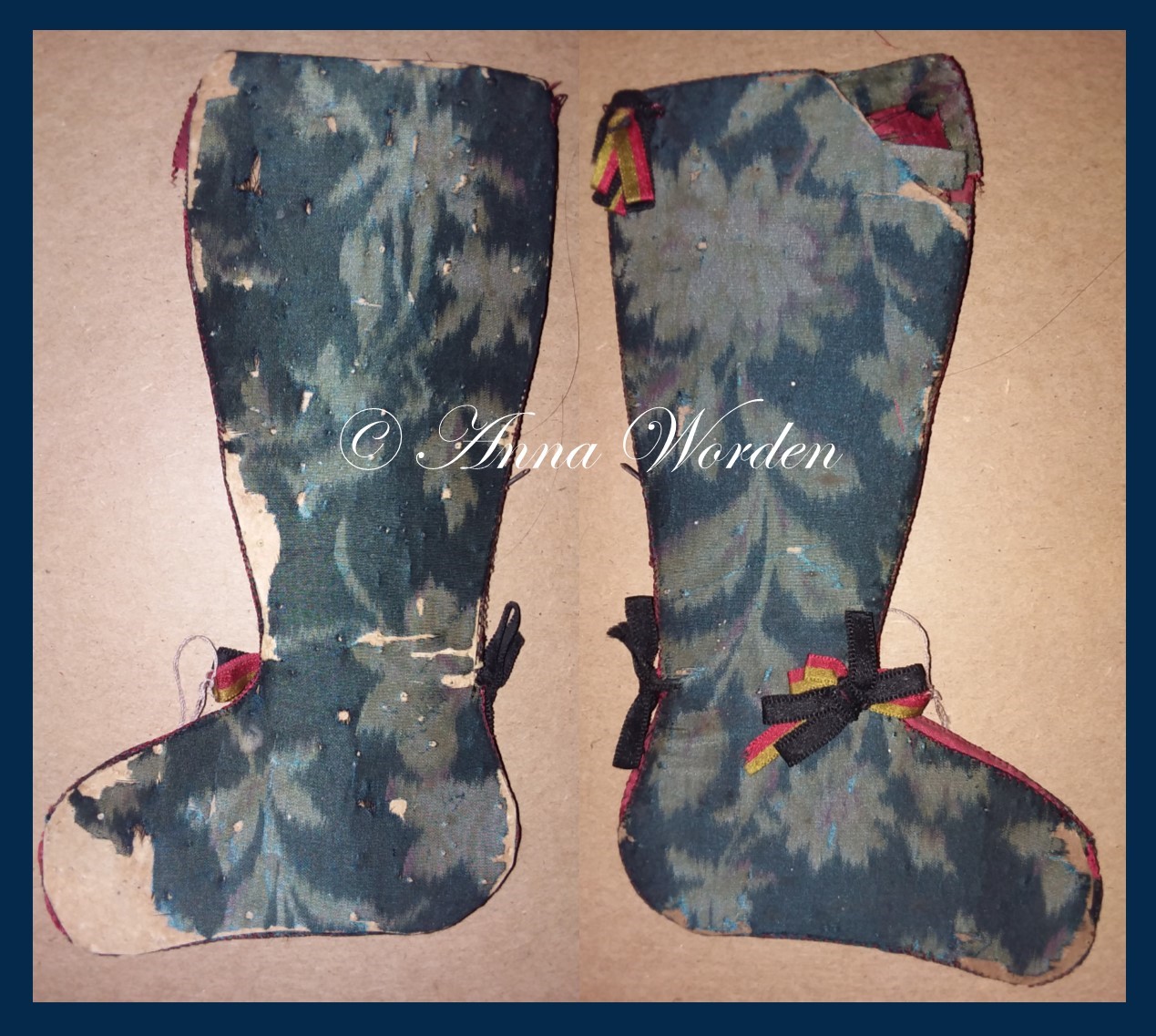
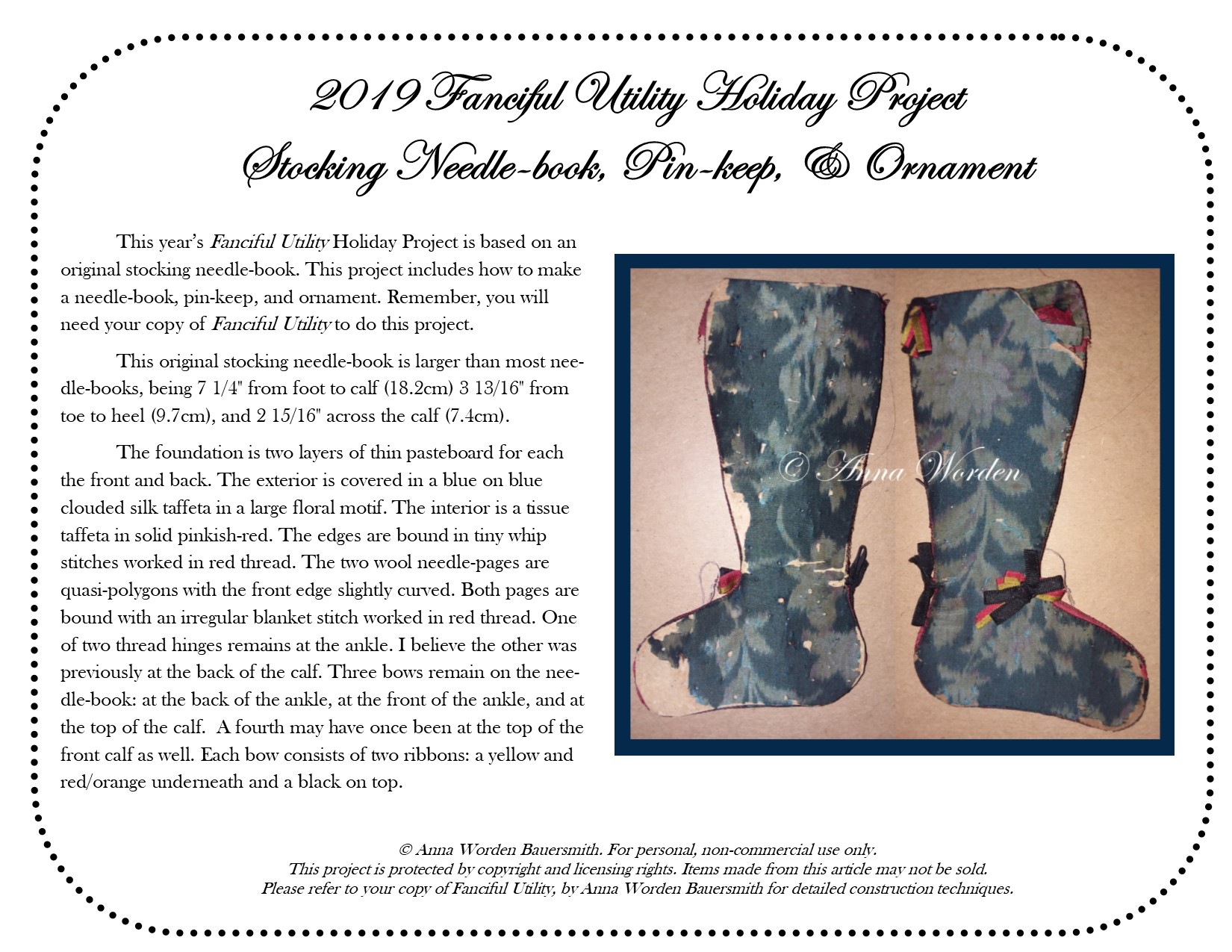
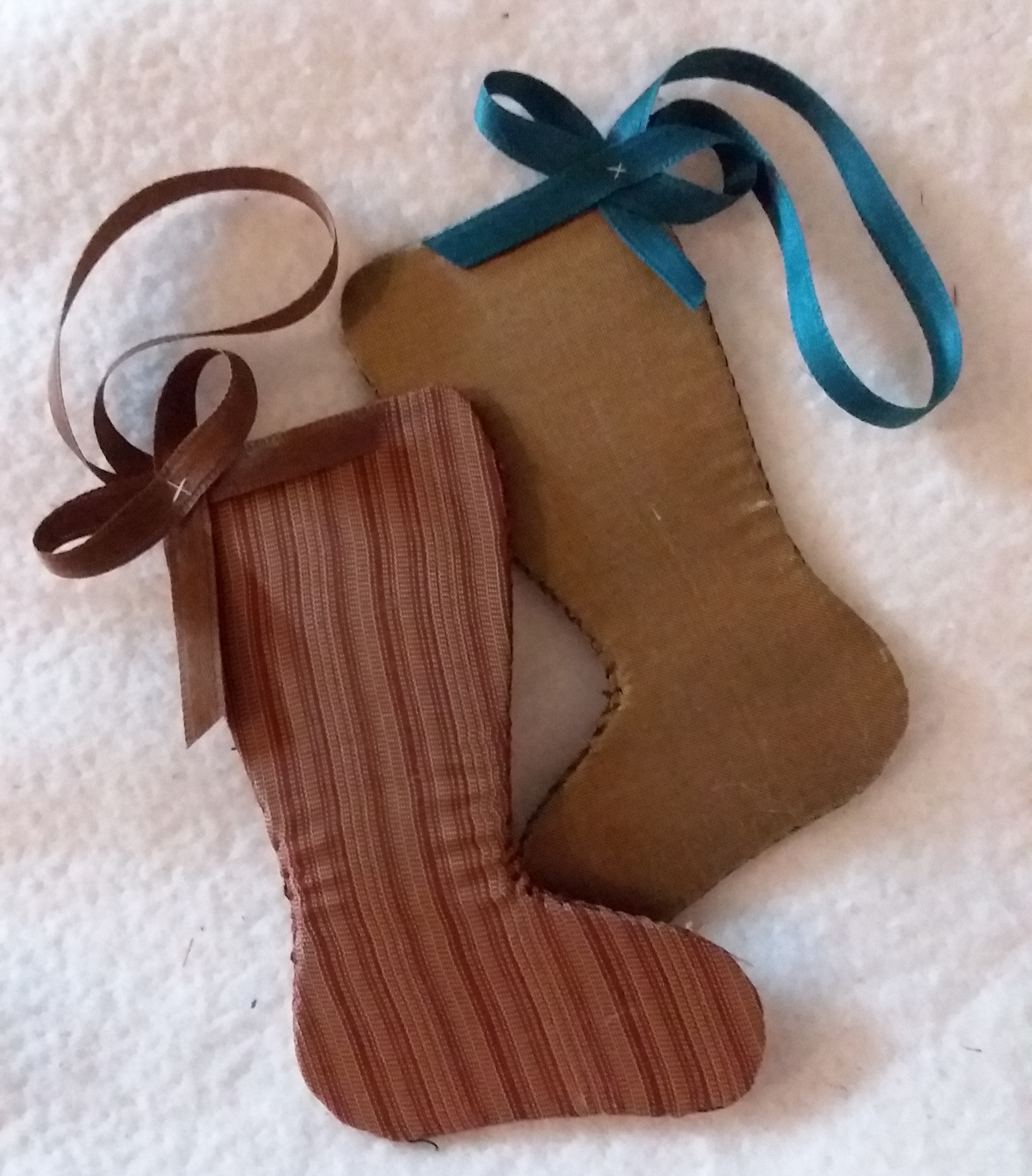
The original needle-book is larger than most needle-books, being 7 1/4″ from foot to calf (18.2cm) 3 13/16″ from toe to heel (9.7cm), and 2 15/16″ across the calf (7.4cm). The foundation is two layers of thin pasteboard for each the front and back. The exterior is covered in a blue on blue clouded silk taffeta in a large floral motif. The interior is a tissue taffeta in solid pinkish-red. The edges are bound in tiny whip stitches worked in red thread. The two wool needle-pages are quasi-polygons with the front edge slightly curved. Both pages are bound with an irregular blanket stitch worked in red thread. One of two thread hinges remains at the ankle. I believe the other was previously at the back of the calf. Three bows remain on the needle-book: at the back of the ankle, at the front of the ankle, and at the top of the calf. A fourth may have once been at the top of the front calf as well. Each bow consists of two ribbons: a yellow and red/orange underneath and a black on top.
Closer looks at some details:
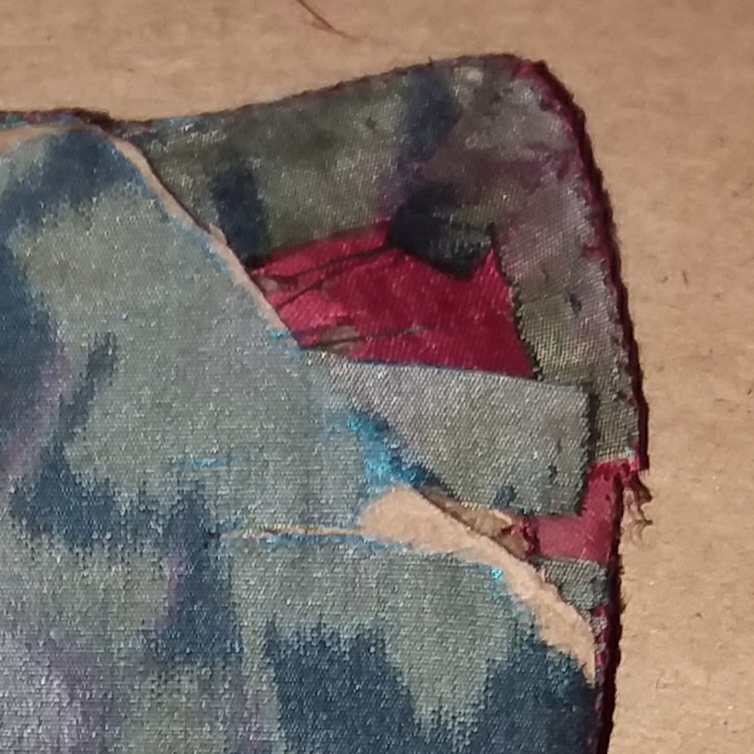
This damaged corner shows a few things. It let me see just how thin the pasteboard is on this piece. I do suggest we use the fairly standard pasteboard most of us have on the backs of notebook. There is a thicker version I like for boxes, but that would actually be too thick for this project. Along the edge of the fragment piece, you can clearly see the whip stitch used for binding the exterior and interior fabrics.
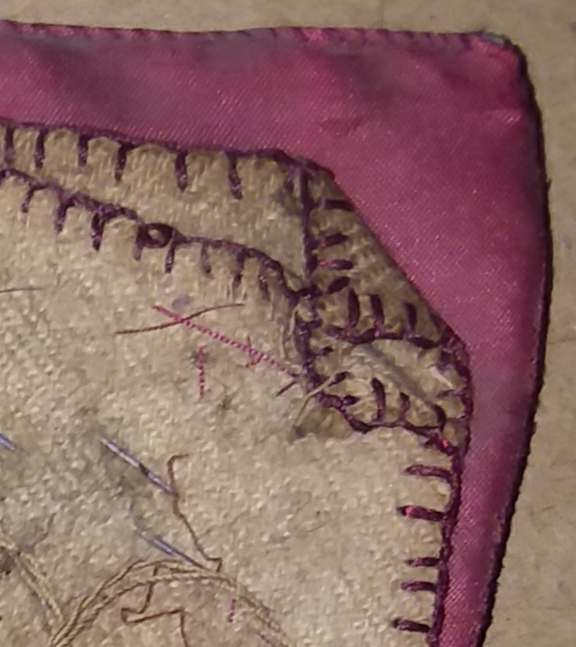
This interior corner shows the binding whip stitch as well. This gives a good view of the blanket stitch on the wool needle- pages. This photo also emphasizes the curves this stocking shape has. I think these curvy lines are what make this shape so appealing.
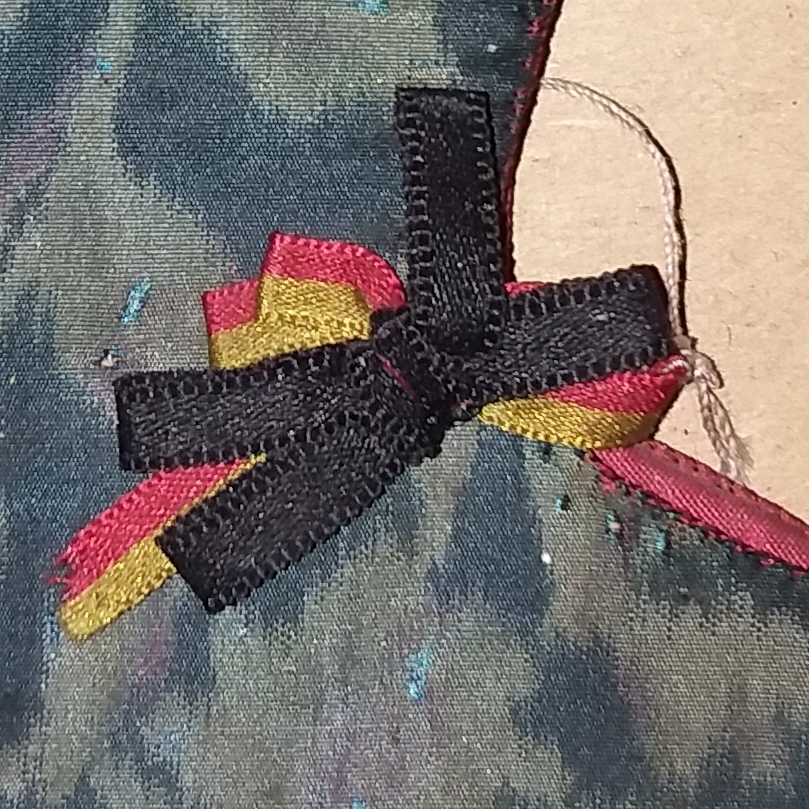
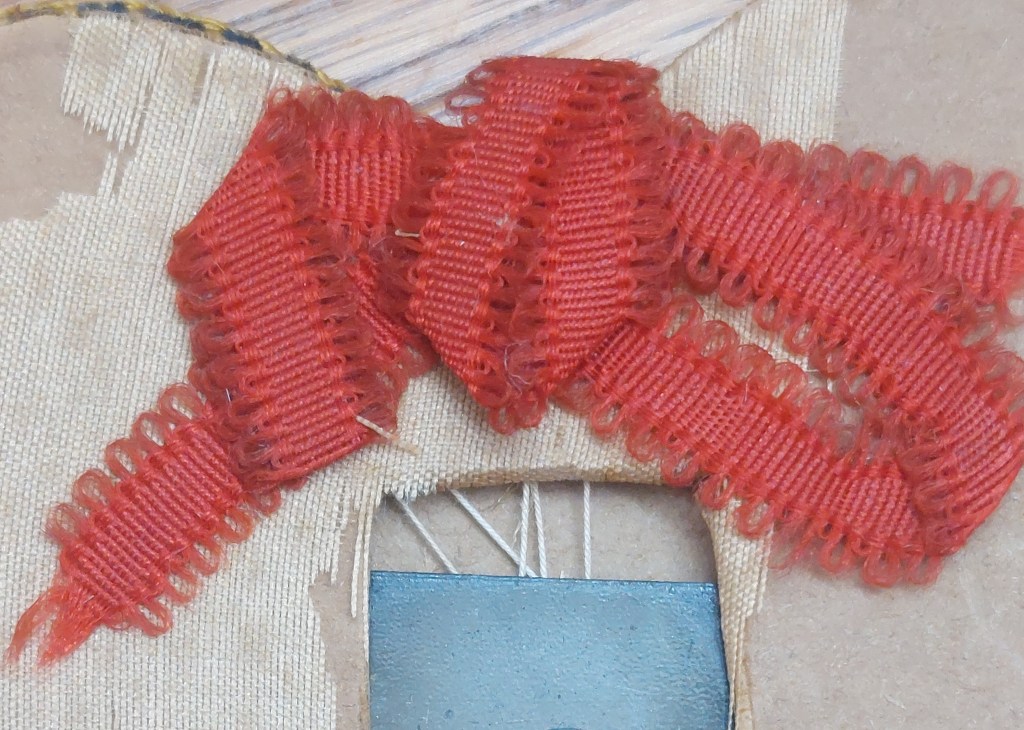
This close-up shows how each bow is really two bows stacked on top of each other. I rather like how the use of a two color ribbon gives the suggestion of three ribbons.
The Project:
Please download this PDF for directions on making the original size needle-book, a smaller 4″ pin-keep, and a 4″ ornament. You will need your copy of Fanciful Utility to do this project.
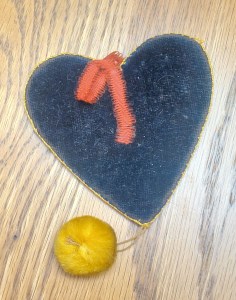
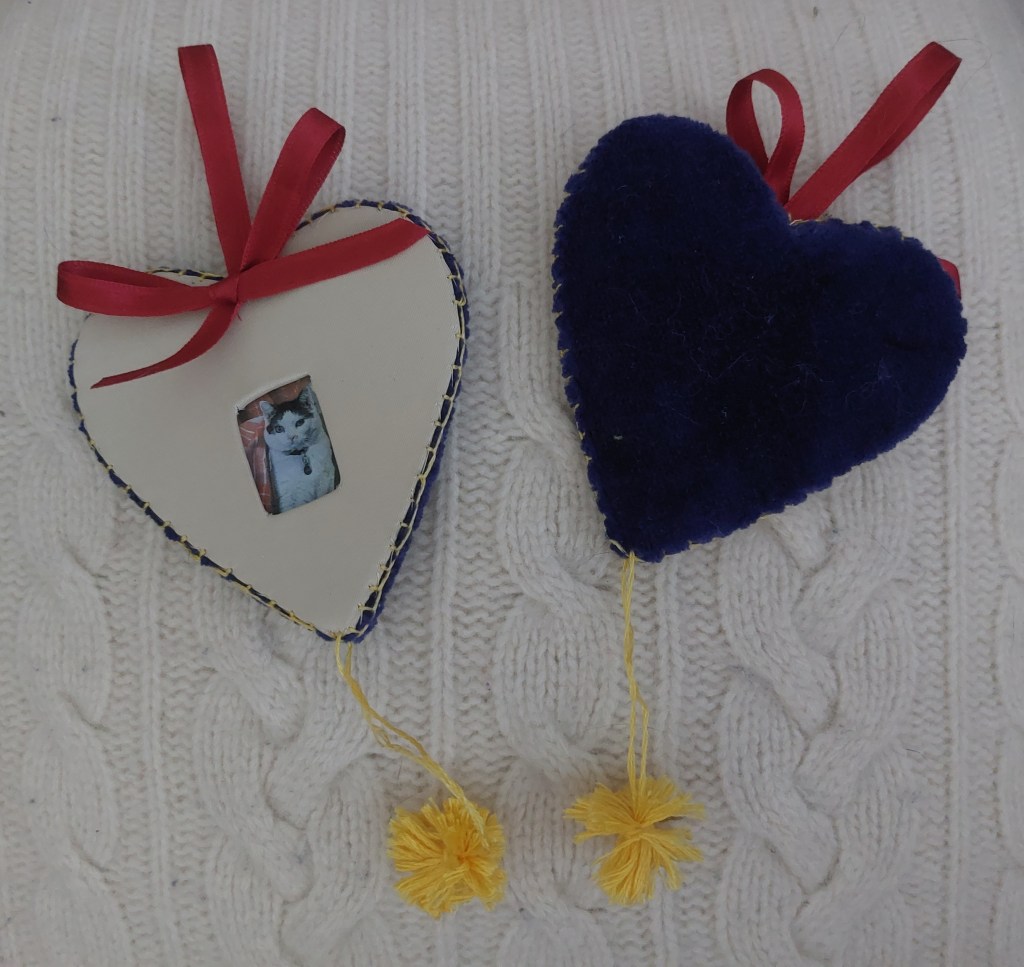
This summer I rescued the sweetest little heart shaped frame from an antique shop changing hands. It was tucked in a little basket on a shelf surrounded by chaos. Delicate items like this are likely to be lost or destroyed in situations where larger items get the focus. I am so glad I saw it.
The heart is 3 1/8″ tall and about the same wide. The 1″×3/4″ opening for the tintype photo sits about an inch above the point of the heart.
It is made of two layers of pasteboard. The back is covered in dark blue velvet. The front is covered in off white silk taffeta that has disintegrated.
The threads pulling the silk and velvet around the pasteboard can be seen through the photo opening as the photo has slipped.
The whole is bound with a bright golden yellow embroidery floss, likely silk, in a blanket stitch.
At the top of the heart is a red ribbon hanging loop and bow. The ribbon is a silk grosgrain with picot edge. At the bottom is a gold silk pom hanging from cord.
I recreated this heart frame from materials on hand. (Directions in pdf coming soon.) I think they came out quite darling.
Do you enjoy reading my blog? Do you find it helpful? Please consider supporting through Patreon or Sending a Tip.
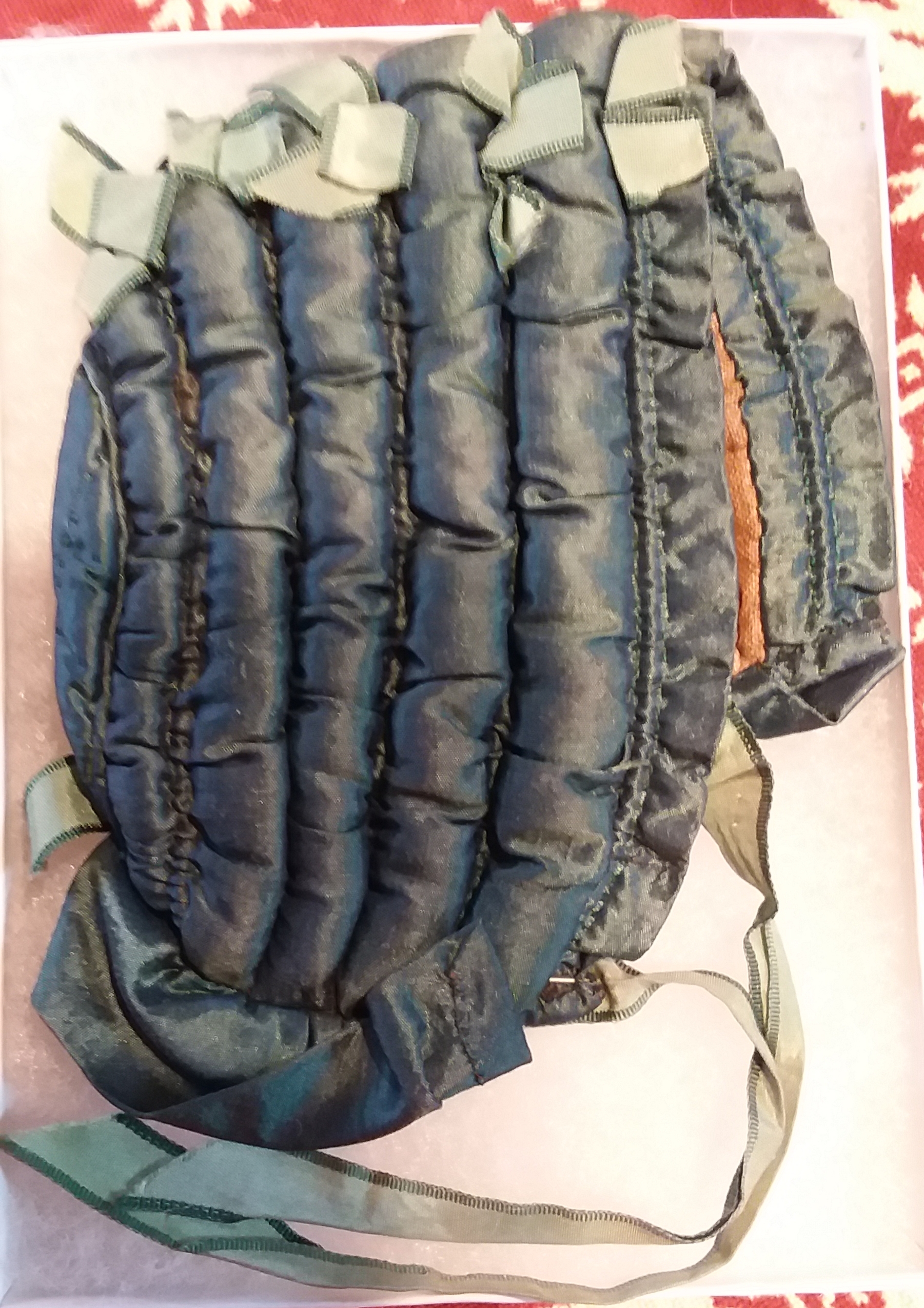
A “Pumpkin” hood or bonnet is a wadded bonnet, most commonly made of silk on the exterior and polished cotton, cotton or silk on the interior. Wide, full channels are filled to a full loft with wool batting either lightly or densely. The channels are separated by smaller channels, single or multiple, that are drawn in by cord or ribbon. The front brim may or may not have a decorative ruffle, attached or tucked from the base exterior fabric. These usually have a petite to moderate bavolet either lightly filled with batting or without batting.
Some other terms that seem to apply: Wadded bonnet/hood, “Ugly”, a “Kiss-me-quick”.
How early were these worn?
Most museums seem to start their dating of wadded, pumpkin style hoods in the second quarter of the century. Some do push earlier, as far as the late 1700s/early 1800s, such as this example from the Boston Museum of Fine Arts.
As domestically made winter hoods were a utilitarian garment rather than a fashionable one, their appearances in fashion literature is limited. I see one set of passages referencing a wadded hood or bonnet, drawn in, worn close to the face that may help us give wadded hoods drawn close to the latter 1830s:
In the Ladies Pocket Magazine, of 1838, London, we see a mention of wadded bonnets as a fashionable item. Of English fashions – “Wadded bonnets which before were very much in vogue, are now almost the only ones adopted in promenade dress, and it must be confessed nothing could be better calculated for the season, particularly when they are worn, as in often the case, over a blond morning cap of the demi-cornette form.” (In this passage, wadded pelisses and wadded mantles are also mentioned.) Of Paris fashions “Winter has set in with all its rigour, but that is of little consequence to our elegantes, who, occupied with the grand dinners, balls, and fetes that are always given in the commencement of winter, have deserted the promenades. Novelty in out-door costume is consequently out of the question, velvet or satin mantles, which are trimmed and sometimes lined in fur, that their busts are defended by a large fur palatine, their hands doubly shielded by fur cuffs, and a muff, and their pretty faces guarded by a large wadded bonnet, which completely meets under the chin, we have said all that can be said of out-door dress.” The year prior, the same publication tells us: “We may cite with confidence, among the new bonnets will be very fashionable, the capotes a conlisse ouatees, or wadded drawn bonnets; the are a most comfortable head-dress, composed of satin or pou de soie, lightly wadded, and simply trimmed with ribbon. They differ a little in shape from the other bonnets, sitting closer round the face.” This may or may not be the beginning point of the wadded, pumpkin style bonnet. Neither publication includes an illustration of this practical winter wear in the midst of the popular large bonnets of the era.
In that same time period, we see wadded and quilted hoods/bonnets constructed for children in The Workwoman’s Guide. The illustrations suggest the quilted versions have larger crowns that are volumous in some cases. It is important to note the difference between this shape and the Pumpkin shape. I believe this is the construction that evolves through the rest of the century as the quilted bonnet.
Blackwood‘s suggested I should look at “quilted wadded capotes” as well as “bonnets” and “hoods”. Though, this February and March 1843 Peterson‘s suggest capotes were quilted, rather than wadded with loft.
One of only photographs clearly depicting a wadded “pumpkin” style bonnet/hood is a bit of tease. While taken in 1897, the photograph does not show contemporary/current wear, rather historical costume wear. This photograph is held by Deerfield.
Were they worn during the Civil War?
Yes, evidence suggest wadded hoods were worn in the 1860s. The 1860 painting, School Girls, by George Augustus Baker, shows the girl on the left in what could be a red silk wadded pumpkin bonnet. The artist did several studies for this painting, including Little Girl in a Red Bonnet,which is undated.
Examples:
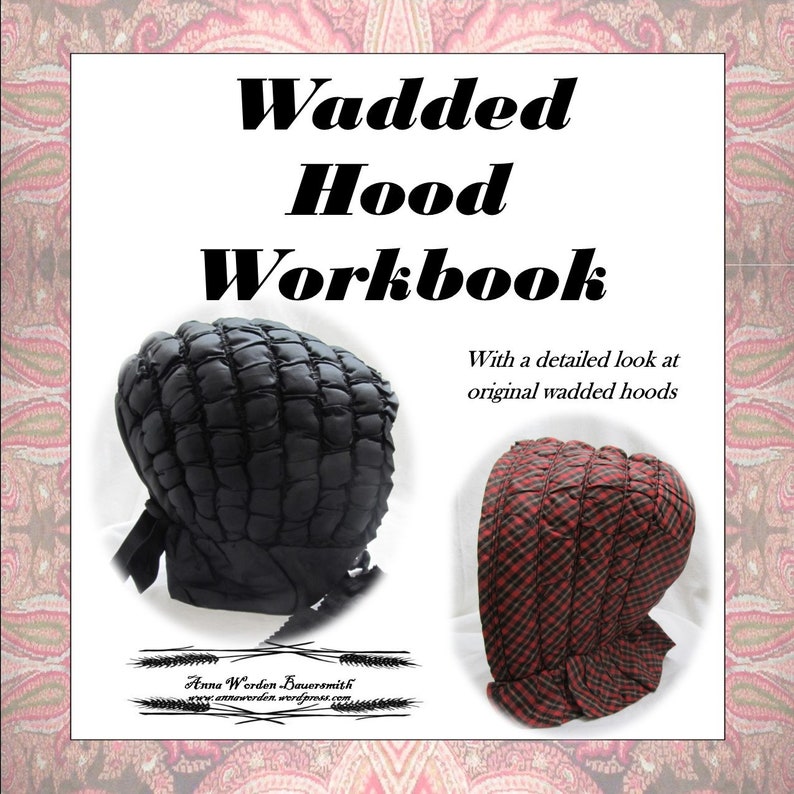
Learn more about Wadded Hoods and How to Make Your Own in my New Wadded Hood Workbook.
In recognition of the coming Halloween, this week’s post will look at various ways of making a pumpkin.
In terms of construction, essentially, a pumpkin can be seen as a large, orange tomato with a stalk.
In the pages of the 1892 Vision; A Magazine for Youth, we find these directions for making a pumpkin pin cushion tucked in next to a tomato:
The foundation of the pumpkin pincushion consists of two circular pieces of stout muslin joined together at the edges, and stuffed with wool. Two pieces of orange silk the same size, are smoothly arranged over the cushion and joined with as small stitches as possible at the edges. The cushion is the caught through the center, the needle being passed in and out through the seam (which should pass along the top and bottom and two sides). Rope silk or twist should be used, and it will have to be drawn very tightly up and down through the center to divide the cushions into sections. Two pieces curved to look like a stem are filled with cotton and caught with invisible stitches to make it “crinkly;” it is then sewed very neatly to the cushion. This cushion may be made any size you desire.
The Ladies’ Home Journal, 1892. Pumpkin Pincushion. By M. J. Safford. The materials needed are a puece of bright yellow surah, satin, or any bit of plain silk stuff, a spool of button-hole twist the same color, a few scraps of dark green silk, a little wadding (wool is preferable) and a piece of thin white cambria. Commence by making the wadding and cambric into a cushion seventeen and one-half inches deep, and flatten it somewhat on the top and bottom like a pumpkin. Gather the yellow material – wool will answer if silk cannot be had – at the top and bottom, and closely together in the center and sewing firmly to the cushion underneath. Next fasten a needle full of twist at the top of the cushion, draw it down to the bottom tightly enough to indent the silk and fasten at the bottom. Repeat this eight times, keeping the threads at an equal distance apart in the center of the cushion, thus dividing it into sections of the same size. Then cut from pasteboard a circular piece two inches in diameter, cover it with dark green silk and sew it to the bottom to conceal the gathering of the silk. Cut from the same green silk a piece three inches long and two wide, and stitch lengthwise four tucks one eighth of an inch to be left outside. Stuff the ease thus made with wadding and hem the bottoms neatly down upon the yellow silk top of the cushion.
Of course, if you can make something into the shape of a pumpkin, you can make a pumpking into something.
Marna found this workcase made from a pumpkin in Godey’s, 1870. I am skeptical of drying a true pumpkin dry enough in my climate. Maybe one of the gourds meant to be dried. The directions begin:
Work-Case Made of a Pumpkin.
Materials. – A yellow pumpkin measuring four and four-fifths inches across, some brown glace silk, thick brown braid, round transparent beads, gold-colored purse silk, fine gild-colored silk cord and ribbon three-quarters of an inch wide, nine round brown glass buttons, some wadding.
The pumpkinto be used for this case must be quite dry when gathered. Then hang it up to be dried. After some weeks cut it into halves, empty each half carefully as far as the skin, and bind each half round the edge with a strip of brown silk a quarter of an inch wide. …… (continued….)
I stopped at the local antique shop on the way back from the post office to see how it was doing with the new owner. I had not planned on buying anything.
I spent $15.
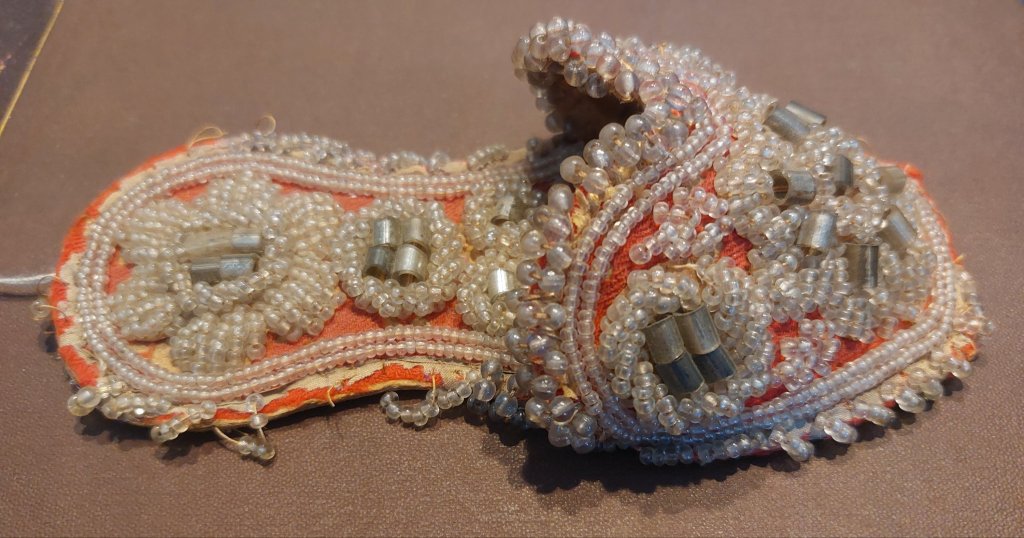
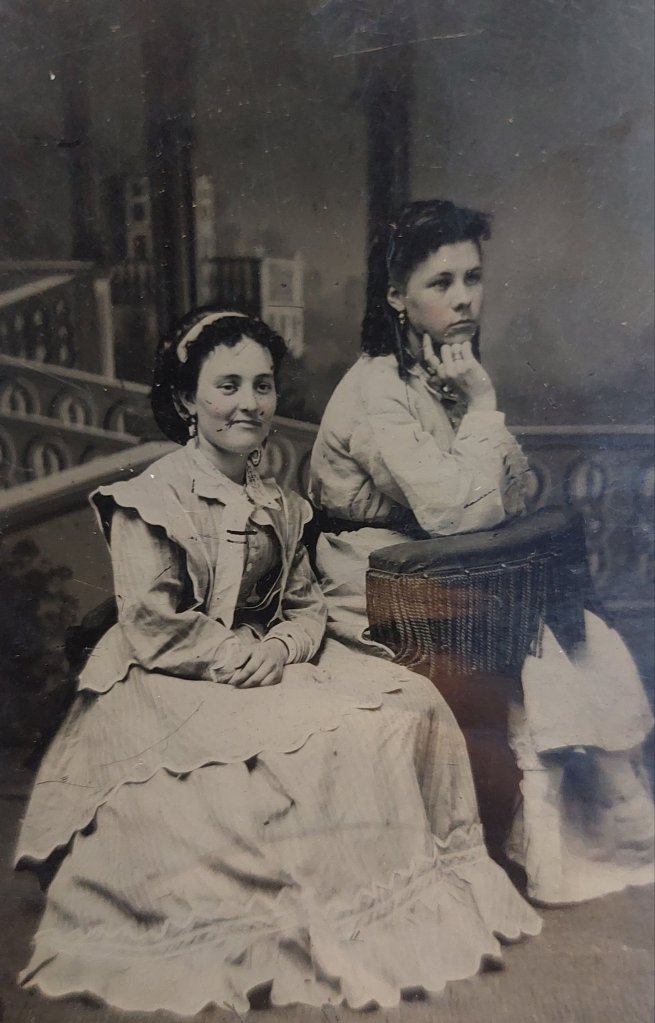
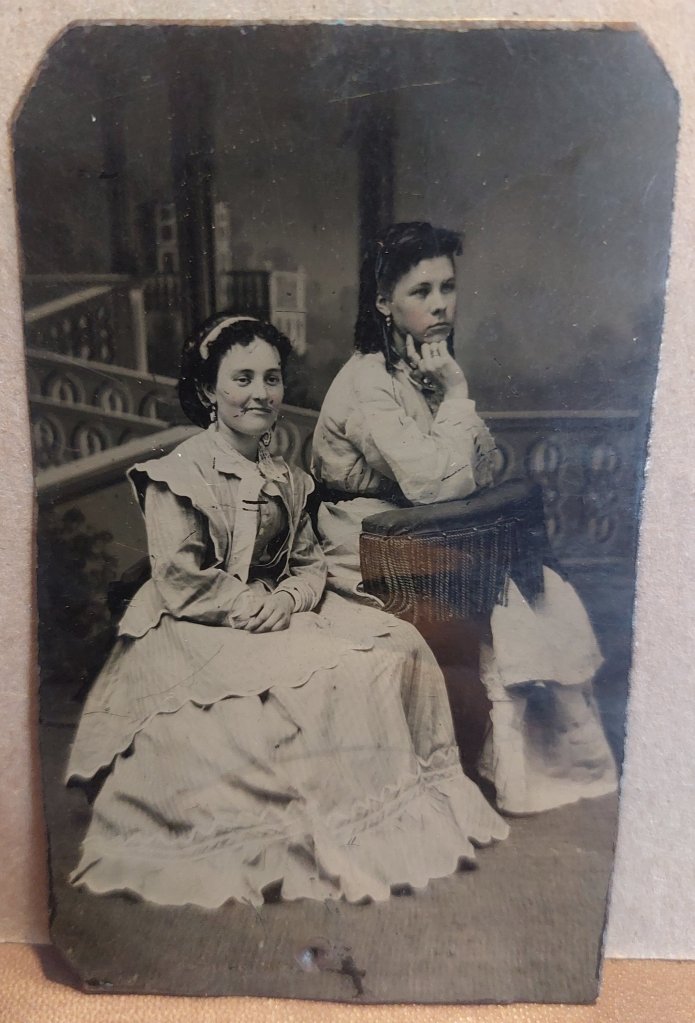
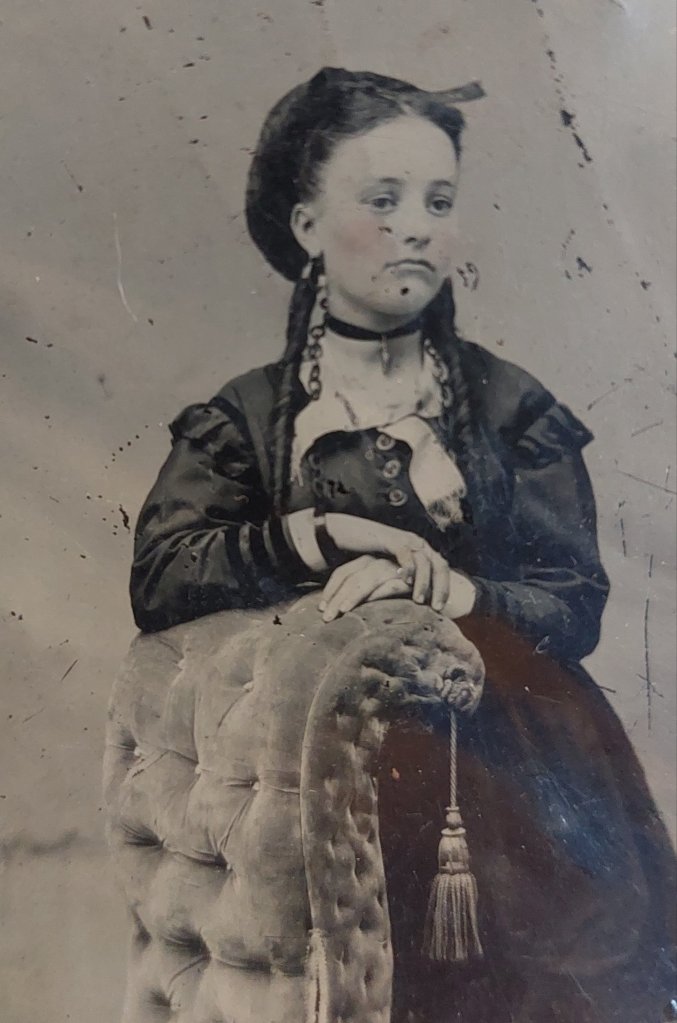
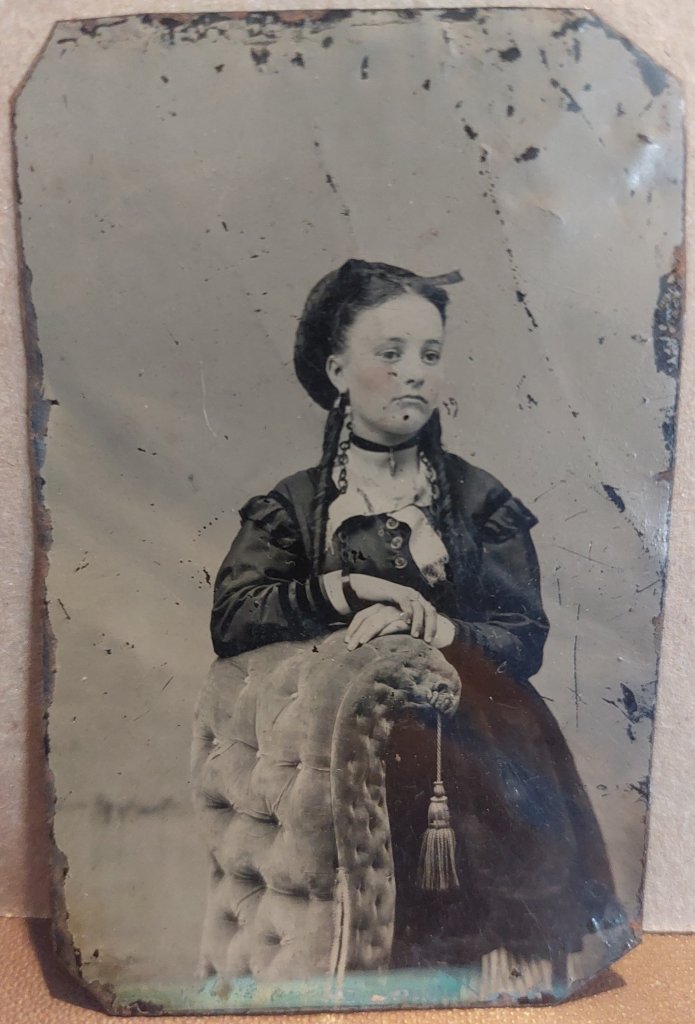
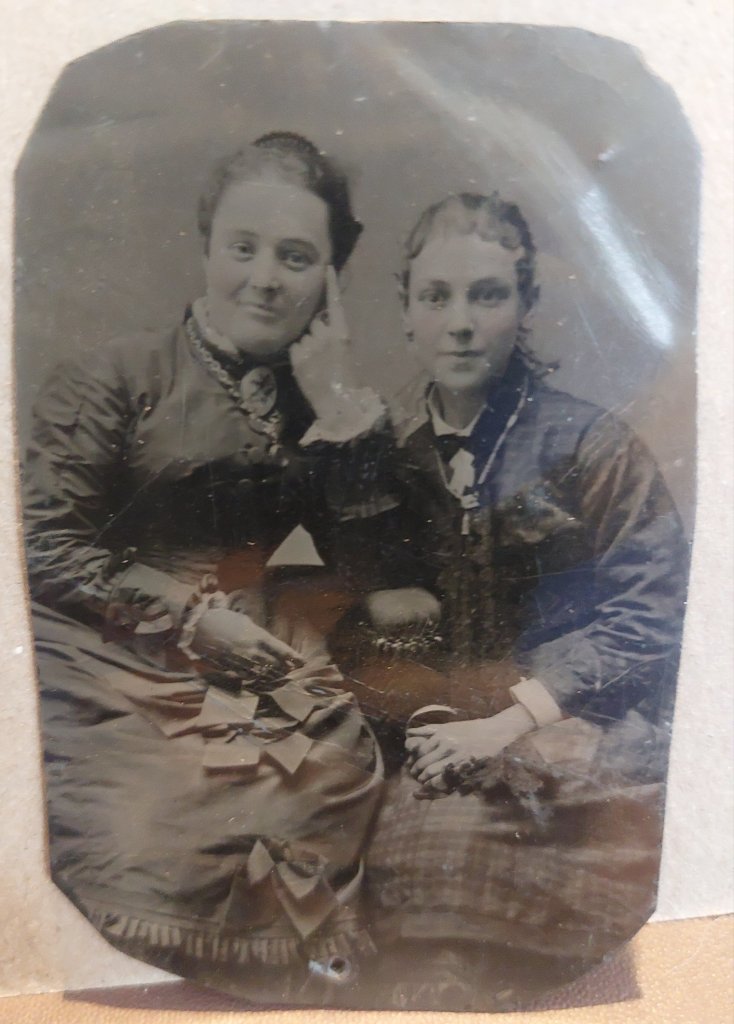
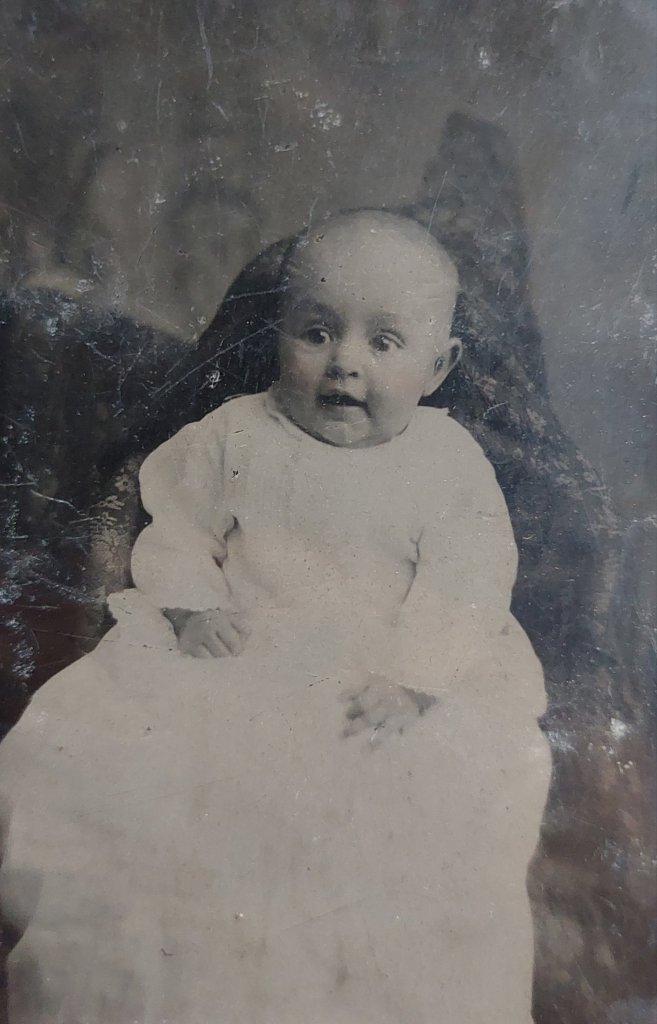
I got some books for family and friends, a beaded slipper, and a pile of tintypes. Yes. For $15.
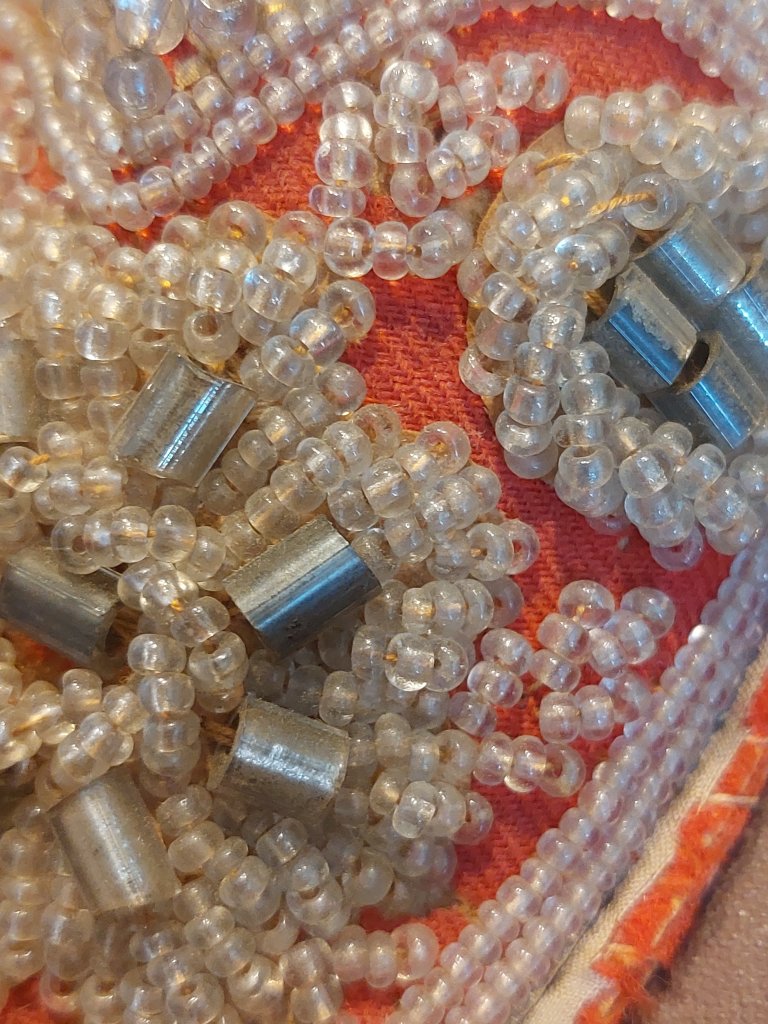
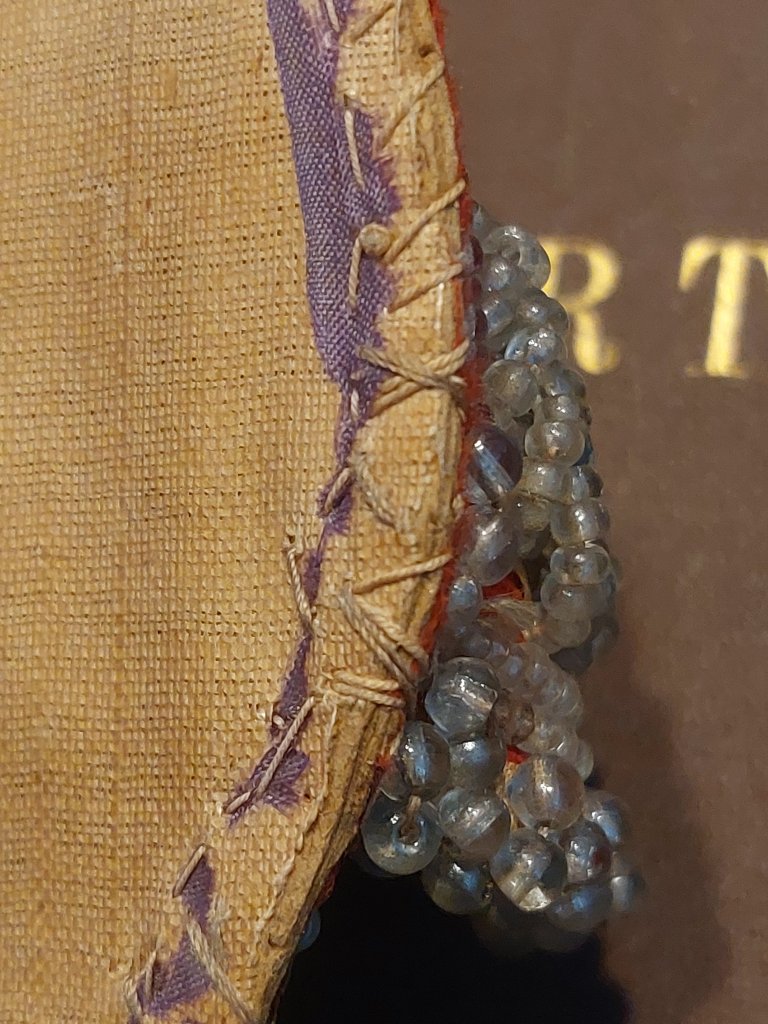
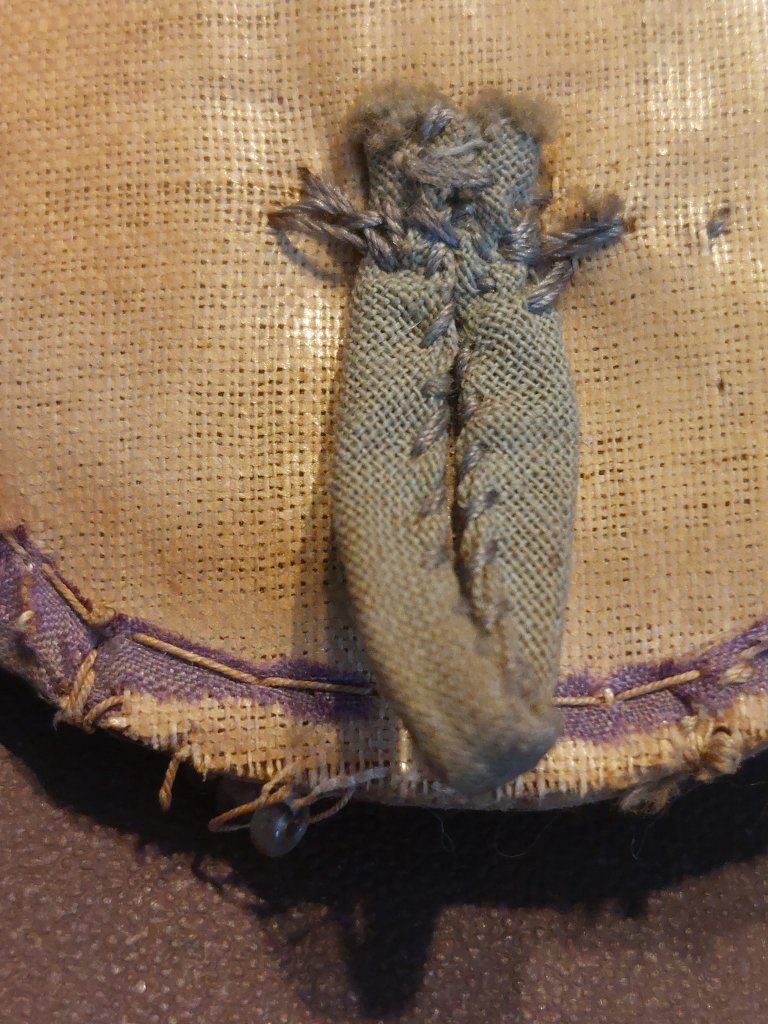
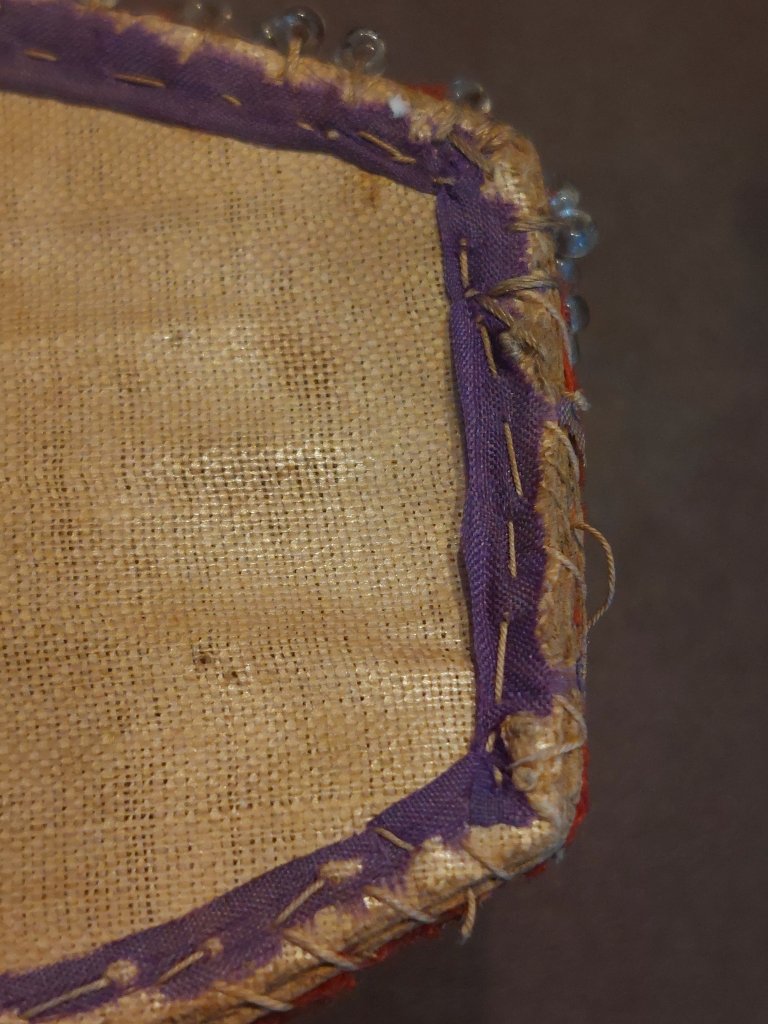
The beaded slipper is most likely a local Haudenosaunee (Iroquois) piece, though ladies magazines did try to mimic the look. At first, I thought the red base fabric was a silk twill. After taking closer photos, I think it is wool, maybe a wool/silk blend.
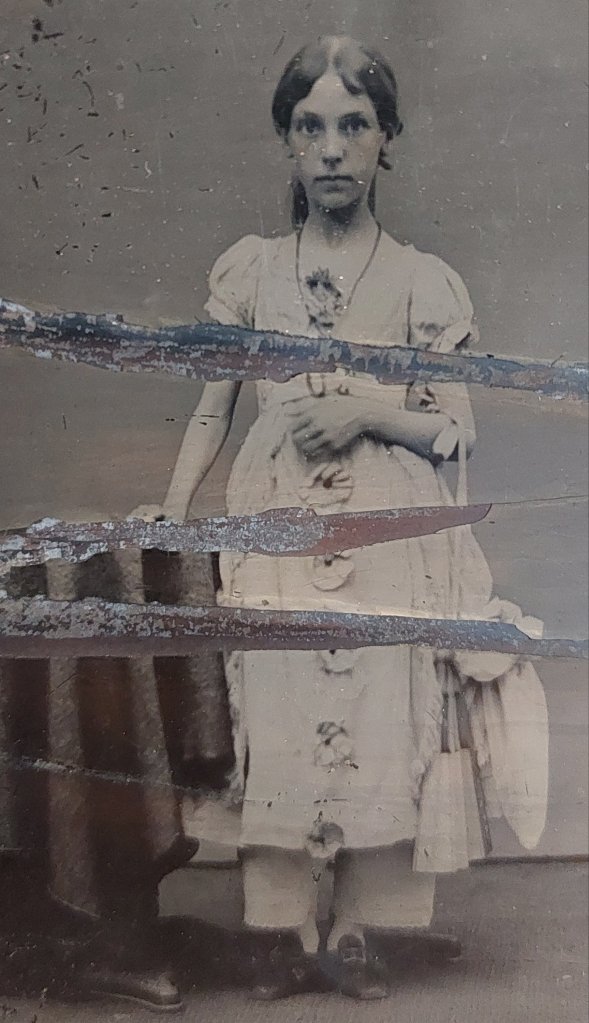
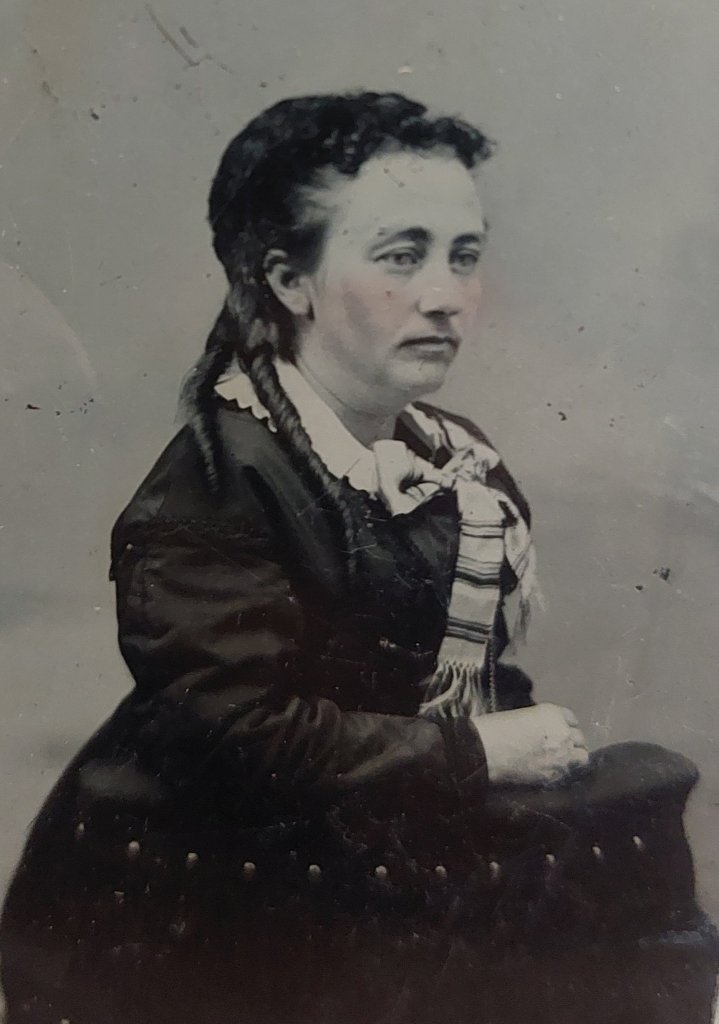
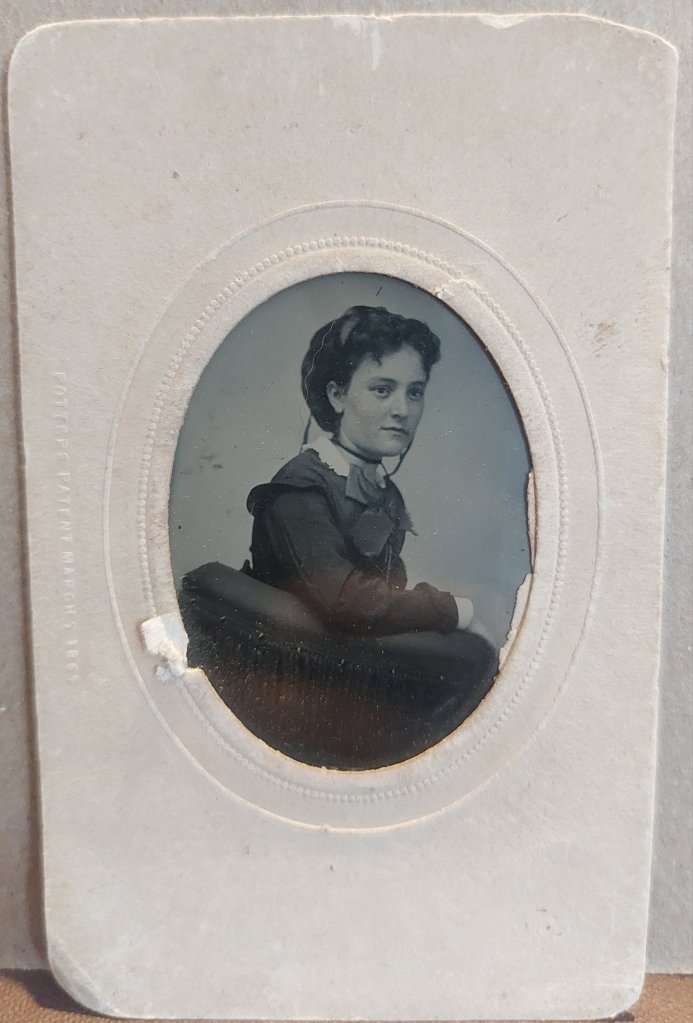
The tintypes were the whole pile for $5. I didn’t even go through the pile to loom at them. I just picked up the pile and added it to mine. They have a lot of damage.
You will see one was folded. This is such a shame because the women’s outfit is amazing. Another of two women either has something on the surface or the surface was smeared. This one has two hats.
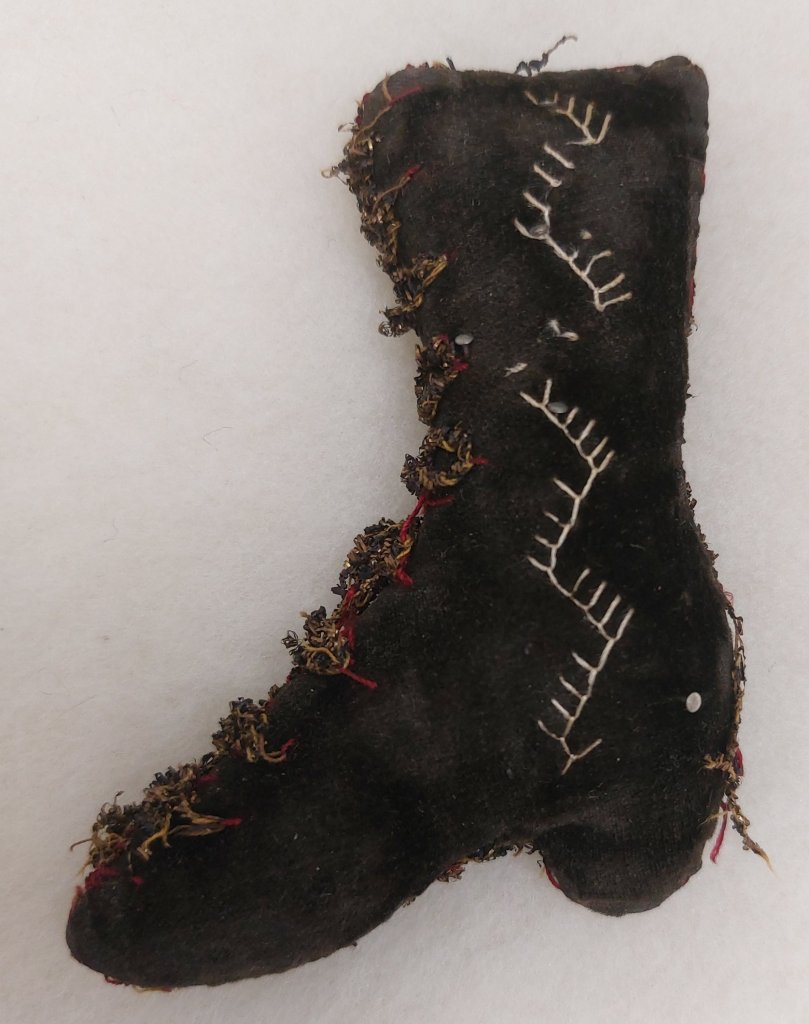
This is an example of a boot shaped pin cushion in my collection. Boots and stocking were fairly common shapes used for making pin cushions and needle-books during the Victorian Era.
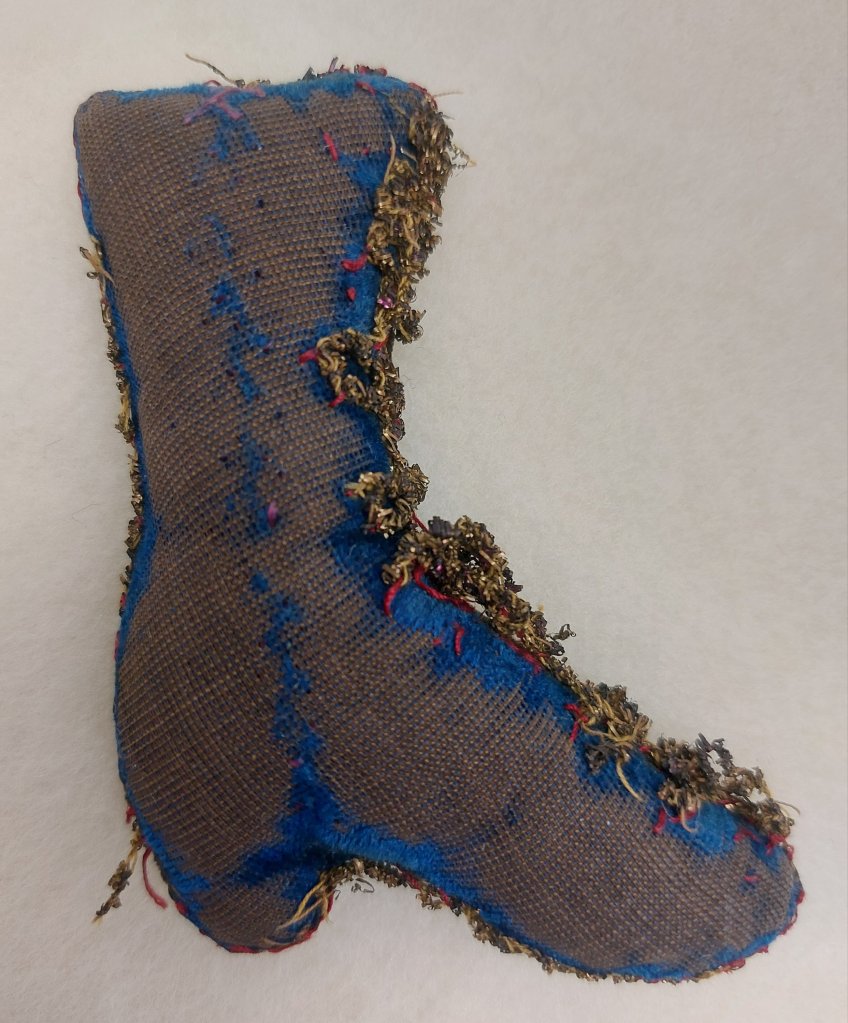
The boot is about 3.5 inches tall and 2.5 inches wide. This cushion is quite weighty for its size, weighing 2.6 ounces. While the piece is too delicate to squeeze to determine the filling, I suspect it is filled with bran or dense sawdust. It seems too large to be filled with emery, though the weight and solidity feels right.
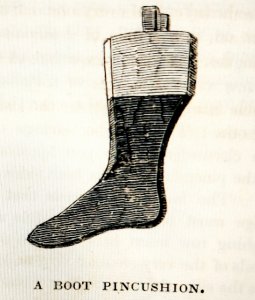
From An American Girl’s Book – Cut two pieces of paste-board into the shape of a boot, in length equal to that of a grown person’s middle finger, or larger if you choose. Cover them with black silk. Put between them several pieces of flannel, cur into the same shape. Unite the two sides of the boot, by inserting, between the edges of each, a binding of black gallon. When this is done, cover the top or upper part of the boot, on both sides, with a bit of thick buff-coloured ribbon, about and inch or and inch and a half broad, to look like the light leather tops on real boots. The. Sew on, at each side of the top, a loop of buff-coloured gallon, to resemble the straps by which boots are drawn on. The pins are to be stuck in the gallon-binding that unites the two sides of the boot.
Both sides of the boot are velvet with most of the pile worn away. One side was a vibrant blue, the other a deep brown. It seems to have been constructed with a brown thread while a red thread was used to add trim. From a distance, the trim seems to be a bullion. Under low magnification, the trim looks to be comprised of two narrow, flat, almost straw like fibers, one light and one dark, set on a thick light brown thread. This trim was arranged in altenating loops along the front of the boot to mimic the look of lacing. Bits of trim remaining suggest a single strand of the trim ran around the edge of the boot as well. The “front” or brown side of the boot has a row of fir or feather stitching. The reverse, “back” or blue side, has a short continuation of this stitching at the top of the boot. Holes in running down this side of the boot suggest this embroidery may have once embellished the length of this side as well.
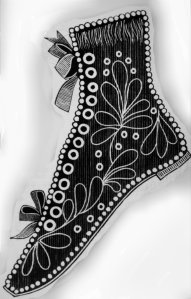
From Godey’s Lady’s Book, 1861 – Boot Needle-Book. This is made by cutting out two shapes in card-board of the same size, and covering them with bronze kid kid, colored leather, or satin, velvet, or silk, any of these materials being suitable. It is ornamented with gold thread in the pattern given. A row of very small pearl buttons is placed up the front, or else a row of gold or black beads. A bow of ribbon is placed where the buttons commence. Both the shapes are worked the same, and the inside are lined with silk. The tops are finished with a fringe, and the two tied together with a bow of ribbon, having the leaves for the inserted between them, and leaving them so as to open.
A few pins remain in the cushion. The placement suggests pins may (or may not) have been used to accent the decorative trim in two ways. A pin remains placed inside a lacing loop hints at the possibility pins were placed to mimic the look of boot/shoe buttons. Two pins remain on the “front” of the boot tucked into the embroidery at the vertices of the Vs
I pulled out my old mini booklets to use for something in the modern side of my life. After folding a stack, I thought I would reshare them as it has been quite some time since I did.
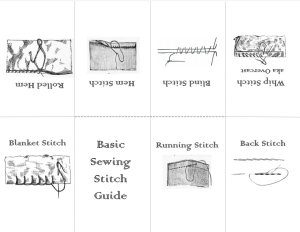
These are quick, guide style references. Each can be printed on a single sheet of paper and folded into a little, pocket size booklet.
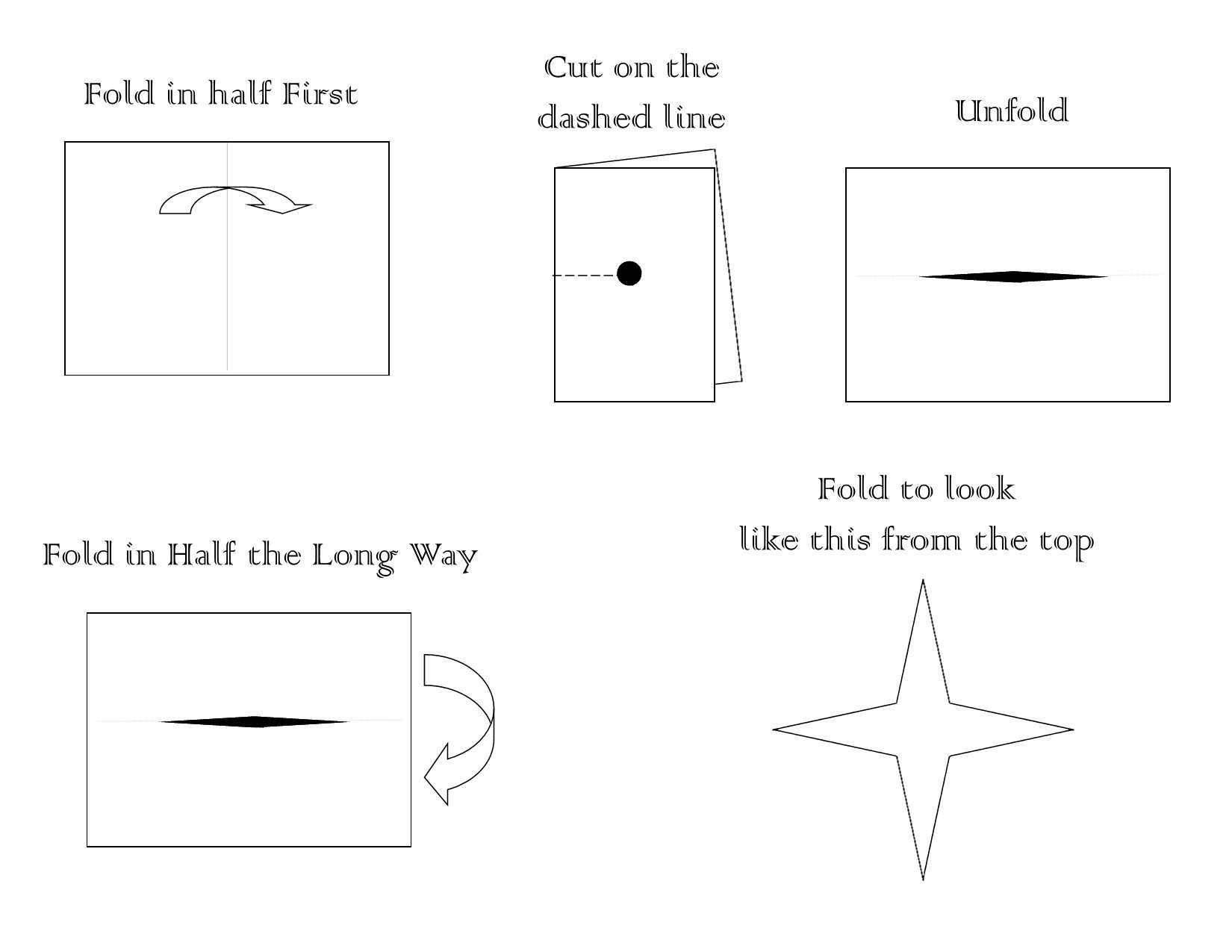
Directions: Fold in half the short wise to cut along the dotted line. Unfold and refold length wise. Fold each side in to the middle. Pull the opposite side out to create a × when viewed from above. Find the front page and flatten into a book. Press with a paper presser or edge of a ruler.
Basic Sewing Stitches
Pleats, Gathers, Gauging, Button Holes
Common Embroidery Stitches
Decorative Embroidery Stitches – Embroidery for Wool Pages
Did you collect shells or stones or nuts as a small child? I vaguely recall being fond of horse chestnuts when I was quite little. The scattered the ground along the front roadside of my Grandparent’s house. Of course, when they fell from the trees they weren’t the smooth, dark, stone like objects but fierce, pointy things with their protective skins ready to stab feet.
My Grandparents liked to collect sea shells. They were organized in a big drawer in the back kitchen. I can’t seem to recall if they were set by size or color or location. Knowing my Grandma and Grandpa, each had a meaning.
Between these memories, I find I view Victorian sea shell and walnut fancy work pieces sentimentally. I can not help but wonder if a pin cushion was made with shells collected and held onto had a special story or memory.
Victorians were quite skilled at creating items out of found objects. Sea shells and walnuts seemed to be quite popular based on written articles and surviving originals. Sea shells both became items, such as pin cushions or needle-books, and decorated items, such as frames and boxes. Their shapes were also copied in pasteboard. Walnuts became items such as pin cushions, boxes, and little bags.
A small pin cushion can be added to a single shell, sea or walnut, or between two matching shells. Velvet seems to be the most common fabric used in combination with sea shells and walnuts. Some are left plain while others are enhanced with painting, often with the stenciling method called theorem. Want to know more about Theorem Painting? I suggest this article.
To make these shell pin cushions, I used the method from A Girl’s Own Toymaker of a cotton inside covered with the velvet on the face and glued in place. Tip: I wrapped thread around the shells and tied snuggly tied to secure the layers while they dry. Once dry, the thread can be snipped and removed.
One of the most involved and intricate fancy work projects I’ve done are the purse like thimble holders made from a pair of walnut shells. The most nerve wracking part for me was doing the holes without cracking the shell. Period directions call for making these holes using a long sharp needle heated red hot in candle light. I ended up drilling the holes with a dremel tool. In hindsight, I over engineered the bag, shaping it to the shell, while the shape disappears as it is glued in place.
Assorted Directions for Using Walnuts and Shells:
The Girl’s Own Toy-Maker (18) Shell Needle-Book. Procure two shells of the same kind and size; perforated nine small holes round the front of the top one, at equal distances, about half an I ch from the front, and two more at the top part of both shells. Take a narrow piece of sarcenet ribbon, put one into the left hand hole and fasten it there, then the front of the shell, under, and through the second hole, so on to the last, and fasten it off. Cut out pieces of fine white flannel I. A little less, and also the form of the shell, bind it round with the same ribbon; putthese inside, and with another ribbon tie them together through the four holes at the top a neat little bow. For the strings in the front some more of the same blue ribbon, and after fasten to each shell, tie together in a little larger bow.
The Girl’s Own Toy-Maker (18) The Shell Pincushion. Many of this kind are extremely pretty, and are easily made. Take a piece of calico, and cut out a pattern of the shape of fig. 2, and large enough to go round just inside the shell; cut another piece, fig 3, sew them together, leave a small hole to put in the bran; fill it, and stitch the remaining portion. Take a piece of blue or red velvet, the shape of fig 2, and sew it all round. Glue the two shells to the cushion, then finish it off with a small bow of the same colored ribbon as the velvet. (Note: Fig 2 is an elongated petal shape the width of the desired shell opening. Fig 3 is best achieved by tracing the shell and adding seam allowance.)
Needle-book. – This we think a very captivating pattern. The five leaves that form one side are covered withgreen silk, gathered in the center and veined with gold beads. Each leaf is bordered with a cross-stitching of corn-colored silk, and edged with chain-stitch. It may be lined with crimson, and the white flannel leaves thathold the needles inside edged with crimson in buttonhole stitch. Over the joining of the leaves is placed the half of an English walnut shell, the perforations necessary for attaching it each covered with a large gold bead. Theribbon bows may be either green or brown. (The Lady’s Friend, 1864 https://hdl.handle.net/2027/umn.31951000753433o?urlappend=%3Bseq=486%3Bownerid=13510798903022 398-512 )
Children’s Fancy Work, 1882
Dainty little pincushions and thimble-case can be made out of walnut-shells. Scrape the inside of the shell till quite smooth, then stuff a little bag of some bright-coloured materials with wadding, making it as nearly as possible the shape of the shell; sew to this a handle—a bit of narrow capwire, covered, answers for the purpose—then drop a little liquid gum into the bottom of the shell and press in the cushion. This can be supplies with a pedestal in the following way: – Take two walnut-shells and pierce a couple holes in the centre of each (A red-hot iron meat-skewer or knitting-needle will do this beautifully.) Now place the shells together against each other, and tie them together with a string or fix them with wire. In the upper half the cushion is placed; the lower forms the stand. For an emery cushion take two halves of a walnut-shell and having scraped the inside, brush over the outside with copal varnish. In both halves make narrow slits in the middle of the sides. Fill a little coloured silk bag with emery-powder and gum it into one half of the shell. Then join both halves of the shell together by means of a ribbon the slits in one side, and tied in a bow on the outside. Through the openings on the other side draw another piece of ribbon six inches long. This serves to open and close the walnut. A thimble-case is easily made of one half of a shell lined with pink wool stuck on with gum, then inclosed [sic] in a tiny bag of its own shape, but large enough to admit being drawn closely over the opening with a running cord.
Children’s Fancy Work, 1882
Toys made from walnut-shells will please the little ones, and the making of them prove no less enticing.
….. Nos 54 and 55. These two illustrations show a pretty little toy, the “Surprise” Basket, closed and open. Two exactly– fitting halves of a walnut-shell are scraped clean and lined with pink or silver paper. Holes should be carefully drilled all the way around in both shells, and then a frill of narrow lace sew round each for the outside and round the inside of the lower one. This is effected by putting the needle through the holes. The edges are then bound with pale blue silk so put on that the stitches do not show. In the lower half of the shell is a tiny wax or china doll with a tiny quilted covering over it. In the upper shell dolly’s tiny wardrobe is packed. The shell is closed by means of pale blue ribbon, a loop and end being sewn to each half.
I decided to set pricing similar to what it was 5 years ago: 1 for $24 A pair for $45 A trio for $60
This year’s strawberry batch is ready!
Now, I just need to photograph and list all of them.
As a treat for tonight (Friday night 🌙) I listed one trio of strawberries and one individual strawberry early. The rest will be available this weekend as I get them photographed. Note: Tonight’s listing include the two extra large strawberries I made in this batch. I can only make more this size if I get more caps.