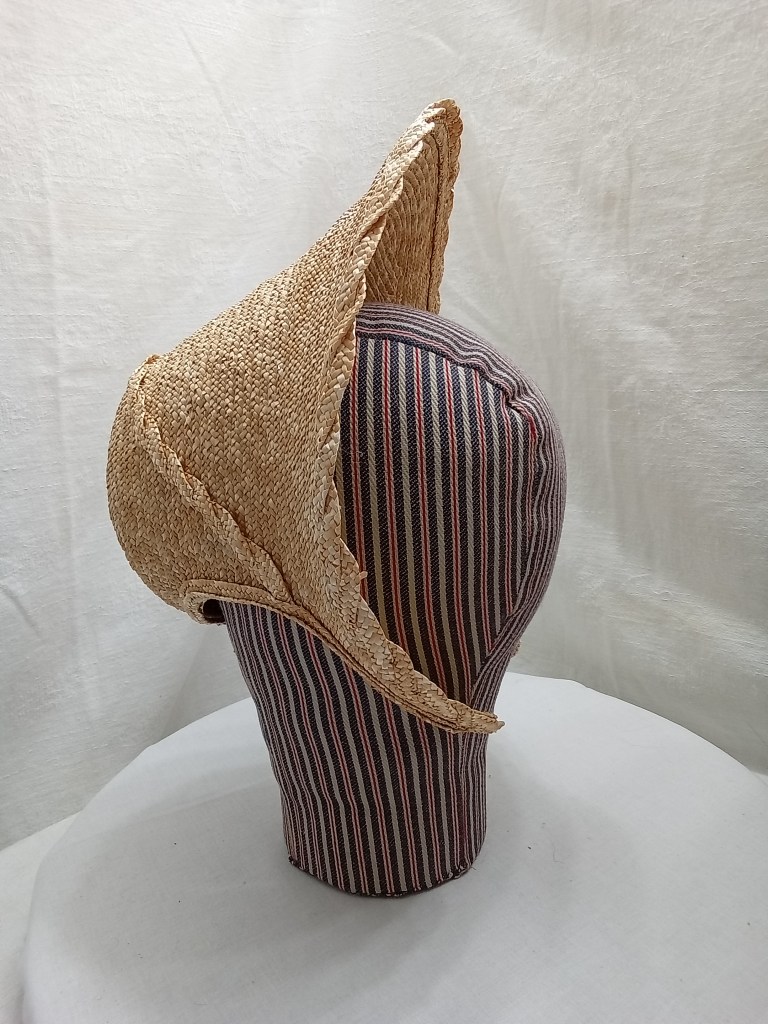
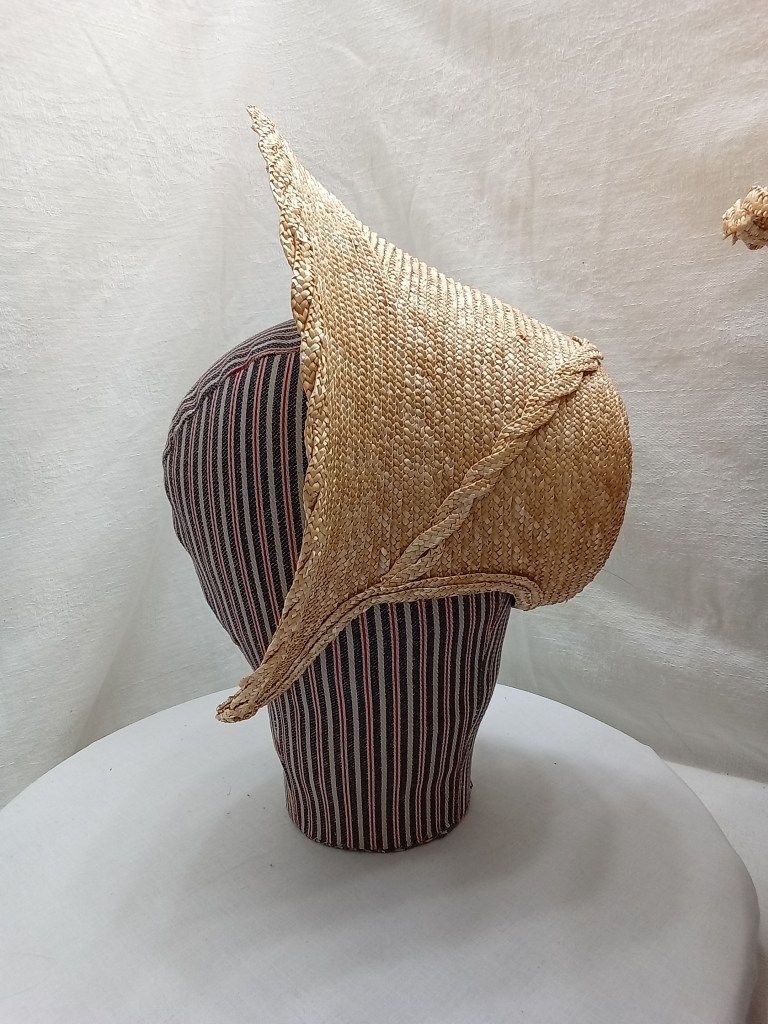
Maybe I am just being hopeful with the rain all week…. but…. I see a flower in the tip of this bonnet.
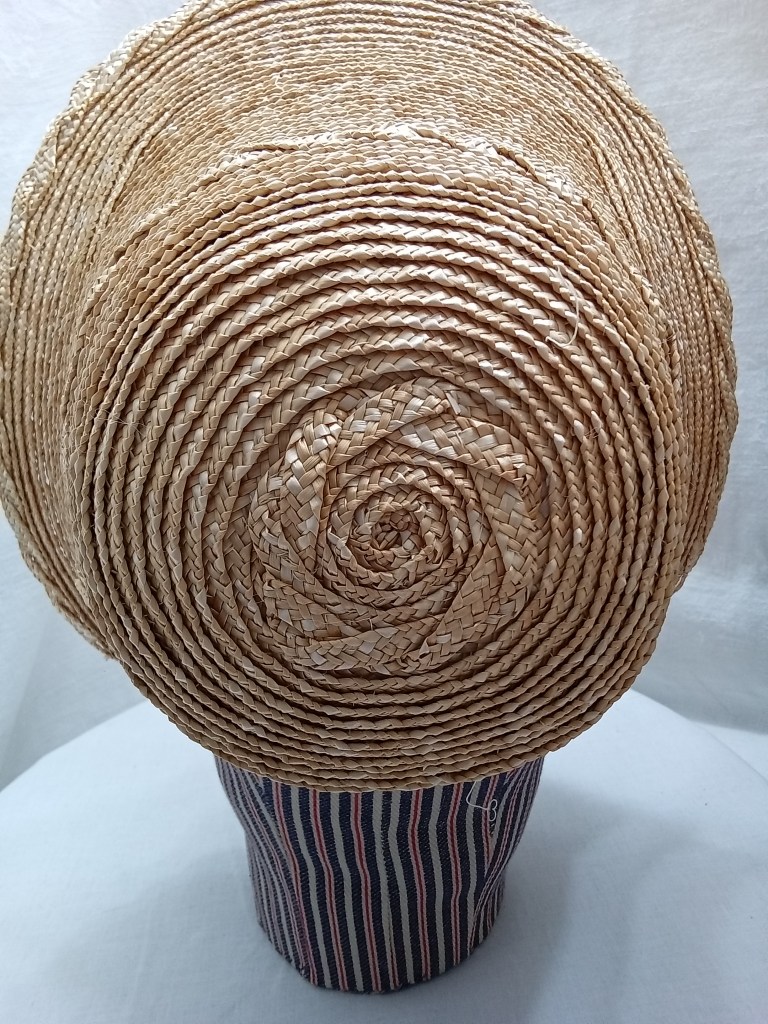


Maybe I am just being hopeful with the rain all week…. but…. I see a flower in the tip of this bonnet.

I am preparing for two upcoming events, two very different upcoming events.
In two weekends, I will be discussing how dolls were used in Victorian Fancy Work. The day will be spent demonstrating how a broken doll can become a pen wipe or pin cushion. I will wrap up the day with a presentation “The Little Companions of Ladies: How Childhood Playthings Became Adulthood Helpmates.” This discussion looks at how dolls transformed from childhood playthings to adulthood helpmates as pin cushions, pen wipers, and other forms of fancy work. We will explore the workbasket pages of popular women’s literature and original pieces of fancy work.

The very following weekend, I will be doing my Women’s Employments interpretation. With the very quick turnaround and timing being while school is in session, I have a new twist. Instead of fully transforming the insurance office into a millinery shop, I plan to be unpacking the new millinery shop through the weekend while searching for a millinery assistant. The latter gives a chance to discuss the qualifications and role for the position. The former allows for stacks of bandboxes and not as many finished pieces.
I have two more events in the active thinking and preparing stages. 🤔 I will share information on those soon.
This weekend, I am hoping to have all the materials for the first event out and ready.
I also hope to sell three millinery pieces and ten copies of To Net, or Not to Net, which I put on sale for the end of the month. Fingers crossed.
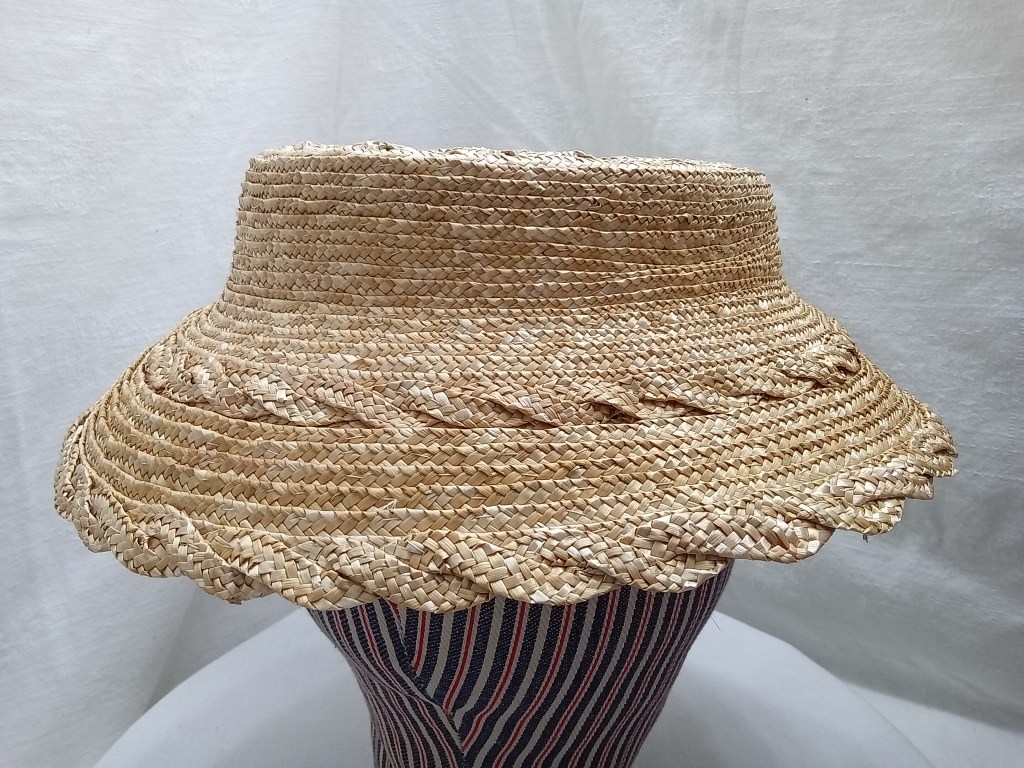
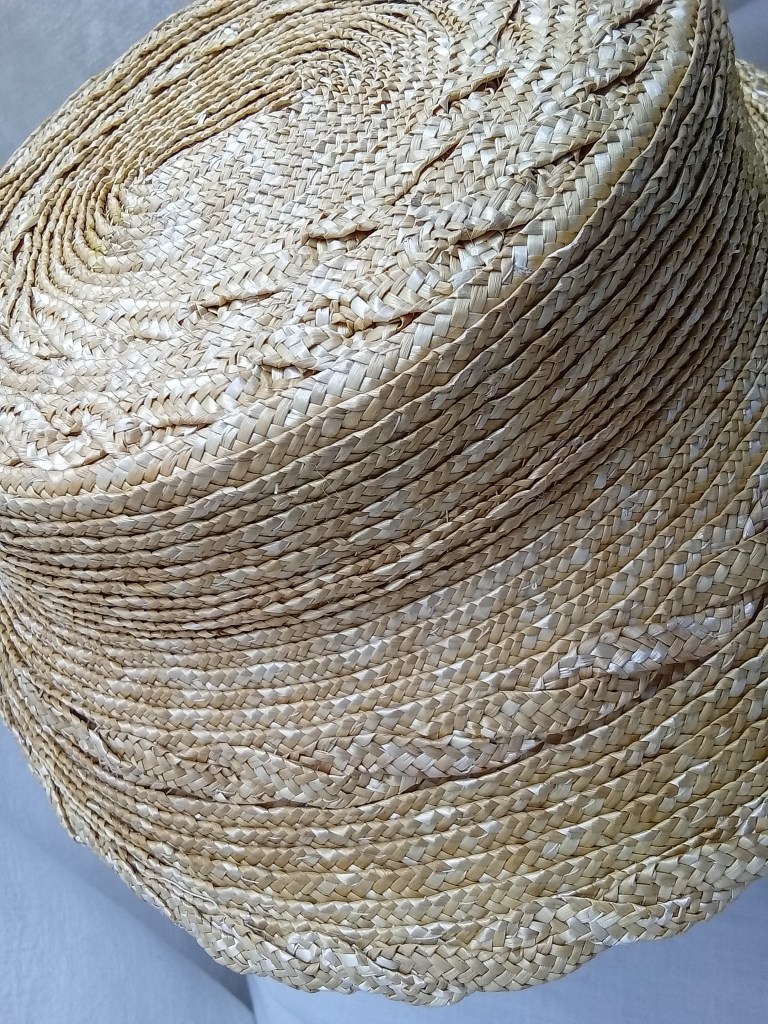
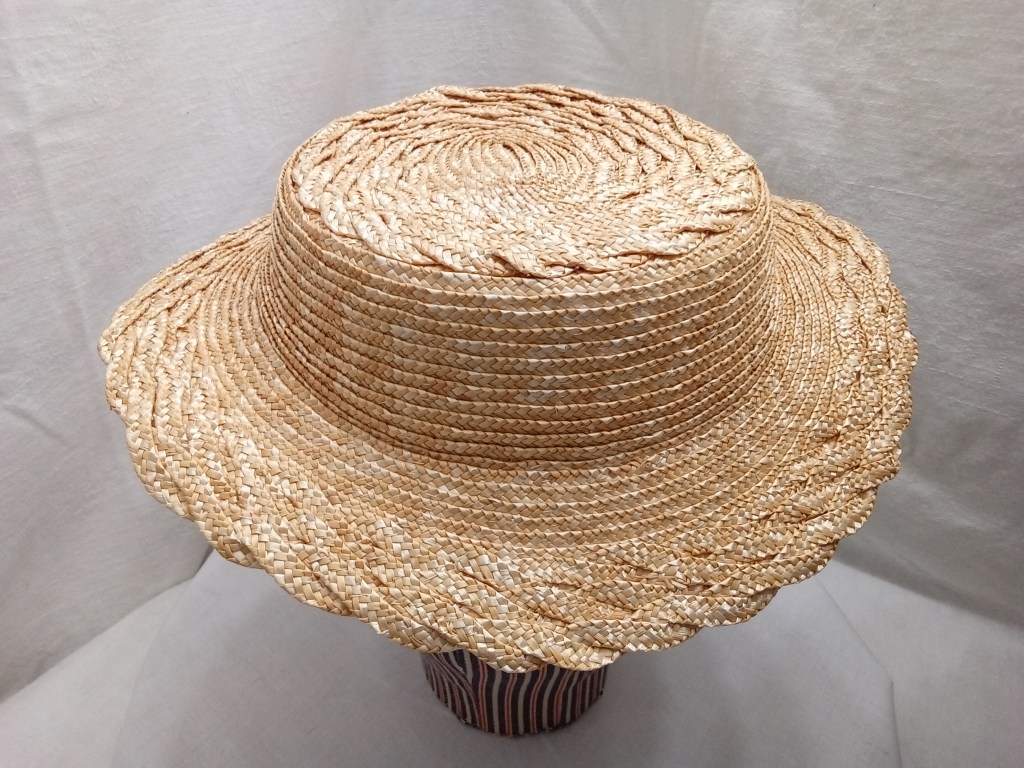
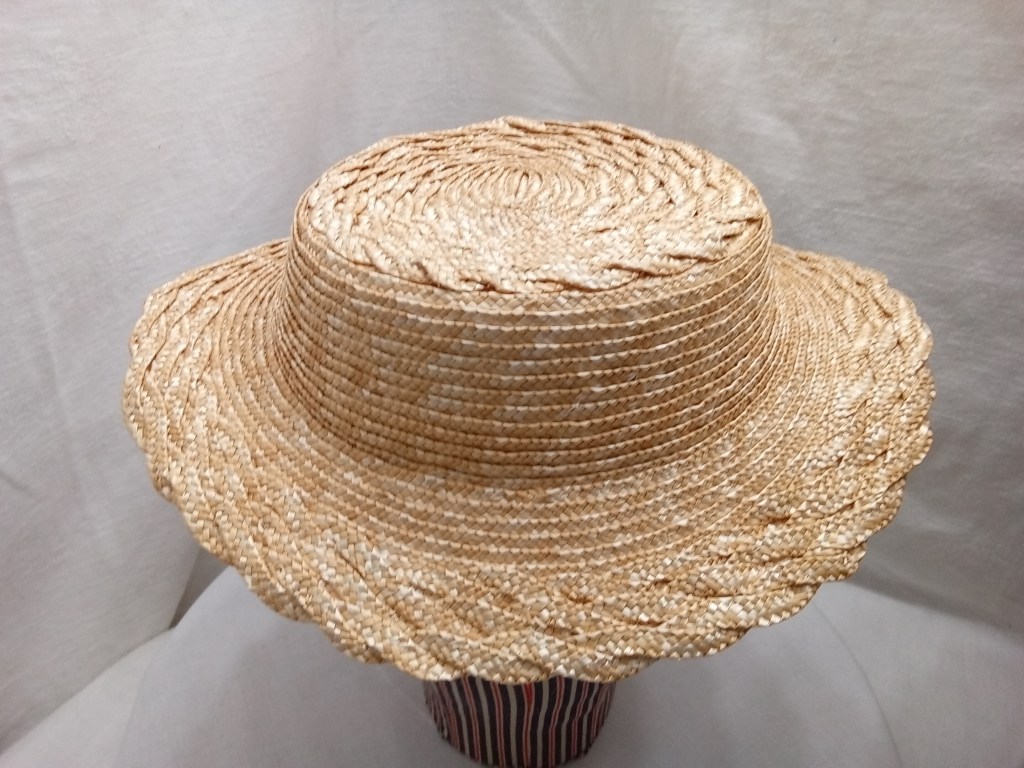
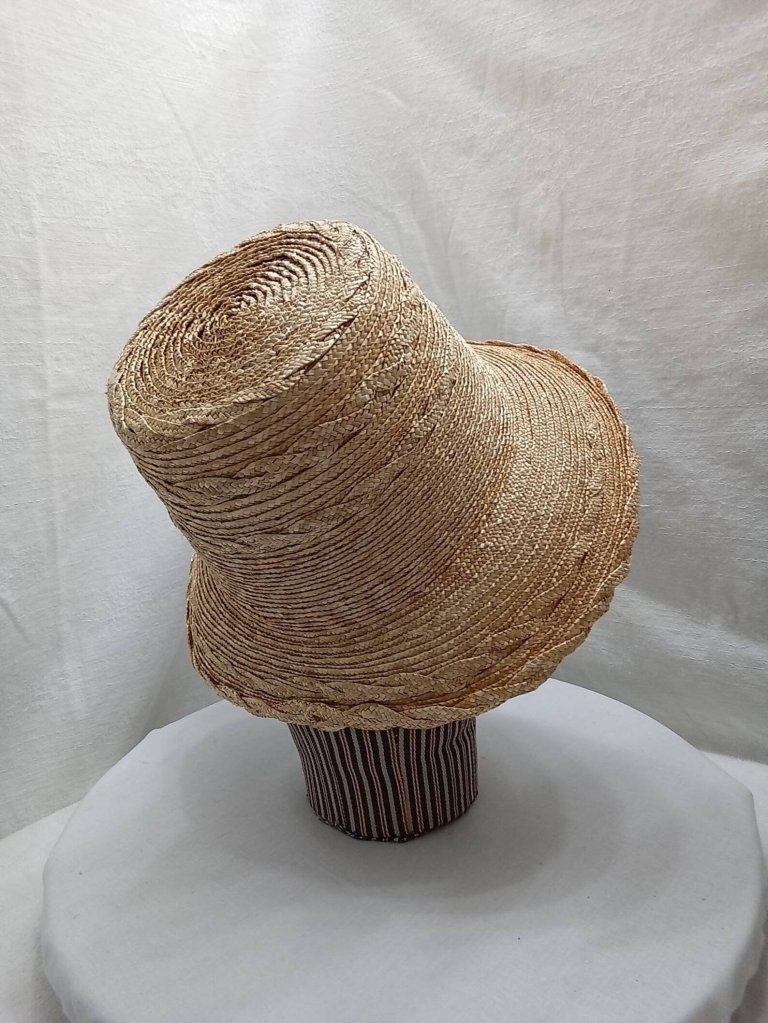
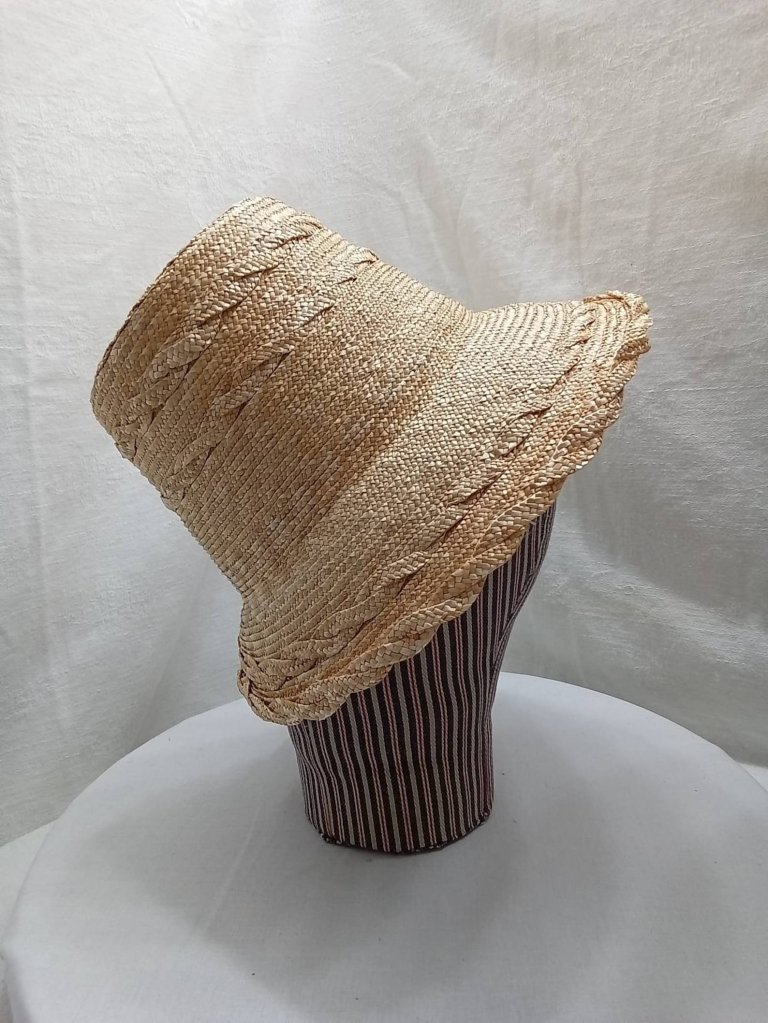
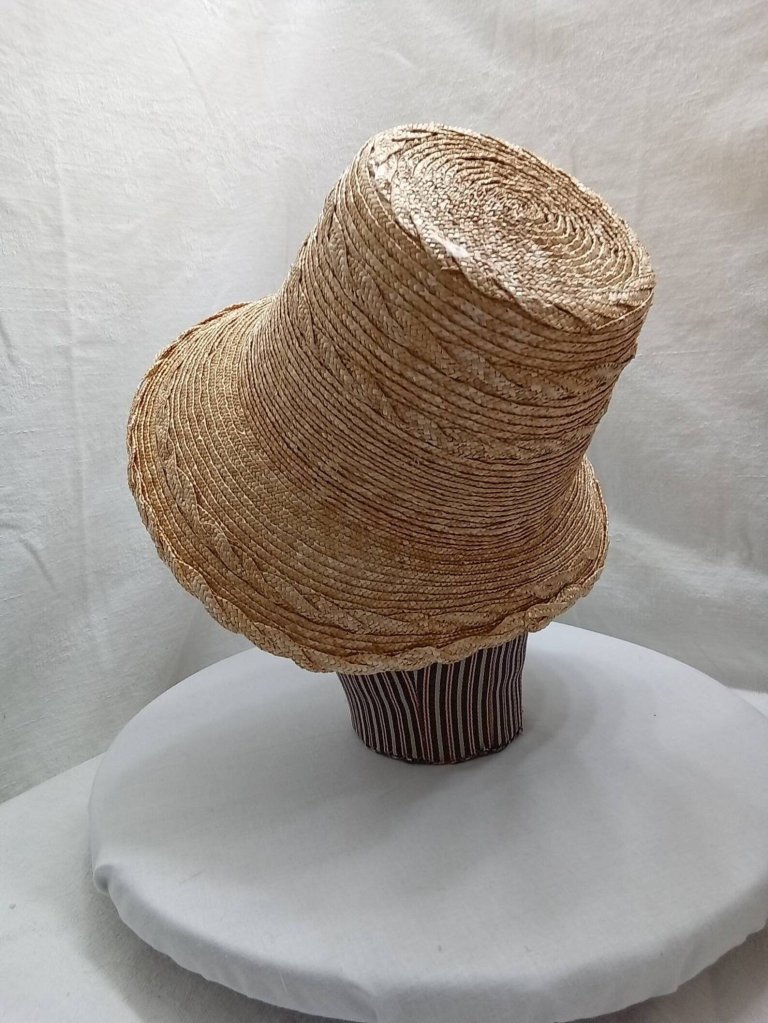
This straw had a mind of its own. As I worked the vining around the brim. The brim curved into this pretty dome shape. I rather love it. I hope you do too.
The crown is 20.25″ around the inside, suitable for an average head.
I have written a couple posts in the past about caring for or storing our bonnets. Lately, a few specifics “uh-oh” fixes have been asked of me. So, I thought it would be good to put together a more detailed article on millinery care and first aid. Here I will be talking about Straw millinery only.
Preventative Care Your Bonnet
The best prevention is to store a bonnet or hat on an archival stand, under a glass dome with its own security system. ….. A dream, right?
(If I could have all the storage space in the world and start over – I would attach two stands to the inside of the lid of a tote (I think they are the 15 or 20 gallon totes) With the lid as the bottom, the tote becomes the top. I could then place a bonnet on each stand with the ribbons rolled up. No wrinkles, no dust, no issues. Again, that is my dream.)
I’m going to boil this down to my list of dos and don’ts:
Do – Keep you hats and bonnets on stands
Do Not – Use foam heads for storage. These will release chemicals that will discolor your bonnets. Even covered with other fabric this can happen.
Do – Cover your bonnets some how to keep dust off of them. Yes, a box is best.
Do Not – Store in overly moist or overly dry areas. Moisture can cause mildew, mold and color issues. Dryness can cause silks to shatter.
Do Not – Store a bonnet on its face, side or bavolet. This will cause crushing, wrinkling and misshaping.
In Case of Mishaps
Rain – A gentle sprinkle can usually be okay with a gentle drying while on the bonnet stand. If you find you were stuck in a heavier rain with your bonnet on, first remove all flowers and ribbons from your bonnet. Hang your flowers upside down. I have this awesome stand from Wilton that was meant for cake making that works great. You may want to use clothes pins to hang them from a clothes hanger. Lay the ribbons flat to dry on a paper towel or old towel as not all ribbons are color fast. You may find you want to remove the bavolet as well. Lay it flat, net side up. Most bavolets can be pressed with the aid of a pressing cloth once dry.
For the bonnet itself, press any mishapings out with your hands gently against the counter if need be. Take a roll of paper towel. Unroll it to about the size of the tip of your bonnet. Place the bonnet face down on top of the upright paper towel. If you left the bavolet attached, let it lay open but not touching the bonnet. Arrange the pleats and work out any wrinkles carefully with you hands. Allow it to dry completely. In the case of a hat, you may need to shape the top of the paper towel roll to reflect the curve of the crown and lay a layer or two of towels over it to make a smooth surface.
Reattach the ribbons and flowers.
Wrinkled ribbons – Ribbons get wrinkled and crinkled when tied and untied. Bonnets should be stored untied with the ribbons neatly rolled into a coil. (I even roll some of mine around little ribbon pillows I’ve made.) Rolling the ribbons will help coax the fibers that were inside in the bow to relax back where they should be while keeping additional wrinkles from forming.
If you find your ribbons to be holding their wrinkles, you can steam them to help relax the wrinkles then roll the ribbon. You can also try pressing the ribbon with an iron using a pressing cloth. (Most silk ribbons are vintage with older fibers, while newer ribbons, even high quality ribbons are a combination of rayon, polyester and nylon. A low temperature and pressing cloth is safer than ending up with your ribbon stuck to your iron or breaking.)
Squashed Flowers – a Flowers can become squashed during wear or storage (or oopses). For velvet flowers, I find a light spraying of spray starch and reshaping with my fingers works best. Spray just a small area at a time, 1 or 2 square inches at most. The petals should be barely damp, not wet. Gently work the damp petals and leaves back into shape. Allow them to dry fully. If you have removed them from the bonnet or hat, clip the flowers to something so they stand up to dry.
For organza or other faux silk flowers, a light steaming may work to help coax the fibers in the petals to be manipulated and reshaped. Allow them to dry fully as well.
Crushed Frill – a A slightly crushed frill can be steamed and reshaped with the aid or a bodkin or hair pin. A severely crushed frill needs to be removed and pressed with an iron. Silk organza or cotton organdy should be able to be pressed on the designated setting. Lace should be pressed on a low setting with the aid of a pressing cloth. I try to press the frill while it is still pleated. (un-pleating and re-pleating is timely.)
Crushed or Shattered Straw – This is a though one. I’ve had a couple people ask me about bonnets that have been sat on or crushed in baggage. If the straw is not completely broken just misshapen, I suggest removing the flowers, ribbons, etc. Dampen the area(s) that have misshapened. Reshape the area(s) with your hands. Use objects in your kitchen for support if need be. Allow the straw to dry fully. If needed, mix some millinery gelatin or white glue & water (1:1) and brush it on the area for firmness and strength.
If a single or only a couple straws have been broken, it may be possible to replace or support those areas with additional plait if a matching plait can be found. To support, clean the break with fine scissors or nail clippers so the cut is along the diagonal of the plait. Unpick the stitches connecting that row of plait to those adjacent. Cut a piece of straw 2 or 3 inches long with diagonal cuts. Slide the piece into the fracture. Line it up carefully. Sew the piece into place catching the layers and the broken strips.
If multiple rows of plait are broken or it is a woven straw, the best chance is to realign the straw (dampened) and support it from the back with sinway or a piece of woven straw. The front of the straw will need the aid of a bodkin and/or tweezers to get the right look. You will want to use millinery gelatin or a glue solution to firm up the realigned straw. I would only recommend this if purchasing a new one is out of the question as it will be very intensive.
Dust or Cobwebs – If you store your bonnet or hat on a stand, you may get cobwebs. My favorite solution is a can of spray air, like the kind used for computers. Spray gently and at an angle.
Squashed Bavolet– A bavolet can get squashed during storage. If this happens, Turn the bonnet upside down. If need be, tie the functional ties together and hang the bonnet from the loop. Steam the bavolet encouraging it to flop over the tip and sides of the bonnet. Steam both the silk side and the net side. Smooth out tough wrinkles with your hands. Once the bavolet is back in shape, let it dry fully and spray with spray starch.
Are you one of the many readers enjoying my millinery blog posts?
Consider becoming a Patreon patron. Doing so helps support my work and helps me write more useful articles.
https://www.patreon.com/AMillinersWhimsy
It seems I was in a vining mood this week. Both, the hat and bonnet I ,are this week have straw vining around them. I picture these decorated with garlands of spring blossoms, maybe some apple blossoms or cherry blossoms.
Don’t miss last weekend’s Regency era bonnet:
Or one of the 1870s capotes:

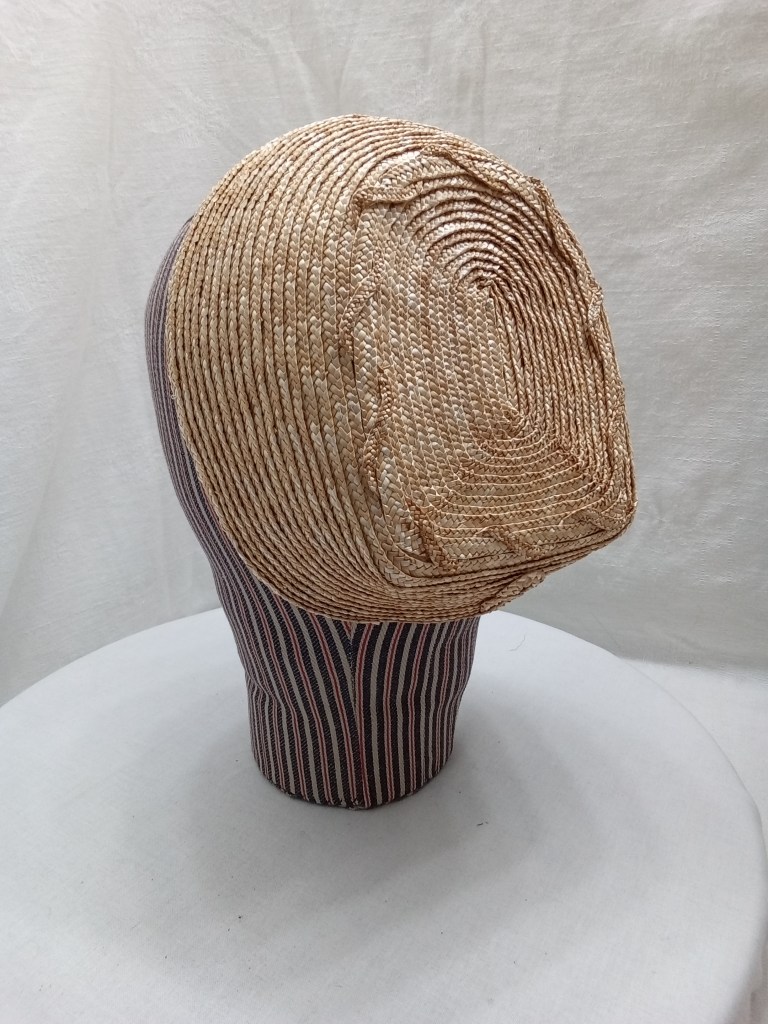
Vining straw winds around the crown and brim of this Regency style bonnet. The crown rises with a taper, with vining around the sides and tip. The lower portion of the crown does not have vining as I picture ribbon there. The brim has a soft curve to it with two bands of vining, including the edge.
You may have noticed some missing images in posts. I apologize for this. I think it is either the new Jetpack app WordPress is using or trying to copy posts from the classic format to new format. Either way, any time I try to fix it from my phone, it gets worse. I will try to fix it asap. If you notice a glitchy photo/post, please let me know so I don’t miss one. Thank you for understanding.
Sunday morning, I did a short Reel about one aspect mass-produced 1850s-1860s style bonnets get wrong. Then, I quickly realized I have much more to say on the subject. I need to get my hands on one of the mass-produced bonnets to really show people what I am talking about. Until then, here is Sunday’s Reel (moved to YouTube. )
~~~This is one of the many wonderful bonnets found in the Susan Greene Collection at the Genesee Country Village. (To see some of their ribbons, be sure to hop over to the Millinery Ribbon Blog.) ~~~ This straw bonnet shows a great many things from the over-all spoon bonnet shape to the shape of the cheektabs to the fineness of the straw. I would like us to look at the bavolet today. We also know the bavolet as the “curtain.” The bavolet is a fabric or ribbon pleated into the back neckline edge of a bonnet. This can resemble a flounce in that the top is drawn in while the lower edge floats or flares out. The bavolet can, but does not need to be a single material as we see here. It can be made of layers of silk, net and lace. Some high-end fashion plates show beading as well.

(Honestly, I don’t think I could handle beads dangling on my neck.)
~~~The construction seams on the underside are covered by a net. Net is used to give the silk bavolet more body and fullness. It is sewn so the net is not seen from the outside and pleated into the bavolet. The bavolet reaches all the way around the back of the bonnet (the tip) and up along the sides while the lower edge connects to the cheektabs.
*The section of ribbon that decorates the exterior of the bonnet can be on the grain or on the bias. The ties need to be on the grain. To see a nice example of the ribbon decorating over the top of the bonnet, see this MFA example that happens to have the bavolet on the grain. Notice how the bavolet flops more than floats.
A couple weeks ago, I decided to try making informative mini videos with reels. Just this morning I realized I can download them and shared them on YouTube. (Again, time travel put me behind the times.) Here are the first three millinery reels. There will be more.






 If I Had My Own Blue Box: