June 2015 – I am receiving an increased number of requests for information on particular chairs and appraisals. While I love to see original chairs, I am not in a position to give advice on the value or restoration of chairs. I simply find patent furniture to be a fascinating research subject.
Here is some information that will hopefully help if you are considering a folding chair….
This 1855 Patent is one of the earlier 19th century folding chair patents. It has a simple side X construction with a slight curve in the back to leg piece. The seat is solid with a cushion set in.
 This chair from the New York State Museum, is circa 1866. This walnut chair was made in NYC by B.J. Harrison And Company. The museum’s descriptions is as follows “32 1/2 x 16 x 17 in. Curved crest rail above two side rails ending in molded rear seat rail. Beneath this are two dowels fitted to another molded rail. Oriental-type rug seat (not original).” The seat folds up with a side X pivot while the back folds down. A similar chair construction can be seen in this 1863 Patent.
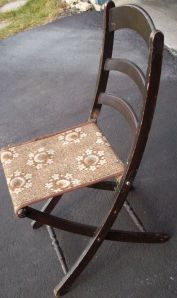
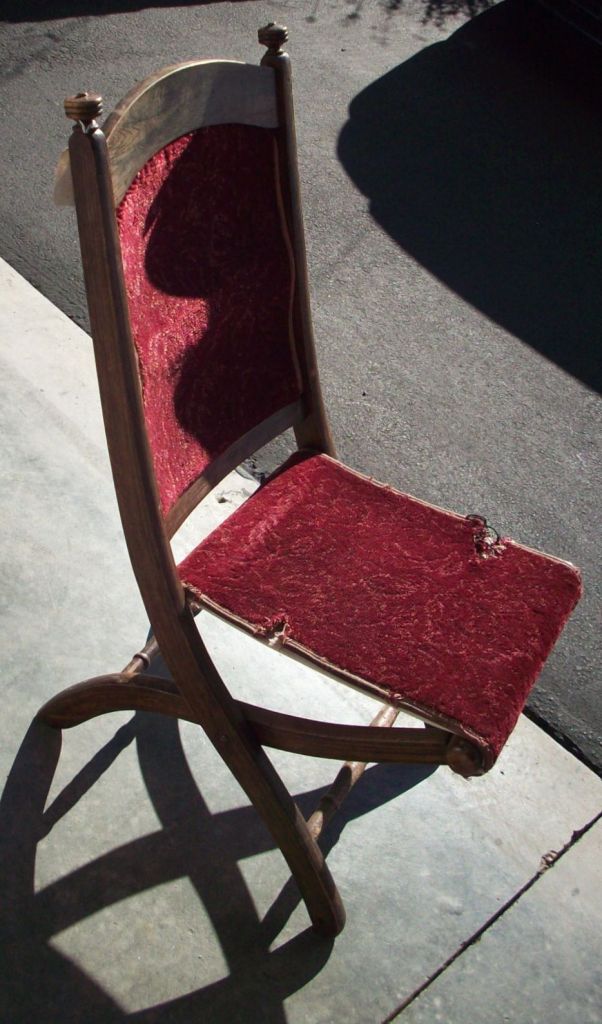
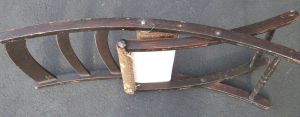 This circa 1860-70 chair is Marta Vincent’s. It has been repaired and recovered from the naked state in which it was found with the finish was completely worn off and the carpet seat was in tatters. The back splint has been replaced. The seat is now a piece of ingrain wool carpet supported by canvas.
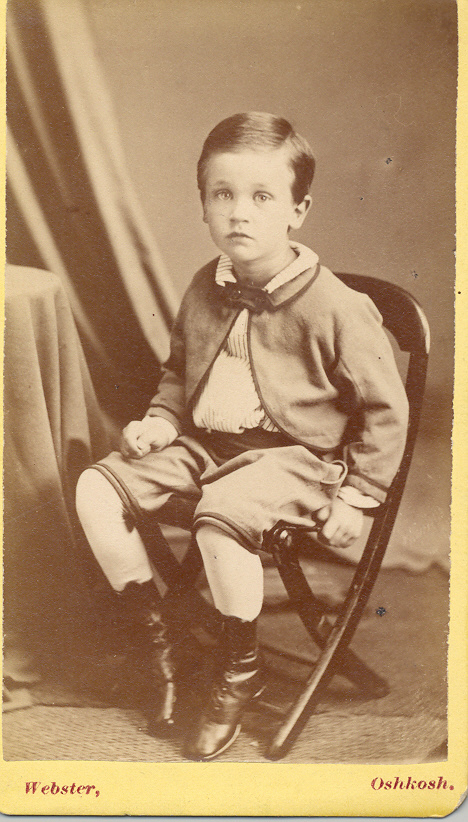
Martha’s above chair is a similar folding shape as the chair in this post war photograph
 The shape of this chair’s curved pieces making the side X construction seen in many full-size chairs attributed to those who worked with Vaill. This construction can be seen in this 1870 Patent 1.
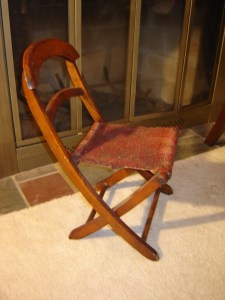
Added March 15th, 2010: A reader contacted me about a chair coming from a private collection. She has been kind enough to share this lovely child’s folding chair which looks much like the one in the photograph above. This chair has a great glowing patina. Notice the darker areas where the chair would have been picked up and carried when folded. The carpet seat is in good condition with deep reds and greens in a large, well centered design. The curves of the legs tend to suggest it was made by someone who worked with Vaill. The back piece is curved nicely while appearing quite solid.
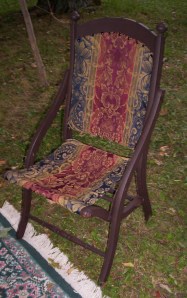
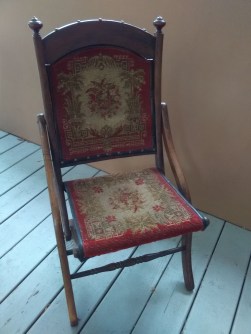
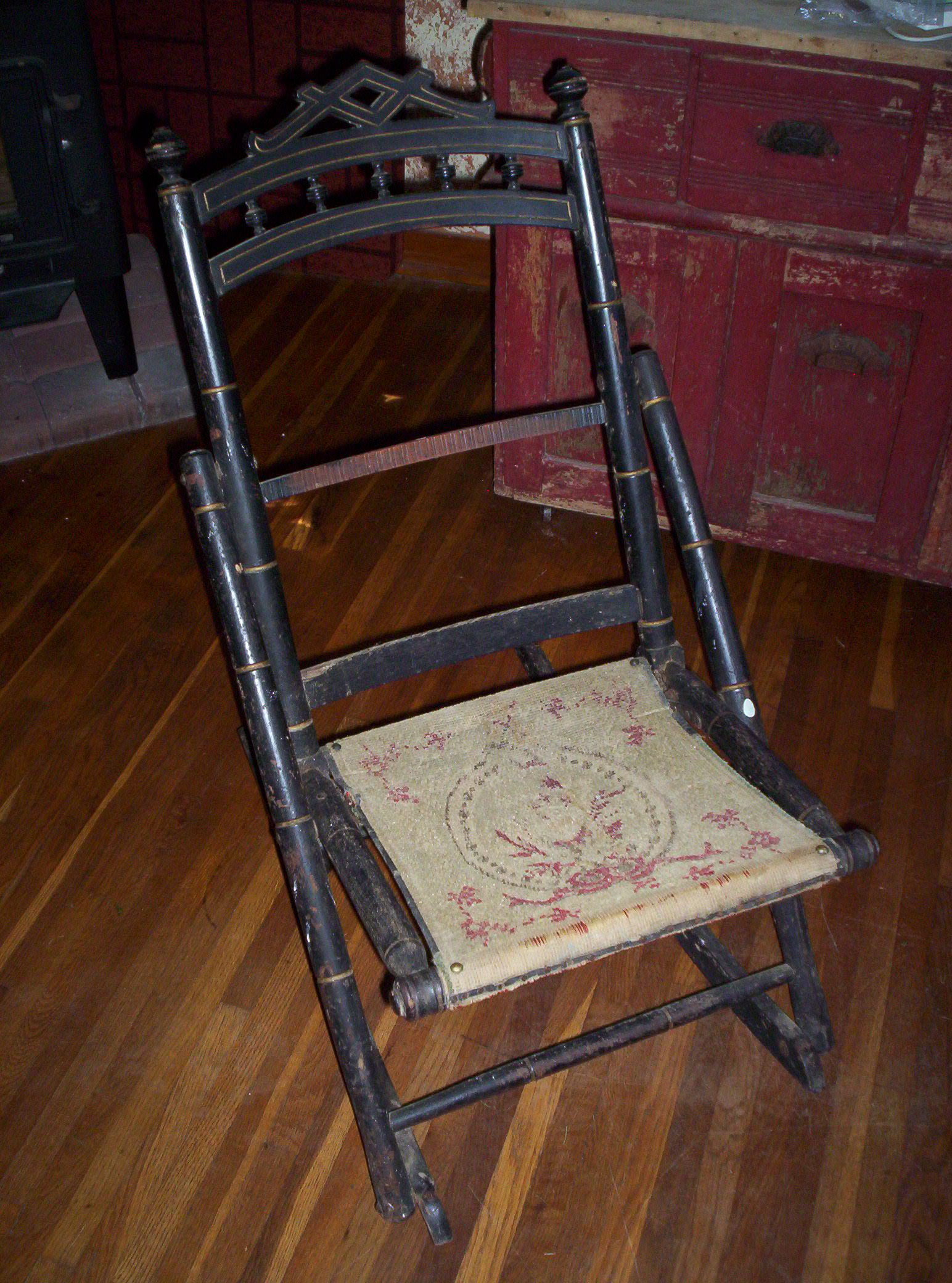
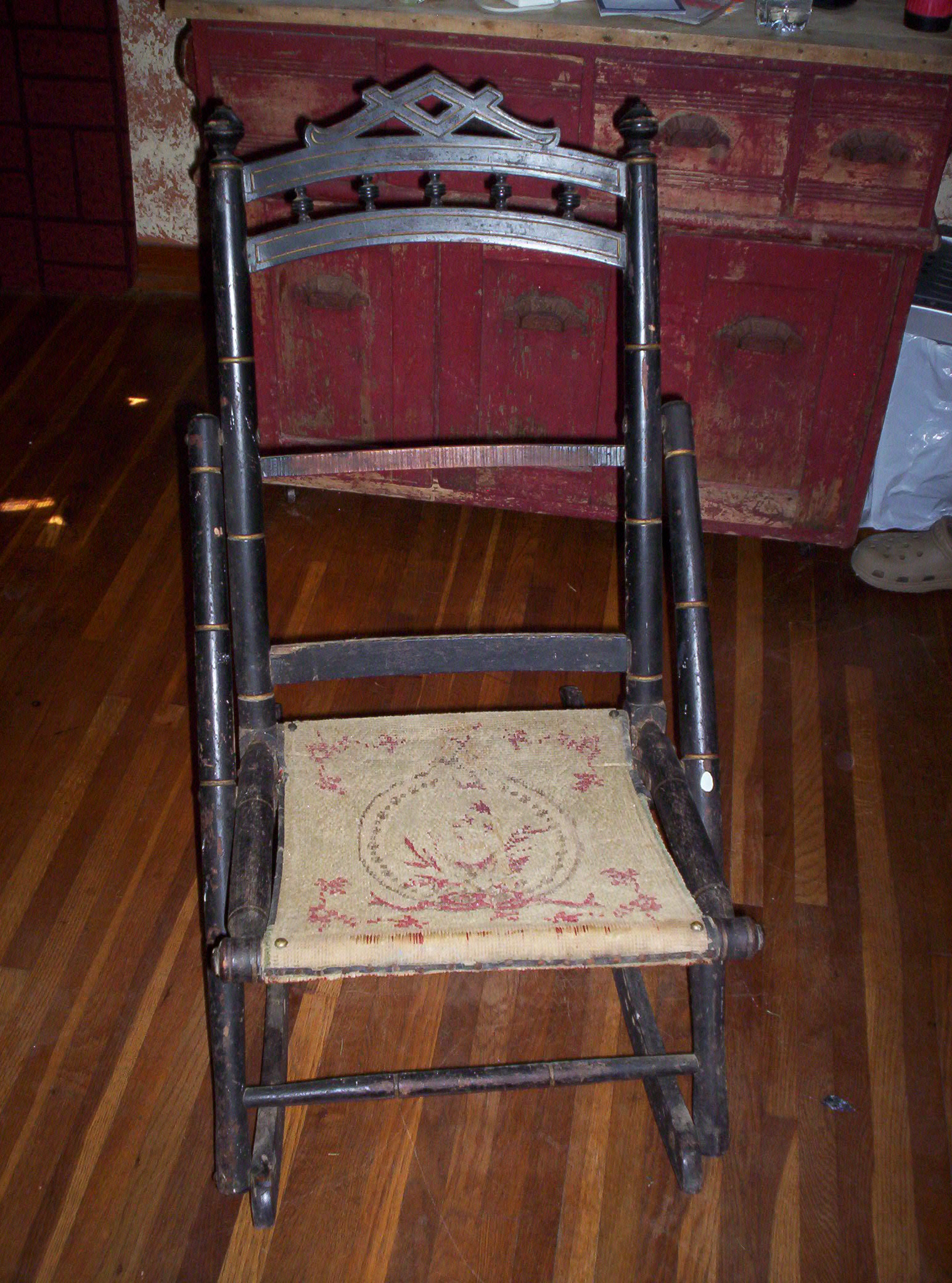
Circa 1870-90. These chairs were manufactured by Edward W. Vaill. It is a side X construction with a second pivot point on the back and a hinge on the lower back leg. The top chair has an incorrect material. The bottom chair shows a floral or scenic design done in tapestry, possibly original or a replacement. In both cases, the wood is likely walnut Notice the curves in the leg and cross support piece. Also notice the turned finials on the top. Both chairs have paper labels found on the front cross runner underneath the fabric. The construction of this chair can be seen in this 1875 Patent by Wakefield, assignor Vaill. This is a similar patent from 1876.
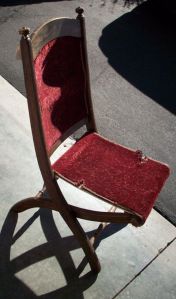
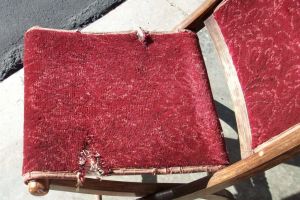
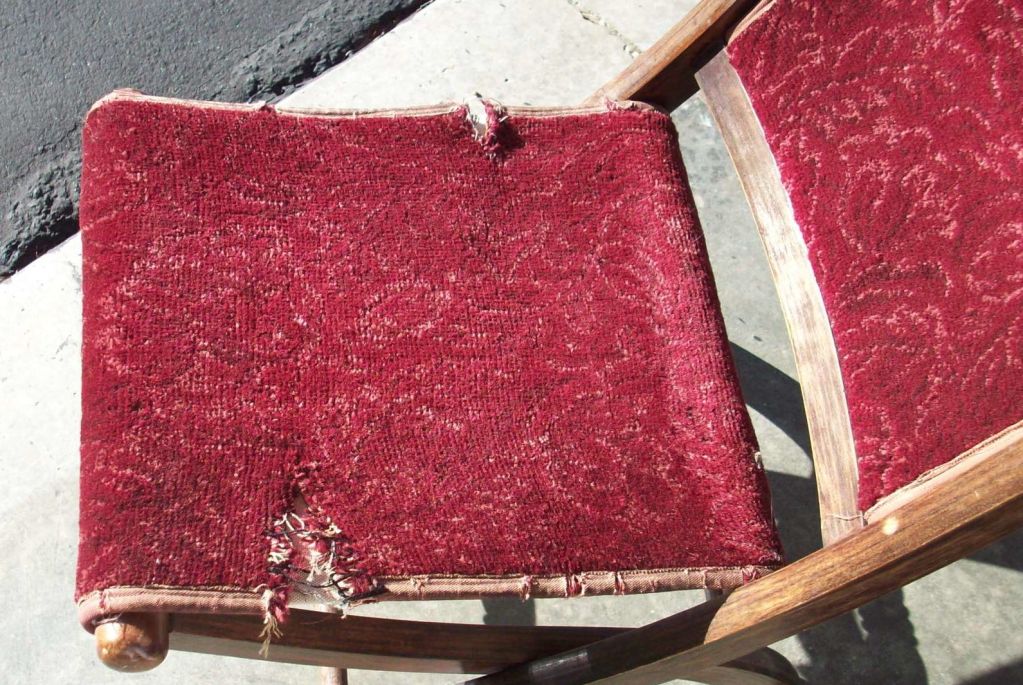
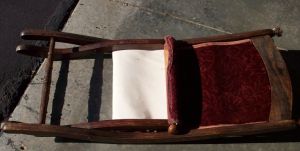 This chair is Marta Vincent’s. I think it could have been made between 1863 and the 1880s. It has the original red carpet, which she has supported with canvas underneath. It appears to have a back similar to the back in the Vaill chair above. The back to front leg cross piece has a slight curve while the other leg begins to show an S curve. It appears to be a walnut. Notice the location of the splits in the seat. These weaknesses are very much at risk of further damage if not supported.
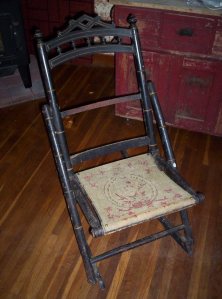
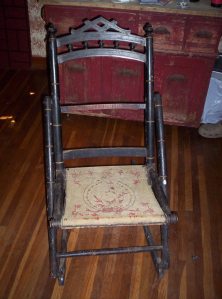 This is my chair, one Dad had for me that was found after he passed. I still have have yet to spend time really looking at this chair. It is an early Eastlake style from the last quarter of the century. The seat material is likely original.
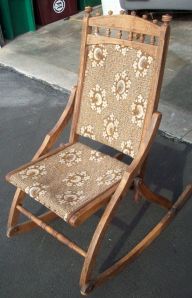
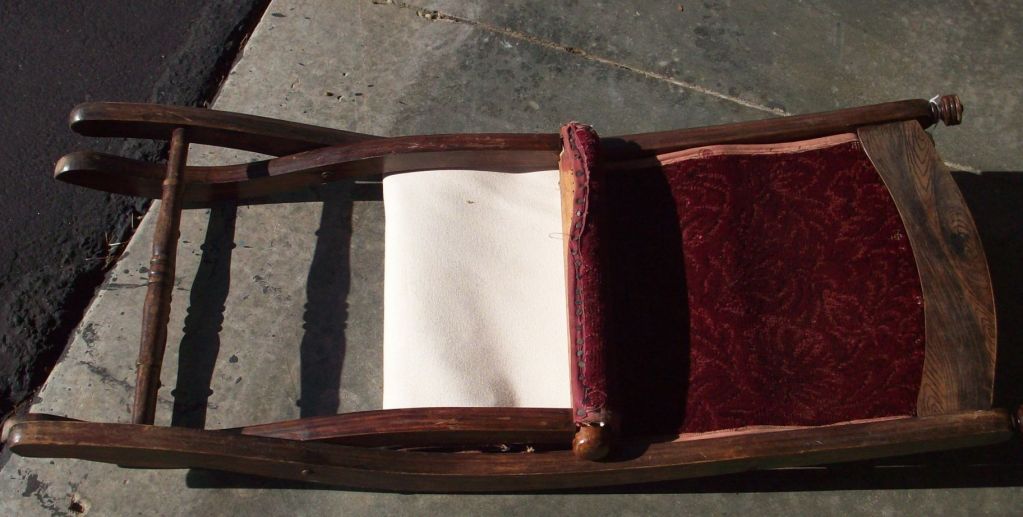
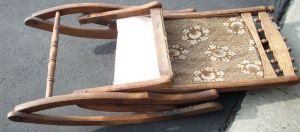 This rocker folding chair is Marta Vincent’s. When Marta found it, it was in pieced needing to be put back together. The seat and back are a vintage ingrain wool carpet with the sear supported by canvas and the outside back is covered in brown cotton sateen similar to the method of the original covering on the red one.
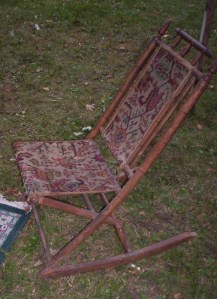 This chair is as it was found. Though nicely intact, the seat and back may not be original. The turning and finials on this chair are quite different then the other chairs seen here. The closest patent I’ve found for dating is this 1881 Patent with a far more complex construction.
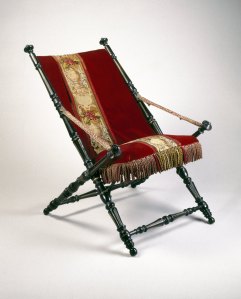 This Chair is held by the Brooklyn Museum. It is attributed to P. J. Hardy as the maker while Hunzinger was likely the designer based on the style and the metal tag Hunzinger label. The Museum’s description is “Folding chair. Ebonized wood with gilt incised decoration, metal hardware, and original upholstery. Turned gilt incised members that terminate in small ball pads intersect at mid-point on sides, secured by small metal rods on which they pivot and allow folding action. Identical turned and gilt incised stretchers connect lower front and back legs. Dark red plush upholstery with central vertical machined floral tapestry panel. Multi-colored fringe to front and sides of seat secured with domed metal tacks. Slung narrow woven textile strips with red key pattern on white ground form arms attached to front and rear stiles with metal attachments; the attachment on back stile has pressed head of putti. Movable black metal members hinged to underside of seat at sides and attached to upper front legs below seat to secure chair when open for seating. CONDITION – Original upholstery faded and distressed, but intact.” For more on Hunzinger’s furniture, please visit this Hunzinger blog.
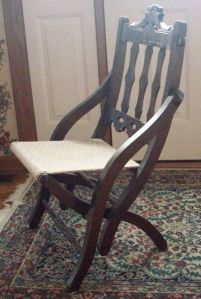 Late 19th century folding chair with an Eastlake feel.
Post-CW Catalog of Folding Chairs.
A pre-Civil War English patent chair:
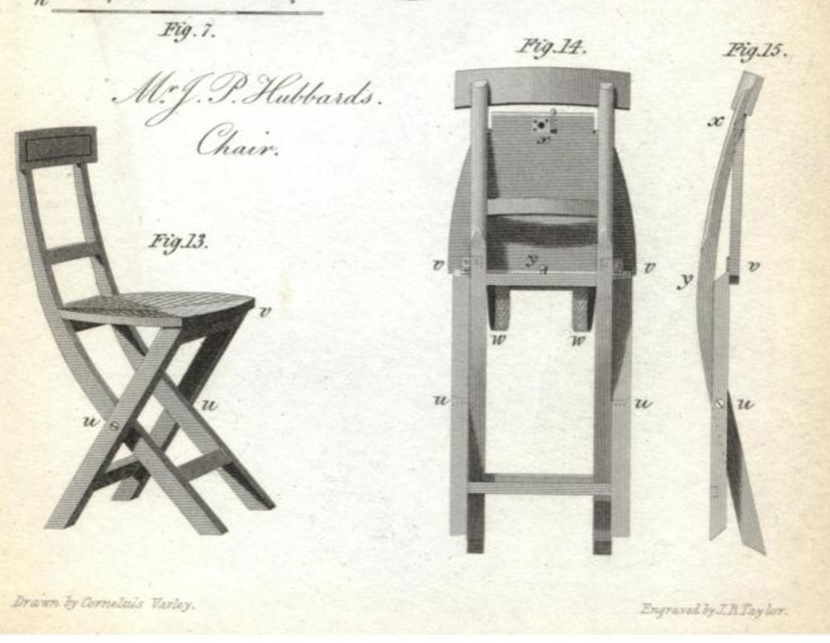
This is one chair I would have dated to later in the 19th century if I came across it in person. This illustration and description comes from 1824 though, in the Transactions of the Society, Instituted at London, for the Encouragement of Arts, Manufactures, and Commerce volume 43.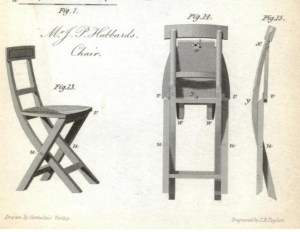 My previous research indicated folding chairs did not appear notably in the US prior to 1850. This illustration, 26 years earlier, is from London.
Folding Chair
The Silver Vulcan Medal was this session presented to Mr. J.P. Hubbard, Leadenhall-street, for a Folding Chair. A specimen which has been placed in the Society’s repository.
In camp, on board ship, and in other situations in which stowage room is very limited, demads are continually making on the ingenuity of the cabinet-maker, to compress into as small a space as possible all articles of domestic furniture when not actually in use. The common camp-stool, either with or without a back, thus forms the substitute for a chair; but the webbing does not make a very firm or convenient seat, and this circumstance induced Mr. Hubbard (who is not a cabinet-maker) to add to it a folding wooden seat, with a spring catch. The result is, a light chair of a very firm and simple construction, which may be afforded at a small cost, and when not in use may be hung upon a peg, or may be stowed away in any other manner, occupying not more than one third the space required for a chair of common construction.
Plate VII, fig 13, shows the chair when open or ready for use. It consists, like the camp-stool with a back, of two frames crossing each other, and united by the screw-pins u u; v is the wooden seat, having two hinges v v in front, and a hole x at the back to receive the spring catch y in the back rail, as shown fig. 14; beneath the seat are two pieces of webbing w w to limit the expansion of the two frames, and thereby to cause the spring catch to fall into its hole without any trouble: fig. 15 is a side view of the chair when folded.
Frequently Asked About Chairs:
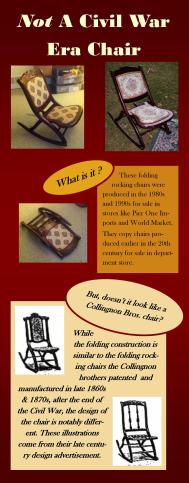
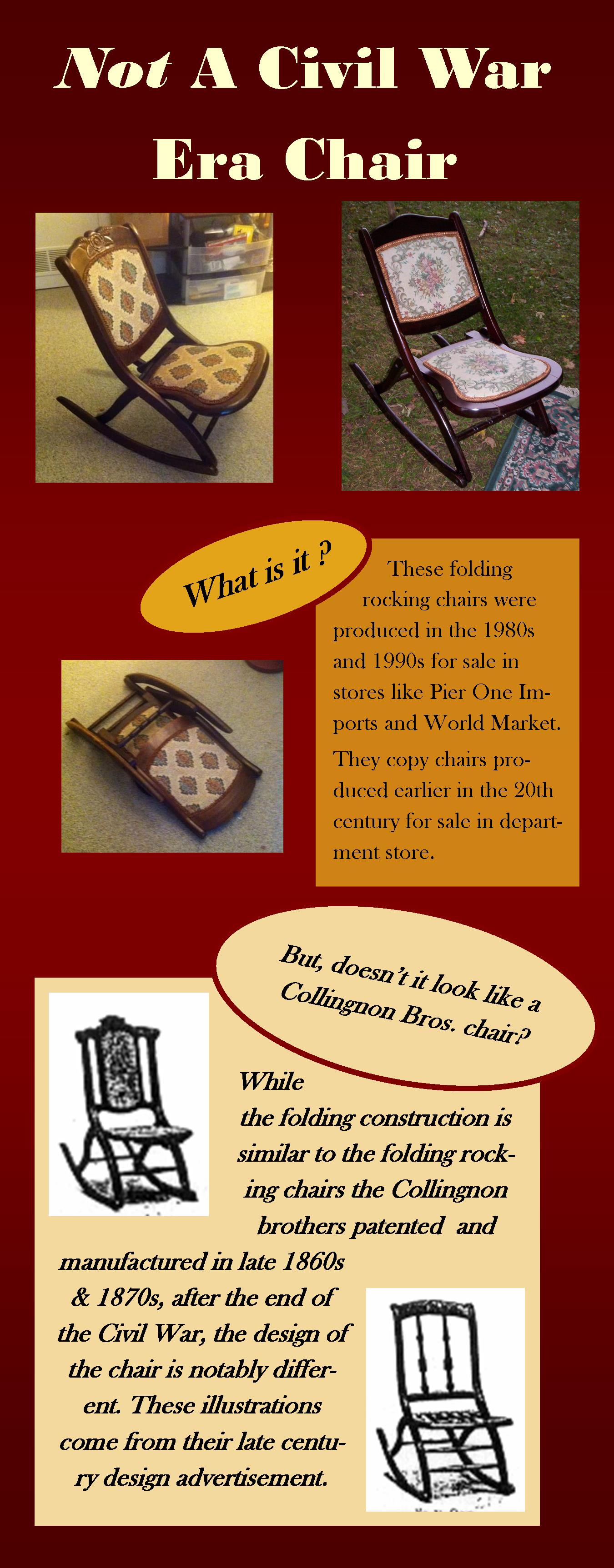
Folding Rockers like this one seem to be every where… good reason…. They were reproduced for stores like World Market and Pier One in the 80s. They are Not a reproduction of a mid-century chair. They are a reproduction of an early 20th century chair.
They are Not Collingnon Brothers chairs. Please cautiously read the Collingnon chair site. I find some pieces are unclear. I recommend looking at this set of search results for their patents, including the 1868 patent which if for a folding chair, not a rocker.
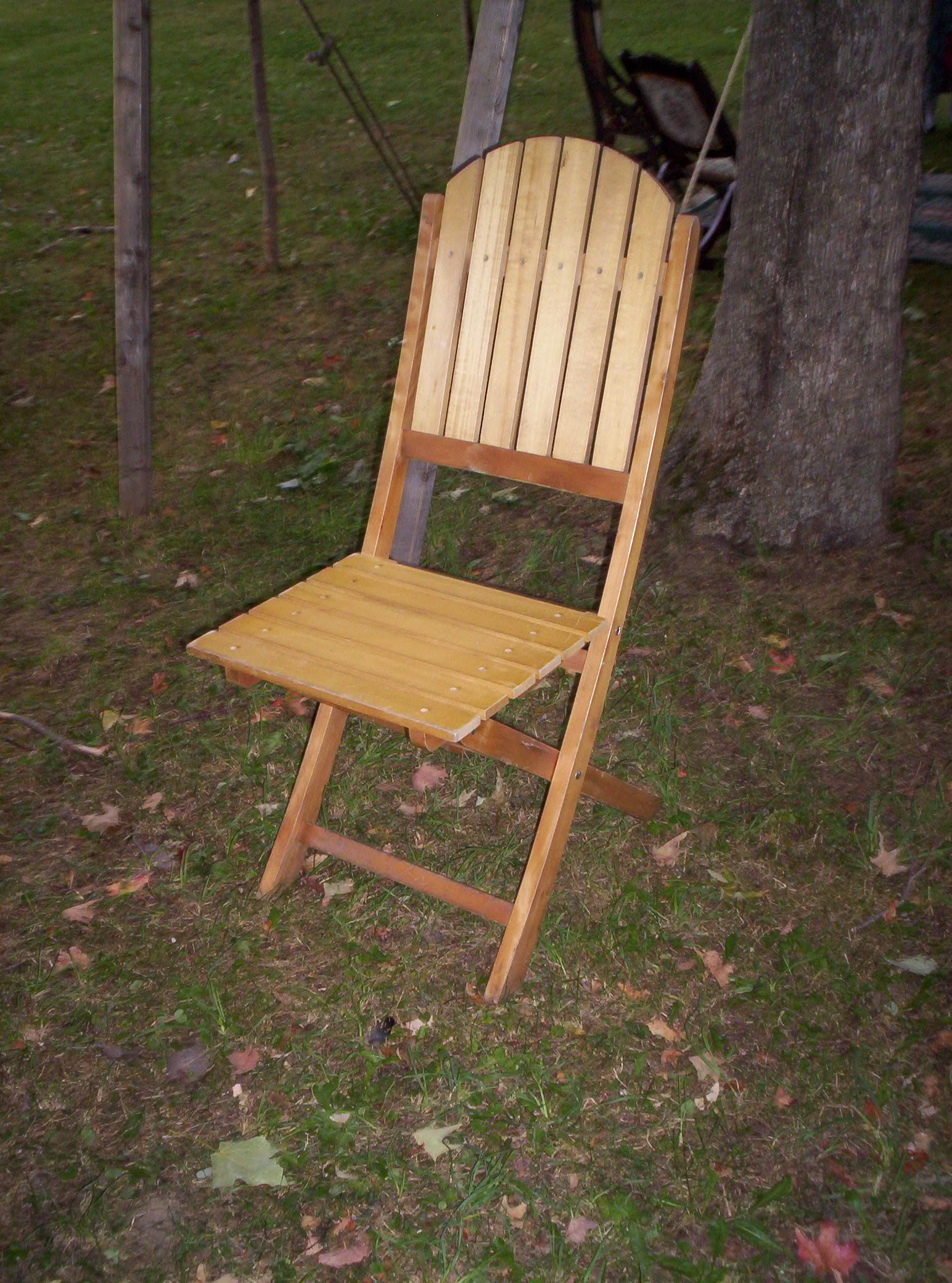
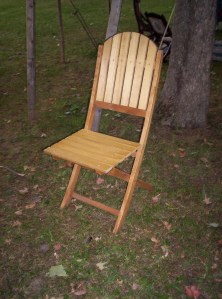 21st century chair manufactured for camping, modern camping. Not a style produced during the Civil War.


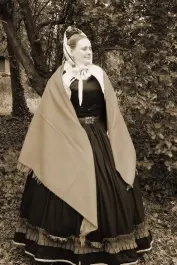
 I was thrilled to see a surviving double square in a red check available. (a double square is a shawl that is twice as long as it is wide, usually 60″ by 120″, also called a plaid regardless of design.) What stuck in my mind as this shawl found its new owner, was the tendency of reenactors and interpreters to play it safe, buying what they see or are comfortable with, whether accurate or not. How does this related to this shawl? The check. When it comes to buying or making an everyday wool shawl, it seems we most often go with a symmetrical plaid or a solid (see the close-up of her other shawl below.) I don’t see a check like this worn often at all. Why? I have a couple thoughts. The first is we wear what we see and what we are comfortable with. Second, extant documentation under represents what I believe was actually available. Going huh? Basically, there are fewer surviving examples of small check shawls then women actually had. In general, there are fewer everyday, working class shawls remaining then the nicer paisleys, lace and higher end silks. A few things may have happened to cause this. The everyday shawls could have been worn out in their day. These shawls could have been deemed by the owner not worth saving. Or, at some point between the mid-19th century and now, the shawls were deemed not as important and worth conserving as other items. Either way, we have fewer examples of everyday shawls to look at and even fewer small checks. Does this mean they didn’t exist as much? Of course not. When looking at original images, we see small check shawls represented. This post-war image shows a small check with a border design. (Sorry, only one on hand until I find the right disk with more images.)
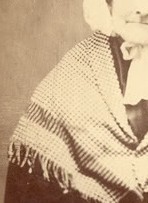 Small check wools are an acceptable choice for a shawl when purchasing a shawl or fabric for a shawl.



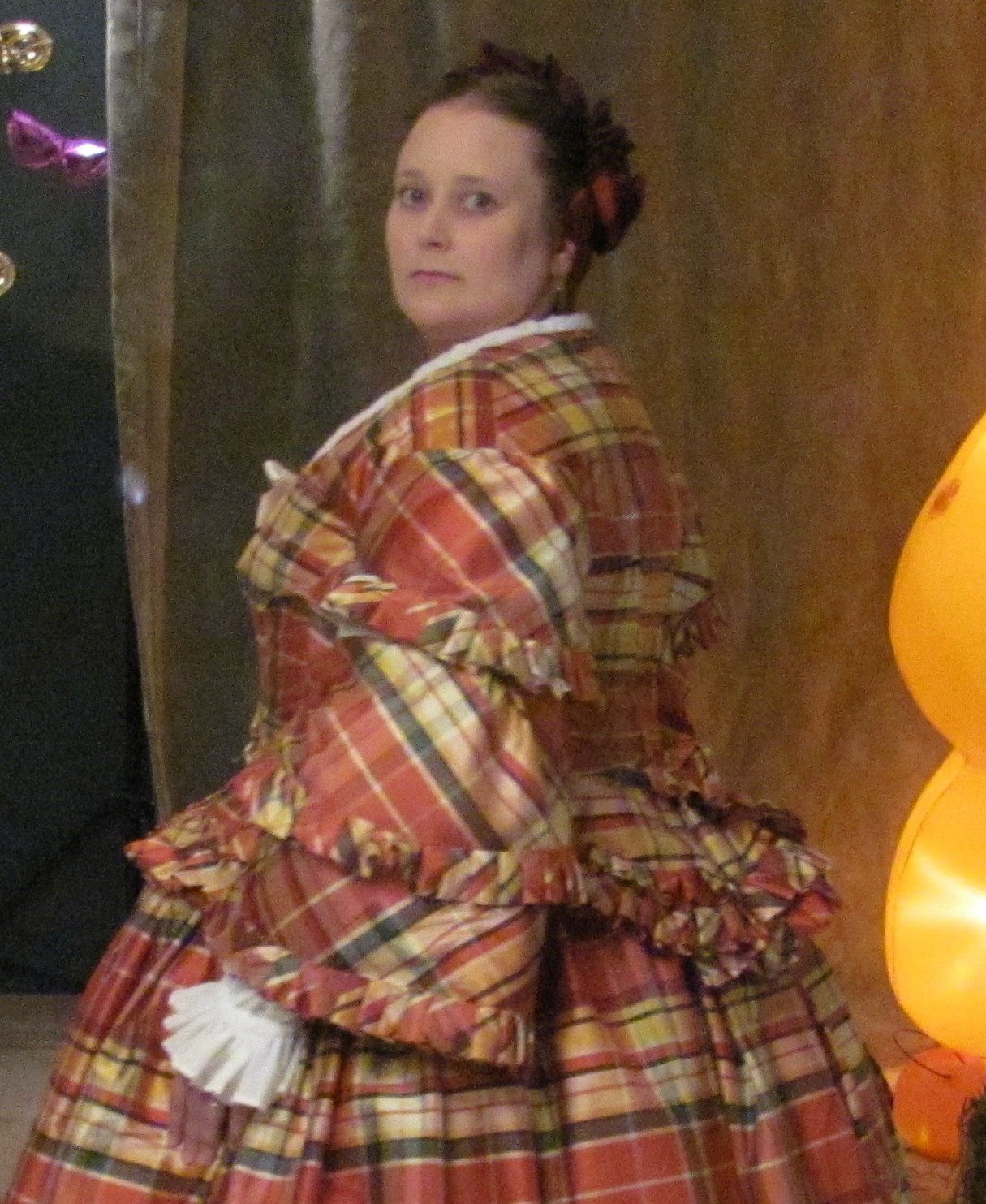
 The back is a two piece back. I tried to line up the plaid horizontally. I think I did fairly well given how the pieces curve. The pepulum is shaped with two box pleats underneath the pleating. The trim was actually an after-thought when I had some left.







 If I Had My Own Blue Box: