Working with Learning Styles

When developing activities or projects for both kids and adults, it is important to understand the different learning styles or multiple intelligences people have.

Visual/Spatial – deals with spatial judgment and the ability to visualize with the mind’s eye.

These learners often do well with visual components. This could include maps, charts, diagrams and timelines with graphics such as illustrations or photos. The maps of the mid-19th century with outlines of buildings and illustrations of homes or significant buildings around the edge of the map can be a big hit. These learners may also appreciate signs with diagrams of what they are looking at or supplemental literature with photographs or illustrations of artifacts. Images pulled from popular 19th century books or magazines could be utilized well with this type of learner such as illustrations of farm machinery or fashion illustrations with patterns.

Logical/mathematical – deals with logic, abstractions, reasoning and numbers.

These learners can work well with numbers and dates. But, their style goes beyond that into logical thinking and reasoning. This learning can get a lot out of activities like mock-digs where they need to reason through the items found during their ‘dig’ to determine what the items may signify or tell about the ‘site’. They also do well with planning activities such as the traditional ‘western trail’ game where the members of a group need to plan what to bring with them for a migration journey.

Verbal/Linguistic – deals with words, spoken or written.

These learners enjoy working with stories whether original stories in written & verbal form or stories they create themselves. They do well with reading original letters, journals or articles. They also do well with writing their own letters in a period style or keeping their own history journal. An activity this learner may enjoy is writing a letter in response to an original letter. Another is to develop a story around an ‘artifact’ either given them or that the piece back together.

Musical/Rhythmic – deals with sensitivity to sounds, rhythms, tones, and music.

These learners love period music and dance. They also do well with the rhyming word games such as those for learning the names of the kings and queens. These learners enjoy singing while they work whether they are churning butter or embroidering. Sometimes they are singing what you teach them; other times they make up their own songs pulling together what they are learning. I love the latter.

Bodily/kinesthetic – deals with the ability to control of one’s bodily motions and the capacity to handle objects skillfully.

This is the learner that loves to handle objects whether original or reproduction. They like to examine pieces personally, looking at the details and how things work. They also like hands-on activities such as helping out during a demonstration of spinning, carding wool or cooking as well as make-and-take projects. This learner also likes role playing and acting out an idea with another object.

Naturalist – deals with nurturing and relating information to one’s natural surroundings.

This learner will do well with connecting topics to the natural world around them. When discussing topics such as food or clothing, they will find interest in where the food or fibers come from, how the plants or animals grow, how the fruits, vegetables, wool or flax are harvested. These learners may also find how land is utilized for settlement or the impact a battle had on the land interesting.

Intrapersonal – deals with introspective and self-reflective capacities.

This self-reflective learner may enjoy reading the personal writings of someone they can relate to. They may also benefit from role playing activities which involve deeper understanding of their character.

Interpersonal – deals with the ability to interact, communicate effectively and empathize easily with others.

This learner enjoys working with others on activities. This can be in the form of social learning or teamwork. They also like role playing and acting out an idea with other people.

Existentialist – deals with the ability to contemplate phenomena or questions beyond sensory.

These learners could challenge you if you are not one of these learners or don’t already know one well. This learner is often the one who asks you those questions that catch you off guard. This idea learner may find the development of social dynamics interesting. With this in mind, you may want to talk with them about the effects of the Civil War on society or how the industrial revolution effected the roles of working class women and the development of social movements in the 1840s and 50s.

Which is Which?

I’m sure you are asking ‘how do I tell which learners I’m working with?’ My biggest suggestion is to watch and listen. Notice what catches each person’s attention when they first arrive. Is it the written sign, an illustration, an object they are reaching for? Listen to what they are asking and how they ask it. Pay attention to key words that may tip you off such as ‘sound’, ‘how long’, ‘why’, and ‘feel’. If you only have your audience for a short time, hopefully you can pick up some signals quickly. If you are unable to, just make a point to incorporate as many of the learning styles as possible. Talk about what appeals to the senses, offer to let them feel a reproduction item or a handful of wool. If you will have your group for an extended time, start your day with a get-to-know-you game. While each attendee is getting to know each other, pay attention to hints from each one. I’ve noticed musical learners will put a rhythm to name games while mathematic and visual learners will make mental lists. Visual learners will also identify something about a person with what they say, requiring them to look at each person in turn. Interpersonal people often look right at a person as well. Bodily/kinesthetic learners as well as some naturalist learners will put movement into the game or even get up and walk through the game from person to person. I have yet to figure out what the intrapersonal and existentialist learners do for this game. I suspect this may be some of those who can close their eyes and recite word for word what each person’s name is and the food, object or saying that went along with them.

Edit 2021: I am curious about who is reading this page. Twice a year the stats for this page go up notably. It seems like a class or such. If someone could leave a comment letting me know, I would appreciate it. Thanks!

Published in: on April 6, 2011 at 7:22 pm  Comments (5)  
Tags:

Optimizing the Visitor Experience at Living History Events

Part 1

I’ve been enjoying reading Stephanie Meyer’s Creating Great Visitor Experiences: A Guide for Museums, Parks, Zoos, Gardens, & Libraries. Reading her book, has prompted me to consider several additional aspects of the visitor experience at living history events. Here are some of my developing thoughts:

The visitor experience begins before the visit. Whether a potential visitor is learning about your event through a website, radio advertisement or print advertisement it is important not only to entice them to come but to give them an accurate understanding of what to expect through words and/or images.

The way a visitor’s day starts can impact the whole  day. This can include how easy or difficult it was to find the event, what parking was like and finding the entrance. A map, good directions and clear signage can help ensure visitors find your event without getting stress or taking excess time. Once a visitor pulls through the front gate a combination of signage and parking guides are a good way to help visitors find the right parking spot. Ideally, parking will be adequate and on a flat, even surface. Given the nature of many events, this is not always the case. Parking guides should be well aware of the parking plan and potential issues with parking. They should also be observant of lower riding cars, taller trucks, families with small children or those who may need handicap parking or shorter walking distances. Guides should be well versed in the safest way to the entrance, the nearest water source and bathroom They could also know for those exiting, how to get back to the highway and where the nearest restaurants are. Another extremely important piece of information that must be covered in the parking lot, via signage, preferably at the entrance and several times after, is whether or not certain items are allowed on site. This could include coolers, glass drink containers, alcohol, chairs, strollers, etc. It will greatly affect a family’s plans for the day if some of these items are not allowed or if they get them to the entrance and have to turn around to take them back to the car.  Signage with a helpful approach can be greatly appreciated. A sign that says “don’t forget your water and sunscreen” could help save a person’s day.

The entrance is not just the way into an event, it sets the stage for the event. An admission table or gate should be welcoming and well informed. Admissions people should know the plan for the event as well as the site layout backwards and forwards. They should be able to not only hand you the very well designed map of the event and accurately detailed schedule, they should be able to answer questions about bathrooms, activities for small children, demonstrations and where particular groups or units are.

I am particular about literature. I believe a map needs to clearly show all the necessities a visitor is looking for as well as the locations of everything they will want to see. The locations of demonstrations, battle seating, hands-on activities, bathrooms and food all need to be marked. Schedules must be accurate. They should cover military and civilian activities, presentations, demonstrations, hands-on activities with times and locations. Most often we see this as a list with what is happening at each time. One of my favorite schedules for an event was actually a chart, in full color, that showed times on one side and locations on the other. Reading across the chart you could see everything that happened at the xyz pavilion through the whole day. Or you could see all the domestic demonstrations colored in green through the day. This format, though costly in color, allowed visitors to easily plan out their day or to glance at to find what is happening nearest them at a particular time.

It is all about details …. next…

Published in: on April 5, 2011 at 3:27 pm  Leave a Comment  
Tags:

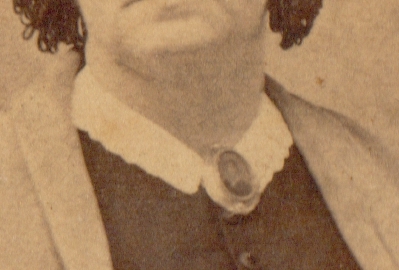
CDV


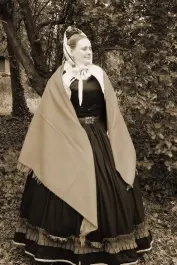
I bought ths cdv for the shawl. Since it has a few interesting componants, I decided to share it.

Published in: on April 3, 2011 at 8:54 pm  Leave a Comment  

Be There… Be With…

There is nothing like walking into a nice building filled curious items you know absolutely nothing about with no labels or signs and no one to guide you or answer your questions despite the neat little benches arranged as for an audience.

#1 Be There 

Be where? Be there for the visitors. Be where visitors will have questions. Be where they will be curious. When planning an event, you need to anticipate what visitors will want to know more about in order to have a guide or historical interpreter there.  Come up with a list of locations visitors will likely have questions or inquiries. This could be at medical scenarios, demonstrations of arms, near cooking demonstrations. No list is ever set in stone from year to year or event to event. You must observe and adapt. Watch visitors. Talk with them. Find out what they learns and liked. Find out what questions they have that weren’t answered during the event. Then adapt. Add to the original list of locations or change locations. Always strive to be there for the visitors; be their guides bas they connect with history.

#2 Be With

Be with your visitors. Sure you are portraying history, teaching history. But, each visitor’s experience should be visitor focused because no two visitors are alike. Each person has a different base knowledge. While one person may remember using a pierce tin barn lantern, while another may think it is a cheese grater. Both deserve the best individualized attention you can give.  When talking with a visitor, do you best to see what they see. truly listen to what they are saying, what they are asking and what they are not asking. By focusing on the visitor, you will be able to convey what you are teaching in the best way for the visitor.

Published in: on April 1, 2011 at 8:05 pm  Comments (2)  
Tags:

Beyond the Wardrobe…. Beyond the History…

Over the past year and a half, after I started dealing with my culture shock and displacement, I had the opportunity to step back and reflect on what is important to me in living history. We already know I love to research. What do I love more? Educating, sharing information … and … how to share information.

The techniques of sharing information goes beyond the wardrobe; it goes beyond the history….

With this in mind, over the next several months you will see a section developing on how to develop visitor focused activities and  how to improve your interpretation techniques. I will look at working with different learning styles, the needs and perspectives of children and families, how to deal with challenges such as the weather and anything else that comes to mind. I hope each reader will get something out of this section and will offer any questions or suggestions.

Published in: on March 30, 2011 at 9:27 pm  Leave a Comment  

Cuffs, Collars and Undersleeves

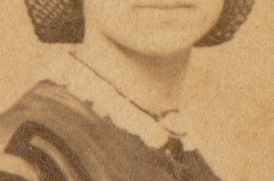
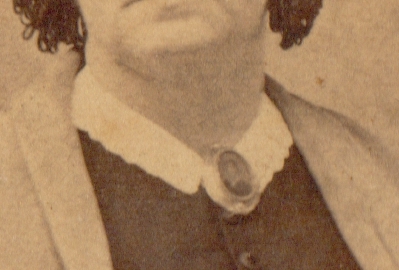
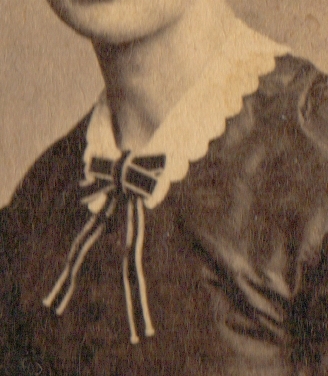
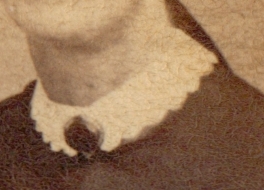
In honor of Georgiana Goldsmith’s “Committee for Cuffs and Collars” (a Facebook post)  here is a pdf image of cuffs, collars and undersleeves  used in a workshop Bevin and I did a few years back. To add to that, here is a 52 page PDF of collars clipped from Peterson’s and Godey’s Magazines.

And from more recent purchases….

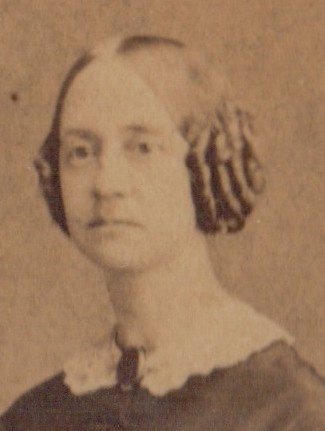
This is image is earlier, likely in the 50s based on her dress and sleeves (there is a reason you can’t see the whole image of each of these. Apologies.) Her collar is wider than what we see in during the CW years.

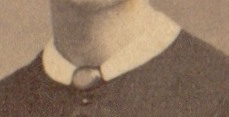
This collar is more typical of the width seen during the CW years. Note how the opening is nearly horizontal. You will see variation in this opening. The edge of this collar, as well as the one in the next image, is rolled and straight.

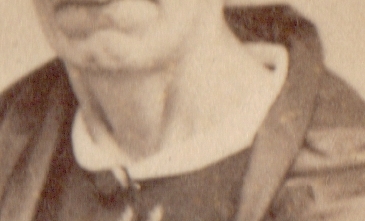
Look at the back of the neck. This image shows the collar wrapped around the edge of the dress’s neckline. Also notice how the collar narrows in the front. It may or may not have a slight curve as it disappears behind the broach.

In contrast to the image above, these next two show an edge above the collar that could possibly be the dress. If this is the edge of the dresses we are seeing, these collars may be tacked on the exterior. (This could be looked into further. *There is a discussion of this on The Sewing Academy.)

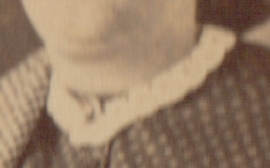
In the next three images you see collars with scalloped edges. These would be finished by hand. I’ve enlarged this image a bit because I know you will want to get a good look at her broach. While looking at her broach, notice the angle of the collar opening along with the width of the collar.  
This collar has rather deep scallops with a diagonal opening. The bow has double loops and moderately long tails.
This collar appears to completely close in the front. It is slightly higher on the neck than the previous images.


Published in: on March 26, 2011 at 5:01 pm  Leave a Comment  

The Usefulness of a Jacket – Godey’s 1858

This is a clip from Godey’s, 1858, I had in my “Distracting Odds and End” folder. It simultaneously speaks of the commonness of a shawl and the usefulness of a jacket.

 Hints on Jackets – When to Wear Them by Mrs. Damas Few things that we wear are, in my opinion, more comfortable than a jacket. There are various sorts, morning and evening- jackets, for young and old; but what I would first wish to call attention to is a comfortable jacket, one that can be worn at any time, the first thing in the morning, and the last thing at night. Mothers of families would do well to have such a one. It is a common practice with many to draw on a shawl; and, as this is generally done in a hurry, it rarely covers the chest, and requires one arm to hold it on. The jackets I now speak of are within the reach even of the poor. The skirt of an old gown, washed, will make a very good one; and to a poor woman it would be a very charitable gift, not to mention the great comfort of it. There can be no difficulty in deciding which looks best, an old shawl put on in a hurry, or a tidy-looking loose jacket, even if made of an inferior material. For the bedroom or house, a washing material should be chosen. If colored flannel is too expensive, a thin wadding put in between the lining and outside is warm and comfortable. Brown calico is sufficiently good and warm for lining, should that be preferred to wadding; but, for invalids, wadding is lighter. These jackets are by no means intended to fit the figure, but merely to sit easy and comfortable. To invalids, they are a great comfort to slip on if they have occasion to go into a cold room, or to wear under a shawl. A girdle or ribbon may be tied round the waist where additional warmth is required. Many ladies, as the winter comes on, give presents of warm petticoats, which are certainly a comfort. But still a substitute is wanted for the woman’s thin cotton body at top; and what better substitute could be offered than a warm jacket? For children, nothing can be so good as a jacket. It leaves their arms free, which is of great importance to them. Indeed, to obtain this freedom, they frequently throw off a cape or shawl, and thus expose the chest and neck, both of which require to be kept warm. Many persons have only one fire to sit by, in which case, should there be four or six in a room, it is almost impossible for one or two not to feel cold. Let those that do slip on a jacket, and they will then feel as warm as those near the fire. I by no means advocate wrapping up too much; but, when occasion requires a little extra warmth, I think that all who know the comfort of it would say that nothing can surpass the jacket.

Published in: on March 23, 2011 at 3:19 pm  Comments (2)  

Dan’s Birthday Present

At one point I was under the dillusion that I would make my husband this beautiful white shirt for his birthday. But, as it t turns out shirts intimidate me. Instead, I went looking for a print for him, an eagle print since he likes eagles. What should have been an easy task wasn’t. There were so many nice prints. But, none of them spoke to me. None, that is until I came across the piece called Wings over Antitiem by John Neal Mullican.

This print was just right. It had the eagle Dan loves and it had to do with the Civil War. (For those of you who don’t know, he and I met reenacting years back.) The print itself just has that nice feel to it. It had to be the one for his birthday. So, I ordered it.

The print arrived on our anniversary. It was very tempting to give it to Dan then. But as it arrived just a little over an hour before we needed to leave for dinner all rolled up in a tube, it had to wait. But, the artist was kind enough to include a mini-print of another eagle print of his I was thinking about. The color in this American Bald Eagle is beautiful. I decided to slip that into Dan’s card which I gave him at dinner.
The artist also included a nice letter about the how the piece developed and some additional information. Looking at his other works, I think we will be looking to buy atleast a couple more pieces. All of his birds are just eye catching. His Barnyard Quartet reminds me of the babies each year in GCVM’s bird boxes.
Since Dan’s birthday landed in the middle of a work week where he was working hours when we wouldn’t be seeing each other, we celebrated his birthday on the weekend. His cake request was a chocolate cake with a strawberry-raspberry filling and Italian Sweet Cream frosting. For dinner, he asked for corned beef, cabbage and potatoes.
Now, we just have to decide on how to frame the print.
Published in: on March 19, 2011 at 1:45 pm  Leave a Comment  

Pasteboard box

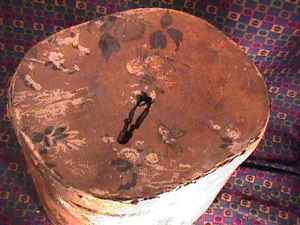
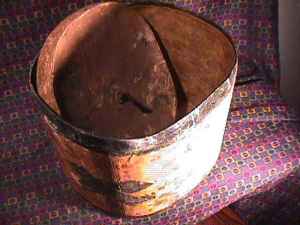
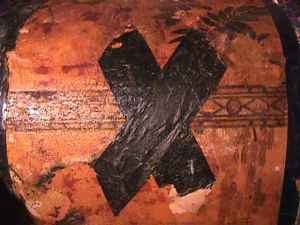
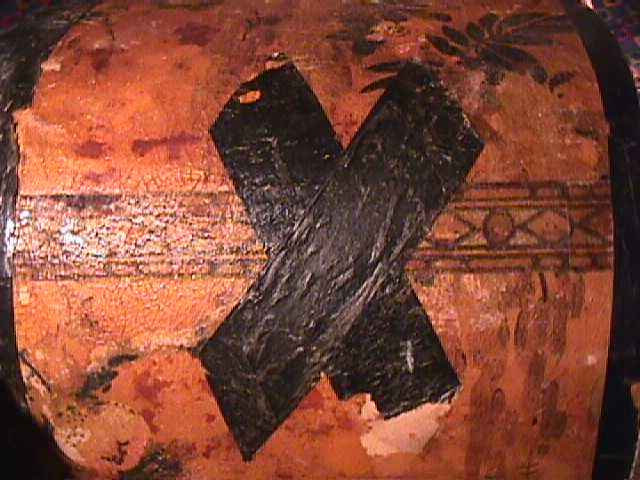
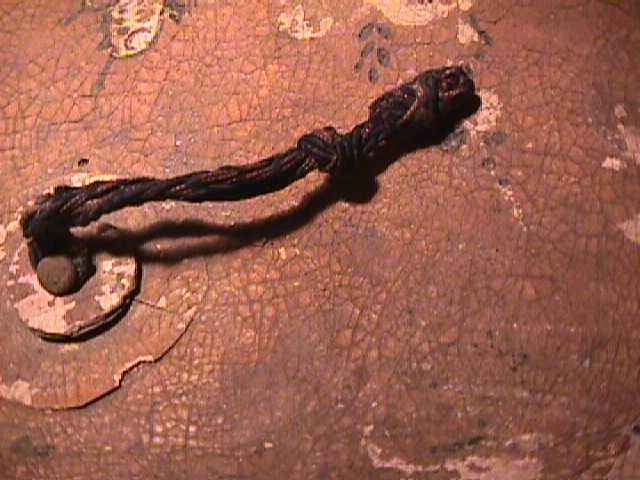
As I was going through photos of Dad, I came across this set of photos of a pasteboard box he had at one point. I don’t have any measurements. From memory, I think the box was about 10 to 12 inches tall and possibly 10 inches wide. I don’t have any notes on the dating or construction. Please just enjoy the photos and offer comments if you wish.

Here is the lid sitting inside and a detail of the cord on the lid.

I don’t know what is going on here. This would be the bottom of the box.

Published in: on March 17, 2011 at 7:00 pm  Leave a Comment  

The Power of Myth – Part 2

As educators, interpreters or reenactors we often encounter myths while working with visitors. These myths can range from a long propagated mis-truth to a family story. When facing these myths we need to find a way to educate while ensuring a good visitor experience.

In my opinion, the type of myth you need to be the most careful about when addressing it the family myth. This is a myth a person has grown up with, believing about their family. It is one which may or may not be rooted in fact, developing or evolving through the years. A family myth can come up at almost any time in a discussion with visitors. They may believe they have a connection with a person, a building, an artifact or a moment in history. The catch is, you have absolutely no idea whether their story is history or myth. With a visitor centered approach, I suggest you listen to what the visitor has to share. Even if everything they are saying doesn’t quite fit with what you know, listen. If you don’t listen to what they are saying, chances are they aren’t going to want to listen to you either. While you are listening, really listening, try to determine what level of additional information they will be receptive to. Some people will be open to a whole different version of the story, the researched and documented research you can provide. For these individuals, first compliment a specific aspect of what they shared, hopefully a piece that is documentable; then offer additional information beginning with a phrase such as “my understanding….” Be certain to offer the visitor a resource or two to go to for their own research such as a book at the library or website that is easy to find. For others, who are significantly attached to their story, possibly in an emotional way, an “opening the door” approach will allow the visitor to hold their story while you offer them a direction for self- inquiry. After acknowledging their story and offering a specific compliment, you could open the door with “have you looked at….?” or “I would be curious to know more about…” Yes, this is an extremely soft approach. But, you are allowing the visitor to retain the integrity of they family myth while encouraging research based education and giving the visitor a good customer experience increasing their likelihood of returning.

I’ll confess, teacher led myths  are the ones that really push my buttons. It is exceptionally challenging to have a tour designed for a class when the teacher continuously interrupts, pulling the students in a different direction filled with inaccurate information. It is also challenging to be giving an in-class presentation only to find the teacher has or is instructing with inaccurate information. Whether you are in their arena or yours, the key to avoiding these issues is communication before the visit. Provide the teacher or teachers with an outline of the tour or presentation as part of a teacher packet with grade specific information and resources. Most museums have a teacher packet for visits and outreach which include pre, during and post visit materials. If you are working with/for a museum, be sure to know this packet well. During one of your initial conversations with the teacher(s), ask about where your talk will fit into their teaching plan or curriculum mapping, what the students will have already learned, what points he or she would like you to address. This is an ideal time and way to focus or tweak your presentation plan and identify any potential areas of inaccurate information and provide the teacher with correct information and/or resources prior to being in front of the students. Of course, you may still have a surprise in the middle of a great talk with a group of students. In these cases, you need to convey the correct information and the importance of documentation all while still supporting the teacher. Yes, it is possible. You can start with something like “That information/story comes from ____. But, new research shows _______” or “That is true for these instances _____ But, at this time ______” (Teachers are one of the few groups you can get away with using the word “But” with without being defensive. They teach the use of the word. For most other people do you best to use words such as “and” to redirect the information.) Be certain to provide the teacher with resources to further research the information new to them after the conclusion of the talk.

Enough typing for tonight. I guess there will be a part 3. In the meantime, for regular postings regarding history myths, subscribe to History Myths Debunked. I enjoy the weekly posts.