I came across an interesting section on embroidery in Cassell’s Household Guide: Being a Complete Encyclopedia of Domestic and Social Economy Volume II, 1869 (published in London and New York.) The book divides it into two parts. I will divide it up a little more for ease of reading. I find this article to be interesting because it shows one mid to late nineteenth century perspective of a skill many of us try to imitate. I will start with this section looking at history with a bit of contemporary observation… “The art of embroidery was originally derived, like many other of our arts and sciences, from the Spanish Moors, by whom it was introduced into Europe early in the Middle Ages. As applied to tapestry hangings, it was at first ued among Christian nations for the decorations of churches, and for employment on State occasions only, till Eleanor of Castile set the example of using it for domestic purposes, which was soon generally followed by the wealthier classes. Throughout the Middle Ages needlework embroidery, chiefly for hangings, but also for some other uses, formed the great occupation of ladies when not engaged in domestic or other duties; and the beauty of their work, together with the invention and design which they displayed in it, are such as might well raise the admiration and envy of the ladies of the present day. These old works have not merely the conventional prettiness which is generally the only, though not the invariable, characteristic of modern needlework, but have often real artistic beauty, and display not merely fancy, beu even imagination, in the designs. In this respect certainly they have little in common with modern “fancy work,” which is apparently so called in a sarcastic sense, from the utter absence of any fancy displayed in it. The modern lady, instead of exercising her inventive powers, simply copies a pattern set before her, stitch by stitch, without the slightest idea of deviating from it if its forms are bad, or of developing this mere copying and counting of stitches demands too much mental exertion, and she must either purchase her “fancy work” ready begun, and the pattern laid out for her, or perhaps even with the ornamental group of flowers or other device already finished, and with nothing left to be done beyond filling in the back ground. This degeneracy in skill and taste from even the standard of those qualities in their own grandmothers, is in great measure to be attributed to the substitution of so limited a style of work as German wool embroidery for the more beautiful and legitimate styles that preceded it. In Berlin wool-work, as it has usually been practiced for the last forty years, anything like real beauty or flow of fancy is an impossibility. That this absence of invention and good taste in their lighter occupations, should continue among ladies is neither necessary pations, should continue among ladies is neither necessary nor desirable. An abundant fancy is a characteristic of the female brain, and ladies would be far happier and better in many ways if they would allow its free development. Few things could be better calculated to effect this than a return to the graceful and beautiful occupation of their female ancestors. There is at the present time much desire for this shown among the upper classes, and legitimate embroidery is again rapidly becoming a fashionable employment.


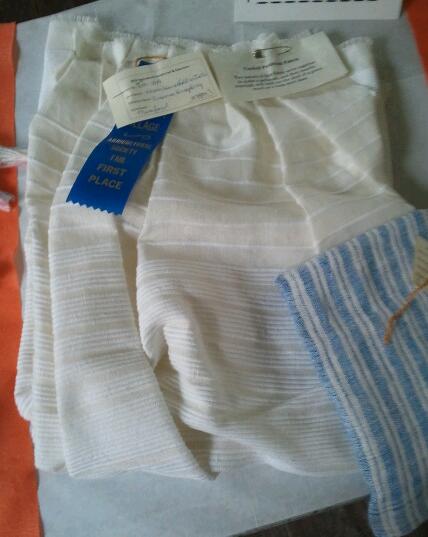

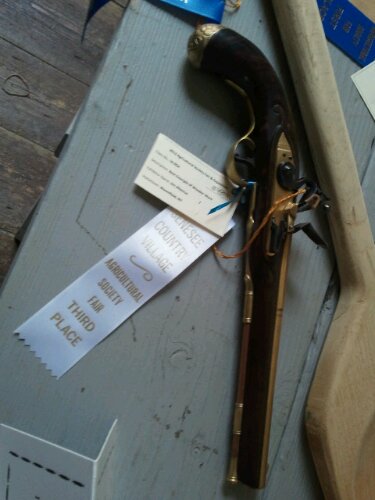

Ag. Fair 2012
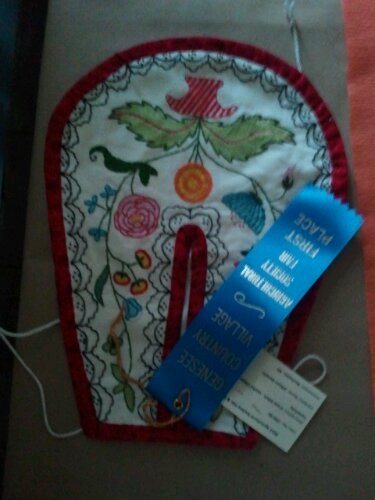
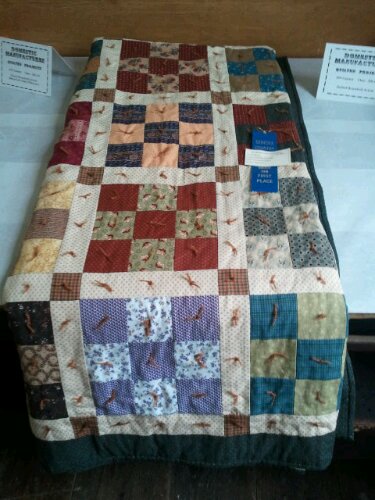
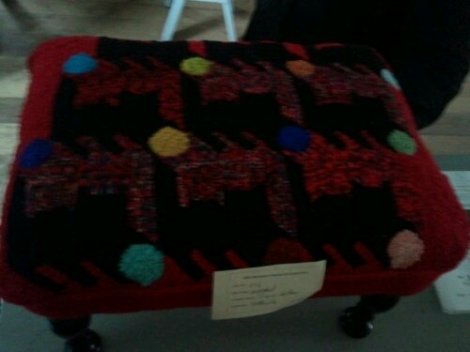
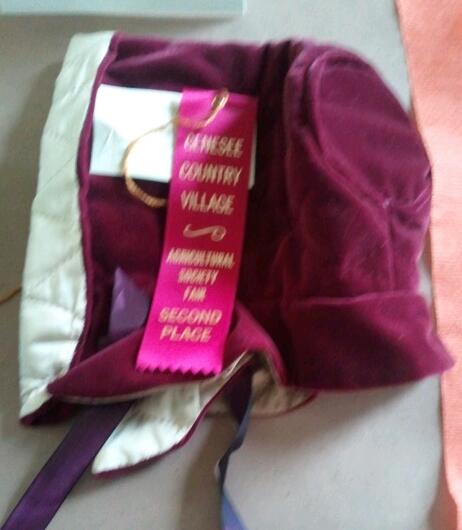
As we head home a bit soaked and with sore feet, I want to share photos of my mom’s, little sister’s & my fair entries.
Here are Lily’s entries….


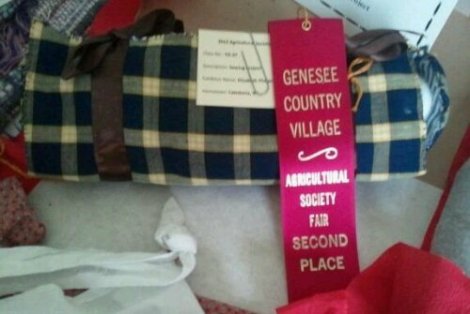
Here are some of Mom’s…


And here are mine….


I’ll add some photos of my favorite entries by other people asap.

Ag. Fair 2012
As we head home a bit soaked and with sore feet, I want to share photos of my mom’s, little sister’s & my fair entries.
Here are Lily’s entries….

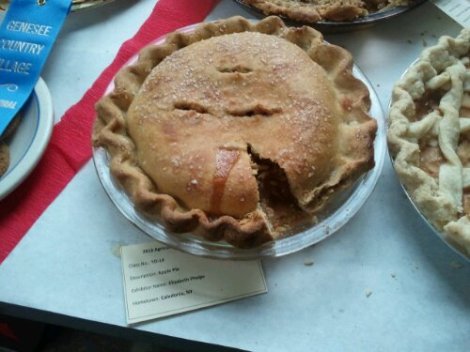

Here are some of Mom’s…


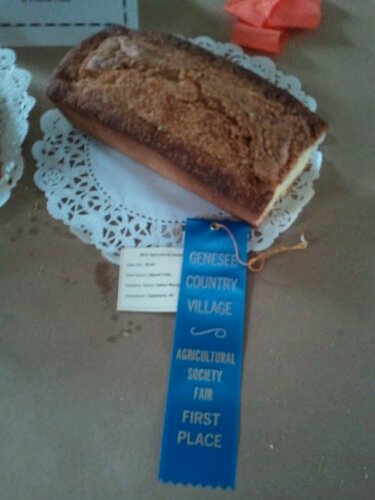

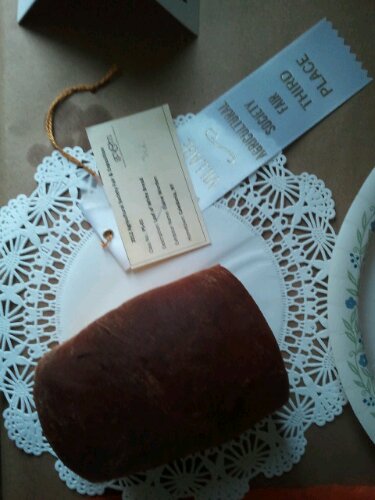
And here are mine….
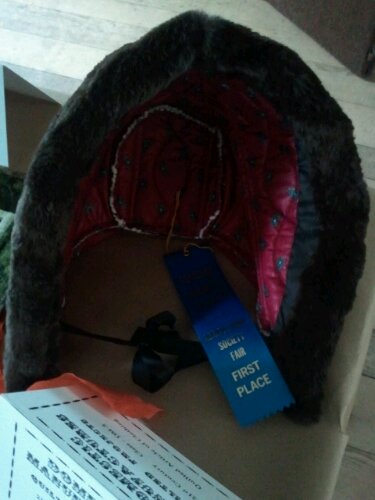
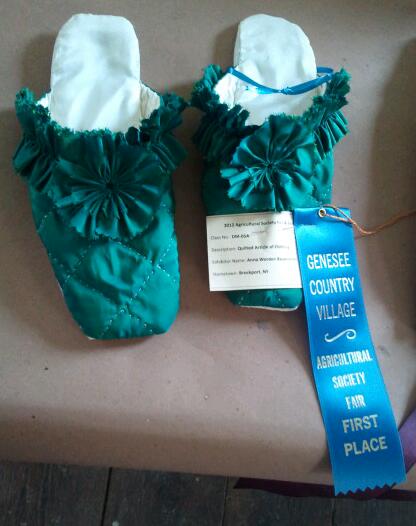
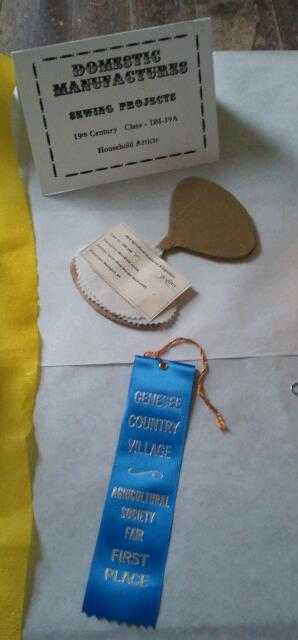

I’ll add some photos of my favorite entries by other people asap.
Thread Winders – A Great Source
With my fancy for sewing cases and needle-books, of course I am always looking the sewing accoutrement to go inside. For some odd, unknown reason I am particularly fascinated by two of them – bodkins and thread winders. I’ll touch on the bodkins sometime in the future. Today I want to talk about a great source for thread winders. I found Scarlets Scarab’s website sometime back. There was something about the warmness and color of the materials they choose and the lines in the work that greatly appealed to me. I finally put in a sampling order last Friday.
They arrived this week.
I couldn’t be more pleased.

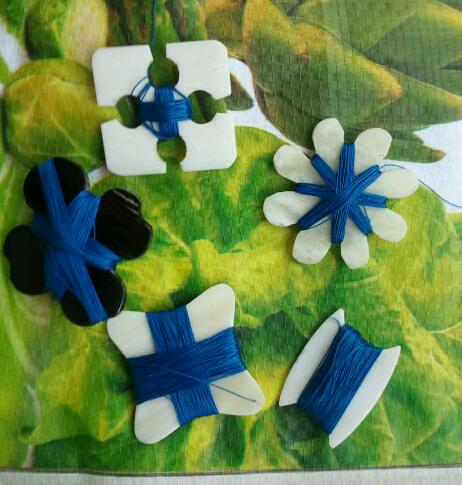
As I said, I ordered an assortment of thread winders. This included both bone and horn in their flower, square, wheel, crab-babies, smu, and fancy thread winders. Kim, the proprietor, also included one of their fish and large thread winders. Can I say I just love the fish? It is beyond adorable. One of the things I like about the thread winders themselves is they are handmade. You can see this in how the symmetry isn’t quite perfect. I rather like that. I also like the smooth texture and fine shaping. I greatly prefer the thinner profiles of these over other bone or horn thread winders I’ve seen. They are easily half to a third the width with a smooth edge. Visually, I prefer the shape of the crab-babies, the smu and the flowers. Once I wind some thread on them, I’ll share my thoughts on which seem to be the most practical. (Hopefully, that will be in the next couple days.)
There are several more items on the site I would love to order including their awls, the bone thimble ornaments and, the long horn hair pin. I also think Dan might have to get some dice for Christmas. I wonder if he would like the compass.
Addition:
I’ve been playing with the thread winders & have a few thoughts. For a larger amount of thread such as you would have in a full sewing basket, I think the square and flower thread winders are the way to go. See how on the square I have thread started at the small crossing? I think this thread winder will hold a good amount of thread in those notchs nicely. On the flower, the winding starts at the crossing but then can also use the dip in the petals. For sewing cases, I think the petite crab-babies are an excellent choice. They hold a nice amount of thread and will tuck into a case easily. The smu has the notch which is helpful for holding the end of the thread.
Parasol
We decided to “Apple-umpkin” today thinking fresh air would be good for us. It was. This parasol had to come home with me. It was getting played with by a child.

Fanciful Utility Arrives
As the first copies of Fanciful Utility arrive this week in people’s mailboxes, I am eager to hear first thoughts.
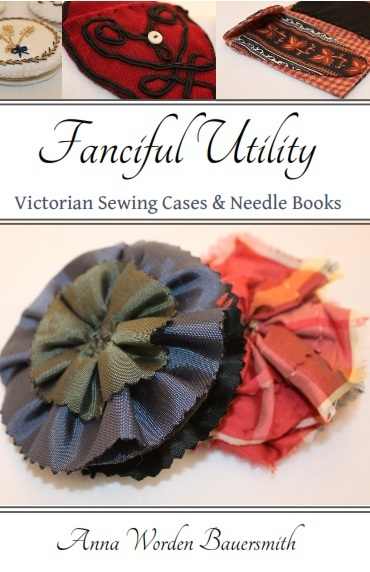
Please share them if you like.
Slipper progress
Both slippers are together. When I started working with the leather soles, I decided the leather just wasn’t going to work. I think a big part was that it was too thick. So, these have canvas soles with soft wool inside. (The leather will get used for a Christmas gift for hubby.) Up next is the ruching, which commence once I locate the pinking scissors. Hopefully, the ruching will add some dimension.

“Travelers and Traveling” from 1860
I stumbled across this article, “Travelers and Traveling” by Mary A. Denison in Peterson’s Magazine from 1860.
I rather enjoyed the first part, but then it took quite a twist.
“Think for a moment of the masses moving in every direction. From homes of wealth and of poverty they come – from the emigrant’s little cabin of mud by the wayside, and the palace of the titled noble – on the they throng, men, women, and children – sick and well – joyful and sorrowful. Some are in the first flush of wedded happiness, on their bridal tour – some are leaving the home of youth and childhood, where they have been sheltered and fondled, to seek a scanty living in a heartless world. Some go at the call of husbands to the land of the golden mountains – some to while away a leisure that is wearisome, to fill a void no earthly pleasure can satisfy. What endless packing of trunks and bags is perpetually in progress from the rising of the sun till its going down! Did you ever think of it, reader? How all th avenues of commerce are crowded with the constant coming and going of articles needed for transportation. Fourteen trunks carried off from the steps of our next door neighbor, who is going to show her two or three dozen new “loves” of dresses at Saratoga. “That place where really noblemen go sometimes, dear!” Truly man (and woman too) is a living locomotive, under full pressure, flying flashing from town to town, from country to country, never at rest, puffing and blowing, and steaming it through the world. Those who have pockets full of money, and can afford to wait for detention of boat or car, ought to enjoy all the delights of traveling. They can stop when they please, put up at the most expensive hotels, keep a hody-guard of waiters about them, all the time, by a liberal supply of the cash – be stared at, talked about, admired, and envied to their hearts’ content. To such, there is scarcely a higher pleasure than to make a sensation. They love to hear the sly side of communication, “Guess he’s rich.” They love to sit in state, on the right hand of the master of ceremonies – to have the wants of their wives and daughters attended to first, and themselves listened to as “Sir Oracles.” So, their little hearts are contented. Then they smack their lips, and talk smoothly of the little things, whose cognizance has chanced to pass through the avenue of their very limited brains. Others, languid and faint, to whom a straw is a burden, endure with indescribable anguish the discomforts of travel. How often have we seen some pale face, touching in its uncomplaining sorrow, leaning wearily upon the seat of car or steamboat! When the bosom is burdened with sighs, and brain and heart are throbbing with pain, the loud laugh of the throughtless, the chit-chat of the happy, the bounding steps of the little child – how strange they seem! One thought only fills the mind – one star shines through the deep gloom – it is the thought and the star of home! They are going home! The dear, old mother is there. At her touch the fires of the brain will sink into slumber; the heart will throb less heavily. The pillow and the couch are waiting there – the voice of love – the prayer of faith. So long the earth –weary for heaven! Sometimes there is a fugitive from justice on board, who sits in sullen silence, with clenched hands and teeth, and hat drawn over his brows. He dares not look at a single face, for he feels that on his own is branded an indelible mark. As the train nears the village or the town, he cowers in deadly fear, for he knows the very lightnings[sic] have proclaimed his guilt, and the officers of outraged justice are on his track. Poor, guilty wretch! was the paltry gain worth all this shame and anguish? The selfish traveler makes his mark. The windows shall be shut and opened, as his sovereign will dictate; though the winds, soothing to him, strike the chill of death through a tenderer frame, he never disturbs his precious self. He is an unabated nuisance – turn him out. It is passing strange, that many travelers, especially mothers with little children, will not take the precaution to provide themselves with water for the journey; a flask and dipper, or tumbler, would not take up an inconvenient amount of room, and would save much annoyance. Once, in traveling, we were seated near a little family, consisting of a mother and two children – one of whom was quite ill – and an aged grandparent. For the first part of the journey all went well, water could be obtained at the depots, to cool the parched lips of the little stranger. But night came on – a stormy night of wind and tempest, and the child grew very sick and impatient; we seem to hear her moaning little voice, faint, weak, and imploring; we see those large, languid blue eyes floating in tears. “Drink, mamma! – drink, drink, mamma!” resounded at constant intervals, accompanied sometimes with bitter cries. We wondered that we had not thought of obtaining water. The mother, worn out with watching and fatigue, burst into teas and sobbed piteously, while the little voice kept up its pleading, monotonous cry, “Drink, mamma, drink!” The fever burned her lips; her cheeks blazed; her breath was like fire – yet no water could be had for love or money, along the route of the rushing train. Think of it, the child was dying of thirst – absolutely perishing for water – and the thoughtless mother had no resort but teas. Could they but quench the poor child’s thirst, we could have wept till morning. Alas! when morning came the little sufferer had put on wing. She died in the cars, and – here we will leave the subject. It may induce some to think.”
Latested Edition
The latested edition of the Citizens and Soldier’s Digest is now available on their website. This edition is filled with several articles of interest.
My husband has positively commented on the article discussing blue pants. He is quite thankful for the information.





 If I Had My Own Blue Box: