FanU Romantic Swap Fabrics

This round of our Fanciful Utility Swaps was the Romantic Swap, focusing on fabrics from the Romantic Era, the 1820s through the 1840s. These are decades of vibrate color and playful to wild designs. This meant for some very fun fabics arriving in the mail.

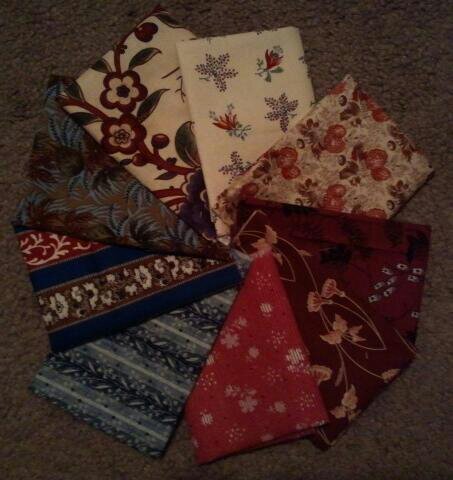
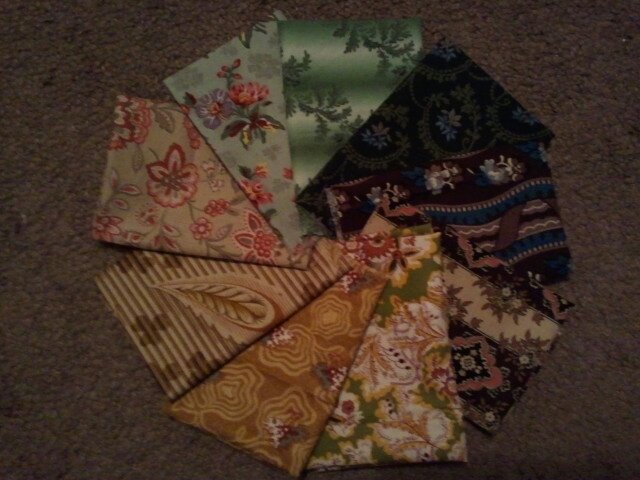
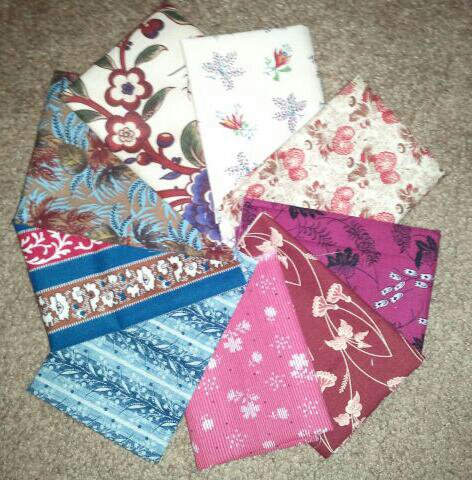
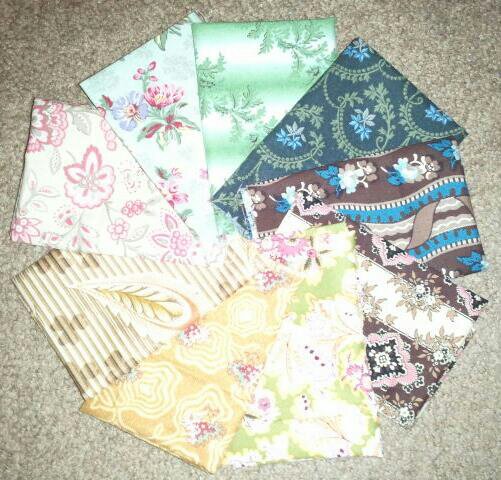
Here are the fabrics we swapped. I had to take the photos with and without the flash, though neither really captured the fabrics in their true light. I hope I have the fabrics labeled right. I flip-flopped which group a couple belong in.

Group 1
imageimage

Clockwise from the top:

  1. Juli Rothemel’s The Mill girls 1830-50
  2. Romantic Old Charleston by Julie Rothermel (group 2)
  3. Windham Dargate Botanicals 1830
  4. or this one is Windam Dargate Botanicals 1830
  5.  Pink and white resist or discharge print with narrow stripes over top, likely a roller print.
  6. The General’s Wives – Blue on blue roller print
  7. Merchants Wife
  8. Dargate Botanicals 1830
  9. Barbara Brackman’s Terry Clothier Thompson 1830

Group 2
imageimage

Clockwise from the top:

  1. Dargate Davinity c1830 by Margo Krager
  2. Grooms Quilt RJR for the Smithsonian c1830-40
  3. Prussian Blue
  4. (ooops should have been in the other photo)
  5. Dargate Botanicals c 1830
  6. New England Quilt Museum for In The Beginning Fabrics
  7. Toast by Jo Morton (should be in group 1)
  8. French General Series Rouenneries Deux in Oyster, c1800s
  9. Collection for a Cause – Mill Brook Seris c1835

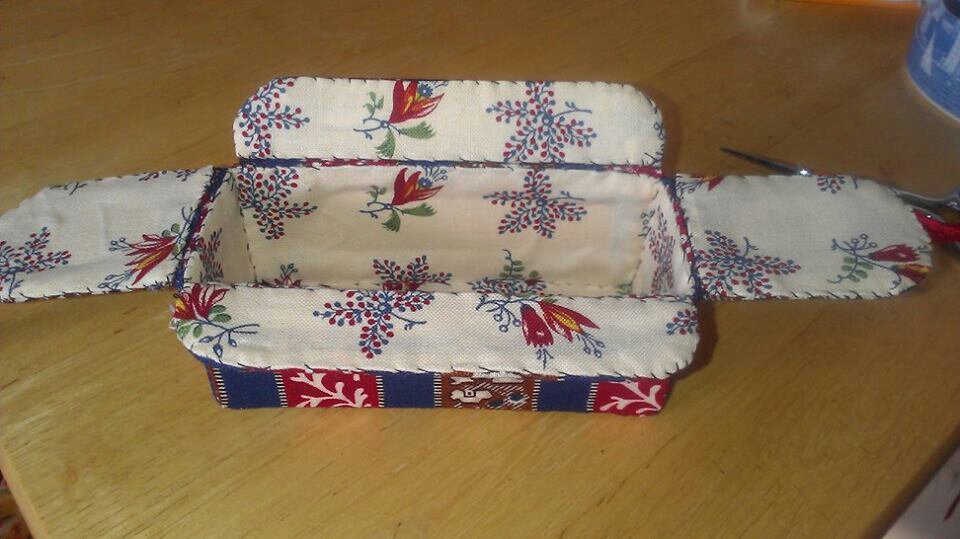
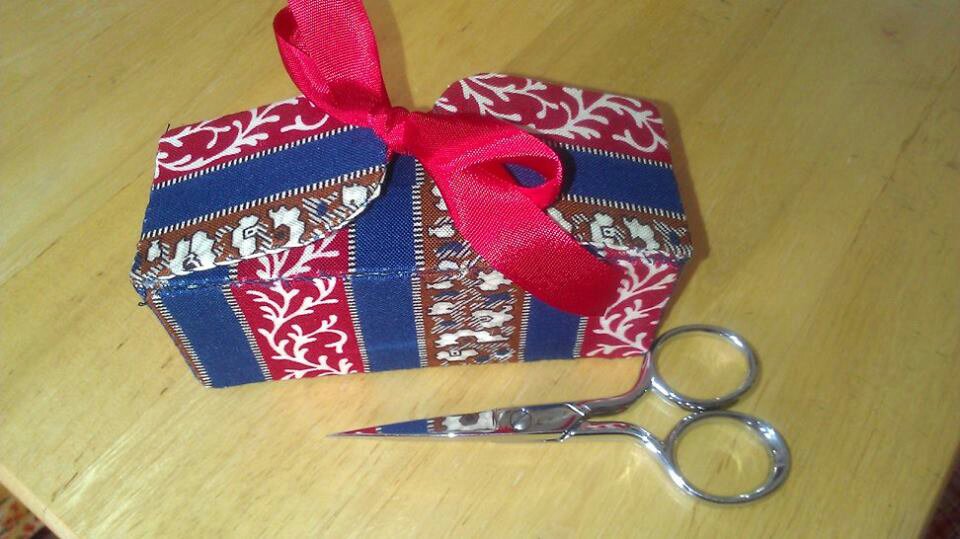
Cindy already dove in with her swap pieces. Using the techniques in Fanciful Utility, she recreated the French sewing box I was obsessed with last fall. She made a great box. I am impressed that she lined up the stripes so well.
image

image

Published in: on February 5, 2014 at 9:11 am  Comments (12)  
Tags:

Resources for Life

“Consider that to-night is the only opportunity the gentlemen may ever have of hearing how adroitly the ladies can flatter them.”

“It is not in the bond,” replied Lucinda.

“What is not?”

“That the ladies should flatter gentlemen.”

“Excuse me,” said Colonel Kingswood; “the ladies having voluntarily taken the responsibility, the gentlemen must insist on their going regularly through the whole ball with all its accompaniments, including compliments, flattery and flirtation, and a seasoning of genuine courtship, of which last article there is always more or less at every large party. And as it appears, that Miss Mandeville has not faithfully done her part during the dance, she must make amends by doing it now.”

“On the latter subject,” said Fitzsimmons, “Miss Mandeville can need no prompting. Her own experience must have made her familiar with courtship in all its varieties.”

“Of course,” resumed the Colonel. “So, Miss Mandeville, you can be at no loss in what manner to begin.”

“And am I to stand here and to be courted?” said Fitzsimmons.

 This comes from “The Ladies’ Ball” in Pencil Sketches; or, Outlines of Character and Manners, by Miss Leslie. (Philadelphia, 1835) https://archive.org/details/atlantictalesor00leslgoog

This earlier compilation of Miss Leslies includes her stories from the periodical series “Pencil Sketches” These include: “The Wilson House; or, Village Gossip”, “The Album”, “The Reading Parties”, “The Set of China”, “Laura Lovel”, “John W. Robertson, A Tale of a Cent” and “The Ladies’ Ball”.

If you enjoy her short stories, you may also enjoy these:

Atlantic Tales: or, Pictures of Youth, by Miss Leslie. Boston. https://archive.org/details/atlantictalesor00leslgoog

Stories for Adelaide: Being a Second Series of Easy Reading Lessons, with Divided Syllables, by Eliza Leslie, Philadelphia, 1829. https://archive.org/stream/storiesforadelai00lesl#page/30/mode/2up

The Gift: A Christmas, New Year, and Birthday Present. Philadelphia, 1845 https://archive.org/stream/giftachristmasa01leslgoog#page/n15/mode/2up (A compilation of stories by others.)


Published in: on February 5, 2014 at 1:35 am  Comments (1)  
Tags:

Video Lectures on the Homefront

Someone, sorry I don’t remember who, shared this website on FB: http://cwmemory.com/2014/02/02/in-the-classroom-with-gary-gallagher/ After listening to the first video “The Confederate Homefront, pt 1”, which covered mostly the political state for the Confederate homefront. I ventured on to the Youtube page. Here I found the more useful “The Confederate Homefront, pt 2” In this video, Gallagher discusses the state of refugees. I would highly suggest this video to newer reenactors or those who need an introduction to refugees.

He also has a two part piece on women during the war, “Women at War” These videos are also very worth watching, being good introductory overviews of women. At approx 6 minutes, he begins to discuss the “ideal”. Of particular interest is American women’s desire to gain weight.

Published in: on February 3, 2014 at 4:00 pm  Leave a Comment  

Fabric Swatch Exchange

I’ve been meaning to write about this fabric swatch exchange I’ve had floating in my head for some time. Now that a local friend has brought up fabric examples, it has floated to the surface. Here is a rough version.

I have this mental picture of each of the members of a group exchanging swatch cards with carefully researched period correct fabrics attached. Each member would cut enough swatches and fill out enough cards for each member of the group. I picture the cards being printed on card-stock. It would be perfectly okay to fill out one card and copy it onto the same/similar cardstock. The cards can then nicely fit into the smaller 9″x6″ three ring binders.

I’ve developed two new swatch cards. The first is for  modern fabrics. This card has space for you to note the current name of the fabric, information on the print/weave/etc, the colors, fiber, appropriate uses, similar original garments and notes.

The second is for swatches from original garments. This card has space to note the source (collection) the sample is from, information on the fiber, weave, print, colors, etc. I envision this card having a photo of the swatch applied to the card. This could be inserted or paste onto the card in the computer or after it is printed. (I also have my previous swatch cards from a few years ago, swatchcards2.)

There are some locations online with original swatchbooks:

I have an electronic swatch exchange in mind as well. In this case, a couple things can happen. At a physical meeting, participants have their swatch cards with swatches layed out on a table so that each one can be photographed with a camera phone or camera. The photos can go into an electronic file to be browsed through. These files can then be shared between friends or groups.

Published in: on February 3, 2014 at 4:00 pm  Comments (1)  

A Year in Millinery Fashion – 1864

The latest Paris creation we have heard of, is a bonnet with fancy net attached, in place of a curtain, and so conveniently arranged that the hair can be immediately placed in it, or relieved at will. As the hair is still worn in the waterfall style, we should think this resille, or net bonnet, an admirable contrivance; we have not, however, seen any. We chronicle all the fashions as we get them from the Paris journals, frequently long before they appear in this country.

To amateur milliners we would say that the most fashionable bonnet cape is almost a complete horseshoe, measuring at the back five inches, and at the sides three and a half. This allows for a tiny frill at the top, and two very shallow plaits at the back. We can answer for the set and style of this cape – always the most difficult part of a bonnet to arrange. (Godey’s, February 1864)

Looking Forward to Spring Millinery

work in progress 3

With the past few weeks of frigid cold and oppressive snow, I know a good many of us are looking forward to spring. I certainly am.

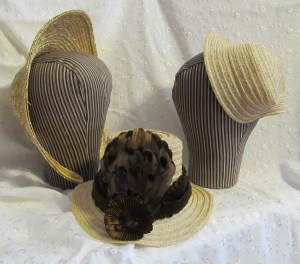
During these weeks I’ve been sewing away. I have a sampling of straw millinery pieces to offer you.

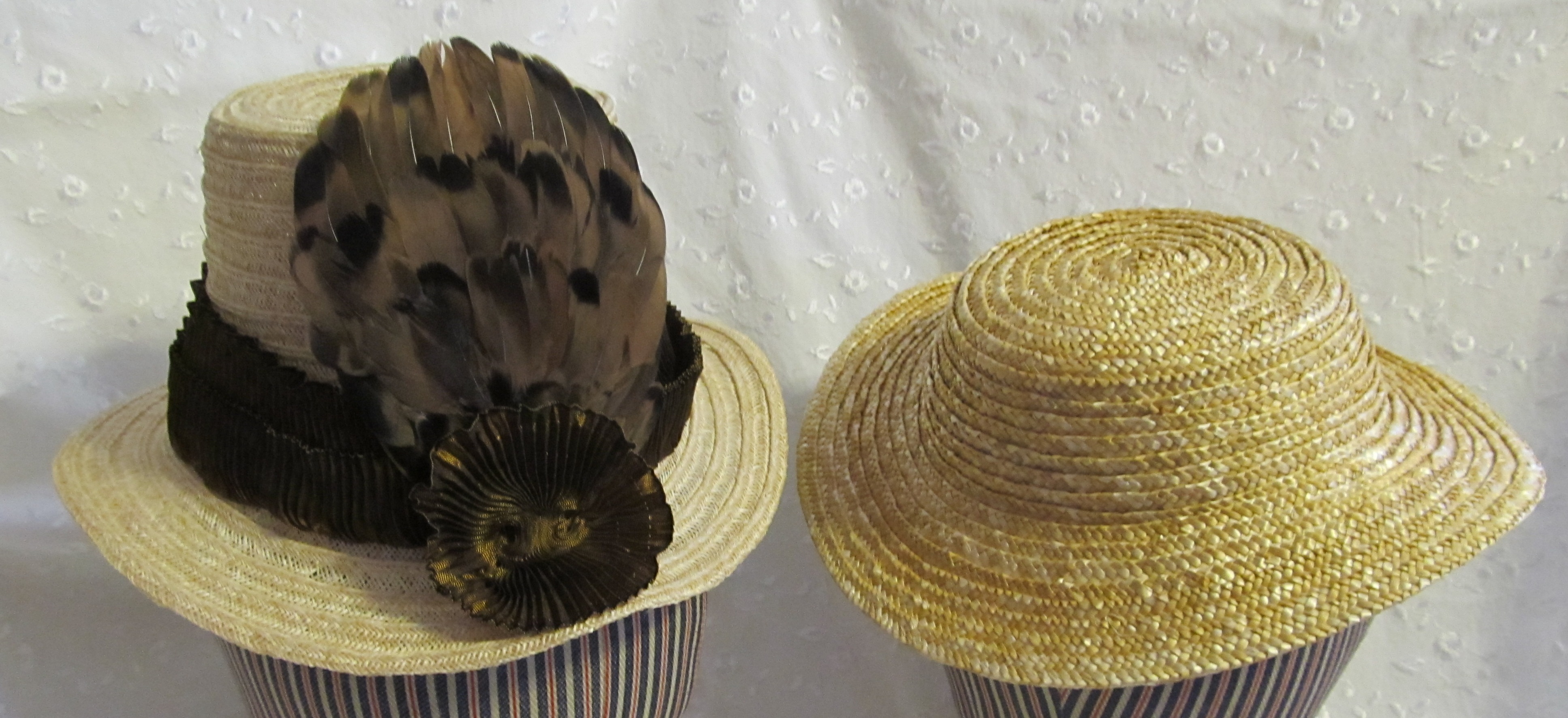
Below, you can see an 1880’s straw bonnet on the right. This little bonnet is one of my favorite later shapes because of the curves the straw does. This bonnet is made from hemp plait. It is ready for you to decorate right now. If someone doesn’t pick it up soon, I’ll pull it down and decorate it. I have some fun ideas for it.

On the left is one of two straw forms suitable for 1859 through 1864. These are whole straw plait, meaning natural straw plaited in whole strands. The one in the photo has a moderately high brim, while the other has a high brim.

In the middle and bottom left is a late 1870s through 1880s hat worked in the hemp plait. It is decorated in a crinkly brown ribbon and an arrangement of feathers. This is my first piece that I hope to step into Steampunk and Whimsy with.

On the bottom right is a fashionable 1860s straw hat for a youth (or young lady with a smaller head). I enjoy this shape quite a bit. It will be fun to decorate and wear.

??????????????????????????????? ???????????????????????????????

This year I plan to work with real straw in a variety of plaits and fineness. I prefer the natural body of the real straw as well as the wonderful smell it has. I have a beautiful fine French plait, a black English plait coming for mourning, an uber-fine, narrow plait for doll pieces and the classic whole straw plait. The four pieces I made this month of the hemp plait is the very last of that plait I have.

Almost forgot. Pricing for the year. 1850s-1864/5 bonnets will start at $85 for whole plait straw. Special plaits or shapes will be higher. Smaller hats for the 60s through 90s will start at $75 depending on how long the shape takes. Special shapes will depend on the time needed and the cost of the plait.

Published in: on February 1, 2014 at 3:50 pm  Comments (4)  

Resources for Life

Women in America; Being an Examination into the Moral and Intellectual Condition of American Female Society, by Mrs. A. J. Graves (New York:1844)

Look round upon the groups of young females who crowd our private parties or public balls; who lounge upon the sofa receiving visits, or throng the city promenades to exhibit their decorated persons or to make morning calls, and how many can you point out among them who have fulfilled one useful purpose of existence to themselves, to their families, or to society? And all this waste of time and energy in the pursuit of folly is in the hope of becoming thereby candidates for matrimony, while by this very means they are seeking to attain. Nor is this all: their efforts defeat the wished for end, inasmuch as the habits of indolence and extravagance in which so many young women are brought up, deter a multitude of young men from becoming husbands, lest they should involve themselves in pecuniary embarrassment; and as wealthy young men are extremely rare, we see marriages in fashionable life every day becoming fewer; thus leaving in our cities a numerous class of finely-dressed, pretty, and accomplished young ladies, doomed to become disappointed “establishment-seekers,” and to fade into fretful and repining “’old maids.” An intelligent, useful woman, who continues in a state of celibacy from choice or from disappointed affection, is an honoured and valuable member of society, but she whose youth has been spent in idleness and folly, and is seeking for a husband in crowded scenes of amusement, becomes a pitiable object – a burden to herself, and the jest and by-word of her acquaintance. (p52-53)

Among the many causes that are tending to deaden in the heart of woman a sense of her appropriate obligations, is the fatal notion that there is something servile in labour. It is, indeed, much to be lamented, that in the praiseworthy effort to redeem herself from the life of slavery and degradation to which past ages doomed her, so many of her sex should have passed to the other extreme – a life of indolence and uselessness Nor is this notion that there is gentility in idleness, confined to females alone: we find it widely and deeply cherished by society at large. Hence we see that the aristocratic titles of “lady” and “gentleman” are by common consent thought to be applicable only to those who hold it beneath their fancied dignity to toil with their hands. The farmer who guides his own plough, and the mechanic who still plies his tools, are thus considered as belonging to a lower caste than the “gentleman” farmer who lives solely upon the toil of his dependant[sic] labourers, or the retired mechanic who has thrown aside his implements, and employs the capital amassed by their use in extensive speculations in lands or stocks. (p25-26)

Published in: on January 30, 2014 at 4:00 pm  Comments (1)  
Tags:

Book Notice: Wearable Prints, 1760-1860

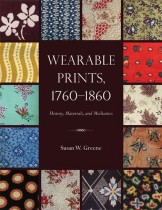
It is here! Well, it isn’t here with me…. yet. So, here are KittyCalash’s thoughts on the arrival of Susan Greene’s book we’ve been waiting for Wearable Prints, 1760-1860.
Remember, the Greene collection is now housed at the Genesee Country Village in Mumford, NY.

Hmmm….. Now, I’m picturing a “Greene” Swap for the Fall. Wouldn’t it be fun to find fabrics similar to those Susan talks about?

Kitty Calash

This just in, literally, from the mail carrier: Susan W. Greene’s long-awaited book,Wearable Prints, 1760-1860. It’s discounted (and out of stock) at Amazon, but should be shipping soon, since I have one right here on my desk.

It’s fair to call this book lavishly illustrated (1600 full-color images in almost 600 pages), and while I have access to a copy at work, I am seriously thinking of buying my own copy, based solely on about 10 minutes skimming the book. There are images not just of fabric samples but also of garments, paper dolls and illustrations that help put the fabrics into context. Images of garments from collections I can’t get into? Delicious! Information to help me understand how to use a printed cotton? Even better.

The book is organized in three main sections: Overview, Colors, and Mechanics. Appendices include timelines, prohibitions, price comparisons, print characteristics, and more…

View original post 186 more words

A Year in Millinery Fashion – 1864

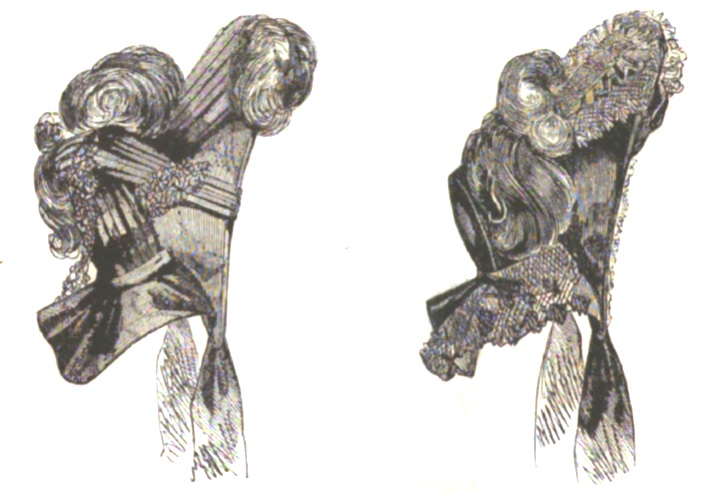
Bonnets rather lower in front and less exaggerated in form, than those which were in vogue during the past summer; they are not decidely Marie Stuart, but partake somewhat of that character; the curtains are deep, and in many cases pointed in the center. Plaid ribbons threaten to become common, so great is the furore for them, the large blue and green plaid being even more popular than those composed of brighter, gayer colors. Chenille fringe is very much worn around the brims of bonnets, and velvet flowers and leaves are also extremely fashionable. If feathers are used, they should be of the same shade as the most prominent colors in the plaid, and flowers should likewise follow the same rule. Velvet flowers, with brown grass and heather, have a good effect in the caps of bonnets which are trimmed with plaid. Black felt bonnets look well ornamented with bright plaid velvet ribbons; these are sometimes disposed in straps at the top of the brim, the straps being fastened down with small jet ornamental buttons.

Black bonnets are very generally worn this winter, even by those who are not in mourning; it will be considered quite sufficient to enliven them with a colored flower, to render them suitable for any dress. For example, a black crepe bonnet, embroidered with jet beads, and trimmed with a tuft of barabout feathers, with ostrich introduced at the tips, would require a moss-rose in the cap, and pink strings. If the bonnet is in black velvet, with a fringe of black chenille around the edge of the brim, and chenille ornaments at the side, the cap would be formed with a spray of sky-blue narcissus, wih opaque white beads in their centers, the trings being sky-blue velvet with white edges. Pinke is also very fashionable for bonnets, and we see many made entirely with pink plush, and a tuft of marabout feathers, with ostrich tips placed in the center of the fronts. Pink velvet bonnets, with bouillonnes of white tulle; pink terry bonnets, with bows of white blonde, with rose-buds intermingling, are also general. (Peterson’s, January, 1864)

1 2


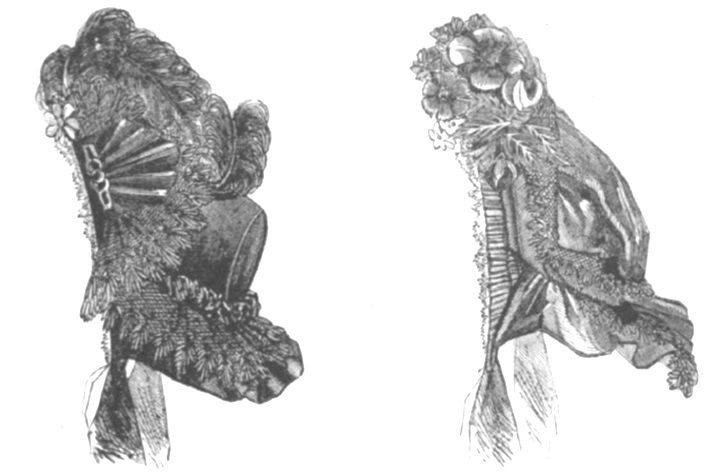
Figs VIII, IX, X, and XI – Velvet and silk Bonnets in various styles, all from the establishment of one of our most fashionable milliners, Mrs. Cripps, New York. (Peterson’s, January, 1864)

Resources for Life – A weekend extra


Dress as a Fine Art, by Mrs. Mary Philadelphia Merrifield (Boston: 1854)

We violate the laws of nature when we seek to repair the ravages of time on our complexions by paint, when we substitute false hair for that which age has thinned or blanched, or conceal the change by dyeing our own gray hair; when we pad our dress to conceal that one shoulder is larger than the other. To do either is not only in bad taste, but is a positive breach of sincerity. It is bad taste, because the means we have resorted to are contrary to the laws of nature. The application of paint to the skin produces an effect so different from the bloom of youth, that it can only deceive an unpracticed eye. It is the same with hair: there is such a want of harmony between false hair and the face which it surrounds, especially when that face bears the marks of age, and the color of the hair denotes youth, that the effect is unpleasing in the extreme. Deception of this kind, therefore, does not answer the end which it had in view; it deceives nobody but the unfortunate perpetrator of would-be deceit. It is about as senseless a proceeding as that of the goose in the story, who, when pursued by the fox, thrust her head into a hedge, and thought that, because she could no longer see the fox, the fox could not see her. But in a moral point of view it is worse than silly; it is adopted with a view to deceive; it is acting a lie to all intents and purposes, and it ought to be held in the same kind of detestation as falsehood with the tongue. Zimmerman has an aphorism which is applicable to this case – “Those who conceal their age do not conceal their folly.” (p12-13)

The immediate objects of dress are twofold – namely, decency and warmth; but so many minor considerations are suffered to influence us in choosing our habiliments, that these primary objects are too frequently kept out of sight. Dress should be not only adapted to the climate, it should be also light in weight, should yield to the movements of the body, and should be easily put on or removed. It should also be adapted to the station in society, and to the age, of the individual. These are the essential conditions, yet in practice how frequently are they overlooked; in fact, how seldom are they observed! Next in importance are general elegance of form, harmony in the arrangement and selection of the colors, and special adaptation in form and color to the person of the individual. To these objects we purpose directing the attention of the reader. (p16)

Had the Bloomer costume, which has obtained so much notoriety, been introduced by a tall and graceful scion of the aristocracy, either of rank or talent, instead of being at first adopted by the middle ranks, it might have met with better success. We have seen that Jenny Lind could introduce a new fashion of wearing the hair, and a new form of hat or bonnet, and Mme. Sontag a cap which bears her name. But it was against all precedent to admit and follow a fashion, let its merits be every so great, that emanated from the stronghold of democracy. We are content to adopt the greatest absurdities in dress when they are brought from Paris, or recommendation by a French name; but American fashions have no chance of success in aristocratic England. It is beginning at the wrong end.


Published in: on January 24, 2014 at 6:06 pm  Leave a Comment  
Tags: