It’s Getting Cold Out There – pt 1

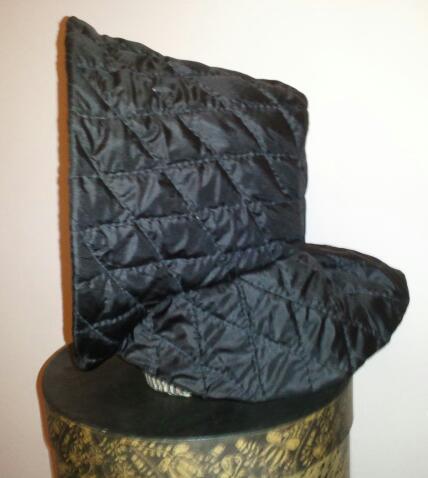
The first hoods of the season.

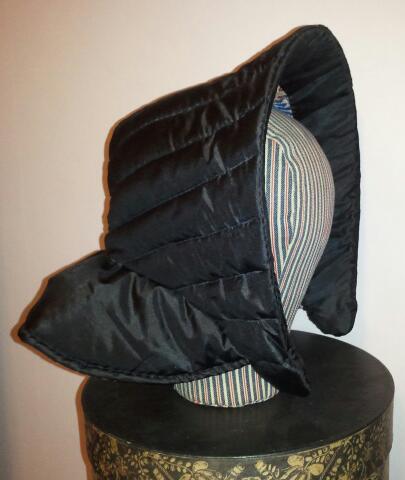
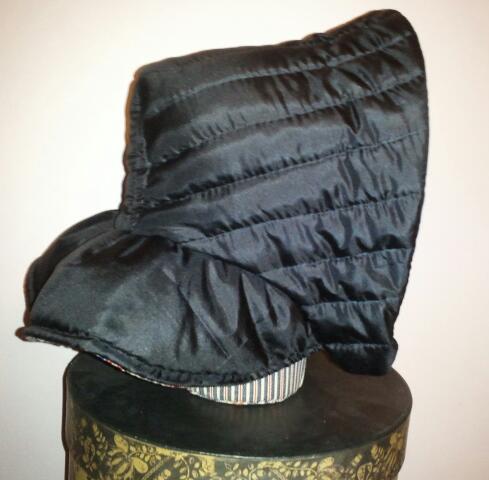
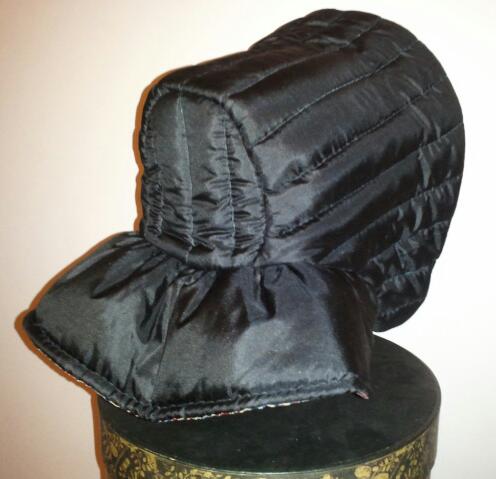
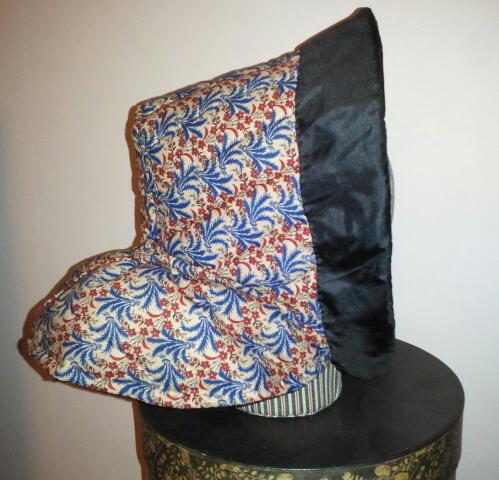
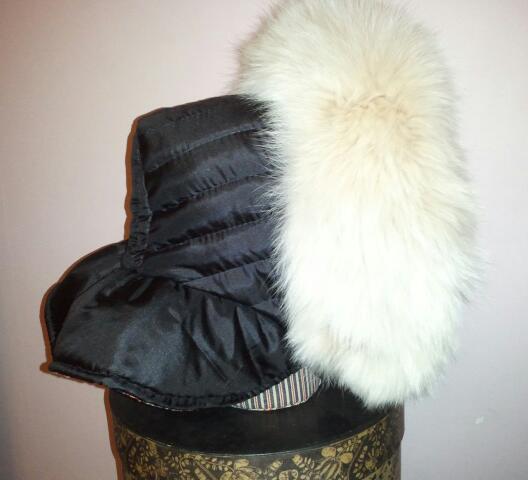
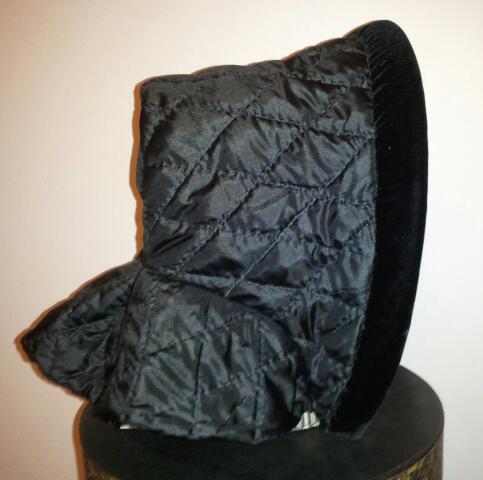
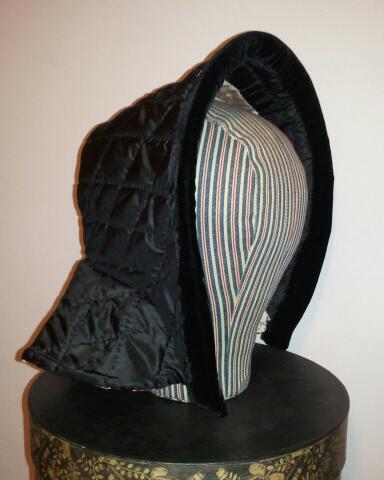
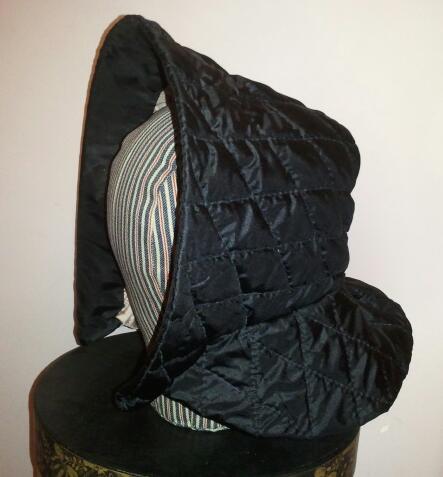
This is about a month later than I planned. Here is the first winter bonnet or hood.
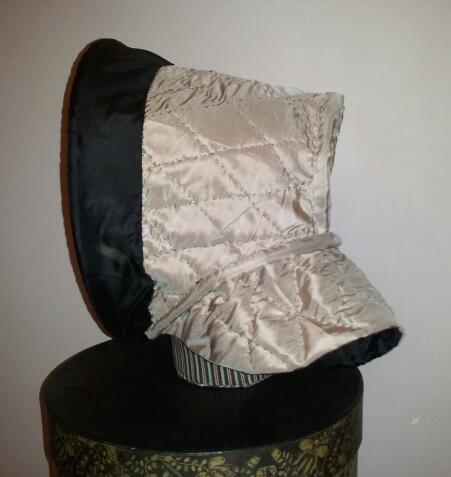
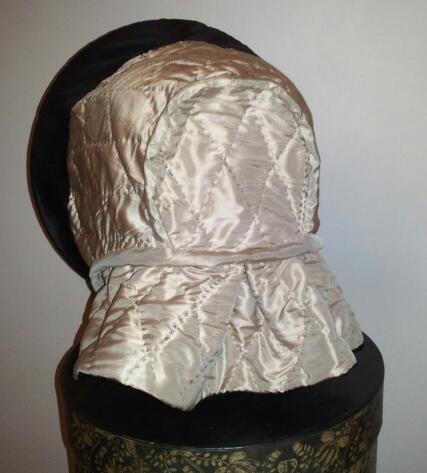
It is a diamond quilted black silk taffeta with a pink & green silk lining, cotton batting and black silk/rayon velvet brim.
All the quilting and construction is by hand.

image

image

At first, I couldn’t decide whether to add the velvet or not. Here it is pre-velvet:

image

image

The inside:

image

image

Published in: on November 11, 2014 at 8:51 pm  Comments (1)  

A Year in Millinery Fashion – 1854

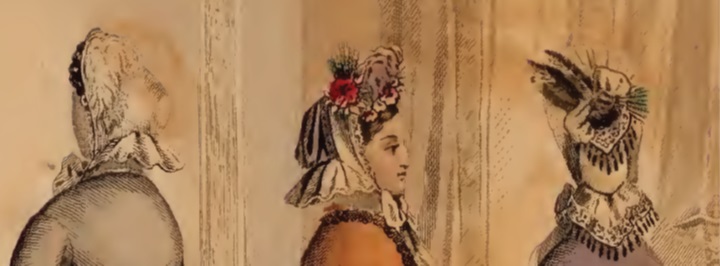
Left – White [unent] velvet bonnet, with white plume.

Center – bonnet of white plush, with soft crown of purple velvet. The trimming is composed of purple velvet and scarlet and white flowers

Right White corded silk bonnet, trimmed with jet black feathers, a purple tip, and fancy grasses. (November Godey’s 1864)

1

Published in: on November 10, 2014 at 1:01 am  Leave a Comment  
Tags:

A Year in Millinery Fashion – 1864

Bonnets without curtains have not quite won the day yet. It is true they do not suit every one, and should not be adopted without exception. It is absolutely necessary to have a large quantity of hair, either natural or added by the coiffeur, in order that the bonnet may look well at the back without its ordinary appendage, over a full chignon, a simple fall of lace, or even a sprig of flowers or bow of ribbon, looks well; but the case is totally different when there is little or no hair at the back, and an empty space is left between the edge of the bonnet and the next. It is, therefore, to be understood that ladies no longer young and addicted to caps, or those who have not adopted the modern and elaborate style of dressing the hair, should net think of wearing a bonnet of the curtainless description, yet the curtain should be very small. The top of the bonnet now bends down slightly toward the forehead. The sides are fluted and very full-trimmed inside.

Veils of colored gauze are very popular. They are quite small, round, and trimmed with a quilling of gauze. For white and black lace veils, fringes of chenille, jet, or straw are worn. (Peterson’s, November 1864)

Published in: on November 8, 2014 at 1:01 am  Leave a Comment  
Tags:

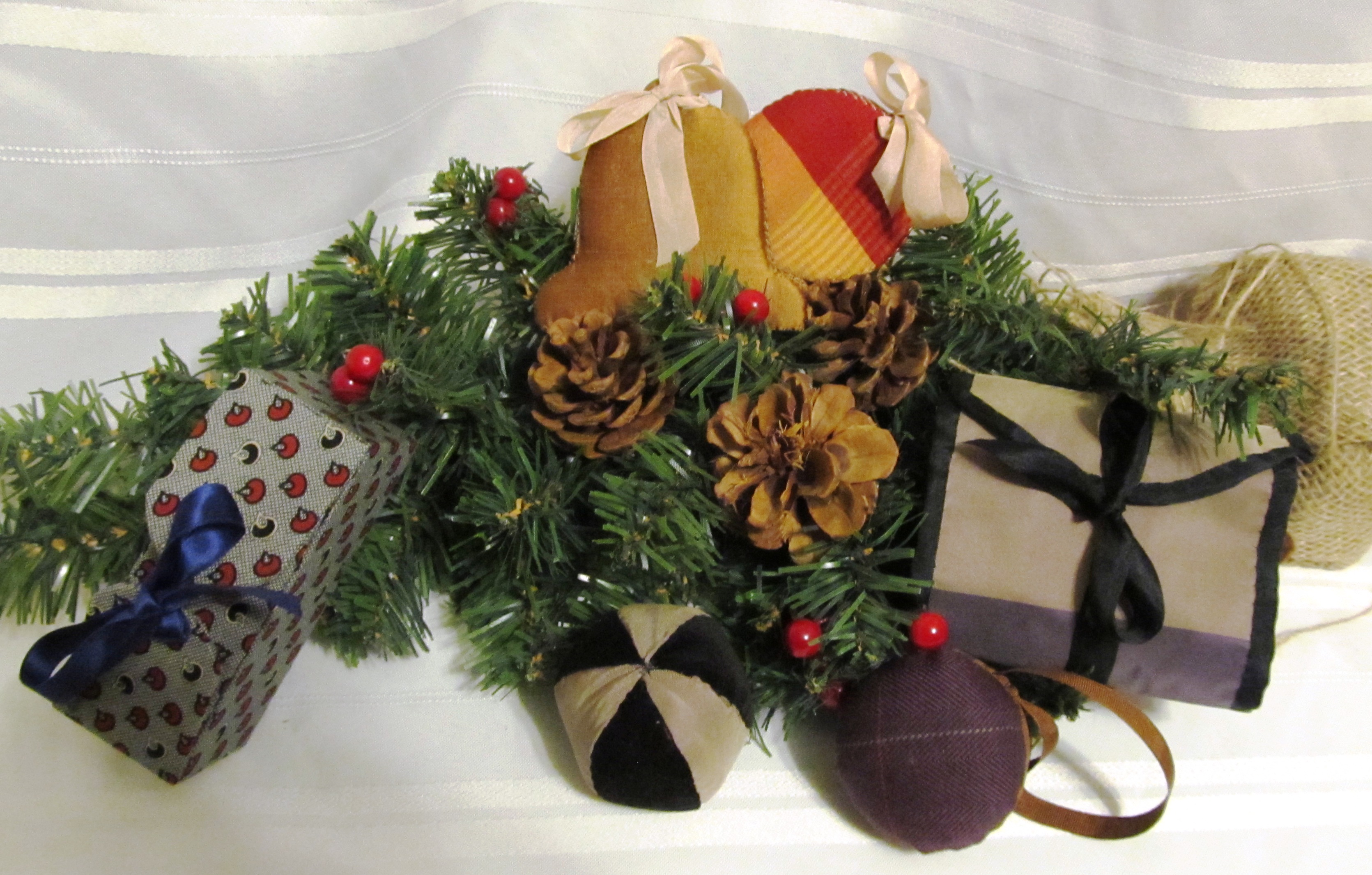
For Your Holiday Browsing…. and Gifting….

I just dressed my Etsy shop for the holidays. Whether you celebrate Christmas, Hanukkah, Yuletide, Kwanzaa or everything, I hope you take a moment to peak in to see all the new goodies. You may just find the perfect pretty for you or a loved one.

???????????????????????????????

Published in: on November 6, 2014 at 8:50 pm  Leave a Comment  

Readings for Rural Life

From Moore’s Rural New-Yorker in Rochester, NY

Nov 5th, 1864 – Appears to be a relative of mine. (Wordens, Lincolns and Stids of South Bristol, Bristol and Canandaigua.)

Economy

The practice of Economy is a virtue, and would seem a necessity now, when the prices are so high and destitution so common. Fathers should teach it  to their sons, and mothers to their daughters. By economy we don’t mean stinginess; but careful, prudent management in the house, on the farm, and throughout all arrangements of both.

We may be a guest or boarder in the family of Mrs. S. Almost invariably her table is well set and all the food palatable. As we so often gather around this well-spread board, we compare it to that of our friend, Mrs. L., whose table, to be sure, is bountifully loaded; but we seldom relish a meal she cooks. There is a towering pile of bread on the plate, a pound or two of butter in the dish, cheese, pickles, cakes &c., in proportion; the platter is loader with meat; but with all this bountifulness nothing is just right – and why is it? Well we can tell you. Mrs. S. is a very careful to cook, if possibly just what will be eaten. She don’t cut a loaf of bread for two or three. She don’t put two or three pounds of butter on at one time, neither cheese nor pickles in such a proportion. When you leave the table you will find but a few fragments left, and so the next meal will be fresh and wholesome.

Look at Mrs. L.’s table. There is meat enough left for two or three meals, a large plate of butter unfit for the table again, bread, cheese, pickles, &c., not half consumed. Mrs. L. don’t intend to be wasteful, so all these eatables are set away in the pantry, (perhaps uncovered) and repeatedly put on the table until hardly fit for swill.

Our experience in housekeeping has taught us the value of economy, in this particular, to be very great. During the past season we employed a domestic at three dollars a week. She was a careless, wasteful girl; having lived in large families, she had not judgement to cook for a few. She would waste more in cooking one week than a tolerable sized family would consume, unless closely watched.

Some ladies have a faculty of repairing their old dresses and making them look like new, and are called very extravagant, while others have three times as many clothes and never looked neat or well dressed. I tell you it is economy here, as well as in the first case. Repair your old clothes, – they may often be turned, dyed or the trimming changed, and you charged with extravagance; but no matter, while it consists in using what others would throw aside. The whole domestic arrangement must come under a system of economy to make it complete. We should know just how far a pound of tea or sugar goes if we do justice to our providers. How much anxiety it would save the fathers and husbands, if their wives and daughters thought how much it cost to live, and remembered those who were toiling so hard to provide for their wants. But there are two sides here. The wives and daughters cannot do all towards making things come out right at the end of the year. If the farmer lets the golden days pass without improving them, and don’t plow until the grain should be up, leaves the potatoes in the field until they are frozen, the corn unhusked until it sours and molds, things will run behind at an astonishing rate.

Some farmers think it all folly to hire a day’s work. We know of those who have nearly two hundred acres of land, and, with the help of two small lads, “carry on the farm,” and raise about the same amount they could off of fifty acres well tilled. Is this economy? Besides it keeps the children constantly toiling. We believe in having children work; but they need pastime, they need recreation and education, and if kept constantly at work they have neither Their forms will be bent, and their spirits broken, before thirty years old. It this economy?

It is economy too, to make your homes beautiful. The ladies must have their silks and jewels, the gentlemen their tobacco and cigars; but they have no money with which to get shrubs, trees and flowers. They must have their Brussels carpets and sofa furniture; but can not have a melodeon or piano. If we can have but one, give us the cottage with its trees, shrubs and flowers, its music and sunshine, its wealth of love, its foretaste of heaven, instead of the dome-like edifice, with its elegant carpets, its velvet-covered furniture, its solemn, still, monotonous air; without flowers and music, or the light affection to gladden the heart, or brighten the long weary journey of life. Yes, it’s economy to make our home beautiful.

Mrs. Mattie D. Lincoln. Canandaigua, N.Y. 1864


Published in: on November 5, 2014 at 6:00 am  Leave a Comment  
Tags:

Workshops at the Domestic Skills Symposium

This past weekend was the Genesee Country Village & Museum’s first Domestic Skills Symposium. Saturday was filled with 4 exceptional presentations and an incredible period lunch, while Friday and Sunday held workshops throughout the day.  Attendees came from approx 6 states and Canada to participate. I really enjoyed meeting new people and catching up with old friends during our sewing.

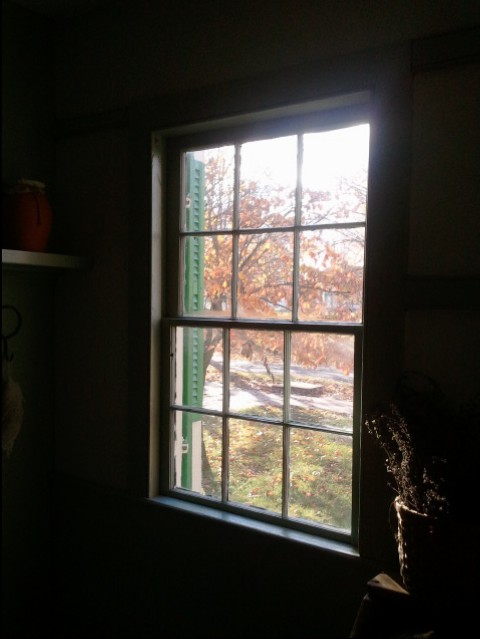
wpid-2014-11-02-08.45.08.jpg.jpegWhile Saturday was a drizzly chilly day suited to being inside for the presentations, Sunday was bright. The sun made all the fall colors sparkle. You can see the beautiful colors out the window of Foster, where I taught a rolled sewing case workshop in the morning and a sewing box workshop in the afternoon.

wpid-2014-11-02-08.54.14.jpg.jpegThe kitchen of Foster was toasty warm and very welcoming after the morning’s chill. Here is our work table all ready for the first workshop. Attendees were able to choose from an assortment of pre-cut 19th century reproduction fabrics selected at the local Chestnut Bay. In the center, you can see the projects of the day along with the free Fanciful Utility templates available on this blog (a button-keep aka “balloon-bag”, a boot needle-book, and a shell needle-book)

Here are a couple photos from the morning class. Everyone was so focused on their work there were times the room was silent. It was so quiet actually, we learned we really could hear a pin drop. In fact, a pin makes quite the ding noise as it hits a painted floor cloth.

image

imageI neglected to take photos in the afternoon as my phone died. We completely lost track of time too.

Published in: on November 3, 2014 at 4:31 pm  Comments (4)  
Tags:

A Year in Millinery Fashion – 1854

Left – Curtainless bonnet. Gray chip bonnet, trimmed with scarlet daises. A fall of black lace is arranged for the crown, over which is a bow of scarlet velvet. Scarlet daisies and black lace form the inside trimming.

Right – Fancy gray straw bonnet, having the crown covered with blue hanging flowers. (Godey’s, October, 1864)

1

“I Couldn’t Live Without It!” FanU Swap – Sign-up Day

Today is the day to sign-up for the FanU “I Couldn’t Live Without It!” Swap!

For the “I Couldn’t Live Without It!”  Swap, Swappers will exchange early to mid nineteenth century appropriate cotton fabrics that just had to come home with them. Pick a fabric that speaks to you. We will mail our fabrics on November 10th.

Please read all the details below. 

To Sign-up, simply comment below with your email and mailing address. (I’ll erase those before approving your comment, so the whole world doesn’t have that info.)

What is a Swap?

This is a chance for to exchange fabric with a small group of people. Each group will have 8 people exchanging pieces of fabric. All you need is a half yard of fabric and envelopes along with your copy of Fanciful Utility.

To Participate:

1: Sign Up Day!
On sign-up day, groups will be assigned on a first-in basis; the first eight will be the first swap group, second eight in the second group, etc. **Please be certain you will be able to fully participate by mailing your fabrics on the Mail-Out Date.**

“Fallen Leaves” Swap Sign-Up Day: September 1st
“All Lined Up in a Row” Swap Sign-Up Day: October 1st
“I Couldn’t Live Without It!” Sign-Up Day: November 1st

Bonus The Greene Swap Sign-Up Day: November 15th


2: Mail-Out Day:
Place a 9×9″ piece of fabric suited to the mid-19th century in envelopes for each of the 7 other people in your swap group, stamp them (be sure to double check at the post office, but the small 9×9″ pieces should mail in a regular envelope with a normal stamp), and send them off no later than the Mail-Out Day.

“Fallen Leaves” Swap Sign-Up Day: September 10th
“All Lined Up in a Row” Swap Sign-Up Day: October 10th
“I Couldn’t Live Without It!” Sign-Up Day: November 10th

Bonus The Greene Swap Sign-Up Day: December 1st


3: Get Fanciful!
Use your Fanciful Utility templates and techniques to make a project from the book, or copy your own from 19th century sources. We’ll all look forward to seeing your projects! You don’t have to sew right away, but don’t keep us waiting forever to see all the fun things!

(If you need a copy of Fanciful Utility, you can purchase them from the publisher at www.thesewingacademy.com

Fabric Guidelines:

  1. For the cotton and silk categories, your fabric should be early to mid-nineteenth century appropriate. (If there is a want for an earlier or later group, we can do that.) Prints and motifs should reflect those available in the 1840s, 50s and 60s. Cotton should be 100% cotton. Silk should be 100% silk.
  2. To keep the swap and sewing possibilities interesting, please avoid solids as best we can.
  3. Fabrics that do not work well for sewing cases should not be swapped. These include sheers, gauzes, heavy, thick, easy-to-fray, slippery and stretch fabrics.
  4. For the “crazy swap” category, think crazy quilt in a sewing case. This could include satins, velvets, textured fabrics. Quality synthetic fabrics are invited.

Swapper Guidelines:

  1. Please be certain you can fully participate in the swap before you sign-up.
  2. If something arises after you sign-up that will effect the date you are mailing your fabrics, please email your group so everyone is aware.
  3. If you fail to fully participate in a swap, you will not be able to sign-up for future swaps. (We do understand medical and family emergencies. I need to be able to ensure swappers will receive fabrics when they send fabrics out.)

Q&A

Yes, you can participate in 1, 2 or 3 of the swaps.

Yes, if we end up with multiple groups, you can participate in more than one group to swap more fabric. If you participate in 2 groups, you should swap 2 fabrics.

Yes, you can swap large and small scale prints.

Yes, you can swap now and sew later.

Yes, we would love to see what you’ve made with the swapped fabric.

Yes, you can use your own fabric in your swapped project.

Published in: on November 1, 2014 at 6:00 am  Comments (12)  
Tags:

A Year in Millinery Fashion – 1864

1 White corded silk front, with puffed silk crown edged with black velvet ribbon, which is fastened inside the front of the bonnet, is carried to the centre of the crown, where it finishes in a point from which to hang clusters of grapes with foliage. Inside trimming is of tulle, scarlet velvet, and purple grapes. 1

2 Eve bonnet of puffed white tulle, with small pointed cape. The front edge of the bonnet and cape are edged with a double row of Marquerites. The same flower, mingled with tulle, foems the inside trimming. 2

3 The front of the bonnet is of quilted gray silk. The crown is soft, and of plain silk crossed with black velvet. Deep blue flowers are arranged on the lower part of the crown, and instead of the curtain are loops of ribbon and lace. The inside trimming is of tulle, black lace, and blue flowers. 3

4 Bonnet formed of rows of violine-colored ribbon, arranged in points. The outside is trimmed with a half wreath of lilies of the vally and a violine-colored feather. The inside trimming is of violine velvet and white flowers. 4

5 Reception bonnet of white royal velvet, with a short cape formed of two rows of blonde. On the outside are white camelias with scarlet velvet leaves. Inside are blonde caps, small white flowers, with coral centres and scarlet leaves. 5

White silk bonnet, with crown of Azurline blue velvet. On the edge of the bonnet is a roll which is strapped with narrow blue velvet. Inside is a very large cluster of blue daisies and grasses. Daisies and grasses are also arranged on the outside of the bonnet. 6

Published in: on November 1, 2014 at 1:01 am  Comments (2)  
Tags:

Readings for Rural Life

From Moore’s Rural New-Yorker in Rochester, NY

Oct 29th, 1864

Cream Cheese

An inquiry in the London Field for a recipe making cream cheese was replied to as follows by three correspondents:

“We put a quart of cream into a clean jug, with half a teaspoonful of salt stirred in, and let it stand a day or two, till thickish. Then we fold an ordinary grass cloth about six or eight times and sprinkle it with salt, then lay it in a sieve about eight inches in diameter. The sides of the cloth should come up well over the sides. Then pour in the cream and sprinkle a little salt on it. Change the cloth as often as it becomes moist, and as the cheese dries press it with the cloth and sieve. In about a week or nine days it will be prime and fit to eat. The air alone suffices to turn the cream into cheese.”

“Take about a half pint of cream, tie it up in a piece of thin muslin and suspend it  in a cool place. After five or six days take it out of the muslin and put it between two plates, with a small weight on the upper one. This will make it a good shape for the table, and also help to ripen the cheese, which will be fit to use in about eight days from the commencement of the making”

“Take a quart of cream, either fresh or sour, mix about a saltspoonful of salt, and the same quantity of sugar. Put it in a cloth and with a net outside, hang it up and change the cloth every other day; in about ten days it will be fit for use.”


Published in: on October 29, 2014 at 6:00 am  Comments (2)  
Tags: