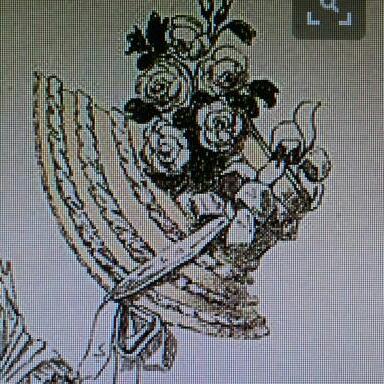
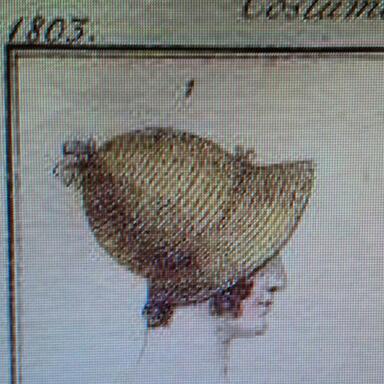
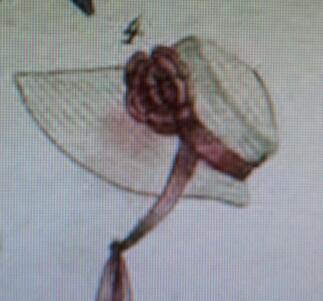
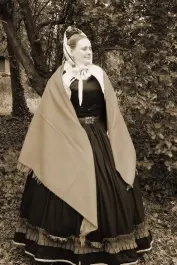
Today, I offer a bonnet with a brim edged in hand shaped VVVVs, finished with antique straw threads. The bonnet is a classically fashionable early Civil War era shape. The deep VVVVs were inspired by an original bonnet in the MET collection.
Leaves of Straw
For I don’t really know how long I’ve been playing with the idea of making my own decorative straw. As you’ve seen, I started shaping straw plait into decorative designs for the edges of bonnets and hats.
A few weeks back, I ordered straw splitters, straw and straw threads. They arrived but I didn’t let myself play with them, trying to focus on a few millinery pieces. Tonight, I finally made my very first leaves:
While they are not perfect, I am pretty happy with them. I think they are rather cute. (I also tried to make a flower with the antique threads. That didn’t go so well. I will need to learn a lot more about flowers.)
What will I do with these? Put them on hats and bonnets of course. (I may also try some ornaments for Christmas. But, those will go up on my other blog.)
Patriotic and Secession Bonnets
***Incomplete Thoughts Post – See Here***
Years ago I became fascinated with the notes Vicki Betts assembled on Red, White and Red. This was very early in my learning research. I was so excited to see so much information in one place, and have it be easy to read. Years later, I still find her research just as wonderful. (If you haven’t spent days and days looking at it, your really should.)
This year, being the year a great many Civil War era reenactors interpret the year 1861 coinciding with me doing as much millinery as I have been is going to give me the opportunity to do a millinery piece (or two) reflecting northern or southern patriotism.
In reading original literature, periodicals, journals, etc., there are two clusters of patriotic apparel and accessories – Those surrounding elections and those surrounding the beginning of the Civil War.
Ah, the elections. I do wish we would interpret the 1840s and 1850s more, as they are filled with so many fascinating events. I also think it would be nice to interpret one of the elections. In the years of presidential elections, the ladies magazines are filled with patriotic themed projects decked out in red, white and blue – slippers, quilts, pillows, etc. Period accounts are filled with descriptive scenes of villages draped in the national colors and women’s bonnets adorned with ribbons of the same. This account of a country election is a short example.
As the Civil War dawned, or possibly pre-dawn, northern millinery reflected patriotic sentiments. Several publications, including Appleton’s Annual Cyclopaedia and Register of Important Events, recount women wearing ribbons of red, white and blue on their bonnets in New York City following the events at Fort Sumter.“On all coats were pinned the red, white and blue cockade, and in every lady’s bonnet ribbons of the same colors were tastefully displayed”
For an understanding of southern patriotism and secession bonnets, please see Vicki Bett’s research (two transcriptions below) and Kathy Kelly Hunt’s article (may require a FB account.)
CHARLESTON MERCURY, March 20, 1862, 1, c. 3
The ladies of Baltimore, notwithstanding Lincoln’s proclamation, appear daily on the streets, in secession colors, to wit “red, white and red.” Bonnets are so constantly trimmed with a red, a white, and again, a red rose, that even the manufacturers have been prohibited from making these rebellious flowers, in order “to support the Government.” Yet, the ladies, who are equal to every emergency, were not to be out-done in this matter. The insulting Yankee soldiers, on several occasions, spoke to the traitorous demoiselles, and even went so far as to tear the trimmings from their bonnets.
According to the
“the streets of Charleston were filled with excited people hazzaing for a Southern Confederacy, and several women made a public display of their so-called patriotism, by appearing on the crowded side-walks with “succession bonnets,” the invention of a Northern milliner in Charleston. Small Palmetto flags, with a lone star on each, fluttered with white handkerchiefs out of many a window…” ( Pictorial History of the Civil War in the United States of America Lossing, 1866)
Here is a short passage on Palmetto Cockades to give you an idea of how these were used to trim Southern bonnets showing their patriotism.
England New England Frustration
***Incomplete Thoughts Post – See Here***
Why? why? why? …. Do I have to love a topic that has oodles and oodles of research and articles written about the happenings in England, but is all but swept aside in the United States.
Yes, please, read this as a full on pout.
There are so many nifty and info packed articles chewing on the cottage industries, straw plaiting included in England…. …. The Female Labour Market in English Agriculture During the Industrial Revolution: Expansion or Contradiction…. Proto-Industrialization? Cottage Industry, Social Change, and Industrial Revolution….. and, who can’t love a title like: How Saucy did it Make the Poor? The StrawPlait and Hat Trades, Illegitimate Fertility and the Family in Nineteenth-Century Hertfordshire
A Working Length
***Incomplete Thoughts Post – See Here***
If you catch my comments on various FB group threads, you will know I have a bit of an obsession with a series of letters in Moore’s Rural New Yorker discussing women’s in-house working attire and related rural articles or columns. Even though the focus of my impressions currently are that of a women business owner, this has captivated my attention. I may be able to use it in my reworking of a straw sewing impression, I also may not. Let’s face it, domestic cleaning work is not my strong point in any century.
We know that (some) mill workers kept shorter skirts.
We know (some) fisher women kept shorter skirts.
We know (some) washer women kept shorter skirts.
Women employed as maids and house keepers, who were photographed in the occupation, show shorter skirts. Here is a house keeper from 1864. Not only is her skirt shorter, those may actually be pants underneath.
What about women working in their own homes? Why do we interpret these activities with full length or just above the foot length skirts? What skirt lengths did the women of the latter 1850s and early 1860s actually wear when they laboured about the house? What skirt supports did they use? What techniques did they use for safety?
The letters/discussion in the Rural NYer make me think it wasn’t cut and dry, that there was quite a bit of variation in what women did and why.
How many times a day do we go up stairs and down cellar, each time carrying half of what we otherwise could if we had not to carry our dress in one hand; and even then one will step on the dress sometimes, and then the ugly rent must be mended. It may do for those who have nothing else to do to have the care and carry their swaddling clothes or hire others to do it, but for us, – the working bees of this world – away with it; it is nothing but slavery to fashion as ancient as the Heather Mythology, of more ancient still for what I know. (Moore’s Rural New Yorker, April 30, 1864.)
Now, just take some of those long dresses that have become faded at the bottom and in front, take out the front breadths, leaving about five, tear off the bottom leaving the skirt long enough to come half way from the knees to ankle joints, use the parts taken out for pants, prepare skirts to suit the length of the dress, running “shurs” in one for three or four hoops from the discarded skeleton, and with good thick-soled shoes or bootees you are well, becomingly dressed for any and all kinds of work that may fall to your lot. (Moore’s Rural New Yorker, April 23, 1864.)
I do not advocate short dresses anywhere but at home, at work. At church and on the street, I think long dresses much more becoming, and wear them myself. Short ones are only for work; have you any objections to them there? If you have, I would suggest that you put on long skirts, and wear them for one week, wash, mop, milk, work in the garden, and if necessary help plant corn. If you don’t lay them aside at the end of the week and say ladies, wear short dresses to work in by all means, you have more patience than falls tot helot of most mortals. Stellie. Prarie Home, Mich,. 1864. (Moore’s Rural New Yorker, August 6, 1864.)
Here in William Hemsley’s Baking Day, we see sacque bodice combined with a likely wool skirt. The skirt appears to be higher than the top of her foot as she does bend forward to work the bread. Her sleeves are rolled up.

This card image shows the skirt pulled up and back. The petticoat, not white, is likely mid-calf. Again, this woman is bending forward. Her sleeves are turned up.
A Question for My Civil War Era Friends
I am making my lists of what to bring for my millinery impression at the GCV Civil War event weekend this year. Is there anything you wish I would bring? Any questions you would like me to cover?
**Remember: I will be in a different building this year. Find me on the Village Square, next to Ward Hovey in the Law Office.**
A Question for Regency Era Friends
I am planning what materials I will take for my straw millinery demonstration at the GCV War of 1812/Jane Austen event. I want to bring a few different straw shapes for visitors to see. Are there any “you really should have” or “oh, I wish I could find” straw shapes that come to mind?
Tonight’s Millinery
Tonight I offer two fancy plait straw bonnets and a youth size fashionable straw hat.
Veil 101 – (Version 1)
This look at veils concentrates on the everyday veils of the mid-19th century, the 1840s through 1860s. It does not include mourning veils.
I am calling this “Version 1” because, despite this post sitting in the drafts folder for well over a year, it does not include everything I want it to, including specific photos.
As some of you know, I have issues with sunlight that can trigger migraines or full-body crashes. So, veils are very important to me. This is very much a “don’t leave home without it” item.
You will notice each of the veils I wear are silk gauze. This is for two reasons. First, when we started exploring veils locally, some years ago, the silk gauze at Dharma was what we felt suitable. Our research has expanded. Second, personally, I find the gauze helps with my light issues nicely. I am kinda afraid to make the change to net. But, I will be giving net a try when I find a net that I feel mimics the feel of those originals I’ve held.
Veil Shapes
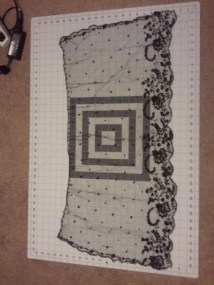
The most common shapes for veils included the wide rectangle and the semi-circle. In each shape, they tended to be wider than they are long, ranging approx from 30″to 40″ wide and 15 ” to 20″ long based on those I’ve been able to see in photos and in person.
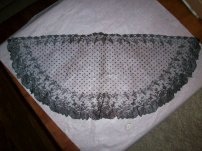
Right above: A rectangular net veil, approx 36″ wide by 17″ deep. Right below: A semi-circular veil. I need to double check the dimensions, as I am pretty sure I bought this one but haven’t a clue where I put it.
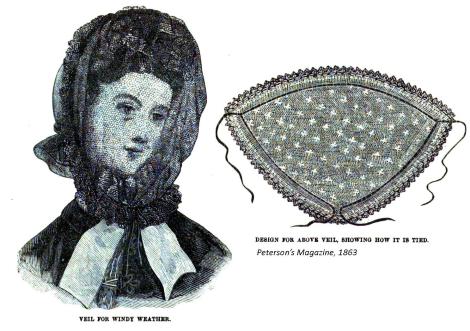
There were some variations to these shapes. This example at the MET may be mid-century. It is a variation on a rectangle with the top and bottom edges curving. There is a shape I would call a petal, with two sides each an arc. At the bottom of the page, you will see a quasi-triangle shaped veil meant for windy weather.
Be sure to browse your favorite and local museums to see original veils.
Veil Materials
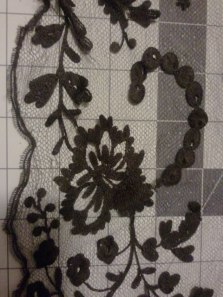
Let me first say I am utterly clueless about lace, or at least entirely lacking confidence in my knowledge of lace. I will leave the details of which lace is which and which is correct to those who have studied lace in depth.
That said. In minimum:
In terms of fibers, silk, linen, wool and cotton all come up for nineteenth century shawls in museum collections.
When looking at the net ground of net or net lace, you want little hexagons. You do not want the little rectangles or diamonds.
Veil Colors
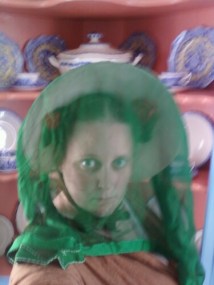
The most commonly found veil colors for the century are black, white and ivory. We can also find blues and greens. These do tend to appear more frequently in earlier remaining veils then in those of the 40s, 50s and 60s.
To the left is an image of me in an 1820s bonnet with a green veil. This is a dyed silk gauze veil made by Bevin Lynn. I found this green to be gentle on the eyes when out in the sun, given moderate protection. It did not give glare as some white veils can do. It did play with the light giving a streaked color effect similar to what some migraines can produce.
I have also worn white and black veils. I find black silk gauze to give the most protection from the sun. It also gives the most vision dampening of the colors I’ve worn. White give some light protection. I prefer it on moderately sunny day for short walks across the tree filled square.
Attaching a Veil
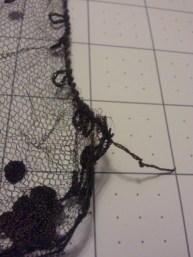
This is how I attach my veil. Original veils show either a channel at the top of the veil or worked holes, through which a thin cord or ribbon can be drawn. In my veils, I prefer to put a small knot or loop in the end. This helps keep the cord from sliding back through and makes it easy to grab.
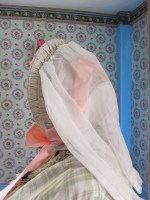
Once this cord/ribbon is drawn up, the veil can be positioned along the brim edge. I drape the veil over the back of the bonnet.
I prefer to pin just back from the edge. With my drawn bonnet, seen here, I pin under the second cane. On my straw bonnets, I pin a row behind the fancy plait or about the 3rd row back. The end pins are pinned upward sorta following the row of cane or plait. In the center top, I pin one or two pins across the veil, trying to catch the cord,
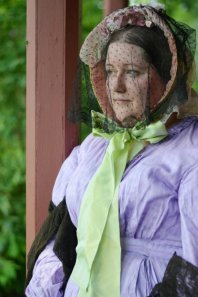
parallel to the cane or plait. (pinning perpendicular to the plait will allow the veil to pull forward or backward as it drapes.) Here you can see how this veil drapes forward and back. This is a silk gauze veil made for me by Bevin. It is trimmed in silk ribbon. It is a little longer than most 1860s veils. Some 1850s images do show a similar length.
Here Betsy Connolly is wearing a semi-circular veil. Notice how she doesn’t have the ends pooling on either side as a rectangular veil would.
Specialty Veils
Research that makes you whine like a child for ice cream
Yep. That is what I am doing right now. Whining like a child. Okay, ice cream would be good too. But, look at this, here.
This is a transcription of an advertisement in a February, 1813 New Orleans Gazette offering a millinery subscription for a new hat for every Sunday. (Either a second transcription or a transcription of another advertisement can be seen here.)
To the Public
A New Hat Every Sunday for Thirteen Dollars a Year.
The subscriber has the honor to inform the public that he has opened a subscription for persons desirous of having a new hat every Sunday, the dampness and dust of this country is very injurious to hats and but few can keep a clean hat more than 15 days.
This has determined the subscriber to make such a proposition to the public, no person can keep a hat longer than 15 days, and they will be answerable for, all kinds of damages out of shape, stains and all other accidents, and the hat, if it or , found the lining is in any way injured another will be put in at the expense of the wearer. This especially will be kept with the greatest cleanliness and the punctuality, which will be observed induces to hope for its success. This list is limited to a certain number and as a number of persons have already subscribed, but a few will now be admitted.
E. Porte – Hatter
No. 11 St. Louis St.
The whine: I have so many questions…..
I want to see the original.
Is this for men’s hats or women’s? The advertisement is signed “hatter” indicating men’s hats. But, it is cataloged under millinery indicating women’s hats.
Is this more like a library subscription? Borrow and exchange?
Did they take the hats in and just clean them? or did they remake them if they were women’s hats?
Was there any connotation socially to participating in this type of subscription? Did people recognize the hat they wore last month?
Did subscriptions like this appear in other areas?
Was this financially viable for a hatter or milliner? Did the subscriptions cover the cost of new hats, cleaning, remaking?
Whine……