Fall Project List

Okay, technically this is more a a belated fall and early winter project list.

Projects you will see in the shop:

  • Check silk winter bonnets, Plaid silk winter bonnets, Solid silk winter bonnets (three patterns this season)
  • New Winter Bonnet Pattern
  • A couple more Shaker style sewing boxes to line
  • A sewing box to line and make a tray for.
  • TLC a nice slope for someone
  • A few pin cushions tbd
  • Christmas items tbd
  • Try new Doll scale idea (surprise)
  • Finish S’s set before the workshop (So I can send her the growing box of things)

Projects for me, gifts, etc:

  •  Evergreens at Twilight
  • Research Pence Jugs for a crochet project. Possibly swap silk threads for this.
  • Crochet new wool muffetts for work
  • Finish the slippers (well, maybe, as I have lost interest in this project)
  • Make Clara a cute Christmas dress based on her halter vest.
  • Finish Cali’s dress that was started last spring
  • I am considering making myself a modern fleece version of one of my winter bonnet patterns.
Published in: on October 20, 2016 at 6:04 am  Leave a Comment  

Today’s Millinery 

Tonight’s winter bonnet is a black silk taffeta trimmed in a ruched plaid silk taffeta, hand quilted with local wool batting and a polished cotton lining.


Also… a Shaker style sewing box. 

Published in: on October 16, 2016 at 6:16 pm  Leave a Comment  

The Pumpkin Bonnet – A Wadded Winter Bonnet

A quick post about wadded bonnets – This is abbreviated because I have a larger publication in mind.

What is a Pumpkin Bonnet?

A “Pumpkin” bonnet is a wadded bonnet, most commonly made of silk on the exterior and polished cotton, cotton or silk on the interior. Wide, full channels are filled to a full loft with wool batting either lightly or densely. The channels are separated by smaller channels, single or multiple, that are drawn in by cord or ribbon. The front brim may or may not have a decorative ruffle, attached or tucked from the base exterior fabric. These usually have a petite to moderate bavolet either lightly filled with batting or without batting.

Some other terms that seem to apply: Wadded bonnet/hood, “Ugly”, a “Kiss-me-quick”.

How early were these worn?

Most museums seem to start their dating of wadded, pumpkin style bonnets to the 1840s. Some do push earlier, as far as the late 1700s/early 1800s, such as this example from the Boston Museum of Fine Arts.

As domestically made winter bonnets were a utilitarian garment rather than a fashionable one, their appearances in fashion literature is limited. I see one set of passages referencing a wadded bonnet, drawn in, worn close to the face that may help us give wadded bonnets drawn close to the latter 1830s:

In the Ladies Pocket Magazine, of 1838, London, we see a mention of wadded bonnets as a fashionable item. Of English fashions – “Wadded bonnets which before were very much in vogue, are now almost the only ones adopted in promenade dress, and it must be confessed nothing could be better calculated for the season, particularly when they are worn, as in often the case, over a blond morning cap of the demi-cornette form.” (In this passage, wadded pelisses and wadded mantles are also mentioned.) Of Paris fashions “Winter has set in with all its rigour, but that is of little consequence to our elegantes, who, occupied with the grand dinners, balls, and fetes that are always given in the commencement of winter, have deserted the promenades. Novelty in out-door costume is consequently out of the question, velvet or satin mantles, which are trimmed and sometimes lined in fur, that their busts are defended by a large fur palatine, their hands doubly shielded by fur cuffs, and a muff, and their pretty faces guarded by a large wadded bonnet, which completely meets under the chin, we have said all that can be said of out-door dress.”  The year prior, the same publication tells us: “We may cite with confidence, among the new bonnets will be very fashionable, the capotes a conlisse ouatees, or wadded drawn bonnets; the are a most comfortable head-dress, composed of satin or pou de soie, lightly wadded, and simply trimmed with ribbon. They differ a little in shape from the other bonnets, sitting closer round the face.” This may or may not be the beginning point of the wadded, pumpkin style bonnet. Neither publication includes an illustration of this practical winter wear in the midst of the popular large bonnets of the era.

In that same time period, we see wadded and quilted bonnets constructed for children in The Workwoman’s Guide. The illustrations suggest the quilted versions have larger crowns that are volumous in some cases. It is important to note the difference between this shape and the Pumpkin shape. I believe this is the construction that evolves through the rest of the century as the quilted bonnet.

Blackwood‘s suggested I should look at “quilted wadded capotes” as well as “bonnets” and “hoods”. Though, this February and March 1843 Peterson‘s suggest capotes were quilted, rather than wadded with loft.

One of only photographs clearly depicting a wadded “pumpkin” style bonnet/hood is a bit of tease. While taken in 1897, the photograph does not show contemporary/current wear, rather historical costume wear. This photograph is held by Deerfield.

Were they worn during the Civil War?

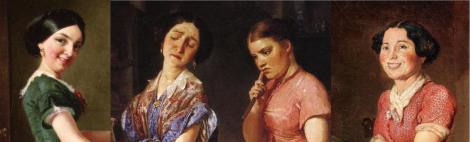
The 1860 painting, School Girls, by George Augustus Baker, shows the girl on the left in what could be a red silk wadded pumpkin bonnet. The artist did several studies for this painting, including  Little Girl in a Red Bonnet, which is undated.

Museum examples:

Published in: on October 13, 2016 at 6:22 am  Leave a Comment  

Today’s Millinery 

I’ve just added an incredibly soft quilted bonnet to my shop. The local, hand combed, wool batt was nearly two inches thick. So soft, with such loft. 

The black silk taffeta bonnet is lightly hand quilted and entirely hand sewn. Inside is a polished cotton lining and cotton sateen ribbon ties. It is trimmed in a gold silk taffeta cut on my antique pinking machine. 

Published in: on October 10, 2016 at 2:59 pm  Leave a Comment  

Today’s Millinery – Berry & Tan Pumpkin Bonnet 

Looking for a snuggly warm pumpkin bonnet? 

This one is made with a deep berry and tan mini check silk taffeta, local wool batting and polished cotton. (I didn’t realize I had the one lining piece polished side in until I was stuffing the batting. So, price cut.) 

Waiting for you in my shop. 

Published in: on October 8, 2016 at 10:22 am  Leave a Comment  

Does Anyone Collect This?

I bought this soft paste sugar dish thinking it might match my teapot. It does not. 

I want to ask my readers if anyone collects the shape before putting it one Etsy. The design is very pretty. The lid is missing the finial. 


I will leave this up for a little while. 

Published in: on October 8, 2016 at 10:10 am  Leave a Comment  

A Winter Hood Story

Except from “The Romance of a Tassel” (The Christmas Annual, 1860)

We were to have a sleigh-ride, and the principal topic of conversation was, the delightful morning and the promise of pleasure; I was olde enough to feel all the enthusiasm of the occasion, and yet to temper my feelings with quietness. My Cousin Kate and I had been knitting some new hoods, beautiful we thought them, and of a new pattern. As my fingers had toiled through the countless loops, I had only thought what a delight it would be to wear it, and a little vanity was mingled with my feeling, for truly I looked like another person in its scarlet and white border than in the faded silk of my old hood.

All the young girls and boys of the village were to go to this ride, and I knew very well that Kate and I would have the most dashing head-gear of the party and I remembered with pleasure, that Esquire Thomas’s son Chester had come from the city and was to be one of the party.

I presume I tried my hood on twenty times the day before, because, I said, it felt so comfortable, but I had to look in the glass each time to see just how comfortable it felt.

After our breakfast was over, my Uncle Oliver rode up with his daughter Nancy, who had been sent to join in the day’s pleasure. She lived several miles back in the country, and I must acknowledge that I felt too little interest in her pale face and quiet manners, because I thought she was not quite so smart in her ways and dress as we village girls; but I had not an unkind heart, and so I ran to meet her with a hearty welcome, saying “Why, how cold you are; your cheeks at least are red as roses; come to the fire.” My mother with gentle manner took off her straw bonnet, trimmed with its light faded ribbon, and gave her some coffee, and I ran to get ready for the ride. It took me an hour. I twisted my curls over and over again. I asked Kate if I looked well enough. Then I put on my hood – too it off – re-arranged my curls. “There,” said Kate at last, “you look like father’s beautiful scarlet and white carnation pinks, and if Chester does not say so, I will box his ears.” – And what will Chester say of you?” I asked “Oh what he always does. “you most beauchiful butcherfly.” “But is not Chester handsome, Susy? And he is really so good, so manly, so noble, father says, none of your fops – but come, let’s go down.”

Just then my mother with her gentle touch opened the door. I remembered the look she cast on me – it was one of mingled pride and trust – her eye was bright and cheerful, but there was a look so ful of hope for me and trust in me, that I ran up to her with a kiss as hearty as when I was five instead of fifteen.

“Susy,” said she, in her animated but gentle manner, “Nancy has nothing to wear but her straw bonnet. She will be ill if she thus exposes herself to the cold wind. She says sh will stay with me rather than suffer as she did coming here this morning.” “Well I think it’s queer how some people live,” said I, “Never having anything to wear that is appropriate.” But Susy, she says her mother has been so sick, and you know her father is rather afraid of pennies.” “Afraid! I should should think he was anything but afraid the way he hugs them. Well, Nancy can have my old hood, thought it don’t look very well, but it is better than that old straw bonnet.”

My mother’s look changed instantaneously; there was a sad, half reproachful, half hopeful look on her face as she opened the door, saying, “Would you like to have her wear the old one?” She shut the door and went out. What a commotion was in my heart. I knew my mother had expected me to offer my new hood to Nancy, and wear the old one myself; but what visions were before me of Chester and the effect of my hood on him; of the general look of the whole party as they saw me again in that old Silk. Then came to my ear the sweet tones of my Mother’s voice. I heard all she felt, but more powerful was the thought of what would they say to see me looking like an “old dud.”

I believe I should yielded to the selfishness of my heart if Kate had not spoken.

“I think it is absurd for your mother to ask it; of course you will wear your own things.” Her tone and manner brought to me my Mother’s hopeful trust in me, for she had called her absurd and I knew she was anything but that.

“Of course I shall,” said I, and I ran from the room with swift step. I tore my hood from my head on the way. “Here Nancy,” said I, “You must wear my hood this once, it is so warm and perhaps your father will get you worsted to knit one – Wont you Uncle Oliver? It only costs a dollar., and just see how fine it looks.”

Continue reading on page 100…
Published in: on October 5, 2016 at 6:00 am  Comments (1)  

A Closer Look at My Winter Bonnets

IMG_7764I have been meaning to write about how I make my winter bonnets for a while now, a while being over a year. I really want to share with you what goes into each of the bonnets I make.

Why do I love working on winter bonnets?

As you know, with my straw bonnets it is all about the art, the lines and curves that make up each style. For the winter bonnets, it is equally as much about the why and how of the construction, they layers and the materials. I love figuring out why a bonnet was constructed in a specific way, what the material choices were for, why this little area was done this way, etc. There is also something about the visual texture the quilting or wadding creates. I find it pleasant.

I also get very, very cold in the winter. The soft, snuggly warmth of a wadded or quilted bonnet is comforting. I often want one of my 19th century bonnets for everyday wear during my frigid, pre-dawn morning commute.

Where do the patterns come from?
Each of the bonnets I am now making come directly from original bonnets in my collection. I have slowly been collecting winter bonnets with a variety of shapes and construction techniques. Each piece goes through my version of a conservation process (how I wish I had the resources to do everything I would like), ensuring there are no buggy nasties, helping the all too often crushed, scrunched, flattened fibers back into shape and stabilizing. Once I think a piece is ready and I am ready to focus on a piece, I have a note taking process that I am sure would make some people’s heads turn sideways in puzzlement. Hey, it works for me. From my notes, I draft a pattern. These patterns are what I use for creating my winter bonnets.

What materials do I use?

I try to use the same types of materials I find in original winter bonnets. Sadly, as with many things, we simply do not have the same silks they did in the 19th century. Of the fabrics we do have, I use silk taffeta, tight weave silk twill, silk faille, some special weave silks and tight weave smooth wool. For linings, again, I use what originals bonnets show – polished cotton, cotton prints, cotton weaves, silk and tropical wools.

For the batting and wadding, I use 100% wool batting. Occasionally, I will layer 100% wool batting with 100% cotton batting to get the right loft and firmness. Depending on the bonnet, I use a variety of lofts and layering. I refuse to use polyester batting. I do not think it is warm enough or gives the look of original bonnets. Due to allergy issues, I will consider using just 100% cotton or alpaca/cotton batting.

How do you know which bonnet will be right for you?

When choosing the right winter bonnet for you, I suggest thinking about the type of weather you have in your area and/or where you will attend events. Picture when you were out in the snow last winter, did the snow stick to your coat and hat? Was the snow wet? If you are in an area with sticky snow, I suggest a very smooth fabric like a silk taffeta. If you have wet snow, the tighter weaver the better. For wet snow, you really want a wool batting, I’d even consider silk interlined with a light wool fabric.

How do you trim your bonnets?

I look to originals to determine what kinds of trim I will use. While period fashion columns do suggest some additional trims, I have yet to determine to what extent these trims were actually used. So far, I have stuck to ribbon and silk trim. I may venture into tassels and beading. Maybe.

For the functional ties, I have found I love cotton sateen. This is entirely Eileen Hook’s fault since she showed me the cotton sateen she picked up at Needle and Thread. Cotton sateen is durable and ties nicely. I anticipate it doing very well in the wet of winter. For decoration, I do prefer silk ribbon, but will also use high quality modern ribbons such as Hyman Hendler’s. 

How do you quilt your bonnets?

Far prefer doing quilting by hand. I like the look of hand quilting more than that of machine quilting. That said, hand quilting can take a long time, a very long time in some cases. Yes, this has to be reflected in the price.  I understand machine can be faster, making a bonnet more affordable. In addition to the time/cost factor of machine quilting, there are occasions when a piece wants a tighter quilting than I can currently get with my hand quilting. I often end up arguing with myself over which approach to take, that of the tighter machine quilting and that of hand quilting.

How long g does it take to make one?

It takes about an hour to cut and mark/chalk most winter bonnets. It takes from as little as 8 hours to quilt and sew an easy bonnet to 16 hours for a more complex quilt design or a wadded bonnet with cording or a unique construction. 

What is the deal with wired and unwired?

From an interpretive perspective, this often comes down to two factors: Do you need to pack your bonnet flat? and How do you want it to frame your face? But, in terms of historical construction techniques, wiring is just one of several structural materials found in originals. (I’m going to hold on to the list of those materials for a certain something special.)

Why do I show photos of the insides?

I want to show you how I finished the insides because I know some people like pretty finished seams. As with originals, sometimes I make the seams pretty and sometimes I leave them.

Do I have an Etsy shop?

Yes! A Milliner’s Whimsy by Anna Worden Bauersmith

Published in: on October 4, 2016 at 6:00 am  Comments (1)  

The First of This Season’s Winter Millinery 

Both of this weekend’s blue ribbon winning winter bonnets are available. Find them in my shop – pumpkin and quilted.


Published in: on October 2, 2016 at 6:44 pm  Comments (1)  

Ag Fair 2016

We just got back from the year’s Agricultural Society Fair. I am rather cold and tired. So, this will be brief. Be sure to see my post on Velvet Vegetables, my whimsical entry that I find of. 

Several of my entries did not fit in categories. 

My play on a horticulture category.

My beaded crochet purse.

A sampling of millinery in miniature.

I also entered a couple millinery pieces. Here is a simple quilted bonnet made with a brightly colored silk. 

My batwing soft crown bonnet, which bows to Anneliese’s incredible cap.

A corded pumpkin bonnet in a mini check silk. 

I made lavender wands for the first time since Grandma died.

Mom entered an assortment, again not as many. 

I took a couple videos this year. (I added a YouTube channel.)

Horticulture tent part 1: https://youtu.be/40wVaKxB33g

Horticulture tent part 2:https://www.youtube.com/watch?v=In0JBLqWn3g

Domestic Skills entries: https://www.youtube.com/watch?v=X8iA56fIu3U

Published in: on October 1, 2016 at 5:31 pm  Comments (1)