One of the nifty things that emerge as you spend more time researching though original texts, is how rampant “borrowing,” “rewriting,” and downright plagiarism were in the nineteenth century. This can be seen in manufacturing articles (often with accelerated gloating), news accounts (as it does today), and fashion accounts. My recent post “A Band of Millinette” took note of a head dress appearing in two American publications with slight variations. I thought it would be informative and a bit of fun to show how this and its sister coiffures developed or mutated from the popular European publications to American publications.
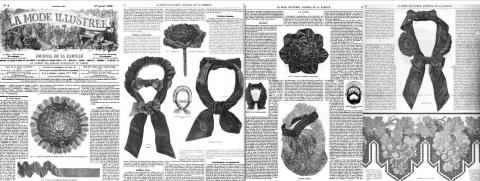
Initially, four coiffures or head-dresses appeared together in La Mode Illustree, published in Paris. Within half a year, they were published individually, in abbreviated form and with redrawn, possibly repeatedly so, illustrations in American publications.
A simplified timeline is such:
- January 1862 – La Mode Illustree
- February 1862 – Der Bazar
- April 1862 – Frank Leslie’s Magazine
- June and July 1862 – Peterson’s Magazine
Looking more closely, this is what we see (I encourage you to click on each publication or thumbnail image to go to the magazine and see the illustrations and descriptions in full.):
La Mode Illustree (Paris) – January, 1862
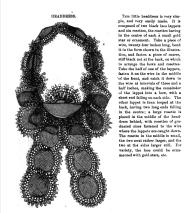
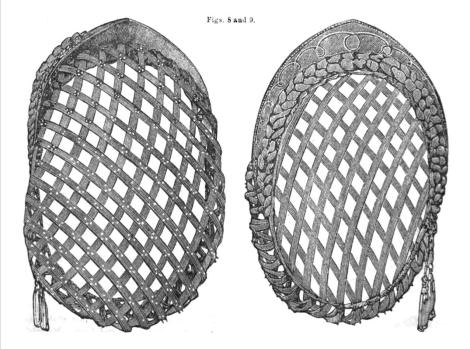
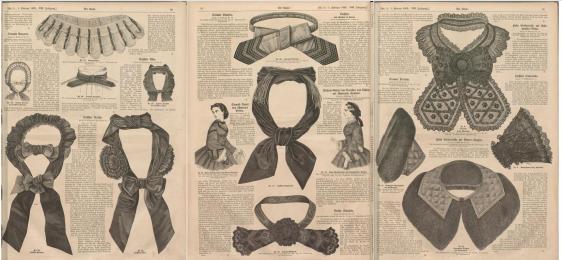
The Coiffure Esmeralda and Coiffure Narissa appear together in the January 1862 edition on page 31. The Coiffure Narissa has two illustrations, an exterior and an interior. The Esmeralda has a single illustration and a description that begins on the proceeding page. This page also has the descriptions of the Esmeralda and Narissa, as well as the coiffure Alice. An interior illustration for the Alice appears on page 34, along with interior and exterior illustrations for the coiffure Isabella. On the following page, we find the exterior for the Alice.
Der Bazar – February 1862
The coiffure Esmeralda appears on page 36 as an illustration and the description on the preceding page.
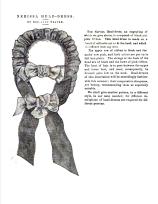
The Coiffure Narrissa appears on page 39 with two illustrations (front (#29)and back(#30)) The lines in the front illustration are crisp, showing the box pleats and where they are stitched to the base, as well as the two colors, black and pink, and the shaping of the bows. Accompanying this is the coiffure Alice, with exterior and interior illustrations. There are subtle changes to the illustrations indicating that they are redrawn.
Frank Leslie’s Magazine – April, 1862
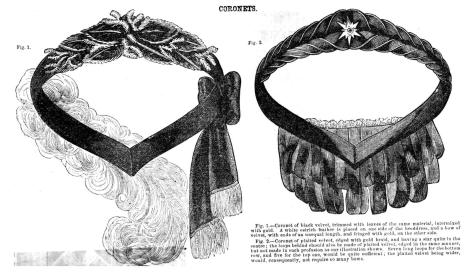
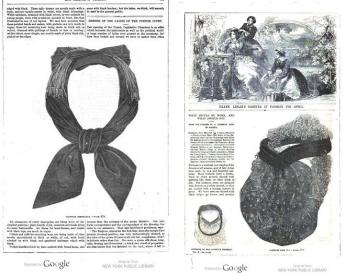
The Coiffure Isabella begins the April edition on page 369 with both an exterior illustration and an interior illustration. The Coiffure Esmeralda appears in illustration on page 380. The descriptions for both appear on page 379. These descriptions appear abbreviated to me, which they excuse:
Nos. 1 and 2. – The Coiffure Isabella is composed of a circlet of black velvet, confined at the back by a jet ornament with pendants. A deep fall of rich black lace conceals the hair behind, while a series of magnificent white plumes are intertwined with the circlet. That is this beautiful head-dress may be more intelligible to those of our readers who may desire to make one than a verbal description could render it, we give also an interior view of it, which will be found of material assistance in facilitating it arrangement.
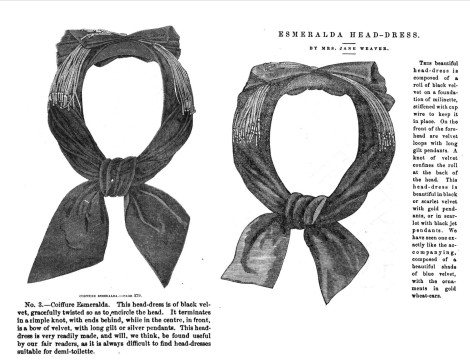
No. 3. Coiffure Esmeralda. This head-dress is of black velvet, gracefully twisted so as to encircle the head. It terminates into a simple knot, with ends behind, while in the centre, in front, is a bow of velvet, with long gilt or silver pendants. This head-dress is very readily made, and will, we think, be found useful by our fair readers, as it is always difficult to find head-dresses suitable for demi-toilette.
The Esmeralda illustration, while redrawn, does retain the tail length and angle of the end cut. We can see some of the construction, including the millinette, which is omitted from the description.
Peterson’s Magazine – June and July 1862
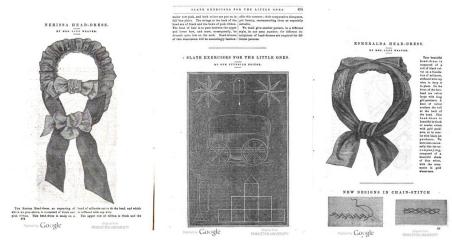
The Esmeralda Head-dress and the Nerissa Head-dress appear in the Peterson’s Magazine in June and July of 1862. The Nerissa appears as an illustration with description on page 494 and 495. The illustration appears to have left out some detail in my opinion. The illustration, redrawn, does not have the definition nor detail guiding construction as I feel the European illustrations have. While some of this may have been lost in digitization, I feel much of this is due to the illustration itself. The Esmeralda Head-dress appears on page 69 of the July 1862 edition. It is accompanied by a single, narrow column of description. This is a redrawn illustration with shorter tails of ribbon compared to the Der Bazar and Le Mode versions. The diagonal cut is also to a lesser degree. The overall illustration is set wider, more circular than ovular.
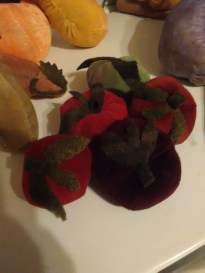 In the past year there have been multiple posts and memes talking about the history of tomato pin cushions originating from tomatoes being a good luck symbol places upon the mantle. Now, there is even a video.


 In 2009 I transitioned from my old “Geocities” website to this WordPress blog platform. Eight years and 1,300+ posts later…. I am almost out of space.


 This first pair of examples, from Godey’s, show a simple band on the right with two millinette pads/ovals to which flowers are stitched, and on left a wider, covered band to which lace and flowers are attached.
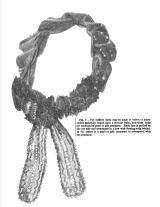 This next head-dress loops heavy ribbon or velvet around the wired base, a “circular frame.” The heavy ribbon allows for fuller body. The focal point in the back is asymmetrical with the lace quilled along one side.