Today’s Millinery 

The piece I’ve been working on for the past week was inspired by the turned up shaping I see in some 1760’s hats. 

Published in: on February 7, 2017 at 5:38 pm  Leave a Comment  

Thanks Godey’s

thanks-godeys

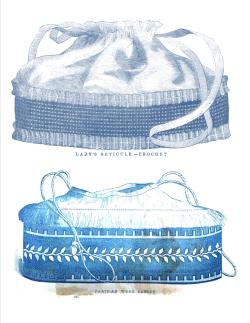
Godey’s Lady’s Book – 1855 – Top February, Bottom December – One a Reticule, One a Work-Basket

On a recent flipping through of the 1855 edition of Godey’s Lady’s Book , I came across first the image of a crochet reticule, the an image of a work-basket. Flipping back and forth, the illustrated similarities were obvious. All I could think was “Thanks Godey’s. This is going to cause some new researcher quite the bit of confusion.”

The directions confirm both the reticule and the work-basket have a cardboard structure. In the case of the reticule, it is covered in crochet satin cord, trimmed in satin ribbon quilled or ruched. The work-basket has a cardboard bottom, that is covered with satin on the exterior, wadded satin on the interior. The sides being a “filet“, which appears to be a chenille covered wire frame. This piece, too, is trimmed with a ruche of quilled ribbon at the top.  Both are lined.

Lady’s Reticule. – Crochet.

(see Plate on page 104.)

Materials. – Fourteen yards cerise satin cord, two and a half yards satin ribbon, three-quarters of an inch wide, to match, yard saranet, a small piece of cardboard, and three skeins of coarse black crochet silk; also two yards of fine cord, gold, cerise, and black.

With the crochet silk work on the end of the satin cord thus:  * 1 sc over the cord, 1 ch, *; repeat until half a yard is done, then close it round, and work on it, holding the satin cord in, * 1 sc, 1 ch, * all round, until the whole of the cord is used; then cover a bit of card-board three inches wide, and long enough to fit the bag, with sarsnet on both sides; and put a piece of silk at the top, with runnings for strings. The silk, as well as the lower part of the bag, should be lined, and a quilling of ribbon of ribbon put at the top and bottom of the crochet work, to finish it. Box-plaiting is the best way of doing this ribbon, and the fancy cord is run in the centre, to hide the stitches.

Parisian Work-basket.

A Christmas Gift.

(See Blue Plate in front of Book.)

Materials. –  A single strip of filet* forms the sides of the basket, the wires of which must be previously covered by chenille, twisted closely round them. To the outside of this the filet is sewed at the top and bottom, and the ends joined at one of the wires. A piece of card-board, covered with silk on one side, and with wadded satin on the other, forms the bottom. A fancy cord, of a color to correspond with those of the embroidery, covers the sewing of filet; and a ruche of quilled ribbon, with a gold thread laid on in the centre, trims the top.

This is a good time to talk about wording – In modern conversation, we often use the word “reticule” to mean the equivalant of a modern carryall purse. This causes some confusion about what a purse is and what a bag is. A purse has a specific purpose. A purse carries coin money A Universal and Critical Dictionary of the English Language in 1850 defines a “reticule” as “A small work-bag, or net; reticle. – in a telescope, a net-work dividing the field of view into a series of small, equal squares.” and a “reticle” as “a small net; a bag; a reticule.” A reticule/reticle is a small bag for carrying things*. A work-bag has a specific purpose. A work-bag carries sewing and needle-work items.

Looking at the dictionary definition, we could surmise that the above reticule is actually a work-bag.

——-

*As a bag for carrying, reticules were an accessory of popularity in the Regency era when skirts were slim. In the 1840s and 1850s, skirts had long since regained their volume, making room for pockets, both as a separate accessory and attached directly to skirts. The need, even the desire for a reticule subsided.


Published in: on January 30, 2017 at 1:00 am  Leave a Comment  

Ribbon Blog Update and Top Ten

First – Ribbon Blog Update

Did you know there is an off shoot of this blog that focuses just on Ribbons?   There is.

This weekend a friend asked me where to find a particular piece I wrote on ribbons. Her question caused me to open the ribbon blog that is an off-shoot of this one. Ack! It was a mess to make sense of on my tablet.

After seeing that…. I did a massive update with significant rearranging. The first page readers will now see is a table of contents. My hopes is this will work more like a mobile, interactive book, that people can consult as they need.

Find the site here:

Millinery Ribbons – 19th Century Swatch-book

ribbon-15

Second – A Question

This question sorta stems from last week’s post about running out of space. I would like to make a page for new readers, highlighting the top ten “Must read” posts and pages.

What posts or pages do you wish everyone would read?

Add your must read favorites to the comments below.

Published in: on January 23, 2017 at 5:00 am  Comments (3)  

Decisions Must Be Made

IMG_0021editIn 2009 I transitioned from my old “Geocities” website to this WordPress blog platform. Eight years and 1,300+ posts later…. I am almost out of space.

A decision must be made regarding the future of my writing. The options are:

  • Wrap this blog up as I use up the rest of the space. (I think that would be about halfway through 2017.)
  • Delete early posts and generally write less.
  • Move to another free blog address, or
  • Start a new blog with a different spin, a new chapter of sorts.
  • Pay for the upgraded version of WordPress. This would allow for enhanced features including videos. (Please know I am currently not making any money off of what I write, neither here nor for any magazines.)

What will help me in my decision:

  • What have been your favorite blog posts or types of blog posts? What haven’t you liked so much?
  • Do you read just what is current, or do  you go back and read older posts?
  • What do you want to see more of?
Published in: on January 20, 2017 at 6:00 am  Comments (12)  

Following the Coiffures

One of the nifty things that emerge as you spend more time researching though original texts, is how rampant “borrowing,” “rewriting,” and downright plagiarism were in the nineteenth century. This can be seen in manufacturing articles (often with accelerated gloating), news accounts (as it does today), and fashion accounts. My recent post “A Band of Millinette” took note of a head dress appearing in two American publications with slight variations. I thought it would be informative and a bit of fun to show how this and its sister coiffures developed or mutated from the popular European publications to American publications.

Initially, four coiffures or head-dresses appeared together in La Mode Illustree, published in Paris. Within half a year, they were published individually, in abbreviated form and with redrawn, possibly repeatedly so, illustrations in American publications.

A simplified timeline is such:

  • January 1862 – La Mode Illustree
  • February 1862 – Der Bazar
  • April 1862 – Frank Leslie’s Magazine
  • June and July 1862 – Peterson’s Magazine

Looking more closely, this is what we see (I encourage you to click on each publication or thumbnail image to go to the magazine and see the illustrations and descriptions in full.):

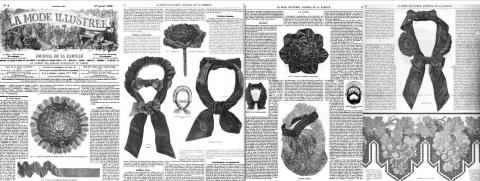
La Mode Illustree (Paris) – January, 1862

The Coiffure Esmeralda and Coiffure Narissa appear together in the January 1862 edition on page 31. The Coiffure Narissa has two illustrations, an exterior and an interior. The Esmeralda has a single illustration and a description that begins on the proceeding page. This page also has the descriptions of the Esmeralda and Narissa, as well as the coiffure Alice. An interior illustration for the Alice appears on page 34, along with interior and exterior illustrations for the coiffure Isabella. On the following page, we find the exterior for the Alice.
lm-series

Der Bazar – February 1862

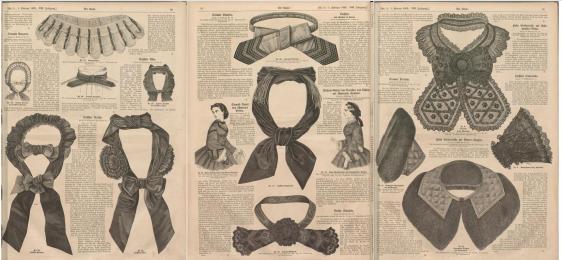
The coiffure Esmeralda appears on page 36 as an illustration and  the description on the preceding page.

The Coiffure Narrissa appears on page 39 with two illustrations (front (#29)and back(#30)) The lines in the front illustration are crisp, showing the box pleats and where they are stitched to the base, as well as the two colors, black and pink, and the shaping of the bows. Accompanying this is the coiffure Alice, with exterior and interior illustrations. There are subtle changes to the illustrations indicating that they are redrawn.
db-series


Frank Leslie’s MagazineApril, 1862

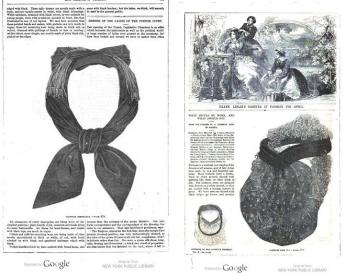
The Coiffure Isabella begins the April edition on page 369 with both an exterior illustration and an interior illustration. The Coiffure Esmeralda appears in illustration on page 380. The descriptions for both appear on page 379. These descriptions appear abbreviated to me, which they excuse:

Nos. 1 and 2. – The Coiffure Isabella is composed of a circlet of black velvet, confined at the back by a jet ornament with pendants. A deep fall of rich black lace conceals the hair behind, while a series of magnificent white plumes are intertwined with the circlet. That is this beautiful head-dress may be more intelligible to those of our readers who may desire to make one than a verbal description could render it, we give also an interior view of it, which will be found of material assistance in facilitating it arrangement.

No. 3. Coiffure Esmeralda. This head-dress is of black velvet, gracefully twisted so as to encircle the head. It terminates into a simple knot, with ends behind, while in the centre, in front, is a bow of velvet, with long gilt or silver pendants. This head-dress is very readily made, and will, we think, be found useful by our fair readers, as it is always difficult to find head-dresses suitable for demi-toilette.

The Esmeralda illustration, while redrawn, does retain the tail length and angle of the end cut. We can see some of the construction, including the millinette, which is omitted from the description.
fl-series

Peterson’s MagazineJune and July 1862

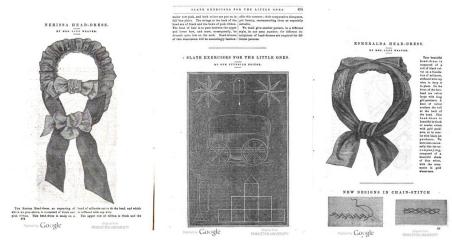
The Esmeralda Head-dress and the Nerissa Head-dress appear in the Peterson’s Magazine in June and July of 1862. The Nerissa appears as an illustration with description on page 494 and 495. The illustration appears to have left out some detail in my opinion. The illustration, redrawn, does not have the definition nor detail guiding construction as I feel the European illustrations have. While some of this may have been lost in digitization, I feel much of this is due to the illustration itself. The Esmeralda Head-dress appears on page 69 of the July 1862 edition. It is accompanied by a single, narrow column of description. This is a redrawn illustration with shorter tails of ribbon compared to the Der Bazar and Le Mode versions. The diagonal cut is also to a lesser degree. The overall illustration is set wider, more circular than ovular.
p-series

Published in: on January 17, 2017 at 1:00 am  Leave a Comment  

First Bonnet of 2017

Here is the first bonnet of 2017. 

I thought it appropriate to make a bonnet that can be worn by those with modest, work class impressions; a bonnet that can span most of the Civil War era years. This bonnet has a round brim with a moderate rise. 

Find this bonnet in my Etsy shop.

Published in: on January 16, 2017 at 12:14 pm  Comments (2)  

 First Hat of 2017

Here is the first straw hat of the season!

I worked off of a painting of Elisabeth Hudtwalcker, which would be late 1700 to the very early 1800s.


This beautiful hat has soft, natural lines with an asymmetrically shaped brim. The crown rises six inches. The larger, 23″ crown will allow for a full coiffure.

I’ve shown it undecorated as offered and with a simple silk scarf wrapped around the crown. See how easy it will be to decorate and how versatile this hat will be!

Find it in my Etsy shop.

I wasn’t sure what I would do as my first piece of the year. Then this painting appeared on my feed.

Published in: on January 16, 2017 at 12:10 pm  Leave a Comment  

A Band of Millinette

I have been toying with the idea of making up a few wired buckram forms for headdresses. As I do not intend to do buckram bonnets, I have a bit of buckram laying about waiting to be used up. On the flip side, most people who want to make a simple head dress don’t want to buy a full yard of buckram or a coil of wire. This seemed like a practical use.

There are many head-dresses or coiffures found in nine-teenth century literature that call for a structured base.

1862 being the year a good many Civil War reenactors are looking at this year, let’s look at what 1862 head-dresses use a foundation:

In 1862, we see many head-dresses that wrap around the head, almost as a coronet of ribbon, velvet or lace, with a symmetrical or asymmetrical focal point landing center back. We also see a similar band with asymmetrical trims, though less frequently. “The most favorite cap of the season is formed of a round crown, set into a narrow band, which just encircles the head. This band is trimmed in various ways…” (Peterson’s, 1862)


Godey's 1862This first pair of examples, from Godey’s, show a simple band on the right with two millinette pads/ovals to which flowers are stitched, and on left a wider, covered band to which lace and flowers are attached.

.

Frank Leslie's 1862This next head-dress loops heavy ribbon  or velvet around the wired base, a “circular frame.” The heavy ribbon allows for fuller body. The focal point in the back is asymmetrical with the lace quilled along one side.

.

.

Peterson's 1862

Similarly, this Nerissa head-dress uses pink and black ribbon on a “band of millinette cut to fit the head, and which is stiffened with cap wire. (This is one of those cases where I wish the illustration better matched the written description. These do not look like box pleats to me.

.

Godey's Lady's Book, 1862

Rather than ribbon, this next head dress is made with lace and rosettes. The base is made thus: “Take a piece of wire, twenty-four inches long, bend it in the form shown in the illustration, and fasten a piece of coarse, stiff black net at the back…”

.

.

This lovely arrangement recently came up on a FB group. I am amused by how they are the same, but not the same. On the right, Peterson’s Magazine, V41-42, 1862. On the left Frank Leslie’s Magazine, v 10, 1862. In both instances, the focal point is atop the head in front, rather than in back, though there is a knot or half bow in that location. The Peterson’s version specifically mentions being “on a foundation of millinette stiffened with a cap wire,” while both illustrations show the form in the illustration.

same-but-not-the-same

Also seen in 1862 are coronet style head dresses. These require a more substantial base,  shaped for both the style and the head. This illustration from Godey’s, July of 1862, shows the same shape coronet embellished in two ways.

Godey's 1862

A similarly shaped coronet is seen here in combination with a ribbon net, with the combination of front and back images.

1

When I started writing this post some days ago, I had the idea in my head to make up a few foundations for making head dresses like these. Since then, I’ve mulled around the idea, I’ve even cut out several pieces of buckram and ordered additional crib tape. My thoughts have wandered from making up a bunch of plain buckram frames to thinking people aren’t going to want to pay the $20-$25 to cover the time and materials to thinking I have the materials it might be nice make a few fully decorated head dresses this year. Then I think I don’t need yet another distraction.

So, what say you…. plain buckram forms? Decorated head dresses? Or, stick to the straw? 6


Published in: on January 15, 2017 at 7:37 pm  Comments (3)  

Thoughts on Late Eighteenth to Early Nineteenth Century Winter Millinery.

I’ve been poking around, looking at women’s winter head wear from 1750-1820, a range of time earlier than I’ve been focusing on for my collection and current research. While doing so, I can’t tell you how many times I’ve rubbed my ears, the oddly shaped spot warped by frostbite some 20 plus year ago in particular. I have not had a problem staying snuggly warm in my 1850s or 1860s attire. Layers + hood = happy. Oh, plus no slip foot wear. But that is another story.

I look at paintings like this one and think “This is how you die.” Or, at least this is how you get yourself awfully sick standing on a balcony overlooking a pond off the shores of Erie in February. Okay, so I set the painting in a mental scene a few decades off. But, you get what I mean. This attire out in the blustery winds of the North East USA is a recipe for trouble. (British Museum painting)

winter-1

A lovely blog, At the Sign of the Golden Scissor, helped me wrap my head around winter wear for these eras that are prior to my knowledge base. Bigger hair. Cloaks with big hoods. Short cloaks with big hoods that seem as much like big hoods with really long bavolets. Muffs. And winter illustrations with hats and bonnets. Okay.

This latter part does have me wondering about winters here compared to winters where the illustrations were drawn and published. I have a general idea that it is not as blustery in England. But, I have never looked at statistics. *add to to do list.*

The same blog nudged me towards the prints in the British Museum. There I found these two 1750s winter images with hood like garments. They were both captioned with the same:

“Winter in all her warmest Dress behold, / To guard her Body from the piercing Cold; // Her Hood and Mantle and her Velvet Muff, / All she can wrap about her’s scarce enough’ and ‘Printed for & Sold by Henry Overton at the White Horse without Newgate, & Rob.t Sayer at the Golden Buck opposite Fetter Lane, Fleet Street.'”

winter-2

These illustrations depict winter head wear closer to what I expect: head encompassing warmth. The one on the left likely being a hood and cape combined, both trimmed with ermine. The one on the right being separates, the hood showing softness that may be quilted or wadded.

The very few extant quilted winter head wear pieces from the end of the 1700s into the early 1800s definitely are more drapey like a hood than structured like a bonnet. Here I have a Pin Board started.

ma-149001-web

LACMA Woman’s Hood United States, circa 1775 Silk sarsanet

This hood from the Los Angeles County Museum of Art seems to have a fairly simple construction and quilting pattern, doubled diagonal and vertical on the crown/brim and through the bavolet. The bavolet seems slightly shaped though the back, being longer and possibly curved. The original is done in silk sarsanet; replicating could be done in a lighter to mid weight silk taffeta. I speculate the interior could either be a polished cotton or another silk. But, those speculations are based on nineteenth century tendencies not eighteenth. As this hood can tie under the chin, bringing the lower brim and part of the bavolet in around the face, this seems to be a hood that would be suitable for someone moving.

sc109035

MFA, 64.685 American, 18th century Silk damask, silk liing, quilting, silk ribbon

Another hood with a tempting construction is on the other end of the spectrum in terms of drafting. This MFA hood has a straight forward brim, but there is a particular curve to the back of the lappets into the neckline with a bavolet that is rather minuet compared to those of the mid-nineteenth century. The crown appears to rise for hair placed higher on the head. Without personal inspection or additional photos, I can only surmise the tip is circular, possibly oval. The three row of quilting follows the line of the brim and lappets, resulting mostly in a vertical appearance, which would give some support to the drape over the face. I am curious if there are any signs that this brim folded back. I have discovered this type of brim reaching forward of the face is wonderful in shielding the face from wind or snow/rain traveling with the wind. Even though this hood could be tied from the inside, I anticipate it would not be ideal for movement or working; it would be more suitable for walking or riding in a carriage.

Published in: on January 11, 2017 at 3:00 pm  Leave a Comment  

A Uniquely Placed Bonnet

housekeeperann2

“House-keeper Ann” Private Collection – Used with permission http://www.ssdaggers.com/HG/WomenWork/housekeeperann2.jpeg

There are very few mid-nineteenth century photographs of women clearly wearing winter hoods. “House-keeper Ann” is particularly unique. The subject isn’t actually wearing the winter hood. Yet, she has it displayed nicely for us to see.

The circa 1864 image shows Ann surrounded by her trade – broom, dust pan, duster, rag, opened oil lamp and jug. Some have noted her clothing as that of reform dress. Others have noted her clothing as shortened for work. (comments on Pinterest pins) She appears to have a cloth or kerchief wrapped around her head, not tightly but not loosely either. About her neck is a plaid, almost scarf like, item. A second set of shoes are in front of her.

The hood is draped upon a standing broom, face down with the handle of the broom hooking the tip of the crown. Here we can rotate and zoom in for a closer look at this hood:

winter

The upper left shows the hood simple rotated from the original image. The upper right shows the hood slightly adjusted to show what the hood may look like if gravity was not pulling against the broom. The lower left is an adjustment of color for observation. The lower right is a further zoom looking at the bavolet.

We see the bonnet is a wadded bonnet. Seven wadded channels run over the brim. Between the 5th and 6th channels from the front, we see this hood may be corded in between the wadded channels. The back channel, the seventh is smaller, nearly half the size of the previous channels. The front most channel appear to possibly have additional shaping. Many original wadded hoods will have the very front of the brim as a ruffle instead of a wadded channel. I do not believe this is a ruffle. It is possibly a less full channel or a channel that has compacted over time.

As the tip is draped over the broom, but does not show the handle distinctly, I surmise there is some wadding between the layers. Two lines closest to us, suggest there may be some quilting in this area as well. The bavolet does not appear to be very full. The front does curve up to the cheek area. The length is moderate. I would estimate it to be 3.5 inches to maybe 4.5 inches long in the back. There is what may be an ornamental lace or ribbon on this bavolet as well. I find this aspect to be interesting and further my speculation on whether the the bonnet belongs to Ann or to Ann’s employer.


 “Hoods or Caleches, made of sating or silk, are now generally worn by ladies as a head covering, in going or returning from parties or the opera, instead of the worsted scarfs so much in use during the last season. These hoods are wadded and quilted, and are so light that on being thrown over the head, they do not in the least disarrange the head-dress. Some are entirely covered with lace, which hangs down in front and at the sides, in the manner of a veil. These are equally comfortable and beautiful for a party hood.” (Graham’s Illustrated Magazine, 1856)

Published in: on January 11, 2017 at 3:00 pm  Comments (1)