Only a few months behind where I planned, I finally have the first batch of shawls up on Etsy for sale. Each of these shawls are 100% wool in sizes common to the mid-century and Civil War era.
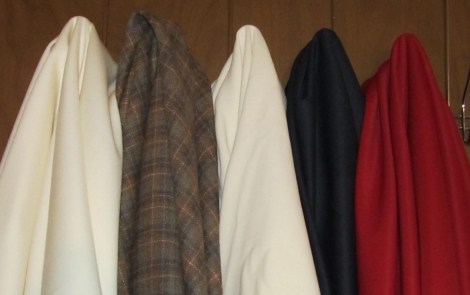
Currently available (left to right)
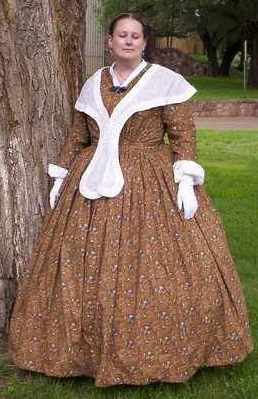
A natural white shawl of light weight 100% wool, measuring 60″ square.
A brown and blue plaid shawl of light weight 100% wool, measuring 59″ square.
A semi-sheer white shawl of very light weight 100% wool, measuring 61″ square.
A dark blue shawl of light weight 100% wool, measuring 58″ square .
A red shawl of light weight 100% wool, measuring 59″ square.
During the mid-19th century, most shawls fit a within a standard size range:
• Square shawls were in the range of 55 inches to 70 inches square with 64 inches square being standard.
• Long shawls are double squares, sometimes called plaids, which were 55 inches wide by 110 inches long to 70 inches wide by 140 inches long with 64 inches wide by 128 inches long being the most common.
• Three-quarter shawls are 3/4ths the width and 3/4ths length of a standard double square shawl. A three-quarter shawl would be 48 inches wide by 96 inches long.
• Scarves are much longer than they are wide. A shawl 3 feet by 9 feet would be considered a scarf. These were more popular earlier in the 19th century.
The exceptions to these standard sizes include lace, knit or crochet shawls.
Pulling from one of my shawl databases I can give you an idea of how sizes were distributed. In the 1850s, 25% of shawls in the database were under 55″ square or 55″ by 110″, 63% were between 55″ and 65″ square (or 55″x110″ to 65″x130″) and 13% were larger than 65″ square. Between 1860 and 1865, 23% of shawls in the database were under 55″ square or 55″ by 110″, 46% were between 55″ and 65″ square (or 55″x110″ to 65″x130″) and 31% were larger than 65″ square.









 If I Had My Own Blue Box: