From Cassell’s Household Guide: Being a Complete Encyclopedia of Domestic and Social Economy Volume III, 1881 (published in London and New York.) 
“The Christmas-Tree may be made at home for a very trifling cost. Long as they have been in fashion in England for juvenile parties, of for Christmas-eve, these trees seem to be still in favour almost as much as ever. Christmas-trees may be covered with paltry trifles, or made the medium of dispensing suitable gifts amongst the members of a household. When the latter plan is to be adopted, each article is to be marked with the names of the intended recipient. It is also very well to add a few boxes of sugar-plums and valueless trifles, which can afterwards be raffled for. The ordinary Christmas-tree is covered with miscellaneous articles, some of more value than others, which are either distributed at hazard by the lady deputed to cut them down, or lots are drawn out of a bag of numbers corresponding to those fixed on the little presents themselves. A good-sized fir-tree, of regular shape, and with nice wide-spreading arms, is wanted. Cover this at regular intervals with gelatin lights, which are better and safer than wax tapers. These lights are like ordinary night-lights, each on contained in a little cup of gay-coloured gelatin, resembling the glass lamps used at illuminations when gas is not employed. Take care to place these lights so that not one of them is put under a bough, which may set alight. Suspend them by fine wire, not cotton or string, which will take fire. A little beyond every light arrange a bright tin reflector, star, or silvered glass ball. A number of flags are requisite to add to the gaiety of the tree, which a few bows of coloured ribbon will also emhance.
A good many small ornamental paper boxes and cases holding sugar-plums will add well to the decorations of the tree. To make paper cones, cut squares of white or coloured paper. Fold the square in half, like fig 2, and cut off the piece at the top, making the two sides equal. When opened, it will resemble fig 3. Gum it as far as the dotted line, and join it. Be sure to join it so that there is not a hole at the point. If it is made of white paper, cut some strips of red, of green, and of gold paper. Edge it with gold, and paste stripes of red, green and gold around it spirally at intervals. If the cone is made of coloured paper, use gold, white, and some favourably contrasting hue. Fig 4 illustrates it. Another pretty way to make a rather superior ornament is to cut a cone of bright green satin-paper, and join it. Cut a tassel, and fasten it at the point. To the top gum a piece of scarlet sarcenet, with a mouth like a bag, and over the join run some blond lace; turn a row each way, and gum a strip of gold paper between (see fig 5). Fig 6 is another kind of sugar-plum case. Cut a straight piece of card, and sew it together to make a round like a drum. Cut a circular piece to fit one end. Cover the sides round with paper, notch the edges, and turn them down at one end over the piece fitted in, and, if well gummed, they will keep it in place. The other end may be sewed in. Cut a round piece of coloured paper, and gum on lastly at the end. Have a bag-top of some pretty piece of passemeterie or gilt paper over the join. If the box is covered with straw-colour, and the bag is of blue satin, it will look pretty. Odds and ends of ribbon may be used in making up these little boxed. A more valuable case may be made by first constructing a box of a strip card, goring it with a strip of paper each side instead of by sewing. Cover this with white paper. When quite dry, bind both edges with blue satin ribbon. Then draw, in water-colours, a garland of flowers round barrel. Very neatly sew a blue satin bag at each end. Put a little powdered scent in, enough wadding to fill the bags, and place it on the tree. It may be suspended by its own strings of blue ribbon. A pedestal is a good design for a fancy case. A design for one is given in fig 8. To construct it, take a piece of card large enough to allow its four sides. Cut this like fig 1, allowing four equal sides and a bit over; half-cut through the dotted lines on the right side. Join it round with the small piece inside, and fix it with strong gum. Cut a square larger then the pedestal, for the base in fig 10, below the dotted line, gum them, and fix on the base. For the lid, cut a piece like the base, and a second piece like Fig 10. Half-cut through the dotted lines. Join the piece as the pedestal was joined, and fix the top to this piece in a similar way to that used in joining the base. But Fig 9 must be a little narrower each side than Fig 1, so that the smaller piece, fig 9, may neatly fit just inside the larger, fig 1. Another way to make this is to cut two pieces like fig 1, one just small enough to fit inside the other, and fix square ends of equal size to each. To close the box, put one inside another. Ornament the outer one with coloured paper, and bind the edges with gold, or merely bind the edges and draw a group of flowers on each side in water-colours, and also on the lid. 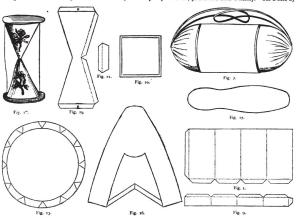
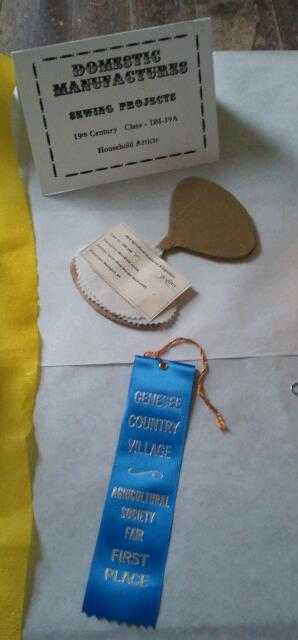
Fig 12, a Drum, can be made of paper, and ornamented with strips of red and of gold paper, and have a few sugar-plums inside. To make it , join a piece of paper as for fig 6. Draw, with a bow-pencil, a round as large as the top, and a second round a little larger. Cut out the larger round, and notch the edges up (fig 13). When you have done this, turn down the edges, gum them, and fit them into the drum. For the outer end cut a similar piece, put a loop of thread or ribbon in the centre, and put it in without gumming it. Made in card, ornamented, filled with sweetmeats, and a piece of net gummed at the top, with a band of gold paper over the join, it is very pretty.
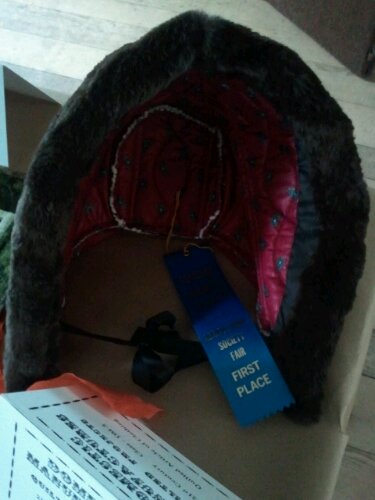
Fig 14 is a Muff. – Make this of a bit of plush that look like fur. Put a shallow, red silk bag-mouth at each end, to look like the lining. Draw up one end and sew it. Cut a piece of paper the size of the muff, roll it round, and slip it inside to keep the muff out stiff. Cardboard can be used in stead of paper. Put in the sugar-plums, and draw up the mouth.
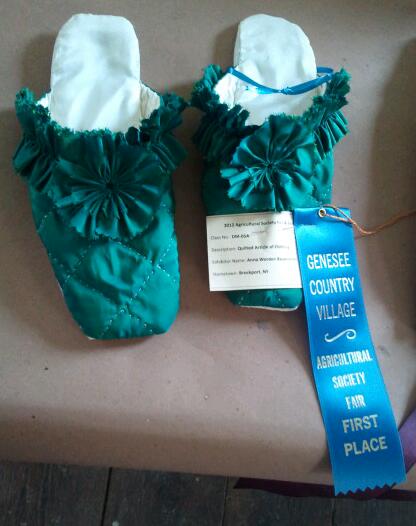
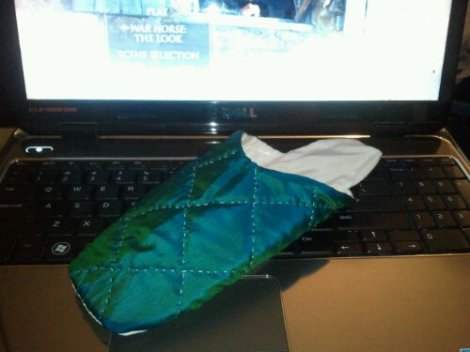
The Lucky Shoe (fig 15) – Cut a shoe by fig 16, of any pretty material; join in and bind it neatly. Cut a sole by fig 17. Before joining the upper part, see that it fits the sole well. Cut the sole of card, and tack the material over it. Sew the shoe to the sole all round outside. Cut a sole of white paper a little smaller than the first; gum it, and fix it inside. Make a back, and sew it neatly to the shoe. Fill with scented wadding, sweetmeats, &c. according to fancy. If the articles on the tree are raffled for, and the tree is intended for grown-up girls, as sometimes happens at a Christmas party, it causes much mirth to secrete a mock wedding-ring in one of the shoes, underneath the sugar-plums or wadding. Then make known to the company that there is a ring to be found, and predict that the finder will be the first married. The lucky shoe is a very good place for it, ad shoes have, in superstitious times, always been associated with supposed charms – the horse-shoe to keep away evil spirits, the old shoe for luck to be thrown after the bride, the shoes crossed at the bedside to make the owner dream of her sweetheart, &c.
The Hour-Glass (fig 18) – This may be made in two ways. First cut four pieces like fig 19, cutting off the dotted piece at the side (not at the top). Cover each piece with white satin; sew them together. Cut two rounds, much larger, of card; cover each with brown satin. Sew on by the pieces marked A and B, fig 19, which are to be turned down. They should have been half-cut through before sewing. Take two pieces of wire, bind coloured ribbon round them, and sew them to the hour-glass. Cut a piece of card like fig 11; half-cut through the dotted line; stitch it to the top; cover the top with satin. This completes the whole of it. The second and simpler way is to cut the hour-glass like fig 19, half-cutting through the dotted lines, and by the side pieces; gum them neatly together. On the sides draw flowers in water-colours, or paste on spangles.



















 If I Had My Own Blue Box: