September Citizen’s Companion

It was so nice to receive this month’s magazine this week. I’ve been so stressed, it was nice to be able to relax with something I can wrap my head around. I’ve decided there is more green on the cover of the magazine then in many places around me. (Sorry South-Westerners, I miss the green of New York.) The cover also made me think of the upcoming Agricultural Society Fair at the Genesee Country Village and Museum. It is about this time of year mom is in the midst of canning a variety of vegetables, pickles and preserves. I don’t know what she is working on for this year given the blight problem with the tomatoes. I’m hoping some basil pesto was done a few weeks back. I love homemade pesto. Mom was the one who entered preserves and food stuffs at the fair over the years. Grandma K. entered quilting and rug hooking projects. I remember her last one she changed at the end just so she could enter it in the fair before she left for the hospital. It was supposed to have a whole additional border with some of the birds from the central motif. My fair entries were more frequent as a kid then as an adult. I won ribbons in the children’s categories for floral arrangements, craft projects and penmanship. If you’ve tried to read my hand writing as an adult you know just how funny that is. The year I can remember we had to write out a portion of the Gettysburg Address.

Back to the magazine.

I want to thank Elizabeth Topping for including pictures from the July event at the Genesee Country Village and Museum. Most people know of the event as “Mumford” rather than by the Museum’s name. I’ve always had trouble making the switch because to me Mumford is the hamlet that several of my family members live in, the old stone church where my brother & sister-in-law and my Grandparents were married is, and where much of my family is laid to rest. This Mumford is much, much older than the Museum which opened the year I was born. The pictures Elizabeth included are lovely. She attended in a year of transition for the event.  This year the museum opened several of the buildings for reenactors to use for scenarios for the event. The plan to do so again next year as well. I am very excited this is the direction the Museum has chosen to go. Since Elizabeth included a nice picture of what I am pretty sure is the kitchen in Livingston-Backus, I have to mention the pottery shown. This pottery is made at the museum in the working pottery. There have been many great artisans over the years. I won’t try to name them because I don’t want to mutilate their names. The pottery is available at the Museum’s Flint Hill Store and  through the Museum’s website www.gcv.org. They have Salt Glaze, Redware and Albany Slip available. I think you will find the prices are very good. For the larger pieces, you may have to visit the store in person. There are many pieces I’ve seen that are not on the site.

That is all for now…..

Published in: on September 10, 2009 at 6:51 pm  Leave a Comment  

16th Annual Ladies and Gentlemen of the 1860s Conference

16th Annual Ladies and Gentlemen of the 1860s Conference

I will be presenting:

Narrow Strands of Silk: Mid-Nineteenth Century Ribbons Used for Millinery

Period literature abounds with young women excited by the purchase of gifting of a new ribbon. What excited them so much about a narrow strand of silk? What, as Mary Davidson’s Silk says, held the public favor for three centuries? In this presentation we will examine the many various ribbons used in millinery including their weaves, designs, texture, and width along with where and how they were used.

We will begin by looking at the manufacture of ribbons, where they were made both domestically and foreign, and where we imported them from. We will learn about the regional manufacturing centers in Coventry, England and the Canton of Bále, Switzerland and the ribbons they produced. We will also see how the onset of war drastically shifted the levels of importation and production of silk ribbons.

Next we will look at the types of ribbons produced and used in the mid-century. This will include examples of the different size ribbons, the weaves, and designs. When looking at the types of ribbons, we will see a much greater variety of ribbons available in the 19th century then is available today. Exhibition catalogs show ribbons from as simple as plain, fancy, or plain fancy to some we may recognize such as numerous velvets, printed, and embroidered, to some we may not yet recognize such as figured lutestring and cut-edged ribbon.  We will discuss which ribbons were more often used for different pieces of headwear; bonnets, caps, nets, etc.

Lastly, we will also look at techniques for achieving the look of period ribbons through textual descriptions and illustrations as well as some original images including how to make bows following period directions. “

Published in: on September 8, 2009 at 5:35 pm  Comments (2)  

Serving Chocolate

While reading, I came across this passage that doesn’t really fit into the article, but I just had to share. The author, John Doran, was discussing the extreamnities of table traits in his book, Table Traits with Something about Them, when he included this rather extreame method of serving chocolate. This is obviously Not how the common American would have drank his or her hot chocolate.

“I will only add that the ceremony of serving chocolate was never such a solemnity in England as in France. In the latter country as late as the days of Louis XVI a man of condition required no less than four footmen each with two watches in his fob according to the fashion to help him to take a single cup of chocolate. One bore the tray and one the chocolate pot, a third presented the cup and a fourth stood in waiting with a napkin, and all this coil to carry a morning draught to a poor wretch whose red heels to his shoes were symbols of the rank which gave him the privilege of being helpless.”

Published in: on July 21, 2009 at 2:33 pm  Leave a Comment  

Chocolate Advertisements

This pair of advertisments appeared regularly in the 1865 Notes and Queries:

Chocolate – Menier

(Manufactured only in France.)

The Healtiest, best, and most Delicious aliment for breakfast known since 1825; defies all honest competition, unadulterated, highly nutritious and pure. Sold in 1/2 lb Packets.

Also, especially manufactured for eating as ordinary sweetmeats, or at Dessert:

Chocolate Creams                   Chocolate Nougat                   Chocolate Praline

Chocolate Almonds                Chocolate Pistaches                Chocolate Pastilles

Chocolate Croquettes and Chocolate Liqueures (very delicate).

Wholesale, MENIER, 23 Henrietta Street, Covent Garden.

Retail, by all responsible houses.


Sold by Grocers and Confectioners.

FRY’S CHOCOLATE

Fry’s French Chocolate for Eating,

in Sticks, and Drops.

Fry’s Chocolate Creams,

Fry’s French Chocolate in Cakes.

J.S. Fry & Sons, Bristol and London.

Published in: on July 21, 2009 at 2:03 pm  Leave a Comment  

Chocolate….

I’m working on an article for the Citizen’s Companion on Chocolate in the Nineteenth Century. What a perfect research topic to appease boredom and chocolate cravings (which I get when I am bored and stressed.) The article will look at chocolate as it became more readily available due to several inventions during the industrial revolution. It will also include a variety of chocolate recipies. Here is a recipe for one of my favorite chocolates:

Chocolate Drops, with Nonpareils. –Have some warm chocolate, as for pistachios; add a little butter or oil to it to make it work more free; make it into balls about the size of a small marble, by rolling a little in the hand, or else put some of the paste on a flat piece of wood, on which you form, and take them off with a knife. Place them on sheets of white paper about an inch apart. When the sheet is covered, take it by the corners and lift it up and down, letting it touch the table each time, which will flatten them. Cover the surface entirely with white nonpareils, and shake off the surplus ones. When the drops are cold they can be taken off the paper easily. The bottom of the drops should be about as broad as a sixpence. Some of them may be left quite plain.” (The Complete Confectioner, Pastry-Cook and Baker)

Published in: on July 17, 2009 at 2:57 pm  Leave a Comment  

What Would You Like?

While adjusting to life in New Mexico and searching for employment, I also find I need a little inspiration or direction for research and writing. I have put together a survey on Survey Monkey to see of anyone has any imput or special requests. I have some questions on what you would like to see on the blog, what you would like me to write for the Citizen’s Companion and what research for larger book/booklet projects.

SURVEY HERE

Published in: on July 7, 2009 at 3:26 pm  Leave a Comment  

Travel Updates…. on new blog

Hi Everyone,

I’ve decided to put my non-living history updates on a new wordpress blog called Anna’s Updates…..  http://annasupdates.wordpress.com/

There isn’t much there yet. But, I do have a few things I want to share about the drive from NY to NM which will be there soon.

Published in: on June 27, 2009 at 11:36 pm  Leave a Comment  

Where do you put your….gloves, fan, purse, etc….Part 2

 Here are some passages referencing where women put their gloves, fan, purse, etc.: 

(a younger girl) “she fancied how her mamma would smile and kiss her, and how her papa would look pleased; and then she thought she would just take the gloves out of her pocket to see how tidy they were. She put her hand into her pocket, and pulled out first her pocket-handkerchief, and then some pretty colour pebbles which she had picked up during her walk, but her gloves were not there; there was no use feeling quite down to the bottom of the pocket, and turning it inside out, and shaking it – the gloves were actually quite gone; though Helen looked anxiously along the gravel walk and in and out among the raspberry bushes, she could not see them anywhere.”

Blind man’s holiday; or, Short tales for the nursery, by the author of ‘Mia and Charlie’.: or, Short tales for the nursery, by the author of ‘Mia and Charlie’.
By Annie Keary
Published 1860
London

This is a child “…as Effie took out of her pocket her gloves, or pocket-handkerchief, or something or  other, she pulled out at the same time Fritz’s letter and dropped it.” 

 By mrs. Florence Williamson
By William Kirkus
Published 1864
London

 “She [Clara] took the gloves, thrust them roughly into the pocket of her dress, bowed coldly and haughtily to the restorer of them, and turned again towards the party with whom she had previously been conversing.”

Chambers’s Edinburgh journal
By William Chambers, Robert Chambers
Published by W. & R. Chambers, 1853
Edinburgh

 “ ‘That reminds me,’ observed Maria, a young lady with some pretensions to good looks, ‘I had better put on my gloves; I have let my hands grow coarse and brown lately that I am ashamed of them, and just because it was too hot to cover them. I think my gloves must be in my bag;’ and diving into the profundities of a black silk affair which hung from her arm, and which also contained her missal and pocket-handkerchief, she withdrew the gloves, and commenced pulling them on.”

The slave son
By Marcella Fanny Wilkins, William Noy Wilkins
Published by Chapman and Hall, 1854


“She, supposing it to be some slur upon her religion, carelessly slipped it into her pocket and thought no more of it. The following morning, as she was taking her gloves out of her pocket, the piece of paper fell to the ground, and on examining it she found it to be a guinea note.”

The living sacrifice; or, A short biographical notice of Sarah Bentley: or, a short biographical notice of Sarah Bentley, of York ….
By John Lyth, Sarah Bentley
Contributor W. R. Lyth
Published by W.R. Lyth, 1848


“Having carefully rolled up, and deposited her gloves in her pocket, she pulled out a pin-cushion…”

Marriage: A novel
By Susan Ferrier
Published by Harper & brothers, 1847


“Her gloves were rolled up in a little ball in her pocket. She was at an age when gloves are rather a nuisance then otherwise.” [meaning an older age]

The doctor’s wife, by the author of ‘Lady Audley’s secret’.
By Mary Elizabeth Braddon
Published 1864
London


“Confident of success, she talked and laughed with unusual liveliness, and as soon as the meal was over, she went out with the fan in her pocket, and Charles by the hand.” [French setting possible]

Seven Years, and Other Tales
By Julia Kavanagh
Published by Hurst and Blackett, 1860


“‘Have you my fan?’ said Mrs. Quigg. I clapped my hand to the pocket where it should have been. There was no fan there. It was gone.”

The United States Democratic Review
By Thomas Prentice Kettell, Making of America Project, Conrad Swackhamer, D. W Holly, Spencer Wallace Cone, Isaac Lawrence
Published by Langtree and O’Sullivan, 1855

“ ‘Are you too hot, my dear?’ asked her tormentor, taking a fan out of her pocket, and raising as she spoke…”

The inheritance, by the author of Marriage. By the author of ‘Marriage’. Revised by the author
By Susan Edmonstone Ferrier
Published 1841


“Taking a box from her pocket, which she said contained the finest lozenges in the world for the preservation of the voice, she requested that one of the gentlemen would have the goodness to provide her with a glass of water, which was placed by the side of her pocket-handkerchief, the box, the fan, and the smelling-bottle.”

“Modern Accomplishments” Home and the world
By Mrs W Rives
Published by D. Appleton and company, 1857
New York


“It is a good practice to carry a pocket fan even in winter, in case you should chance to feel the heat more sensibly than any other lady in the room.”

The behaviour book: a manual for ladies / by Miss Leslie
By Eliza Leslie, Cairns Collection of American Women Writers
Published by W.P. Hazard, 1853
Philadelphia


“She took a fan from her pocket….”

Autumn hours and fireside reading
By Caroline Matilda Kirkland
Published by Charles Scribner, 1854


“….she stepped into the carriage, took a place beside Madame d’Epplen, and demurely drew from her pocket a large fan, the movement causing the exposure of a pair of strong gauntlet gloves that had been concealed beneath, and which immediately protruded from their hiding-place, to the no small amusement of her companions.”

At Odds: A Novel
By Jemima Montgomery Tautphoeus
Published by R. Bentley, 1863
 London


“‘Dear me, Mrs. Colton, I’m exhausted coming up those vile stairs!’ said Mrs. Fountain, drawing out of her pocket a beautifully carved fan, which she opened and began fanning herself, and displayed at the same time her white hand, which was covered with diamond and opal rings…”

Portraits of My Married Friends, Or, A Peep Into Hymen’s Kingdom: Or, A Peep Into Hymen’s Kingdom
By Uncle Ben, Rhoda Elizabeth Waterman White
Published by Appleton, 1858

“The consciousness of this did not flash upon Mabel until she had drawn the
little silver reticule from her pocket and exposed her destitution …”

Mabel Vaugh by Maria Susanna Cummins – 1857


“Steadying herself against the post of the folding- door, she took a pair of
scissors from her pocket”

 All The Year Round by Charles Dickens – 1862

“She drew an elaborately worked purse of green silk from her pocket and counted out into my hand three pieces of old French gold.”

”John Heathborn’s Tale” Harper’s new monthly magazine
By Henry Mills Alden, Sarah Orne Jewett, Cairns Collection of American Women Writers
Published by Harper & Brothers, 1864


[Queen Elizabeth] “A pocket looking-glass hangs from her side, and a fan is clasped in fingers loaded with precious stones…”

“Curiosities of Fashion, in the Matter of dress”
Eclectic Magazine: Foreign Literature
By John Holmes Agnew, Walter Hilliard Bidwell
Published by Leavitt, Trow & Co., 1863


“A large fan of peacock feathers hung from her wrist….” [fanciful]

“The Toad’s Curse” Graham’s magazine
By George R. Graham, Edgar Allan Poe, John Davis Batchelder Collection (Library of Congress)
Published by G.R. Graham, 1853
Published in: on June 9, 2009 at 11:26 am  Leave a Comment  

Candlelight Tours – GCVM

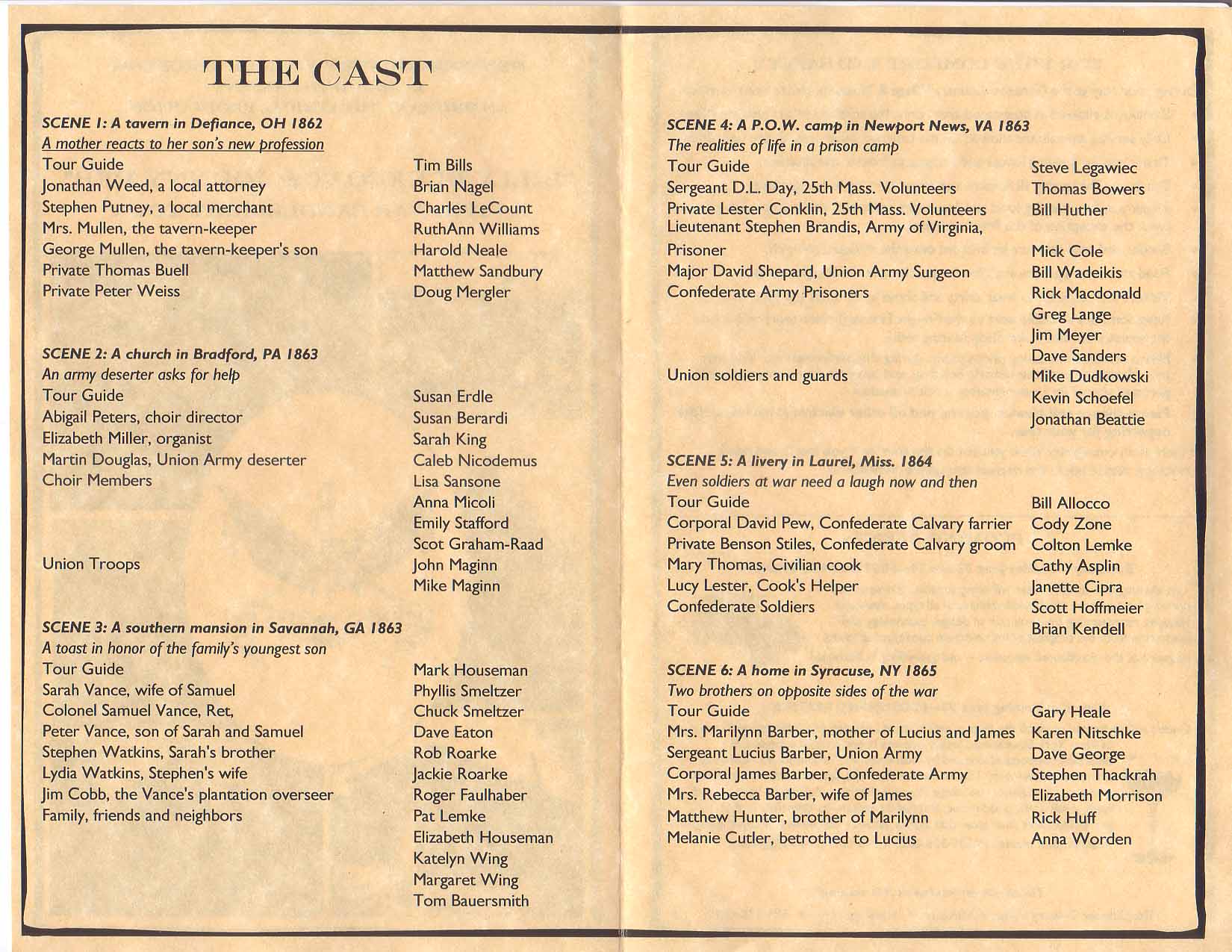
Saturday’s weather was absolutely wonderful for evening tours. (well, up to the very last part of the last two tours when the wind picked up and it started to rain.) I would like to thank Jim for the lovely script. I hope we were able to bring the audience to the edge of the precipice as you described. I appreciated the strength you gave Melanie’s character. Though, as the evening progressed I couldn’t decide if I agreed with her actions or not. I didn’t expect that. Thank you to everyone in our final scene. It was nice to work with all of you. It was especially nice to get to work with Rick for what will be my final event at GCVM for quite some time. For those of you who don’t know, Rick is largely responsible for me beginning CW era reenacting. While working at GCVM and dancing with the McKay Dance Society, he introduced a trio of us to the hobby. I would also like to thank Bevin who stepped up to what became a rather challenging and exhausting task. (I’m sure you slept pretty soundly after all that running.)
Cast list

scan

Published in: on June 1, 2009 at 7:17 am  Leave a Comment  

Survey on Working Attire

A couple weeks ago I started collecting images of women wearing corsets while working for the local museum I volunteer at. (see this thread http://thesewingacademy.org/index.php?topic=4833.0) Thank you all very much for sending images. The Director I was working with is very happy with what we put together. While looking for images, I sent a message to Connie at the CC. She found the search interesting and wondered if I could take it a bit further by looking at what women wore while working in the mid-century. So, as a research/writing project to work on once I get resettled, I’ve decided to look at support garments as worn during various types of work/labor in the mid-century and by those currently doing living history. As part of the latter section, I put together a short survey on SurveyMonkey asking about support garment habits of reenactors. (SurveyMonkey limited the number of questions I could ask with a free account. So, the questions are narrowed down from what I started with.) If you would like to participate, the survey is at http://www.surveymonkey.com/s.aspx?sm=jj0CcjV5sg70sWALz6_2bgBA_3d_3d There are questions about what support garments you wear under different situations, about the fit of your corset and what influences when/how you wear it. The survey is anonymous. So, please answer truthfully as possible.

Published in: on May 26, 2009 at 8:36 am  Leave a Comment