CDVs to Share

I happened upon a table of CDVs at the fleamarket this weekend. At 50 cents each, they were just the right price for my exceedingly light purse of late. Of the couple hundred images I flipped through, there were only three from the early to mid 1860s. I am happy to share them with you.

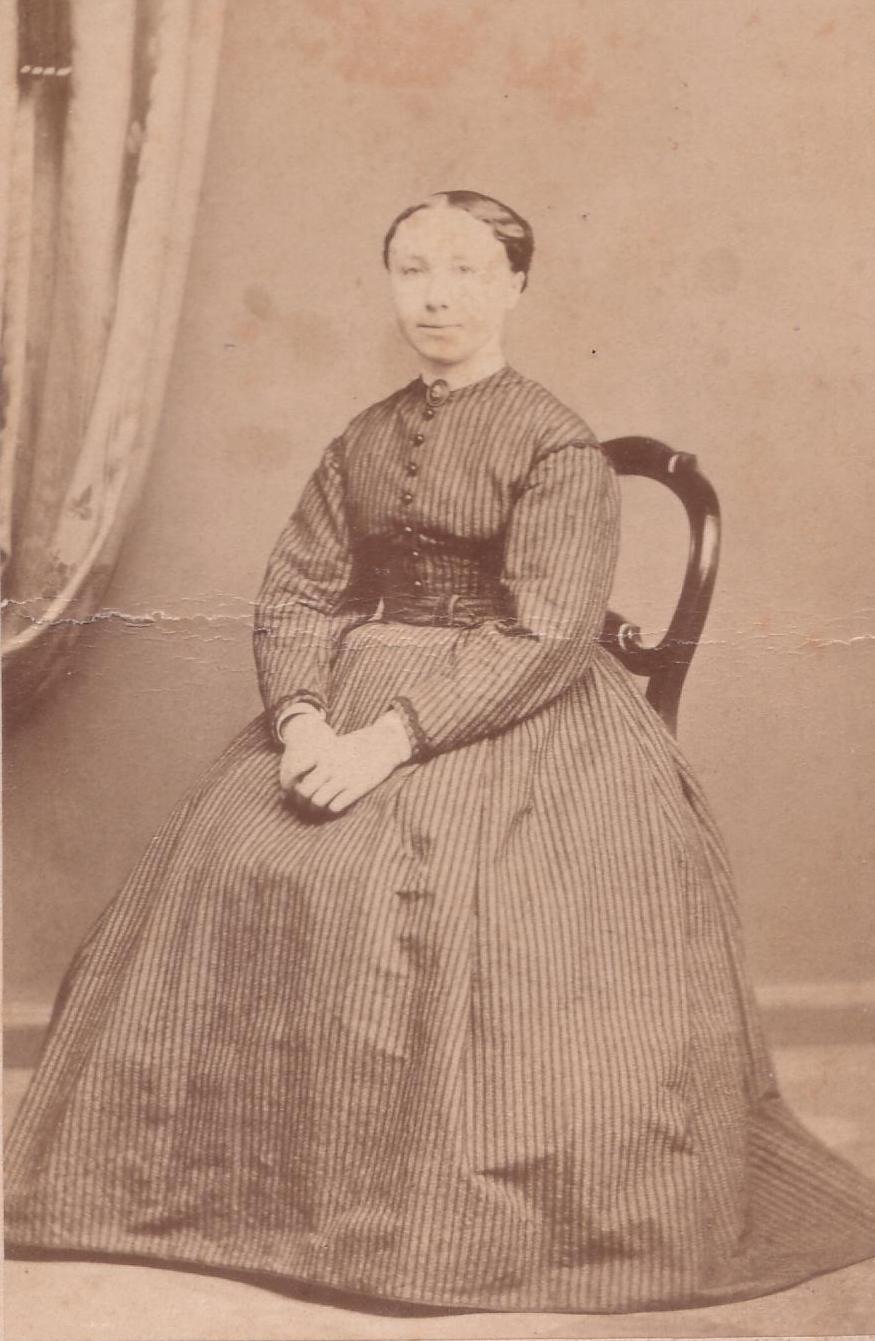
This first image shows us wonderfully clean lines.  I think she had this image taken possibly in 64 or 65 based on the slightly raised collar and the large box pleats in her skirt.  

This is a good image to help someone understand the structure of the shoulder for this time. Her striped fabric help show how the front bodice panel is cut. The bit of trim she used accents the slightly dropped armscye position. We also see a basic coat sleeve. She, or her dress maker, chose to position the upper portion of the coat sleeve on the grain, allowing the elbow and lower sleeve to fall somewhat across the grain. Her cuffs or possibly undersleeve peak out of her sleeve that lands at least an inch above her wrist. (I’ll admit, I am one who fusses with my sleeve lengths once the dress is made.

I can’t help but notice her buttons, or actually the position of one particular button. As a busty woman, I find that mid-bust button essential. You can even see how that button, her 5th one down, has more pull on it that those above. I’m curios about her belt. It appears to me to be self fabric  with the stripes running horizontally. This may be an illusion of shadows. But, either way, take a look at the closure. To me that looks like a fabric “loop” for the lack of a better word, which the belt slides through. You can also clearly see the braid on her hem. May 5th c
 

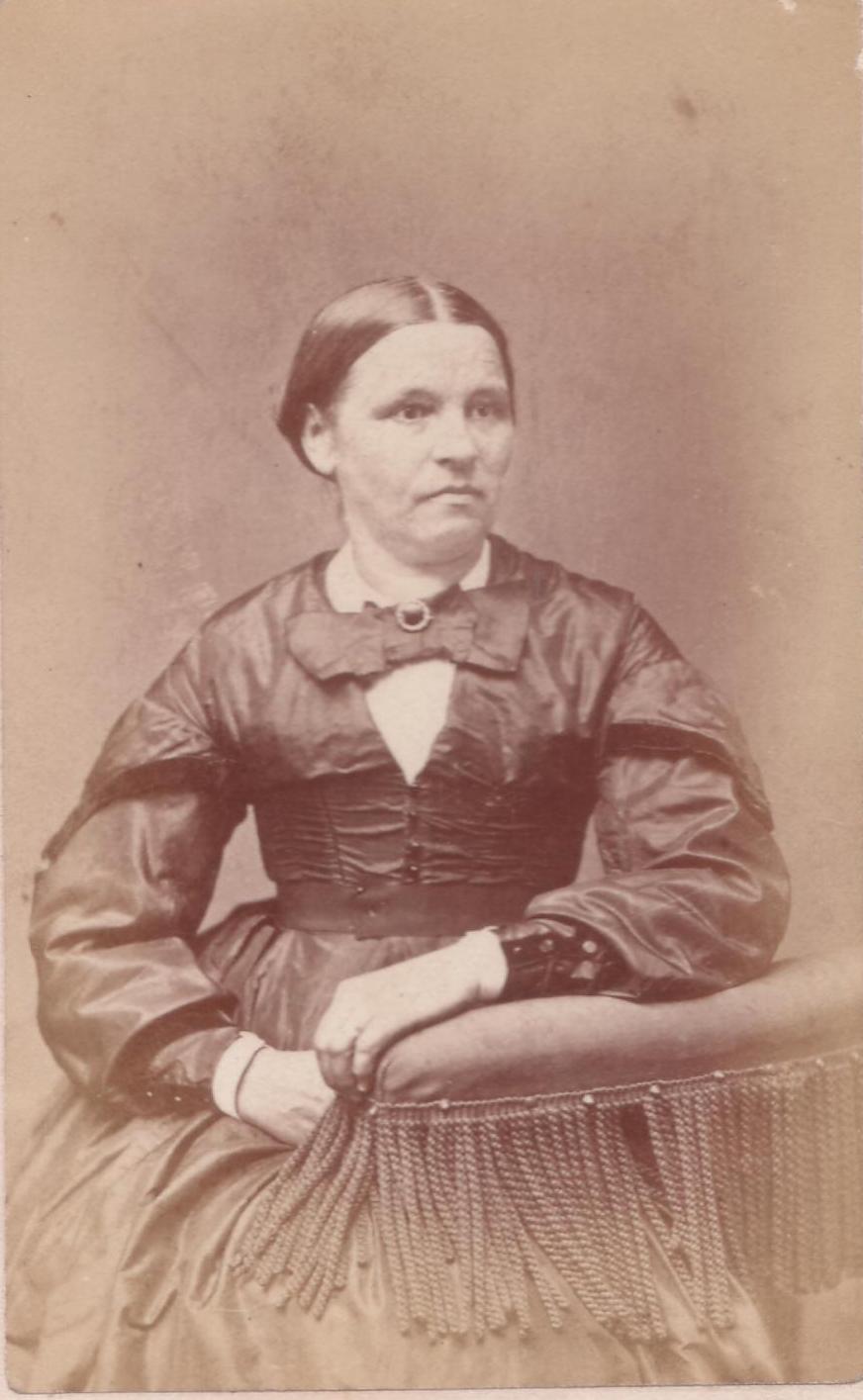
Next we have a woman with similarly simply kept, neat hair. This image has several neat tid-bits to ponder. I really want to take her bow off to see her full neckline. I can not quite tell if the white is a single piece or a tucker and collar separately. On the left side of her neck, I want to say collar because it looks like the white goes over the dark of the dress. On the opposite side, it looks like the dress is going over the white. I would love to know what other see. Now, that bow. I want to place this image as transitioning from the 50s into the 60s because of the V of the bodice. The thing is, that bow, the size of that bow just doesnt’ fit for that timing because I see the bows this size coming later. The other thing about the bow is against that little pin, the fabric  seems rather wrinkled to me.

I do think this image is nice timing for those of us who have recently or are just now getting out our clothes after a long running winter, to find things are a bit….. snug. The lower half of her bodice is just that. The fabric is taught against her corset with tension lines/wrinkles running horizontally through her whole ribcage. A very nice, reaffirming thing to see.

Now look at her belt. Do you see how she’s closed this ribbon belt with a simple pin? Nice.

Looking at her sleeves, we see she has more of a drop in her armscye than the woman above. The eye is pulled further down by her sleeve cap. This cap is quite deep, appearing to go halfway to her elbow, and trimmed with velvet. The velvet is used again at her cuff along with what may be two or three buttons. This, too is a coat sleeve construction, with a more fitted wrist. May 5th A
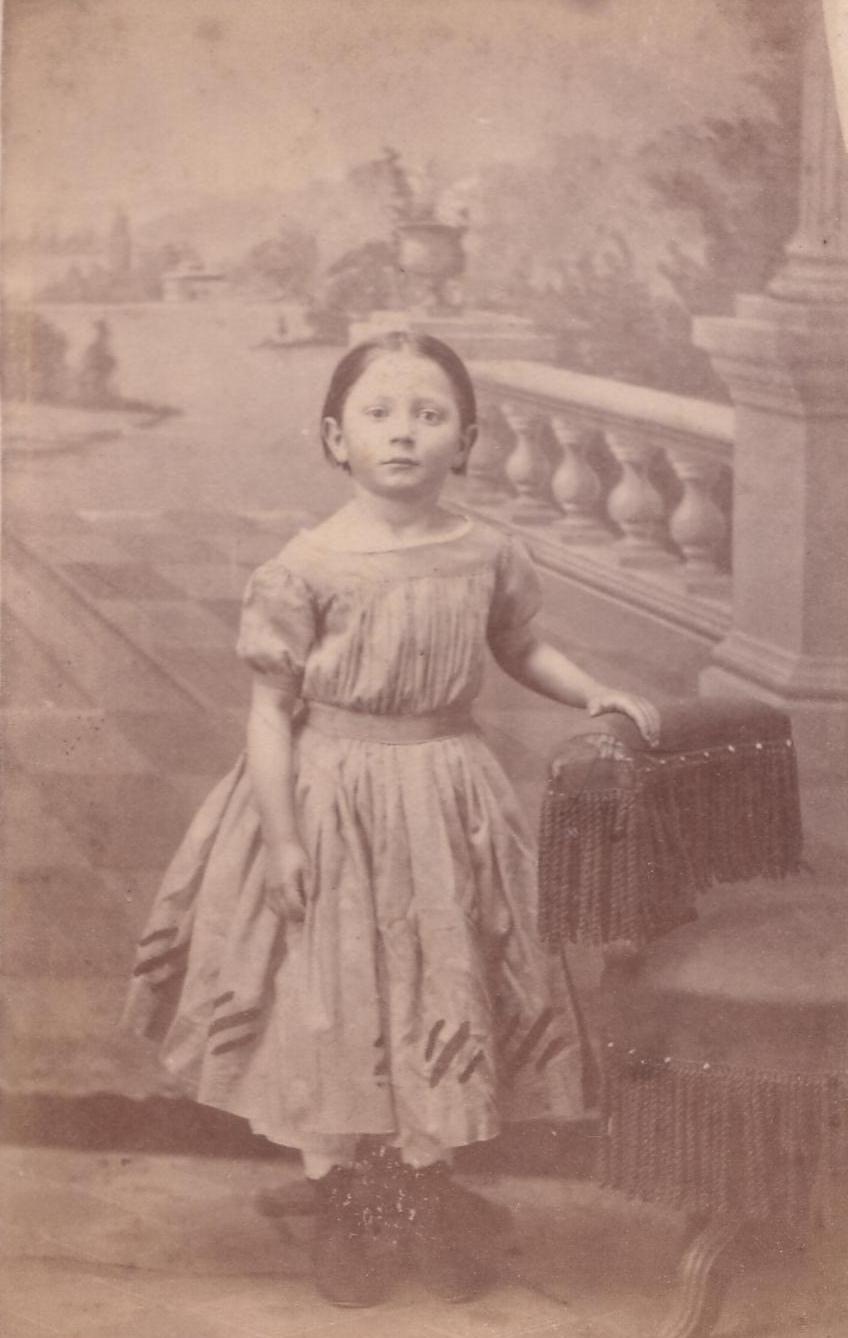
 This was the first image in my ‘yes’ pile. Look at that expression! She looks so happy to have her photo taken. I wonder what this kid was like because neat and pressed don’t shine through in this image, more of slightly, though naturally dishevelled. Her neckline is a bit askew, her skirt has wrinkles and she looks like she is putting in every effort to stand still for the camera. For me, this image has life. Now, as far as her clothing. I don’t know as much about children’s clothing. I see a neat trim or tucker around her open neckline. What I’ve heard called an ‘infant bodice’. Her shoulders look slightly dropped, with simple sleeves. The trim on her skirt looks like a trio of stripes that could be another fabric or ribbon. Her skirts do seem petticoat full. I’m having trouble seeing the feet area because of some markings on the image itself and something I think is behind her. (Don’t crush my interpretation of her expression saying that is a stand to aid her in her pose and the expression is one of irritation.) She does look like she’s wearing boots. May 5th b
Published in: on May 6, 2013 at 6:00 am  Leave a Comment  

Reproduction Gutta Percha Belt Buckle

I have long wanted a reproduction* gutta percha belt buckle. Guess what surprised me in my mailbox today.
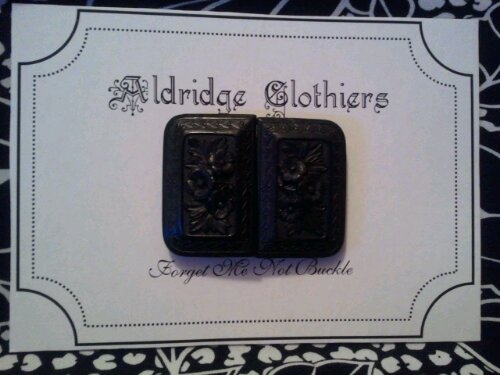
A most beautiful buckle from Aldridge Clothiers. This, the  “Forget Me Not Buckle” is one of several buckles they offer along with earrings and broaches.

image

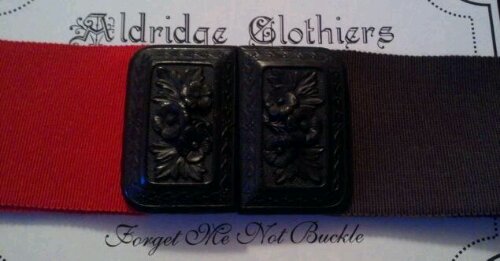
I am very impessed with the detail. I hope you can see it in this photo. The morning glories are lovely.

image

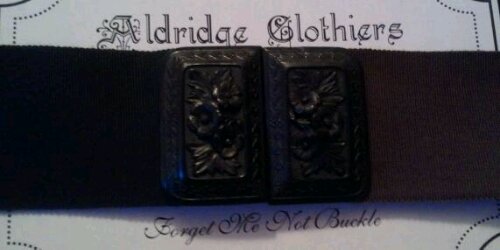
I grabbed some of my petersham ribbon to compare. I have yet to decide which ribbon to go with. The helpful insert that comes with the buckle suggests velvet ribbon.

image

image

If you are looking for an excellent reproduction piece, please visit Aldridge Clothiers.

Published in: on May 4, 2013 at 6:57 pm  Leave a Comment  

Patriotic Embroidery Patterns

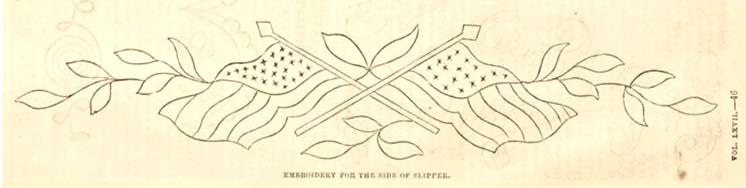
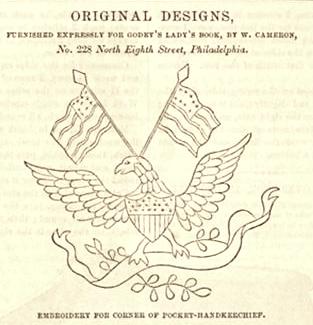
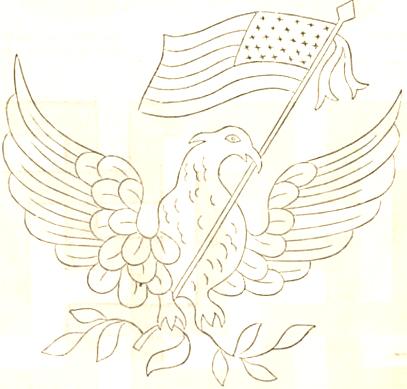
I know several groups are looking at depicting displays of patriotism this season be it individually or an organized festivity. This trio of images comes from Godey’s 1863.

g63c g63a

g63b

Published in: on March 28, 2013 at 6:00 pm  Leave a Comment  

A Springy New Series – Another Look at Millinery

As we move into spring, Oh, Happy Spring, my Saturday posts are going to move from travel to millinery. Don’t worry, I am continueing my travel research. The forthcoming millinery posts will primarily focus on theories, ideas, trends and storys revolving around millinery rather than just straight fashion.

To start, here is a passage from “Aesthetics of Dress” from Blackwood’s Edinburgh Magazine,  1845. It takes a different look at bonnets than we are accustom.

Bonnets, however, have more to do with women than with men; and we defy our fair friend to prove that these articles of dress, about which they are always so anxious (a woman – a regular genuine woman, reader – will sacrifice a great deal for a bonnet), are either useful or ornamental. And first, for their use; if they were good for anything, they would protect the head from the cold, wet, and sunshine. Now, as far as cold is concerned, they do so to certain degree, but not a tenth part so well as something else we shall talk of by and by: as for wet – what woman ever trusted her bonnet in a shower of rain? What woman does not either pop up her parasol, or green cotton umbrella; of if she had not these female arms, ties over it her pocket-handkerchief, in a vain attempt to keep off the pluvious god? Women are more frightened at spoiling their bonnets than any other article of dress; let them but once get their bonnets under the dripping eaves of and umbrella, and, like ostriches sticking their heads under ground, they think their whole persons safe – we appeal to any man who has walked down Cheapside with his eyes open, on a rainy day, whether this be not true. And then for the sun – who among the ladies trusts to her bonnet for keeping her face from freckling? Else why all the paraphernalia of parasols? why  all these endless patents for sylphides and sunscreens of every kind, form, and colour? why can you never meet a lady in a summer-walk without one of these elegant little contrivances in her hand? Comfort, we apprehend, does not reside in a bonnet: look at a lady travelling, whether in a carriage or a railroad diligence – she cannot for a moment lean back into one of the nice pillowed corners of the vehicle, without running imminent risk of crushing her bonnet: her head can never repose; she has no travelling-cap, like a man, to put on while she stows away her bonnet in some convenient place; the stiffened gauze, or canvass, or paper, of which its inner frame-work is composed, rustles and crackles with every attempt at compression; and a pound’s worth or two of damage may be done by a gentle tap or squeeze. Women, if candid, would allow that their bonnets gave them much more trouble than comfort, and that they have remained in use solely as conventional objects of dress – we will not allow, of ornament. The only position in which a bonnet is becoming – and even then is only the modern class of bonnets – is, when they are viewed full front; further, as we observed before, they make a nice encadrement for the face; and, with their endless adjuncts of lace, ribands, and flowers, they commonly set off advantage. But it is only the present kind of bonnet that does so; the old-fashioned, poking, flaunting, square-cornered bonnet never became any female physiognomy; it is only the small, tight, come-and-kiss-me style of bonnet now worn by ladies, that is at all tolerable. All this refers, however, only to that portion of the fairer half of the human race which is in the bloom of vigour of youth and womanhood; those that are still in childhood, or are sinking into the vale of years, cannot have a more inappropriate, more useless, covering for the head than what they now wear, at least in England. Simplicity, which should be the attribute of youth, and dignity, which should belong to age cannot be compatible with a modern bonnet: fifty inventions might be made of coverings more suitable to these two stages of life.  

I also want to add – Isn’t it interesting what we find inspiring or what spurs ideas for us? This particular passage takes a very different look at bonnets than we are used to. Within it is a basic notion that has been bugging me for some time now in my research. The way this gentleman phrases this concept has planted an idea, more like framework, in my head. Yes, I am being vague on purpose. This framework could either become a facinating conference presentation or blog series. Which is tbd.


Hat Boxes

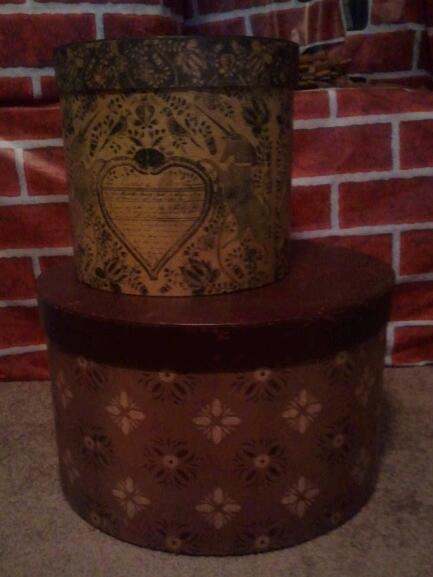
For some time we’ve needed a larger hat box for one of Dan’s hats. It didn’t need to be anything fancy, just something to safely store his hats. At first we were certain Joann’s or Tuesday Morning would have something big enough. Wrong. Their boxes all fell short of the 16.5″ minimum diameter. We even looked at Christmas gift boxes. Finally, I found the right box! Bevin suggested Dogwood Trading Company in Dansville, NY. Please see their contact information below. They had just the right assortment of band boxes. Large. Small. Tall. Wide. Round. Oval. Square. Each one is nicely sturdy. The designs range with many reflecting the look of paper. The prices are very nice too. The bottom box, the one for Dan’s hat, is 17″ across. It is taller than the 8″ his one hat needed. So, I foresee this box holding more than one of his hats. This was only $18.99. The store has at least 4 other prints in this size. They do have a larger one in a beautiful print that looks like a woven blue blanket. Love it! I just haven’t a clue where it would go right now. At the very affordable price on it, I may have to go back for it. There are others this size too.

image

The top box isn’t a size or shape I was actively looking for. But, it looks like it will nicely hold a mid-century bonnet or hood. Plus, look at that paper. It had to come home. An alternative thought process was that while I previously/currently store my bonnets in totes, there isn’t as much tote storage space in this apartment. (Confession – at one point, I had a tower of bonnet totes in my front closet.) It may be time to go back to hat and band boxes for millinery. They look great and are great storage. If you need strong boxes for storage, do give Dogwood Trading Company at try. The staff were extremely nice & helpful.

image

Decorating for Christmas in 1869

Excerpts from “Christmas Decorations of the Home” from Cassell’s Household Guide: Being a Complete Encyclopedia of Domestic and Social Economy Volume II, 1869 (published in London and New York.)

“The materials to be used include all kinds of evergreens, everlasting flowers, and coloured and gilt papers. It is a strange thing that, though mistletoe is used in the decoration of house, not a sprig of it is put into a church. But in house decoration no Christmas would be thought complete if there did not hang in hall or dining-room a bunch of its curiously-forked branches, with their terminal pairs of nerveless pale-green leaves, and white crystalline berries.

Holly is of course the special tree of the season. Its leaves bent into various curves, its thorny points, and its bunches of coral-red berries, make it the prince of evergreens. Let it be conspicuous throughout the decorations. It is a good plan to strip off the berries, and use them strung in bunches, as the berries get hidden when the sprigs are worked into wreathes and devices, and the berries, bent into little bunches, dotted about the festoons here and there, look very effective.

Ivy must be introduced with care. Small single leaves come in with good effect in small devices, or to relieve a background of somber yew or arbor vitae. The young shoots of the common ivy are best, or of the kind which grows up trees and old walls, which are very dark and glossy, with a network of light-coloured veins.

Laurel is a very useful green in sprays, and the single leaves may be applied with excellent effect in wreathes, or overlapping one another in borders. The variegated ancuba makes a pleasing variety in the colour.

Yews and arbor vitae are useful, especially the small sprays of them, for covering the framework of devices.

Myrtly and box also are pretty in narrow borderings, into which coloured everlasting flowers may be introduced. The black bunches of ivy berries may sometimes be used with advantage, to give points of contrast in decorations. Of course if chrysanthemums, Christmas roses, primulas, and camellias can be obtained, the general effect is heightened and the decoration becomes more elaborate and more elegant.

[directions for making wreaths]

If holly berries are scarce, a good substitute may be found in rose hips, which may have a small piece of wire passed through them as a stalk, and several twisted together. The fallen holly berries, strung on wire, made into rights, and slipped over the leaves, are very effective, also split peas, glue on here and there in the shape of small rosettes, look like golden flowers, and they may be made to resemble holly berries by pouring over them red sealing-wax melted in spirits of wine.

… Holly strung has a very good effect. It is very quickly done, and looks like a rich cord when finished, and all the banisters in a house may be draped in holly. It is made by threading a packing-needle with the required length of twine, and stringing upon it the largest and most curly looking holly leaves, taking care to pass the needle through the exact centre of each leaf.”

Published in: on December 2, 2012 at 9:09 am  Comments (2)  
Tags:

Lighting a Christmas Tree

I found this little snip-it rather intriguing and a bit horrifying. I just had to share. It comes from the December 1867 edition of the American Agriculturalist. We housekeepers know that this is really the busiest season of the year, but the work is so agreeable and is interspersed with so much that is delightfully mysterious, we never think of it being work at all, and only regret we have not each two pairs of  hands, that we might accomplish more. Christmas is so near, and then – well – Charlie is coming home from Chicago, and Willie from New York. They will come so late, we must have a tree all trimmed, the presents hung, and the candles ready to be lighted before they arrive. What a pity we cannot have gas out here in the country, and so have a Christmas tree drop-light, like the one cousin Tom has in Liverpool! The most vivid imagination could scarcely convert our little candles and lamps (I beg their pardon for mentioning it. May their shadows never be less, ) into the fifty bright jets which illuminated their tree; or transform Jennie’s doll, which will hover with out-stretched arms over our tree, suspended from the ceiling by a string around her waist – a contrivance of Ralph’s – into the silver Christ-child nestling in the upper branches, “all radiant with light as with a flood of glory,” as Tom described it in his letter to Ralph. Father says if the Petroleum Oil Gas Co. gets to work, and does as well as he thinks it will, we shall have our house lighted with gas before another Christmas. I don’t suppose father would get us a drop with fifty lights, but one with six or eight, as in figures 1 and 2, would be very nice among our candles and lamps. Yes, eight, opened to the best advantage, as shown in figure 1, would quite set off a tree.”

Published in: on December 1, 2012 at 9:08 am  Leave a Comment  
Tags:

Some 19th Century Reading for the Season

Here is a mid-nineteenth century book that takes a look at Christmas, New Years and Twelfth Night. The Book of Christmas: Descriptive of the Customs, Ceremonies, Traditions, Superstitions, Fun, Feeling, and Festivities of the Christmas Season, by Thomas Kibble Hervey (1845)

This short book is filled with history and traditions from the 19th century perspective. The Christmas book: Christmas in the olden time, its customs and their origin : the holly and ivy, sports of the eve, Yule log, boar’s head, the dinner, mummers, Lord of Misrule, Saturnalia, carols, mysteries and plays, boxes, &c. &c, by Pattie & Glaiser (London,1859)  

Another – Christmas in the Olden Time, or The Wassail Bowl,  by John Mills (1846)

Looking for some poetic phrasing for the character growing up in the 1830s? Christmas, a Poem,  by Edward Moxon.

A short to moderate pieces of fiction – Christmas at Under-Tor: An American Christmas Story,  by Clarence Gordon;   Christmas Hours, by Ticknor & Fields (1858)

Published in: on November 28, 2012 at 9:11 am  Comments (2)  
Tags:

Two Surprise Finds – or, When Costumes aren’t Costumes

As many of you know, Dan and I are finally moving. Since I gave away some furniture before going to NM, we are in need of a dining table and bookshelve. Today we stopped in to a warehouse that had some tables listed on craigslist. Inside we found theater sets and racks of costumes instead. Of course, we had to look.

On those racks I found two dresses that needed to be rescued. One is a brown windowpane plaid wool sheer. The other is a simple cotton.

I took some photos to share then rolled them up for a closer look once we are in our place and I can lay them out with some more light. At that point, I’ll take some measurements. Both dresses are study quality because they are damaged and altered in some ways for theater wear.

Here is a slide show of the brown sheer. You will see, it has some significant fracture points in the bodice and skirt. Looking at the bodice, you can see a dart fractured on the left. On the right the same one was removed. There are two darts remaining. The neckline has a very narrow piping. Notice the net applied, likely, at a later date. The waist is pleated through the sides and front; gauged in the back. The change in the turn-over is very noticable. The sleeve is simple a “look at this sleeve”. I look forward to making more notes on it. The net is the same at the neckline. Looking at the repairs and alterations, we see several theatrical ones including one I need to look closer at in the waist on the back right side. There is a,likely, contemporary gusset under the right arm.

This slideshow requires JavaScript.

Here is the cotton dress. This one is either an original or one stallar early reproduction. My ‘iffiness’ is due to a couple features that just aren’t very common in dresses from 1855 to 1865. Maybe these push the dress slightly later time period or maybe it is a costume. The neckline is the big one for me. (of course this is the photo that didn’t come out clear.) The most common neck treatment seen is the narrow piping with self fabric and cord. This has a self fabric strip of fabric that is set on the grain. This brings the neckline slightly higher. The other piece is the closer, actually the top of the closer. This is not a technique I’ve seen before. Two small bits are the piping which is a tad bit thicker than I would expect as well as the lining, which is also a tad heavy. Now, these aspects could just be a utilitarian componant. On the flipside, the aspects that make me think this is an original are the pocket, the deep pocket which is an aspect of mid-nineteenth century dress that moved from a smaller research tid-bit to a wider-known in the past ten years, and the fabric used for the hem backing.

Published in: on November 24, 2012 at 5:05 pm  Comments (1)  

Homemade Christmas Ornaments from 1881

From Cassell’s Household Guide: Being a Complete Encyclopedia of Domestic and Social Economy Volume III, 1881 (published in London and New York.)

The Christmas-Tree may be made at home for a very trifling cost. Long as they have been in fashion in England for juvenile parties, of for Christmas-eve, these trees seem to be still in favour almost as much as ever. Christmas-trees may be covered with paltry trifles, or made the medium of dispensing suitable gifts amongst the members of a household. When the latter plan is to be adopted, each article is to be marked with the names of the intended recipient. It is also very well to add a few boxes of sugar-plums and valueless trifles, which can afterwards be raffled for. The ordinary Christmas-tree is covered with miscellaneous articles, some of more value than others, which are either distributed at hazard by the lady deputed to cut them down, or lots are drawn out of a bag of numbers corresponding to those fixed on the little presents themselves. A good-sized fir-tree, of regular shape, and with nice wide-spreading arms, is wanted. Cover this at regular intervals with gelatin lights, which are better and safer than wax tapers. These lights are like ordinary night-lights, each on contained in a little cup of gay-coloured gelatin, resembling the glass lamps used at illuminations when gas is not employed. Take care to place these lights so that not one of them is put under a bough, which may set alight. Suspend them by fine wire, not cotton or string, which will take fire. A little beyond every light arrange a bright tin reflector, star, or silvered glass ball. A number of flags are requisite to add to the gaiety of the tree, which a few bows of coloured ribbon will also emhance.

A good many small ornamental paper boxes and cases holding sugar-plums will add well to the decorations of the tree. To make paper cones, cut squares of white or coloured paper. Fold the square in half, like fig 2, and cut off the piece at the top, making the two sides equal. When opened, it will resemble fig 3. Gum it as far as the dotted line, and join it. Be sure to join it so that there is not a hole at the point. If it is made of white paper, cut some strips of red, of green, and of gold paper. Edge it with gold, and paste stripes of red, green and gold around it spirally at intervals. If the cone is made of coloured paper, use gold, white, and some favourably contrasting hue. Fig 4 illustrates it. Another pretty way to make a rather superior ornament is to cut a cone of bright green satin-paper, and join it. Cut a tassel, and fasten it at the point. To the top gum a piece of scarlet sarcenet, with a mouth like a bag, and over the join run some blond lace; turn a row each way, and gum a strip of gold paper between (see fig 5). Fig 6 is another kind of sugar-plum case. Cut a straight piece of card, and sew it together  to make a round like a drum. Cut a circular piece to fit one end. Cover the sides round with paper, notch the edges, and turn them down at one end over the piece fitted in, and, if well gummed, they will keep it in place. The other end may be sewed in. Cut a round piece of coloured paper, and gum on lastly at the end. Have a bag-top of some pretty piece of passemeterie or gilt paper over the join. If the box is covered with straw-colour, and the bag is of blue satin, it will look pretty. Odds and ends of ribbon may be used in making up these little boxed. A more valuable case may be made by first constructing a box of a strip card, goring it with a strip of paper each side instead of by sewing. Cover this with white paper. When quite dry, bind both edges with blue satin ribbon. Then draw, in water-colours, a garland of flowers round barrel. Very neatly sew a blue satin bag at each end. Put a little powdered scent in, enough wadding to fill the bags, and place it on the tree. It may be suspended by its own strings of blue ribbon. A pedestal is a good design for a fancy case. A design for one is given in fig 8. To construct it, take a piece of card large enough to allow its four sides. Cut this like fig 1, allowing four equal sides and a bit over; half-cut through the dotted lines on the right side. Join it round with the small piece inside, and fix it with strong gum. Cut a square larger then the pedestal, for the base in fig 10, below the dotted line, gum them, and fix on the base. For the lid, cut a piece like the base, and a second piece like Fig 10. Half-cut through the dotted lines. Join the piece as the pedestal was joined, and fix the top to this piece in a similar way to that used in joining the base. But Fig 9 must be a little narrower each side than Fig 1, so that the smaller piece, fig 9, may neatly fit just inside the larger, fig 1. Another way to make this is to cut two pieces like fig 1, one just small enough to fit inside the other, and fix square ends of equal size to each. To close the box, put one inside another. Ornament the outer one with coloured paper, and bind the edges with gold, or merely bind the edges and draw a group of flowers on each side in water-colours, and also on the lid.

Fig 12, a Drum, can be made of paper, and ornamented with strips of red and of gold paper, and have a few sugar-plums inside. To make it , join a piece of paper as for fig 6. Draw, with a bow-pencil, a round as large as the top, and a second round a little larger. Cut out the larger round, and notch the edges up (fig 13). When you have done this, turn down the edges, gum them, and fit them into the drum. For the outer end cut a similar piece, put a loop of thread or ribbon in the centre, and put it in without gumming it. Made in card, ornamented, filled with sweetmeats, and a piece of net gummed at the top, with a band of gold paper over the join, it is very pretty.

Fig 14 is a Muff. – Make this of a bit of plush that look like fur. Put a shallow, red silk bag-mouth at each end, to look like the lining. Draw up one end and sew it. Cut a piece of paper the size of the muff, roll it round, and slip it inside to keep the muff out stiff. Cardboard can be used in stead of paper. Put in the sugar-plums, and draw up the mouth.

The Lucky Shoe (fig 15) – Cut a shoe by fig 16, of any pretty material; join in and bind it neatly. Cut a sole by fig 17. Before joining the upper part, see that it fits the sole well. Cut the sole of card, and tack the material over it. Sew the shoe to the sole all round outside. Cut a sole of white paper a little smaller than the first; gum it, and fix it inside. Make a back, and sew it neatly to the shoe. Fill with scented wadding, sweetmeats, &c. according to fancy. If the articles on the tree are raffled for, and the tree is intended for grown-up girls, as sometimes happens at a Christmas party, it causes much mirth to secrete a mock wedding-ring in one of the shoes, underneath the sugar-plums or wadding. Then make known to the company that there is a ring to be found, and predict that the finder will be the first married. The lucky shoe is a very good place for it, ad shoes have, in superstitious times, always been associated with supposed charms – the horse-shoe to keep away evil spirits, the old shoe for luck to be thrown after the bride, the shoes crossed at the bedside to make the owner dream of her sweetheart, &c.

The Hour-Glass (fig 18) – This may be made in two ways. First cut four pieces like fig 19, cutting off the dotted piece at the side (not at the top). Cover each piece with white satin; sew them together. Cut two rounds, much larger, of card; cover each with brown satin. Sew on by the pieces marked A and B, fig 19, which are to be turned down. They should have been half-cut through before sewing. Take two pieces of wire, bind coloured ribbon round them, and sew them to the hour-glass. Cut a piece of card like fig 11; half-cut through the dotted line; stitch it to the top; cover the top with satin. This completes the whole of it. The second and simpler way is to cut the hour-glass like fig 19, half-cutting through the dotted lines, and by the side pieces; gum them neatly together. On the sides draw flowers in water-colours, or paste on spangles.

Published in: on November 21, 2012 at 8:41 am  Comments (2)  
Tags: