Sew Along – Work Bag (week4)

By special request due to the storm approaching the east coast, I am sharing this post early.

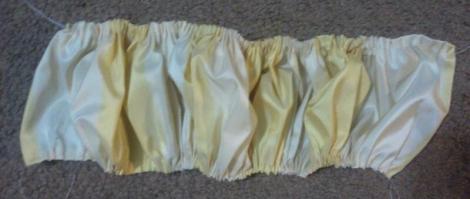
This week we are attaching the balloony section we gauged last week to the covered paste board.

Cotton Work Bag

We are attaching the long section we gauged last week to two of the the covered pasteboards (the ones that are backed with the lining fabric.) The gauged fabric will be attached along the curved section of the pasteboard. The flat side will not have fabric attached.

2015-12-27-22.44.22-1.jpg.jpeg 2015-12-27-18.14.39-1.jpg.jpeg

We will attach the pasteboard and the gauged fabric right sides together with the decorative side of the pasteboard, using a whip stitch. Line up the center point you marked on one side of the gauged fabric with the bottom center of the pasteboard. Pin these points together. Line up the quarter points with just above the curve on the pasteboard. (I’ll get a better photo of that.)

On each end, fold a quarter inch of the gauged fabric under. Line this fold up with the top of the pasteboard curve where it meets the flat side. Pin both ends as well.  (sorry, I will try to get a photo of this.)

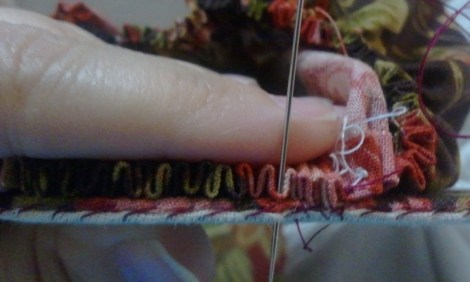
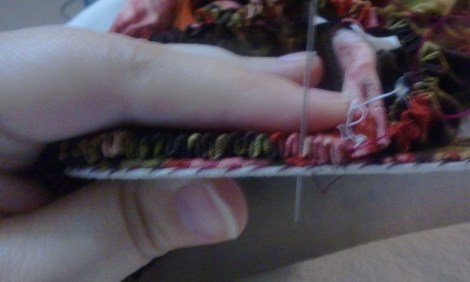
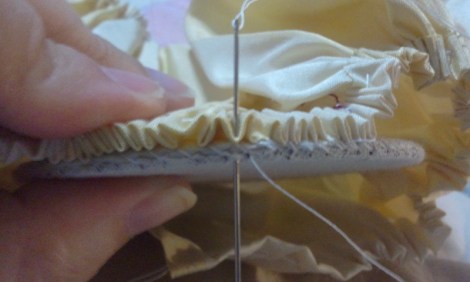
Using a whip stitch, attach the folds of the gauging to the pasteboard. Go through both the decorative and lining fabrics, but not the paste board.

2015-12-29-17.26.45.jpg.jpeg 2015-12-29-17.26.56.jpg.jpeg

2015-12-29-18.34.07.jpg.jpeg

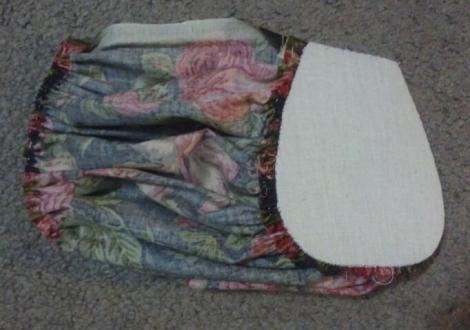
When one side is finished, it will look something like this. You may need to coax the gauged fabric to lay flat aligned with the pasteboard. (outside and inside shots.) (Yes, I make use of the salvege.) 2015-12-29-18.00.36.jpg.jpeg 2015-12-29-18.01.08-1.jpg.jpeg

Repeat the pinning and whip stitching process with the second covered pasteboard.

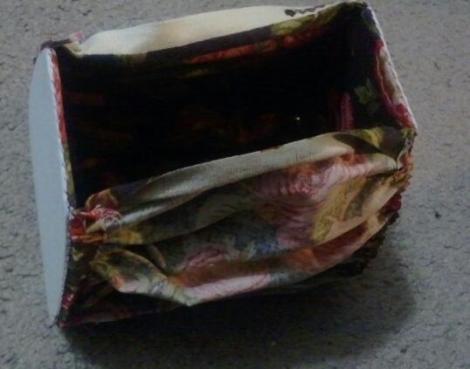
When finished, you will have two sorta horse shoes attached to the gauged fabric. Take some time to play around with how these fit together. It is a rather nifty combination. 2015-12-29-18.32.24-1.jpg.jpeg 2015-12-29-18.32.30.jpg.jpeg 2015-12-29-18.33.02-1.jpg.jpeg 2015-12-29-18.33.13-1.jpg.jpeg

Lay the workbag out flat to check your stitches.  2015-12-29-18.33.49-1.jpg.jpeg

You have completed this week’s step. (You can turn it right side out if you want.)

——————————————————————————————————————————-

Silk Work Bag

We are attaching the long section we gauged last week to two of the the covered pasteboards (the ones that are backed with the lining fabric.) The gauged fabric will be attached around the entire circle on each side.

2015-12-29-20.16.03-1.jpg.jpeg2015-12-27-21.15.13-1.jpg.jpeg

We will attach the pasteboard and the gauged fabric right sides together with the decorative side of the pasteboard, using a whip stitch. Mark each circle in quarters. (pencil on the inside lining is fine.)

With the first pasteboard –  Fold a quarter inch under on each end. Line these  up with the top point on the pasteboard. Pin. Line center point of the gauged fabric up with the bottom point on the pasteboard and pin. Do the same with the side quarter points. (Sorry for the lack of photo.)

Using a whip stitch, attach the folds of the gauging to the pasteboard. Go through both the decorative and lining fabrics, but not the paste board.

2015-12-29-20.25.57.jpg.jpeg 2015-12-29-20.27.09.jpg.jpeg

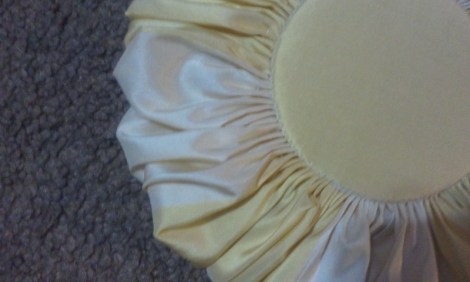
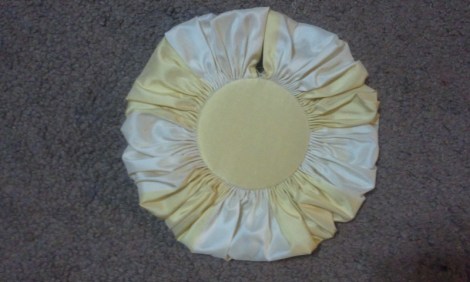
When one side is finished, it will look something like this. You may need to coax the gauged fabric to lay flat aligned with the pasteboard.2015-12-29-22.03.08.jpg.jpeg

Repeat the pinning and whip stitch with the other pasteboard side.

When finished, check your work. Once you turn this one right side out, it will be be difficult to turn it inside out again.

2015-12-29-22.02.37.jpg.jpeg 2015-12-29-22.02.32.jpg.jpeg

Published in: on January 22, 2016 at 9:59 am  Comments (2)  
Tags:

2016 Happenings?

Last year we took a nice cruise on the Canandaigua Lady. I am now pondering what we could do this year….

?Another cruise?

?A picnic?

?A trip on the canal?

I really want to do a warm us up tea at the Caledonia Village Inn. A Saturday afternoon by their warm fire sounds so nice right now. I need to pick a date that soon. (though, I am noticing they open at 4.)

I stumbled upon Granger Homestead’s Mystery Tea. While this is different than what I have in mind, is sounds like it could be fun. What do you think? This is such a lovely home.

I also want to do a couple of those sewing get togethers that seemed to fall through the cracks this past year.


Published in: on January 19, 2016 at 4:00 pm  Leave a Comment  
Tags:

From “The Farming Daughter”

Michaela, The Farming Daughter, shared the winter bonnet she made with my pattern. Please, take a look: http://thefarmingdaughter.com/2016/01/18/the-bess-bonnet/


Published in: on January 19, 2016 at 6:00 am  Leave a Comment  

Doll Millinery and Accessories

With my reduced attention span during the last two months of being a germ magnet, I’ve been working on some much smaller projects. Doll projects actually.

Cali has a new work bag that is in the same style as the work bag we are doing for the sew along. Her little bag is about 3″ wide. It is made with a bold cotton print and muslin lining. It is trimmed with pleated silk ribbon.

As Cali is a time traveling doll, both backward and forward in time, I have yet to decide if she will be sharing her adventures here on this blog or over on Don’t Paint the Cat. Who knows, she may get demanding and ask for her own blog.

I made a second one of the same fabric for another doll wanting one.
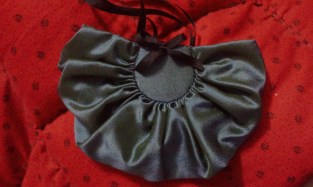
imageI loved the look of the small gauging around the little center, I went ahead and made one of silk as well. This one is a blue and green shot silk. It is worked in black thread and trimmed in black silk ribbon for the handles and bow.

2016-01-13-18.36.11.jpg.jpeg


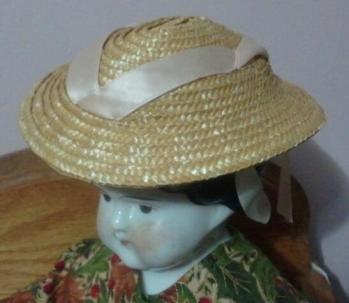
Of course, the ultimate accessory is a nice piece of millinery. Here is Cali in a fashionable straw hat with a little pink silk ribbon. (she may or may not be keeping this one.)

2016-01-15-06.18.46-1.jpg.jpeg

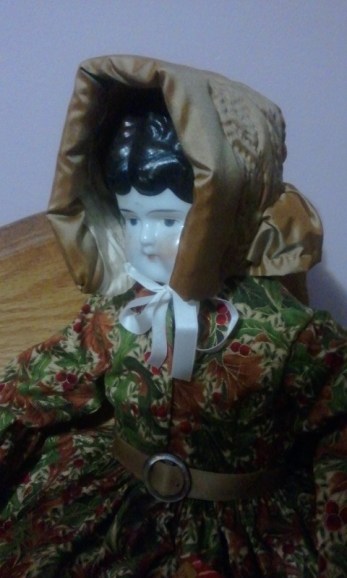
This quilted silk hood will keep her snuggly warm. It is hand quilted on a rose and gold shot silk, in a double scallop pattern.

2016-01-15-06.21.17.jpg.jpeg


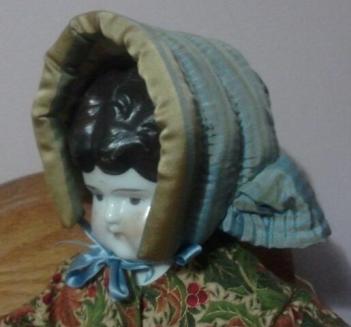
This wadded hood is made with a slightly smaller pattern for a slightly smaller doll. Thus, the snug fit on Cali. (This will be available.)

2016-01-15-06.18.06-1.jpg.jpeg

Here is a straw toque style hat waiting to be trimmed. Cali doesn’t like this one for herself. Her head is wider and not as deep. It will be so cute trimmed out in velvet.

2016-01-15-06.21.43-1.jpg.jpeg

Here are a few millinery pieces I did a while back. The straw is made with tiny 3-4mm straw plait. I have more of this that I am looking forward to working with this year. The drawn bonnet mimics a human size drawn bonnet I did two years ago. To keep warm, there are a pair of winter bonnets in black and a blue-gray silk.


Besides Cali and Mea’s dress fabric stash tucked away in their trunk, there are many other items I would like to make for them….

Dreamy To-Dos:

Published in: on January 16, 2016 at 1:00 am  Comments (1)  
Tags:

Protected: GVHSA – Local group only

This content is password-protected. To view it, please enter the password below.

Published in: on January 15, 2016 at 4:10 pm  Enter your password to view comments.  
Tags:

How do I …. My Shawl

I am being asked more and more frequently about repairing or strengthening shawls.

Oh, how I wish I had taken classes textile conservation and preservation already. But, I haven’t.

Before proceeding, I want to say I do not encourage the wear of original shawls.

What causes damage to a shawl

  • Folding creases the thread and causes fractures.
  • Dryness can dry out the fibers and make them brittle.
  • Moisture can invite mildew or mold.
  • Moths can eat holes.
  • Time is just time as it wears away the life of fiber.
  • Chemicals/dyes can cause some threads/fibers to be less stable than others. These can deteriorate quicker.


Reading up on the options

Further reading

  • Preservation begins at home: How to care for your textile collections” by Julia M. Brennan. (This is one of the nicer, easy to follow articles for at home.)***
  • Caring for Textiles blog.
  • The Museum Textiles “Issuu” page.
  • “A Conservator’s Approach to Viewing Textiles”, Textile Society of America, Proceedings of the Seventh Biennial Symposium, Sante Fe, NM, 2000.
  • Preserving Textiles: A Guide for the Nonspecialist,  Indianapolis Museum of Art, Indianapolis, Indiana:  1999, 92pp.
  •  “Treating Mrs. Robertson’s 1802 Dress”, Costume Society of America, Dress, Earleville, Md,  1993-4, pp. 65-73.
  • “Fabric Wallcoverings: Historic Use, Cleaning and Conservation”, Historic Preservation, The Interiors Handbook for Historic Buildings, Vol. II, Washington, DC, 1993, pp. 5. 21-24.


For in-depth information on shawls and their history, read Paisley, Plaid, & Purled: Shawls of the Mid-Nineteenth Century

PPandP book cover

Published in: on January 14, 2016 at 6:00 am  Leave a Comment  

What I have on my mind…

When I should be sleeping….

image


image


image


image


image


image


image


image


image

image

2016-01-13-10.09.24.jpg.jpeg

http://www.nationaltrustcollections.org.uk/object/1362638

http://www.nationaltrustcollections.org.uk/object/1349756

http://www.mfa.org/collections/object/leghorn-straw-bonnet-47759

Published in: on January 13, 2016 at 5:00 pm  Comments (2)  

Shawls for Historic Interpretation

For more in-depth information, read Paisley, Plaid, & Purled: Shawls of the Mid-Nineteenth Century
PPandP book cover

—————————————————————————————

Shawls for Historic Interpretation

Kashmir, Paisley and Paisley-type Shawls
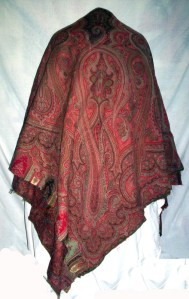
Paisley family shawl, possibly French

Fibers, weave and size: These shawls should ideally be made of hair brushed from the Kashmir/cashmere goat or from a wool and silk blend. The silk should be the warp or blended into the wool in a small amount. Avoid shawls with a rayon or acetate blended with the wool. Original Kashmirs are very light weight because of the tapestry twill weave. I have yet to be able to compare the weights of original and new. Look for sizes around 64 inches square or 64×128 inches as a double square.

Design: When looking for a Paisley shawl, look for a strong cone motif. The cone motifs should radiate out from a center field of black, white or red. These radiating motives create a star or spoked flower appearance from a distance.  The spokes should be connected with ribbon like borders consisting of small floral motives. By our era a newer shawl would have a smallish center. But, the higher cost of these shawls along with their durability means it would not be unlikely for a grown woman to have a shawl with a larger center from her youth. The outer border can be on two or four sides. This borer should be comprised of smaller designs brought together in the border. Kashmir borders will have more independent blocks of design while French borders will visually entwine each block with it’s neighbor.

Two other design options include the striped shawl and the border shawl.

Where to look: There are some nice shawls coming out of India. Many of these are available on online and via Ebay for various prices. When doing an online search use “Paisley Shawl” or “Cashmere Shawl” or “Antique Shawl” for your key words.

(note: I have read several 1990’s news stories regarding the skinning of goats for their under-coat hair, which is used to make shawls, thus endagering the goats. While shopping be sure to find a merchant you are confidant in.)

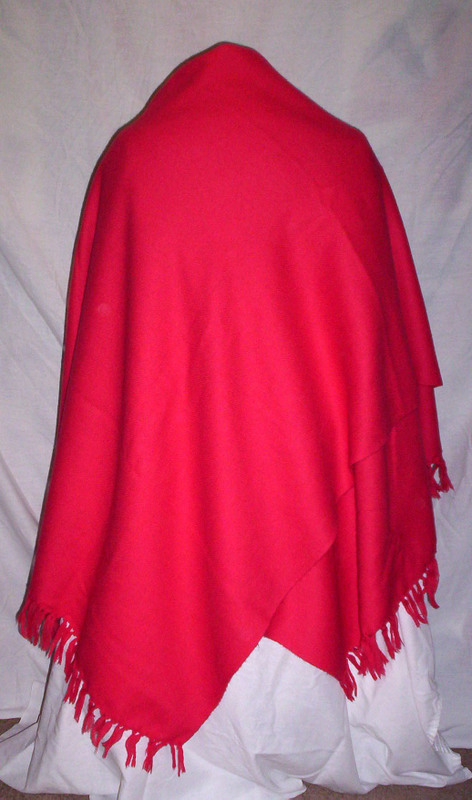
Woven shawls Red Wool Shawl
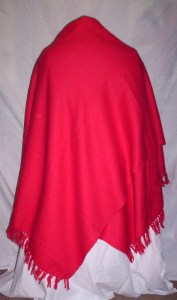
Fibers, weave and size: Wool or wool/silk blends. These should also be 64 inches square or 64 inches by 128 double square. A shawl relatively near these dimensions will look nice. The weave should be a tight plain or twill weave. The shawl can range from light weight to rather heavy if hand-woven.

Design : Look for solids, checks, plaids (preferably symmetrical) stripes and border plaids.
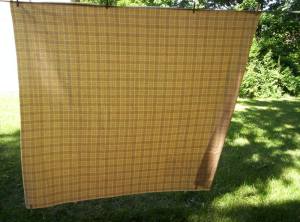
Golden yellow plaid shawl with detailWhere to look: This is a type of shawl you can make yourself. Many Museums offer weaving classes thru-out the year. You can also make a fabric shawl from woven wool lengths. You will need a dress weight to coat weight wool rather than a heavy weight  in a 54 inch to 60 inch width. Plain woven fabric and plaid woven fabrics work well. The yardage can fringed on the end by unravelling the ends by hand. To calculate your yardage, decide if you want a square or double square shawl and how long you wish your fringe to be on the ends. For a square shawl, purchase the width of the fabric plus 6 to 12 inches for fringe. For example: if you want a double square shawl out of 60 inch wide fabric purchase 130 inches for a 120 inch shawl with 5 inch fringe.  (see the article on fringing a shawl)

Printed shawls

Fibers, weave and size: Printed shawls come in wool, cotton and blends of wool, silk and cotton. Ideally, you would find a 64 inch square shawl, but the common 55 inch square shawl is not bad.

Design: Printed shawls vary by region. Look for period motifs and borders.

Where to look:  The Russian Pavlovo Posad company still makes printed shawls in their 19th century designs. There are several sellers listing these on ebay and more on the web. I am still trying to find a direct link to the company. I may have to settle with a regular address and phone number. Use “Pavlovo Shawls” or “Russian Shawls” for your internet search.

Sheer Shawls – Muslin Shawls, Grenadine & Barege

Fibers, weave and size: I still have not found sheer shawls that I like. These were silk, wool or cotton. They frequently had a plain central field and a stripe border creating a plaid motif.

Lawn, Gauze, Voile, Silk Organza & Batiste fabrics can be used to make a sheer shawl. The edges would need to be hand finished with a rolled hem. This isn’t what original shawls have though. You may want to starch the fabric as well. You can add tucks to the border or ribbon to the border or edge.  

Design:: Plain, woven plaids, woven checks, woven border plaids.

Where to look: – Online fabric merchants including Exclusive Silks and Fashion Fabric Club

Silk Shawls

Fibers, weave and size: I have not yet found the ideal silk shawl. Thai Silks has larger white shawls in their scarf section. These are a little smaller than ideal, but may suit your needs.

To make your own shawl, you want a durable silk, in the 64inch square range, no slubs with or without fringing. Look for a taffeta, china or habotai silk. Do not use satin.  I have seen solid color, shot (or changable silk) and patterned silk shawls. A couple of the India, China and Thai merchants sell nice silk shawls. I tend to think play it safe for silk shawls and go for simple. Also, many list as silk but are selling Viscose.

Design:: If you want to embroider your shawl, I highly suggest looking extensively at originals.

Embroidered China Crape

There are some fabulously beautiful embroidered shawls out there… but only a few designs are suitable. I occasionally pick through ebay to see what is out there. It is rare I find something that meets size, design, quality and fiber standards. But it is possible.

**Edit – The previous finds are no longer available. I’ll keep an eye out for more.

Lace Shawls

Sadly, every modern lace shawl I have seen is a synthetic. I may not have found the right maker. I suspect the prices may be quite high.

Crochet and Knitted Shawls

Great thing about these is you can make them your own. There are several patterns available in magazines and guide books. Many of these patterns are available digitally through Accessible Archives and online from various sites.

If you are purchasing a shawl, be sure to ask where the pattern design came from and what fibers the shawl is made out of. The shawl patterns above are worked in wool or silk.

Orenburg Lace Shawls

Fibers, weave and size – These should be 100% wool

Design – See originals

Where to look: – These are available from the same places the Pavlavo shawls are available. But not all are 100% wool. These should be square and very, very fine. The idea is they could fit through a wedding band. Most of the ones I see listed on Ebay don’t look like they have been blocked (set to the square shape.)

For more in-depth information, read Paisley, Plaid, & Purled: Shawls of the Mid-Nineteenth Century

PPandP book cover


Published in: on January 7, 2016 at 5:00 pm  Comments (3)  

What’s Inside – The Pin Cushion Experiment

***Note- This post will be updated as I test more fillings from the t0-do list.***

Squishing filling into a pin cushion one day, I started to wonder what a fun game it would be to stuff a bunch of pin cushions with different fillings and see if people could guess which was which.

As weird thoughts go, this one kept rolling round in my head… Over the years, then and now, what all have people tried to stuff their pin cushions with? How did each one act? What worked? What didn’t? What really didn’t? …. This rolling became a “must try this.” I had a bunch of pin cushion circles left from the workshops didn’t? Yep….

Let’s first look at the history:

What did “they” fill their cushions with? I have seen a few materials inside pin cushions and sewing cases.  There are others I not experienced in person but know to have been used. These include:

  • bran
  • raw wool
  • scraps of wool threads such as those pulled from fabrics
  • straw or flax
  • sawdust and wood shavings
  • emery

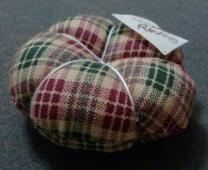
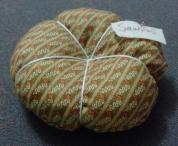
For the ‘experiment’, I used both materials that would have been used in the 19th century and modern use ones. I thought it would be an interesting comparison. Factors I looked at included easy of stick-ability, weight, compression and effects on pins over time. Each of the cushions are made with quilt weight cotton and crochet cotton. The crochet cotton helps determine how the filling compacts.

What I stuffed with:

wpid-2015-11-16-20.39.54-1.jpg.jpegWool batting/roving – This seems to provide the softest/squishiest of the wool fillings. It is firmer than the poly-fil. While it compacts, it does so evenly with a moderate amount of pull on the string.

The cushion is fairly light weight. Pins stick easily with a slight depression before going through the fabric. As wool roving and batting are easily available, this is an inexpensive and accessible, period correct option.

wpid-2015-11-17-18.16.54-1.jpg.jpegRaw, cleaned wool – This seems to provide the densest, least squishy of the wool fillings. The raw wool I used was fairly tightly wound to itself in clumps. I think this made stuffing the cushion easier. I can feel some of those twists inside. It compacts consistently with a little more pull on the string than the roving did. Some areas do feel less dense than others. The pins stick easily with a slight depression before breaking through the fabric.

The natural lanolin in the wool is said to be good for the needles. Raw wool may be easily available for some but not others. If available, this is an inexpensive period correct option.

wpid-2015-11-17-18.16.41-1.jpg.jpegWool scraps – The scraps for this cushion were threads pulled from about 8-9 square inches of heavy weight wool that had been washed and lightly felted. This cushion compacts consistently and evenly. It is not as dense as the raw wool. The pins stick easily with a slight depression before breaking through the fabric.

If someone regularly works with wool, this is a free stuffing option as scraps would abound. It does take some time to pull the threads apart.

wpid-2015-11-16-20.40.29-1.jpg.jpegPoly-fill – This is the softest and lightest of the cushions I have here. It is also the squishiest of the bunch. I found this cushion to compact unevenly and inconsistently. You can see this in the segments in the photo that are  misshapen. (I did make a second cushion to recheck my process.) This cushion takes compression before the pin will break through the fabric.

This is an inexpensive option for filling a modern pincushion. I would like to note, this fill made my eyes burn.

wpid-2015-11-16-20.38.48-1.jpg.jpegWalnut hulls with lavender – This cushion is filled with a commercial product for making pin cushions. It is ground hulls with lavender inside. The hulls are about the size of coarse salt on soft pretzels, maybe a little bigger. This filling was easy to fill with, though a bit messy (each hull could be picked up by hand.) The cushion is one of the heavier of this batch. It will not roll or slide. This would be a good option for a weight. There compression is even and consistent. Pins go right in with a rather pleasing ‘crunch’ feel.

The bag I have cost about $5. I expect it will make a half dozen pin cushions this size. I need to investigate the authenticity of this option.

wpid-2015-11-16-20.39.16-1.jpg.jpegSawdust – The sawdust I used was somewhere between dust and shavings, some was little, soft curls of wood. This made a weighty cushion that is quite as heavy as the walnut hulls. Pins go into this cushion nicely without much depression. The cushion compressed consistently but with some uneven areas.

If you have a wood shop, this is a free option for filling that is period correct. Be sure to pick clean, dry shavings. I do not know if any particular woods would be better or worse, or if any would turn corrosive over time.

Those I still need to do:

Sand – Need to get some

Emery – It is here, somewhere….

Cotton battingYawn

Bran – Need to get some

Rice – Need to just make it

Human Hair – Not sure I’m going to do this or not. 

Those I did not try:

Silica beads – Though several websites say silica makes a nice pin cushion, I am somewhere between skeptical and hesitant. I think of silica in connection with moisture control, that the packets attract moisture. I really don’t want a pin cushion that attracts moisture. All I can picture is the damp-rid bins we use in storage – ewy-goowy messes.

Graphite – How I laughed at this one. I do not want any additional ground or powdered graphite in my house. Husband tracks enough home on a daily basis. *In all seriousness, I simply can not picture a graphite filled cushion going will when working with white silk.

Others also mentioned on various sites and discussion boards…. pencil shavings, rock salt, small pet bedding, vase filler , foam wrapped in batting,

What do we like in our pincushions?

Liz Clark “The one in my little FanU sewing box is filled with wool roving, and it’s my favorite. I don’t sew with pins on the machine, but I do sometimes use a few for handsewing and the wool keeps them nicely!”

Gail Kellogg Hope“I have sevearl. My least favorite is the modern tomato. Not enough weight & I chase it across the floor a lot. My Fat Lady, who is larger, weighted and filled with polyfill. My great-grandmother’s woven, which is filled with sawdust fo some kind…. I like the weight. Weighted is important to me. That way I’m not knocking it across the room when all I want to do is put a pin in it. It shouldn’t take two hands to put it in.”

Eileen Hook” I have 1. a sand filled pin cushion (one of those pin cushions with a bag attached for little bits of thread), 2. a poly filled one, and 3. a wool raveling filled one. The sand filled one is good because it’s solid and heavy enough that it doesn’t slid across the table. Poly fill is light and easy to find in qntitty, but it is pretty light and the cushions aren’t as ‘solid.’ The wool ravelings are period appropriate and I used them for my period pin cushions. I can stuff quite a lot of wool into a pin cushion!! It feels more substantial than the poly fill.”

Carolann Schmitt – “I use a magnet pin cushion on my sewing machine, ironing board and cutting table. I use a fabric pin cushion stuffed with wool batting when I’m hand-sewing. The wool batting helps prohibit rust and moisture building up on the pins. And I always have an emery bag at hand to remove the protein buildup on pins and needles.”

Others Talking about Stuffing:

Published in: on January 6, 2016 at 7:00 am  Comments (13)  

Paisley, Plaid, & Purled – Q&A

PPandP book cover

Now Available. Paisley, Plaid, & Purled: Shawls of the Mid-Nineteenth Century
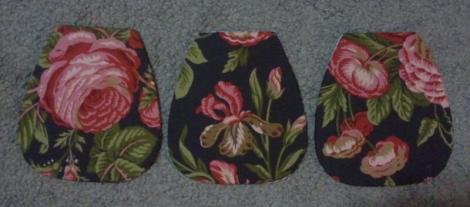
Why an E-book and not a printed one? I decided to publish PP&P as an e-book because it would be easily accessible for readers. As soon as it was purchased, it was there for them. No wait. 

Going with an e-book also meant not having the additional cost of printing and shipping. A printed version would have to have been $25-30 plus shipping, which increased notably in 2016. 

Does PP&P have patterns? PP&P includes original directions for over 30 shawls, both knit and sewn. Right now, the quilted shawl particularly appeals to me. 

Does PP&P have photographs? Yes. I included over two dozen CDVs in color, several with close-ups. The great thing about an e-book as a PDF is you can zoom in too. I also included photographs of original shawls. (I really need a nice studio to take photos of more I would like to share.)

Why $15.00? It was really hard coming up with a price for Paisley, Plaid, & Purled. I wanted the book to be easily affordable. But, I also needed to cover my costs. What I ended up doing is taking the expenses I had (LOC, ISBN, original shawls, CDVs, ILLs, copies/printing, etc) and dividing by 100 (a hopeful number of books. That number became the price. This does mean that I don’t actually make any money on PP&P until after I sell 100 books. (Oh, I also realized I wasn’t very good at keeping track of the little expenses such as museum fees, materials, etc.) 
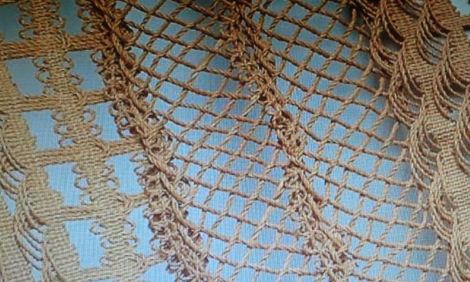
Published in: on January 1, 2016 at 12:41 pm  Leave a Comment  
Tags: