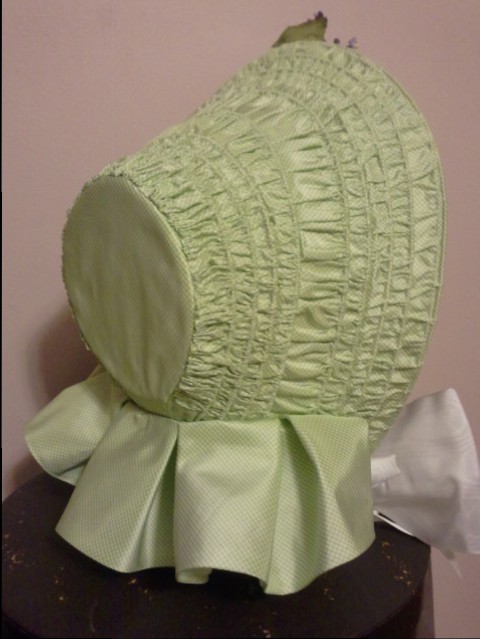
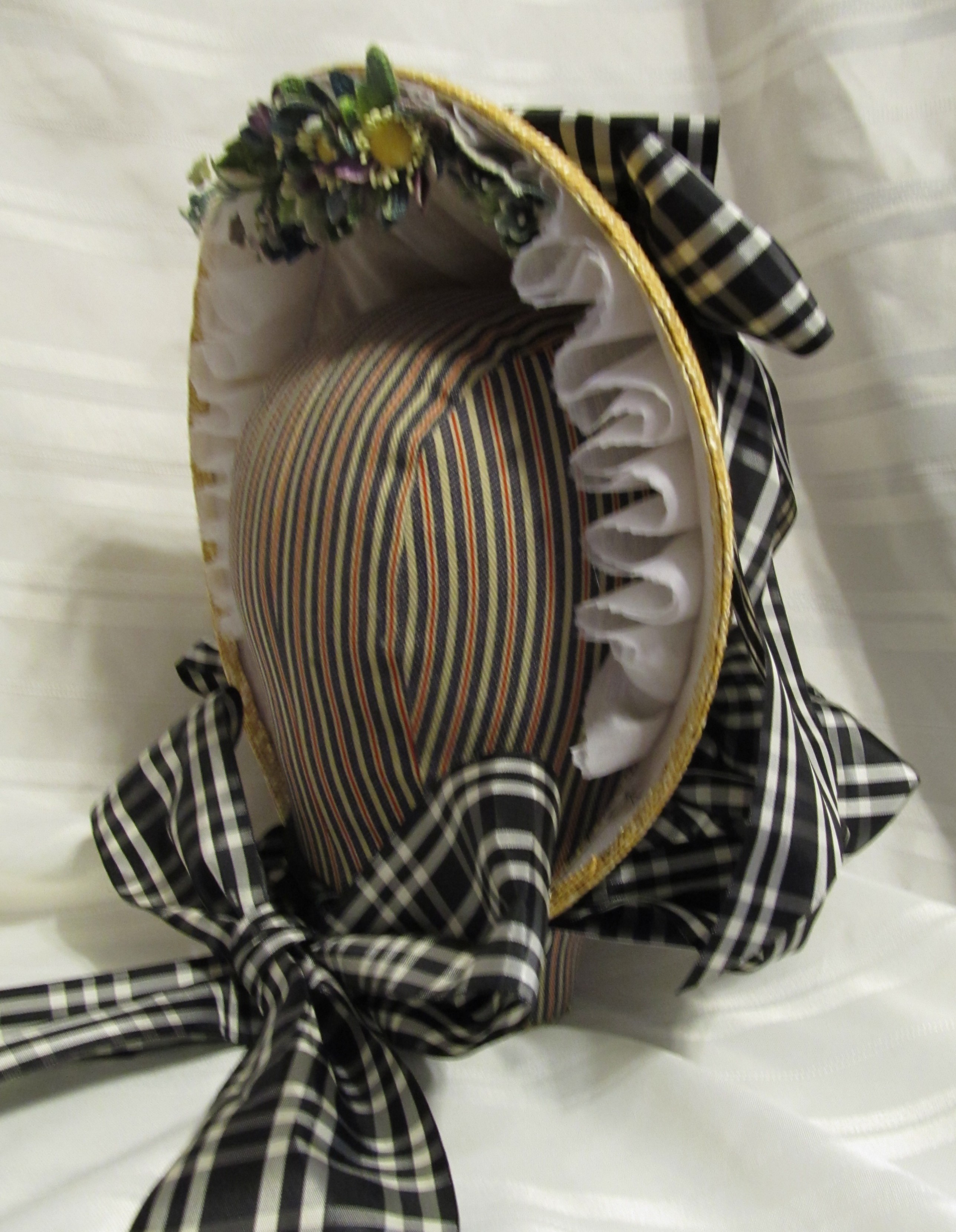
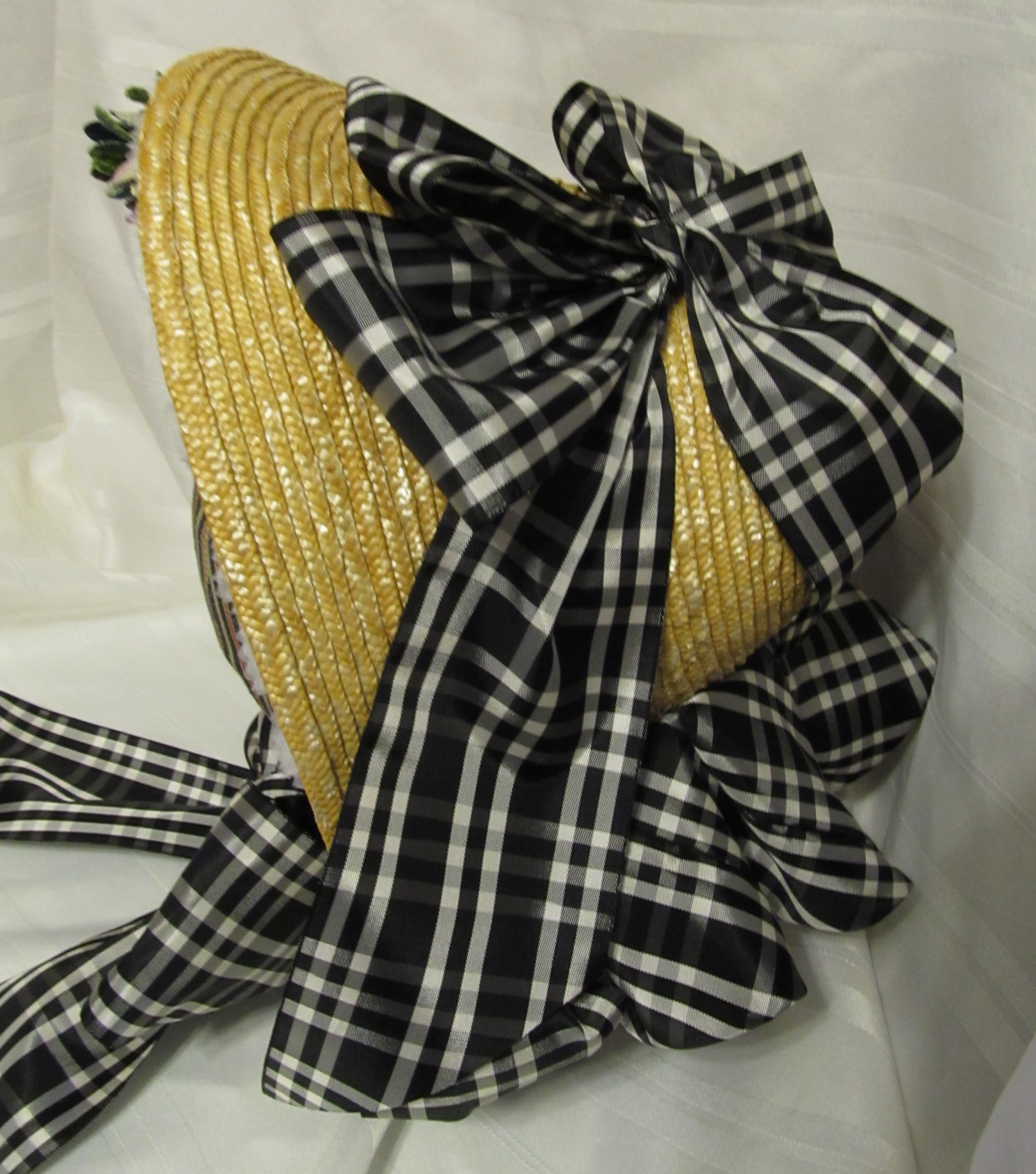
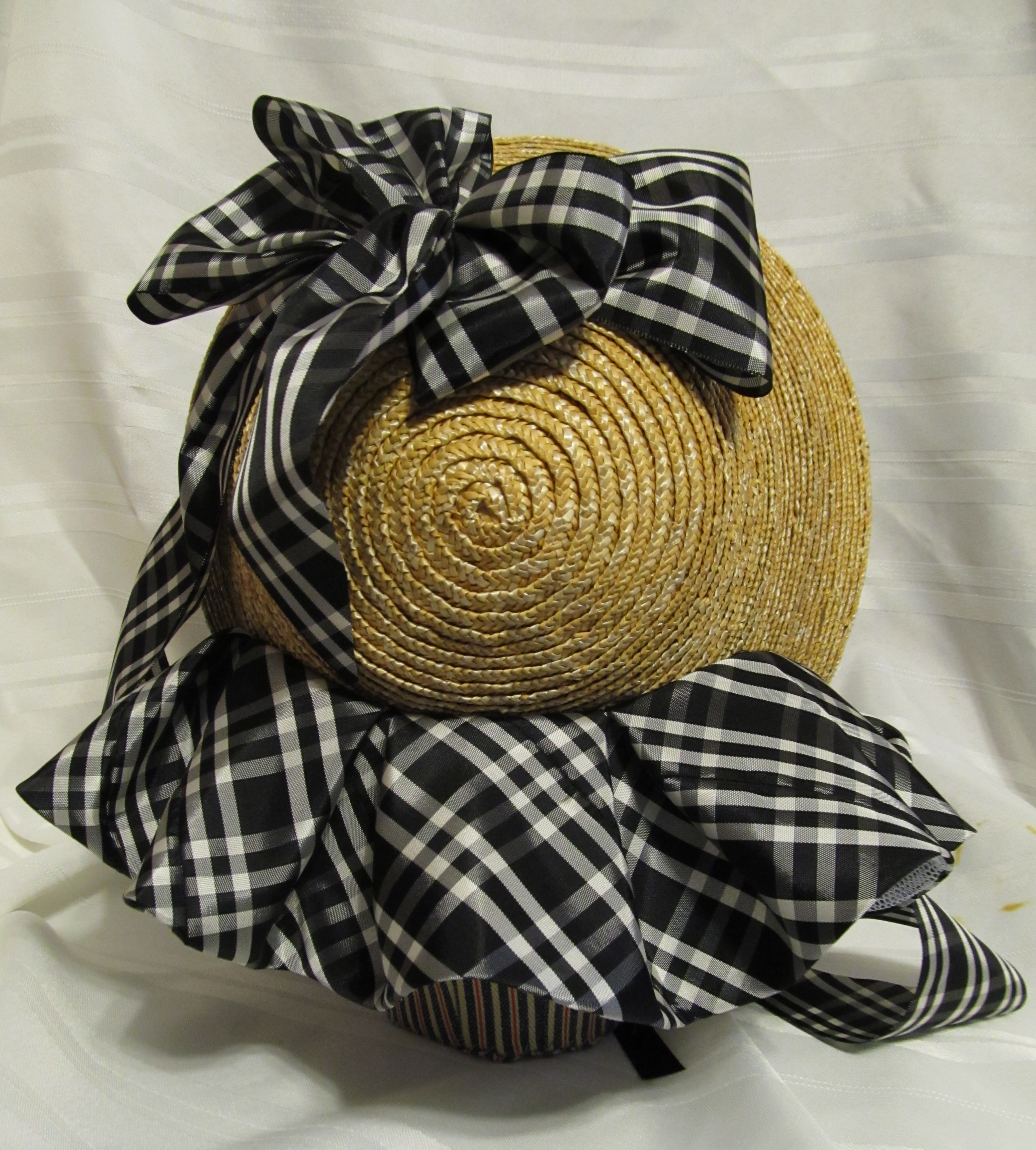
Green Mini-Check Silk Drawn Bonnet.

The form for this bonnet has been sitting on the work table since mid-summer, with the silk patiently waiting.

wpid-2014-09-24-21.13.06-1.jpg.jpegI played with the shaping of the buckram form to get the brim to flare up into a high fashionable shape. This is a shape that will want a bonnet stay. (Yes, I will get to taking some photos of stays asap.)

wpid-2014-09-24-21.12.43.jpg.jpegFor this piece, I wanted to play with the texture created by placing the drawn canes evenly together, following the curving shape of the brim. I used the thicker of the canes to play off the tiny check. I found this really emphasizes the curve of the brim and visually elongates it. I love how that works.

wpid-2014-09-24-21.12.57.jpg.jpegThe decorative ribbon is the German moire I like in white. It makes for a nice, wide ribbon that ties beautifully and lasts. The functional ties are silk satin, in ivory.

I set the organza frill high and slightly asymmetrically. Part of me wants to fill in the sides all the way through the cheektabs. But, this placement is supposed to emphasize the vertical line and height.

wpid-2014-09-24-21.13.49-1.jpg.jpegNow the flowers. As I worked with the silk, I knew it really wanted purple. I found a pair of pretty purple velvet roses and delicate white lilies whose edges have just a hint of purple. The spray of velvet blossoms add to the height. I went with a small bouquet set asymmetrically.

Almost forgot. This bonnet is available on Etsy.


Published in: on September 25, 2014 at 4:02 pm  Leave a Comment  
Tags:

A Year in Millinery Fashion – 1864

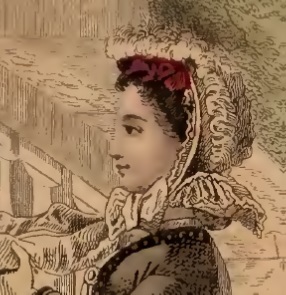
A Leghorn bonnet, trimmed
with a salmon and black ribbon. The feathers are black. The inside trimming is
composed of scarlet velvet, black lace, and salmon-colored flowers.  (Godey’s, September, 1864)

3

Published in: on September 22, 2014 at 1:01 am  Leave a Comment  
Tags:

Children’s Headwear

Lately, I’ve been hearing an assortment of “kids didn’t wear…”, “children only wore…”, “she’s too young for….” and so on.

Ehhhh…. not so much. Children had a variety of headwear to choose from. Here is an attempt at a survey of paintings to help us get a better idea. (Clicking on the thumbnails will take you to the full paintings)

Let us start with this little boy from Britain.  The title, A Visit from the Hall, suggests his family rents or works the land.  He is young. I would estimate 2 or 3 years of age. He wears a long smock that may be a dress and what might be the start of pants underweight. He holds a cap in his hand.
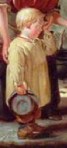
A Visit from the Hall Edwin Cockburn 1855This little girl is getting direction from her mother, in Responsibility by Hugh Cameron (1869). I can’t help think “Little Red Riding Hood” here. Except instead of a red hood she is wearing a white, possibly blueish, soft bonnet or hood. It may be a quilted bonnet. The weather may or may not be slightly chilled outside, as she wears a light outer garment and not arm coverings. Responsibility  by Hugh Cameron 1869

In this Cameron painting, The Village Well (1871), the girl is wearing a short sleeve dress, pinafore and pretty pink sunbonnet. This appears to be a corded sunbonnet to me. The curtain/bavolet is long, hanging over her shoulders protecting her neck. In her hand (sorry I cropped that) is a jug for water. The Village Well Hugh Cameron 1871This girl coming through a garden gate is also wearing a pink sunbonnet. This one has a ruffle around the brim and a much longer curtain. At the Doorway  John George Brown 1867
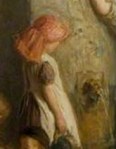

This girl’s sunbonnet is white. You can see it tied under her chin with a ribbon that appears to have color. The Picnic John George Brown 1861For an additional sunbonnet, see Pay Toll.

The next few images depict fairs. Looking at the whole paintings, we see a wide variety of clothing. In Alfred Mudge’s Walking the Walsall Fair (1859) we see two girls wearing structured bonnets, meaning buckram or straw bonnets. The lower image shows a girl who wears a pinafore type garment over her dress which is just above the ankles. I think she is 11 to 14. Her bonnet hints at straw while distinctly showing the bavolet and ribbons. She is holding the hand of another child, possibly a girl if that is long hair, who is wearing a hat with a ribbon. In the upper image, which is to the right of the first girl in the whole painting, is a girl who may be a bit younger than the first. She wears a bonnet perched far back on her head, to the point of falling off. Walking the Walsall Fair by Alfred Mudge 1859This next child is a bit blurry because I tried to zoom in too far. She is from William Samuel P. Henderson’s Fair Day (1856). She is quite young, maybe 3 to 5. She wears a dark, possibly black, structured bonnet tied with light, possibly blue, ribbons under her chin. Fair Day by William Samuel P Henderson 1856


For additional “reading”, this page has several good paintings for clothing in general.

Also see, Looking out for the Engine while the Bell Rings for an assortment of head wear.

Published in: on September 19, 2014 at 6:50 pm  Comments (1)  

A Year in Millinery Fashion – 1864

White silk bonnet, trimmed with violet ribbons and pink roses. A net formed of ribbons is attached to the bonnet.  (Godey’s, September, 1864)

3

Published in: on September 15, 2014 at 1:01 am  Comments (2)  
Tags:

A Year in Millinery Fashion – 1864

Pearl-colored crape bonnet, trimmed with black lace. A fan of pearl-colored silk and white feathers, The trimming inside is of pink ribbon and stiff white feathers. (Godey’s, September,
1864)

3

Published in: on September 8, 2014 at 1:01 am  Leave a Comment  
Tags:

A Year in Millinery Fashion – 1864

Bonnet of white chip, trimmed with a long white plume. The inside trimming is of Ophelia velvet. (Godey’s, September, 1864)

3

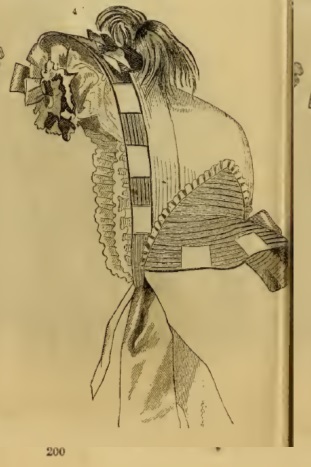
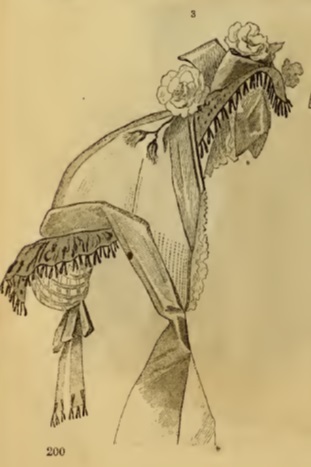
Bonnets – The capes of the bonnets have almost entirely disappeared. In fact, in Paris, not only the capes, but the crowns also, have disappeared. The bonnets there, during the past summer, have consisted of a straw or tulle front, profusely ornamented with flowers and lace, and only a half-handkerchief of lace falling over the hair at the back, this being trimmed with sprays of flowers – no crown, no cape. It will be seen that we are fast approaching thse models by one of our wood-cuts. Still, the apprehension of neuralgia will prevent us from adopting this style in full for the winter. A Paris authority says:

“The bonnet shape, as it now stands, is small in every respect, and is not intended to hide either hair or face; on the contrary, it seems rather to connive at showing both. The mass of hair at the back, the bandeaux in front, the ears and ear-rings are all left unconcealed. A vast quantity of both white and colored tulle is worn about the bonnets of the present day, which proves soft and vastly becoming, when brought in such close contact with the skin, and will be found advantageous to both old and young faces. Long tulle strings are very general; and tulle is frequently arranged in such away as to do away with the necassity of a cap at the sides. Instead of being placed as a scarf upon the outside of the front, it is placed upon the edge, thus falling half inside and half outside the bonnet; a quilling is then unnedassary, the plain tulle scarf providing equally as becoming, and not crushing so easily as the quilled blonde.” (Peterson’s, September, 1864)

Published in: on September 1, 2014 at 1:01 am  Leave a Comment  
Tags:

Black & White on Straw

???????????????????????????????I’ve been delayed in sharing this bonnet. I actually thought I had.

This straw for a local client who was inspired by the black and white drawn bonnet.


The straw form is made of the French plait I’ve come to like so much. It has a flattering brim height and shape. The bonnet’s shape and size fit her perfectly.

Inside the brim is an organza frill and colorful assortment of flowers.
???????????????????????????????

This bonnet took a whole lot’a ribbon. The bavolet is pieced bias cut sections of the ribbon. The fashion ties are a full yard long each. Then a full, four loop bow decorates the exterior. ??????????????????????????????? ??????????????????????????????? ???????????????????????????????


Published in: on August 28, 2014 at 2:15 pm  Comments (2)  
Tags:

A Year in Millinery Fashion – 1864

In bonnets, bombazine, crape Maretz silk covered with crape, and all crape with crape ruche inside, are the only styles admissible for deep mourning.

There is no dress that requires more discretion in the choice and arrangement than that called second mourning, but it is one of the most elegant, when well selected.

For half mourning at this season of the year, Mme. Demorest is making black grenadine richly trimmed with flutings and silk, or ribbon quilled and laid on in various designs, while an endless variety of chine grenadines, lustiness, crapes, and Mozambiques, in black, gray, and lavender, give ample scope for a display of taste in all the gradations of mourning dress.

Some very beautiful designs in shawls have been exhibited this summer, in black grenadine with a border composed of white and violet stripes edged with a heavy silk fringe.

Basquines and circulars made in lusterless silk, and without trimming, are in light mourning.

For a half mourning bonnet black tulle puffed and trimmed with violet; or, for full dress, white crape covered with black lace and trimmed with violet flowers and violet strings; the latter is very much admired as a reception bonnet.

One of the most elegant bonnets we have seen this season was composed of a new material having the appearance of fine Tarleton and velvet woven together to form small diamonds; the bonnet was covered plain with the material, while a simple, trailing vine of black ivy leaves, veined with white, fell over the crown and cape inside; white and black flowers and white strings. (Godey’s, August, 1864)


A Year in Millinery Fashion – 1864

Fig. 4 is a black crinoline bonnet, with loose crown of white spotted tulle; the crown is divided from the bonnet by a shaped piece of pink silk, edged at the bottom with a narrow black velvet and a jet fringe, and having in the centre a group of white roses, rose-buds, and a few tufts of grass; the front edge of bonnet is finished by a narrow guipure lace turned back. The curtain of pink silk edged with a black velvet and jet fringe; the strings are of pink silk, and the cap is of blonde or tulle, trimmed with white roses, buds, and a few fullings of black lace. (Godey’s, August, 1864)

1

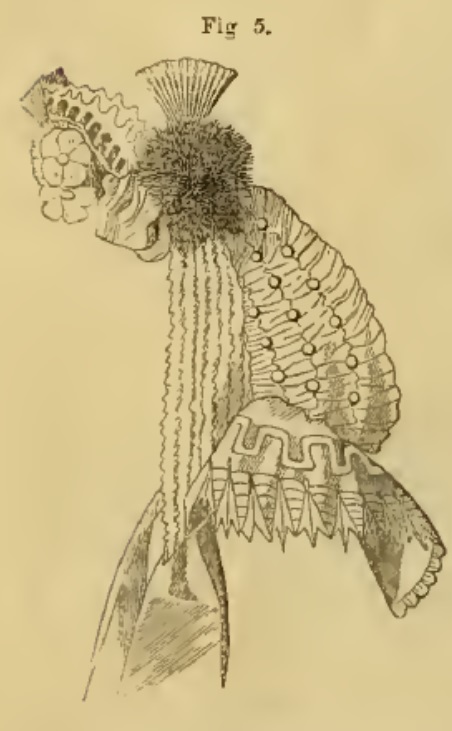
                         Fig. 5 is a dress bonnet, composed entirely of fullings of white tulle, those on the crown being formed into a species of boullions, divided lengthwise at intervals by small artificial pearls; at the top of front, rather towards the left side, is a group of green leaves, with a tuft of white silk or feathers; the curtain is formed of broad white lace. The strings are of white silk, and the cap is of blonde, trimmed at the top with a group of large white flowers. (Godey’s, August, 1864)

 2

 Fig. 7 is a Leghorn bonnet; the front trimmed with a shaped piece of maize silk, plaited like a fan towards the top; at the top is a plume of maize ostrich feathers. Strings of maize silk, and blonde cap with a few roses and rose-buds. (Godey’s, August, 1864)

 3

A Year in Millinery Fashion – 1864

Fig. 2 is a bonnet of white chip, with loose crown of spotted tulle; all round the upper edge of crown is a band of plaid ribbon, and on the top part of crown is a half diamond of tulle, edged with a plaid ribbon, and a chenille fringe to match the plaid. The curtain is of white lace, and has in the centre a small square of plaid ribbon, edged at the bottom and sides by chenille fringe. The strings are of white silk, and the cap is of blonde or tulle, and is trimmed with roses, rose-buds, and bluets. (Godey’s, August, 1864)

 2

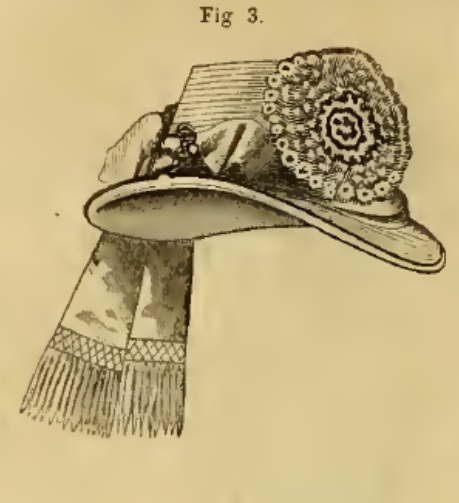
                          Fig. 3 is a Monsqueraire hat of Leghorn or white straw. Round the hat is a scarf of blue ribbon, with a large bow and long fringed ends at the back; in front is a rosette of black and white speckled feathers, surrounded by an edging of blue flowers or bluets. The brim is edged with black velvet. (Godey’s, August, 1864)

1

Published in: on August 11, 2014 at 1:01 am  Comments (1)  
Tags: