Understanding the Ribbon Bavolet

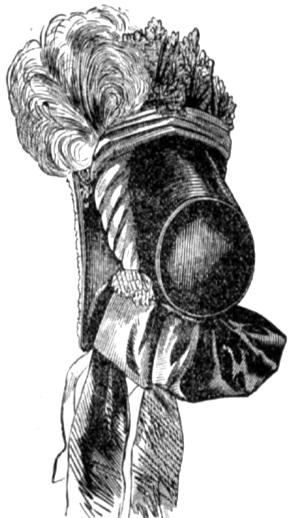
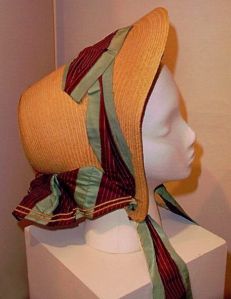
Straw bonnet from the Greene Collection at the Genesee Country Village

Straw bonnet from the Greene Collection at the Genesee Country Village

~~~This is one of the many wonderful bonnets found in the Susan Greene Collection at the Genesee Country Village. (To see some of their ribbons, be sure to hop over to the Millinery Ribbon Blog.)   ~~~ This straw bonnet shows a great many things from the over-all spoon bonnet shape to the shape of the cheektabs to the fineness of the straw. I would like us to look at the bavolet today. We also know the bavolet as the “curtain.”  The bavolet is a fabric or ribbon pleated into the back neckline edge of a bonnet. This can resemble a flounce in that the top is drawn in while the lower edge floats or flares out. The bavolet can, but does not need to be a single material as we see here. It can be made of layers of silk, net and lace. Some high-end fashion plates show beading as well. (Honestly, I don’t think I could handle beads dangling on my neck.)


~~~The construction seams on the underside are covered by a net. Net is used to give the silk bavolet more body and fullness. It is sewn so the net is not seen from the outside and pleated into the bavolet.  The bavolet reaches all the way around the back of the bonnet (the tip) and up along the sides while the lower edge connects to the cheektabs.

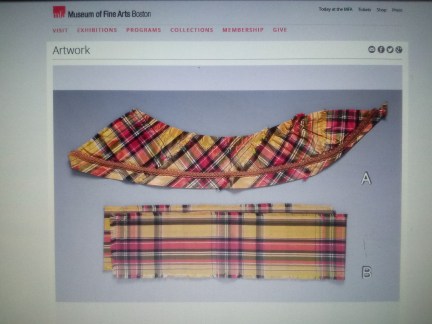
*The section of ribbon that decorates the exterior of the bonnet can be on the grain or on the bias. The ties need to be on the grain. To see a nice example of the ribbon decorating over the top of the bonnet, see this MFA example that happens to have the bavolet on the grain. Notice how the bavolet flops more than floats.
20190312_081424.jpg


Published in: on February 28, 2014 at 3:26 pm  Comments (2)  

A Year in Millinery Fashion – 1864

Bonnets by no means follow the outline of the face, byt are simply lower in front than those which have been so perseveringly worn during the last two years. The sides of the bonnet
are very narrow, being almost close to the cheeks; so little space is left that there is only sufficient for one quilling of blonde at each side, or, if a colored crepe cap is adopted, for one narrow row of box, pleating. In some instances, the front is made very wide at the top, so as to allow a superabundance of trimming in the inside; but the more oval form appears to be
generally preferred. (Peterson’s, February, 1864)

Published in: on February 24, 2014 at 1:02 am  Leave a Comment  
Tags:

A Year in Millinery Fashion – 1864

A French Hat of Black
Velvet, from Mrs. Cripps, 912 Canal street, New York. The velvet is laid plain
on the foundation. Directly across the front on the top, is white illusion,
covered by a fullness of black thread lace, which droops slightly over the
front. From the inside on the right, over the joining of the velvet and lace to
the left where it extends down the side, in a roll, to the cape. On the scarlet
velvet, at the top of the cape, is a flower made of black thread lace, and one
to correspond on the folds at the top of the hat. They are something entirely
new. From under the velvet, on the left side, starts a white ostrich feather,
which falls over the front. The inside has full white blonde ruche on either
side; at the top are folds of scarlet velvet and white illusion intermingled;
on the right is a bow of white illusion, in the center of which is a bunch of
white velvet jasmines, with leaves and buds. Rich black strings.  (Peterson’s, February, 1864)

1

Published in: on February 17, 2014 at 1:00 am  Leave a Comment  
Tags:

A Year in Millinery Fashion – 1864

The latest Paris creation we have heard of, is a bonnet with fancy net attached, in place of a curtain, and so conveniently arranged that the hair can be immediately placed in it, or relieved at will. As the hair is still worn in the waterfall style, we should think this resille, or net bonnet, an admirable contrivance; we have not, however, seen any. We chronicle all the fashions as we get them from the Paris journals, frequently long before they appear in this country.

To amateur milliners we would say that the most fashionable bonnet cape is almost a complete horseshoe, measuring at the back five inches, and at the sides three and a half. This allows for a tiny frill at the top, and two very shallow plaits at the back. We can answer for the set and style of this cape – always the most difficult part of a bonnet to arrange. (Godey’s, February 1864)

Looking Forward to Spring Millinery

work in progress 3

With the past few weeks of frigid cold and oppressive snow, I know a good many of us are looking forward to spring. I certainly am.

During these weeks I’ve been sewing away. I have a sampling of straw millinery pieces to offer you.

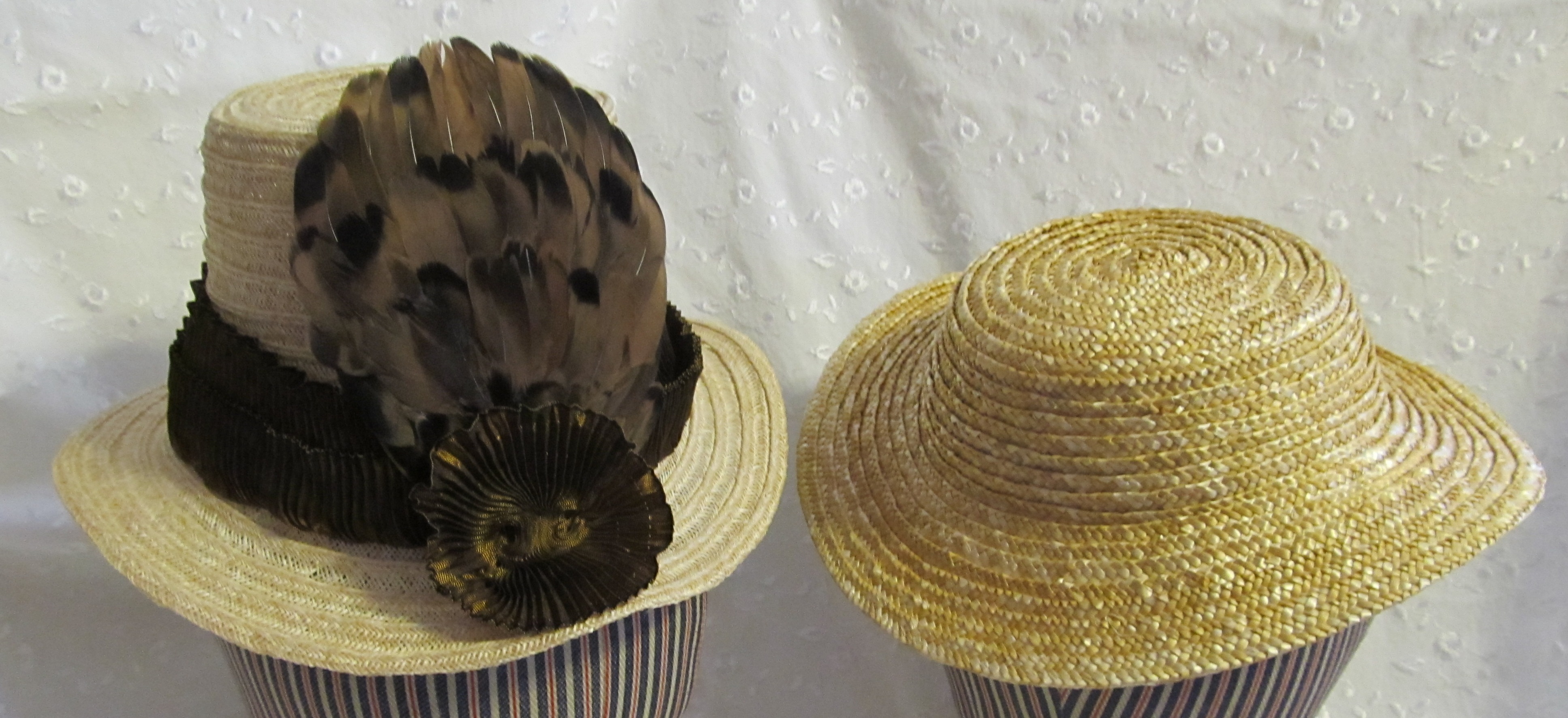
Below, you can see an 1880’s straw bonnet on the right. This little bonnet is one of my favorite later shapes because of the curves the straw does. This bonnet is made from hemp plait. It is ready for you to decorate right now. If someone doesn’t pick it up soon, I’ll pull it down and decorate it. I have some fun ideas for it.

On the left is one of two straw forms suitable for 1859 through 1864. These are whole straw plait, meaning natural straw plaited in whole strands. The one in the photo has a moderately high brim, while the other has a high brim.

In the middle and bottom left is a late 1870s through 1880s hat worked in the hemp plait. It is decorated in a crinkly brown ribbon and an arrangement of feathers. This is my first piece that I hope to step into Steampunk and Whimsy with.

On the bottom right is a fashionable 1860s straw hat for a youth (or young lady with a smaller head). I enjoy this shape quite a bit. It will be fun to decorate and wear.

??????????????????????????????? ???????????????????????????????

This year I plan to work with real straw in a variety of plaits and fineness. I prefer the natural body of the real straw as well as the wonderful smell it has. I have a beautiful fine French plait, a black English plait coming for mourning, an uber-fine, narrow plait for doll pieces and the classic whole straw plait. The four pieces I made this month of the hemp plait is the very last of that plait I have.

Almost forgot. Pricing for the year. 1850s-1864/5 bonnets will start at $85 for whole plait straw. Special plaits or shapes will be higher. Smaller hats for the 60s through 90s will start at $75 depending on how long the shape takes. Special shapes will depend on the time needed and the cost of the plait.

Published in: on February 1, 2014 at 3:50 pm  Comments (4)  

A Year in Millinery Fashion – 1864

Bonnets rather lower in front and less exaggerated in form, than those which were in vogue during the past summer; they are not decidely Marie Stuart, but partake somewhat of that character; the curtains are deep, and in many cases pointed in the center. Plaid ribbons threaten to become common, so great is the furore for them, the large blue and green plaid being even more popular than those composed of brighter, gayer colors. Chenille fringe is very much worn around the brims of bonnets, and velvet flowers and leaves are also extremely fashionable. If feathers are used, they should be of the same shade as the most prominent colors in the plaid, and flowers should likewise follow the same rule. Velvet flowers, with brown grass and heather, have a good effect in the caps of bonnets which are trimmed with plaid. Black felt bonnets look well ornamented with bright plaid velvet ribbons; these are sometimes disposed in straps at the top of the brim, the straps being fastened down with small jet ornamental buttons.

Black bonnets are very generally worn this winter, even by those who are not in mourning; it will be considered quite sufficient to enliven them with a colored flower, to render them suitable for any dress. For example, a black crepe bonnet, embroidered with jet beads, and trimmed with a tuft of barabout feathers, with ostrich introduced at the tips, would require a moss-rose in the cap, and pink strings. If the bonnet is in black velvet, with a fringe of black chenille around the edge of the brim, and chenille ornaments at the side, the cap would be formed with a spray of sky-blue narcissus, wih opaque white beads in their centers, the trings being sky-blue velvet with white edges. Pinke is also very fashionable for bonnets, and we see many made entirely with pink plush, and a tuft of marabout feathers, with ostrich tips placed in the center of the fronts. Pink velvet bonnets, with bouillonnes of white tulle; pink terry bonnets, with bows of white blonde, with rose-buds intermingling, are also general. (Peterson’s, January, 1864)

1 2


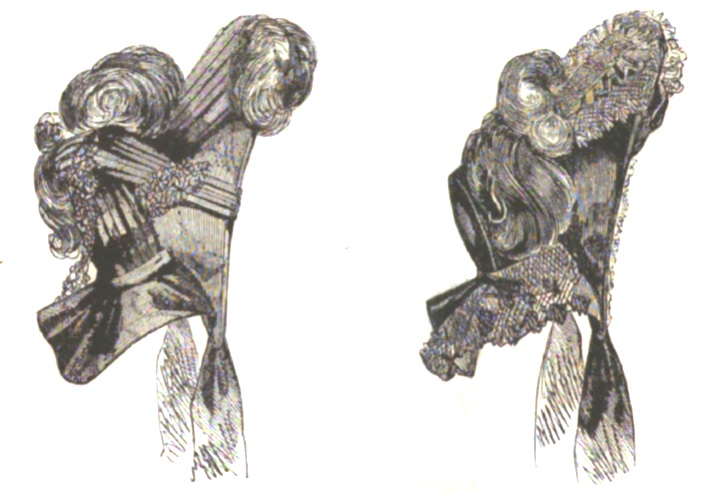
Figs VIII, IX, X, and XI – Velvet and silk Bonnets in various styles, all from the establishment of one of our most fashionable milliners, Mrs. Cripps, New York. (Peterson’s, January, 1864)

A Year in Millinery Fashion – 1864

Black velvet bonnet, trimmed with a fall of black lace and black feathers. The inside trimmings consists of pink roses and blonde. (Godey’s, January, 1864)

1

A Year in Millinery Fashion – 1864

1

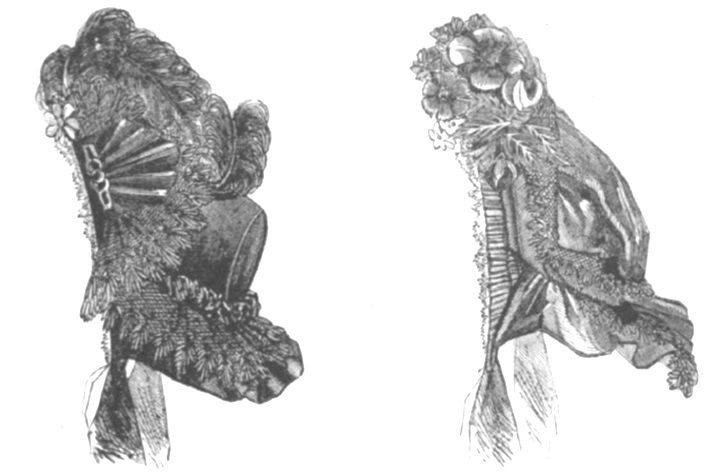
Left– White uncut velvet bonnet, with a falling crown of purple velvet, and trimmed with fern leaves.

Right  – Bonnet of white silk, trimmed with lace and crimson carnations (Godey’s, January, 1864)

Beginning the year, we already see the trend of using trim to add height to the bonnets at the tip of the brim. In the image on the left we see not only height, but a projection forward as well. This projection of the “spoon” as we often call it, has varied in the previous years. In ’64, we will see it move forward, then begin to drop to the top of the head allowing the trims on top to do all the work for height. The fern leaves on this bonnet are part of a movement for leaves and grasses you will see throughout the year. The line of the purple velvet, dropping from atop the crown downward, is also the beginning of this line which will extend from the top of the high top brim, flowing down to beyond where we have previously seen the bavolet. Note in the bonnet on the right, we still have a bavolet, in this case in a lace, topped with carnations.

A Year in Millinery Fashion – 1864

“It is said that, as regards to invention, one milliner does more in a month than the world architects in a score of years”

Each Monday in 2014 will be focused on the millinery fashion of 1864. Drawing from fashion descriptions and illustrations, we will look at how the bonnet evolves during the year, the materials used to trim them and the popular colors and combinations. The year starts out light as the magazines did as well. As late spring and summer approaches, the posts will contain multiple illustrations and descriptions.

I hope these posts will prompt some discussion of the finer points of millinery during 1864. This is a year where bonnets significantly change.

Published in: on January 6, 2014 at 1:01 am  Comments (1)  
Tags:

Mini-Millinery Success!

This stems from yesterday’s post. Doll size straw plait bonnet take #2 fits Jo’s head and hair just right. I look forward to decorating her bonnet. I’ll be making Mae’s next. Working with her wide hair while getting a 50 shape will be an interesting challenge.

image

image

image