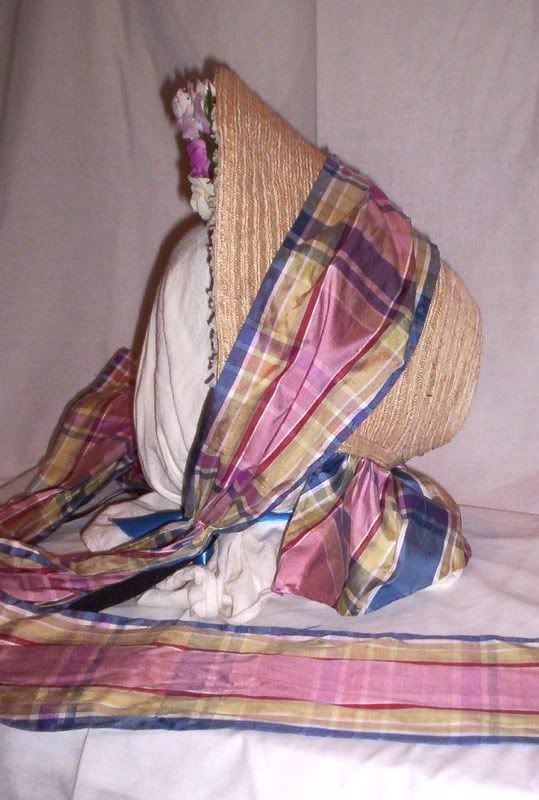
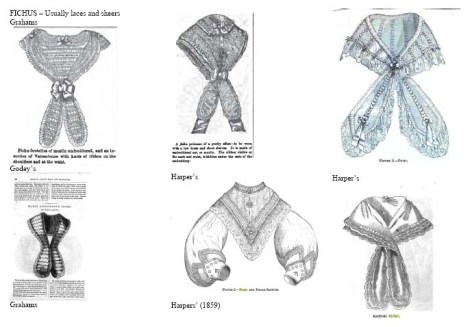
Frilly Fru-Fru – Fichus, Pelerines, Berthas, etc

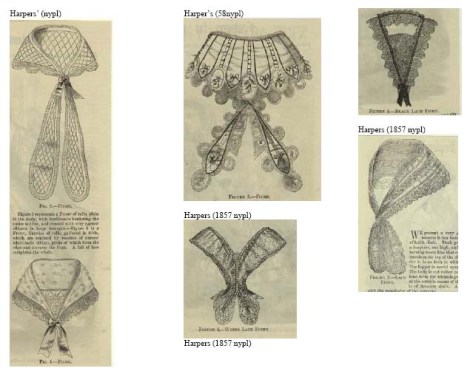
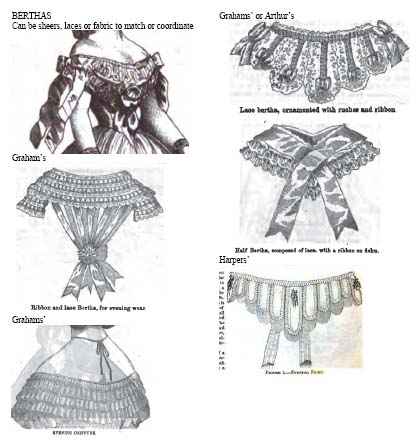
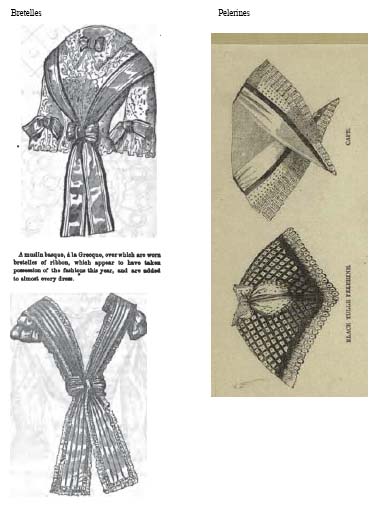
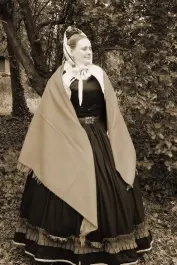
There just simply isn’t enough frilly fru-fru out there in the reenacting world. I am referring to the neglect of those pretty accessories women wore during the mid-century such as fichus, bertha, pelerines and also headwear like caps.


Anna Allen has a lovely example of a fichu taken from a Godey’s illustration and directions

http://www.thegracefullady.com/civilwargowns/accessories_fichuri.htm This is another example of her’s http://www.thegracefullady.com/civilwargowns/ready-mades_netfichu.htm This fichu is very easy to make and fun to wear. [pictures of mine to come as soon as I get new camera batteries.]


Here http://thesewingacademy.org/index.php?topic=3226.msg55443#msg55443 Colleen Formby has a great example of a mantle based on an original.


untitled-1untitled-2untitled-3untitled-4 


The MET has several fichus, berthas, etc in their collection. Here are a couple examples:

 White cotton lace http://www.metmuseum.org/works_of_art/collection_database/all/fichu/objectview_enlarge.aspx?page=2&sort=0&sortdir=asc&keyword=fichu&fp=1&dd1=0&dd2=0&vw=1&collID=0&OID=80052043&vT=1


Mid-century lace

http://www.metmuseum.org/works_of_art/collection_database/all/fichu/objectview.aspx?page=5&sort=0&sortdir=asc&keyword=fichu&fp=1&dd1=0&dd2=0&vw=1&collID=0&OID=80052412&vT=1

British silk

http://www.metmuseum.org/works_of_art/collection_database/all/collar_bertha/objectview.aspx?page=4&sort=0&sortdir=asc&keyword=bertha&fp=1&dd1=0&dd2=0&vw=1&collID=0&OID=80052173&vT=1

French silk lace http://www.metmuseum.org/works_of_art/collection_database/all/cape_pelerine/objectview.aspx?page=2&sort=0&sortdir=asc&keyword=Pelerine&fp=1&dd1=0&dd2=0&vw=1&collID=0&OID=80052118&vT=1

Published in: on March 11, 2009 at 11:33 am  Leave a Comment  

Bonnet Stories – Straw Evolution

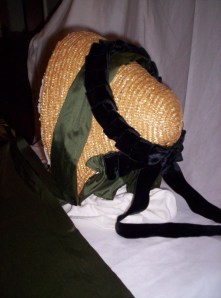
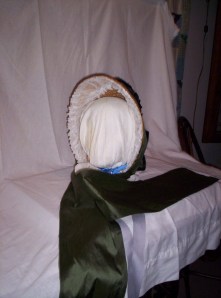
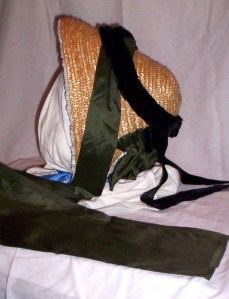
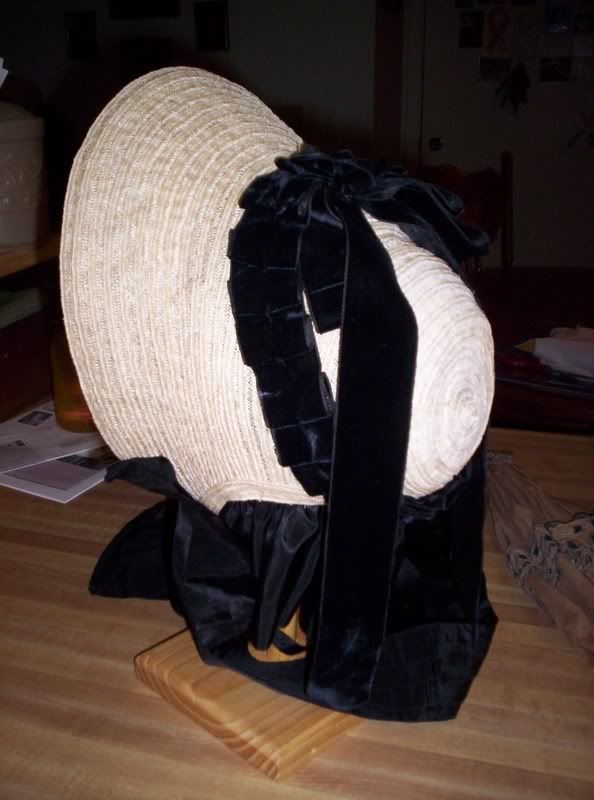
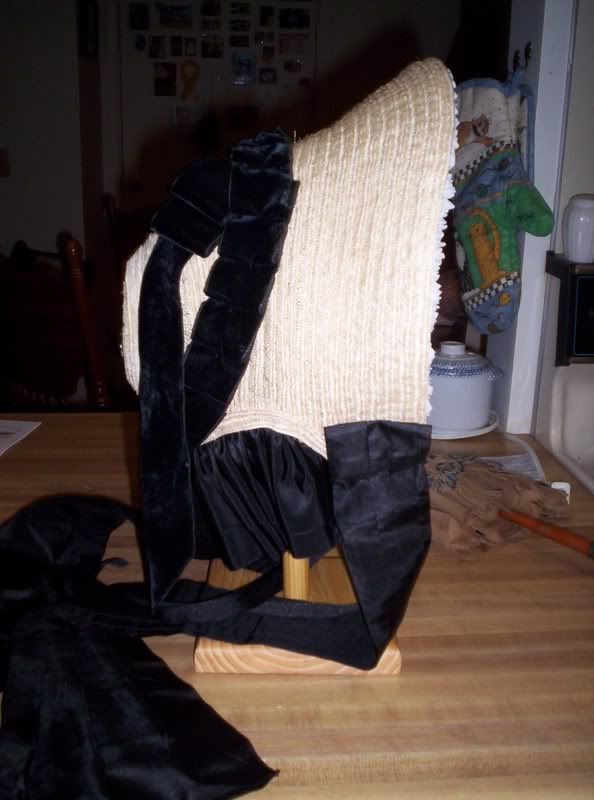
I was working on this straw before Dad passed away last spring. It was originally getting trimmed in green as seen here.

101_0694101_06959

It was then transformed into my second mourning bonnet for the 2008 season.

Pictures to come

This year, it will get changed again…

Pictures to come

Published in: on March 10, 2009 at 1:38 pm  Leave a Comment  

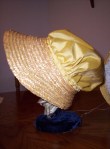
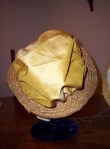
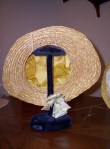
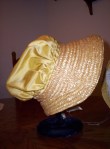
Bonnet Stories – Ginger Caned Bonnet and Regency Bonnet

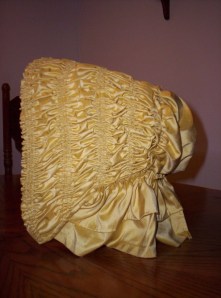
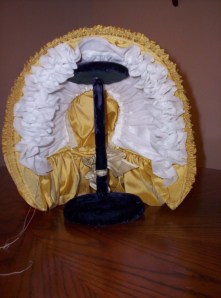
This was my first experience with making a caned bonnet and making a Regency era bonnet. Since it was a new millinery project for me, I decided to reuse material. These bonnets used to be the dress I wore to my brother’s wedding a few years back. I just loved this ginger silk and had to make it into something I would use more often.

The caned bonnet was one I worked on with Bevin as she did her first caned bonnet. We used her buckram pattern for the base. The cane is the smallest cane I could order from Frank’s Cane and Rush Supply. (Excellent service by the way.) My can is sandwiched between layers set in groups to define the difference between the caned and loose areas. Overall I thought this was an easy, fun project. I liked the caned look so much I started a white sheer caned bonnet (to be posted sometime.) I want to find the right flowers and ribbons for this. I am leaning towards burgundies, rusts, or deep greens. Purples might be an option too.

 Ginger bonnet 1Ginger bonnet front

The Regency bonnet came about after a conversation with Pam. While I hadn’t had any Regency clothing at the time of making the bonnet, I just needed to see how it would go together.  

7685

Published in: on March 10, 2009 at 1:31 pm  Leave a Comment  

Website to Blog Transition

I’ve discovered the visitation to this blog is much more frequent and consistent than my website. Between this and finding I can put pdf files up easily here, I plan to put more materials here. In the meantime, I thought it would be helpful to link back what is already on the website.

Information for From Field to Fashion: Straw Bonnets is available on the website.

To Net or not to Net is fairly popular, discussing hairnets of the mid-century. http://www.geocities.com/shadowofthesundial/netarticle.html

The original shawl article is available on the website at http://www.geocities.com/shadowofthesundial/earlyvictorianshawls.html. The E-book Early Victorian Shawls is available here https://annaworden.wordpress.com/2009/01/22/straw-bonnet-work-book-early-victorian-shawls/

I have a series resources in PDF format available here http://www.geocities.com/shadowofthesundial/list.html  including: Anatomy of a Dress – The basic structure of a mid-century dress.

Anatomy of a Bonnet – The basic structure of a mid-century bonnet.

Fringing shawls – A guide to fringing a wool fabric shawl.

Making Bonnet Ribbons – A guide to making bonnet ribbons from fabric or narrower ribbons.

Event Prep Cheat Sheet- A helpful sheet to help you have the basics for an event.

Introductions- Hints on how to give basic introductions.

Swatch cards template- A template for swatch cards

Transcription of ”Home” by Fergurson and Transcription of “Politeness” by Fergurson

Books and Paper- Information on the sizes of paper and books.

Flowers from Godey’s- These are directions for making various flowers from Godey’s I plan to eventually make. I’ll be adding more directions as I am able to scan more originals and as I attempt each flower.

Packing and Storing Small storage containers for packing and storing small items.

Tents and Camping –

Soldiers’ Aide – Acquisition and Distribution Chart –

Creature Comforts, those things that make life more comfortable at events.

Dining and Entertaining

Keeping your hands busy Needlework ideas for at events

Money and Measures

I am planning on updating and moving over all the Social Movements reading lists from the Social Movement Series in the Citizen’s Companion. For right now, those lists are here. http://www.geocities.com/shadowofthesundial/social.html  

I hope this makes accessing things easier for everyone. Thanks for visiting.

Published in: on March 3, 2009 at 1:33 pm  Leave a Comment  

Shopping For Millinery

This was originally printed in full in The Citizen’s Companion.


Modern, 21st century fashion doesn’t give us many opportunities to wear fun hats very often. That makes wearing bonnets and hats in from the 19th century much more fun. Most of us enjoy, some do stress, looking for bonnets or hats. The goal each time? Finding an authentic bonnet or hat that fit within the person’s budget, needs and skills.

There really is a wide range of options for headwear out there to fit just about everyone’s needs. Here is a general outline of millinery options to match with your time, skills and budget.

Custom Made Bonnets

One route is to have a custom made bonnet designed for you. This method requires no sewing skill from you at all. Your level of creativity is flexible as is your own research level. The milliner can choose with you the right shape for the years or seasons of your portrayal while considering the shape of your face

“Every one finds that one shape suits her better than another. The next point in making a bonnet is that the “artiste” should have a light hand, and should make it “off-hand,” without letting it lie about to get soiled or tumbled. Things which are not expensive, but are made of common materials, should look fresh. If they have that merit, no one will examine them very closely to see whether the lace is real, or the flowers of the first quality. Satisfied with the general effect and style, no inquiries will be instituted into the cost of the materials. People are not so particular where their eye is pleased. On the contrary, where the effect is good, cheapness increases its value in the estimation of those who know that one and one make two.”(Routledge’s Manual of Etiquette Routledge, George. Published London 186? http://www.gutenberg.org/etext/12426 )

She or he can then select the fabrics, ribbons, trims, and other embellishments that will best compliment your attire in a period method. This route can be one of the more costly depending on the type of bonnet selected, the amount of work and the materials used. Custom buckram/silk or straw bonnets start around $ 120 to $180 and go up; hoods range from $50 to 170 depending on materials and design. A custom bonnet, hat or hood could take weeks or even months to complete based on your milliner’s schedule. Plan accordingly.

The milliner you choose for your custom bonnet should be knowledgeable of period construction, shapes, fashion, and socio-economic influences on an impression. Talk or meet with her/him before hand; ask about their research and to see examples of their work. Be sure to discuss the impression or scenario you need the bonnet for, including the background of your character, the situation and what you will wear.

Millinery Off the Rack or Via the Internet

Buying a bonnet, hat or hood off the rack of via the internet has many advantages. The purchase is instant with no wait for construction of embellishment. If shopping in person, you can try the piece on to see how the shape suits you and your dress. You can also inspect the construction, method of attaching trim, etc. – Were the ribbons sewn on with cotton or silk thread? Was the straw plait sewn with cotton or linen thread not nylon? Are the flowers paper, silk, dried, fabric or plastic? Are the flowers pinned or sewn on rather than glued? How is the shape of the cheek tabs? Are there functional ties as well as decorative? If the milliner is present you can also ask questions – Was this piece based on an original, a photo, a fashion description? What kind of buckram was used? Is the milliner willing to make alterations/changes for you?

This route doesn’t require you to know how to sew or construct a bonnet. I do suggest you have a general knowledge of period shapes and materials. Take some time before shopping to look at original piece that fit your impression taking note of the shape and material. Bring some of your favorites with you. Do be aware of impulse purchases.  You may end up with a bonnet you love that doesn’t go with your wardrobe or impression. Off the rack bonnets range from $90 to $200; straw bonnets$100 to $180; hoods $50 to $120; hats $70 to $150; sunbonnets $30 to $80.

We now move to options that require some sewing skills as well as knowledge of period millinery.

Finishing a purchased base

You can purchase a buckram or straw bonnet base or straw hat to finish and embellish on your own. This requires basic to moderate sewing skills. You start with a base that is accurate in shape, materials and construction. For a buckram bonnet you will need to cover the base with your desired fabric. Some milliners will provide directions for this. For buckram and straw bonnets you will need to line the interior as desired, add interior ruching or a cap, a curtain, functional ties, decorative ribbons, and embellishments. (See the section on making your own bonnet for material considerations.) A buckram base costs between $30 to $60; Straw bonnet bases $40 to $80; hats $35 to $60. Some milliners offer bases which are partly finished including the lining and cap.

Taking a class

One of the most enjoyable routes is to take a bonnet making class. Knowledgeable instructors are available to teach sessions on making just about every piece of headwear – buckram bonnets, straw bonnets, quilted hoods, corded bonnets, slat straw bonnets and hoods. You can find a class in a travelable distance. You can also arrange for an instructor to come to you to do a session for your local civilians. Depending on the type of headwear, sessions vary from an afternoon to a weekend or several consecutive evenings. Costs also vary according to the project, what materials are supplied, and where the instructor is coming from. Buckram and straw bonnet classes run $75 to $150; hoods and sunbonnets $50 to $110.

Most projects require basic to intermediate sewing skills. The great advantages to taking a class to make your bonnet or hood is the wealth of knowledge that comes with your instructor as well as the hands-on guidance through each step. An additional advantage is the camaraderie that develops with other participants during the class.

Making your own bonnet

If you are comfortable with your sewing skills, making your bonnet on your own is an option. You can choose to purchase a kit, purchase a pattern or follow period directions. Before beginning your bonnet or hood, even before making any purchases you must research. You will need to read up on period construction, materials and fashion. I recommend looking at original examples.

 Buckram bonnet kits cost $25-$45; straw bonnet kits $20-$35; buckram bonnet patterns $15-$20; hood patterns $10-$20; sunbonnet patterns $8-$16 . There really isn’t a pattern for a straw bonnet because they were originally sewn row by row in the round. There are some directions available though. (contact the author for these.)

Each type of headwear requires different materials. This greatly varies the total cost of the bonnet or hood chosen. For a buckram bonnet you will need buckram, milliners wire, cotton for under lining the silk, cotton or silk for lining the inside, silk or wool to cover the bonnet and make the curtain, 1”ribbon for functional ties, 2-3 yards of wide silk ribbon for decorative ties, white cotton or silk net or sheer for interior ruching/cap and additional ribbon, flowers, feathers, etc. for trim. For a straw bonnet you will need 17 yards of ½” wide straw plait (more yardage is needed for narrower plait), milliner wire, watered down glue for sizing/stiffening, cotton or silk to line the inside, net cotton or silk for ruching, 3 yards of 4” to 6” wide ribbon or ½ yard silk for decorative ribbon and the curtain, 1 yard of 1” ribbon for functional ties and additional ribbon, flowers, feathers, etc. for trim. For a quilted hood you will need 1 to 2 yards of wool or silk depending on the fabric design and the type of hood, 1 yard of lining silk or cotton, cotton or wool batting, 1 yard of 1” ribbon and 1-2 yards of decorative ribbons. You may also want a fur trimming. For a sun bonnet you will need about a yard of cotton, silk or wool, ½ yard of corresponding lining fabric, cardboard for slats or cords for cording, and ribbon or fabric for ties.

Closing

            As you can see, there are many millinery options to choose from. If you have time through the off season and want to network, find a class. It is a great way to make new friends. If you think you are likely to get snowed in over the winter or would enjoy some quiet evenings after the kids have gone to sleep, pick up the materials to make your own bonnet to have on hand when the opportunity arises. If you haven’t a moment to spare, tuck away some pictures of bonnets you enjoy so you can order or pick out the right bonnet for you. Choose the option that best fits your needs while striving for the most accurate piece of headwear.


Published in: on February 23, 2009 at 8:43 am  Leave a Comment  

Pattern Review – Period Impressions’ Straw Bonnet Pattern

About two or three years back I did this review of Period Impressions’ Straw Bonnet Pattern for some folks on the SA. I am putting it here for easy access.

Initial observations regarding the materials and directions:

– The pattern is drawn for a low and high brim bonnet with a separate tip.

– The materials list includes additional items you will need to purchase – covered wire, thread, Fray Check and glue. Depending on where you purchase these, the cost will be $5-12 for these. 

– The straw plait is extra fine. It is very pretty. I like how the plait can be manipulated. On the brim and body of the bonnet, this plait easily adjusts for tension and width. The plait doesn’t need to be dampened for the body and brim. It does help for the crown coiling.

On a closer look at the plait, I am not sure if this is a period correct plaiting technique or straw splitting technique. Straw splitters make the strands flat to be braided individually or in pairs. The plait is very pretty in design that is fine. The cotton cording on either end is not something I have seen before.

There are some definite advantages to the flexibility of the plait. This is especially true when making the center of the point. But, since it is so fine and fiddly, it could be harder for a first-timer to work with. It would be easier for some one to make the bonnet from plain split straw of the same width. For this reason, I would suggest the buyer to purchase 18 to 20 yards of 1/2″ 5 or 7 strand split straw to use instead. This is more plait than provided by the kit because the amount provided in the kit is barely enough not allowing for error or flaws in the plait.

 – I didn’t understand why Fray Check was included in the materials list at first because the plait I have worked with before didn’t fray. As I worked with the plait, I discovered it does fray at the ends. I would rather see the ends stitched together then Fray Check used.

– I like that they suggest dyeing the straw before hand if desired.
– The glue solution works well for a sizing on both the included plait and plain plait.

Notes on bonnet construction:
– The suggested method of gathering the plait on one side with a running stitch for the crown is nice. The gathering may not work on plain plait. At the same time, I find it easier to coil the crown creating body with plain plait than this plait. This plait is very floppy.

 – The directions at row 7 are different than what I do in that area. I start creating height in the brim further back in the crown. I don’t see directions to do this. In the area around row 7 from the front, I would normally pull the sides back a little while pushing the cheek tab forward a little. This usually takes place over 2 to 5 rows.

– It would be helpful for the transitional points to be marked on the pattern; where row 7 should land, where row 16 should land, etc.
– I don’t like how the cheektabs are shaped. They appear to square. (Admittedly, squared cheek tabs were one of my early mistakes.) There should be a graceful curve along the sides of the crown down into the cheektabs. You will want to look at original bonnets to see how the line should change to more of a curve.

– In the final two illustrations and directions, the “fall” doesn’t look to be right. It should reach further along the sides than illustrated. Look at original bonnets to see where the curtain and ties should be positioned.

– I kept pinning the template closed after each row to see how the plait sat. When I work in the round from back to front, I adjust the tension of the plait a good deal. This doesn’t work the same on the template working flat. The back side of each row of plait appeared looser than I would have liked. I started pulling the top/middle of each row a bit tighter.

– I ran a gathering stitch around the back of the body before attaching the back of the crown. This technique gives a nice transition between the two pieces.

– I ran out of plait after binding the raw edges. I would need about 20 inches more to have enough to cover the wire.

– Last but quite significant – When it came to ripping out the interfacing…. frustrated is a gentle word for what I felt. The stitches on the backside need to be very small for the interfacing to come off nicely. 

Additional thoughts:
– This bonnet needs wiring at the brim and sides for sure.


– I am a little worried about the glue sizing and the flexibility of the plait combined with high humidity and/or rain. I think this will be a “no rain” bonnet.

Images:
Close up – foggy

http://img.photobucket.com/albums/v95/Deliagodric/Bonnet%20Pictures/101_0078.jpg
prior to sizing:
http://img.photobucket.com/albums/v95/Deliagodric/Bonnet%20Pictures/101_0075.jpg
http://img.photobucket.com/albums/v95/Deliagodric/Bonnet%20Pictures/101_0077.jpg
http://img.photobucket.com/albums/v95/Deliagodric/Bonnet%20Pictures/101_0076.jpg
After sizing and decorating (version 1)

http://img.photobucket.com/albums/v95/Deliagodric/Bonnet%20Pictures/101_0123.jpg

http://img.photobucket.com/albums/v95/Deliagodric/Bonnet%20Pictures/101_0121.jpg

After sizing and decorating (version 2)

http://img.photobucket.com/albums/v95/Deliagodric/Bonnet%20Pictures/101_0688.jpg

Published in: on February 15, 2009 at 1:31 pm  Leave a Comment  

Judith Peeble’s “Jump Start Your Event Season”

If you haven’t already, do check out Mrs. Peeble’s post on the WCC.

http://www.westcoastcampaigner.com/forums/showthread.php?t=1432

She discusses everything from mending and caring for clothes to planting an herb garden to tent, furniture and china care. She has many wonderful tips to share.

Published in: on February 3, 2009 at 12:54 pm  Leave a Comment  

Walk the Walk Program by the Landmark Society

This event is this Friday. It sounds like an absolute must see event. Please check it out.

http://www.landmarksociety.org/events/events.html?CA=8&EID=287

Published in: on February 2, 2009 at 1:38 pm  Leave a Comment  

Groundhog’s Day…. how long until Spring???

I don’t know how many of you are as anxious for spring as I am. While I think snow can create the most beautiful landscapes, I find driving in it quite tiresome. I also find, on mornings like this morning, sliding on ice a bit nerve racking. (I’m so glad I’ve been exercising because I would have landed right on the ground otherwise.) Given that today is Groundhogs Day, I feel a little better that spring will actually be here eventually.

            The earliest reference to Groundhog’s Day that shows up on Google Books is in 1893. Other days landing in the February 2nd vicinity show up more often including Candlemas, Imbolc, and Purification Day. In the 1832 and 1841 almanac The Year Book of Daily Recreation and Information by William Hone describes the February 2nd holiday:

“February 2. Candlemas Day. This day is so called, because it the papal church a mass was celebrated, and candles were consecrated, for the church processions. To denote the custom and the day, a hand holding a torch was marked on the old Danish calendars.”

In John Timbs’ 1861 Something For Everybody :

Candlemas.

The Pagan Romans celebrated their Juno Februata on the day which is the vigil of Candlemas, Feb. 1st; and hence the name of the month February is unquestionably derived. In some of the ancient illuminated calendars, a woman holding a taper in each hand is represented in the month of February.

Candlemas is evidently traceable to the ancient custom of lighting up churches and chapels with candles and lamps, and carrying them in procession. The practice of lighting the churches has been discontinued in England since the second year of Edward VI.; in the Romish Church, the original name, and all its attendant ceremonies, are still retained. Herbert, in his Country Parson, refers to a relic of this practice in the custom of saying “when light is brought in, God sends us the light of Heaven,—and the parson likes this very well. Light is a great blessing, and as great as food, for which we give thanks; and those that think this superstitious, neither know superstition nor themselves.”

The candles for this festival were made in great quantities in Roman Catholic times; the Wax Chandlers’ Company was incorporated as early as 1483; the chandler of old lent out wax-tapers for hire ; and wax was .brought to him to be made into “torches, torchettes, prykettes, or perchers, chaundelle or tapers for women ayenst Candlemas.”

Notwithstanding the Popish character of Candlemas, and its hallowing and conjuring of candles, in 1628 we find a Bishop of Durham, climbing ladders to light up his cathedral with 220 candles and 16 torches; and in 1790, the collegiate church of Ripon, Yorkshire, was, on the Sunday before Candlemas Day, ” one continued blaze of light all the afternoon by an immense number of candles.”

Ray, in his Proverbs, has: “On Candlemas Day, throw candle and candlestick away;” and “Sow or set beans on Candlemas waddle,” i.e., wane of the moon.

Another reason was that the use of lighted tapers, which was observed all winter at vespers and litanies, was then wont to cease till the next Allhallow Mass. Women used to carry candles when they were churched; in the north of England, this is called Wives’ Feast Day. Christmas evergreens were removed, and box substituted in their place, as Herrick thus enjoins, in his Hesperides:—

Down with the Rosemary and Baycs,

Down with the Misleto;
Instead of Holly, now up-raise

The greener Box (for snow).


The Holly Hitherto did sway,

Let Box now domineere

Until the dancing Easter Day

On Easter’s Eve appear.


Then youthful Box, which now hath grace,

Your houses to renew;

Grown old, surrender must his place

Unto the crisped Yew.


When Yew is out, then Birch comes in,

And many flowers beside,

Both of a fresh and fragrant kinne,

To honour Whitsuntide.


Green Rushes, then, and sweetest Bents,

With cooler Oaken boughs,

Come in for comely ornaments,

The re-adorn the house.


Thus times do shift; each thing his turne do’s hold;

New things succeed as former things grow old. “


There are many other descriptions and histories of the available on GB.


We are likely most familiar with the weather forcasting method of watching the groundhog reacting to his or her shadow. These are some of the other predictions that were made at this time of year: (From Something for Everybody mostly relevant to the climate in England I suspect.)


            When the wind’s in the east on Candlemas Day,

            There it will stick till the second of May.


            When Candlemas Day is fine and clear,

            A shepherd would rather see his wife on the bier.


            After Candlemas Day, the frost will be more keen,

            If the sun then shines bright, then before it has been.


            You should on Candlemas Day

            Throw candle and candlestick away.


            On Candlemas Day, if the thorns hang a-drop,

            Then you are sure of a good pea-crop.


In The Borderer’s Table Book published in London, 18__, this look how well winter will hold can be found a set of predictions that make me think I’ll have a long winter in this area (the weather was nice yesterday and is again today.)

On Candlemas-day, throw candle and candlestick away.

                        A windy Christmas and calm Candlemas are signs of a good year.

                        If Candlemas-day be fine, it portends a hard season to come.

            If Candlemas-day be cloudy and lowering, a mild and gentle season.

                        That hind had as life see his wife on the bier,

            As that Candlemas-day be pleasant and clear.

                        If Candlemas-day be fair and bright,

            Winter will have another flight.

                        If Candlemas-day be clouds and rain,

            Winter is gone, and will not come again.

                        When Candlemas-day is come and gone

            The snow lies on a hot stone.

                        February fill dike, be it black or be it white,

            But if it be white, it’s the better to like.

                        Of all the months in the year, curse a fair February.

                        If Candlemas-day be dry and fair,

            The half of winter’s to come and mair.

                        If Candlemas-day be wet and foul,

            The half of winter’s gone at Yule.

                        It Candlemas-day is fair and clear,

            There’ll be two winters in the year

.

For more seasonal proverbs, also see Proverbs of All Nations, London, 1861.
Published in: on February 2, 2009 at 10:54 am  Leave a Comment  

Fan Dance

A recent post on the Sewing Academy brought up one of my pet peeves, the Fan Dance. This dance is popular at many of the north-eastern events. I love cotillions (dance games). But, most of the time I see this dance done, it isn’t done the way it is described in mid-century dance manuals. At events I see it danced in long lines rather than in a circle as described. I’ve seen the dance done in a circle. This format makes it far more fun for all involved.

Below are period versions of the fan dance.

From The Prompter by William DeGarmo (New York, Raymond & Caulon, Printers, 1865.)

“L’ÉVENTAIL–(THE FAN.)

“The first couple perform a Tour de Valse or Galop. The gentleman conductor seats his lady upon a chair in the centre of the room, and brings two gentlemen (one by each hand) in front of the lady, who offers to one of the two her fan, and dances with the other. The gentleman who receives the fan must follow the dancing couple round, fanning them at the same time.”


From American Dancing Master, and Ball-room Prompter by Elias Howe (Boston 1862)

The Fan–L’Eventail. (Waltz, Polka, or Mazourka Step.)

“Three chairs are placed in the middle of the room upon the same line. The two at the ends should be turned contrariwise to that in the centre, as in the figure of the Glass of Champagne. The first couple sets out in waltzing. The gentlemen seats his lady upon the centre chair, and seeks two other gentlemen, whom he places in the two other chairs. The lady offers her fan to one of the gentlemen at her side, and waltzes with the other. The gentleman with the fan must follow the waltzing couple, fanning them and hopping about the circle.”


From The Art of Dancing, by Edward Ferrero (New York, 1859)

“The Fan Three chairs are placed in the centre of the room on a line. The two at the extremities must be turned contrariwise to that in the centre. The first couple leads off in a waltz. The gentleman seats his lady on the centre chair, and gives her a fan; he proceeds to select two other gentlemen, whom he seats on the other two chairs. The lady offers the fan to one of the two gentlemen seated at her side, and waltzes with the other. The gentleman who holds the fan must follow the dancing couple, fanning them, while hopping on one leg.”


From The Drawing-Room Dances by Henri Cellarius (London, 1847)

“The Fan–L’Eventail. (Waltze, polka.)

Three chairs are placed in the middle of the room upon the same line. The two at the ends should be turned contrarywise to that in the centre, as in the figure of the Glass of Champagne. The first couple sets out in waltzing. The gentleman seats his lady upon the centre chair, and seeks two other gentlemen whom he places in the two other chairs. The lady offers her fan to one of the gentlemen at her side, and waltzes with the other. The gentleman with the fan must follow the waltzing couple, fanning them and hopping about the circle.”


Published in: on January 29, 2009 at 10:34 am  Leave a Comment