“How much did a bonnet cost?”

This is one of the hardest questions for me to answer. Why? Because I don’t fully know.

Ideally, I would have a big pool of bills/receipts, an assortment of ledgers from many different milliners, and a few dozen diary entries to create a database of prices based on year, region, area, time of year, type of piece, etc.. Then, I would feel like I had a hint of an answer.

But, I don’t have that. I don’t think anyone has that.

I save every 19th century bill/receipt that comes up for sale. I have even bought a few. I note every diary entry.

I try really really hard not to cry at the auction in front of all those people when a dealer out bids me on the stack of ledgers with a milliner’s ledger in it.

Take a moment.

Yes. It happened. I saw them go out the door.

….

Diary entries like these from Caroline Richards of Canandaigua, NY give us a look at the prices she paid for her millinery:

Wednesday, 1854 – Ann Eliza is going down street with us this afternoon to buy us some new summer bonnets;. They are to be trimmed with blue and white and are to come to five dollars. We are going to Mr Stannard’s store also, to buy us some stockings.

April 12, 1856 — We went down town this morning and bought us some shaker bonnets; to wear to school. They cost $1 apiece and we got some green silk for capes to put on them. We fixed them ourselves and wore them to school and some of the girls liked them and some did not, but it makes no difference to me what they like, for I shall wear mine till it is worn out. …

 Saturday, 1854 – We got our new summer hats; from Mrs Freshour’s millinery and we wore them over to show to Aunt Ann and she said they were the very handsomest bonnets she had seen this year. 

Bills or receipts can show the price of items from particular stores. They can also show the variety of store types as well as methods of keeping track of sales. This bill from 1849 lists several items purchased:
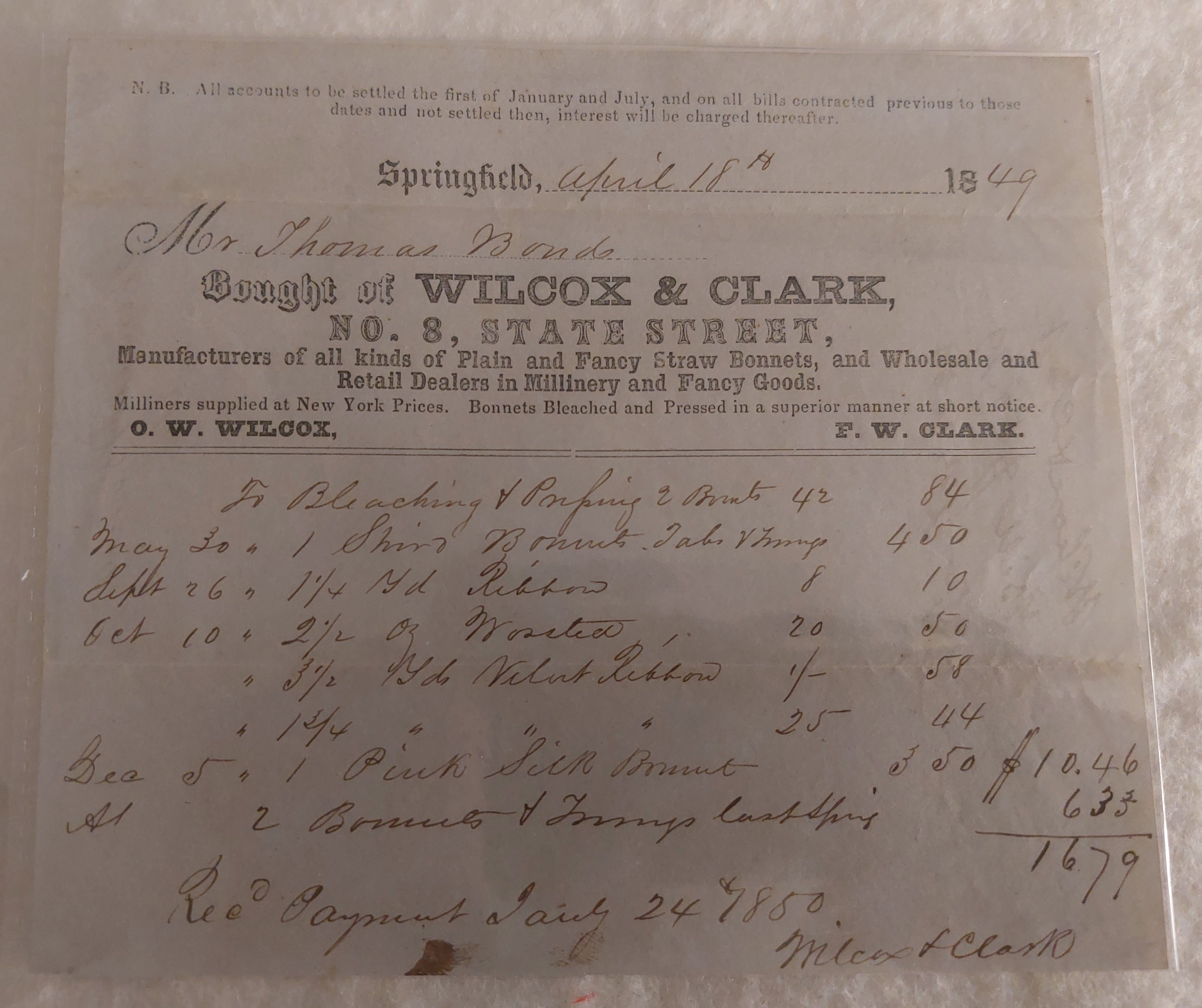
One trimmed bonnet cost $4.50 in May. A pink silk bonnet cost 43.50 in December. Two bonnets and trimmings “last spring” cost $6.35. (This bill also tells us the products and services this shop in Springfield provides, the frequency in which this family of an unknown number of women purchases bonnets, and the delay in payment from “last spring” to April, 1849 for this bill to January, 1850 for the payment.)

If I have to give a price, I can give a window for the mid century of as low as $1 for Shaker bonnets for school to $4.50 for a decorated silk bonnet. But, my answer has holes in that these examples span two different geographic regions and come from two different size cities.

So, the exploration continues…….


Do you enjoy reading my blog? Do you find it helpful? Please consider supporting through Patreon or  Sending a Tip.

Published in: on June 26, 2023 at 12:05 am  Leave a Comment  

“Do You Hand Sew All of It?”

In person, as a visitor watches, the question is usually “Are you hand sewing all of it?” or something about the stitches itself. Online, the question I get is about what kind of machine I am sewing with.

Straw plait millinery was hand sewn up until the invention of the straw sewing machine in the late 1860s. The first straw sewing machine was for sewing the bind edge of a bonnet or hat, not the whole body. The machine for sewing all of the straw came just a short time later. These machines came into common, but not universal use, in the 1870s. I say not universal use because some original pieces from the 1880s still show hand sewing for the construction.

I sew my straw millinery as they did in the nineteenth century up through the mid-century: by hand.

I use little stitches on the outside and long, half inch to inch long stitches on the inside.

To this day, I am still amazed by the visible stitches inside many straw bonnets. Here is an original bonnet I have in my TLC collection. The left photos is outside. The right photo is inside. Notice how you can barely, if at all, see the stitches on the outside, while on the inside the stitches are very visible.

From an artistic or craft standpoint, I find I have far more control over the straw when working by hand. I can adjust the tension, slightly curve, shape, or even fold the straw as I work. This allows me to create the shapes of each style including the height seen in an 1860’s spoon bonnet or the straw bavolet in an 1840s bonnet or the V point of a Regency or late century hat. This straw manipulation is the job of my left hand. So, both hands get tired, often very tired and sore, when I push them. I go through a lot of creams and visit my massage person regularly.


Do you enjoy reading my blog? Do you find it helpful? Please consider supporting through Patreon or  Sending a Tip.

Published in: on June 19, 2023 at 12:05 am  Leave a Comment  

“What is a Cottage Industry?”

A cottage industry at its simplest is product creation in the home.

Product creation in the home, cottage industry, simultaneously provides income for the home, ideally utilizing the resources immediately or locally available, and contributes to the economy of rural and developing areas. When the product created went from the home to a larger manufacturer, as was the case with sewing straw bonnets or hats, this was known as piece work. This is not to say home manufacturing solely occurs in rural or developing areas. Product development can also be done in urban homes, where it is often referred to as home manufacturing instead of cottage industry. In this case, the materials are often provided. Flower making or band-box making would be examples of this.

Straw plaiting and straw sewing as cottage industries in the 19th century were prominent in England and Italy in Europe, and in the New England through New York areas of the United States. (Some areas, such as Luton in England, continued plaiting well into the 20th century.) Straw cottage industry took fibers easily grown in these regions, commonly wheat and rye, and transformed them into money earning product. (more details in From Field to Fashion) The workflow differed between the US and England. In England, straw markets were the norm. Plaiters and sewers exchanged their goods for the best price of the day based on their materials and work. In the US, an industry representative would come to collect finished work in exchange for pay. (I did read a single passage saying a woman could take her work to the local dry goods store with the merchant acting as the industry representative. I need to find additional support for this to be sure of the actuality.) These pieces (bonnets and hats) would then go a factory to be wired and finally sized (blocked and stiffened.) At this point, they were ready to go to straw goods stores and millinery shops.

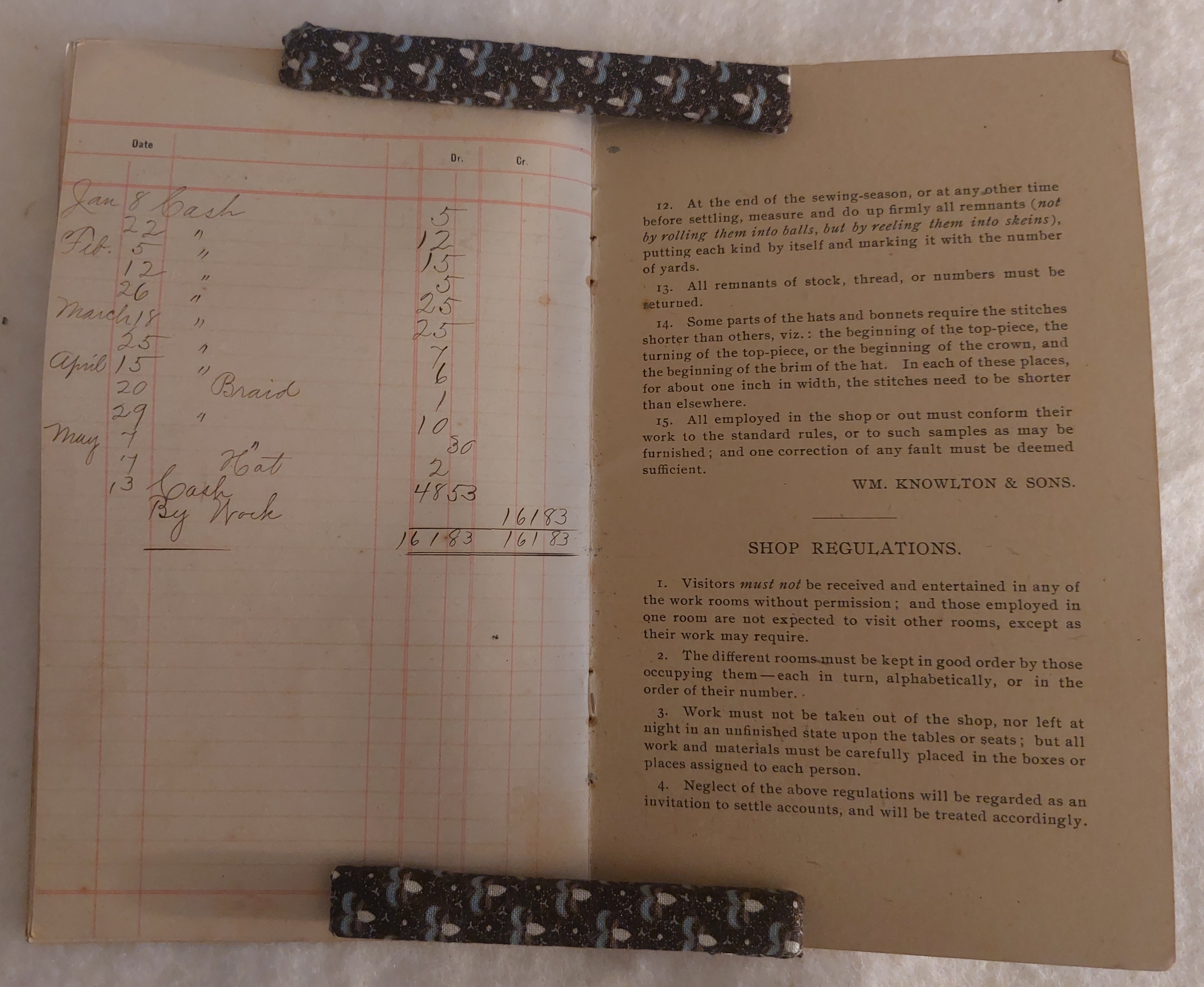
I used to think straw sewing as a cottage industry in the US faded out by the turn of the century. Then, I discovered this log book for tracking straw sewing from 1904. Likely, this sewing was done by machine. This is based on the year and by the number of pieces this person could get done in a month. The booklet gives directions for sewing and shop regulations inside each cover. The pages give space for tracking: Date – Block – Pattern – Goods – Price – Amount


Do you enjoy reading my blog? Do you find it helpful? Please consider supporting through Patreon or  Sending a Tip.

Published in: on June 12, 2023 at 12:05 am  Leave a Comment  

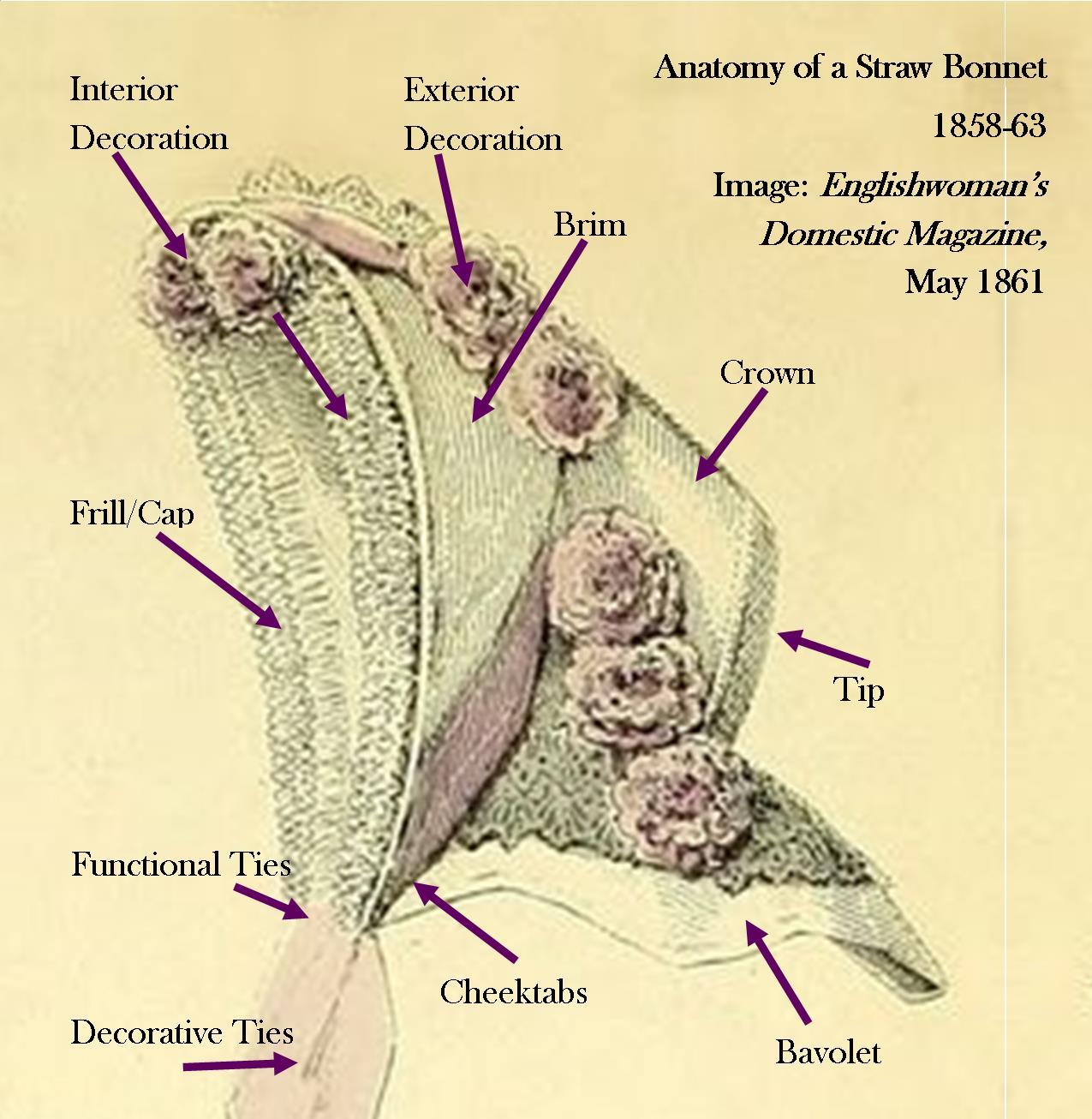
Anatomy of a Straw Bonnet

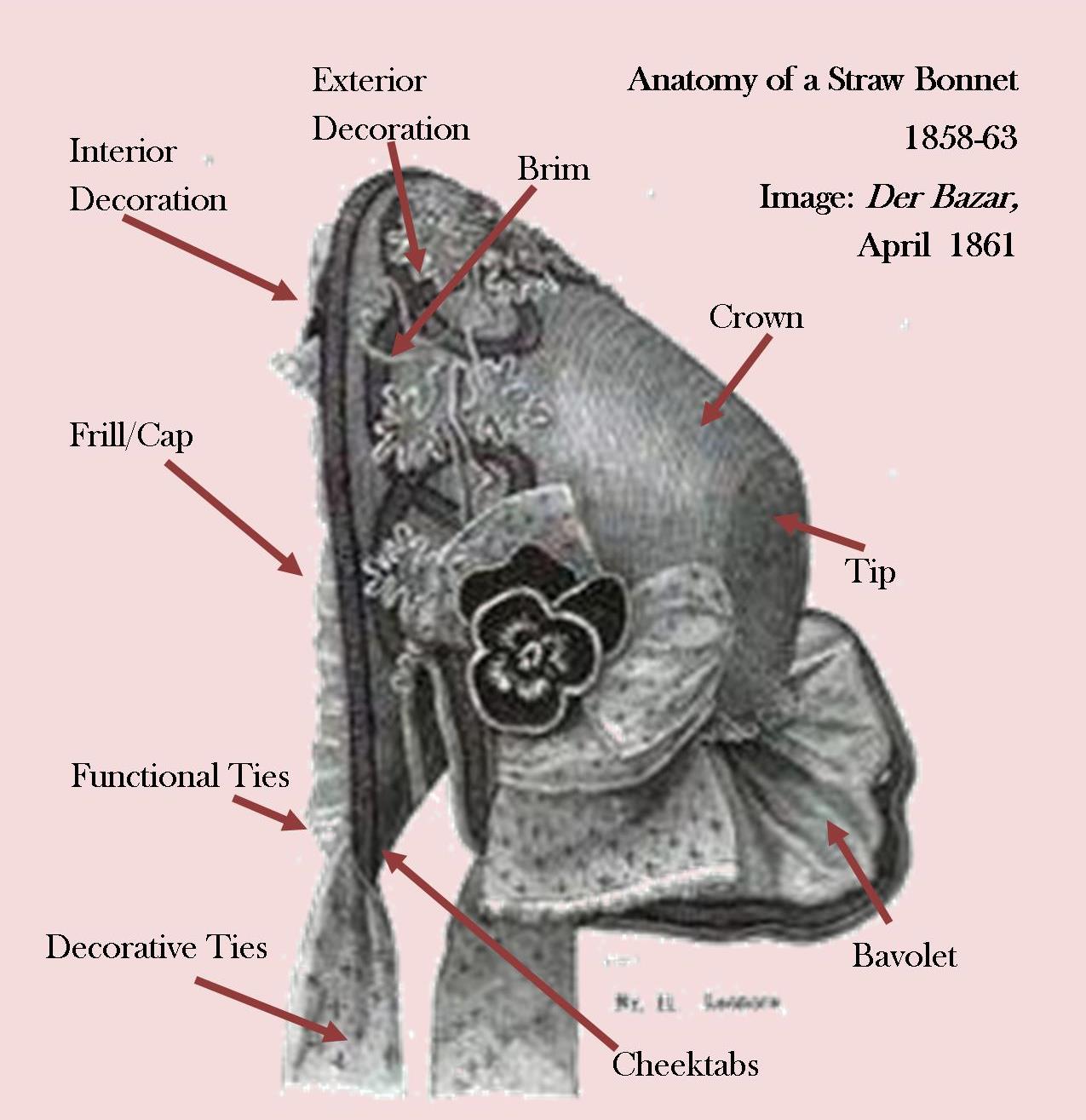
Each of these points are general for fashionable bonnets made of straw, primarily straw plait, from approx 1858 through 1863. Finer points adjust with each season’s prevailing fashion.

General Construction – Straw bonnets were sewn by hand in the round. Plaits ranged from 1/8″ split straw to wider whole straw and fancy plaits. Woven straw was also used.

Anatomy 1

Tip – The back section of the crown in the tip. On a straw bonnet this can either be domed, flattened at the back curving to the side of the crown. It should not have a sharp angular transition from the back to the sides.

Crown – The crown of a straw bonnet should create a smooth transition from the crown to the brim. Much of the shaping in the bonnet will be created in this transition area.

Brim – The brim of a straw bonnet will vary according to fashion. The brim’s edge should be a single or double row of straw plait. It should not have raw edges needing to be bound.

Cheek-tabs – The cheek-tabs should have a gentle curve coming from the neck edge of the crown along the side of the bonnet dropping down to roughly your jaw line meeting the brim edge. This is a graceful line, not a straight edge or angular transition. There is a variation in the twist of the cheek-tab from the fifties into the sixties. The cheek-tab is part of what helps hold a bonnet in place.

Binding – The binding on a straw bonnet should be straw plait. Raw edges were covered on the exterior and sometimes the interior along the back of the cheektabs, sides and tip. Multiple rows were used as well.

Lining – A lining is a functional layer of light weight, open-weave cotton covering most of the interior of the bonnet. It aids in keeping the straw from snagging the hair while worn. The lining can not be seen when the bonnet is worn.

Frill/Cap/Ruche –This decorative layer of gathered cotton or silk  covers fills the inside of the brim. This is very fine most often net, lace or organza. The full frill aides in holding the bonnet in place.

Facing – Some bonnets have a facing of silk from the edge of the brim through the first couple inches of the interior brim.

Bavolet/Curtain – The bavolet is attached to the binding edge on a straw bonnet along the sides and crown. This silk piece should be lined with net to give it more body. The bavolet may be a single piece of fabric, most often on the bias and occasionally on the grain, or pieced from bias cuts of ribbon. The bavolet may also be decorated.

Functional Ties – The functional ties are attached to the interior of the cheek-tabs or under the decorative ties. These are narrower ribbon to hold the bonnet in place.

Decorative Ties – Decorative ribbons are wide, 3″-8″ based on a wide survey I did years ago. They are on the grain, not bias. Tied, they do not take the support of the bonnet.

Interior Decoration – Interior decoration also helps hold the bonnet in place.

Anatomy 2

Find the earlier video on Bonnet Stays here: https://youtu.be/gcnLtlDGblk

Wearing the Mid-Nineteenth Century Hat

2016-03-16-13.23.13.jpg.jpeg

Wearing nineteenth century clothes, we find they fit differently than our modern clothes. The waist is in a different spot. The bust sits differently. Seams are used to accent or de-accent parts of the body. The fit feels different and moving in the clothes is different. The same is true for hats and bonnets. In previous posts I’ve talked about bonnets and perch. Here, we are going to look at how a hat was worn and how it “fits”.

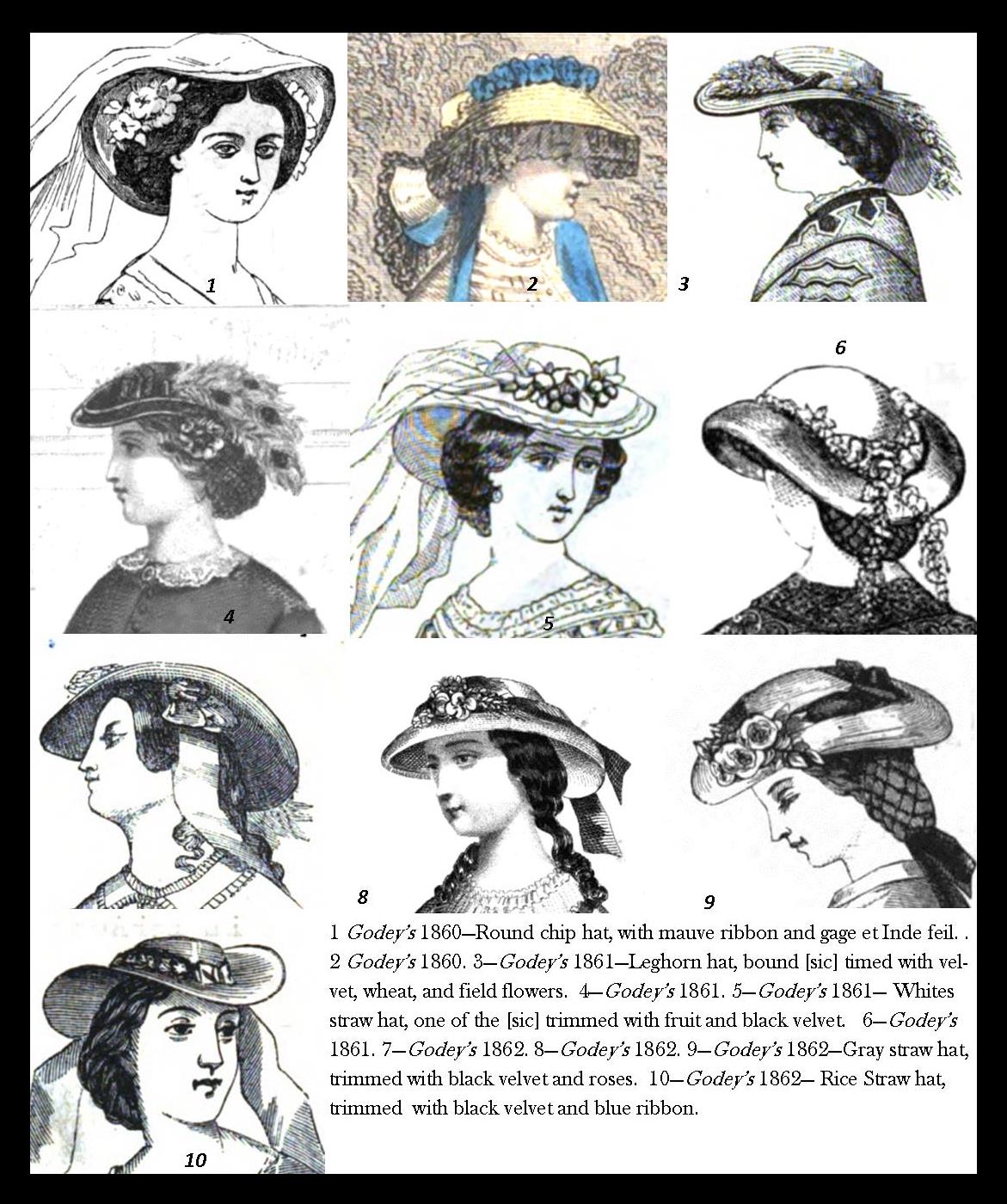
In the 1850s and 1860s, hats were worn much higher on the head than we are accustom to in the twenty-first century. Think about when you wear your modern beach or garden hat. You know that line across your forehead where it sits after a long hot day? You do Not want that. A mid-nineteenth century hat sat higher, at the top of your forehead, at your hair line, or even higher. Take a look at these fashion illustrations from 1860-1862. Notice where each hat sit. In a few illustrations, the front hairline is obviously below the crown line. In others, the crown sits just at this line. The hat sits atop the head, not encompassing it. The curve of the brim is what dips to the eye line, not the hat itself.

examples

What does this mean for you when picking a size?

There are two factors for finding a comfortable fit: Size and shape.

The difference in wear or placement means we measure for a mid-nineteenth century had differently than we do for a twentieth or twenty-first century hat. The modern hat is measured just above the eyebrow. (This is also where many of us measure for bonnets. We want to keep you on your toes.) For mid-nineteenth century, we measure higher, at the hair line. In this illustration, we can see the difference between where the two measurements would be.

measure

These higher, hairline measurements are often smaller than those taken at the eyebrow. A hat worn at this point can be slightly smaller to slightly larger for comfort. So, add and subtract an inch to your hairline measure.

For example: I am 22.5″ around at my eyebrows and 21.5″ at my hairline. The vast land of the internet tells me that the average woman’s head measures 22.5″ to 22 5/8″ around at the modern measuring point. So, I am about average. I comfortably wear a mid-nineteenth century hat that is 19.5″ to 21.5″

General guidelines I use:

  • Small = Less than 21″ at the hairline (crown less than 20″)
  • Average = 21″-22.5″ at the hairline (crown 20-21.5″)
  • Large = Greater than 22.5″ at the hairline (crown greater than 22″)

Just like every head measures a bit differently, they are each shaped a bit differently.

round oval

When looking from above, some people have rounder heads while other have more oval heads. Both of these shapes to the right can have a circumference of 22.5″. Yet, the same hat would fit each head differently.

I will try to indicate which hats have rounder crowns or more oval crowns. I am in the process of naming the crowns. Hopefully, that will help.


My straw hats and bonnets are available in my Etsy shop as I finish them: https://www.etsy.com/shop/AnnaWordenBauersmith

Are you one of the many readers enjoying my millinery blog posts?
Consider becoming a Patreon patron. Doing so helps support my work and helps me write more useful articles.
https://www.patreon.com/AMillinersWhimsy
Published in: on June 1, 2023 at 12:05 am  Leave a Comment