Resources for Life

Women in America; Being an Examination into the Moral and Intellectual Condition of American Female Society, by Mrs. A. J. Graves (New York:1844)

Look round upon the groups of young females who crowd our private parties or public balls; who lounge upon the sofa receiving visits, or throng the city promenades to exhibit their decorated persons or to make morning calls, and how many can you point out among them who have fulfilled one useful purpose of existence to themselves, to their families, or to society? And all this waste of time and energy in the pursuit of folly is in the hope of becoming thereby candidates for matrimony, while by this very means they are seeking to attain. Nor is this all: their efforts defeat the wished for end, inasmuch as the habits of indolence and extravagance in which so many young women are brought up, deter a multitude of young men from becoming husbands, lest they should involve themselves in pecuniary embarrassment; and as wealthy young men are extremely rare, we see marriages in fashionable life every day becoming fewer; thus leaving in our cities a numerous class of finely-dressed, pretty, and accomplished young ladies, doomed to become disappointed “establishment-seekers,” and to fade into fretful and repining “’old maids.” An intelligent, useful woman, who continues in a state of celibacy from choice or from disappointed affection, is an honoured and valuable member of society, but she whose youth has been spent in idleness and folly, and is seeking for a husband in crowded scenes of amusement, becomes a pitiable object – a burden to herself, and the jest and by-word of her acquaintance. (p52-53)

Among the many causes that are tending to deaden in the heart of woman a sense of her appropriate obligations, is the fatal notion that there is something servile in labour. It is, indeed, much to be lamented, that in the praiseworthy effort to redeem herself from the life of slavery and degradation to which past ages doomed her, so many of her sex should have passed to the other extreme – a life of indolence and uselessness Nor is this notion that there is gentility in idleness, confined to females alone: we find it widely and deeply cherished by society at large. Hence we see that the aristocratic titles of “lady” and “gentleman” are by common consent thought to be applicable only to those who hold it beneath their fancied dignity to toil with their hands. The farmer who guides his own plough, and the mechanic who still plies his tools, are thus considered as belonging to a lower caste than the “gentleman” farmer who lives solely upon the toil of his dependant[sic] labourers, or the retired mechanic who has thrown aside his implements, and employs the capital amassed by their use in extensive speculations in lands or stocks. (p25-26)

Published in: on January 30, 2014 at 4:00 pm  Comments (1)  
Tags:

Book Notice: Wearable Prints, 1760-1860

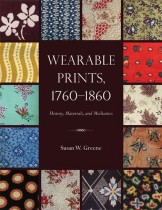
It is here! Well, it isn’t here with me…. yet. So, here are KittyCalash’s thoughts on the arrival of Susan Greene’s book we’ve been waiting for Wearable Prints, 1760-1860.
Remember, the Greene collection is now housed at the Genesee Country Village in Mumford, NY.

Hmmm….. Now, I’m picturing a “Greene” Swap for the Fall. Wouldn’t it be fun to find fabrics similar to those Susan talks about?

Kitty Calash

This just in, literally, from the mail carrier: Susan W. Greene’s long-awaited book,Wearable Prints, 1760-1860. It’s discounted (and out of stock) at Amazon, but should be shipping soon, since I have one right here on my desk.

It’s fair to call this book lavishly illustrated (1600 full-color images in almost 600 pages), and while I have access to a copy at work, I am seriously thinking of buying my own copy, based solely on about 10 minutes skimming the book. There are images not just of fabric samples but also of garments, paper dolls and illustrations that help put the fabrics into context. Images of garments from collections I can’t get into? Delicious! Information to help me understand how to use a printed cotton? Even better.

The book is organized in three main sections: Overview, Colors, and Mechanics. Appendices include timelines, prohibitions, price comparisons, print characteristics, and more…

View original post 186 more words

A Year in Millinery Fashion – 1864

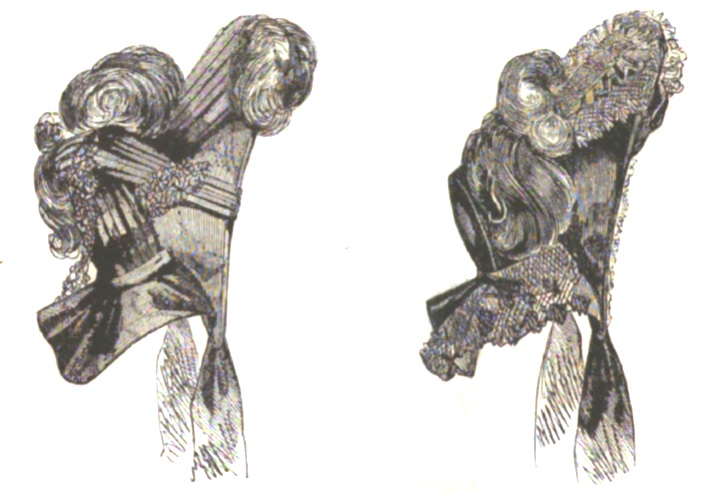
Bonnets rather lower in front and less exaggerated in form, than those which were in vogue during the past summer; they are not decidely Marie Stuart, but partake somewhat of that character; the curtains are deep, and in many cases pointed in the center. Plaid ribbons threaten to become common, so great is the furore for them, the large blue and green plaid being even more popular than those composed of brighter, gayer colors. Chenille fringe is very much worn around the brims of bonnets, and velvet flowers and leaves are also extremely fashionable. If feathers are used, they should be of the same shade as the most prominent colors in the plaid, and flowers should likewise follow the same rule. Velvet flowers, with brown grass and heather, have a good effect in the caps of bonnets which are trimmed with plaid. Black felt bonnets look well ornamented with bright plaid velvet ribbons; these are sometimes disposed in straps at the top of the brim, the straps being fastened down with small jet ornamental buttons.

Black bonnets are very generally worn this winter, even by those who are not in mourning; it will be considered quite sufficient to enliven them with a colored flower, to render them suitable for any dress. For example, a black crepe bonnet, embroidered with jet beads, and trimmed with a tuft of barabout feathers, with ostrich introduced at the tips, would require a moss-rose in the cap, and pink strings. If the bonnet is in black velvet, with a fringe of black chenille around the edge of the brim, and chenille ornaments at the side, the cap would be formed with a spray of sky-blue narcissus, wih opaque white beads in their centers, the trings being sky-blue velvet with white edges. Pinke is also very fashionable for bonnets, and we see many made entirely with pink plush, and a tuft of marabout feathers, with ostrich tips placed in the center of the fronts. Pink velvet bonnets, with bouillonnes of white tulle; pink terry bonnets, with bows of white blonde, with rose-buds intermingling, are also general. (Peterson’s, January, 1864)

1 2


Figs VIII, IX, X, and XI – Velvet and silk Bonnets in various styles, all from the establishment of one of our most fashionable milliners, Mrs. Cripps, New York. (Peterson’s, January, 1864)

Resources for Life – A weekend extra


Dress as a Fine Art, by Mrs. Mary Philadelphia Merrifield (Boston: 1854)

We violate the laws of nature when we seek to repair the ravages of time on our complexions by paint, when we substitute false hair for that which age has thinned or blanched, or conceal the change by dyeing our own gray hair; when we pad our dress to conceal that one shoulder is larger than the other. To do either is not only in bad taste, but is a positive breach of sincerity. It is bad taste, because the means we have resorted to are contrary to the laws of nature. The application of paint to the skin produces an effect so different from the bloom of youth, that it can only deceive an unpracticed eye. It is the same with hair: there is such a want of harmony between false hair and the face which it surrounds, especially when that face bears the marks of age, and the color of the hair denotes youth, that the effect is unpleasing in the extreme. Deception of this kind, therefore, does not answer the end which it had in view; it deceives nobody but the unfortunate perpetrator of would-be deceit. It is about as senseless a proceeding as that of the goose in the story, who, when pursued by the fox, thrust her head into a hedge, and thought that, because she could no longer see the fox, the fox could not see her. But in a moral point of view it is worse than silly; it is adopted with a view to deceive; it is acting a lie to all intents and purposes, and it ought to be held in the same kind of detestation as falsehood with the tongue. Zimmerman has an aphorism which is applicable to this case – “Those who conceal their age do not conceal their folly.” (p12-13)

The immediate objects of dress are twofold – namely, decency and warmth; but so many minor considerations are suffered to influence us in choosing our habiliments, that these primary objects are too frequently kept out of sight. Dress should be not only adapted to the climate, it should be also light in weight, should yield to the movements of the body, and should be easily put on or removed. It should also be adapted to the station in society, and to the age, of the individual. These are the essential conditions, yet in practice how frequently are they overlooked; in fact, how seldom are they observed! Next in importance are general elegance of form, harmony in the arrangement and selection of the colors, and special adaptation in form and color to the person of the individual. To these objects we purpose directing the attention of the reader. (p16)

Had the Bloomer costume, which has obtained so much notoriety, been introduced by a tall and graceful scion of the aristocracy, either of rank or talent, instead of being at first adopted by the middle ranks, it might have met with better success. We have seen that Jenny Lind could introduce a new fashion of wearing the hair, and a new form of hat or bonnet, and Mme. Sontag a cap which bears her name. But it was against all precedent to admit and follow a fashion, let its merits be every so great, that emanated from the stronghold of democracy. We are content to adopt the greatest absurdities in dress when they are brought from Paris, or recommendation by a French name; but American fashions have no chance of success in aristocratic England. It is beginning at the wrong end.


Published in: on January 24, 2014 at 6:06 pm  Leave a Comment  
Tags:

Resources for Life

A TRIFLE.

 A quart of cream.
 A quarter of a pound of loaf sugar, powdered.
  Half a pint of white wine and Half a gill of brandy mixed.
  Eight maccaroons, or more if you choose.
  Four small sponge-cakes or Naples biscuit.
  Two ounces of blanched sweet almonds, pounded in a mortar.
  One ounce of blanched bitter almonds or peach-kernels.
  The juice and grated peel of two lemons.
  A nutmeg, grated.
  A glass of noyau.
  A pint of rich baked custard, made of the yolks of eggs.

 Pound the sweet and bitter almonds to a smooth paste, adding a little rose-water as you pound them.

 Grate the yellow peels of the lemons, and squeeze the juice into a saucer.

 Break the sponge cake and maccaroons into small pieces, mix them with the almonds, and lay them in the bottom of a large glass bowl. Grate a nutmeg over them, and the juice and peel of the lemons. Add the wine and brandy, and let the mixture remain untouched, till the cakes are dissolved in the liquor. Then stir it a little.

 Mix the cream and sugar with a glass of noyau, and beat it with a whisk or rods, till it stands alone.

 As the froth rises, take it off with a spoon, and lay it on a sieve (with a large dish under it) to drain. The cream, that drains into the dish, must be poured back into the pan with the rest, and beaten over again. When the cream is finished, set it in a cool place.

 When the custard is cold, poor it into the glass bowl upon the dissolved cakes, &c. and when the cream is ready, fill up the bowl with it, heaping it high in the middle. You may ornament it with nonpareils.

 If you choose, you can put in, between the custard and the frothed cream, a layer of fruit jelly, or small fruit preserved.


Seventy-Five Receipts for Pastry Cakes, and Sweetmeat (Philadelphia, 1832) is one of Miss Leslie’s earlier culinary/cooking works. https://archive.org/details/seventyfiverecei06677gut (For those unfamiliar with Project Gutenberg, I do suggest browsing for a while. The vast majority of their texts have been transcribed into plain text, while several are read aloud.) She includes easy to follow ingredient lists and directions. I happen to think there are very tasty sounding dishes in this book.

You may also enjoy some of her other cookery books:

Miss Leslie’s New Receipts for Cooking, 1874 https://archive.org/details/misslesliesnewre02lesl

Miss Leslies’ New Cookery Book, 1857 https://archive.org/details/misslesliesnewco00lesl

Miss Leslie’s Complete Cookery, 1853 https://archive.org/details/misslesliescompcol00lesl

Published in: on January 23, 2014 at 6:00 am  Comments (3)  
Tags:

Information Packed Image

Many of us love Pinterest for daily eye-candy and possible inspiration boost. Well, today this image came rolling onto my screen. It instantly caught my attention because it is so full of information.

This is the “Quilting Frolic” by John Lewis Krimmel (1813)

I just had to share it with you. immediately, before even diving into what I see.

Luckily, there is a very nice blog post already out there Looking at the “Quilting Frolic”

At the Athenaeum, we also see his works: “The Blind Fiddler” (1812), “Blind Man’s Bluff” (1814), “Village Tavern” and “Country Wedding” showing interiors.

Published in: on January 21, 2014 at 4:00 am  Comments (3)  

A Year in Millinery Fashion – 1864

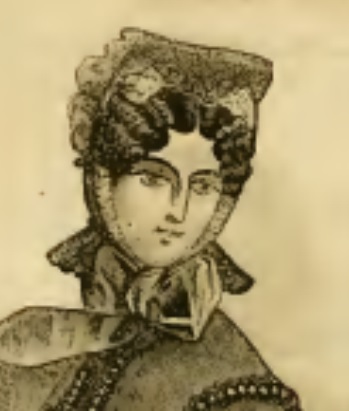
Black velvet bonnet, trimmed with a fall of black lace and black feathers. The inside trimmings consists of pink roses and blonde. (Godey’s, January, 1864)

1

Resources for Life

It is said that soon after the publication of Nicholas Nickleby, not fewer than six Yourkshire schoolmasters (or rather six principals of Yorkshire institutes) took journeys to London, with the express purpose of presecuting Dickens for libels – “each one and severally” considering himself shown up to the world as Mr. Squeers of Dotheboys Hall.

Now, if Dickens had drawn as graphic a picture of Dothegirls Hall, we firmly believe that none of the lady pricipals of similar institutes would have committed themselves by evincing so little tact, and adopting such impoltic proceedings. They would wisely have held back from all appropriation of the obnoxious character, a passed it over unnoticed; as if it could not possibly have the slightest reference to them.

Therefore we wish that those of our fair readers whom certain hints in the following pages may awaken to the consciousness of a few habitual misbehavements, (of which they were not previously aware,) should pause, and reflect, before they allow themselves to “take umbrage too much.” Let them keep in mind that the purpose of the writier is to amend, and not offend; to improve her young country-women, and to to annyoy them. It is whith this view only that she has been induced to “set down in a note-book” wuch lapses from les bienseances as she has remarked during a long course of observation, and on a very diversified field.

She trusts that her readers will peruse this book in as friend a spirit as it was written. ~Eliza Leslie.

 This is the preface from Eliza Leslie’s The Ladies’ Guide to True Politeness and Perfect Manners; or, Miss Leslie’s Behaviour Book (Philadelphia, 1864) https://archive.org/stream/ladiesguidetotru00lesl#page/n3/mode/2up  Her guidance not only covers individual behaviour, but also how to prepare the room or home for different occasions. This includes a suggestion of opening the window sashes in the summer for tea.

Published in: on January 16, 2014 at 1:08 am  Leave a Comment  
Tags:

FanU Romantic Fabric Swap

Today is the day to sign-up for the FanU Romantic Swap! New ideas 1

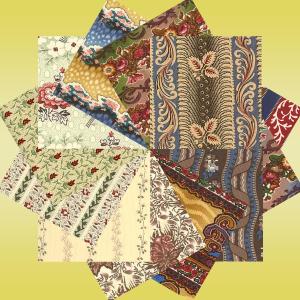
For the Romantic Swap, Swappers will exchange reproduction cotton prints from the Romantic Era, 1820s through 1840s. This era is full of fun, wild even, colorful prints. We will mail our fabrics on January 31st.

Please read all the details below. 

To Sign-up, simply comment below with your email and mailing address. (I’ll erase those before approving your comment, so the whole world doesn’t have that info.)

What is a Swap?

This is a chance for to exchange fabric with a small group of people. Each group will have 8 people exchanging pieces of fabric. All you need is a half yard of fabric and envelopes along with your copy of Fanciful Utility.

To Participate:

1: Sign Up Day!
On sign-up day, groups will be assigned on a first-in basis; the first eight will be the first swap group, second eight in the second group, etc. **Please be certain you will be able to fully participate by mailing your fabrics on the Mail-Out Date.**

Romantic Swap Sign-Up Day: January 13th
Paisley Swap Sign-Up Day: February10th
Mini-Print Sign-Up Day: March 10th

Bonus Patriotic Swap Sign-Up Day: April 14th

2: Mail-Out Day:
Place a 9×9″ piece of fabric suited to the mid-19th century in envelopes for each of the 7 other people in your swap group, stamp them (be sure to double check at the post office, but the small 9×9″ pieces should mail in a regular envelope with a normal stamp), and send them off no later than the Mail-Out Day.

Romantic Swap Sign-Up Day: January 31st
Paisley Swap Sign-Up Day: February28th
Mini-Print Sign-Up Day: March 31st

Bonus Patriotic Swap Sign-Up Day: April 30th

3: Get Fanciful!
Use your Fanciful Utility templates and techniques to make a project from the book, or copy your own from 19th century sources. We’ll all look forward to seeing your projects! You don’t have to sew right away, but don’t keep us waiting forever to see all the fun things!

(If you need a copy of Fanciful Utility, you can purchase them from the publisher at www.thesewingacademy.com

Fabric Guidelines:

  1. For the cotton and silk categories, your fabric should be early to mid-nineteenth century appropriate. (If there is a want for an earlier or later group, we can do that.) Prints and motifs should reflect those available in the 1840s, 50s and 60s. Cotton should be 100% cotton. Silk should be 100% silk.
  2. To keep the swap and sewing possibilities interesting, please avoid solids as best we can.
  3. Fabrics that do not work well for sewing cases should not be swapped. These include sheers, gauzes, heavy, thick, easy-to-fray, slippery and stretch fabrics.
  4. For the “crazy swap” category, think crazy quilt in a sewing case. This could include satins, velvets, textured fabrics. Quality synthetic fabrics are invited.  

Swapper Guidelines:

  1. Please be certain you can fully participate in the swap before you sign-up.
  2. If something arises after you sign-up that will effect the date you are mailing your fabrics, please email your group so everyone is aware.
  3. If you fail to fully participate in a swap, you will not be able to sign-up for future swaps. (We do understand medical and family emergencies. I need to be able to ensure swappers will receive fabrics when they send fabrics out.)

Q&A

Yes, you can participate in 1, 2 or 3 of the swaps.

Yes, if we end up with multiple groups, you can participate in more than one group to swap more fabric. If you participate in 2 groups, you should swap 2 fabrics.

Yes, you can swap large and small scale prints.

Yes, you can swap now and sew later.

Yes, we would love to see what you’ve made with the swapped fabric.

Yes, you can use your own fabric in your swapped project.

Published in: on January 13, 2014 at 6:00 am  Comments (15)  
Tags:

A Year in Millinery Fashion – 1864

1

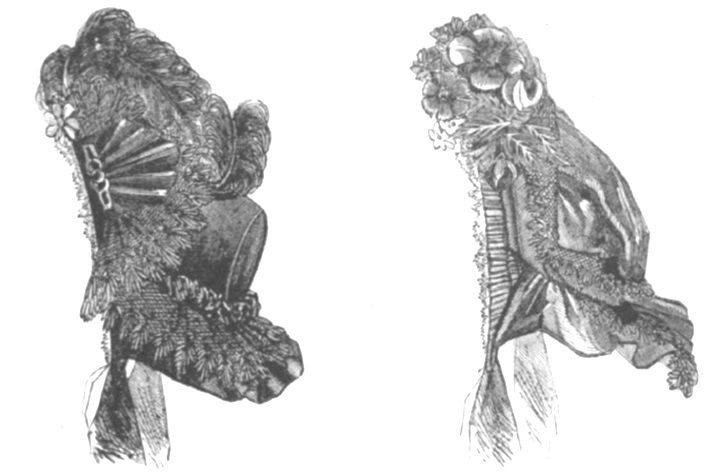
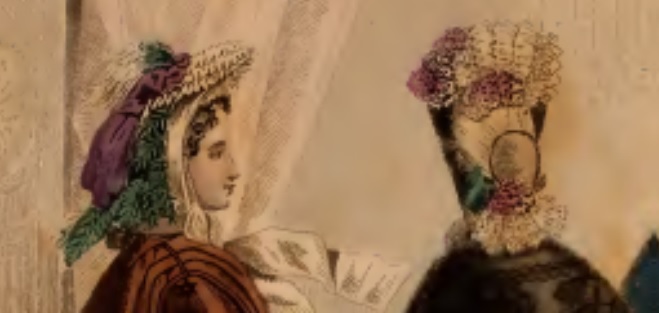
Left– White uncut velvet bonnet, with a falling crown of purple velvet, and trimmed with fern leaves.

Right  – Bonnet of white silk, trimmed with lace and crimson carnations (Godey’s, January, 1864)

Beginning the year, we already see the trend of using trim to add height to the bonnets at the tip of the brim. In the image on the left we see not only height, but a projection forward as well. This projection of the “spoon” as we often call it, has varied in the previous years. In ’64, we will see it move forward, then begin to drop to the top of the head allowing the trims on top to do all the work for height. The fern leaves on this bonnet are part of a movement for leaves and grasses you will see throughout the year. The line of the purple velvet, dropping from atop the crown downward, is also the beginning of this line which will extend from the top of the high top brim, flowing down to beyond where we have previously seen the bavolet. Note in the bonnet on the right, we still have a bavolet, in this case in a lace, topped with carnations.