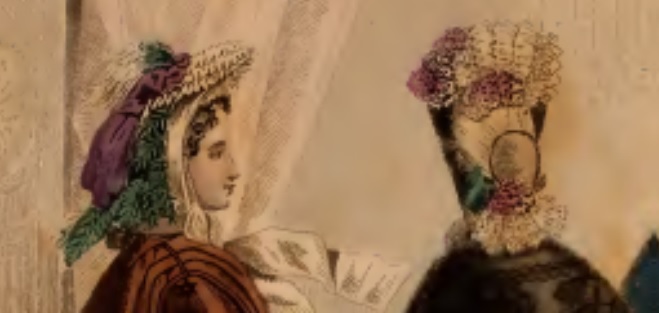
Bonnets are certainly smaller than they were a year ago, and have now, we think, attained a very good size. In Paris, efforts have been made to have the bonnets very small, but without success, as all the ladies of decided taste cling to a “just medium.” (Peterson’s, April, 1864)
A Year in Millinery Fashion 1864
In this demi-season, when there is a perfect stagnation of fashion, and when milliners and dressmakers lament that there is positively nothing new, we find at Mme. N. Tilman’s, of Ninth Street, a choice lot of new importations.
Among the bonnets was a very peculiar one of black tulle, with scarlet velvet front, and the crown was formed of one large scarlet velvet carnation pick. The inside trimming was of scarlet carnations, and the strings of scarlet and black striped ribbon, quite Scotch-like, and a novelty; for until now plain ribbons alone have been tolerated for bonnet strings. The length of the strings should be one yard and three-quarters. Another very exquisite bonnet was of felt-colored velvet trimmed with aigrette of blonde lace and a heron plume. Inside more Scotch flowers, consisting of tufts of scarlet, green, and blue berries with gold spikes, interwoven with golden veined ivy. The tout ensemble of this bonnet was very charming. (Godey’s, March, 1864)
A Year in Millinery Fashion – 1864
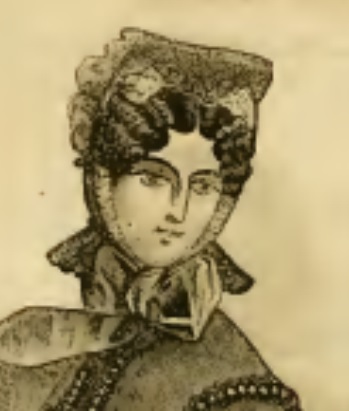
Bonnets by no means follow the outline of the face, byt are simply lower in front than those which have been so perseveringly worn during the last two years. The sides of the bonnet
are very narrow, being almost close to the cheeks; so little space is left that there is only sufficient for one quilling of blonde at each side, or, if a colored crepe cap is adopted, for one narrow row of box, pleating. In some instances, the front is made very wide at the top, so as to allow a superabundance of trimming in the inside; but the more oval form appears to be
generally preferred. (Peterson’s, February, 1864)
A Year in Millinery Fashion – 1864
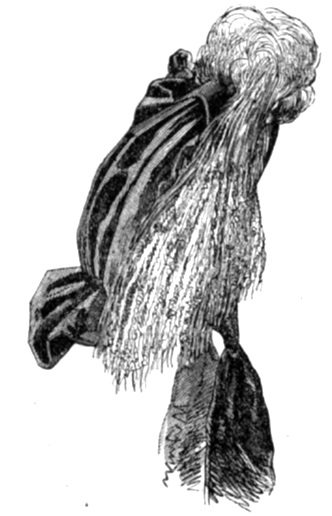
A French Hat of Black
Velvet, from Mrs. Cripps, 912 Canal street, New York. The velvet is laid plain
on the foundation. Directly across the front on the top, is white illusion,
covered by a fullness of black thread lace, which droops slightly over the
front. From the inside on the right, over the joining of the velvet and lace to
the left where it extends down the side, in a roll, to the cape. On the scarlet
velvet, at the top of the cape, is a flower made of black thread lace, and one
to correspond on the folds at the top of the hat. They are something entirely
new. From under the velvet, on the left side, starts a white ostrich feather,
which falls over the front. The inside has full white blonde ruche on either
side; at the top are folds of scarlet velvet and white illusion intermingled;
on the right is a bow of white illusion, in the center of which is a bunch of
white velvet jasmines, with leaves and buds. Rich black strings. (Peterson’s, February, 1864)
A Year in Millinery Fashion – 1864
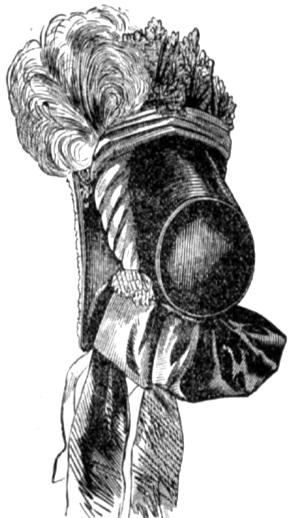
A Black Velvet Bonnet, with
plain front and cap crown, from Mrs. Cripps, 912 Canal street, New York. On the
left side is a heavy rosette of black velvet, under which is fastened a
magnificent cherry willow feather, which sweeps over the front and down the right
side to the bottom of the cape. On the inside are mixed black and white ruches
on both sides; on the top is a full white ruche, a rich bow of cherry velvet,
with an end on the lower side; on the right is a bunch of black feather
flowers. Broad black strings. (Peterson’s, February, 1864)\
A Year in Millinery Fashion – 1864
The latest Paris creation we have heard of, is a bonnet with fancy net attached, in place of a curtain, and so conveniently arranged that the hair can be immediately placed in it, or relieved at will. As the hair is still worn in the waterfall style, we should think this resille, or net bonnet, an admirable contrivance; we have not, however, seen any. We chronicle all the fashions as we get them from the Paris journals, frequently long before they appear in this country.
To amateur milliners we would say that the most fashionable bonnet cape is almost a complete horseshoe, measuring at the back five inches, and at the sides three and a half. This allows for a tiny frill at the top, and two very shallow plaits at the back. We can answer for the set and style of this cape – always the most difficult part of a bonnet to arrange. (Godey’s, February 1864)
A Year in Millinery Fashion – 1864
Bonnets rather lower in front and less exaggerated in form, than those which were in vogue during the past summer; they are not decidely Marie Stuart, but partake somewhat of that character; the curtains are deep, and in many cases pointed in the center. Plaid ribbons threaten to become common, so great is the furore for them, the large blue and green plaid being even more popular than those composed of brighter, gayer colors. Chenille fringe is very much worn around the brims of bonnets, and velvet flowers and leaves are also extremely fashionable. If feathers are used, they should be of the same shade as the most prominent colors in the plaid, and flowers should likewise follow the same rule. Velvet flowers, with brown grass and heather, have a good effect in the caps of bonnets which are trimmed with plaid. Black felt bonnets look well ornamented with bright plaid velvet ribbons; these are sometimes disposed in straps at the top of the brim, the straps being fastened down with small jet ornamental buttons.
Black bonnets are very generally worn this winter, even by those who are not in mourning; it will be considered quite sufficient to enliven them with a colored flower, to render them suitable for any dress. For example, a black crepe bonnet, embroidered with jet beads, and trimmed with a tuft of barabout feathers, with ostrich introduced at the tips, would require a moss-rose in the cap, and pink strings. If the bonnet is in black velvet, with a fringe of black chenille around the edge of the brim, and chenille ornaments at the side, the cap would be formed with a spray of sky-blue narcissus, wih opaque white beads in their centers, the trings being sky-blue velvet with white edges. Pinke is also very fashionable for bonnets, and we see many made entirely with pink plush, and a tuft of marabout feathers, with ostrich tips placed in the center of the fronts. Pink velvet bonnets, with bouillonnes of white tulle; pink terry bonnets, with bows of white blonde, with rose-buds intermingling, are also general. (Peterson’s, January, 1864)
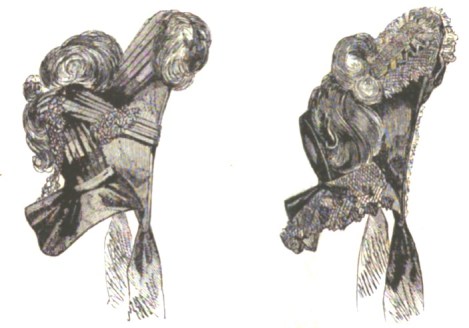
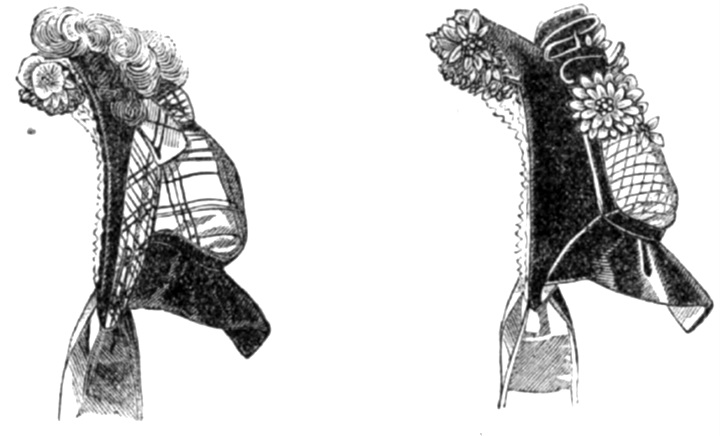
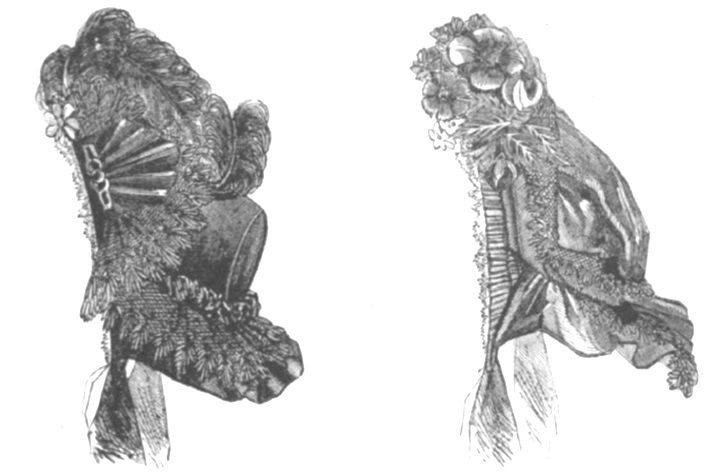
Figs VIII, IX, X, and XI – Velvet and silk Bonnets in various styles, all from the establishment of one of our most fashionable milliners, Mrs. Cripps, New York. (Peterson’s, January, 1864)
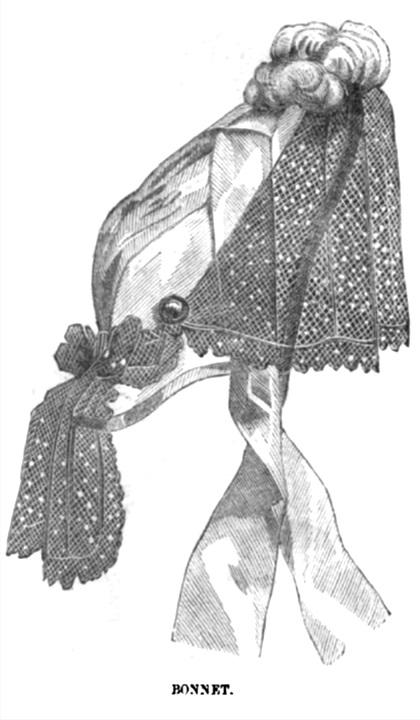
A Year in Millinery Fashion – 1864
Black velvet bonnet, trimmed with a fall of black lace and black feathers. The inside trimmings consists of pink roses and blonde. (Godey’s, January, 1864)
A Year in Millinery Fashion – 1864
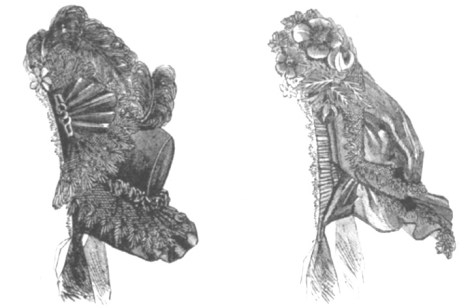
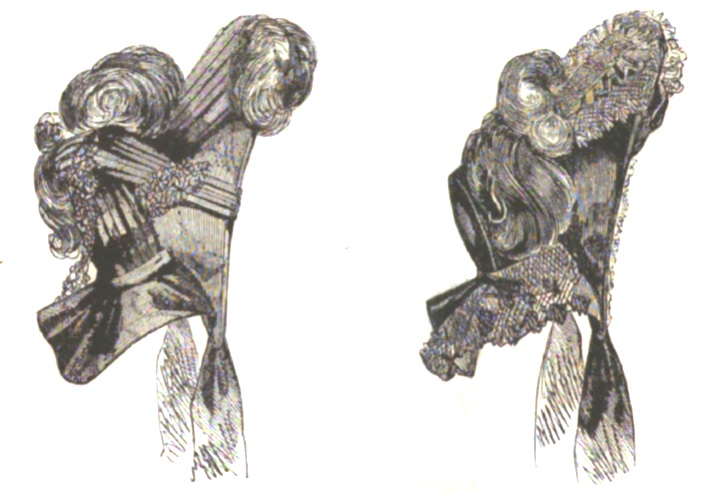
Left– White uncut velvet bonnet, with a falling crown of purple velvet, and trimmed with fern leaves.
Right – Bonnet of white silk, trimmed with lace and crimson carnations (Godey’s, January, 1864)
Beginning the year, we already see the trend of using trim to add height to the bonnets at the tip of the brim. In the image on the left we see not only height, but a projection forward as well. This projection of the “spoon” as we often call it, has varied in the previous years. In ’64, we will see it move forward, then begin to drop to the top of the head allowing the trims on top to do all the work for height. The fern leaves on this bonnet are part of a movement for leaves and grasses you will see throughout the year. The line of the purple velvet, dropping from atop the crown downward, is also the beginning of this line which will extend from the top of the high top brim, flowing down to beyond where we have previously seen the bavolet. Note in the bonnet on the right, we still have a bavolet, in this case in a lace, topped with carnations.