A Year in Millinery Fashion – 1864

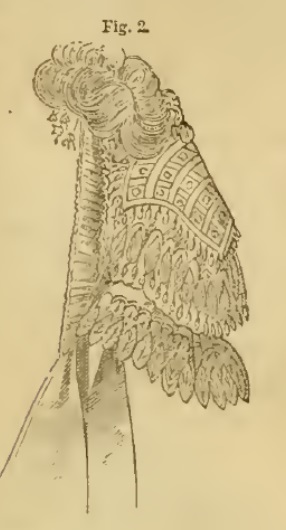
Fig. 2 is a bonnet of white chip, with loose crown of spotted tulle; all round the upper edge of crown is a band of plaid ribbon, and on the top part of crown is a half diamond of tulle, edged with a plaid ribbon, and a chenille fringe to match the plaid. The curtain is of white lace, and has in the centre a small square of plaid ribbon, edged at the bottom and sides by chenille fringe. The strings are of white silk, and the cap is of blonde or tulle, and is trimmed with roses, rose-buds, and bluets. (Godey’s, August, 1864)

 2

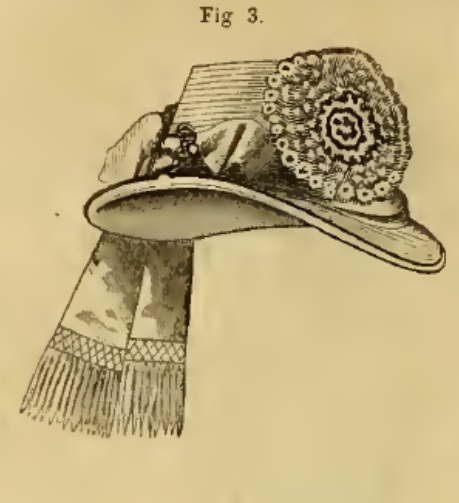
                          Fig. 3 is a Monsqueraire hat of Leghorn or white straw. Round the hat is a scarf of blue ribbon, with a large bow and long fringed ends at the back; in front is a rosette of black and white speckled feathers, surrounded by an edging of blue flowers or bluets. The brim is edged with black velvet. (Godey’s, August, 1864)

1

Published in: on August 11, 2014 at 1:01 am  Comments (1)  
Tags:

A Year in Millinery Fashion – 1864

This commences our series for the fall months, and it is made in silk or light cloth, as the season requires. The piquancy and convenience of the style renders its fashion one that is widely popular. The passamenteries vary greatly, so that the tastes and pecuniary considerations of all may be accommodated. The above was drawn from a rich Manganese brown summer cloth, adorned with an exceedingly neat gimp and pendent button ornaments

For the present “heated term” of course the various shapes and styles of laces are the mode. The great mass, however, of our friends having already made up their summer toilets, are looking for the approaching autumn fashions. We, therefore, prefer giving the above. (Godey’s, August, 1864)

 2

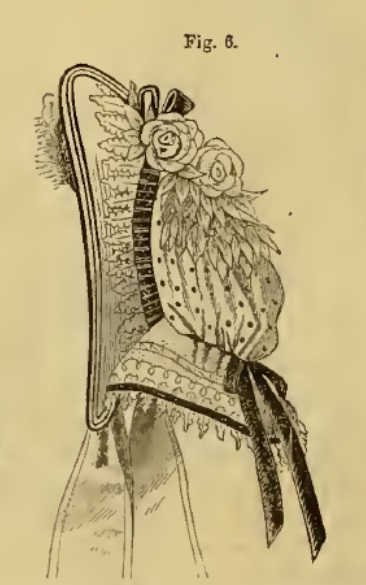
                         Fig. 6 is an elegant bonnet of white chip, with loose crown of spotted net; the crown is separated from the front of bonnet by a black velvet, edged with black lace; at the top of this is a small bow of black and velvet, with a group of roses and rose-buds, the front edge is bound with black velvet. The strings are white, and has a bow and long ends of black at the back. Cap of blond, trimmed with roses and buds. (Godey’s, August, 1864)


Bonnets have suddenly shrunk to the tiniest proportions, and, if they contract no more, will prove very becoming. They are so small that, sometimes, the ear is left entirely exposed, displaying the large, unbecoming ear-rings, which are again coming into fashion.

Some of the simplest and prettiest bonnets are those made after the style of fifteen years ago, viz: a very transparent white muslin, lined with some pretty, delicate shade of silk.

Hats are of a variety of shapes. The high-crowned, narrow-brimmed hat is still worn, byt it usually has a scarf of black lace, or net, tied in a bow behind. The front can be trimmed with either bows of ribbon, flowers, or plumes. Then the little round hat, known, in England, as the “pork-pie,” which is- youthful and pretty, but utterly useless for shade; and the casquette, with the rim covered with velvet, and turned-up in front, but sloping off at the sides and into a point behind. (Peterson’s, August, 1864)

A Year in Millinery Fashion – 1864

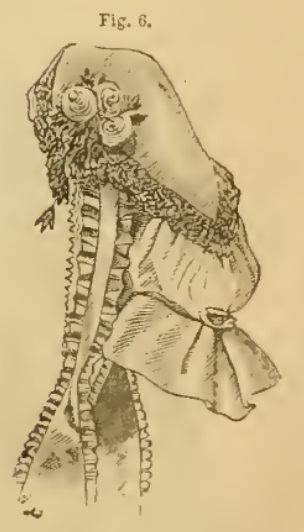
Fig. 6 is a bonnet of Marie Stuart form. The top of the bonnet is formed of a half diamond shaped piece of Ophelia crepe, edged round with black lace; at the left side of this are three white roses and a few fuchsias of black velvet. The loose crown is of white spotted muslin, and the curtain is of Ophelia crepe. The strings, instead of starting only from the ears, pass along the front edge of bonnet; they are of white satin edged with quillings of Ophelia crepe. (Godey’s, July, 1864)

                      1   

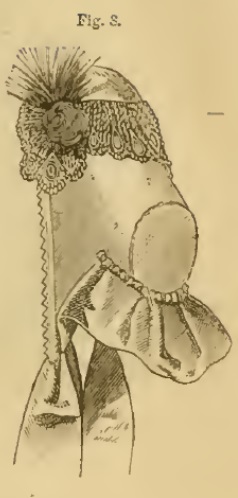
Fig. 8 is a bonnet of green crepe; at the top of crown is a group of lilac flowers. All round the front edge is a narrow garland of lilac, covered by fullings of tulle; the space between the garland and the crown is covered by narrow fullings of tulle. The curtain is partly covered by a deep white lace flounce, and the strings are of green ribbon. (Godey’s, July, 1864)

2

A Year in Millinery Fashion – 1864

Fig. 5 is an elegant bonnet of white silk edged with blue silk, and having a curtain and strings of the same. At the top, rather towards the left side, is a cockade of blue satin, with a mother of pearl centre and a few short white feathers. Blonde cap, having at the top a few bows of blue ribbon, with a rose and some buds. (Godey’s, July, 1864)

2

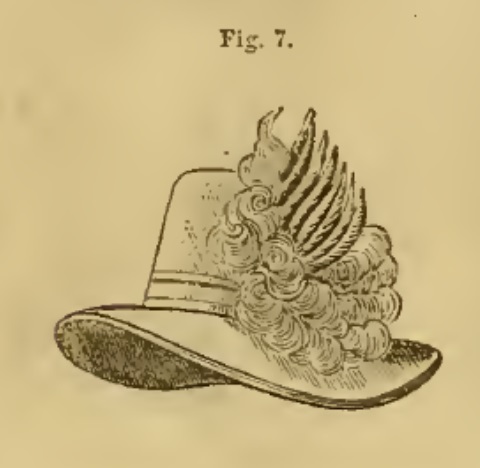
 Fig. 7 is a Mousquetaire hat drab straw, trimmed by two narrow bands of scarlet velvet, and having in front a plume of black and red feathers, and one large ostrich feather. (Godey’s, July, 1864)

1

A Year in Millinery Fashion – 1864

Buff and salmon are very much used for the trimming of both bonnets and hats. On many of the bonnets a single flower is arranged on the outside. For instance, a water-lily, the leaves glistening with dew-drops. Or the bright tinted tulip. Of the latter flower we have seen many elegant specimens. Feathery, silvery, pearl, and silk grasses enter largely into the composition of moutures for bonents and headdresses. Upon examining the elegant, wavering grasses, we found the hundreds of little spikelets to be formed of mother-of-pearl and steel; but so tiny and delicate, that the least breath would set them in motion; and the various lights thrown on them caused them to glitter almost like jewels.

Large, fancy wheat ears in salmon or buff crepe, with long silky beards, form a very stylish trimming for a black horse-hair bonnet.

Much artistic skill is displayed in the arrangement of headdresses, though there is but little change in the style; nor will there be, until there is a decided change in the arrangement of the hair.

Sprays of pink coral, scarcely to be detected from the real article, arranged with grasses and shells, form a charming coiffure. Marie Antoinette tufts of the rarest flowers, and of the most graceful coloring, are to be found at Mme. Tilman’s. Of the tufts and half wreaths of which we have spoken in a previous article, we shall shortly give illustrations. Many other beautiful fantasies we could mention; but we must also speak of children’s hats.

For information we visited Mr. Genin’s establishment, 513 Broadway, New York. Among the newest and most becoming styles, are Arion, Casquet, and Armenia. The former has the crown tapering in front, and rounding at the back. The brim is narrow in front, runs to a point behind, and the edges are curled. The Casquet resembles the Arion, only that the brim is narrower and not curled. The Armenia has a high straight crown, narrow brim, which forms a curve both front and back, the sides being perfectly straight. In some of the models, the brim at the side consists merely of a tiny of velvet.

Besides the above mentioned styles there are many others; but the three we have named seem to be the favorites, and are to be had in all sizes from ladies to infants.

Some of the dress hats have a brim entirely covered with velvet. The principal timmings for ladies and misses are feathers and velvet. All kinds of feathers are brought to requisition – peacock’s, heron, king fisher’s, cock’s, and even eagle plumes.

For children, silk flowers, shells, wheat ears, and ribbons, are the accepted trimmings. Straw ribbons and tassels arranged with high colored velvets, are very dressy.

For school hats, the different shades of gray or cuir, and the mixed straws, are the most suitable both for misses and boys. The turban and Scotch styles, though old, are very much adopted, and with the mask veil and the hair arranged en Grecque, present quite a jaunty and pretty appearance. They are suitable, however, only for misses.

Where ribbon is used, it generally terminates in long streamers at the back. Frequently, however, narrow ribbon velvet is laid in deep points round the crown fastening underneath, a tuft of feathers or flowers in front.

A drawn rosette of salmon-colored crepe lisse, with a scarf of the same, edged with a delicate straw fringe, forms a very light and pretty trimming for a hat.

For little boys, there are numerous; some have a round crown, with rolled brim. These are generally of a plain colored straw, trimmed with a band of blue or brown ribbon, fastened at the side with a pearl clasp. More fanciful shapes are trimmed with an aigrette, consisting of a small rosette of peacock’s feathers, from which spring three straight feathers or a wing. The sailor-shaped hat is also fashionable.

Infants’ hats are generally of white straw, bound with velvet, either a bright blue, lilac, or cherry. Narrow bands of the same encircle the crown, and, in front, a short white plume is caught with a bow of white ribbon. For a boy the plume passes over the crown, for a girl it falls at the side. (Godey’s, July, 1864)

A Year in Millinery Fashion – 1864

Fig. 3 is a bonnet of white crape, with curtain and strings of green silk. At the top of front is an ornament, composed of a piece of green silk edged with broad black lace, and having on the left side a tuft of black feathers. (Godey’s, July, 1864)

                         1

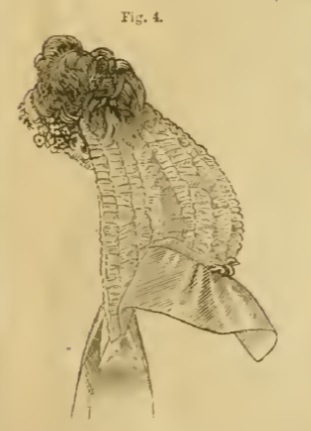
Fig. 4 is a bonnet composed entirely of fullings of white tulle. The curtain and strings are of violet silk. At the top of front is a group of violet feathers, and in the cap are some bows of violet ribbon and a few violet flowers. (Godey’s, July, 1864)

2

Hats have high crowns, and the feathers are mostly arranged in tufts in front instead of round the border or brim; peacock’s, heron’s, and kingfisher’s, indeed, every variety of feather, is brought into requisition for these hats; but in Paris a decided preference is shown for the eagle’s plume for this purpose. (Peterson’s, July 1864)

The mention of the eagle’s plume makes me wonder how many of the fashionable millinery feathers came from now endangered birds.

A Year in Millinery Fashion – 1864

Fig. 2 is a dress bonnet of white tulle; down the front edge is a fulling of tulle, and at the top of the front is a plume of white feathers. The top and crown of the bonnet are covered
by a square of white lace, edged with a small white silk ball fringe; at the top edge of this square is a deep flounce of white lace, edged with ball fringe. The strings are of white silk, and the cap has a few small pink flowers at the top. (Godey’s, July, 1864)

1

A Year in Millinery Fashion – 1864

Fig. 1 is a bonnet of rose-colored crepe, with curtain of the same. Near the front edge is a narrow band of the crepe, edges by a white lace; at the top of front is a group of roses and rose-buds, mixed with fulling of lace or blonde; from beneath the group, a passing down the back of crown, is a fulling of tulle edged with narrow lace; at the back curtain is a small rose-bud with leaves, from under which, falling over the curtain, is a broad lappet of tulle edged with white lace. The strings are of pink silk. (Godey’s, July, 1864)

1

A Year in Millinery Fashion – 1864

Round hats are now very generally adopted. Some of the prettiest we have seen were in cuir-colored straw trimmed with velvet and feathers to match. Others were of chip, straw, and imitation Leghorn, elaborately trimmed with spun glass, shells, plaid velvet, and feathers. Veils, or rather scarfs, of white or black lace, are frequently looped at the side of the hat, and fall as a streamer at the back. The hats we have seen were not as high and pointed as those of last season. The brim fits rather closely to the face, and the back of the brim droops, and is much longer than the front.

We noticed some very pretty hats trimmed with bands and loops of velvet in front, and a pointed cape of velvet edged with lace covering the brim at the back.

Little girls are wearing half gypsies of straw. These are rather pointed in front, flare much at the sides to display a full cap of lace and ribbons, and at the back turn up like a turban. Cased silk bonnets with inimitable muslin and lace crowns, trimmed with the lightest of feathers, are also among the Spring costumes for little girls. Muslin and lace caps of every description are worn, they are generally of the Marie Stuart shape, with quite deep capes at the back. They are highly trimmed with ribbons, and frequently a tiny bunch of bright flowers is nestled among the soft lace on one side.

Mask veils are altogether worn. That is, the veil is drawn closely over the face, and fastened on top of the bonnet or hat with an insect pin. It is, however, difficult to arrange an ordinary veil in the mask style, on the small turban hats now so much worn by young ladies. We would therefore recommend the veil manufactured for the purpose, and just introduced by G. W. Vogel, of 1016 Chestnut Street, Philadelphia. These veils are a little over a quarter yard wide, perfectly  straight, and just sufficiently long enough to fit round the hat. For the Spanish hat there is another veil, which is decidedly novel. This has a hole in the centre, which passes over the crown of the hat; round this is a beading in which the elastic is run. The veil is pointed in front, and at the back, while the sides are shallow.

(Godey’s, June 1864)

A Year in Millinery Fashion – 1864

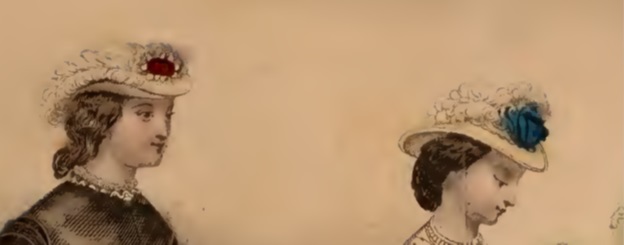
Straw hat, with a brim lined and turned up with mauve velvet. The trimming consists of a long white plume, scarlet flowers and a short mauve plume. (Godey’s, June 1864)

1