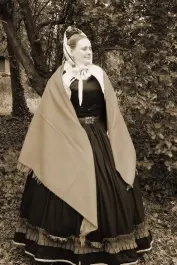
Wins, Regrets, and Foggy Bits

Biggest Wins of 2024

☆ Not completing everything on my goal list. While I am struggling financially from
not meeting my sewing & sales goals for the latter part of the year, I am still okay with not pushing myself to focus on the sales and sewing to-do list through the whole of the year. Something happened this summer during my summer assignment that is hard for me to explain. I worked hard all day at tasks that had a very clear, physical start>do>complete process with no loose ends or flux due to being pulled this way or that. The result surprised me: I finished each day feeling accomplished and found I no longer had the strong need to “make” when I got home. That need to make was replaced by the want to do, to be outside, to wander, to see, to people. This was a feeling I had not felt like this, let alone for weeks, in a very long time. It was nice. This also meant I made significantly less through the summer – less shop stuff, less project stuff.

☆ One of my favorite making parts of this year was finally venturing into  making Bergère hats. It took me too long to embrace making these 18th-century hats.  Between a lack of confidence for maintaining the smooth flat brim and thinking the market was fulfilled by the mass-market, machine sewing hats out there, I pushed off making this style for years. After making the first couple, I quickly found I enjoy making them. This is great news because as we enter 2025, we are rolling into America250 preparations. My plan is to make Bergère hats each month this coming year, both plain and decorative.

☆ My other creative/making win of the year is patchwork. Fancy patchwork, aka “crazy quilt” patchwork, is something I flat out rejected for years. Why? I have no idea. Making a patchwork cat last year sparked my fondness for the process. Now, I find the freehand (unplanned) process of piecing silk scraps and embroidering as the whim flows to be a calming form of process art. In a way, this is my personal Victorian version of the modern, mindfulness slow-stitch trend.

☆ Speaking at Symposium – Of course, speaking at GCVM’s Fall Fashion & Textile Symposium is on the top of my list. (It only sits at the bottom chronologically.) This “win” is doubly important. First, I’ve wanted to do another conference or symposium, ever since speaking at the Genteel Arts Conference in 2010. Opportunity and ability finally aligned this year. Many thanks to those of you who requested a talk from me in the spring. Following the Symposium, I have had requests for smaller speaking engagements quasi-locally in the coming year. Stay tuned for information on those. (PS – I do have a dream vision of displaying a large assortment of my original winter hoods alongside a presentation on the styles of hoods.) Second, the research rabbit hole of looking for rural milliners through various documents is ….. Incredible? Amazing? Fascinating? Basically, it is one I am very glad to be on. I find I really enjoy trying to uncover the stories of women who would have otherwise been forgotten.

Regrets of 2024

♤ I flat out regret the Recreational Dress from this summer. I don’t recall ever having such disdain for a project. As I write this, I am not even sure where I stuffed that outfit. The whole process from research to making felt forced. When I displayed it for the intended event, the layout was visually appealing. But, that is where the positive ended for me. The whole day felt disconnected with little engagement.  I never even wore it.

♤ My biggest not-doing regret of the year is not pushing myself to participate in a particular exhibit I was asked about doing. I really dropped the ball on that one. (Yes, I am leaving that cryptic.)

♤ While I am not sure I can count my epic face plant fall in the school parking lot as a regret as I didn’t choose to do or not to do it, that moment had a significant negative impact on the latter part of the year. The injury itself kept me from sewing for many weeks. I still haven’t sewn a hat or bonnet since October because my thumbs just aren’t there yet. (Knees keep swelling too.). Not being able to sew going into the holiday season left me about $4,000 behind in sales compared to last year. Mentally, I find I am extra cautious about every step and how I hold things. I dislike this.

Foggy Bits

I am not sure what to call this section. These are things I tried, but I can’t really say whether they are successes or failures, or I am just perplexed by them.

◇ Given last year’s response to doll millinery, I thought it was a brilliant idea to invest in doll scale blocks for hats and bonnets. Afterall, I do have hanks of narrow straw plait on hand. Then, doll items just sat there.  I have theories on why – Determining size and fit virtually, view time for new customers. Going forward, I need to decide whether to make more or box the doll millinery blocks up.

◇ Along the same lines is Clara’s Corner – I had this idea of making a bunch of cat themed items for that section of the shop to help pay for Clara’s rent and Chewy order. I didn’t get as far on the making of cat themed items beyond the bookmarks. (The bookmarks did really well last holiday season. Then stopped.)

◇ I have a lot of hope for my Digital Whimsy shop section. I love the idea of offering smaller, nearly free projects throughout the year. I am not sure if people love it as much as I do. I have my fingers crossed that it will be successful in the coming year.

It looks like that brings me to thinking about 2025.

What do I have in mind for 2025?

More presentation style programs


Focusing late 18th century straw millinery in preparation for United States’ 250th anniversary in 2026


More writing

More Fanciful Utility sewing cases

♡ Less chaos in the sewing/millinery room

Visual Year in Review

Published in: on December 20, 2024 at 10:01 am  Leave a Comment  

New One-Piece Quilted Winter Pattern Q&A

20 people have my new One-Piece Quilted Winter Hood Pattern in their cart.

What questions can I answer?

How long does this winter hood take? It took me about 12 hours, in one day, to hand sew the entire hood from cutting to finishing. This was with light hand quilting that took 9-10 of those 12 hours.

How big is this hood? I forgot to mention in my original posting & listing that I included 2 sizes for this hood: the original hood size and an enlarged size. The original fits my average to small head. The enlarged size will better fit an average to larger head. Of course, size up or down as needed.

How much fabric is needed? This hood can be made with 2/3rds of  yard of 60″ silk taffeta.  It can also be made with a different silk inside and out, with a 24″×30″ piece for each. You will also need batting, pieced bias, and ribbon.

Is piecing okay? Absolutely! The original hood was created using piecing. So was my pink example. (It was a triangle of silk taffeta.)

What paper does the pattern print on? The pattern is laid out to print on standard 8.5″×11″ paper rather than one large sheet. (I assumed most people don’t have a large printer at home.) It prints on 8 pages that tape together.  This is a hand drawn pattern rather than a machine drawn one.

Is this the one you made in fleece? Yup. I made a modern fleece hood using this pattern and a $3 red plaid fleece blanket from my local Dollar General. Tip: Use the larger size template because of the thickness of fleece.

Published in: on December 7, 2024 at 10:20 am  Leave a Comment  

Which Winter for Which Weather?

Not sure which winter hood fits your 19th-century needs?

Think about the potential weather conditions for your event. Is is going to be cold? Very cold? Snowy? Windy? Might there be freezing rain? 🥶 ☃️ ❄️


Also, think about what you will be doing. Do you need to see what is happening around you? Are you doing farm chores? Do you need to keep an eye on children? Will there be traffic?

A wool wadded hood is the warmest hood. It also hugs the face, allowing you to see around you. This also means it won’t protect your face from wind or freezing rain.

A lappet style hood has the best protection for the face, shielding you from wind, driving snow, and freezing rain. This means it also limits your vision. The thinner batting layers provide light warmth.

A quilted hood can be made with wool batting, providing moderate warmth.  If the brim is turned forward,  it can provide some protection of the face.

My newest, one-piece quilted hood is the fastest and easiest to make. When made up as the original with light batting, it provides light warmth. Turn the brim forward for some protection of the face. If made in the larger size with denser wool batting,  it could provide moderate warmth.

Published in: on December 6, 2024 at 4:40 pm  Leave a Comment  

The Easiest Quilted Winter Hood (of the 19th century)

I am excited to announce my newest pattern is now available!!!

My newest quilted winter hood exemplifies how a garment can be historically accurate and functional, yet still be pretty and easy to make. When worked in tissue weight silk taffeta and soft wool batting, this winter hood is snuggly warm with a brim that can be folded back framing the face or turned forward to protect from the wintery elements.

I truly believe this is the easiest to make 19th century winter hood I’ve examined, making it ideal for less experienced sewers. At the same time, the quilting can be enhanced to a more challenging design for the more advanced sewer. If buying new, a single yard of 60″ wide light weight or tissue taffeta all that is needed along with batting and ribbon ties. In keeping with the economical nature of the original, I would love to see people make this hood from their stash, piecing the interior and exterior silk layers.

This pattern publication includes two parts in PDF: A 12 page booklet with a brief(ish) story of the original quilted hood and detailed directions for making your own, and a set of printable pattern pieces.

As a bonus, I’ve included a separate PDF for making a doll size quilted winter hood.

On a modern aside: This is one of the hoods I think would make up well with modern fleece for everyday use. I previously made my Lappet Style Hood up in a nearly Pepto-pink fleece for the frigid early mornings. The fit of this hood is so comfortable for me, I can see it worked in fleece to wear while clearing the car and maybe even driving.

Published in: on November 29, 2024 at 10:01 am  Leave a Comment  
Tags: , , , ,

Drawn Bonnet

This drawn bonnet was found at an estate sale in Perry, NY, by a friend of my mom’s.  Holding it in hand, it is surprisingly solid with a bit of weight compared to the straw bonnets I usually handle.

The top of the crown has a low rise to the brim with a bit of curve that may be original or from age. The front edge of the brim has a hint of the curve found in “spoon bonnets.” From the front, the brim edge is more of a vertical oval currently.  Though, the front wires feel as though it spend some time stored on one side.

The construction is a basic wire & buckram foundation with shot brown silk drawn over cane. Feeling along the brim, I suspect wire supports running front to back bent or collapsed inside. (I suddenly wish I could xray a bonnet like this some time.) This may be responsible for the dip in the area of the front most cane and flounce.

One tie remains. The matching satin ribbon is 2 1/2″ wide.

The crown tip is an oval. It is slightly concaved in the photo. I was able to reshape it after taking the photo. The crown tip foundation was originally shaped. At the base of the crown tip is a self fabric bow with a gathered dot-like center.

Detail of cane channels and flounces.
Detail of ribbon attached to cheektab
Detail of bavolet interior
Published in: on November 17, 2024 at 6:04 pm  Comments (1)  

Patchwork Pin Cushions

aka Crazy Quilt Pin Cushions

With a mix of feelings from Finally to Frustration,   can now share with you the series of patchwork pin cushions I’ve been working on.

I started these before falling, smashing my knees and hands. The pile of mini-pillows sat here taunting me for weeks. Slowly, I tried to embroider them. Each time, my hand would yell at me. I ended up doing one or two every couple evenings. Yesterday, I finished up the last of the batch. (The finally part.) Then, last night, my thumb yelled at me. (The frustration part.)

They are all in my Etsy shop awaiting homes.

Initially,  I planned an assortment of goodies for the holiday season, including patchwork pin cushion of various shapes, patchwork ornaments, and some millinery.  The millinery can not happen at this point as my hands definitely can not sew the straw yet, nor the quilting for winter hoods. I still hope to be able to make a few more things, but I’m not sure. (As I write this, I am realizing I need to make a few animal pin cushions or pen wipers for December and a Regency ballgown for New Year’s somehow🤔)

Well, that came out more dismall than intended.

Um, yay! Look, pretty things! 😊

Published in: on November 11, 2024 at 8:45 am  Leave a Comment  

Fall Fashion and Textile Symposium

Saturday morning, I had the pleasure of being the opening speaker at GCVM’s Fall Fashion and Textile Symposium, presenting Unveiling Rural Milliners, a look at small town milliners and their millinery shops.

Accompanying my talk, I shared a sampling of extant bonnets and bonnet blocks from my collection, including a unique 1880s squash bonnet. 

The second presentation by Tricia Noel of the Yates County Historical Society, looked at the Public Universal Friend and their clothing in the late 18th century.

Following lunch, Wilma Townsend, of the Ontario County Historical Society,  shared collection pieces illustrating the textiles produced and purchased in Ontario County.

The final speaker was Nicole Rudolph, looking at the construction of 19th-century shoes. Nicole’s very informative presentation was accompanied by the opportunity to examine in hand several original shoes and boots, including a waterproofing insole that I was captivated with because I think it be warm and comfortable. (I also think it is molded pasteboard inside peeking the FanU side of my brain.)

I was excited when someone asked if I was going to share more about the milliners’ stories I included in my presentation.  I already scheduled a few of the stories I gathered on Patreon I. The coming weeks. I was also toying with the idea of turning the stories into mini-podcasts. Being asked about the stories, I am going to move forward with that. (I have yet to decide which platform to put those on.)

I talked with a few local(ish) people who were interested in me speaking at their organizations/sites. This is absolutely something I would like to explore further and welcome inquiries. ( I will admit, I am more comfortable with spring through fall as winter driving makes me very anxious.)

I also walked away with some homework of my own. I had a few questions I need to look further into, including the profit margin milliners saw and the names of straw varieties used for millinery.  I plan to develop a video presentation focusing on exploring millinery billheads and one or a series looking at specific images/photos.

Listening to Wilma’s presentation,  I found my mind churning up an idea around “How was it made”, hopefully a safe spin on the popular cable show from some years back. I could see a whole day program looking at how different textile & fashion materials were made. Imaging a half hour on a myriad of focused topics: MOP buttons, gutta percha, ribbon, tape, straw foundations, buckram and other stiff foundations, beads (glass blowing), etc..

Brandon Brooks announcement the Spring Symposium will be a 2 day event in April, mentioning new research from graduate students.

If you attended the Symposium, in-person or virtually, I invite you to share feedback or ask questions through this Google form.

Published in: on November 10, 2024 at 7:22 am  Leave a Comment  

Fall Fashion and Textile Symposium – For Attendees

A very quick note for attendees at GCVM’s Fall Fashion and Textile Symposium.

Thank you to everyone who attended both in-person and virtually.  I invite you to take a closer look at many of the images in my presentation, Unveiling Rural Milliners, in my Virtual Gallery of millinery images.

I will try to address questions in the coming days. Please send additional questions and feedback with this simple Google form:

Feedback & Questions Form for Attendees

Published in: on November 9, 2024 at 2:05 pm  Leave a Comment  

Fanciful Utility Holiday Ornaments

Create your own Victorian-inspired holiday ornaments with these three unique sets of patchwork directions, blending Fanciful Utility techniques and classic quilting methods. Each project draws from original Victorian fancy work, inviting you into a calming, mindful process as you work with fabric remnants to craft intricate designs. These small, therapeutic projects are perfect for holiday crafting or any time you want a peaceful creative break.

I was planning to release these this weekend after the Symposium I am speaking at. But, when I woke up this morning, I realized some people could use a little project to calm the mind now.

This series has 3 different sets;

  • Fanciful Utility Holiday Ornaments – This set uses Fanciful Utility techniques to create ornaments working fabric over a paper or pasteboard foundation.  There are 5 different ornaments in this mini-publication.
  • Fanciful Utility Holiday Patchwork Ornaments – This set combines Fanciful Utility techniques with traditional quilt piecing. There are 6 different patchwork ornaments in this mini-publication.
  • Fanciful Utility Holiday Pieced Stars Ornaments – This set adapts traditional English paper piecing techniques with a FanU flair. There are 5 different patchwork ornaments in this mini-publication.

Note: I developed these in the past couple weeks while I have not been able to sew. I greatly appreciate my sample stitchers, Eileen and Geri, as well as sanity checker Marna.

If you want to adventure into fancy patchwork, aka crazy quilt, embroidery,  consider Patchwork Whimsy: A Victorian Stitch Guide. This collection of decorative stitches could pair nicely with either of the patchwork ornaments above.

Published in: on November 7, 2024 at 8:15 am  Leave a Comment  

Patchwork Whimsy: A Victorian Stitch Guide

If you know me in person or have been following me for a while, you likely know I am stubborn, I can’t stand not doing something, and I will push myself when I really should be resting. To make a long story short, I fell on my way into work on Wednesday, turning my ankle, smashing my knees, and jamming my hands/wrists. I’ve attempted to ice, elevate, rest, all those things. I find I can not sew, at least not the way I hyper-focus sew. As such, I have a pile of patchwork pincushions waiting for their embroidery, sitting here mocking me.

I decided if I can’t sew them, I can write about sewing them. Thus, a new mini-publication, primarily written and layed out with my left hand and small fingers.

Patchwork Whimsy: A Victorian Stitch Guide pulls from three late nineteenth century fancy work manuals with the intent to inspire your fancy patchwork, what we more commonly call “crazy quilts” now. It is 22 pages, with many illustrations of stitches and sample projects (not directions for doing the projects.) I did include my patchwork cat template because I put it on the cover.

Patchwork Whimsy is in the Digital Whimsy section of my Etsy shop for only $1.58.

I admit, I am hoping to sell a bunch of these because I’ve lost several days of sewing in a season where shop sales are already frighteningly low.

Published in: on October 20, 2024 at 5:11 pm  Leave a Comment  
Tags: , , , ,