Red

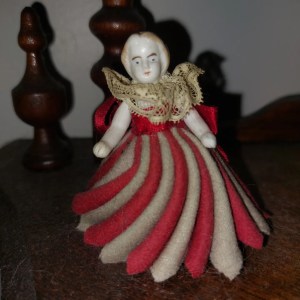
For the second day of #historyinherhands  for Women’s History Month, I offer this doll pen-wipe with her red and white wool skirt.
Pen-wipes or pen-wipers were used for dabbing off or cleaning ones pen while writing letters, journals, and such. Some pen-wipes were simple, being rolls or circles of fulled wool. Others were fanciful decorations as well as tools. This particular style doll pen-wiper is attributed Shaker origins, being made for purchase. Her folds of red and white wool act as a skirt holding her jointed body upright.

Published in: on March 2, 2022 at 7:22 am  Leave a Comment  

Sharp

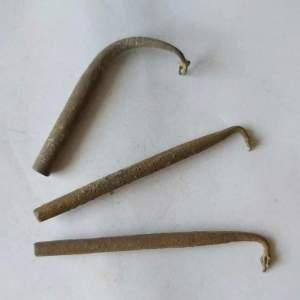
For the first day of Women’s History Month for #historyinherhands “sharp” I offer straw splitters. Straw splitters were a small yet powerful tool in the hands of women both in the New England to Mid-Atlantic region of the US and in England as well as Italy. This tool split tubes of straw into narrower pieces which were plaited, or braided, into straw plait for hats and bonnets. Plaiting and sewing straw was a cottage industry in which women could earn money for themselves and their family.

Published in: on March 1, 2022 at 7:37 am  Leave a Comment  

Repaired!

Good News!

I was able to repair the collar for the miniature millinery block I unboxed. (see that video here: https://youtu.be/z5Ca-VjeYSE )

I talked with a couple friends who are curators and did a little research on repairing plaster. Then, over three sessions, I repaired the collar part of the millinery block. It had broken into 3 large pieces and a chip. (there was an area of old loss previously there.) I am pleased with the repair visually. I do not know how strong it is. I won’t be wiggling it to find out. This piece will be a display piece among my full size millinery blocks. It will be getting a cushion and storage support of its own though.

Published in: on March 1, 2022 at 6:39 am  Leave a Comment  

Unboxing a Small Millinery Block

Just a warning, this unboxing did not turn out as hoped. But, I am making the most of it.

The backstory: A couple weeks ago, I bought a modern doll size hat block that I’ve been curiously watching for months. I had been wondering about these modern little blocks for a couple years. They seemed to be pretty popular with doll people. I was curious if I could use one using nineteenth century techniques, handsewn techniques rather than glue. To my delight, I could. After a week of making a few doll hats, I was quite pleased and satisfied. Then, I randomly opened Etsy with a search “doll hats”… and… this came up.

It was a tiny version of a millinery block in my collection.

I ordered it.

I expected to come later this week. It came today.

I am quite delighted with the little hat block.

Sadly, the collar portion did not survive the journey. I am sad about this. Talking with curator friends, I will be repairing it. I first need to look into the proper ways to do so. Plaster is not a material I have experience with.

This millinery block creates many questions I need to find answers to. Was this for a doll’s hat or was this a salesman’s sample? If this was a salesman’s sample, how does that change the premise that the full size blocks were supplied by representatives of the straw factories for straw sewers to use? If this is a doll size block, were there and are there other doll size block? Who would have sewn the doll size hats? Are there remaining doll hats from these blocks? This will likely become a lengthy research rabbit hole.

Published in: on February 19, 2022 at 4:16 pm  Leave a Comment  

Projects Ahead

Exploring Fancy Millinery

I started, I mean I finally started, playing with the straw motifs that have been rolling around in my head for a couple years. I am mimicking the look of the antique straw motifs I have. These will embellish a bonnet with a sinmay brim, a sheer similar to period horsehair foundations. Currently,  I am picturing vining straw threads, straw leaves, and spirals.

Doll Meets Kerchief

Have you seen the kerchiefs reproduced from the Greene Collection? They are available at the Genesee Country Village and Museum as well as Burnley & Trowbridge. 

I am using the red and black kerchief to make a dress for one of two Jenny Lind style porcelain dolls I lucked upon. You may notice these dolls have the same head as Bonnie, the bonbon doll, and Violet, her sister. I am very excited to have 4 of the same by different artists.

What about the other doll? By request, I am looking for the right red and white or pink and white micro stripe silk taffeta to make her a Peppermint doll. During this past December’s Open House days, visitors asked for a Peppermint doll.

Wool Challis Dress

I bought myself a birthday dress length of semi-sheer wool. It is a mid-size plaid in red, grey, and natural white. I ordered six yards of the 54″ width. If I can make the math work, I may do a double or triple flounce skirt on a cotton base. I am picturing a deepish V neck in a mid1850s style with funnel sleeves.

Rose Sheer Dress

This fabric and dress has been bumped down the priority list for the past few years. This is a fabric I love. The plan for this is also an 1850s style but with a simply gauged skirt. I may try a deeper V neckline with a white insert tbd and open sleeves to reflect the line of the neckline.

Pocket Activity

I loved how visitors connected with the pockets I brought for Chocolate Weekend last July. I want to explore this more with people. While I won’t share details yet, I have what I think is a fun, interactive idea to look further into pockets.

Published in: on February 12, 2022 at 8:19 am  Leave a Comment  

For the Love of Pockets

If you have been following even for a short while, you know I love pockets. I love making pockets. I love having pockets.
For years, I carried a basket or a purse. It would get filled with a myriad of this and that, period and modern.
All this stuf I thought I needed to have on me. Extra water, a camera, a little money…. You know what? It all just added up and added up. Frankly, it was heavy and a PITA.
It also wasn’t accurate.
Then, one glorious day, I learned about pockets. Dresses had pockets! We aren’t talking the wimpy pockets in women’s jeans that barely hold a few dollars and a small set of keys. We are talking huge, mother of all pockets!
Skeptical?
Don’t think they could be that big?
Take a look at my dress from a few years ago. Okay, 15 years ago. (Ignore the hair falling down and the gloves for rusty nails. This was a heavy work day, building fences and moving corn.) The pocket in that dress is holding my lunch including a couple bottles of water and bananas. Can you tell?

I wear two pockets when dressed in Victorian era clothing. Each of my 1830s through 1860s dresses has a pocket on one side, preferably the right side. In this pocket goes the things I need throughout the day of the event, the period items. On the other side is a separate pocket that sits either below my skirt or below my skirt and upper petticoat. This pocket holds the modern items I hope not to need during an event but should have on me in case of emergency or when I leave.

The dress pocket with period items holds:

  • Building key
  • A small wallet/pocket with ID and cash. This is roughly 3.5”x2.5”.
  • Handkerchief
  • Possibly a workpocket
  • Possibly a purse (a small item that carries money)
  • Possibly a fan
  • Possibly a glass

My seperate tie-in pocket holds:

  • Epipen
  • Medications I need immediate access to
  • Car key (mine pop apart)
  • Phone if I need it

This video shows a sampling of what I carry in my pockets:

Want your own pocket? I have a few available in my Etsy shop: https://www.etsy.com/shop/AnnaWordenBauersmith?ref=simple-shop-header-name&listing_id=1086425702&section_id=10182162

Plain cotton pocket set into the seam of a cotton plaid skirt. The pocket is nearly rectangular shape with a fold down the long side, and a seam on the bottom and short side.

Pockets were most often set into the seam of a skirt. Originals show pockets were long, wide enough for the hand to fit comfortably, and both rounded or squared on the bottom. They are often a plain or cotton print with the seam to the outside of the pocket. Sometimes a support stay attaches to the pocket part way down and to the waistband. A straight edge of the pocket lines up with the skirt seam, and the skirt edge folds over the edge of the pocket. I prefer to do two rows of stitches around the edge of my pocket for a strong pocket.

The Lady’s Guide to Perfect Gentility and Manners, by Emily Thornwell, 1859.

Seperate tie-in pockets proceed the Victorian era by many decades. While seperate pockets grew less common by the 1840s and 50s as dress pockets became more common, they were still in use and recommended for situations like travel.

Separate pocket beneath the petticoat for travelling – Eliza Leslie’s The Behaviour Book , 1853 & 1859.  Republished as The Ladies Guide to True Politeness and Perfect Manners, 1864.

Currently, there is a pair of pockets embroidered by sisters Mary Ann and Hannah Rose Brigham of New Hampshire in an Etsy shop One is dated 1850. Both show wear indicating their use.

What did they carry in their pockets?

The Behaviour Book: A Manual for Ladies, Eliza Leslie. 1855.

Published in: on January 23, 2022 at 11:27 am  Comments (1)  

A Pair of Bonnets

Usually, when we see a bonnet in a cdv we get a bit from a slightly turned front angle. We can see some shape and some trims.

Delightfully, this image gives us fairly clear, nearly sixty degree angles of not one but two bonnets. As these beautiful bonnets are distinctly 1840s pieces, I suspect this is a cdv copy of an earlier image, though I am not well versed in photography nor that process.

We can see both bonnets have a nearly horizontal transition from crown to brim. The brims reach forward of the face, one in a near circle, the other circular with a more vertical line to the cheektabs. These cheektabs are wide, with a gentle curve, lasting at and just below the chin. Both bonnets feature shallow bavolets, while the one on the right shows just a hint of what may be straw plait. Trim is minimal on both, with ribbon or sashing wrapping around the crown of the bonnets in two different methods. One ribbon appears solid while the other shows a design, likely floral. Neither bonnet shows trims on the interior or the lined bonnets. The women’s seperatly worn caps can be seen inside the bonnets.

Published in: on January 19, 2022 at 2:20 pm  Comments (1)  

Anatomy of a Straw Bonnet

Each of these points are general for fashionable bonnets made of straw, primarily straw plait, from approx 1858 through 1863. Finer points adjust with each season’s prevailing fashion.

General Construction – Straw bonnets were sewn by hand in the round. Plaits ranged from 1/8″ split straw to wider whole straw and fancy plaits. Woven straw was also used.

Anatomy 1

Tip – The back section of the crown in the tip. On a straw bonnet this can either be domed, flattened at the back curving to the side of the crown. It should not have a sharp angular transition from the back to the sides.

Crown – The crown of a straw bonnet should create a smooth transition from the crown to the brim. Much of the shaping in the bonnet will be created in this transition area.

Brim – The brim of a straw bonnet will vary according to fashion. The brim’s edge should be a single or double row of straw plait. It should not have raw edges needing to be bound.

Cheek-tabs – The cheek-tabs should have a gentle curve coming from the neck edge of the crown along the side of the bonnet dropping down to roughly your jaw line meeting the brim edge. This is a graceful line, not a straight edge or angular transition. There is a variation in the twist of the cheek-tab from the fifties into the sixties. The cheek-tab is part of what helps hold a bonnet in place.

Binding – The binding on a straw bonnet should be straw plait. Raw edges were covered on the exterior and sometimes the interior along the back of the cheektabs, sides and tip. Multiple rows were used as well.

Lining – A lining is a functional layer of light weight, open-weave cotton covering most of the interior of the bonnet. It aids in keeping the straw from snagging the hair while worn. The lining can not be seen when the bonnet is worn.

Frill/Cap/Ruche –This decorative layer of gathered cotton or silk  covers fills the inside of the brim. This is very fine most often net, lace or organza. The full frill aides in holding the bonnet in place.

Facing – Some bonnets have a facing of silk from the edge of the brim through the first couple inches of the interior brim.

Bavolet/Curtain – The bavolet is attached to the binding edge on a straw bonnet along the sides and crown. This silk piece should be lined with net to give it more body. The bavolet may be a single piece of fabric, most often on the bias and occasionally on the grain, or pieced from bias cuts of ribbon. The bavolet may also be decorated.

Functional Ties – The functional ties are attached to the interior of the cheek-tabs or under the decorative ties. These are narrower ribbon to hold the bonnet in place.

Decorative Ties – Decorative ribbons are wide, 3″-8″ based on a wide survey I did years ago. They are on the grain, not bias. Tied, they do not take the support of the bonnet.

Interior Decoration – Interior decoration also helps hold the bonnet in place.

Anatomy 2

Find the earlier video on Bonnet Stays here: https://youtu.be/gcnLtlDGblk

Victorian Plain & Fancy Work BINGO

Today I offer Victorian Plain & Fancy Work Bingo.

In lieu of monthly challenges, I thought a year long game that could be played independently would be fun.

Published in: on January 4, 2022 at 1:29 pm  Comments (2)  

Hello 2022

I step into this new year as one would step barefoot into freshly dewed grass.

With gentle caution and anticipation. The dew will be frosty cold and wet, yet the grass will be so soft underfoot, with hope and connection.

Just me?

Not knowing what to expect from this year, I do not have the expected list of garments and accessories I hope to sew. Instead, I have framework and a plan.

One of the biggest things I need to keep on top of this year is my budget. As you know, the cost of just about everything has gone up. Meanwhile, contractual increases from my main job does not cover it. I need to push myself to make up the difference with my millinery business going forward.

Patreon Shift

I will be moving more content to Patreon as exclusive Patreon access. This is to thank my current generous Patrons and to encourage new Patrons. The majority of new In Detail publications will be moving Patreon. I will also be exploring additional Patreon exclusive content such as project insights and video content.

Millinery

Knowing most are entering this year with a combination of hope and uncertainty, I want to assure you my millinery will focus on quality and sound research. I want you to be confident when you purchase a bonnet or hat from me, knowing it is well made, with period techniques, and will last many years when cared for.

As I write this in mid-December, my plan is to start sewing shop pieces during recess for January. I am toying with some special straw ideas. A friend actually asked me about something similar, not knowing I planned to explore the idea. I am taking that as a sign.

Interpretation

I plan to continue my focus on women’s employment this year. There is so much of this history to be found and shared, some of it good, some of it bad. I hope to find individual stories from or about these women to accompany the numbers and accounts.

I also want to further explore the connection between fancy work items and the people who created them, the stories the items can tell, and how visitors connect with them. I am continually amazed with how individual visitors connect with particular items, be it a sentimental childhood memory, a deep sensory recollection, or some detail that weaves into something else they know. I feel there is something deeper here to explore, though I am not quite certain what that something is yet.

Clara’s Friends

I will be making an announcement regarding Clara’s Friends soon.

YouTube Channel

I am going to continue the YouTube channel, but I will need to cut back the amount of time I put into it. While I loved making videos over the past two years, I found I was putting more time into them than I realized. Since YouTube will not be an income source, I have to cut back on the amount if time I put in each week. I currently plan to do videos from programs/events, when I have something useful to share, and if I have a project for you. This may change a bit as seasons change or as the year progresses.

Me?

Well. I am still working on some life things. Aren’t we all?

Balance and stability are my personal foci for the year. I bought myself some hiking boots. I miss nature and the woods. A big personal goal this year is to spend more time with Mother Nature. Walking. Sitting. Listening. Feeling.

For personal sewing…. I find I like my plait 1830s dress so much, I am going to make another. I also find I want another cooler weather dress or at least basque. I need to go through my wools to see what I have. I may have a light green plaid with enough yardage to do a basque and skirt set.

Published in: on January 1, 2022 at 1:05 am  Leave a Comment