Image

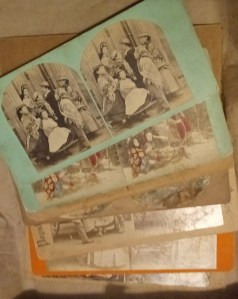
On this 16th day of #historyinherhands , I offer this assortment of stereoviews. Each dual images offered a story as it was viewed. Some told stories familiar. Some told stories of far away.

Published in: on March 16, 2022 at 5:05 am  Leave a Comment  

Paper

On this 15th day of #historyinherhands , I offer one of the many crafts of paper. This mid-twentith century box was constructed by hand of card stock and covered in paper inside and out. The pages of children’s books and ladies’ magazines were filled with useful and playful crafts made with paper.

Published in: on March 15, 2022 at 5:05 am  Leave a Comment  

Organize

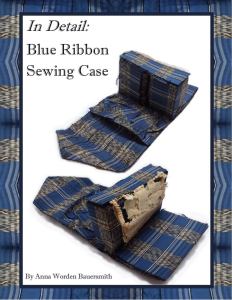
On this 14th day of #historyinherhands , I offer this blue silk sewing case. This excellent piece is both an example of how women organized their sewing tools and organization in construction as this is made almost entirely from a length of ribbon.

Published in: on March 14, 2022 at 5:05 am  Leave a Comment  

Got Perch?

A favorite blog post from 2014

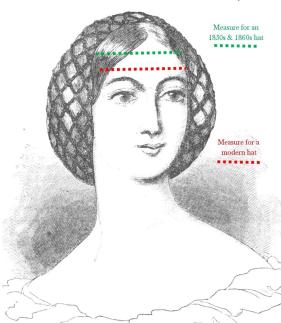
A CDV recently appeared that brought up how women wore their bonnets perched on the backs of their heads from 58ish to 63/4ish. (I want said cdv & will be bidding. Fingers crossed.) Here is a close-up:image

See how the bonnet sit further back on her head? Her interior flowers land almost at her mid-line.
The question I am hearing is “how did they do that?’
There as a few aspects that help:
– A bonnet stay. This is a ribbon, strip or even wire inside the bonnet, positioned to act like a headband holding the bonnet in place. (These need to be fitted to the wearer.)
– The frill and interior decoration. The placement and fullness of these act like a catch or a band to help hold the bonnet.
– Balance. The front to back balance of the bonnet needs to put more weight in the brim and forward crown area of the bonnet rather than the back.
The placement of the hair can also be a contributing factor.

This is my first straw bonnet, years & years ago. While it has some early issues, it shows what a stay can do. These photos were taken after a parade marching into 40 mph winds that ended in a hail storm. During this walk, the force of the winds actually snapped a bone in my cage. But, the bonnet stayed put.image

image

Here is Lily in the same bonnet. It sits further back on her. But, stays pretty well. (It finally got to retire after this.)image

This next bonnet is a different shape, drawn. Instead of a stay, it holds put thanks to the frill and flowers. The frill is gathered like ruching in this one. The back edge sorta stands fluffed, holding against my hair.image

image

This is my bonnet from last year. (How awful is my facial expression?) I think you can see the position of this one. This stays with the work of the frill and my hair.image

image

Here is how I often wear my hair:image

Now, Lily’s bonnet from last year does need a stay as she does have some issue with I staying put. Granted, se is also showing kids how o play with games including stilts much of the time. She also has far better posture than I do. Now that I think about it more, she has less hair in the back too.image

Here is a photo of both of us from last month with the same two bonnets. (different ribbon on mine) This shows the fullness of the frill pretty well.image

Tomorrow, I’ll be wearing my new soft crown. It has the ruched frill but no stay. Of course, the weight will be at the top. I will likely be wearing my veil turned back over the bonnet most of the day. I will report back on how well it stays.

Betsy Connolly sent me some beautiful photos showing excellent perch. (The photos are so pretty, I’m not going to crop them.) She says some have stays, some do not. She agrees that staying put is about balance.image

image

image

Here is Lisa Springstube Lindsey in a mourning bonnet with the full frill helping hold it and a Marie Stuart:image

image

Here is Beth Chamberlain with two good examples:image

image

If you have a good ‘perch’ photo & would like to share it, please let me know (I think if you link it in the comments, I can grab it. Otherwise, email or message me.)

Published in: on March 14, 2022 at 5:05 am  Comments (1)  

Fragile

On the thirteenth day of #historyinherhands , I offer bonnet veils. Lace worked on delicate silk net, can make bonnet veils quite fragile as a decade and a half passes.

On my much neglected to-do list is to re-roll the modest assortment of veils I have in archival paper.

Published in: on March 13, 2022 at 5:05 am  Leave a Comment  

Labor

For this twelfth day of #historyinherhands , I offer this carte de viste of milliners with their work in hand. While milliners get most of the attention in the bonnet and hat making trade, we must not forget the many assistants, straw plaiters, straw sewers, flower makers, lace makers, and more who’s labor made the beautiful confections possible.

Published in: on March 12, 2022 at 6:05 am  Leave a Comment  

Invention

For this eleventh day of #historyinherhands , I offer a pinking machine. Pinking machines replaced pinking dies or pinking irons in the second half of the nineteenth century. No longer did a dressmaker or milliner need to cut scallops an inch or so at a time. Lengths of silk could be quickly run through a pinker with the turn of a crank. This meant yards and yards of decorative trim could be created in a fraction of time with a fraction of effort. As the twentieth century progressed pinking machines were replaced with pinking scissors and pinked fabric transitioned from decoration to utility hidden inside garments.

Published in: on March 11, 2022 at 6:05 am  Leave a Comment  

Women’s Employments Crossword

I made a fun little crossword. You can do it online here:

https://crosswordlabs.com/view/womens-employments-in-the-19th-century

Or print this pdf version:

Published in: on March 10, 2022 at 9:24 am  Leave a Comment  

Footwear

For this tenth day of #historyinherhands , I offer this stocking shaped needle-book. Footwear, including boots, shoes, and stockings, were popular shapes for making needle-books and pin cushions. These appear throughout women’s monthly publications and books of fancy work with recommendations of making them for gifts or fairs.

Published in: on March 10, 2022 at 6:05 am  Leave a Comment  

Fashion

On this nineth day of #historyinherhands , for Women’s History Month, I offer accessible fashion in the form of these combs, one a vulcanite, one a gutta percha. Often the pages of Godey’s Lady’s book were filled with fashions not affordable to the every day woman, or practical. The use of gutta percha, mirroring the look of more costly jet and bog oak, made fashion more accessible to working class women.

Published in: on March 9, 2022 at 6:05 am  Leave a Comment