For the past couple years, I’ve done part of the CW unit for the HS I work at. Here are the class outline and the basic handout files in Word format.
Spring Workshop – Making Bishop Style Undersleeves
These are the directions for making bishop style undersleeves from the spring workshop.
What type of under sleeves do you want/need?
Under an open pagoda sleeve?
Under a modified pagoda sleeve?
Under an open coat sleeve?
How full do you want your under sleeves? Very full? Moderately full? Lightly full?
How much poof do you want your sleeves to have?
Original moderately full sleeves tend to be from 8” to just over 9” across the top or 16” to 18” around. Fuller sleeves fall up to 30” around for very fine nets. I generally find one half of the width of 36” full bodied sheer or semi sheer fabric makes a moderately full under-sleeve. You can make a fuller sleeve of fine sheer cotton but they should not be as wide as those of net. If you add tucks, ruching or other embellishments, you can add to the visual fullness of the sleeve.
In determining the length of the under-sleeve consider the length of your arm as well as the length of your dress sleeve. Original sleeves are as short as 12” and as long as 22”. The longer sleeves have layers of decoration that fall below the wrist. For a bishop under-sleeve, measure from your wrist to two inches above your elbow. Forearm length _________ Add 1” for gathering at bottom and top. If you want more poof to your sleeve add an inch to three inches. Sleeve fabric length __________.
The cuffs of your bishop style under sleeve will need to fit comfortable around your wrist. Measure your wrist _________ add 1 1/2” for closure and comfort ________. Original sleeves show cuffs an inch to about two inches wide. How wide do you want your cuffs? ________ Multiply by 2 and add 1/2” _________.
Do you want the top edge to be gathered to fit your arm or do you want it loose to baste or pin in your dress sleeve? If you want a gathered edge, measure around your arm about an inch above your elbow. _______ Add 1 ½” for comfort and closure. ________ If you want your sleeve to be loose, use the width of your sleeve for the top.
Cut two rectangles of the lawn according to the measurements you have for the width and length of you sleeves. Place a pin along the edge that will be the wrist. Gather along the wrist end to the measurement of your wrist.
Cut two cuff pieces according to the cuff measurements above. Fold each in half lengthwise and press. Fold ¼” seam allowances in and press on all sides.
Cut two upper bindings 2” by the measure for your upper arm or the width of your sleeve. Fold edges in ½” and press. Fold in half and press with raw edges inside.
If you are gathering the top, gather the top edge of the sleeve to the width of the binding.
Sew the length of the sleeve from the top to 2-4” from the bottom. (Enough to comfortably get your hand through) Narrowly turn the remaining raw edge under and hem.
Pin or baste the cuff onto the wrist gathering. Attach the cuff.
Attach the binding at the top. Turn the raw ends under as you do.
Attach a tiny hook and thread loop or button to your cuff for closure.
Examples:

Serving 19th C. Style – Miss Beecher’s Rules for Setting a Table
Miss Beecher’s Treatise On Domestic Economy:
ON THE CARE OF BREAKFAST AND DINING-ROOMS.
An eating-room should have in it a large closet, with drawers and shelves, in which slfbuld be kept all the articles used at meals. This, if possible, should communicate with the kitchen, by a sliding window, or by a door, and have in it a window, and also a small sink. made of marble or lined with zinc, which will be a great convenience for washing nice articles. If there be a dumb-waiter, it is best to have it connected with such a closet. It may be so contrived, that, when it is down, it shall form part of the closet floor.
A table-rug, or crumb-cloth, is useful to save carpets from injury. Bocking, or baize, is best. Always spread the same side up, or the carpet will be soiled by the rug. Table-mats are needful, to prevent injury to the table from the warm dishes. Teacup-mats, or small plates, are useful to save the table-cloths from dripping tea or coffee. Butter-knives, for the butter-plate, and salt-spoons, for salt-dishes, are designed to prevent those disgusting marks which are made, when persons use their own knives, to take salt or butter. A sugar- spoon should be kept in or by the sugar-dish, for the same purpose. Table-napkins, of diaper, are often laid by each person’s plate, for use during the meal, to save the tablecloth and pocket-handkerchief. To preserve the same napkin for the same person, each member of the family has a given number, and the napkins are numbered to correspond, or else are slipped into ivory rings, which are numbered. A stranger has a clean one, at each meal. Tablecloths should be well starched, and ironed on the right side, and always, when taken off, folded in the ironed creases. Doilies are colored napkins, which, when fruit is offered, should always be furnished, to prevent a person from staining a nice handkerchief, or permitting the fruit-juice to dry on the fingers.
Casters and salt-stands should be put in order, every morning, when washing the breakfast things. Always, if possible, provide fine and dry table-salt, as many persons are much disgusted with that which is dark, damp, and coarse. Be careful to keep salad-oil closely corked, or it will grow rancid. Never leave the salt-spoons in the salt, nor the mustard-spoon in the mustard, as they are thereby injured. Wipe them, immediately after the meal.
For table-furniture, French china is deemed the nicest, but it is liable to the objection of having plates, so made, that salt, butter, and similar articles, will not lodge on the edge, but slip into the centre. Select knives and forks, which have weights in the handles, so that, when laid down, they will not touch the table. Those with rivetted handles last longer than any others. Horn handles (except buckhorn) are very poor. The best are cheapest in the end. Knives should be sharpened once a month, unless they are kept sharp by the mode of scouring.
On Setting Tables.
Neat housekeepers observe the manner in which a table is set more than any thing else; and to a person of good taste, few things are more annoying, than to see the table placed askew; the tablecloth soiled, rumpled, and put on awry; the plates, knives, and dishes thrown about, without any order; the pitchers soiled on the outside, and sometimes within ; the tumblers dim ; the caster out of order; the butter pitched on the plate, without any symmetry ; the salt coarse, damp, and dark ; the bread cut in a mixture of junks and slices; the dishes of food set on at random, and without mats; tne knives dark or rusty, and their handles greasy; the tea-furniture all out of order, and every thing in similar style. And yet, many of these negligences will be met with, at the tables of persons who call themselves well bred, and who have wealth enough to make much outside show. One reason for this, is, the great difficulty of finding domestics, who will attend to these things in a proper manner, and who, after they have been repeatedly instructed, will not neglect nor forget what has been said to them. The writer has known cases, where much has been gained by placing the following rules in plain sight, in the place where the articles for setting tables are kept.
Rules for setting a Table.
1. Lay the rug square with the room, and also smooth and even ; then set the table also square with the room, and see that the legs are in the right position to support the leaves.
2. Lay the tablecloth square with the table, right side up, smooth, and even.
3. Put on the teatray (for breakfast or tea) square with the table; set the cups and saucers at the front side of the teatray, and the sugar, slop-bowls, and cream- cup, at the back side. Lay the sugar-spoon or tongs on the sugar-bowl.
4. Lay the plates around the table, at equal intervals, and the knives and forks at regular distances, each in the same particular manner, with a cup-mat, or cup- plate, to each, and a napkin at the right side of each person.
5. If meat be used, set the caster and salt-cellars in the centre of the table; then lay mats for the dishes.
wid place the carving-knife and fork and steel by the master of the house. Set the butter on two plates, one on either side, with a butter-knife by each.
6. Set the tea or coffee-pot on a mat, at the right hand of the teatray, (if there be not room upon it.) Then place the chairs around the table, and call the family.
For Dinner.
1. Place the rug, table, tablecloth, plates, knives and forks, and napkins, as before directed, with a tumbler by each plate. In cold weather, set the plates where they will be warmed.
2. Put the caster in the centre, and the salt-stands at two oblique corners, of the table, the latter between two large spoons crossed. If more spoons be needed, lay them on each side of the caster, crossed. Set the pitcher on a mat, either at a side-table, or, when there is no waiter, on the dining-table. Water looks best in glass decanters.
3. Set the bread on the table, when there is no waiter. Some take a fork, and lay a piece on the napkin or tumbler by each plate. Others keep it in a tray, covered with a white napkin to keep off flies. Bread for dinner is often cut in small junks, and not in slices.
4. Set the principal dish before the master of the house, and the other dishes in a regular manner. Put the carving-knife, fork, and steel, by the principal dish, and also a knife-rest, if one be used.
5. Put a small knife and fork by the pickles, and also by any other dishes which need them. Then place the chairs.
On Waiting at Table.
A domestic, who waits on the table, should be required to keep the hair and hands in neat order, and have on a clean apron. A small tea-tray should be used to carry cups and plates. The waiter should announce the meal /’when ready) to the mistress of the family, then stand by the eating-room door, till all are in, then close the door, and step to the left side of the lady of the house. When all are seated, the waiter should remove the covers, taking care first to invert them, so as not to drop the steam on the tablecloth or guests. In presenting articles, go to the left side of the person. In pouring water never entirely fill the tumbler. The waiter should notice when bread or water is wanting, and hand it without being called. When plates are changed, be careful not to drop knives or forks. Brush off crumbs, with a crumb-brush, into a small waiter. When there is no domestic waiter, a light table should be set at the left side of the mistress of the house, on which the bread, water, and other articles not in immediate use, can be placed.
On Carving and Helping at Table
It is considered an accomplishment for a lady to know how to carve well, at her own table. It is not proper to stand in carving. The carving-knife should be sharp and thin. To carve fowls, (which should always be laid with the breast uppermost,) place the fork in the breast, and take off the wings and legs without turning the fowl; then cut out the merry thought, cut slices from the breast, take out the collar bone, cut off the side pieces, and then cut the carcass in two. Divide the joints in the leg of a turkey.
In helping the guests, when no choice is expressed, give a piece of both the white and dark meat, with some of the stuffing. Inquire whether the guest will be helped to each kind of vegetable, and put the gravy on the plate, and not on any article of food.
In carving a sirloin, cut thin slices from the side next to you, (it must be put on the dish with the tenderloin underneath 😉 then turn it, and cut from the tenderloin. Help the guest to both kinds.
In carving a leg of mutton, or a ham, begin by cutting across the middle, to the bone. Cut a tongue across, and not lengthwise, and help from the middle part.
Carve a forequarter of lamb, by separating the shoulder from the ribs, and then dividing the ribs. To carve a loin of veal, begin at the smaller end and separate the ribs. Help each one to a piece of the kidney and its fat. Carve pork and mutton in the same way.
To carve a fillet of veal, begin at the top, and help to the stuffing with each slice. In a breast of veal, separate the breast and brisket, and then cut them up, asking which part is preferred. In carving a pig, it is customary to divide it, and take off the head, before it comes to the table; as, to many persons, the head is very revolting. Cut off the limbs, and divide the ribs. In carving venison, make a deep incision down to the bone, to let out the juices; then turn the broad end of the haunch towards you, cutting deep, in thin slices. For a saddle of venison, cut from the tail towards the other end, on each side, in thin slices. Warm plates are very necessary, with venison and mutton, and in Winter, are desirable for all meats.
Increasing Spectator & Civilian Interaction
Spectator friendly activities
· Sewing – Invite spectators to try sewing and handiwork projects. If you are working on a treadle or hand-crank sewing machine, invite them to try the machine. If you are quilting, have an extra needle and thread started for them to try. If need be, you can remove the stitches at the end of the event.
· Spinning and Weaving – If you are working with fibers, have a drop spindle or small loom on hand for them to try.
· Knitting – Have an extra ball of yarn and a set of needles for spectators to try.
· Food – Have them churn butter. (one of the few food relate activities that are allowable.)
· Laundry – If doing a partial laundry impression without the hot water and caustic chemicals, spectators can participate. Scrubbing wet clothes and hanging them can be a favorite of children.
· Games – Almost every child and many adults love to play with period games. If your children are playing, invite a visiting spectator family to play as well. This will give the adults plenty of question and answer time as well. Parlor games are fun and often new to adult spectators. Invite them to join your game of conundrums or tableax vivants.
Inviting Spectators to participate
· It is important to offer an opportunity to try an activity to a spectator. Often they will be interested but to shy to ask.
·
Potential Spectator Hazards
· It is generally best not to have spectators handle original items outside of control situations with the proper surface and gloves.
· Spectators should not be allowed to handle or taste food.
· Spectators, though very interested, should not be allowed handle sharp or hot objects.
· Spectators should not be allowed to handle loaded firearms.
· Spectators should be kept a safe distance from fires.
Working with School Groups & Encouraging Student Interest
· Younger spectators relate better to the character, personalities, and personal stories of people rather than facts, details and technical concepts.
· Presenting a concept, event or series of events from the perspective of a character helps a student connect and develops a story-line.
· Give students the opportunity to think critically and voice their perspectives on issues and events.
· Link past events with present day experiences kids can relate to. Example – Soldiers’ aide groups gathering supplies for CW soldiers compared to student groups gathering items for care packages for soldiers.
· Provoke curiosity and creativity.
· Themes that can work well with students include
o Choosing between different options, right and wrong
o Dealing with pressure from peers and superiors
o Needs, wants and problems solving – ex. How to provide food for your family if there wasn’t any available to purchase? What would a soldier do if he saw a cool stream of water during a hot day of marching?
o
·
·
Tips for Teaching the Civil War
· http://www.fredericksburg.com/CivilWar/Teaching/index_html
· http://blog.teachthecivilwar.com/
· http://www.civilwar.org/historyclassroom/hc_curriculum1.htm
· Document analysis worksheets http://www.archives.gov/education/lessons/worksheets/
A Closer look at Straw Plait
One of the most common mistakes in making a straw bonnet for living history or reenactment, is choosing a plait that is to wide and coarse. I will admit, I too made that mistake in the begining. We are often tempted and occasionally encouraged to use the straw from a craft bonnet for making a straw bonnet. Again, yes in the begining I did this. But, I’ve since learned and would like to advise you learn from my mistakes rather than wasting your time.
So, what is wrong with the straw from a craft hat from the craft shop? Most of them are to wide and to coarse. Occasionally, you can find narrower craft straw. But, not always. Take a look at the image below. A is a craft straw. It is 3/4″ wide. Some comes as wide as 1″. While there were wide straw strips used during the era for bonnets, these were much more delicate, often woven or crochet. You can see the difference in the quality of the straw itself compared to the other plaits. Plait A is made from whole straw. Whole straw is not bad. It is a method used for making plait throughout the 18th and 19th centuries. You can see how the whole straw E is the width of the straw used in plait A.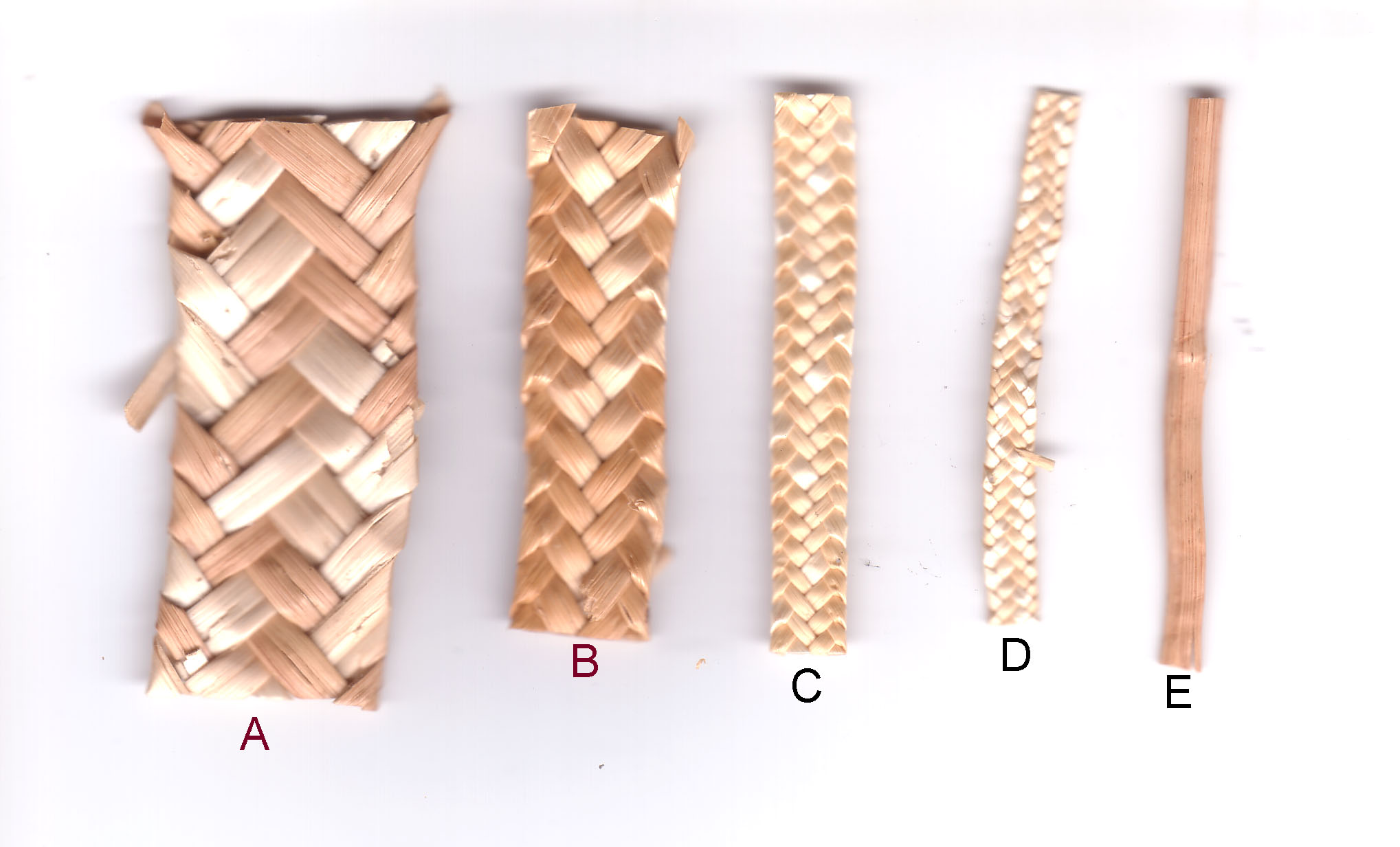
Plait B is approx 1/2″ made from whole straw. This straw has a nice even color. The straw is in nice shape and is pliable. This is a good straw to begin. This straw comes from Frank’s Cane and Rush Supply.
Plaits C and D are narrower plaits from Judith M’s Millinery, 8mm and 6mm each. These are split plaits. Split plait is made by splitting a single straw into narrow widths before braiding them. To acheive an all matte or all shiny plait two split plaits are layered together. Notice how plait D is the almost the same width as the straw E.
If the straw plait has been dyed, it may require more sizing and wire to hold shape. Some how some dyes weaken the body of the straw.
The below image shows a straw plait along side a hemp plait. You can see the difference between them easily at this magnification. The hemp is a stringier fiber than straw. The hemp needs more sizing and wiring to hold its shape compared to whole or split straw plait.

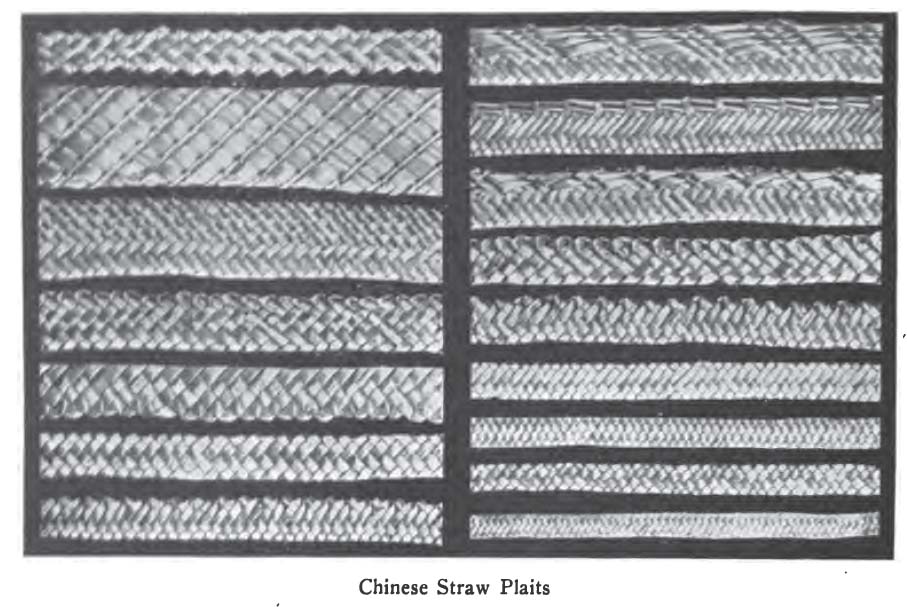
This page from The Millinery Department, 1918, by Aiken, shows straw plaits from the early 20th century.
Just for fun check out….
Straw Bonnet Fashion Descriptions
From Harper’s Monthly and Harper’s Weekly
June 1850 – Open-work straw bonnets, of different colors, are adopted for the earlier summer wear, trimmed with branches of lilac, or something appropriate… Many of the straw bonnets are of dark-colored ground, ornamented with fine open straw work.
April 1851 – Fashions for Spring – Straw bonnet – Figure 4 shows an elegant style of a straw flat for little miss, trimmed in connection with the tie, with several folds of satin. The only external ornament is a long ostrich feather sweeping gracefully around the front of the crown, and falling upon the side of the brim.
July 1851 – Rice straw bonnet; a very small open brim, the interior trimmed with tufts of red and yellow roses and their foliage, and white brides. The exterior of the bonnet is decorated with a wreath of the same flowers intermixed with thin foliage and light sprigs of small white flowers and buds.
October 1852 – The bonnet is made half of straw, half of taffeta. The brim is straw veined with black or mixed with aloes, and the crown has a soft top of ruffled taffeta, with a bow of ribbon.
November 1852 – Rice-straw bonnet. Inside blonde and tufts of field flowers. Wide plaid ribbon as a fanchon, bordered on the lower edge with a deep blonde. Curtain of plaid ribbon.
May 1853 – Bonnet of fancy straw, trimmed with black lace and narrow light purple velvet; the curtain is of white satin and the strings of very broad satin ribbon.
May 1854 – [This bonnet] is entirely unique. It is composed of hair and Swiss straw, with rows of grape-leaves of embroidered and shaded green satin. It is lined with green silk. Groups of pale pink roses, with sprays of the lily of the valley, form the trimming. Inside is a simple ruche of blonde, very full upon the cheeks.
May 1854 – This page has an excellent sketch of a bonnet body with this description: “The ‘Shape’ or skeleton which we give below will serve to show the general form of Bonnets, as they will be worn for the season.”
May 1856 – The bonnet shapes, from the latest Parisian models, will give a clear idea of their forms, without the aid of verbal description. It will be note, among other variations from former styles, that the crown slopes more forward. These shapes are finished in almost every conceivable way, according to individuals taste.
Godey’s Ladies’ Book
February, 1851 – We have seen one fashion of trimming straw bonnets pervade a whole community. When “bows on top” were the rage, we have seen twenty bonnets pass through the “meeting-house” porch with that peculiar cockade of ribbon at the junction of the crown and brim.
May, 1851 – Dainty straw bonnets, the little brims filled with lace and violets, only too real, of the floating sprays of lily of the valley and the jasmine.
October, 1851 – Speaking of ribbons, very few have, as yet, laid aside their straw bonnets. Our autumn is so mild, that they are universally worn until cold weather fairly sets in, or the winter openings commence.
October, 1852 – …straw bonnets with silk linings, replacing those of crape, and trimmed with rich ribbons, are most generally seen. The ribbons are of deep colors, with a bright spot, figure, or stripe enlivening them. For instance, a black ground and small crimson palm-leaf, royal purple with a bright green spot, etc. etc. The varieties of style in which bonnets are trimmed defies all description; some have simply a wide, rich ribbon passed over the brim, and confined at the top with a knot or band of straw, spreading out at the ear, and drawn in again to tie beneath the chin. If the straw is fine, and the ribbon wide and thick, this, with a cape of the same, is all that is necessary.
There is another style, the ribbon brought very far forward in a point on top of the bonnet, a second band of ribbon follows it, only not inclining so far forward. Others, whose white trimmings of the summer are still in good order, consult economy and taste at the same time, by ornamenting the cape by two rows of narrow velvet ribbon, in some bright color, as cherry or bright green, with inside bows to correspond. However, each town and village has its own prevailing fashion in this matter, and we leave it to the taste of our readers, with a general rule to avoid, as far as possible, a multiplicity of bows and dangling ends.
January, 1854 – Fancy straws are very much worn trimmed with plaid or flowered ribbons. Groups of wheat ears, poppies, and grass are placed at each side of the bonnet, when the ribbon is of a kind with which such decorations will harmonize. For the interior a great deal of blond is worn, and it would appear quite de rigueur that the two sides should by no means correspond. If a flower is placed in the blond on one side, a knot of velvet ribbon will be seen on the other; and one will be placed on the temple, while the other is low down on the cheek. Roses and black velvet are the most common; and the prettiest trimmings for the interior of a straw bonnet.
July, 1854 – According to our usual plan, the topics for this month’s consideration are traveling and evening-dress, more particularly as it is now the height of the watering-place season…… The most suitable bonnets are lawn and straw, lawn bonnets being as much, or more worn than the past season. They are trimmed with braids, or box-plaited frills of the same outside, and with bows of narrow colored ribbon inside the brim. White, violet, pink, pale green, or white and either of the shades mixed, form the best contrast to the hue of the lawn. In some, the bows are not more than an inch in width, and extend around inside the brim, singly above the forehead, and in a cluster on each side. Straw bonnets are usually lined with plain white crape, with knots of ribbon, or cap ruches of plain blonde footing, for inside trimming.
August, 1854 – Home Dresses for the Country. Plain straw bonnet, Princess braid, trimmed with ruches of white and wine-colored ribbon.
September, 1854 – White straw bonnets, trimmed with black ribbon, and black silk dresses and mantles, are much the fashion for children and young people, though we much question the propriety of children wearing mourning at all, since they cannot understand its meaning, and its sombre hue is not a type of childhood.
April, 1855 – Fashion plate description “Split English straw bonnet, with a light curling plume on the left side. Bonnet-cap in blonde, with irregular knots of pink ribbon, and cluster of arbutus on one side.”
April, 1855 – The straw bonnets follow very closely the shape of those in silk, introduced about Christmas; we mean the long oval crown and slightly flowing brim. This is an almost invariable rule; the winter silk shaping the summer straw, as the straws are principally sewn at that season. They are trimmed with ribbon and blonde.
May, 1855 – Letter to correspondents – Straws will be worn as much as ever; there is no symptom of their going out. A well shaped, plainly trimmed straw bonnet is always ladylike, no matter how coarse it may be.
May, 1855 – Light, or glace silks, straw bonnets, and new mantillas, make Broadway and Chestnut Street like a garden-bed flushed with daisies and all spring flowers, on the first sunny days our late season has brought to us. In Richmond, Charleston, and still more southern latitudes, the first freshness of spring costumes is already dimmed, and packing-boxes are on their way to replace them with still lighter fabrics. The materials made up this month are principally summer tissues, and lawns, organdies, etc……Bonnets of straw lace are very lightly trimmed, wheat ears are among the favorite outside bouquets. Blonde and fine flowers inside the brim. We are obliged to defer our items in this department, as also of Brodie’s mantillas, and several other novelties, having given so much room to the mantua making department.
July, 1855 – Lace straw bonnets, mixed with, or made up over crape of various colors, are much worn. Neapolitan braid, plain and ornamented, is a favorite in this admixture, and straw flowers, rosettes, etc., outside and in, are a peculiar feature of the season. Genin’s bonnet-room or department is noticeable for some beautiful varieties. Satin straw is also a novelty, and makes a very light and showy bonnet, mixed with straw lace, ribbon, and flowers. The inch wide, No. 4 ribbon, so much in use, is often edged with narrow black or white blonde, and bonnet-caps have still the foundation of blonde, mixed with flowers, knots of ribbon, blonde edging, so intermixed and diversified as to be beyond description. Lawn traveling-hats, as much worn as ever, are varied by mixtures of purple, green, or blue ribbon, forming lattice work with the lawn bands. We noticed these also, for the first, at Genin’s.
April, 1857 – Child’s dress “Straw bonnet, with field flowers in the cap.”
October, 1857 – Style of trimming for a straw bonnet; black velvet ribbon, edged with lace; narrow velvet band about the brim, crown, and curtain.
May, 1858 – Traveling-dress – “Less expensive, and quite new, we notice a mixture of Leghorn and fine English split straw. The Leghorn forms a band around the brim and cape, two or three inches on the brim, and of proportionate width on the cape. We believe this style originated at Genin’s, always famous for its Leghorns. Chip and dark-mottled straws, sewn in alternate braids, make a very light and elegant bonnet. There is also an entirely new and inexpensive broad braid of Neapolitan and Tuscan combined, almost as light, and trimmed with crape quillings, narrow blonde, and ribbon. These last are the favorite materials for trimming straws; gimps of chenille, straw, and straw grelots, or pendants are also used. The last are introduced in the blonde bonnet caps, which are still in favor. White veils of real blonde, blonde lace or thulle, spotted with straw or silk, and finished by a row of blonde, will be much worn. Blonde edgings will be used in all bonnets, on the curtains of straws, and mixed with all crape or silk hats. The designs are unusually good. There is an infinite variety of Dunstables and fancy straws, with tea-colored and lavender-colored plain straws.”
May, 1860 – Fashion plate description “a rice straw bonnet trimmed with mauve ribbon and a sheaf of wheat mixed with mauve flowers.”
May, 1860 – During the mild weather, a few new bonnets have made their appearance, and are marked by a decided increase of brim. The most conspicuous are the fine split straws, trimmed with wide black ribbon laid slanting and surmounted by bunches of field flowers, the wheat ears predominating…. The straw hats and bonnets for ladies and children are of white, black, gray, and mixed black and white; the styles are new and of great variety.
March, 1861 – The shape of bonnets is much less of a poke than last year; flatter on top, and more open at the ears. A drawn lining for straws of crape, silk, or satin, with the edge projecting a little to form a tiny ruff of the material, when seen from the outside. The tendency is to discard blonde ruches altogether for bands, rolls, and plaitings of ribbon, plain blonde, and flowers. There is a great variety of braids, mixtures of gray and brown orin prevailing, and some delicately-fine Dunstables and split French straws; chip is also seen with rice straw.
March, 1861 – Fashion plate description. “Straw bonnet, bound with gold color, and trimmed with a gold-colored net, with cord and tassels; strings and cape of Solferino ribbon.”
July, 1861 – Leghorn bonnet, with a wide green ribbon laid plainly over it; on the left side is a large bunch of lilacs; ruche of violet crape in the inside of bonnet, but not extending down the sides.
Leghorn bonnet, with fancy open crown, trimmed with black ribbon and scarlet flowers; the cape and front of bonnet are bound with scarlet velvet.
Fancy straw bonnet, with edge of front bound with black velvet; the crown is open, and lined with a black cape of maize-colored silk, with black lace over it; the trimming of the bonnet is bunches of yellow grass, loops of black lace and maize flowers inside.
Brown Leghorn hat, trimmed with a very full brown feather of black velvet ribbon.
September, 1861 – Discussing new colors of the season “a rice straw bonnet, with a wreath of scarlet geraniums and green leaves placed quite on the back of the crown and fastened by a knot of black lace, or a black lace barbe, raised by a knot of rose sublime ribbon, with a cape of the same shade in silk, covered by black lace and a bow and flowing ends of black velvet ribbon…. Belgian straw bonnet, covered with a black silk net, from which small elongated olives hang all round. The bandeau inside is composed of a large ruche of flame-colored silk, pinked at the edge, supported by another ruche of black silk; voluminous tufts of large corn poppies are put at the sides so as to completely fill up the cheeks of the bonnet. Below these tulle lappets are seen. The curtain is black silk with a plaited head and a bow of black ribbon formed of two long loops and two long ends hanging down. The whole outside of the bonnet has no other ornament than the net which covers it and hangs down as a fall in front and on both sides. On one side, however, placed upon the net, there is a voluminous tuft of poppies. Strings of ribbon, black, with red edges, and a stripe of straw-color in the middle. Straw bonnets trimmed with ribbon (plain black ground with bouquets of cherries worked on it), branches of cherries, white blonde and black lace. The trimming of this bonnet consists of a ribbon which goes round it and comes to the left hand side, where it forms a large bow in which branches of cherries are inserted. The end of this ribbon hangs down at the side. The curtain, of plain thulle, is covered by another, all of blonde, which forms three flat plaits; one on each side and a third in the middle. The inside of the front is covered with narrow black lace. On the forehead there is a bandeau composed of ribbon knotted in the middle and crumpled at the sides. Blonde down the cheeks.”
October, 1861 – Tuscan straw bonnet, trimmed with fruit and flowers; the cape is of white silk, bound with lilac; the front of the bonnet is bound with lilac velvet.
March, 1862 – The shape of straw bonnets is already defined. They follow the high brim and sloping crown of the past winter, and are very shallow at the side, so that the top trimming dies away to a narrow ruche of tulle on the cheek. There is a new style of ruche. The plaits have the air of being separated by a plain space, but the effect of the late full roche is also gained, softening the outline of the face, and inclosing the cheek in a line of wavy, delicate blonde. Across the brim, flowers and lace are still carried; on the outside of the bonnets, the Letitia bow will be very popular. It is a flat bow, exactly on top— to describe a bonnet trimmed in this way— a pretty spring straw, with the high brim, curtain of mauve silk, with two square plaits at the back, plain on the sides. The plaits are trimmed across with rows of straw and small pendent ornaments of straw. Strings of No. 30 ribbon; from the cape, pretty well at the back of the bonnet, a plain ribbon, of the same width, ascends, meeting on top in a Letitia bow, formed of two flat loops, one turned each way, passing under a flat tie; on each corner of the loops are small pendent ornaments of straw. Inside, a ruche; at the top, a broad, close bunch of purple violets, with a pink moss rose and foliage on each side.
We have seen ribbon of an inch and a half in width used in this way: three rows across the top of the bonnet, and in one case, five, of an inch in width, covering the whole bonnet.
We have seen a very pretty chip hat, with cape of bright June green; the front has a broad, rich white ribbon passed over it, at the top a knot, in which is placed a light plume, which curls over the edge of the brim, and forms a part of the bandeau; bright, green leaves complete it. Strings of broad white ribbon. Next month we commence our regular notices of spring openings, by Miss McConnel, Mrs. Scofield, and others.
August, 1862 – English straw bonnet, with mauve cape edged with lace, and trimmed with a tuft of violets and a feather tassel. The inside trimming is of roses and violets.
August, 1862 – Light gray straw hat [image shows a bonnet], trimmed with gray feathers. Gray silk cape, with a fall of black lace; Vesuve flowers inside….Chip straw bonnet, trimmed with pink roses and a barbe of black lace embroidered with straw and fringed ends. White silk curtain, with black lace in the center.
March, 1863 – Traveling costume facing. “Mode-color straw bonnet, trimmed with ribbon of the same color. The face trimming consists of blonde tabs and apple-green ribbon.
May, 1863 – Fashion plate description “White straw bonnet, trimmed with green, and coronet trimming of pink roses with foliage.
August, 1863 – Rice straw bonnet, trimmed with white lace and lavender-colored feathers.
December, 1863 – a very simple fancy straw bonnet, and ribbons to match her dress.
October, 1864 – Have, for instance, a white straw bonnet, trimmed with a rich Eugenie blue velvet, and the cape of white silk. The inside trimming can be of rosebuds and blue velvet…. We give these hints for the benefit of amateur milliners who wish to exercise their skill in trimming summer bonnets suitably for autumn.
October, 1864 – Curtainless bonnet. Gray chip bonnet, trimmed with scarlet daisies. A fall of black lace is arranged for the crown, over which is a bow of scarlet velvet. Scarlet daisies and black lace form the inside trimming. …Fancy gray straw bonnet, having the crown covered with blue hanging flowers. The cape is of blue silk, trimmed with ornaments of gray straw. Strings of blue ribbon. Inside trimming of gray grass and blue flowers.
From Vicki Bett’s Southern Newspaper Research
CHARLESTON MERCURY, August 9, 1860, p. 1, c. 3
Where Our Bonnets Come From.–There are six or seven millions of women in the United States, and each woman considers herself an injured individual if she don’t [sic] have at least four bonnets a year. Now, did all these followers of fashion ever stop to reflect where the multitudinous chapeaus [sic] come from? We think we can enlighten them. Foxboro, in Massachusetts, is, probably, the largest place of straw manufacture in the world. At one factory, three hundred girls and two hundred and seventy men are employed outside of the factory, and fifteen thousand hats and bonnets are manufactured per day. Very little of the straw goods used are plated in this country, the wages being too high here to afford it at the importing rates.
CHARLESTON MERCURY, September 14, 1860, p. 4, c. 1
Our New York Correspondence. Fashion Letter. New York, September 8.
………The polka spot straw bonnet is very much sought for this season. A fine black straw, dotted with white–some of these are trimmed with vivid scarlet velvet and black feathers. The capes are always bias, sometimes of black silk, bound with the pervading colors. There is a rage for black in bonnets, in silk, straw, or Neapolitan. I saw one of the latter, trimmed with black bitter-sweet berries, with golden eyes, pendant from broad Magenta velvet leaves; the cape was of black velvet, bound with Magenta; one string of the same color, the other of black; the ruche of black Malihes lace, contrasted with rich Magenta velvet flowers, tipped with marabout feathers. I understand that white straw bonnets have to beat a retreat before their colored rivals, or dye! Fashion has naught to do with politics, however, and if your correspondent dons a black chapeau, be assured it will not cover a Republican head…….
NASHVILLE DISPATCH, April 29, 1862, p. 3, c. 4
New Southern Straw Hat and Bonnet Manufactory.
The People of Nashville and vicinity are informed that they can be supplied with Hats and Bonnets from the production of their own soil—no way inferior, if not surpassing any English importation or any handicraft of the Northern States. Also, that their old Hats and Bonnets, however much soiled and out of modern style, can be made to compete with new ones, in shape and finish, at very short notice, and on reasonable terms. Hats and Bonnets are colored and finished in superior style.
Black lace Veils, &c., although reduced to an apparently worthless condition, may be restored to their primitive beauty in color and finish. Feathers colored white and red, and finished to equal new. All those who wish to see “old things pass away and all things become new” in the way of Hats, Bonnets, Lace, &c., will please call at No. 15½ Kirkman’s Block, Summer street.
SOUTHERN ILLUSTRATED NEWS, September 19, 1863, p. 85, p. 1-3
A Blockade Correspondence. Edited by Refugitta.
Number 7. Richmond, August, 1863.
…….Straw platting is another mania throughout the State. I have not doubt, you, with your beautiful Leghorn and Dorsey’s fall trimming of wheat-ears and lace, would turn up your nose at the bonnet grown, and platted, shaped and pressed upon one spot! But you would be astonished at the success of some endeavors in the ‘Rough and Ready’ style of hat and bonnet. Almost every lady in Richmond sits down in her parlor, with a circular roll of straw, to supersede the old time crochet and tatting, two feminine fancies, by the way, of which my ignorance has always cherished unmitigated horror.
Your reduced friend, Florence.
NEW ORLEANS] DAILY PICAYUNE, April 17, 1864, p. 2, c. 5
Spring Bonnets. [From the Round Table.]
……Black crinoline and black straw are in great vogue for useful bonnets. They are very simply and becomingly trimmed with blue and green tartan, with a pretty aigrette in front of field grass and blue daisies.
Bonnets of gray straw and small black and white checkered silk, with soft (cap) crowns, are most in favor for traveling purposes. The trimming is simply a large cluster of narrow ribbon bows with ends, pinned near the top, or high on the side of the crown. Gray straw bonnets trimmed in this way have cap crowns in check or plaid to match the bows and curtains…….
Straw trimmings, by the way, are a great feature of the season’s decorations. They are very beautiful, and quite as costly as rich lace and imitation jewels. They are straw borderings with pendant attachment, straw bands for jockey hats with rich tassel—narrow straw ribbon daintly [sic] striped; an immense variety of loops and clasps and staffs, and curious ornaments of all kinds, with knobs, rings, chains, knapsacks, and all sorts of vagaries attached, of delicately woven hair. But the triumph of straw art is the production of a sort of straw guipure, very rich and very effective, and manufactured in barbe like bands. Straw flowers are also made with transparent leaves, terminating in aigrette plumes, which compose charming montures, in conjunction with blue corn-flowers upon bonnets of Leghorn for instance, with curtain of Mexican blue.
MONTGOMERY WEEKLY ADVERTISER, April 22, 1863, p. 2, c. 7
Straw Hats and Bonnets.
The summer season is approaching when straw hats and bonnets will be “in fashion.” It is important that we should look about us and see what substitute we can provide for those we have heretofore had of Northern manufacture. A correspondent of the Edgefield Advertiser recommends selecting the finest and largest straw from the rye field, for braiding straw, and gives the following direction for cutting and preparing it: “The rye must be cut while in bloom, cut as carefully as possible to prevent breaking, cut early in the morning and bundle it immediately, before the sun has much power on it. It must then be taken to a kettle of boiling water and each bundle steeped three minutes, then open the bundles and spread out to dry and bleach, a clear sun being almost indispensable to fine color. After it becomes properly dried, put into a bundle again to be kept in a dry place where the dust cannot soil it.”
Advertisements:
DAILY CHRONICLE & SENTINEL [AUGUSTA, GA], January 8, 1860, p. 2, c. 3
Fashionable Millinery.
Mrs. E. O. Collins, begs to inform her numerous friends and patrons, that she has recently returned from New York, and is daily exhibiting a large stock of Rich and Fashionable French and American Millinery, consisting of Velvet, Silk and Straw Bonnets; Dress Caps, Head Dresses, Ribbons, Bridal Wreaths, Flowers, Rouches, Hair Braids, Curls, Hair Pins, Wax Beads, Bonnet Pins, &c, &c.
DAILY CHRONICLE & SENTINEL [AUGUSTA, GA], March 8, 1862, p. 3, c. 3
Millinery Goods.
5 cases Straw Bonnetts; [sic]
2 ” Leghorn ” ;
5 ” ” Flats;
5 ” Blk Straw ” ;
5 ” Brown ” ” ;
5 ” Slate Color ” ;
6 doz. Bonnett [sic] Frames;
25 ” ” Boxes;
20 boxes Superior Bonnet Ribbons;
20 boxes fine Flowers. For sale by Joseph Lippman, Savannah Geo. feb28-d2w
WASHINGTON [ARK.] TELEGRAPH, February 5, 1862
Fashionable Millinery. Miss L. Tapana Would most respectfully announce that she has opened, adjoining Moore & Smith’s Drug Store, a Fashionable Millinery Establishment, Lace, Crape, Silk, Chip, Leghorn and English Straw Bonnets, Misses’ and Children’s Hats, in every shape and color, Head Dresses, Caps, Gloves, Trimmings, and Berthas. Bonnets bleached, trimmed and remodeled. Every thing in the line got up in as elegant a style as can be procured in the city or elsewhere. Dress making will also be carried on.
LITTLE ROCK] ARKANSAS TRUE DEMOCRAT, April 11, 1861, p. 2, c. 8
Millinery, Millinery
Ladies if you want a handsome Bonnet, call on Mrs. Jones’—She has just received a beautiful lot of Crape, Hair and Straw Bonnets, which she will sell to suit the times.
April 11, 1861.
COLUMBUS [GA] ENQUIRER, April 10, 1860, p. 3, c. 7
Latest Styles of Dress Goods For Spring and Summer……Geo. W. Atkinson & Co’s.
Straw Goods!
Ladies’ newest style White and Colored Crape Bonnets;
Neapolitan, English, Straw and Linen Braid do.
Misses and Children’s Flats and Bonnets;
Misses’ Neapolitan Flats;
Children’s Leghorn Flats and Hats.
We have a beautiful stock of the above goods, and will sell them cheap for cash.
Graham’s American Monthly Magazine of Literature, Art, and Fashion
By Ann Sophia
(all bonnet descriptions)
July – Page 82
Bonnets – This is the most difficult of all tasks. What are bonnets like? Of what are they made? Of an amalgamation of every thing. What is their form of shape? None. They are a capricious combination of flowers, tulle, crape, silk, straw, velvet, and ribbon, held together by a few wires and a few stitches – worn on the back of the head, serving as a back ground to faces more or less pretty, and two enormous bandeaux of fuffed hair. Leghorn bonnets tried to come into fashion, but spite all the feathers and flowers heaped upon them they failed to please, being found too simple for the occasion. Black lace, straw, and black velvet, are great favorites, mixed with pink and black roses.
We will describe a Parisian bonnet lately imported. It was of pink crape. Between each puffing of crape where insertions of straw flowers, with black velvet leaves. Round the edge was a black lace fall, of a quarter deep, thrown over the front of the bonnet, and falling at the sides. Underneath, several ruchings of blonde, with roses and black velvet. The strings were of black lace, lined with pink.
August – Page
Bonnets – Crape and straw mingled in amiable confusion, still hold the ground – variety of color too, is added to variety of material. Dark colors are decidedly the favorites, and the still favorite mixture of black continues. A few elegances have attempted, at Vichy and at Pau, to wear the Pamela hats, which here are worn only by children, and are called “Jenny Linds.” But this caprice, allowable only to ladies who can change there bonnets once a week, has not been followed generally, nor should it, for though in reality these bonnets actually shade the face more than the present covering for the head, they have an impudent, coquettish air with them, which renders them unbecoming to the street. Dark brown, gray, and drab straws, are much worn, trimmed with ribbons of bright colors. The principal trimmings continue still to be on the inside of the hats, that is, round the face, extending very wide on either side of the face. White crape bonnets, with rosettes of white gauze ribbon and ruchings of blonde, are much worn, thought they are but the wear of a morning, and destined to exist but the space of one pic-nic. Still, they are not expensive, and nothing is more becoming.
September – Page 278
Bonnets – Flora has disappeared from the bonnets, and Pomona has been installed in her place. Now more flowers, only fruits are now to be seen twining and winding amongst the crape and tarlatane and straw; of which these bonnets, unchanged in form, are composed. As yet the tropical fruits have not yet been tried, but the vegetable garden has been invaded. The Countess Xaintrailles, wore at the Gymnase a white crape bonnet with a wreath of tender green peas, leaves, tendrils, pods and all; and the Princess Mathilde has appeared in a delicious head-dress, composed of guipure lace and nasturtions; but she wore with a floral anachronism allowable in a princess, the flower with the fruit.
A pretty straw bonnet, recently sent from Paris, has all the characteristics of the present fashion. It consists (being very small, open and worn at the back of the head) of black velvet and straw. There is no curtain to those bonnets, but a row of bows and ends of cherry-colored and black ribbons, set closely together, forms a substitute. At the edge of this bonnet four quillings of black blonde and ribbon alternately, then on one side there is a bunch of cherries, the leaves of which mingle in a long bow and end of ribbon and black lace on the opposite side. The face trimming is of white blonde with a wreath of cherries. The strings are of ribbon, trimmed with black lace”
October – Page 374
Bonnets are all now made in dark crape, mixed with velvet. Brown is a favorite color, mixed with bright flowers and the never-changing black velvet. Almost all bonnets are worn with light voilettes of the color of the bonnet, attached to the edge. These voilettes of veils are composed of tulle, some embroidered in straw, some in jet, but the newest style consists in plain tulle, with several quillings of very narrow gauze ribbon of the same color. When thrown over the bonnet, this combination of ruches produces a charming effect. THE most opposite combinations are to be found in the autumn bonnets; straw and velvet are to be worn all winter, and crape and velvet will even be tolerated side by side. Short bunches of ostrich feathers are to be worn on each side of the bonnet, and one or two are often used as inside trimmings, and when very short, mingling with the blonde facings, they are very becoming.
November – page 472
Bonnets – The charming small bonnet as radiant as a rainbow, appearing like an artistic relief to a beautiful picture, or a refulgent halo to the “human face divine,” is still the favorite style: thus the modern belles of Paris, supported by Count Calix, have prevailed over the “ancient regime,” backed by Jules David.
The composite hat is the present style, it being composed of numerous materials, including straw, tulle, blonde, crape, feathers, artificial flowers, ribbons, fruits, etc, We cite a few samples which we regard as the most attractive.
Body of white rice straw, with open edge and plain front, trimmed with velvet incrustations; at each side of the passes a noeund of velvet; three small bands of black velvet are place a half inch apart around the apron and one row around the crown, and several rows from this extending back and terminating at the centre of the round summit. The inside ornamented with violets, pink ribbons and blonde. To the under side of the border is attached a veilette (voilette) or small, black scalloped edged lace veil, which is thrown back to cover the whole bonnet, and produce a rich and enlivening effect.
Hat of white crape, covered with a light embroidery over the passé. On one side a tuft of blue and white flowers placed fare back on the passé , and returning they mix with the ribbons and tulle underneath. On the other side is placed high above the temple a little feather roulee; brides of azure taffeta, the shade of the feather.
Hat formed of bouillons of white tulle, separated by insertions of straw guipure, trimmed profusely with lilies of the valley and foliage.
Hat of straw, ornamented with a bunch of grapes and underneath, a few grapes observable in the folds of blonde.
Hat of crinoline of apple-green sating, edged with black blonde, ornamented with red and black feathers, and underneath with orange blossoms inter mixed with blonde.
We might continue to cite styles of bonnets in vogue, “till the crack of doom,” so great is the variety of composition and trimmings; but the marked peculiarities consist in the liberty of taste which everybody displays in selecting trimmings from feather, ribbons and flowers, of every color, and in such combinations as suits the taste. The shape constitutes the fashion, and that is a pretty ornament to the face which must not disguise a single lurking charm of beauty.
December – Page 564
Bonnets – In the composition of this charming head ornament, velvet takes the place of ribbons of early autumn, to mix with the straw flowers and diaphanous trimmings which have been in such general favor this year.
Both “Le Follet” Of Paris, and the “Court Journal” of London, note as a novelty, “a bonnet composed entirely of roses, in narrow blonde, separated by tersades of chestnut-colored velvet, and taffetas mixed. Upon the crown, this same trimming formed a small fauchon, finished on each side by a tuft of poppies, in several shades of red, and mixed with long leaves of chestnut velvet. The inside was ornamented with similar flowers.” The poppy is a flower now much in favor for trimming bonnets, as its rich scarlet hue blends well with dark-colored velvet of satin.
Among the bonnet of the latest production, are those composed of velvet, or, of velvet and satin intermingled. Among them may be mentioned on having the front of black velvet, edged with puce-color satin. The crown of the last named material, and the brim, is trimmed with a double row of black lace, vandyked at the edge, and set on in slight fullness, the points of the vandykes being turned upward. Two small ostrich feathers, black and puce-color, are placed on one side with returning ends, which hide the lower part of the left side of the brim. Tulle and poppies, in lilac and black velvet, form the inside trimming.
A bonnet of sea-green therry velvet, is trimmed with the same material, intermingled with black lace, and a black or green ostrich feather, with black end, trims one side of the brim. The under trimming is composed of a torsade of velvet and lace, which passes along the upper part of the forehead, and unites with the bouillonnes of tulle at the sides.
A cassowary feather, which forms and elegant ornament for bonnets, has been employed to trim a bonnet of dark-blue satin, the inside trimmings consisting of flowers and ruches of tulle.
A bonnet of brown satin has been trimmed with a profusion of black lace, vandyked at the edge. A circular piece of lace covers the back of the crown, and a barbe of lace, intertwined with a bow of satin, in placed on one side; the under trimmings composed of small rosettes of black lace, here and there fixed with ruches of blonde.
Wreaths of crape flowers, with velvet foliage are much in favor; for instance, a wreathe of roses, of several shades from the rich red to the delicate pink, is an elegant trimming for a pink or blue crape bonnet.
Upon a gray guipure straw bonnet, worked with black velvet, we have seen yellow, white, and blue roses, with chestnut velvet leaves, with refreshing effect. Inside was placed a bouilloune of white blonde, with small bows of black velvet, and leaves of black crape. The roses which ornamented the outside, formed large bunches on each side, and were united on the top by a bow of black velvet. Across the curtain, which was very much turned up and edged with black velvet, were sprays of small rose-buds, commencing at the bouquets of roses on each side. Black velvet strings completed this elegant bonnet.
Another beautiful bonnet is of sea-green therry velvet, trimmed on one side by a bouquet of tube-roses, made of white feathers, with crape leaves. On the other side was placed a bow of green gauze ribbon, spotted – in very small spots – with black velvet, and from this hung long branches of foliage and tuberose buds; one was taken back across the top of the curtain, which was edged with a ruche of ribbon to match that forming the bow. A second ruche was placed inside the curtain, quite at the edge, giving great elegance to this part of the bonnet; and another surrounded both the exterior and interior of the front, on each side of which was a ruche of blond. This graceful trimming was completed by rose-buds, small black velvet bows, and bouillinnis of white blonde. Some velvet bonnets worn by our distinguished belles, are trimmed so profusely with blonde bouquets of pink roses, and black feathers, and feathers in different gaudy shades, that they appear light enough for summer. The style of shape is still small, with round crown, being the most charming ornament that was ever invented for the head, because, instead of hiding beauties, it heightens, enlivens, gives them tone, and sets them off to advantage.
The Lady’s Home Magazine: Edited by T. S. Arthur and Miss Virginia F. Townsend.
Volume XV From January to June, 1860
Philadelphia: T. S. Arthur, 1860
On Google as – Arthur’s Home Magazine by Timothy Shay Arthur – 1860
[Page 55] Fashions for January – Details of plate
“Bonnets. – With the increased size of all outdoor bonnets, there is a corresponding diminhing in the size of copotes for wear at the opera. The opera capote is made of white, pink, or emerald green crape, velvet epingle, or silk, – shaped to fit the head, with a front precisely square across from the back of each ear, the only trimming being about two yards of white lace, caught under the border, and edge of the curtain, and thrown back over the whole capote in a sort of misty halo – a very favorable caping of full costume, which does not detract but rather brightens the intellectuality of the wearer. The hair is then either worn in flat bandeaux, or it is crimped at the sides, and worn boaffante, if the style of features require it. The brides or bonnet-strings are usually white, or otherwise, they harmonize with the trimmings. The wild poppy or rose-bud is sometimes employed on the capote, place of the border near the edge, and the veil thrown over them. We have seen some with white veil caught up at each side, by the ears, with jeweled agraffes and brooches; but this gives the appearance of involved complexity, and is not so pretty as is the more simple manner of wearing the veil. Of street bonnets, the Marie Stuart shape still maintains. The black taffetas bonnets, with a chou edging the border and the curtain, and with floral ornaments, ribbons, and strings, of velvet. The shape from the Marie Stuart. It is the latest importation from Paris, where it has a very respectable paternity.”
[page 112] Serial “Letters to the Girls” by Aunt Hattie
“her bonnet was of the coarsest straw and old-fashioned, and her crinoline did not trouble her about entering the pew-door, and her faded shawl, in contrast with your bright ones, looked as unsightly as a mound of gray earth, in the midst of the most lovely parterre of flowers.”
[page 185] “The Little Girl at the Palings” Serial by Virginia F. Townsend
“She wore an old-fashioned straw bonnet trimmed with faded blue ribbon, and a brown gingham dress…”
Fashions for February page 124
“The latest style of bonnet is the soft crown. It is not generally adopted here, but it is coming in. It is our province to keep readers of the Home Magazine apprised of what is the reigning mode, and – as nearly as we can – to indicate to them the tendency of the fickle goddess, Fashion.”
“Of the present style of Bonnet: – Soft crowns, we have stated, are the mode; but many square ones are worn in Broadway, though several colors in a bonnet are indispensible. The first matter to be borne in mind is, to let your strings be of the same color as your hat – not to blend with the trimmings or ornaments. Black velvet is often trimmed with green ribbons and red floral enliveners, with blonde for the frame of the cheeks, and a ribbon, with a knot on one side of the temple and flower on the other.
Green velvet epingle is also a fashionable material, trimmed with black velvet edges, with bias over the passé, band gathered in at the upper edge of the curtain, and green strings.
A pretty bonnet is on composed of very dark purple velvet, trimmed with pink and white. For instance: The border and curtain are of dark purple velvet, the crown in stripes a half inch wide, of white, pink, and purple, alternating; or of pink and purple stripes of purple edged with a very narrow row of white lace. The whole edged with white lace, even to the strings. A roleau of cock feathers to encircle the hat at the connection of the border and passé. This is a charming full dress chapeau.
The very last style of dessons for a velvet bonnet , is a ruche of lace and one Magenta purple, entirely encircling the face; but it is better taste to employ a double ruche of white blonde at the ears, and cover the forehead with purple, gathered by three rosettes of black lace.
Capotes for the opera and to wear at marriage receptions, are still very small. Whereas the bonnet extends forward and upward from the ears, rather offensively, the capote is extremely modest. It is made of pink, blue, or azof, approaches not forward a square line over the head from the back of each ear, and is enlivened by a white lace veil caught at the edge of the border and thrown back to the crown. The crown is edged with lace, and strawberry point lace covers the upper two-thirds of the curtain. The capote fits the head, leaving nor room for a dessous, except a ruche, and roses and pinks from the cheeks to the chin. Flowers of lilac, rose, and pink shades, are preferred for full dress, not forgetting that emblem of purity, the camellia-japonica.”
Fashions for March 190
“The cottage bonnet is again reviving under the auspices of a new composition and new mode of trimming it. One composed of blue velvet and blue crape of another shade, is slightly pointed at center front over the forehead. The crown is of velvet and the front of drawn crape, edged with a roleau of crape. On one side it is decorated with three blue camellias, and with two on the other. The lower part of the strings are of blue velvet edged with blonde. The tour of the face is formed of white blond and plinne of black lace over the forehead. The plain style of bonnet with soft crown and distinguished in form, is also in vogue. It is large and plain in the border all round; but it has a cache of elegance, owing to the flat appearance of the plaited crown.”
Fashions for April 255
“Lady on the Right. – Costume for a young lady. – Bonnet of rice straw, sewed, ornamented with Malines tulle, and with little bouquets of rose-buds in masses of white taffetas with pinked edges, and little velours zero, edging the white taffetas with pinked edges, and little bandeau under the border of tulle ruches are retained by little black velvet buckles, and on each side it is enlivened by a little bouquet. The curtain is of white taffetas, with a white ribbon gathered in at the seam.”
Fashions for May 315
“Bonnet of white silk, with soft, sloping crown, the back part formed of alternate bands, an inch wide, of green and white silk. The curtain and border are all white, edged with green. Strings white, and the border ornamented with a rouleau of green and red, and a bouquet of Spring flowers and foliage on the left side. The dessous (under the border) is formed of white lace or blonde, as relief to the cheeks, and a bandeau of red ribbon over the forehead, grasped by three little rosettes of black lace. Gloves of lilac, green, or drab kid, and black satin Francais lace-boots.”
“Straw bonnet in the cottage shape, approaching the elevation of the border, as given to the Broadway chapeau. The trimmings are of lilac, with a fall of wheat heads on the left side. Dessous of white blonde ruches for the cheeks, and a torsade over the forehead, under the border, of lilac ribbon and lilac flowers and foliage.
It is the fashion now to make some bonnets without a frame to the face, or dessous,”
“The Broadway Bonnet is the marked peculiarity of ladies’ dress this Spring. Some of the best houses are making it without a dessous. The shape of the bonnet gives it the marked feature of the style; for, whether made of straw or silk, it is always plain, large, dignified, reaching far forward and upward, with a soft, plaited crown. At the sides it flares, evasively, at the ears, and the border then extends forward and upward from the head, as if it cared not for consequences. From the wide border, the crown slopes backward, being composed of inch-wide longitudinal plaits. The curtains is of medium depth. The bonnet of the figure on the right is in fashion but not the extreme of it. To be so, it should approach further forward and upward, giving it an appearance between hoydenishness and dignity. It is, nevertheless, plain; and the trimmings recommended for the bonnets on the picture-plate are in greatest favor. The bonnet consists of a wide plaited and sloping crown, not a vey deep curtain, but a very wider border, very flaring at the ears, with strings (brides) the same color as the predominating on of the bonnet.”
“On her head she work an incomparable straw bonnet. It was not fine, but finely shaped, in keeping with the Broadway model. The only trimming perceptible on the charming bonnet was a rose over the right temple, under the brim, from which extended to trosade to the left of the crown on the outside, where one single, full-blown rose, and a tuft of green ribbons were its only ornaments. The soft crown was of plaits of straw and green silk, alternating. Each ear-ring was a massive gold, in the form of a ring two inches in diameter, like an infinitesimal cart-tire, with the outer edge chased.”
“T.S. Arthur, Esq. Dear Sir: The bonnet represented by the ‘lady on the right,’ in the color plate for May, is the popular style for this Spring; but the most marked, peculiar, taking, and dietingue form, is that which is termed the BROADWAY BONNET. In no feature of costume is the truth of the aphorism of Raphael, that ‘the outline is the picture,’ more clearly illustrated than in this singularly and stylishly shaped bonnet. It is all the rage with the Haut Ton; and as I find it difficult to get it engraved on the steel plate, I send a copy to you on tracing-cloth, with the request that you get it carefully transferred and engraved on wood, for the benefit of the fair readers of the Home Magazine. I drew it from a bonnet that is recognized as a type of the highest style of the millinery art.
For a blond, the Broadway appears will with a front (the border and passes are in one piece) of straw, edged with a lilac ribbon and an infinitesimal edging of white lace. The ear should edge the curtain of lilac. The crown should be formed of plats of straw and bands of ribbons of lilac, alternating; formed in the cap-shape, quite full, falling and sloping. At the ears the border flares at nearly a right angle with the head. The strings are of lilac ribbon, edged with a little white lace. The border is ornamented on the left side with a lace chou, or rosett, with a bouquet of flowers and leaves of lilac, falling from its centre to below the ear, with a knob of lilac ribbons springing from beneath the rosette. From the rosette, or chou, a torsade of lilac ribbons crosses the passé to the right side, extending over the border to the inside of the border at the temple, where it ends under a full-blown double-rose and rose-leaves. There is no other ornament under the border, no ruche or cap.”
Fashions for June 374
[color plate] “Toilet for the Country. – Undulating straw hat, very low in the crown, and trimmed with velvet strings and field flowers.”
“… The hat for riding costume is of straw, has a crown of drab silk, and drab silk lines the brim; and it is ornamented with a tuft of yellow or drab cock feathers, tipped with green. The crown is three and a half inches wide, is curled slightly on each side.”
“The hat is of thin, fine felt, half stiff; oval, convex crown, three and a half inches deep; brim three inches wide, and flat set; velvet ribbon band and strings; no binding to the brim. The color may be black, brown, or drab. Straw bats of this shape and trim may be substituted.”
[page 375 with illustrations] “The important subject with demoiselles – and one of the most interesting to their anxious mammas – is the type of the Broadway Bonner most suitable to their years and complexions. Types of this genre are multiplying so fast that even we feel puzzled in selecting those best calculated for the lady readers of the Home Magazine. There are now three distinct types: The plain front and cap crown – the border and passé being in one piece, with a full crown covered with lace, like the following engraving: [the left one]. The plain front may be of fine Leghorn straw of it may be of green, lilac, or drab silk. The curtain is the same color and material. The crown is of a relief in color, full and sloping, covered with white lace for evening wear, and black lace, or lace netting, for morning. Between the crown and the front (passé and border) is a rouleay of ribbon to harmonize with the under crown; and the heading of the curtain is a very narrow ruche in the same color. The strings are either of ribbon of half width, like the crown, and half like the front, or like the front and curtain.
Although at the inauguration of the Broadway Bonnet many fine artistes in millinery thought it advisable not to ornament with a dessous, but to leave the hair – as nature’s ornament – unaided; yet this has since been found not to answer, and both the edgings and dessous are now subject to the caprice of the wearer or the milliner. The bonnet from which we made the drawing for the above [left] engraving, is by the most talented artiste of the house of Brown & co., opposite the Metropolitan Hotel. It has not a single floral ornament, the edges are entirely plain, but the dessous is made of ribbon and jets; the knots and bows of ribbon to harmonize with the color of the border. It is one of the most stylish bonnets that we have seen.
The next type of the style is composed of a plain border, a shirred passé, and a triple band crown similar to the following engraving: [right illustration] The border of this bonnet is of plain drab silk; crown of the sloping cap form, with either three box-plaits, or three ribbons of same color, falling over the back of the crown, and caught up lightly under the narrow pinked ruche which heads the curtain. Curtain of same material as the border. The passé is shirred, and either of French blue or green silk. The (brides) strings, are of the two colors composing the bonnet. The ruches are the same color as the passé. The dessous is composed of floral ornaments, with checks of blonde. This forms a general bonnet, fit for most occasions. The colors may be selected to improve the complexion; and green would be better than blue – as the passé- for a pale complexion.
The third type of the Broadway Bonnet is the same shape as the first engraving, except that the crown is hard and covered with lace.
One of the most beautiful bonnets of this genre was entirely of straw, with ornamental straw bands over the full straw crown, and borders of straw in exquisite workmanship.
The drab border and curtain, with the crown covered with figured lace, is the favorite style.
The picture-plate with the next number, will represent on of the most attractive bonnets of the season.”
Volume XVI July through December
Fashions for July page 55
“Broadway Bonnet; border and passé of rich straw or fine chip, platted and all in one, with either square or sloping crown, covered with white silk net. Curtain of white silk, and the strings white. A narrow lace edging trims the border and curtain, and a ribbon, like the edge of the border, separates the crown from the passé , under which is a lace ruche. Blonde and roses with foliage forms the dessous, while roses, buds and foliage trim the lower part of the crown and part of the passé.”
“The soft-crown bonnet is preferred for morning wear, but the square crown, with lace or net covering, is preferred for evening wear. The most beautiful bonnets seen at the Academy of Music, are of purple and Isly green crapes. They are made very large, in the Broadway style, and elaborately trimmed with white point lace and flowers of the season. We have seen a few fine straw bonnets trimmed with a single bird of paradise on one side of the passe and all the rest quite plain, and with a blond ruche only under the brim, with the strings of white, edged with figured straw. The curtain is sometimes white and edged with straw, and a very small white lace often edges both curtain and border. The style of bonnet is gradually enlarging forward and upward, but without brining it farther forward at the sides than the ears. The bonnet which we presented with the colored plate was reduced by the engraver, who has not given a faithful copy of our drawing; it is therefore a bonnet of scarcely medium size, whereas we intended to represent one as rising three inches above the head at the centre of the border. I am told by the Misses Watson, Mrs. Dougal, and other modistes, who work for our most selected ladies, that the oval-pointed border is giving place to one more round, and that the square, stiff crown, covered with white lace, is preferred by their clients of most refined taste. The mourning bonnets of black crape, trimmed with purple ribbons, rosettes, and tufts of lilacs, are among the most beautiful ones of the season. Purple and black and white check are the goods and trimmings for half mourning.”
Fashions for August page 120 (plate is for children)
“Straw enters largely into the composition of trimmings for dresses, as well as into the confections for bonnets.”
“Bonnets are about the same as when we last reported, save, perhaps, the border is more round and less pointed; but the shape is still high, and far forward in the border, receding at the sides to the ears, and the square crown is preferred for evening wear. There is no established style for trimmings; but if the bonnet is of cactus chip, or of Belgian straw, or Italian rice straw, the curtain is of silk, and the crown either covered with net or not, according to taste; but the sparce trimmings of ribbon roleaux, or tracery over the forehead, with blonde ruches for cheeks, and tuft of large red velvet flowers on the left side, and a torsade of ribbon leading to the other side, and ending in a knot, with plain strings, is the preferable style. Full dress bonnets of crapes in lively shades are elaborately trimmed with lace and straw confections, tufts of flowers and blonde with golden petals, and golden figures on the brides.”
Fashions for September page 184
[plate] “Walking dress – bonnet of black reps or taffetas silk, enlivened by the weaver with small bouquets in natural colors. The edges are bound with dahlia ribbon. On the right side of the bonnet, at the joining of the passé and border, is a chou of magenta purple, with a petalic centre of black lace. Above the forehead is a quarter circle of green and purple ribbon and flowers, and the cheeks are either of blonde ruches or white point lace. The brides (strings) are of black ribbon, ornamented with floral bouquets by the weaver in keeping with the materials of the rest of the bonnet. The crown is plaited into bands, falling full on the curtain. This bonnet is both pretty and plain, and lasting withal. The shape is very graceful – judged by the most acceptable contour for the present – and we commend it to the fair readers of the Home Magazine as the inauguration of the union of that kind of taste and judgment which is most attractive to the coarser sex, especially to us widowers.”
Fashions for October Page 248
“Bonnet of tulle-blonde with a single feather, and a little bruyere. Interior of black lace, bruyere, checks of white lace and white strings.”
“Bonnet of Belgian straw, trimmed with tufts of violet and black lace, place rather far back on the passé, near the crown. The curtain is covered with black lace. The crown trimming of lace called an appret, and it covers the tufts of flowers. White blonde cheeks; aureole over the forehead of lace and flowers.”
“Bright or lively colors are still in favor for bonnet trimmings, and strings ornamented with stars of gold or silver, are in high favor for full toilet.
“With the colored plate we have given the shape of the Broadway bonnet as now preferred; the soft crown having lost favor, is seldom seen at evening parties or at the opera; and out young ladies evince a dislike for wearing it to our most fashionable churches, and they would not for anything if a fashionable wedding was to be solemnized in the church.”
Fashions for November page 311
Nothing of interest on straw bonnets, shawls or ribbons
“Hat of rice straw; curtain of black silk striped with rose. Rose and black lace ornaments with both the outside and below the border, with cheeks either of white lace or blonde. Wide strings of rose-colored ribbon.”
Fashions for December page 373 – Just covers a bride and caps.
Website to blog transition part 2
Little bit by little bit…..
Getting ready for and Getting to Events:
Basic Guidelines for women
Event Prep Cheat Sheet – A helpful sheet to help you have the basics for an event.
Packing and Storing & Small Containers Hints for packing and storing your items inclucing small items.
Tents and Camping – Information on tents and camping
Creature Comforts – those things that make life more comfortable at events.
Clothing and Millinery:
Anatomy of a Bonnet1 – The basic structure of a mid-century bonnet.
Making Bonnet Ribbons – A guide to making bonnet ribbons from fabric or narrower ribbons.
Godey’s Flowers & Godey’s Scissor’s Case– These are directions for making various flowers from Godey’s I plan to eventually make. I’ll be adding more directions as I am able to scan more originals and as I attempt each flower.
Swatchcards Template – A template for swatch cards
Culture and material Culture:
Introductions – Hints on how to give basic introductions.
Books and Paper – Information on the sizes of paper and books.
Soldiers’ Aide Acquisition and Distribution Chart
Keeping Your Hands Busy – Needlework ideas for at events
Etiquette and Manners Resources – A list of resources
Citizen’s Companion Articles
I wish I would have started this blog a couple years back when I started writing articles for the Citizen’s Companion. This would have been the perfect place to put lengthier bibliographies, additional pieces of information that didn’t work into an article, or additional pieces after the article is published. It would have also been a fun place for Q&A.
I am going to attempt to go back and add some of reading lists or bibliographies for previous articles starting with the Social Movement Series. I will also schedule the bibs or reading lists for upcoming articles to post in the month that edition is coming out.
If there are additional tid-bits of information I could add here, I will try to do that. This may even work as a good place for article feedback.
“Serving 19th Century Style” extended reading list
Abell, Mrs. L.G. Woman in Her Various Relations: Containing Practical Rules for American Females. New York: Fairchild, 1855.
A Catalogue of Tin, Japanned, & Zinc Wares, Sold by Robert Howard & Co…. London: J.H.Banks, 1842
Beecher, Harriet. Miss Beecher’s Domestic Receipt-Book. New York: Harper, 1856.
Beecher, Harriet. Miss Beecher’s Housekeeper and Healthkeeper. New York: Harper, 1874.
Child. The American Frugal Housewife. New York: Wood, 1841.
Freeman, Dr. Larry. Victorian Silver. Watkins Glen, NY: Century House, 1967. This book has lots of interesting information and illustrations. Sadly, most are not captioned.
Holland, Margaret. Silver: An Illustrated Guide to American and British Silver. London: Octopus Books, 1973, reprinted 1991.
Leslie, Eliza. Miss Leslie’s Lady’s House-Book; a Manual of Domestic Economy. Philadelphia: Hart, 1850.
Laughlin, Ledlie Irmin. Pewter in America: Its Makers and Their Marks, Vol 3. Barre, Massachusetts: Barre, 1971.
Osterberg, Richard. Yesterday’s Silver for Today’s Table. Atglen, PA: Schiffer, 2001. This book has exceptional color photographs and shows original examples next to modern examples.
Pewter Collectors Club of America, Inc. Pewter in American Life. Providence, RI: Mowbray, 1984.
Pickford, Ian Silver Flatware: English, Irish and Scottish 1660-1980. Woodbridge, Suffolk: Antique Collectors Club, 1995.
Simmonds, Peter Lund. The Dictionary of Trade Products, Manufacturing, and Technical Terms. London: Routledge, 1858.
Stevens, Ed. Domestic Economy for Girls. This book provides a detailed account the serving dishes used. Two draw backs for us include the 12-17 years post era publication and the London publication.
Stowe, Harriet Beecher. House and Home Papers. BostonL Ticknor and Fields, 1865.
To see examples of japanned trays please see the Wolverhampton Arts and Gallery at www.wolverhamptonart.org.uk
Frilly Fru-Fru – Fichus, Pelerines, Berthas, etc
There just simply isn’t enough frilly fru-fru out there in the reenacting world. I am referring to the neglect of those pretty accessories women wore during the mid-century such as fichus, bertha, pelerines and also headwear like caps.
Anna Allen has a lovely example of a fichu taken from a Godey’s illustration and directions
http://www.thegracefullady.com/civilwargowns/accessories_fichuri.htm This is another example of her’s http://www.thegracefullady.com/civilwargowns/ready-mades_netfichu.htm This fichu is very easy to make and fun to wear. [pictures of mine to come as soon as I get new camera batteries.]
Here http://thesewingacademy.org/index.php?topic=3226.msg55443#msg55443 Colleen Formby has a great example of a mantle based on an original.
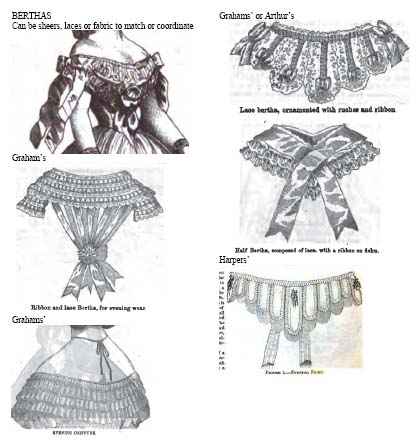
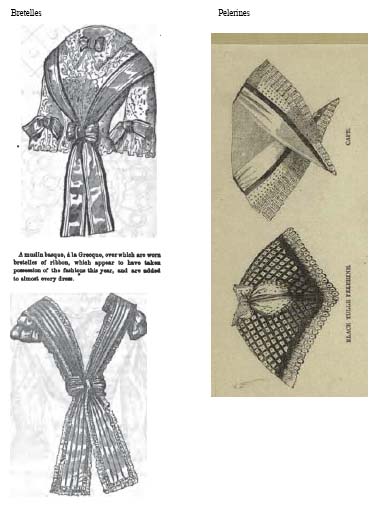
The MET has several fichus, berthas, etc in their collection. Here are a couple examples:
Mid-century lace
British silk
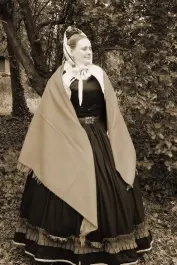




 If I Had My Own Blue Box: