Visuals for Dressing Your Table

 It appears my article on Dressing Your Table in the most recent Citizen’s Companion has sparked a few questions about how to dress specific tables. This is great because it means people are thinking about their tables. I am starting a follow up article that will look at dressing tables for various situations. In the meantime, I hope these images are helpful. Don’t just take them as a rule book – look, think and evaluate.

Recreated Examples:

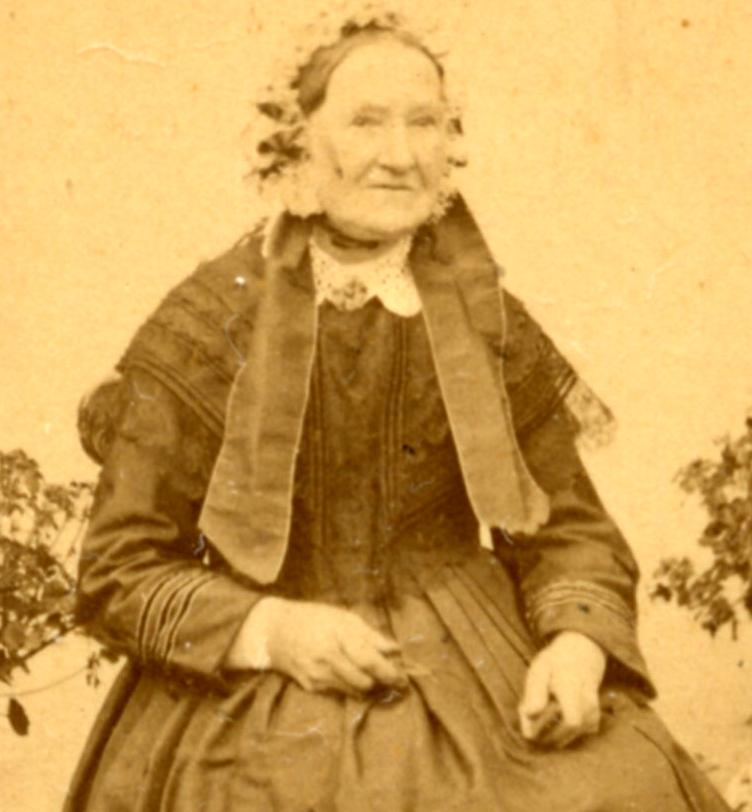
Livingston-Backus House  at the Genesee Country Village and Museum. (c 1850s) (have to point out this person also took a picture of Grandma) Same house done for Yuletide. I really think this needs a cloth.

I think this is Jones Farm done for the Yuletide program at GCVM. It is a working class farming family’s home normally interpreted 1850s.

McKay Kitchen dressed for Yuletide. Another working class family that is a little better off. Usually interpreted 1840s.

Dining room in the Hyde House also known as the Octagon House at the Genesee Country Village and Museum. (c 1870s) Another

Kitchen of the Hyde House (I don’t think this choice would be acceptable for the 1850s)

Dining room in Hamilton House (c 1880s, GCVM) another and another

Family Dining room at Hosmer’s Inn (c1818 interpreted 1830s) Public Dining Room

Examples from Paintings:

White Clothes

Family Life on the Frontier by George Caleb Bingham (c1845) where it drapes a large table.

Another drapes a table in home with more means in The Contest for the Bouquet by Seymour Joseph Guy (c1866).

Most still lifes I have saved also show a white cloth (or now cloth). Each of these show tables set with food. A few examples: several by John F. Francis, Fruit Still Life with Champagne Bottle by Severin Roesen (c1848)

Colored Coverings

 Francis William Edmonds’ Barking Up the Wrong Tree (c. 1850-55) a red cloth covers a small table. This cloth has either a yellow or golden double stripe border. This is a modest working class or  lower middle class home.

Parlor table

Lady in an Elegant Interior by David  de Noter (c. 1852). This round table in what appears to be a parlor is draped in a red patterned cloth which has colors that remind me of paisley shawls (though I doubt this is a shawl.) The cloth is rather tossed or roughly draped.

A small table in Christmas Time by Eastman Johnson (c1864) has another red patterned tablecloth. This one is neatly draping the table.

A dark green cloth with a decorative border drapes a parlor table in Lilly Martin Spencer’s Patty Cake. Another lovely green cloth is draped over a round parlor table in Reverend Atwood and His Family (page 5). This cloth has what appears to be a woven in border type design. This is a similar cloth as well.

One table I am not sure about is in the painting The Song of the Shirt by John Thomas Peele (c1847). The woman is working on her sewing. I don’t know if the yellow fabric with holes draped across the table is a table cloth or simply a piece of cloth.

Kitchen Tables

Kitchen tables, used for work, are shown without clothes. Examples would be The Speculator by Francis William Edmonds (c 1852), The Young Wife: First Stew by Lilly Martin Spencer (c1854), Kitchen Interior by Thomas Hicks (c1865)

This is an example of a painting and a recreation at an exhibit at the Wehle Gallery at GCVM. Notice how the cloth has been removed from the table while she works. I think the cloth in the painting would have just reached over the edges of the kitchen table like those described in advice books. This would have been a utilitarian cloth not a damask.

Cloth Free

Long cloth-less table in the 1821 painting The Dinner Party by Henry Sargent. That cloth free table goes against everything I’ve read about setting a table for dining. There are a few tables from Shaker communities here in Stereovies without clothes.

Illustrations:

1859 Fifth Ave. Hotel NY

1864 Soldier’s Depot Dining

Photos:

This is Tea not a dinner  a colored table cloth.

1870 hotel dining room, 1885 hotel dining room

Orphans home labled 1870, possibly earlier looking at her dress

Other images:

This link shows the same dining room in different centuries. This is England but still interesting to see.

It is to bad these images don’t go back further in time…. White House Family Dining Room and State Dining Room

This is a virtual tour of a later dining room from much further up the socio-economic scale. (I have trouble with the lace cloth for the dining room in the mid-century. I don’t know about later in the century. Directions for making lace cloths seem to me to be meant for parlor or sitting-room use not for eating on.)  

Thoughts….

I do have to say, while putting together images for this I’ve developed the distinct opinion that not enough table cloths are used when a table is set. Cloths protected tables from more than just people’s spills. Advice books often start thier directions for setting a table with heating a room and removing the table cover.

Published in: on March 26, 2010 at 1:36 pm  Leave a Comment  

Examples of Tableclothes and Covers


pre 1800

Late 18th century

Table cover late 18th century

Mat, 18th 0r 19th century

1800-1839

Woven, coverlet tablecloth, PA c1800

Cover or cloth, long but not wide enough to fall over sides of a table, c1800

Quilted cotton table cover

Table cover

Table cover, linen plain weave with cotton

1840-1869

Block print floral table cover 1859

Wool, bordered, size for a parlor or sitting room table

Embroidered linen with wool for parlor

Part of a linen damask note the patching

Table cover from 1851 Grand Exhibition Not for dining on.

 1870-1899

Illustration 1889 table or piano cover

c1895 English

C-1900

German c. 1900

English c1900, English c1900, Another

Published in: on March 26, 2010 at 1:36 pm  Leave a Comment  

Ribbon Findings


from ebay

from ebay. I like this one because it shows a frayed edge.

ebay. Also look at this end.

ebay. Narrower plaid hair bow

Published in: on March 23, 2010 at 5:30 pm  Leave a Comment  

Book Reprint

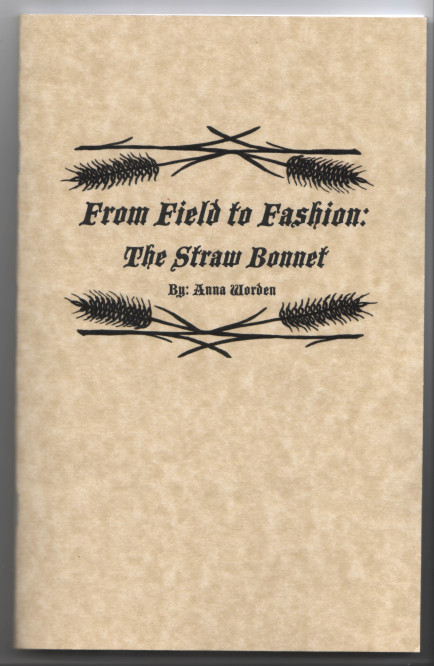
For those waiting for  From Field to Fashion to be reprinted….. I am finally reprinting it!

I am doing my best not to increase the price which was previously $10.00. If interested, please email me or add a comment (which gets to me via email). If all goes right, they should be ready in April.

bookletscan

From Field to Fashion is a 46 page booklet with the following sections:
– Straw Bonnets and the Straw Bonnet Industry
– Straw, Harvest and Preparation
– Straw Plait
– Straw Cloth
– The Straw Bonnet Base
– Industry and Labor
– Finishing the Straw Bonnet
– Who Wore a Straw Bonnet When?
and an Appendix:
1 – Original Bonnets Online
2 – Bonnet Production in Massachusetts, 1855
3 – Millinery Establishments by State, 1860
4 – Straw Bonnet Shapes
5 – Fashion Quotes from Harper’s Monthly & Weekly
6 – Fashion Quotes from Godey’s Ladies Book
7 – Straw bonnet quotes from fiction
8 – Wheat and Rye produced, 1850 & 1860
9 – Straw Industry Statistics
10 – Straw and Bonnet Related US Patents

Ribbon info requested at the Conference


Someone requested the color, width and design charts. Here they are.

Feel free to ask questions or comment.

Published in: on March 8, 2010 at 6:33 pm  Leave a Comment  

Conference Dress

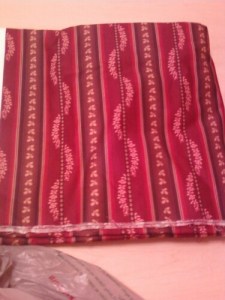
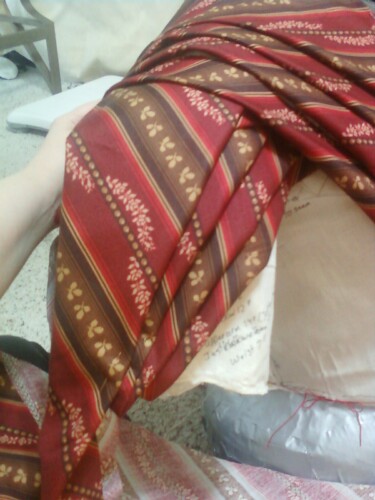
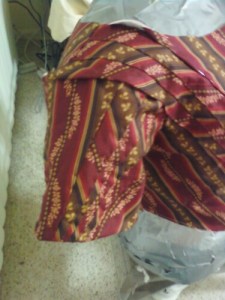
Now that the Conference has passed, I can put up some notes on my dress. Here is the fabric:

I was hoping for stripes or a plaid. When seeing the fabric, I just had to give the bias strips a try. This was my inspiration dress. 

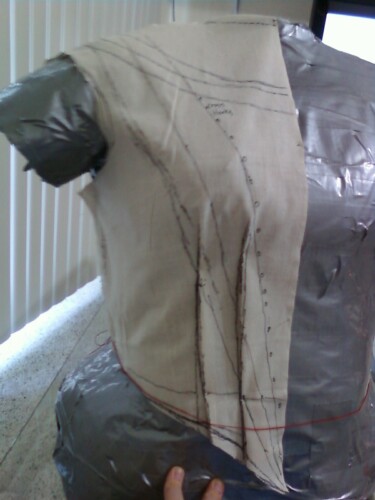
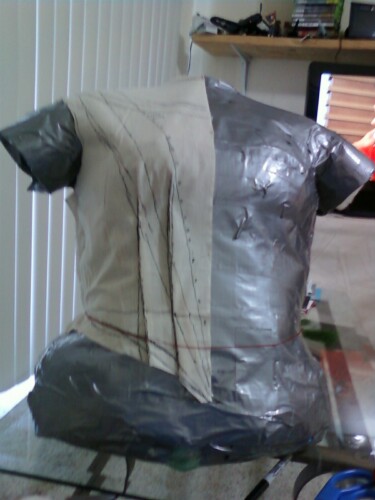
Dan helped me with a new duct tape dummy. Then came the fun of draping.  

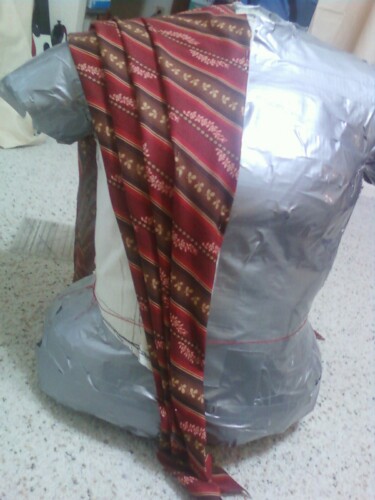
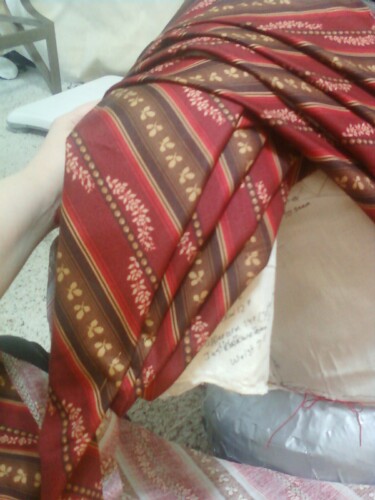
The bias strips were cut 3″ wide. (I did goof originally and cut them all the same direction.) At first the strips were laid straight. Then I tried to ease the strips in towards the center a bit. These then got tacked to the lining from the outside in. The center piece closes across to hook on the left side diagonally.

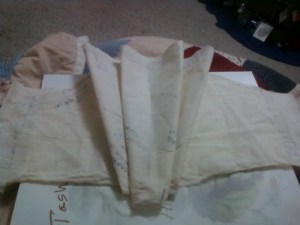
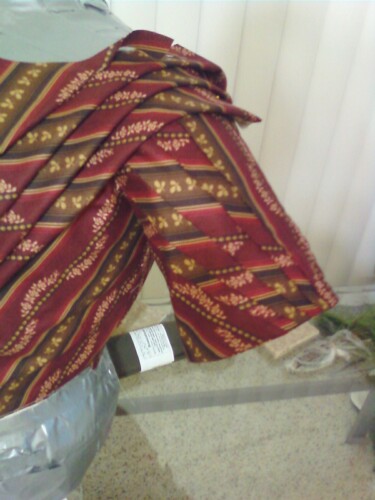
When thinking out the sleeve, I was tempted to pleat a solid piece. Then I realized I could use the bodice technique on the sleeve. The flat pieces were tacked to the lining first then the bias pieces, again from the outside in.

Here is some of the draping as I worked on that idea.

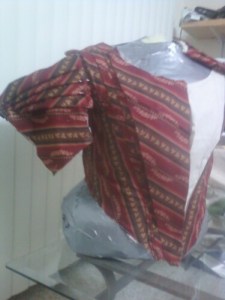
Although the sleeve idea came together after the bodice idea, the sleeves got done first. Here is one sleeve attached while I was working on the bodice bias strips. (sorry for it being blurry.)

Here the strips were getting attached to the lining with top stitching. The sleeve is pinned in place just at the top.

Here is the sleeve tacked in. This is before the shoulder seam was finished with the bias strips.

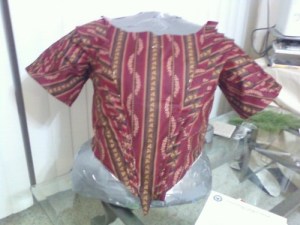
These are the last two pictures I took (sorry). The center front piecs is pinned on waiting to be stitched

I’ll try to remember to take some pictures of the finished dress and point out some of the details.

Published in: on March 8, 2010 at 6:27 pm  Comments (3)  

Another Fichu

I finished a fichu like the first one. This one is in cotton voile.

I am making a list of fabrics to order in a few weeks. Right now I plan to order more cotton voile, silk organza, some net, and maybe a striped voile. If you have any thing you would like to see done up, let me know and I’ll see if I can order some fabric.


Published in: on February 7, 2010 at 2:23 pm  Leave a Comment  

For sale soon

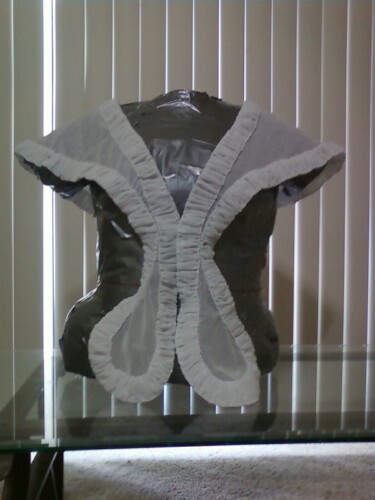
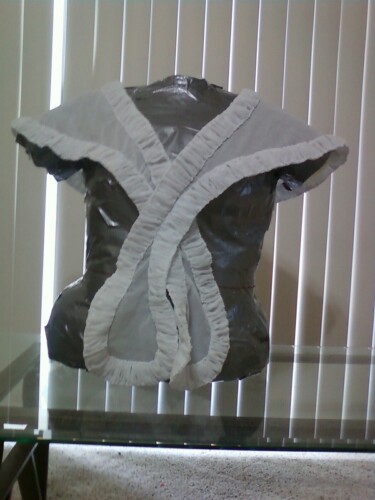
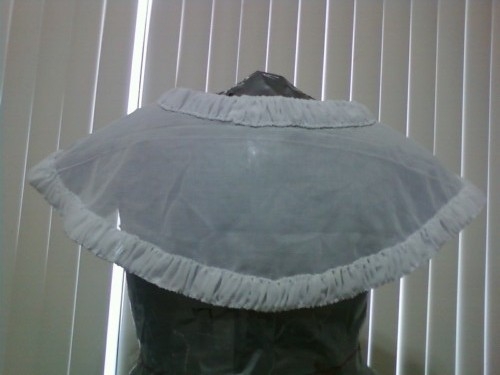
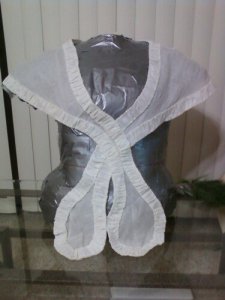
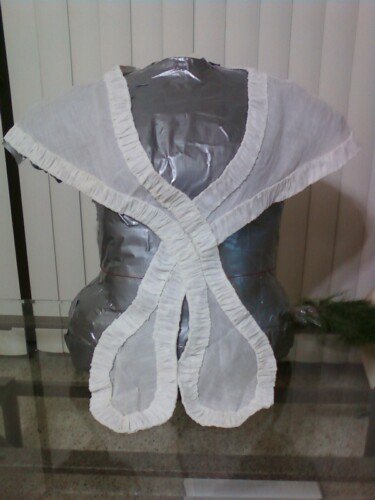
I am going to start making sheer outerwear such as the fichu and pelerine below soon.

Fichu based on a Godey’s 1859 pattern, in white cotton lawn

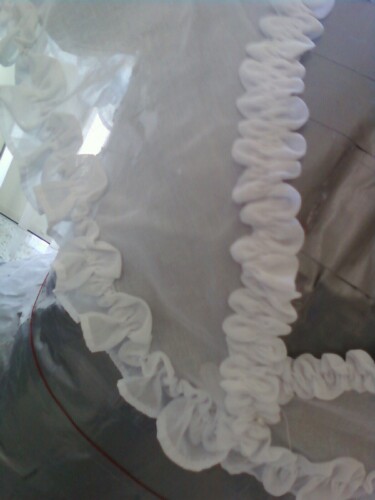
Pelerine in white cotton voile with scalloped ruching and ruffle.

Published in: on February 3, 2010 at 5:53 pm  Comments (4)  

Table Linens – Part 3

A passage in the 1845 The Ladies’ Work-Table Book’s,  1845 section on plain needlework is nearly identical to a section in Sarah Josepha Hale’s The New Household Receipt-book.

“Table Linen – This department of plain needlework comprises table cloths, dinner napkins, and large and small tray napkins.

“Table Cloths. – These may be purchased either single or cut from the piece. In the latter case, the ends should be hemmed as neatly as possible.

“Dinner Napkins. – These are the various materials; if cut from the piece, they must be hemmed at the ends the same as table cloths. Large and small tray napkins, and knife-box cloths, are made in the same manner. The hemming of all these should be extremely neat. It is a pretty and light employment for all young ladies; and in this way habits of neatness and usefulness may be formed, which will be found very beneficial in after life.

“Pantry linen. – In this department you will have to prepare pantry cloths, dresser cloths, plate basket cloths, china, glass and lamp  cloths, and aprons. Pantry knife-cloths should be of a durable material. The dresser cloths, or covers, look neat and useful. They are generally made of huckaback of moderate fineness; but some ladies prefer making them of a coarser kind of damask. The plate basket cloth is a kind of bag, which is put into the plate basket to prevent the side from becoming greased or discolored. They are made of linen, which is well fitted to the sides, and a piece the size and shape of the bottom of the basket, is neatly seamed in. The sides are made to hang over the basket, and are drawn round the rim by a tape, run into a slit for that purpose. China cloths, and also glass cloths, are to be made of fine soft linen, or diaper; and the cloths used in cleaning lamps, &c., must be of flannel, linen, or silk. All these articles are to be made on the same manner, that is, hemmed neatly at the ends; or if there be no selvages, or but indifferent ones, all round. Nothing looks more slovenly than ragged or unhemmed cloths, which are for domestic use. Little girls of the humbler classes might be employed by the more affluent, in making up those articles and a suitable remuneration given them. ….

There was an interesting passage of the August 17th entry of the 1864 Book of Days:

“‘Table-cloths’ have been in use in Englad certianly since the Saxon period, and in that and every succeeding era.  The word ‘napkin’ was fomerly applied to handkerchiefs and table-linens, as well as to cloths for head-dresses, &c. ‘Napery’ was the general term for linen, especially that for the table. ‘Towel’ requires no explaination.”

Additional Reading:

The Linen Trade, Ancient and Modern by Alexander Johnston Warden 


Published in: on October 31, 2009 at 12:43 pm  Leave a Comment  

The Travel Experience and Proving a Negative

Two random thoughts kept me awake for a while the other night, the experience of travel and proving a negative.

The first was spurred on by an audio book about the Rev. War I am attempting to listen to on the way to and from work. One of the characters was traveling by some type of carriage on a muddy, rutty road. In the story, he was trying to keep his mind on something other than the tossing and rocking of the carriage. Of course this got me wondering about what it was actually like to ride for an extended time in a carriage or stage. Several months ago I wrote about travel in regards to the modes and prescribed etiquette. This pondering is more about the actual experience. In our modern car travel we have radios, heaters, air conditioning, artificial light, adjustable seats and so on. On the hour plus trips we tend to take frequently, I curl up in my seat, talk with Dan, check my mail, make shopping lists. I have lots of space and a comfortable seat. Thinking about what I might do on a journey in the 19th century, I first thought I would bring needle-work or a book like is often depicted in movies. But then I started wondering about the amount of natural light in different vehicles. We are accustom too much more artificial light in the present-day. How much natural light would a woman have wanted to do her needle-work or to read by in a closed vehicle? I’m not sure how much light makes it into some of these vehicles. The carriages I usually see used at various events are open or have a roof that can pull up. There is plenty of light in those. When I see closed vehicles, they are in generally on display inside carriage barns. In those situations it is difficult to determine how much light gets in a vehicle when there is limited light inside in the first place. I wish I would have paid more attention on the occasions at the museum when more vehicles were out for use.  The next piece I wondered about is the actual riding.  I was trying to imagine what it was like to travel in a closed vehicle in a mid-century dress. As I mentioned, I like to curl up in the car. There is a huge difference between me in my jeans or a little modern dress and the cloths from mid-century. I know what it is like to ride in a late century train car with a cage on. The seats are comfortable for an adult woman and a child. But the seating is tight for two adults and extremely tight for two adult women wearing 100″+ cages. In our experience, with the larger cages one woman sits down then the other sits with her skirts on top of the other. This can be Highly inconvenient. With smaller cages, 90-100ish inches it is possible to sit side by side with our skirts tucked to our sides quite comfortably. I wish I knew how the dimensions of these seats compare to the seats of the 1850s. The width, depth, height and space between them would all be factors. So would the aisle width and storage spaces. Even though the seating was tight, I didn’t find it overly uncomfortable because the space was open, air could move around the car and the window let in plenty of light to see by. Would these three aspects still be available in a closed horse-drawn vehicle? Would a mid-19th century woman place as much importance on them as I do?

On to the second pondering….

On of the struggles we have in researching what was or wasn’t available, popular or fashionable during the 1850s and 60s is proving/showing that something wasn’t. With finer points of fashion we can sometimes find a reference to something falling out of fashion. Great! But what about aspects of material culture that don’t have convenient textual references holding against them? When the concept of proving a negative was mentioned in a recent email discussion, I seriously stared thinking about what the process might be or the process I would take. (Okay, so when I am stressed and can’t sleep my mind wanders on the oddest of subjects.) The project that came to mind was the research on folding chairs. While I didn’t start our to prove a negative, in a way that is what I faced for the civilian use of folding chairs. While folding furniture had been around for centuries, the use of folding chairs was not prevalent for domestic use during the first half of the nineteenth century. The reemergence of folding furniture, also referred to as patent furniture, coincided with the onset of the Civil War. What became a vast array of beautiful and creative domestic and travel furniture in the later half of the century, began as functional pieces with a military purpose. Looking at this example it is possible to chart the frequency of patents and advertisements through the century. Doing so, we see the start of chairs for military use and the transition into the domestic sphere. Additionally, we can look at the patents for this furniture and the manufacturing establishments. We see when those contracted for the military moved to producing domestic folding furniture and when their establishments grew. So, my approach to proving a negative requires looking at the timeline  or spectrum of the subject matter’s existence and production; looking at when something was in use/favor, when it emerged, when it declined, what was in its place if anything. It would have been nice to have some of my former science wing coworkers to ask how they would scientifically approach proving a negative.

Published in: on October 31, 2009 at 12:16 pm  Comments (1)