Cuffs, Collars and Undersleeves

In honor of Georgiana Goldsmith’s “Committee for Cuffs and Collars” (a Facebook post)  here is a pdf image of cuffs, collars and undersleeves  used in a workshop Bevin and I did a few years back. To add to that, here is a 52 page PDF of collars clipped from Peterson’s and Godey’s Magazines.

And from more recent purchases….

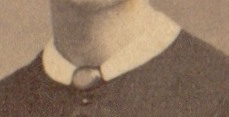
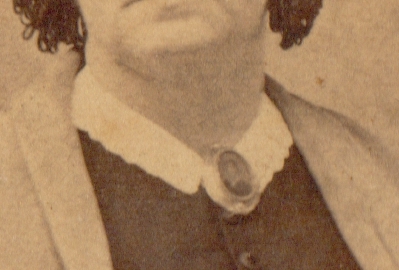
This is image is earlier, likely in the 50s based on her dress and sleeves (there is a reason you can’t see the whole image of each of these. Apologies.) Her collar is wider than what we see in during the CW years.

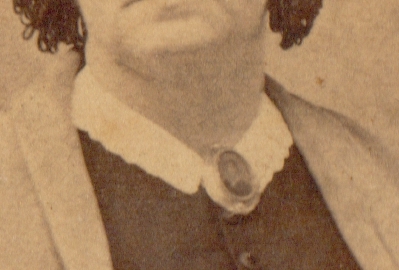
This collar is more typical of the width seen during the CW years. Note how the opening is nearly horizontal. You will see variation in this opening. The edge of this collar, as well as the one in the next image, is rolled and straight.

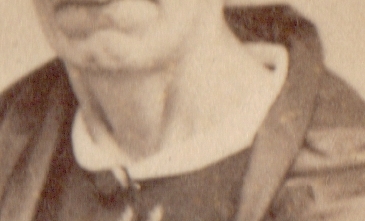
Look at the back of the neck. This image shows the collar wrapped around the edge of the dress’s neckline. Also notice how the collar narrows in the front. It may or may not have a slight curve as it disappears behind the broach.

In contrast to the image above, these next two show an edge above the collar that could possibly be the dress. If this is the edge of the dresses we are seeing, these collars may be tacked on the exterior. (This could be looked into further. *There is a discussion of this on The Sewing Academy.)

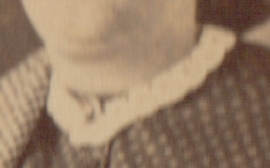
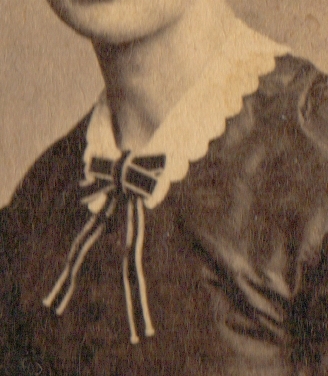
In the next three images you see collars with scalloped edges. These would be finished by hand. I’ve enlarged this image a bit because I know you will want to get a good look at her broach. While looking at her broach, notice the angle of the collar opening along with the width of the collar.  
This collar has rather deep scallops with a diagonal opening. The bow has double loops and moderately long tails.
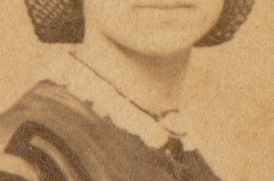
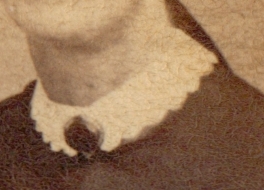
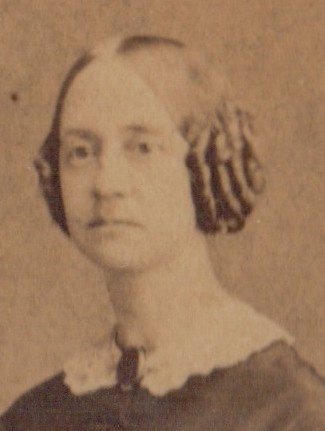
This collar appears to completely close in the front. It is slightly higher on the neck than the previous images.


Published in: on March 26, 2011 at 5:01 pm  Leave a Comment  

The Usefulness of a Jacket – Godey’s 1858

This is a clip from Godey’s, 1858, I had in my “Distracting Odds and End” folder. It simultaneously speaks of the commonness of a shawl and the usefulness of a jacket.

 Hints on Jackets – When to Wear Them by Mrs. Damas Few things that we wear are, in my opinion, more comfortable than a jacket. There are various sorts, morning and evening- jackets, for young and old; but what I would first wish to call attention to is a comfortable jacket, one that can be worn at any time, the first thing in the morning, and the last thing at night. Mothers of families would do well to have such a one. It is a common practice with many to draw on a shawl; and, as this is generally done in a hurry, it rarely covers the chest, and requires one arm to hold it on. The jackets I now speak of are within the reach even of the poor. The skirt of an old gown, washed, will make a very good one; and to a poor woman it would be a very charitable gift, not to mention the great comfort of it. There can be no difficulty in deciding which looks best, an old shawl put on in a hurry, or a tidy-looking loose jacket, even if made of an inferior material. For the bedroom or house, a washing material should be chosen. If colored flannel is too expensive, a thin wadding put in between the lining and outside is warm and comfortable. Brown calico is sufficiently good and warm for lining, should that be preferred to wadding; but, for invalids, wadding is lighter. These jackets are by no means intended to fit the figure, but merely to sit easy and comfortable. To invalids, they are a great comfort to slip on if they have occasion to go into a cold room, or to wear under a shawl. A girdle or ribbon may be tied round the waist where additional warmth is required. Many ladies, as the winter comes on, give presents of warm petticoats, which are certainly a comfort. But still a substitute is wanted for the woman’s thin cotton body at top; and what better substitute could be offered than a warm jacket? For children, nothing can be so good as a jacket. It leaves their arms free, which is of great importance to them. Indeed, to obtain this freedom, they frequently throw off a cape or shawl, and thus expose the chest and neck, both of which require to be kept warm. Many persons have only one fire to sit by, in which case, should there be four or six in a room, it is almost impossible for one or two not to feel cold. Let those that do slip on a jacket, and they will then feel as warm as those near the fire. I by no means advocate wrapping up too much; but, when occasion requires a little extra warmth, I think that all who know the comfort of it would say that nothing can surpass the jacket.

Published in: on March 23, 2011 at 3:19 pm  Comments (2)  

Dan’s Birthday Present

At one point I was under the dillusion that I would make my husband this beautiful white shirt for his birthday. But, as it t turns out shirts intimidate me. Instead, I went looking for a print for him, an eagle print since he likes eagles. What should have been an easy task wasn’t. There were so many nice prints. But, none of them spoke to me. None, that is until I came across the piece called Wings over Antitiem by John Neal Mullican.

This print was just right. It had the eagle Dan loves and it had to do with the Civil War. (For those of you who don’t know, he and I met reenacting years back.) The print itself just has that nice feel to it. It had to be the one for his birthday. So, I ordered it.

The print arrived on our anniversary. It was very tempting to give it to Dan then. But as it arrived just a little over an hour before we needed to leave for dinner all rolled up in a tube, it had to wait. But, the artist was kind enough to include a mini-print of another eagle print of his I was thinking about. The color in this American Bald Eagle is beautiful. I decided to slip that into Dan’s card which I gave him at dinner.
The artist also included a nice letter about the how the piece developed and some additional information. Looking at his other works, I think we will be looking to buy atleast a couple more pieces. All of his birds are just eye catching. His Barnyard Quartet reminds me of the babies each year in GCVM’s bird boxes.
Since Dan’s birthday landed in the middle of a work week where he was working hours when we wouldn’t be seeing each other, we celebrated his birthday on the weekend. His cake request was a chocolate cake with a strawberry-raspberry filling and Italian Sweet Cream frosting. For dinner, he asked for corned beef, cabbage and potatoes.
Now, we just have to decide on how to frame the print.
Published in: on March 19, 2011 at 1:45 pm  Leave a Comment  

Pasteboard box

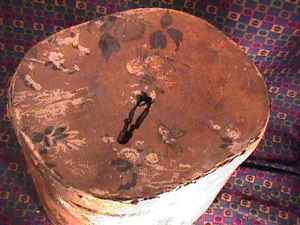
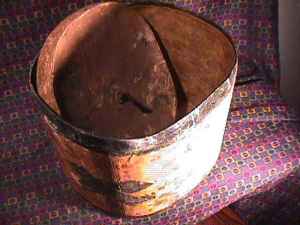
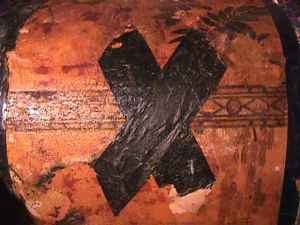
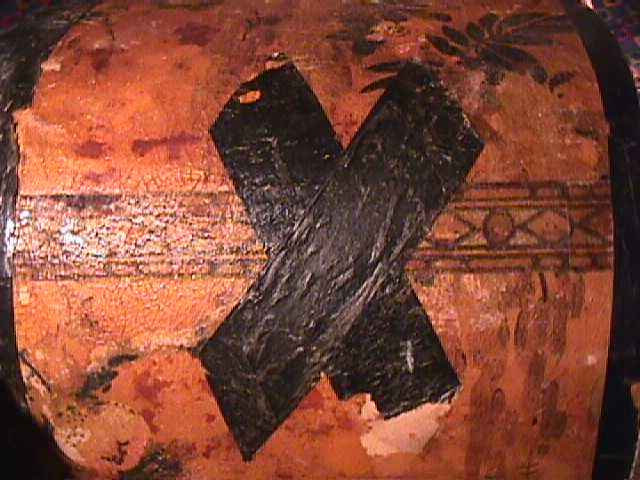
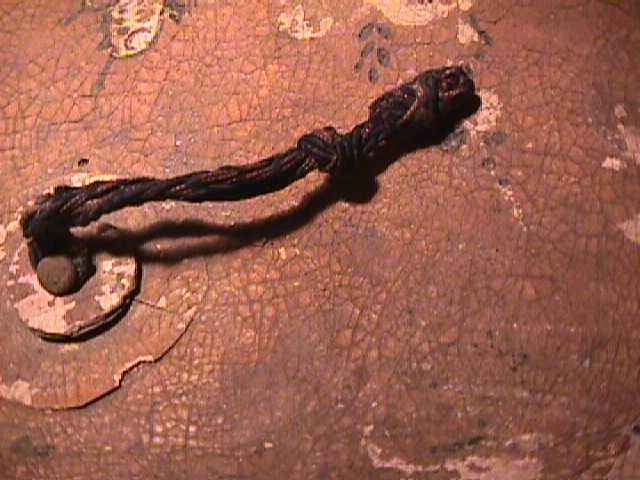
As I was going through photos of Dad, I came across this set of photos of a pasteboard box he had at one point. I don’t have any measurements. From memory, I think the box was about 10 to 12 inches tall and possibly 10 inches wide. I don’t have any notes on the dating or construction. Please just enjoy the photos and offer comments if you wish.

Here is the lid sitting inside and a detail of the cord on the lid.

I don’t know what is going on here. This would be the bottom of the box.

Published in: on March 17, 2011 at 7:00 pm  Leave a Comment  

The Power of Myth – Part 2

As educators, interpreters or reenactors we often encounter myths while working with visitors. These myths can range from a long propagated mis-truth to a family story. When facing these myths we need to find a way to educate while ensuring a good visitor experience.

In my opinion, the type of myth you need to be the most careful about when addressing it the family myth. This is a myth a person has grown up with, believing about their family. It is one which may or may not be rooted in fact, developing or evolving through the years. A family myth can come up at almost any time in a discussion with visitors. They may believe they have a connection with a person, a building, an artifact or a moment in history. The catch is, you have absolutely no idea whether their story is history or myth. With a visitor centered approach, I suggest you listen to what the visitor has to share. Even if everything they are saying doesn’t quite fit with what you know, listen. If you don’t listen to what they are saying, chances are they aren’t going to want to listen to you either. While you are listening, really listening, try to determine what level of additional information they will be receptive to. Some people will be open to a whole different version of the story, the researched and documented research you can provide. For these individuals, first compliment a specific aspect of what they shared, hopefully a piece that is documentable; then offer additional information beginning with a phrase such as “my understanding….” Be certain to offer the visitor a resource or two to go to for their own research such as a book at the library or website that is easy to find. For others, who are significantly attached to their story, possibly in an emotional way, an “opening the door” approach will allow the visitor to hold their story while you offer them a direction for self- inquiry. After acknowledging their story and offering a specific compliment, you could open the door with “have you looked at….?” or “I would be curious to know more about…” Yes, this is an extremely soft approach. But, you are allowing the visitor to retain the integrity of they family myth while encouraging research based education and giving the visitor a good customer experience increasing their likelihood of returning.

I’ll confess, teacher led myths  are the ones that really push my buttons. It is exceptionally challenging to have a tour designed for a class when the teacher continuously interrupts, pulling the students in a different direction filled with inaccurate information. It is also challenging to be giving an in-class presentation only to find the teacher has or is instructing with inaccurate information. Whether you are in their arena or yours, the key to avoiding these issues is communication before the visit. Provide the teacher or teachers with an outline of the tour or presentation as part of a teacher packet with grade specific information and resources. Most museums have a teacher packet for visits and outreach which include pre, during and post visit materials. If you are working with/for a museum, be sure to know this packet well. During one of your initial conversations with the teacher(s), ask about where your talk will fit into their teaching plan or curriculum mapping, what the students will have already learned, what points he or she would like you to address. This is an ideal time and way to focus or tweak your presentation plan and identify any potential areas of inaccurate information and provide the teacher with correct information and/or resources prior to being in front of the students. Of course, you may still have a surprise in the middle of a great talk with a group of students. In these cases, you need to convey the correct information and the importance of documentation all while still supporting the teacher. Yes, it is possible. You can start with something like “That information/story comes from ____. But, new research shows _______” or “That is true for these instances _____ But, at this time ______” (Teachers are one of the few groups you can get away with using the word “But” with without being defensive. They teach the use of the word. For most other people do you best to use words such as “and” to redirect the information.) Be certain to provide the teacher with resources to further research the information new to them after the conclusion of the talk.

Enough typing for tonight. I guess there will be a part 3. In the meantime, for regular postings regarding history myths, subscribe to History Myths Debunked. I enjoy the weekly posts.

The Power of Myth – part 1

In a field where we focus on research, facts and supportable evidence we often come across stories or explanations that are less than true. At times we find these un-supportable, un-documentable, un-researched tales to be irritating, unsettling or just pressing a button. I’m sure for many of you a particularly popular or unpopular myth often used as a marketing ploy comes to mind.

According to the Oxford Dictionary, a Myth is “1) a traditional story, especially one concerning the early history of a people or explaining some natural or social phenomenon, and typically involving supernatural beings or events; traditional stories or legends collectively:the heroes of Greek myth. 2) a widely held but false belief or idea:he wants to dispel the myth that sea kayaking is too risky or too strenuousthere is a popular myth that corporations are big people with lots of money; a misrepresentation of the truth:attacking the party’s irresponsible myths about privatization; a fictitious or imaginary person or thing; an exaggerated or idealized conception of a person or thing:the book is a scholarly study of the Churchill myth.” Comparatively, Folklore is the “traditional beliefs, customs, and stories of a community, passed through the generations by word of mouth; a body of popular myth and beliefs relating to a particular place, activity, or group of people.”

Our world is full of myth, folklore and tall-tales that have a great impact on how we perceive the world around us. There are monumental stories we learn in school or through progressing media, books, television and movies. How many of us remember being intrigued by a tale from Arthurian legend or the stories of and Robin Hood? There has been a recent resurgence of Greek and other ancient mythology seen in our movie theaters and working its way into television story-lines. While this grabs the newest generations so captivated by media, we all can see how mythology has worked its way into the art, architecture and stories of almost any generation. Looking at a more personal level, we each have the deeply personal family stories that may have a foot-hold in truth or may not. This could be a story about great-great-great-grandpa discovering gold in the back field of the family’s farm or the story of how the family came to live here or own “this” artifact.

As historians and interpreters we come across a few different types of myths we encounter.

  • There are the myths and tales of folklore which have grown with our nation similar to the monumental stories mentioned above. These include stories about our founding fathers, presidents, and iconic leaders such as the story of George Washington and the cherry tree. We could also include stories such as those about Paul Bunyan and Babe the Big Blue Ox. Many of us in my generation learned these stories in school as a precursor to learning chronological history.
  • There are the family history myths which include stories of family history and what a family memento might be. Often times we here that a great-great-aunt so-n-so was at the first Women’s Rights Convention or that on a family dad’s-dad’s-mom’s-mom’s side they are related to someone important. These stories may or may not be true. But, to the individuals who grew up with them, they are extremely important.
  • There are the stories or explanations for something that developed about an event or item well after the contemporary era. In the areas of material culture we see this a great deal. This would include the previously alluded to marketing motivated myth above which began in the 1990s, nearly a 150 years after when the myth addresses with no plausible documentation. A good many myths about the 1700s and 1800s developed during the 20th century . In some cases the propagation of myth was unintentional due to research flaws whether narrow information, anomalies, or a missing piece. In other cases, the propagation of not-true, un-documented information was intentional.

In part 2 we will look at techniques for dealing with these myths.

Barbara Smith’s “My Dreadful Farby Snood”

This incredibly funny song was written by Barbara Smith after being inspired by Anna Allen’s Farby Snood.

MY DREADFUL FARBY SNOOD

Lyrics by Barbara Smith Inspired by Anna Allen
www.thegracefullady.com/civilwargowns/ready-mades_farbysnood.htm
Sung to the tune of “Oh My Darlin’ Clementine”
April 11, 2008

On a Website, or was it Ebay?
Trying hard to make a dime,
Dwelt a re-en-actor merchant,
Selling LOVELY nylon Snoods.

CHORUS:
Oh my dreadful, oh my dreadful,
Oh my DREAAADFUL Farby Snood!
Wish you were LOST, and gone forever
How I loathe you, Farby Snood!

Bright it was, so color-ful-ul,
Hypnotiiiiiiiiiizing were his wares,
Authentic help so close at ha-and,
To help me hide my Modern Hair.

CHORUS

Clicked the mouse-y, paid the PayPal,
And my Snood, was winging home!
No more tears o’er my poor hai-air,
My Lovely Snood would cure it all!

CHORUS
 
Morning of the, next Encampment,
found me spooooorting my new Snood,
Rainbow Bright could do no better,
Imagine my so sunny Mood!

CHORUS

Promenading, through the Ca-amp,
Head a-blaze just like the sun!
What’s that titter? What’s that chortle?
It’s at ME, they’re poking fun!

CHORUS

Now you ladies, may just learn the,
moral ooofffff my little tale –
Trust you not that scheming sutler
Avoid like fire, the Farby Snood!

CHORUS:
Oh my dreadful, oh my dreadful,
Oh my DREAAADFUL Farby Snood!
Wish you were LOST, and gone forever
How I loathe you, Farby Snood!

Published in: on March 1, 2011 at 4:30 pm  Comments (4)  

Presenting the Lives of Women in Different Social Situations

Repost – This post was originally posted in January 2009


While reading the first three chapters of The Other Civil War, a presentation idea came to mind. The idea stemmed from a clothing accessory presentation/discussion method Bevin and I were discussing that I believe Liz posted on the Sewing Academy.

The original accessories presentation took three or four women from different socio-economic positions and accessorized them. This would include a poor woman, a working woman, a middle-class woman and a leisure class woman each dressed in a basic dress. The visual would be best if their basic dresses were similar with just slight variations for class such as a basic brown wool dress or brown silk dress. Accompanying the women is a table of accessories the women may wear mixed together including aprons, bonnets, jewelry, gloves, shawls, parasols, etc.. The audience would work together to accessorize each of the three or four women with appropriate items. The end result should transform a group of slightly varied women to individuals distinctly dress for their social positions.

The presentation inspired by this text focuses on the daily lives of women from different social positions. This will require several women distinctly dressed to represent different social positions. Ideally these women would fully span the civic and economic ranges both North and South including a slave woman, a very poor woman, a free black woman, a working woman, a middle class woman, a plantation mistress, a northern leisure class woman, and etc. Each woman would need to be prepared with the information about what their life was like. They should each know about the lives of women like them – their work and leisure, dreams and hardships, freedoms and restrictions, rights and isolations.  They would start with a dramatic presentation of who they are with a short autobiographical speech to start with. Another option would be an excerpt from a woman similar to the position they represent. After all have introduced themselves, they can interactively  discuss their lives and possibly answer audience questions.

To do this in a school setting, a photograph of each woman would be needed. I suggest a modern color photograph so the students can really see who they are looking at. A one page ‘autobiography’ would be prepared for each woman along with a life fact sheet. (These could also be used as a teacher packet for pre or post visit materials.) During the presentation, select a student to read the autobiography (length according to age/grade.) Discuss how each woman’s life was similar and different.

Published in: on February 27, 2011 at 9:23 am  Leave a Comment  
Tags:

CW Reenacting on a Budget, a Minimal Budget

Repost – This was originally posted in January 2009

As anyone who has been in this hobby for a few years knows, historical reenacting can become quite pricey. Hobby costs, money and our personal budgets can be a very sensitive subject for most people. But, if I can be willing to talk on the Sewing Academy and at workshops about the challenges of extra body padding, I should be able to be share about the challenges of a purse without padding. Right? To start, I am a teaching assistant, which means my rewards definitely come from working with my students, not in dollar signs and the cost of my education exceeds my compensation. With that in mind, I’ve been very creative in stretching my reenacting budget over the years. One thing I want to emphasize before continuing, stretching the budget and saving money does NOT mean sacrificing authenticity. In the long run, sacrificing authenticity is far more costly because that means you’ve spent money on something you have to replace down the road.

The first two steps to keeping within a tight budget are very intertwined – Research and Planning.

Keeping up on current research and doing your research is key to focusing on what you need and what is accurate. The most inexpensive ways to keep up on research is to join some of the online discussion groups. There are several forums including the Sewing Academy, the Authentic Campaigner, the West Coast Campaigner, and the CW Reenactor Discussion Forum. There may also be smaller forums for your geographic area or your particular area of interest. There are also many list-servs discussing a variety of topics from general reenacting to specific event preparations and general fashions to particular skill areas. You can find this through places like Yahoo Groups or Google’s services. There are some discussion groups on social networking sites as well. There are several very useful websites on the internet. But, please be cautious. Some websites do not have the most up-to-date or documentation supported information. A website could look wonderfully put together, but be greatly lacking in good information. Never rely on one source for any piece of information. Always look for supporting documentation. Reading is an essential part of research. It can also be a costly part of research when you start filling your personal library. This is where your local libraries can be helpful in previewing books prior to purchasing them. (I’ll be doing a separate blog entry on libraries in the research section.) There are several periodicals directed towards the CW and/or mid-century enthusiast. The Citizen’s Companion is published with the CW civilian reenactor in mind.  This publication now includes The Watch Dog. The Civil War Historian has sections specifically for civilians. The Camp Chase Gazette and the Civil War Curiour are more military centered. You may also be interested in history journals. These can sometimes be read through library databases.  Some Museums and Historical institutions publish newsletters or journals with very informative articles.

Planning includes planning your budget, planning your events, planning your wardrobe, and planning your material culture needs. Start with determining just how much you are willing and able to spend on your hobby. You can approach this in a few different ways. This could be a yearly amount, a monthly amount, or an amount coming from one source such as a second job. Also, explore what skills you may have to barter with. (more on bartering later.) When planning your wardrobe and material needs, the goal is to purchase or make once for the long term. Items that have to be replaced due to inaccuracies or poor quality or discovering it just doesn’t meet your needs is a waste of money and time. Waste is best to be avoided.

If you are just starting your wardrobe or want to redo a solid base, please check out Elizabeth Stewart Clark’s article “The True Cost of Authenticity” which shows you how you can develop a basic wardrobe on $10 a month. Her method does require some significant patience and self-control during the first year. The result is a solid base wardrobe. When planning your wardrobe, it is important to determine what your main type of impression will be. This will depend on what types of events you will be attending. Since I now have a wardrobe in place, my year to year planning is based on what the year will include, what has worn out in the previous year, what no longer fits, and what I just Have to have. When garments wear out or don’t fit due to body changes, on a tight budget, I find it necessary to reuse what I have as best as I can. It is helpful to make a running list through the year or in the fall of what has worn out, been damaged or permanently stained. I’ll admit, I have to do this in the fall because I forget during the busy year. Since my tight budget years has coincided with my body changing years of my 20s, I actually have several dresses in different base sizes to rework and play with.  I find it very helpful to know what years, what areas and what circumstances each event I will be attending in the upcoming year. This helps me focus on whether I will need pre-war, early-war, mid-war, late-war, blockade influenced, working class, middle class, or just plain working clothes. This also helps me determine which accessories I will need during the year. (Since I have the largest portion of my wardrobe packed in long-term storage totes, in the late winter, I unpack what I think I will need for the upcoming year. The scary part is trying things on and noting what will need to be adjusted. Everything I won’t need gets packed back into the totes. The garments I will need go into the trunks and boxes in the apartment or a hung in the closet.) I’ve discovered it is best for me to sew in the winter months because garment I tend to sew in the fall are often forgotten about. But that is one of my quirks.

Okay enough theory, lets move on to some specific examples and tips.
Published in: on February 24, 2011 at 11:38 am  Comments (1)  

Mistakes = Waste of money

Repost – This was originally posted in January of 2009

There are times when I look back and wish I would have followed my own current advise when I first started reenacting, especially the key points of research and planning. When I started reenacting I was in my late teens, in college, working at a museum I loved, easy with plastic money and very eager. This was a recipe for mistakes.

Now we all made mistakes when we first started. Mistakes are best avoided by good research and good advice. Here is my confession list of mistakes for you to avoid:

– The first ‘dress’ I made was a nightmare. I made a skirt from a pale blue bed sheet with badly had embroidered Xs along the bottom. That skirt weighed a ton! Wore it once and tossed it. Wasted time and about $5 for the sheet.

– The first wash dress I made was a poly/cotton. That dress helped me with heat exhaustion and a visit with the EMTs. Garbage. Wasted time and about $15 for fabric.

– Hats, bad hats and wrong hats. I was given the wrong advice to make hats from those teardrop wedding hats. These were just wrong no matter how cute they were. Waste of time and up to $100 for the bases and decorations. Ouch.

– Modern corsets – My first two corsets where modern ones. Both were synthetic materials that just didn’t breath. Synthetics = HOT & BAD. Neither of these gave the right shape or support. The first had cheap, thin metal boning that bent very easily when laced tightly. This became a big problem when a bone broke in my back in the middle of a museum play infront of about 500 people. I finished the play, dancing, with the metal sticking in my back. I still have the scar. I would have been better off with a custom made corset. Wasted about $180; gained a scar.

– Amish stockings and cute striped stockings – Yes the Amish ones are white cotton. But, they simply do not fit at all. These were like giant bags around my ankles that constantly needed to be readjusted. The striped ones fit much, much better. But, it turns out those are just for kids not adults. Wasted about $30 on Amish stockings; handed down striped stocking to little sister. Admittedly, I still haven’t found the perfect for me all cotton stockings. My favorite cotton stockings are 95% cotton, 5% spandex from a local merchant. My favorite wool stockings are from Sock dreams for $10. My dream stockings are 100% silk ones sold by a local merchant for $50. 

– Enamelware – At different points I had a set of blue speckled enamelware and white enamelware. The blue were dishes. The white was a pitcher with a small round basin and a large oval basin. Both, not acceptable. The upside is I traded a crate of the blue stuff for an original piece of grayware which Grandma collected. I resold two of the white pieces. The oval one is a great cat bed. Not sure what I wasted there. The trade and resale probably broke even.

Published in: on February 23, 2011 at 11:40 am  Leave a Comment