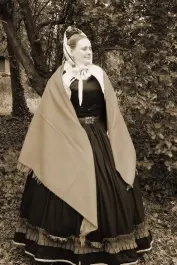
Shawls of the mid-nineteenth century were very large by modern standards, huge in many cases. They were so large that they are often mistaken for blankets or tablecloths when pulled from trunks or at antique shops.
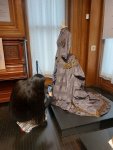
The shift from scarf shawls, those that were long and narrow, of the Regency era to square shawls was firmly in place by 1830 and 1840s. The image to the right is ca 1840s. Notice the size of these shawls.
In the 1850s shawls began to increase in size dramatically. When folded in half diagonally, creating a triangle, these shawls descended nearly to the ground from the shoulder. Rectangular shawls, known as long shawls, double squares, or plaids, became popular. These were folded in half to create a square, then in half again to be worn as a triangle.
Square shawls should be in the range of 55 inches to 70 inches square with 64 inches square being standard.
Long shawls are double squares, sometimes called plaids, which should be 55 inches wide by 110 inches long to 70 inches wide by 140 inches long with 64 inches wide by 128 inches long being the most common.
Three-quarter shawls are 3/4ths the width and 3/4ths length of a standard double square shawl. A three-quarter shawl would be 48 inches wide by 96 inches long.
Handkerchief Shawls are notable smaller in size. Shawls this size were listed and taxed differently in tarriff schedules. It was common to add borders to a handkerchief shawls.
Scarves are much longer than they are wide. A shawl 3 feet by 9 feet would be considered a scarf. These were more popular earlier in the 19th century.
Exceptions to these standard sizes can be seen for lace, knit, and crochet shawls which tended to be triangular.
Next, consider weight. One of the mistakes I observe is the use of wool which is more of a blanket weight than a shawl weight. The weight of fabric is determined in ounces per linear yard. If you want to think of wool weights in terms of modern suit weights, a tropical weight is the lightest and regular is generally the fabric worn for a winter suit.
For more in-depth information, read Paisley, Plaid, & Purled: Shawls of the Mid-Nineteenth Century
Fibers, weave and size: These shawls should ideally be made of hair brushed from the Kashmir/cashmere goat or from a wool and silk blend. The silk should be the warp or blended into the wool in a small amount. Avoid shawls with a rayon or acetate blended with the wool. Original Kashmirs are very light weight because of the tapestry twill weave. I have yet to be able to compare the weights of original and new. Look for sizes around 64 inches square or 64×128 inches as a double square.
Design: When looking for a Paisley shawl, look for a strong cone motif. The cone motifs should radiate out from a center field of black, white or red. These radiating motives create a star or spoked flower appearance from a distance. The spokes should be connected with ribbon like borders consisting of small floral motives. By our era a newer shawl would have a smallish center. But, the higher cost of these shawls along with their durability means it would not be unlikely for a grown woman to have a shawl with a larger center from her youth. The outer border can be on two or four sides. This borer should be comprised of smaller designs brought together in the border. Kashmir borders will have more independent blocks of design while French borders will visually entwine each block with it’s neighbor.
Two other design options include the striped shawl and the border shawl.
Where to look: There are some nice shawls coming out of India. Many of these are available on online and via Ebay for various prices. When doing an online search use “Paisley Shawl” or “Cashmere Shawl” or “Antique Shawl” for your key words.
Woven Shawls
Fibers, weave and size: Wool or wool/silk blends. These should also be 64 inches square or 64 inches by 128 double square. A shawl relatively near these dimensions will look nice. The weave should be a tight plain or twill weave. The shawl can range from light weight to rather heavy if hand-woven.
Design : Look for solids, checks, plaids (preferably symmetrical) stripes and border plaids.
Where to look: This is a type of shawl you can make yourself. Many Museums offer weaving classes thru-out the year. You can also make a fabric shawl from woven wool lengths. You will need a dress weight to coat weight wool rather than a heavy weight in a 54 inch to 60 inch width. Plain woven fabric and plaid woven fabrics work well. The yardage can fringed on the end by unravelling the ends by hand. To calculate your yardage, decide if you want a square or double square shawl and how long you wish your fringe to be on the ends. For a square shawl, purchase the width of the fabric plus 6 to 12 inches for fringe. For example: if you want a double square shawl out of 60 inch wide fabric purchase 130 inches for a 120 inch shawl with 5 inch fringe. (see the article on fringing a shawl)
Printed Shawls
Fibers, weave and size: Printed shawls come in wool, cotton and blends of wool, silk and cotton. Ideally, you would find a 64 inch square shawl, but the common 55 inch square shawl is not bad.
Design: Printed shawls vary by region. Look for period motifs and borders.
Where to look: It is difficult to find accurate printed shawls. The Russian Pavlovo Posad company still makes printed shawls using variations of their 19th century designs.
Sheer Shawls – Muslin Shawls, Grenadine & Barege
Fibers, weave and size: I still have not found sheer shawls that I like. These were silk, wool or cotton. They frequently had a plain central field and a stripe border creating a plaid motif.
Lawn, Gauze, Voile, Silk Organza & Batiste fabrics can be used to make a sheer shawl. The edges would need to be hand finished with a rolled hem. This isn’t what original shawls have though. You may want to starch the fabric as well. You can add tucks to the border or ribbon to the border or edge.
Where to look: – Online fabric merchants including Exclusive Silks and Fashion Fabric Club
Silk Shawls
Fibers, weave and size: I have not yet found the ideal silk shawl. Thai Silks has larger white shawls in their scarf section. These are a little smaller than ideal, but may suit your needs.
To make your own shawl, you want a durable silk, in the 64inch square range, no slubs with or without fringing. Look for a taffeta, china or habotai silk. Do not use satin. I have seen solid color, shot (or changable silk) and patterned silk shawls. A couple of the India, China and Thai merchants sell nice silk shawls. I tend to think play it safe for silk shawls and go for simple. Also, many list as silk but are selling Viscose.
Design:: If you want to embroider your shawl, I highly suggest looking extensively at originals.
Lace Shawls
Sadly, accurate lace shawls are not reproduced currently as far as I am aware. Modern lace shawls tend to be synthetic, with incorrect motifs.
Original lace shawls are fragile. In my opinion, they should not be worn.
Knit and Crochet Shawls
Great thing about these is you can make them your own. There are several patterns available in magazines and guide books. Many of these patterns are available digitally through Accessible Archives and online from various sites. There are now social media groups dedicated to 19th century knitting and crochet.
If you are purchasing a shawl, be sure to ask where the pattern design came from and what fibers the shawl is made out of. The shawl patterns above are worked in wool or silk.
For more in-depth information, read Paisley, Plaid, & Purled: Shawls of the Mid-Nineteenth Century
Now Available. Paisley, Plaid, & Purled: Shawls of the Mid-Nineteenth Century
“Isn’t straw delicate” is one of my favorite questions. It shows a visitor is thinking through what I am working with, imagining the fiber itself, and questioning either what they see or what they think.
Straw as a straw is delicate. It can be snapped or shredded with little effort.
Yet, straw once paired together with other straw can be quite strong.
Straw braided and sewn together can hold its shape well. It can be relatively strong. It can also withstand elements better than other contemporary materials.
One of the great things about straw is it can be forgiving, allowing it to be retrimmed or redecorated a number of times.
One of my favorite straw bonnet stories from the nineteenth century tells of a young woman who has the same bonnet for ten years. She redecorates it yearly.
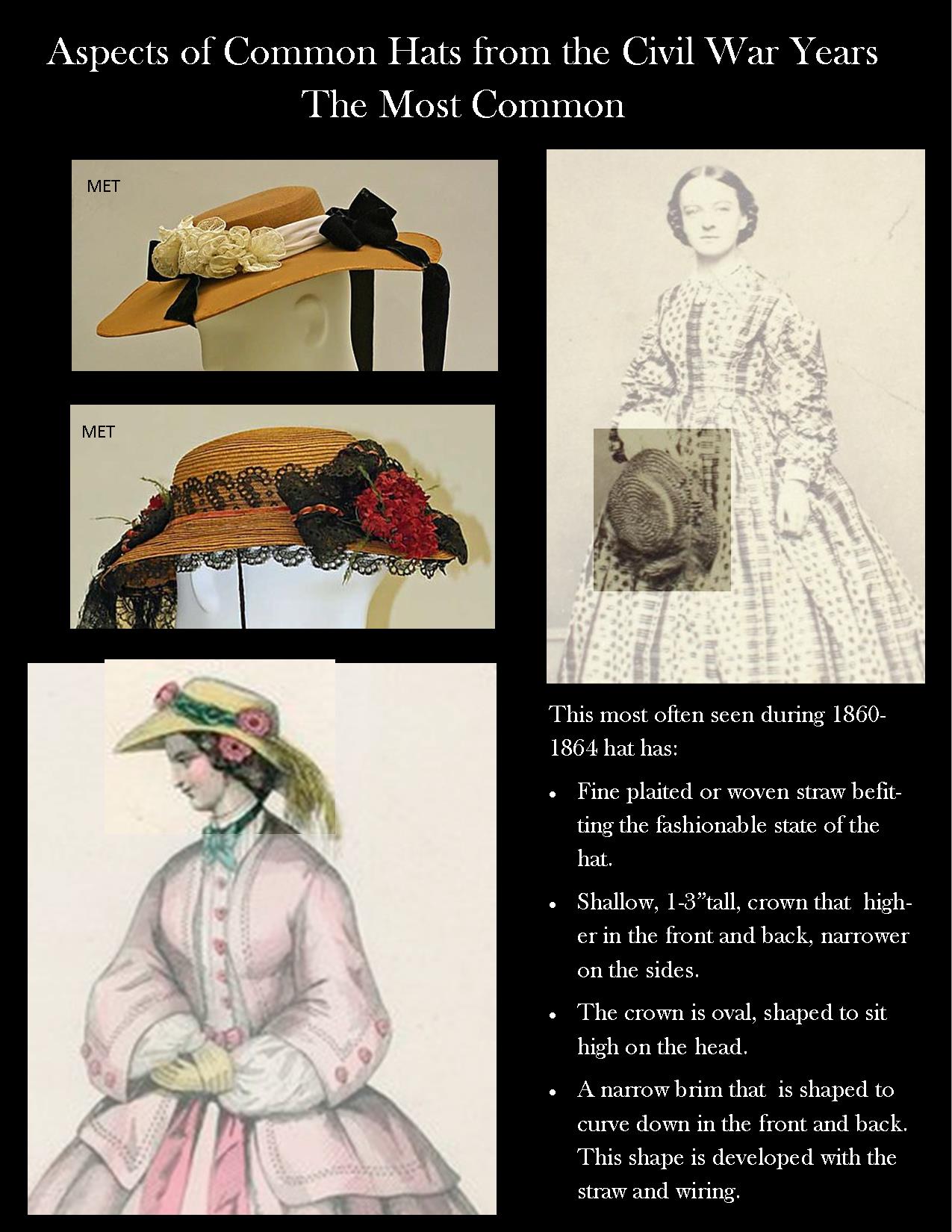
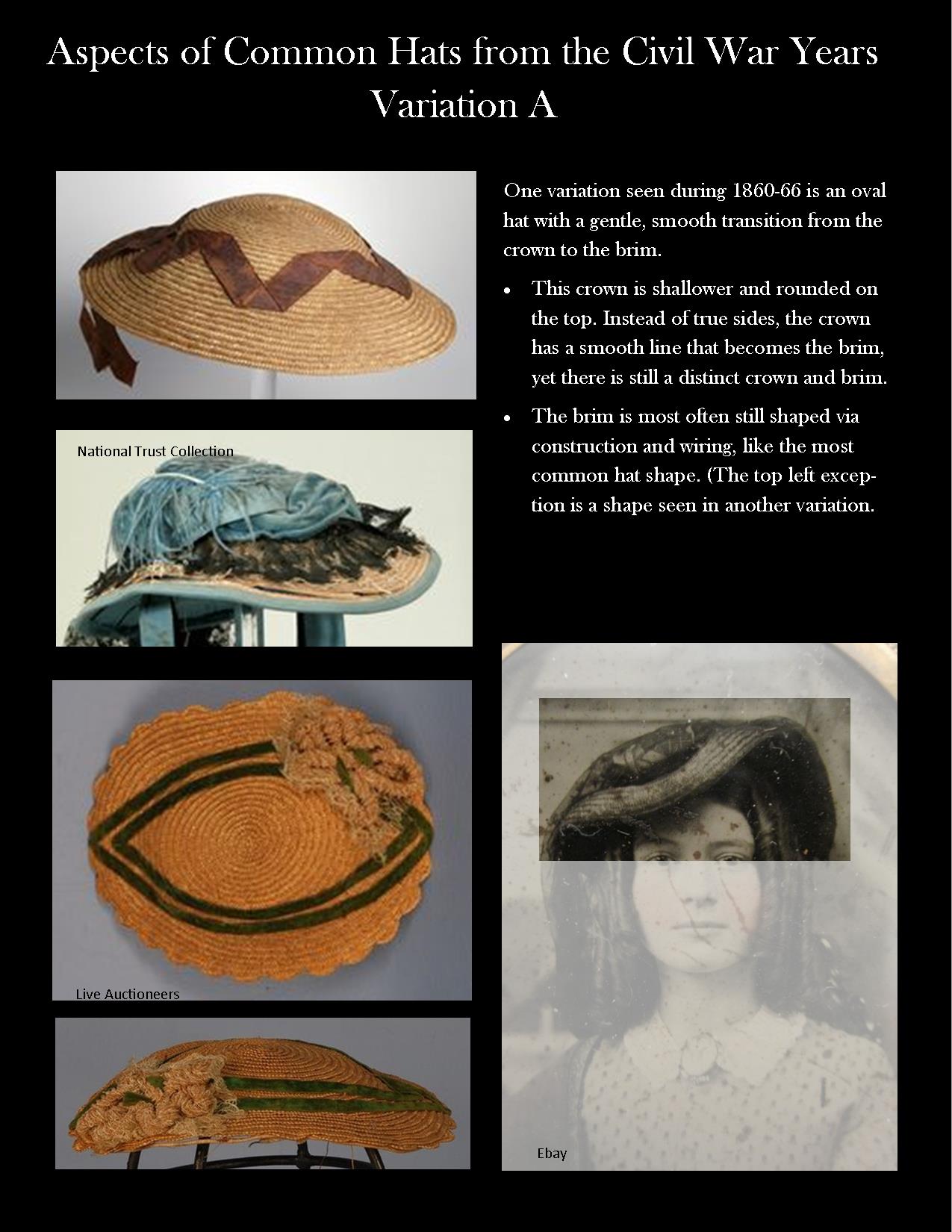
Advertisements for millineries and straw goods stores often include bleaching and reblocking of straws in their lists of goods and services. Straw bonnets and hats can be reblocked into their original shape with new sizing (stiffening) or, within reason, be reblocked into a newer shape for a more updated style.
Straw can also be repaired. This can be seen in original bonnets and hats with patches of straw plait.
Clients have shared with me a few survival stories over the years. Most recently, is this hat who had a rough journey to its owner. The box suffered significant damage including the dented in side seen here and the opposite side ripped into. The hat within survived with only some mis-shaping from the trauma.
Another hat took an impromptu flight and dip into the ocean while its wearer was on a leisurely excursion. The boat was able circle around while the hat floated in the water. When it was fished out, the hat needed only to dry before it could be worn again.
Now, this isn’t to say straw millinery is invincible. A straw hat or bonnet is unlikely to survive being sat on or trampled. Straw can also be susceptible to mold or mildew if not properly dried after getting wet or damp. Straw can also become brittle if stored too long in a dry area.
Do you enjoy reading my blog? Do you find it helpful? Please consider supporting through Patreon or Sending a Tip.
Clara would like me to start by telling you she strongly opposes the production of publications such as this, as doing so resulted in not only I forgetting to feed her dessert last night but also second breakfast this morning. Such lapses in responsibility can not be tolerated.
That said….
These little booklets are all Malinda’s fault.
Once upon a time, a group of then young interpreters and reenactors in Western New York got together occasionally to learn and create new items for their impressions. With the discovery of a supply of small boxes, the practice of maintaining a hair kit began.
Some two decades later, I still use the same hair kit when at home.
Being said once young interpreters and reenactors are now less young and some have young of their own, the next generation is now building their own hair kits.
A hair kit is essentially a portion of the toilet, often meant to be mobile to meet the modern needs of interpreters and reenactors. The container, selected to meet the needs of user, houses the necessities used in dressing the hair.
These small booklets are meant to accompany the hair kit with the beginner or novice in mind. I arranged one for teens and one for adult women. Each gives very brief tips for the beginner and an assortment of photographs & illustrations for inspiration. The contents focus on the hair of everyday, working- and middle-class women.
To create the booklet, print the PDF in black & white or color. Select double sided, flipping along the long side. Stack the three sheets of paper on top of each other. Cut across the center horizontally at 5.25″. Place the top three sheets on top of the bottom three sheets. Fold in half. Stitch in the fold with strong thread or string if you choose.
Part of me thinks I should be placing these with the option to purchase (Etsy or Patreon) due to the number of private collection photographs included. But, I feel this type of resource should be easily accessible. If you wish to say thank you for publications such as this or the many free projects I offer, I invite you to join my Patreon.
This is one of the hardest questions for me to answer. Why? Because I don’t fully know.
Ideally, I would have a big pool of bills/receipts, an assortment of ledgers from many different milliners, and a few dozen diary entries to create a database of prices based on year, region, area, time of year, type of piece, etc.. Then, I would feel like I had a hint of an answer.
But, I don’t have that. I don’t think anyone has that.
I save every 19th century bill/receipt that comes up for sale. I have even bought a few. I note every diary entry.
I try really really hard not to cry at the auction in front of all those people when a dealer out bids me on the stack of ledgers with a milliner’s ledger in it.
Take a moment.
Yes. It happened. I saw them go out the door.
….
Diary entries like these from Caroline Richards of Canandaigua, NY give us a look at the prices she paid for her millinery:
Wednesday, 1854 – Ann Eliza is going down street with us this afternoon to buy us some new summer bonnets;. They are to be trimmed with blue and white and are to come to five dollars. We are going to Mr Stannard’s store also, to buy us some stockings.
April 12, 1856 — We went down town this morning and bought us some shaker bonnets; to wear to school. They cost $1 apiece and we got some green silk for capes to put on them. We fixed them ourselves and wore them to school and some of the girls liked them and some did not, but it makes no difference to me what they like, for I shall wear mine till it is worn out. …
Saturday, 1854 – We got our new summer hats; from Mrs Freshour’s millinery and we wore them over to show to Aunt Ann and she said they were the very handsomest bonnets she had seen this year.
Bills or receipts can show the price of items from particular stores. They can also show the variety of store types as well as methods of keeping track of sales. This bill from 1849 lists several items purchased:
One trimmed bonnet cost $4.50 in May. A pink silk bonnet cost 43.50 in December. Two bonnets and trimmings “last spring” cost $6.35. (This bill also tells us the products and services this shop in Springfield provides, the frequency in which this family of an unknown number of women purchases bonnets, and the delay in payment from “last spring” to April, 1849 for this bill to January, 1850 for the payment.)
If I have to give a price, I can give a window for the mid century of as low as $1 for Shaker bonnets for school to $4.50 for a decorated silk bonnet. But, my answer has holes in that these examples span two different geographic regions and come from two different size cities.
So, the exploration continues…….
Do you enjoy reading my blog? Do you find it helpful? Please consider supporting through Patreon or Sending a Tip.
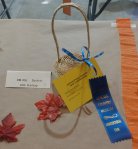
Making these workbags, they truly feel like a convergence of Fanciful Utility and Straw Millinery.
I made the Bonbon Baskets last year for Chocolate Weekend at GCVM.
I laugh a little when I think about how times I must have flipped by the illustrations of items made with straw while doing my research for Fanciful Utility. The pages of Lady’s magazines and fancy work manuals are speckled with items made from straw – from slippers to bonbon baskets to workbags.
Many of the bags are made from the same plaited straw used for making millinery. A few are made to resemble hats, while a few others are even made from hats.
The straw foundations for the bags, whether basket shaped or a disk, are made much the same way as a straw hat. The plait is hand sewn in a spiral, into the appropriate shape. Then, it is blocked into a more defined shape with the aide of a stiffener.
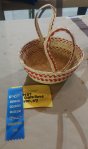
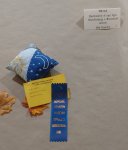
The bag/basket style workbag is similar to reticles found earlier in the century and constructed based a bag in An American Girl’s Book. It is essentially a silk bag with a straw basket for the bottom. The basket foundation can vary in size and shape. It shows up in various publications, calling for different materials. My tapered square basket makes for a very roomy bag capable of holding a good size project such as a knit scarf, shawl, or undersleeves.
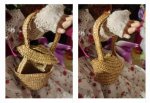
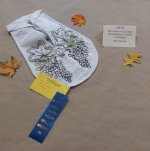
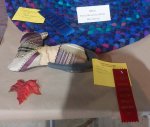
The folded disk workbag, that resembles a taco, is based on a pair of illustrations. One of these is described as a knitting bag, calling for an 8″×12″ straw foundation with pockets set inside. My first version is smaller, using the last of a straw hank. The center is a silk bag, which closes with a drawstring. The straw foundation is lined in silk with a pocket on each side. This size and construction would work well for carrying basic sewing tools: scissors, needles, threads, pins, thimble.
While researching for another potential program, I came across a description that was essentially a wild grass sewn as for making a hat, and made into a balloon style bag. This style bag can be rather roomy for its petite size.
I will be adding bags to my Etsy shop as I make them in between millinery. I will also be adding straw foundations for you to make your own workbags.
When I hear questions about what women wore around the house or farm to work, I often think back to Moore’s Rural New-Yorker. In 1861, an ongoing conversation between readers formed a column discussing dress as functional dress and over-dressing. The majority of those contributing to the conversation were rural New York residents, with some further away as well.
I forgot I had compiled many of these column clips into a document for easier reading. I titled itFollowing the question.
Given my recent reform dress, I thought it would be appropriate to bring the conversation forward to highlight the difference (& similarities) between the public aspect of fashionable reform dress and the functional aspect of practical attire some women chose to wear at home.
Moore’s Rural New-Yorker January 5th, 1861 Over-dressing “The over-dressing of American ladies in the streets, at hotels, and in the churches, is a subject remark among travelers from abroad, as well as sensible people at home.” Rural New Yorker There is a foreign savor about your discourse, Mr. Celebs. The true sons of “Uncle Sam” do not sit in judgment against the wives and daughters of their own country. Hav’nt [sic] you been taking a jaunt in the Queen’s dominions, and been accustomed to the sight of those somber-colored satin dresses that last from one generation to another, and from thence drawn your conclusions? Doubtless you have encased yourself in an armor of impenetrable reserve while the “conflict of” charms is viewed afar off, and while good care is taken that your position is beyond the reach of “Cupid’s darts.” Who are the sensible people you speak or? Are there any who do not make obeisance to keeping up appearances , especially in dress? A few prodigies of excellence and economy may exist; but the torch of Diogenes would evidently be required to find them. Suppose the American Ladies are somewhat in advance of those on the other side of the “big pond,” is there any rule by which they can be judged? Is there any judging in matters of dress? Surely nothing is more capricious than taste. But if fault exists in matters of dress, where does it originate? For what purpose do they array their dear little selves in the most becoming style? Is it for their own gratification alone? On whom do gentlemen lavish their unceasing attention at “the Springs,” at Newport, at the ball, and, if you please, at the little private party in your own circle? To whom do gentlemen solicit introductions? Is it the plainly-dressed, unpretentious young lady? Or is it that little butterfly of a coquette, made radiantly beautiful by silks and laces? If I am not mistaken, men seldom value a jewel unless it be handsomely set. Dress, or over-dress, has a semblance of wealth, and husbands are not unfrequently bought with the lustre of money alone, and the conclusion of the matter sometimes is, that they find themselves beautifully “sold.” Personal beauty is worshiped next to mammon, but is rarely appreciated except it be assisted with elegance of dress, and often the chief attraction of the handsome face is dependent on some peculiarity of style, or shade of color in dress, which is made the subject of study by those who know the secret of their power in society. Indeed, the great wonder is that so much attention is paid to mental culture and general intelligence. Goodness and intelligence must receive the homage that is due for their sakes alone, before a reform in dress can be expected. Newspaperdom is not the path to this field of reform. Honestly, Mr. Celebs, does not an American woman possess more attractions for a better-half with her great fault of over-dressing, or, rather, her fault of trying to please, than any of those English ladies who possess such a keen relish for roast beef and porter? Would you like to be taken captive by any of those German beauties whose liking for lager bear is equal to that exhibited by Artemas Ward’s musician – or would you prefer a French lass to serve up frogs in your dish of fricassee, and keep you spending half your life at a “café?” – instead of a neat little American home, where the vine and shrubbery grow undisturbed, and where the sunshine can play hide and seek, and the dear wife, arrayed in the becoming dress you so dearly love to see, is ever ready to welcome you. Linda Bennett. Hammondsport, N.Y., 1860 We wonder if Linda is not indulging in a sly hit at the occupants of the Rural sanctum, – administering her castigation over the shoulders of the devoted “Celebe?” At all events, she comes to the defense of American ladies with true spirit and courage, – genuine feminine grit, – and while we must, with the most profound respect, acknowledge the ardor displayed, we beg leave to enter our protest at being thus summarily read out of either the Union Federal, or Union Matrimonial, For the first, – and we include that naughty little sister, Miss S. Carolina, – we cherish a devotion that will last while pulse beats or heart throbs, and latter, bless your dear heart, Linda, we love with all our powers of body and soul. We speak knowingly, too; for instead of “keeping beyond the reach of Cupid’s arrows,” one of the aforesaid weapons touched us delicious years agone, as those who compose “our own circle” at home, – the little ones who clamber upon our knees and dally with locks where the frosts of winter are somewhat thickly sown, – could testify. In Linda’s remarks relative to the male race, there is unfortunately, too much of truth; we think, however, that the cause of this moral delinquency is not rightly judged. As to the question of dress, and the modes of styles thereof, we do not consider ourselves competent critics, and will take the advice of witty writer she mentions: – “Never don’t do nothin’ which it isn’t your Fort.” Our correspondent has broached the subject, – the ladies have the matter in charge, – and we will be glad to have them discuss its influence upon their sex, in a philosophical and hygienic point of view, through the columns of the Rural.
I think my post-event adrenaline crash has hit, a day and a half later, due to stuff that needed to be done. But, I am determined to write this post before zoning out into straw sewing land or flat out falling asleep. (This will be a personal perspective post.)
Independence Day was Beautiful!
I was a little worried leading up to the event because my weather app kept calling for thunderstorms, and I had a whole new interpretation & activity to do. Luckily, no thunderstorms. It was all 🌞 sun! Okay. So, it was incredibly humid… 99% if my app is to be believed. Attendance was strong. Here is the view out the door of the seminary at visitors gathering in the village square for the Naturalization Ceremony.
The new interpretation & activity I was doing focused on civic voice, discussing what was important to people in the 19th-century, helping young visitors connect that with what is important to them now, and offering them a chance to share what is important to them. I had a major cram session the days leading up to events. I never studied like that for school.
All-in-all, I learned a lot from preparing for the interpretation and doing the activity. I look forward to future opportunities to discuss the issues important to people in the 19th-century.
I suspect, many of you want to know about the reform dress.
The focus on civic voice and issues of the 19th-century was the perfect opportunity for wearing a reform dress. I had wanted to make a reform dress for a few years but didn’t really have a reason to do so.
I wanted to make a reform dress that was fashionable 1850s to emphasize the public aspect of the attire, rather than the at-home functional or watercure, recreational aspects. This meant a V neckline, wider collar, open sleeves, basque bodice potentially. I also wanted to incorporate some of the comfort aspects in the ideology behind this attire. This meant the gathered, looser bodice and looser cut armscyes.
I had not quite 4 yards of teal tropical weight wool and what I thought was 2 yards of black tropical wool. As I began working, I discovered the teal had some sun fading on old folds and I had far, far less black than I thought. Luckily, I recently picked up a tote filled with end and damage cuts of wool suiting, including several pieces of black. I was able to piece together enough of the black pieces to make the underskirt, trousers, and trim.
Initially, I planned to do a pattern of diamonds around both skirts (I am calling the long teal basque a skirt in this case.) Black diamonds on teal. Teal diamonds on black. With June what it was, I got to a week before the event and knew I needed to change the trimming plan. I opted for the stripes with diamonds. I am pleased with how this came out. I would not have been pleased with the fussy diamonds appliqued quickly.
I was stuck on the sleeves for quite some time. I wanted a looser cut armscye, similar to travel attire, and an open sleeve for the 50s. But, I did not want to fuss with undersleeves. Luckily, evidence of open sleeves without undersleeves was shared with me. I cut my basic open sleeve. Then, on a whim, tried gatherers above the elbow. I Love this sleeve, both the look and feel of wearing them.
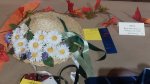
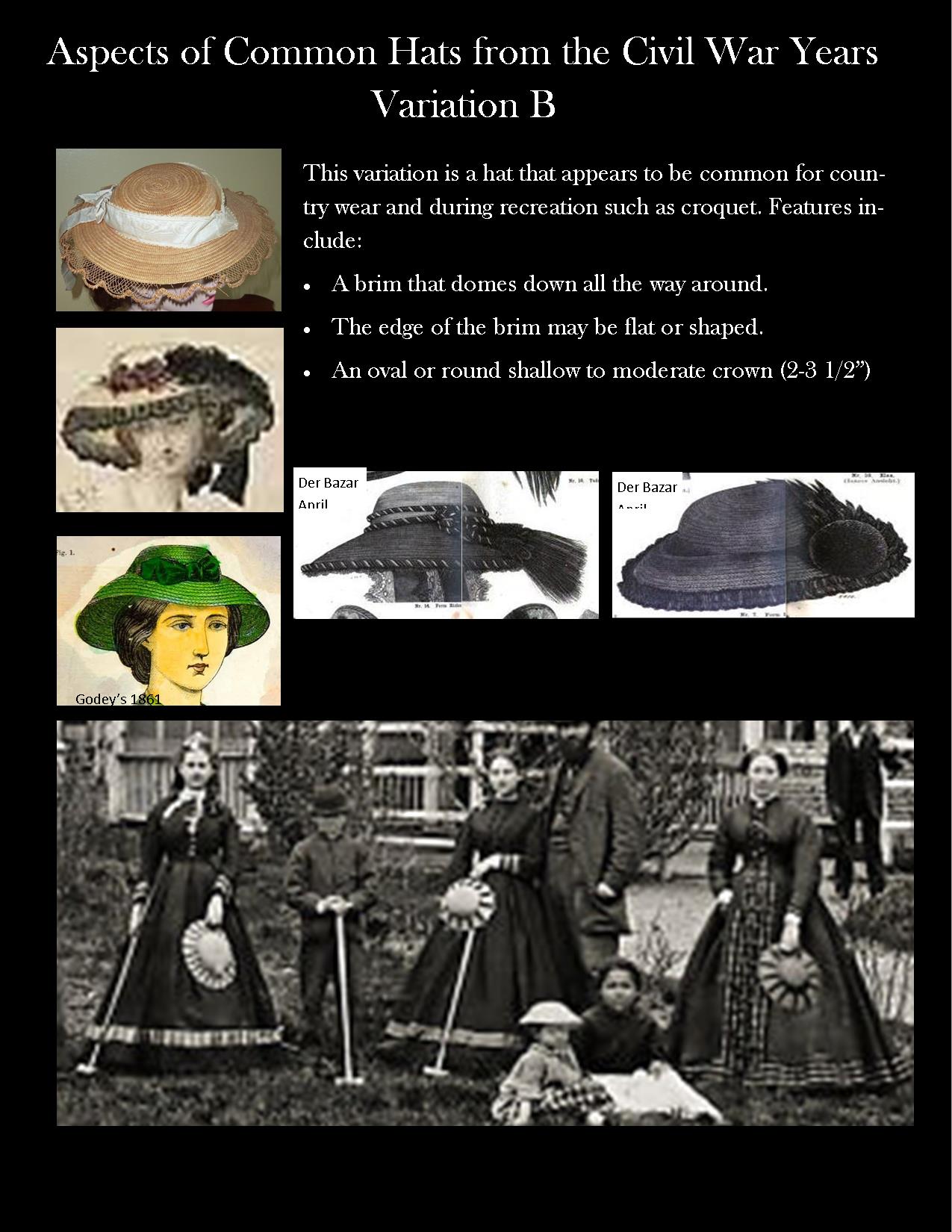
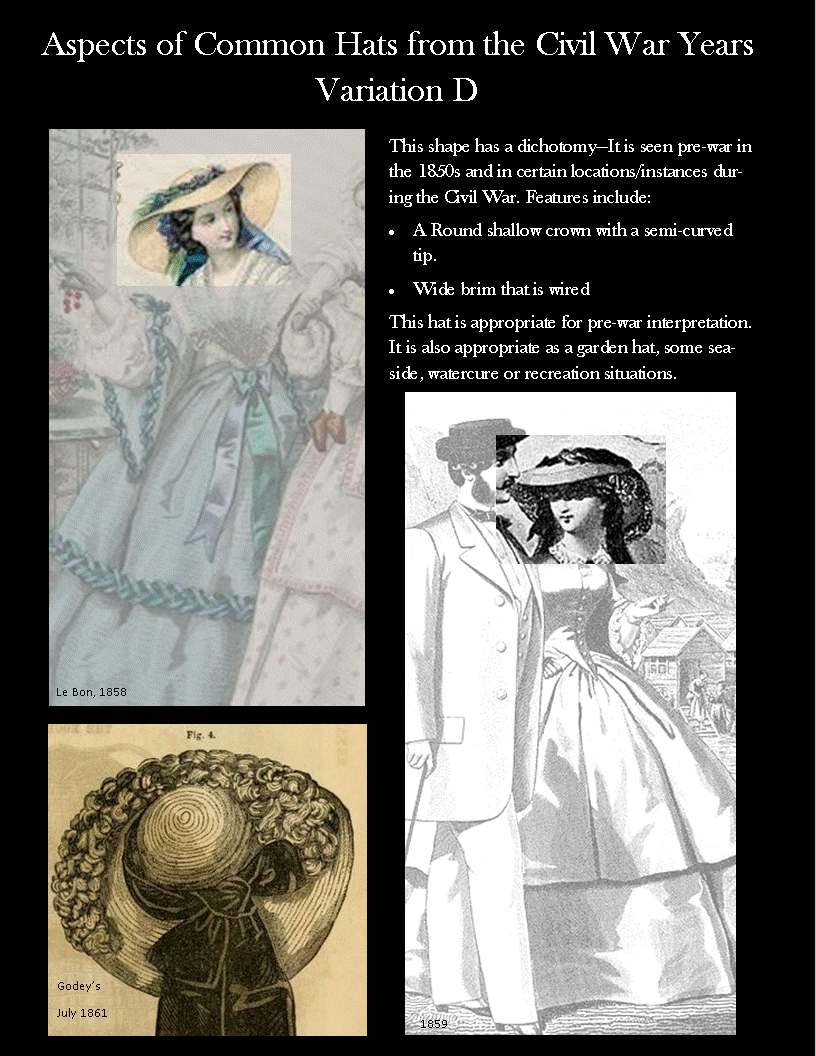
I finally made a hat for myself. Seven or eight years ago, I bought daisies for a hat for myself. They have been waiting all this time. I knew, despite illustrations showing both hats and bonnets, I wanted a hat for this outfit. I also know I wanted a slightly wider brim with a little something extra in the straw. I didn’t go as far as I planned on the brim width, again due to time. I trimmed it with two silk ribbons, daisies, and violets.
Now, let’s talk about the parade…..
I had not marched in the parade for several years. I became very sun sensitive while in New Mexico, like intense pukey migraine bad. Since returning, I’ve not participated in the parade. Instead, I would stand at the fence around Livingston and watch from the shade, wishing I could do the parade and sometimes trying to hold back tears. When several museum friends asked me if I was going to march in the parade, I replied I wasn’t sure. I was drawn. My reform dress deserved to be in the parade. Yet, I was scared of the sun.
At the very last minute, according to the seminary clock, I decided screw the migraine/nausea, I was doing the parade.
I grabbed my parasol and headed for the meadow.
(Photo courtesy of S.P.)
😀
There was a moment lining up that I realized the vast majority of the museum people there were younger and/or newer than me. Given that I was 11 when I first did this parade, that was quite the realization.
I am going to see if I can get Sue to write something about her ensemble. (Photo courtesy of A.H.D.)
It was just a couple times around the square….. but….. it really was a big deal for me. No head ache. No migraine. No faint feeling. No nausea.
Now, for some post-event thoughts on the details of my reform dress. I had planned to do an edited video. But, well, you know I am bad about going back and doing that.
Even since making the bonbon baskets, I have been wanting to make other items from straw. Luckily, lady’s magazines and fancy work manuals are speckled with projects, including workbags.
There are three different style workbags I want to make in straw.
The first style is this basket bag style. The base is a basket made of straw plait sewn to shape. The top is a silk bag that draws closed. The construction concept is seen in A Girl’s Own Book, by Lydia Child as well as other publications. The basket base is made with a variety of materials in each description.
For my first two of this style, I created a tapered square straw basket base. The bag tops are silk taffeta with drawstring closures. Both the basket and bag are lined with silk. I may have over engineered the process considering it was past 10pm when I finished the bag portions last night.
Both of these bags are available in my shop. I think I will be able to do one more. I have a smaller round version in mind as well. If there is interest, I will make a couple straw basket bases as well.
The next style is one I can’t help seeing as a taco. The straw base is a circle or oval in a taco shape with the silk bag set inside. I have a mini taco waiting as I write. I have two different ways of making this in mind.
The third style came to me as I was looking for something else yesterday. I already misplaced the image. It was a “duh” moment as I was reading a description of plaited grass/straw fibers being sewing into circles and used for the centers of what was essentially a Balloon Bag. Yes, the Balloon Bag for the sew along years ago. So, of course, I need to make one. I am not sure how well guaging silk onto straw will go. I may add a layer for strength.
Look forward to these styles in the next few days.
Many thanks to Joyce, ot the Time-Traveler’s Rabbit Hole, and Marna for their assistance in finding the examples in the thousands of pages of original publications.