A Year in Millinery Fashion – 1864

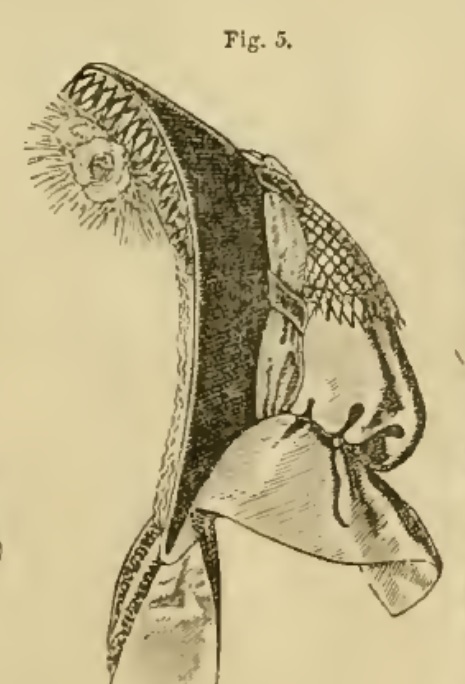
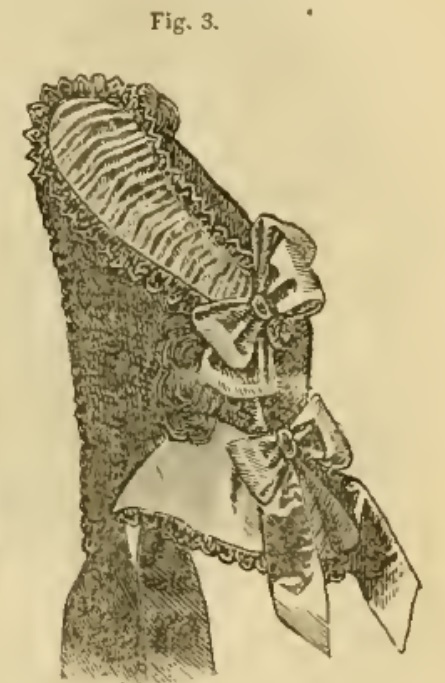
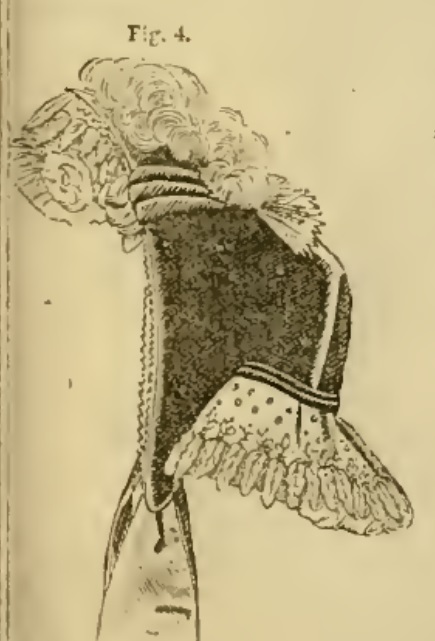
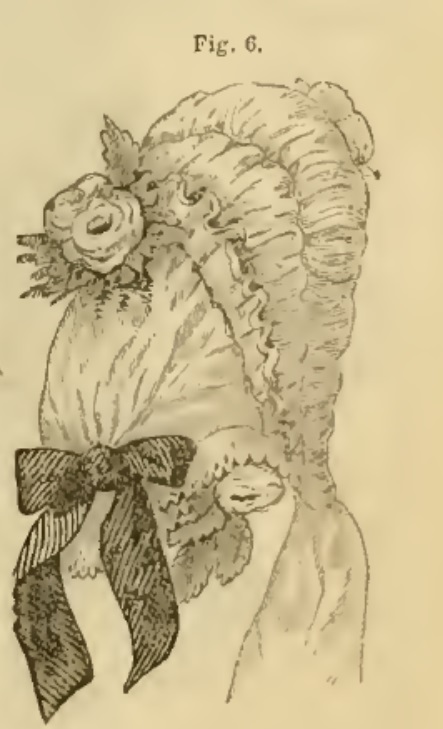
1 White corded silk front, with puffed silk crown edged with black velvet ribbon, which is fastened inside the front of the bonnet, is carried to the centre of the crown, where it finishes in a point from which to hang clusters of grapes with foliage. Inside trimming is of tulle, scarlet velvet, and purple grapes. 1
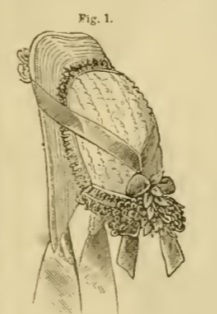
2 Eve bonnet of puffed white tulle, with small pointed cape. The front edge of the bonnet and cape are edged with a double row of Marquerites. The same flower, mingled with tulle, foems the inside trimming. 2
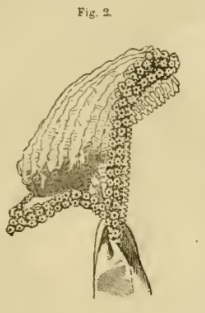
3 The front of the bonnet is of quilted gray silk. The crown is soft, and of plain silk crossed with black velvet. Deep blue flowers are arranged on the lower part of the crown, and instead of the curtain are loops of ribbon and lace. The inside trimming is of tulle, black lace, and blue flowers. 3

4 Bonnet formed of rows of violine-colored ribbon, arranged in points. The outside is trimmed with a half wreath of lilies of the vally and a violine-colored feather. The inside trimming is of violine velvet and white flowers. 4
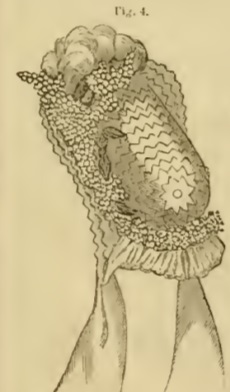
5 Reception bonnet of white royal velvet, with a short cape formed of two rows of blonde. On the outside are white camelias with scarlet velvet leaves. Inside are blonde caps, small white flowers, with coral centres and scarlet leaves. 5

White silk bonnet, with crown of Azurline blue velvet. On the edge of the bonnet is a roll which is strapped with narrow blue velvet. Inside is a very large cluster of blue daisies and grasses. Daisies and grasses are also arranged on the outside of the bonnet. 6

Published in: on November 1, 2014 at 1:01 am  Comments (2)  
Tags:

Readings for Rural Life

From Moore’s Rural New-Yorker in Rochester, NY

Oct 29th, 1864

Cream Cheese

An inquiry in the London Field for a recipe making cream cheese was replied to as follows by three correspondents:

“We put a quart of cream into a clean jug, with half a teaspoonful of salt stirred in, and let it stand a day or two, till thickish. Then we fold an ordinary grass cloth about six or eight times and sprinkle it with salt, then lay it in a sieve about eight inches in diameter. The sides of the cloth should come up well over the sides. Then pour in the cream and sprinkle a little salt on it. Change the cloth as often as it becomes moist, and as the cheese dries press it with the cloth and sieve. In about a week or nine days it will be prime and fit to eat. The air alone suffices to turn the cream into cheese.”

“Take about a half pint of cream, tie it up in a piece of thin muslin and suspend it  in a cool place. After five or six days take it out of the muslin and put it between two plates, with a small weight on the upper one. This will make it a good shape for the table, and also help to ripen the cheese, which will be fit to use in about eight days from the commencement of the making”

“Take a quart of cream, either fresh or sour, mix about a saltspoonful of salt, and the same quantity of sugar. Put it in a cloth and with a net outside, hang it up and change the cloth every other day; in about ten days it will be fit for use.”


Published in: on October 29, 2014 at 6:00 am  Comments (2)  
Tags:

Count Down to the Symposium

There are just 3 days until the Genesee Country Village’s Domestic Skill Symposium.

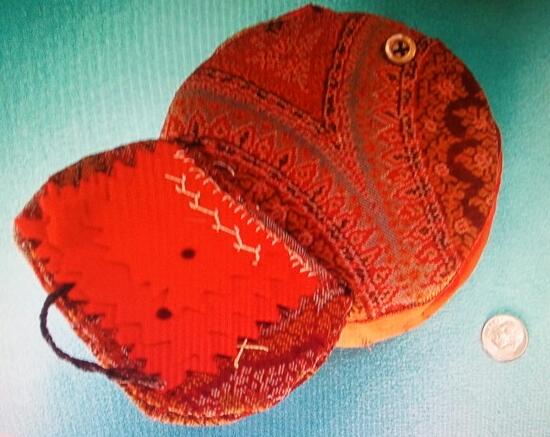
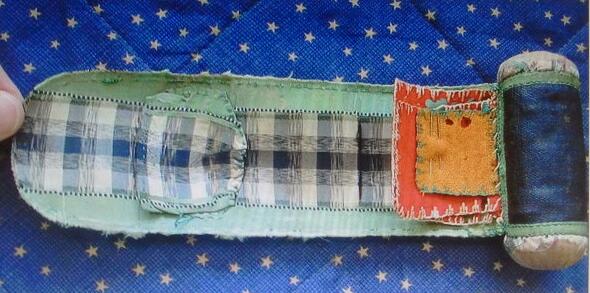
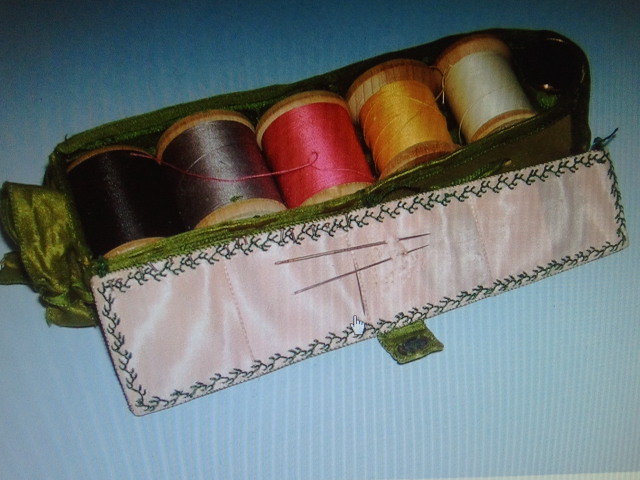
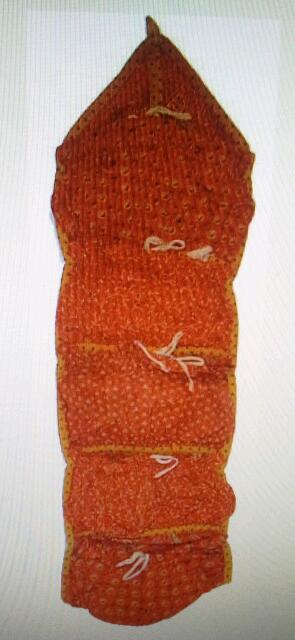
I will be teaching two workshops on Sunday. We will be making a rolled sewing case in the morning and a sewing box in the afternoon.

Some of you may know I am an obsessive pre-planner. That being so, I pre-cut the fabric in my mind a half dozen times before actually starting cutting it last night. Yep, that’s me.

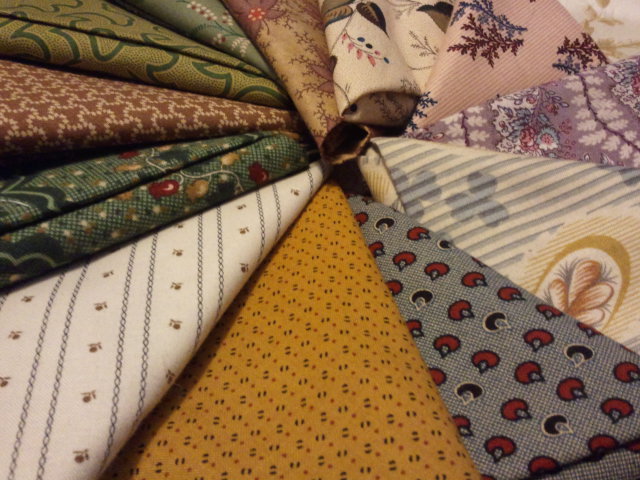
But, check out these pretty fabrics: image

Each one is a reproduction cotton from my favorite fabrics shop: Chestnut Bay.

How great is it to have a fabric shop with a reproduction room so close by?!?

When I sat down to cut, I opted not to use the larger prints because I thought that would be unfair to participants. Plus, bigger prints are harder to work with if you happen to be one obsessive about centering motives or getting balance or symmetry.

I am so excited, not only to hold my workshops but also to see the museum hold this symposium. They have such a great venue for this.

A Year in Millinery Fashion – 1864

Bonnet for light mourning. The front is of black silk, with a fall of chenille fringe drooping over the front. The crown and cape are of white silk, trimmed with a chenille fanchon. The inside trimming is white roses, black grass, and white tulle. (Godey’s, October, 1864)

1

  Bonnet of white silk, with puffed front and cap crown. The cape is very short, and raised on the right side it display a rose and bud. A bunch of roses with leaves is placed over the crown. Roses and black velvet with blonde are arranged as an inside trimming. (Godey’s, October, 1864)

2

FanU Swap: “All Lined Up in a Row”

Whoo-hoo, the gangs all here!
With this rough week, it was nice to come home to the final piece to this month’s swap.
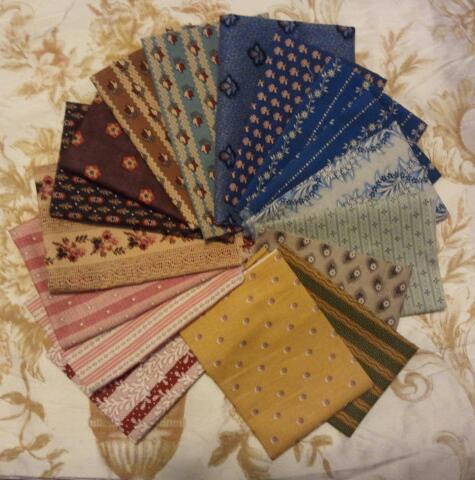
It was bound to happen. Actually, I’m surprised it took this long. We not only had the same print in a different colorway (brown and blue) we also had two of the exact same fabrics.
I think this just goes to show great minds think alike!
Here are this month’s “All Lined Up In a Row” fabrics:

image

Next month’s swap is the “I Just Had to Have It” swap. I can’t wait to see what swappers share!

Published in: on October 23, 2014 at 4:51 pm  Comments (1)  

To-Make List

My current wish to-make list. It only seems challenging when it is to be finished by Thanksgiving. 

image

image

image

image

image

image

image

image

image

image

image

image

image

Published in: on October 23, 2014 at 12:27 pm  Comments (2)  

“I have not seen that”….. Yet

As many of you know, I am working on a not so little project. I have been trying hard (really, really hard) to keep quiet about what I am doing and what I am finding. But, I am horrible at keeping my own secrets. I’ve slipped. I’ve hinted. I’ve nearly screamed out-loud, jumping up and down, “you’ve got to see this!”

This has very much become a project of “Yet.”

In a world where we look for common construction techniques and norms in materials, it is rather exciting to be working on something where all sorts of materials and construction techniques.

I really feel as though when I say “I have not seen that yet“,  “yet” is truly a “I just might see that” or an “it wouldn’t surprise me if” or a “let me see it”, rather than a “that wasn’t common” or a “they really didn’t do that.”

How fun is this:

Cotton batting/wadding… yep
Wool batting/wadding ….yep
TBD wadding… yep
Paste-board… yep
Paper… yep
Woven straw… yep
Cotton cording… yep
Stiff paper cording… yep
Silk…. yep
Cotton… yep
Wool… yep
Fur …. yep
Beads… yep
Ribbon… yep
Drawn… yep
Gauged… yep
Gathered…. yep
Piecing… yep
Selvages… yep
 

Now, this said, I am one who loves patterns, trends and tendencies. I would love to chart out the years, the regions, the urban to suburban, the age of maker/sewer, and anything else I can to get an even better understanding.

Published in: on October 22, 2014 at 12:30 pm  Comments (1)  

Readings for Rural Life

From Moore’s Rural New-Yorker in Rochester, NY

Oct 22nd, 1864

The Expression of Dress – Women are more like flowers than we think. In their dress and adornment they express their nature, as the flower do in their petals and colors.  Some women are like the modest daisies and violets, they never look or feel better than when dressed in a morning wrapper. Others are not themselves unless they can flame out in gorgeous dyes, like the tulip of bush rose. Who has not seen women just like white lilies? We know several double marigolds and poppies. There are women fit only for  velvets, like the dahlias; others are graceful and airy, like the azaleas. Now and then you see hollyhocks and sunflowers. Then women are free to dress as they like, uncontrolled by others, and not limited by their circumstances, they do not fail to express their true characters, and dress becomes a form of expression very genuine and useful. – Meredith.


Published in: on October 22, 2014 at 6:00 am  Leave a Comment  
Tags:

A Year in Millinery Fashion – 1864

Bonnet suitable for very light mourning. It is of eased black silk, with a full piece of white silk, edged with lace, laid on the bonnet from the crown to the front. A black feather is fastened at the side of the crown with a bow of white ribbon. The cape is of white silk, edged with black lace. This inside trimming is formed of violet and white velvet. (Godey’s, October, 1864)1

                         Cuir-colored silk bonnet, with a cape of white crepe covered with rich blonde. The trimming is place on top of the bonnet, and is formed of bands of Solferino velvet and feathers. The inside trimming is tulle and Solferino flowers. (Godey’s, October, 1864) 2

Bonnet of white silk, with
puffed front and cap crown. The cape is very short, and raised on the right
side it display a rose and bud. A bunch of roses with leaves is placed over the
crown. Roses and black velvet with blonde are arranged as an inside trimming. (Godey’s,
October, 1864)

3

Perplexing me

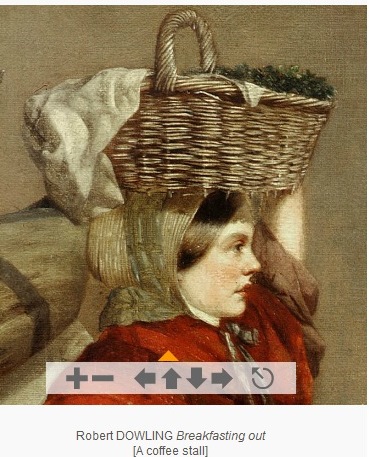
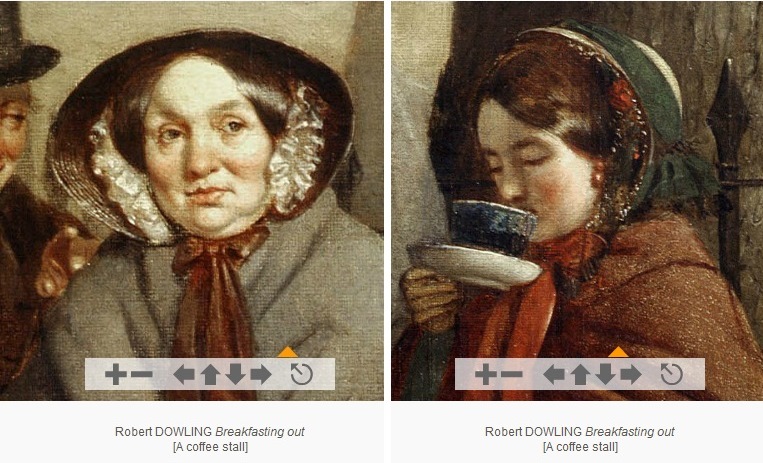
Last night, E.T. shared Robert Dowling’s Breakfasting Out, Britain 1859 in one of the Fb groups discussing the tea drinking. My eyes went to the basket placed on top of a woman’s head, on top of what looked like a fashion bonnet via my little phone’s screen. All I could think is:

“What??? Squash???”
“I must be seeing this wrong.”

So, I had to see this close-up. Thank you National Gallery of Australia.

Not only was I seeing a basket on top of a fashion bonnet, but a straw bonnet. I…um…..???

With previous thoughts, I would have imagined holding a basket on top of a sunbonnet or a soft bonnet such as a hood. But, a structured bonnet? A straw bonnet? What about the straw? the flowers? Squash?

Straw and basketI must think about this.

Okay, maybe the painting is showing us some damage to the bonnet – the slit on the lower edge of the tip and the maybe spot on the brim. Maybe these are just shadows. Okay, maybe this is a lower brim bonnet. Maybe she doesn’t have any flowers. Yes, it could be an older bonnet. Yes, it could be her form of a working bonnet. Yes, straw held a wide range of qualities.

But? Still?

We have a bonnet treated as a working bonnet with a fashionable curve to the brim. She seems to consider it durable enough to handle the weight of the basket and contents (which appear to be leafy greens and a cloth.)

The rest of her attire: Red plaid shawl wrapped around the shoulders and upper body. Possibly a two piece sacque & skirt combination is suggested by the fabric that falls to the hips over a different color skirt, likely wool. The bodice sleeves are rolled up, revealing a white lining. The skirt and apron appear to be pulled up in front. A hint of horizontal striping is under the lift of the skirt. This may be a work petticoat or a corded petticoat. Her boots are worn, very square in the two, with a low heel and off-center closure that I can’t quite identify as buttoning or lacing. Her stockings are light color, white and a bit slouched.

While I’m looking at this, I should also note the other two straw bonnets in the painting. The older woman is wearing a shape/style popular in the 40s with more width than height. The younger woman sipping her coffee has a smaller bonnet is a shape fashionable for the mid 50s with flowers placed primarily along the sides. She appears to either be traveling or shopping to me.

second

Published in: on October 15, 2014 at 6:25 am  Leave a Comment