A quick video
March is coming to an end. Spring recess has started. I am home from getting my shoulder worked on. (I am trying to keep it relaxed and not pull up on it.) I am feeling pretty relaxed. This is nice.
Today, I had something fun happen. One of my Reels had a huge spike in views on FB this morning. Now that I am home, it looks like the views have slowed. As of nowish, a little over 87,000 people watched my 7 second video over 112,000 times. The vast majority of those were between 7 am and noon. This super short video was just a whim I created from the short video I did on my wool petticoats not being soggy:
That video was just a spur of the moment quick video in response to a comment someone made about petticoats getting soggy.
All in all, I am amused and pretty happy. While 112k is far from technically being viral, it isn’t bad for a little niche video.
It does make me wonder if I should post that boot scraping video from last fall. 🤔

Today marks 2 weeks until the 2024 Eclipse. Living in the Path of Totality, there is a lot of excitement about the Eclipse locally. An abundance of events are happening throughout the region, from museums to villages to drive-in theaters and beyond.
I will be spending this historic event at my favorite historic site: The Genesee Country Village and Museum!
Now, of course, this being Western New York, noone really knows what Mother Nature will throw at us. It could be beautiful clear sky. It could be partly cloudy. It could be an incredible spring storm. Either way, guests will have a historic experience at GCVM.
I have special project I’ve been working on for the event. It is a whole world of fancy work I’ve wanted to try my hands at for a while. This happens to be the perfect event for it. (Patreon patrons have had a sneak peek.)
I would love to hear where you are planning to spend the eclipse.
PS… Don’t worry, I plan to be ready for a very slow drive home that night.
I’ll admit, I wasn’t sure how many people I would see today as I crawled out of my complex with the blanket of snow provided by Mother Nature throwing one last winter storm at us. This week was the winteriest winter we’ve had this winter.

To my delight, visitors arrived promptly at opening and stayed steady through the whole day.

I had some excellent questions, including some that will require me to do homework:
My topic today was winter weather wear. This is turning out to be a staple topic that I enjoy talking with visitors about. Today, we also talked about floor coverings & how to keep the feet warm.
Partway through the day, a friend commented about soggy hems. It made me pause because in that moment I realized I wasn’t having that problem despite clearing my car of 5-6″ of snow, stopping at the grocery store, and walking into the village though 6-8″ deep snow.
I found a number of people wanting a this vs that comparison, winter verses summer. This makes me want to try a side-by-side sometime with 2 tables, one with winter wear and one with summer wear.
With the amount of discussion that went into living in the cold, I would like to dress the bedroom for winter sleeping. I would draw from my Keeping Warm in Winter article from years ago, with some updates.
Now that I am home and sitting, this week has caught up, and I may be out cold soon. Though, I find this to be a very relaxed tired, the kind that comes with accomplishment.
My next event will be the Eclipse Festival. I have something extra special in the works for Eclipse day. (Patreon patrons have been getting a sneak peek.)
Did you know I have an assortment of short videos about 1850s & 1860s bonnets?
I do!
I just made another one.
Confession: I made this video because I am frustrated with seeing inaccurately made bonnets mass produced and sold to unknowing reenactors and interpreters. I don’t want you wasting your money or time on something that won’t meet your goals.
Want more videos?
Here is my millinery Playlist.
Or click through these….
Some longer videos:
As this confusing winter hints of spring, this seems to be the year of the picnic.

I am excited to see several history minded picnics coming up this spring. It looks like people are planning both smaller intimate gatherings and larger events, as well as year specific events and timeline events.
As those with a picnic or two on their schedule prepare their picnic attire and neccessities, I am getting questions about picnic headwear.

In developing straw millinery pieces, I rely strongly on visual inspiration. In this case, seeing picnics, those attending, and their hats & bonnets. I keep a file of paintings, photographs, stereoviews, and illustrations in my phone to reference as I work.

These images show us women wore both hats and bonnets were worn during picnics. Some scenes also show women wearing sunbonnets.
These captured picnic scenes also show us the transition in millinery styles from the 1850s to the 1860s and through the end of the century. For the most part, the bonnets depicted in images follow the fashion norms of the time or year. Through the 1850s and 1860s, hats also maintain the basic shape and size norms but tend to have minimal decoration with a simple ribbon being most common. This difference seems to lessen in the 1870s with more adornment on some hats, while the variety of hats expands.
The hats of the 1850s have shallow crowns and wide brims. The crown, the top portion that sits on the head, can be a curved dome shape or a flat top with tapered sided. This crown rises only a couple inches, making the hat sit high on the head. (This can feel quite different compared to a modern hat.) The brims depicted in paintings range from about a handspan on each side to as wide as shoulder width. (My shoulders are 15 inches wide. A friend’s are 17 inches wide.) These brims are shaped, dipping down at the front and back. Views from the side, the brim edge creates a soft C facing down. This curved shape is supported by wire sewn into the edge of the brim.


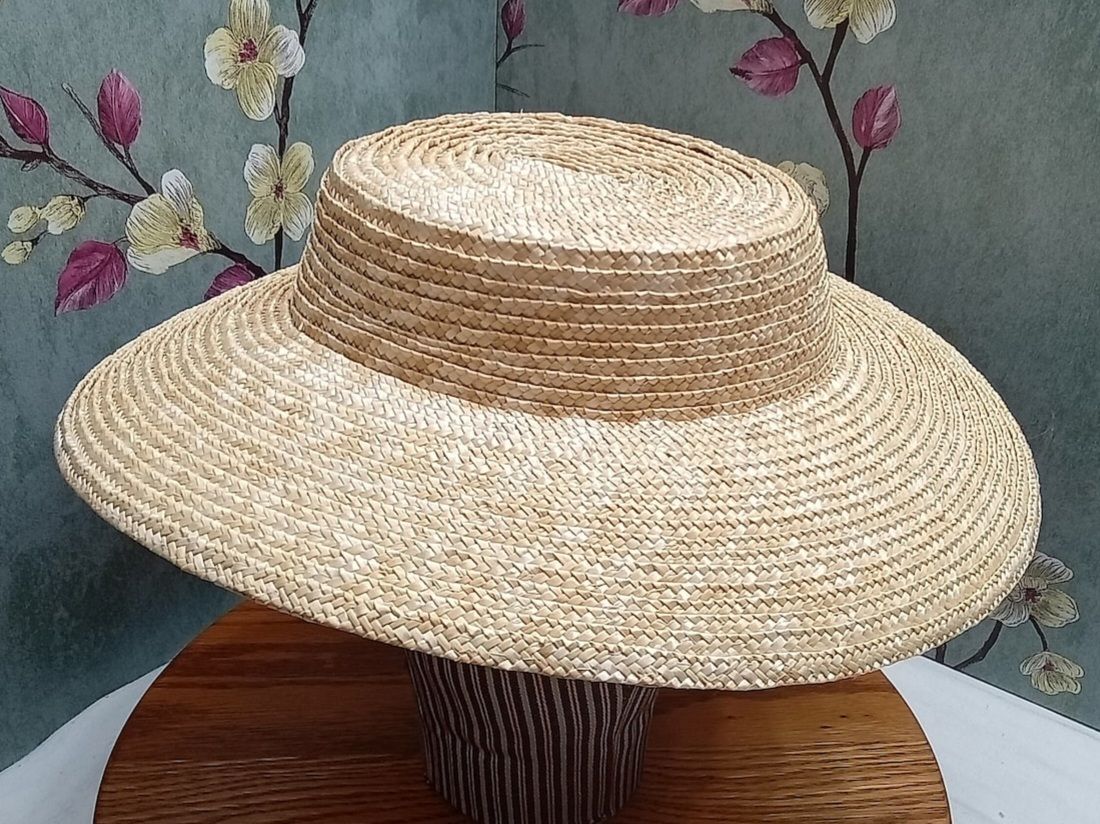

Paintings and photos show these hats trimmed with ribbon. Most often, ribbon encircles the crown with a bow centered at the back. Some hats are shown with loops or ruche of ribbon at the front or sides as well. A very limited number also show ruched ribbon at the brim edge, or a few flowers.
Hat crowns stay shallow in the first half of the 1850s while the brims become much narrower, spanning less than a hand width. This image shows two hats made with the same crown but different width brims, the top for the early 1860s, the bottom for the late 1850s. Hat brims of the 1860s provide little to no shade for the face. As with the previous decade, these brims are shaped, dipping down at the front and back. Views from the side, the brim edge creates a soft C facing down. This curved shape is supported by wire sewn into the edge of the brim.

Those desiring a wider brim for this decade may want to consider a country hat. This hat has a brim that is slightly wider while doming down around the head.


Images show 1860s picnic hats trimmed with simplicity similar to that of the 1850s, using ribbon as the primary embellishment. This is a style shape I see in photos of picnics and croquet.
At the risk of over generalizing, it seems once we pass into the 1870s, the variety of headwear in picnic images increases notably. Those depicted are fashionable for the season. More trims are evident on hats.
I will make a point to create hats and bonnets with picnics through the spring. Please check my shop for pieces available.
I will also be creating some pieces with rural cemeteries in mind as a new exhibit on The Rural Cemetery Movement will be opening in May. The millinery worn when visiting or picnicking in a cemetery is similar. Though one particular piece stands out on my to-do list:
Locally, it feels as if Mother Nature doesn’t know what month it is, and to be honest, neither do I.
I mentioned last month that January and February tend to be slow sales months. While this holds true, I somehow managed to make 10 millinery pieces this month. With this in mind, my first thank you really needs to go to my massage therapist who keeps my hands working. I started seeing her a few years ago when my hands were so swollen and tight I dropped the iced tea pitcher, making a huge mess. My next session will need to focus on the spasms and knots developed this month.
I also want to thank each person who humored me in my last-minute planning for the Bookworm Retreat. Liz and Gina got nearly daily messages asking about progress. Meanwhile, Marna and Sara got squirrelly questions about frames and signs.
Thank you to everyone who ordered something this month. I am just one hat and one e-publication shy of my goal for the month. Not bad for a short winter month. I do want to remind people that in spring and early summer, it can become difficult to get the millinery piece you want because pieces sell faster.
You may have noticed a shop name change. Please help by sharing this new url:
I continue to be grateful to my Patreon Patrons and your on-going support. February’s pocket was a sweet romantic design. The coming March design is a quilted one taken from two original pockets.
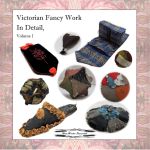
In celebration of this weekend’s Bookworm Retreat and my birthday this week, I am offering Victorian Fancy Work In Detail. This compilation will be available all week in my Etsy shop for $20, a monumental savings over buying seven separate In Details. I will decide at the end of the week whether to continue to offer the publication and at what price.
If you enjoyed Fanciful Utility, you will love my Victorian Fancy Work In Detail. This volume is packed full of full color photographs detailing 9 original pieces of Victorian fancy work. Each piece is described in detail, thus the publication series name. Most of the pieces are accompanied by directions for making your own reproduction.
This volume includes:
~ Blue Ribbon Sewing Case (template, no directions)
~ Velvet Slipper Pin Cushion (directions)
~ Embroidered Velvet Needle-book (directions)
~ Pillow Pin Ball Pin Cushion (directions)
~ Corded Pin Ball, aka Earl’s Ball (directions)
~ Paper Pieced Pin Ball (directions)
~ Heart Pin Cushion
~ Frozen Charlotte Pen Wiper (directions for 2 versions)
The volume comes to 119 pages in full color. Due to Etsy’s upload size constraints, the publication is divided into 3 files. While I do allow the printing of a single hardcopy for yourself, I caution that this one will take a lot of ink.
As “Volume 1” suggests, I do intend to do a volume 2. I am continuously keeping an eye out for pieces to include.
This is a fun little story I started some time back. It is the idea that I used for my AI homework in the previous post.
We’ve all heard stories of the little mouse who just doesn’t fit in. In recent years, there has been a brave mouse who helped save a princess and a little cook who helped save a cooking empire. Ok, so that cook was a rat not a mouse. This is a similar story.
Our little mouse lived with his family, his mother, father, and three siblings, in a beautiful historic house museum. This little mouse’s name was Alex. All his life Alex’s mother and father told him and his siblings how lucky they were to live in such a beautiful, old house. Alex’s school lessons took place through-out the house, where he and his many mouse classmates learned about all the Federal furniture, early Victorian decoration and mid-nineteenth century textiles. Alex’s classmates’ favorite day of the week was when they learned about 19th century food and cooking. Alex, on the other hand just couldn’t figure out how the little old lady who made the food never figured out bits and pieces went missing.
That wasn’t the only thought Alex had that was different from his classmates, or his family for that matter. Actually, Alex had very little interest in most everything around him. While his sister loved to watch the human school groups come visit and try to answer all the kids’ questions before the tour guide, Alex simply was not amused. While Alex’s brothers like to race each other from the second floor grandmother’s clock to the first floor grandfather’s clock in the parlor in the time from the first chime to the last chime, Alex simply was not amused. While Alex’s best friend George, enjoyed collecting all the bits and pieces of thread and fabric from the women sewing to make his own quilt, Alex simply was not amused.
But, there was one weekend a year that Alex loved. When the weather turned warm and the days a bit longer, the house museum would host a living history event. Hundreds of people from all around the area would come set-up camp and dress in historic clothing while visitors would wander through the house’s yard. Alex was very excited to see all these people. It turns out that while Alex was not interested in the 19th century, he loved vintage goodies; they were so much newer then everything he grew up with. His room was filled with vintage items he collected each year on this weekend. Each year, as people arrived on Friday, Alex would watch paying close attention and coming up with his scouting plan for that evening. Then as evening came, he would prowl the area collecting.
This particular year, Alex was quite excited as he watched people arrive. He had already spotted a group of women over by the willow tree that kept bringing plastic totes out of their car. That will be where he will start. Then, if everything isn’t too heavy, he’ll work his way back to the house.
As the sun began to set, Alex ventured out.
Alex learned the best place to travel was along the edges of the tents as these were fairly safe and protected areas. He especially liked the tents that had straw packed along the sides, as if needed he could hide or stash his finds there. As he scurried, Alex realized he was actually stepping in time with the music being played a several tents over. He even surprised himself with that one. Then he stopped quick. A sound. A very different sound. It was coming from the next tent. He ran ahead and ducked under the canvas. There was a man, half dressed in the gray wool so many of the other men were wearing, sitting on the ground hunched over. Bleep, bleep, bling, bleep. It was one of those little noise making toys the school kids brought with them and the teachers took away. Alex tried to climb up the tent pole to get a better view. He found these games interesting. But, he knew better then to take one as he already found they stop working after a few days. He also knew he couldn’t be distracted to long. He had to move on.
Back outside, Alex headed right for the willow tree. As he got closer, he knew he was in the right spot. A table cloth had slid off of a blue plastic ice box outside the tent. He slid under the edge of the tent. Once inside, he assessed his surroundings.
At the top of the little folding stool, one of the ones Alex saw women fall over on many times, Alex became very excited. Left in a pile was one of those bags the women wore on their heads holding their hair. This was just perfect. Alex was hoping he would find something like this because his bed was getting old and he really wanted a hammock to sleep in. Green would be perfect. He rolled it up as best he could and slung it over his shoulder. As he did, he saw something shiny on the bed below. He worked he way down to the bed and over to the shiny object. Once again, Alex was happy. It was a pony-tail lady. Alex loved these pony-tail ladies. He had a whole collection of them.
This is where I stopped writing 13ish years ago.






 If I Had My Own Blue Box: