Shaker Style Sewing Boxes

You likely have heard me rave about the Shaker style boxes by a local artist. He uses beautiful woods: maple, walnut, pine, cherry, curly maple and even exotic woods. His work is not only beautiful, it is perfect as sewing boxes. They are also great for gifts. I neglected to take photos of the presentation Shaker box I lined for Lily. The long narrow shape made it ideal for her knitting needles as well as sewing notions. 

This weekend, I finally finished lining a few of them I picked up this past summer. Each one is lined with 100% silk over pasteboard,  using Fanciful Utility techniques. These linings are not permanently attached so not to damage the beautiful wood. 

I tried a couple different techniques for sewn connections for the two pieces each box needed for the walls. Initially, I did not want to use the overlap method as I wanted a smooth wall. It turns out, this gives the strongest connection. It was great for the tray. The smoothest connection was the diagonal. At least while it was in the pasteboard only stage. I am hoping the pasteboard will relax back against the wood as it was prior to being covered on silk. 

I selected a dark shot brown silk taffeta for this box to bring out the stripes in the exotic zebra stripe wood in the lid. The lining has two pockets in the sides. It will be finished with matching silk pin cushion and needle-book as original Shaker sewing boxes had. 

This shallow walnut box wanted a simple lining with some dividers. 

The diagonal divider is flexible. It can arc in making a smaller space or arc out for a larger space. 


This deeper painted box made the most sense with a tray. The bottom is line halfway up with an open space for larger tools or a project. The removable tray has three compartments. The silkribbons make it easy to lift out. I wanted the tray to be lose rather than snug so it was easy to get in and out. It does tip along the length. If I could get the bottom back out, I would add two small compared to minimize tipping. But, that link find really in there. 


A couple of these will be available in my Etsy shop. Others already have homes or were gifts. I think I have one more that may be available, a light pine one the size of the yellow one. 

Walnut lined with blue silk.
Mustard gold lined with red and brown check silk. 

Published in: on January 8, 2017 at 4:32 pm  Comments (2)  

Millinery 2017

I thought it would be nice to say a few things about the millinery for this coming year. This is going to be one of those developing posts that will evolve as the year progresses. 

.
My Millinery 

I focus on two types of millinery: straw plait millinery and quilted/wadded winter millinery. All of my straw pieces are hand sewn using historic techniques. I use both original bonnet and hat blocks, as well as hand carved blocks for blocking my pieces. I use two different millinery sizings.  While I primarily offer straw forms, I occasionally offer fully decorated pieces. When I do, I use appropriate techniques and as accurate trimmings as possible. Given the likelihood that antique silk ribbons will shatter or fracture, I strongly prefer not to use them in pieces to be worn. I want you to be able to wear your millinery for years. 

.
Eras

I am slowly expanding the time periods I am creating pieces from. As of January, this is a rough outline: 

  • 1400-1600s – Researching 
  • Late 1700 – Starting to look at
  • Regency era – Developing hard to find shapes. 
  • 1820s-1830s – Dabbling. (Large brims are a challenge by hand)
  • 1840s – Working off an original block. 
  • 1850s through 1864 – Making a variety of bonnets and hats
  • Bustle era – Make an assignment hats. These are sporadic. 
  • Modern – Yes, modern is on this list as I plan to make a few fascinators.

Sizing 

I tend to make more average to small bonnets and hats because I have an average to small head. Sizing can be as challenging as it is for clothes. Keep in mind that measurements is as much a factor as how a piece was worn for a particular era. In the American Civil War era hats sat higher on the head that they do now; bonnets sat further back on the head in the latter 50s than they did in the 40s or earlier 50s, etc. 

As a starting guideline, measure around your head just above your eyebrows. I am 22″ there today. Yep, I said today. I tend to vary a half inch either side depending on my hydration and hair. You may as well. When I say Smal, average and large, this is generally what I mean:

  • Small is 20″- 21″
  • Average is from 21.5″-22.5″
  • Large is 23″-23.5″, maybe 24″

As of right now, January, the 1840s pieces blocked on the original block and the Regency capotes fit me. This means the tend to fit the average to smaller heads nicely. I hope to carve a larger capote block. But, that one is hard. I have to recarve most of the foam hat blocks as they take a beating each season. So, there will be a variety of those. 

Pricing

I will do my best to keep millinery pieces as affordable as possible. Please, keep in mind each piece is entirely hand crafted, that I hand sew each row of straw, and I hand select each trim used. With the current cost of straw, necessary materials and shipping, undecorated straw forms will start at $100 for bonnets and larger hats, $85 for smaller hats. Variations in straw will influence the price. 

Custom Requests 

 My year follows the public schools schedule here in New York. While school is in session, I will not be taking requests. I will offer “off the shelf” hats and bonnets.  School is in session with exams through nearly the end of June. I will take limited requests during the summer recess. (*I have about a dozen pieces following over from last season.) 

I fully admit I am much more of an artist than a business person. I get rather scatter brained. I had so many requests this last summer and inquiries into the fall, I still have several to complete. I am going to try a new process for keeping track. While my board with flags worked for a few years, I ran out of pins and flags last year. 


Published in: on January 6, 2017 at 11:03 pm  Comments (1)  

Work-Baskets and Bags

Work-Baskets and Bags (American Agriculturalist, 1867)

Prize Essay by Miss Eva M. Collins, Rochester, N.Y.

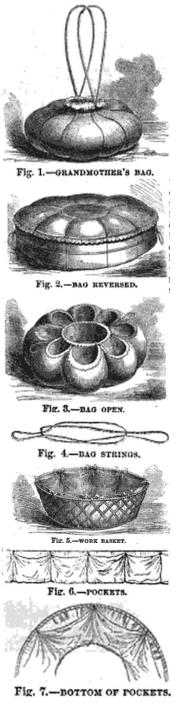
1Every lady, whether a woman or a little girl, should have a convenient receptacle for the implements which are necessary for her use in sewing. A household work-box, basket, or bag, is a household nuisance. Each person should have her own thimble, wax, thread, needles, scissors, etc., and a place to keep them; and the manner in which she keeps the latter is a pretty sure index to her habits of neatness and order in other respects. So great a variety in the style of these articles lies within reach of each of us, that our individuality can in no way be better discerned than in the choice we make. Our minister tells us that copying is a suicidal act, and that the spirit of the aphorism is applicable to the commonest incidents of daily life. Why not, then, to our selection of an article which presents so great a variety of forms? – not that he can mean, in this case, that we should each have a work-box unlike those we see about us, in order to express our individuality, for it would be but another form of the same act, and equally suicidal in its nature;  rather than each should sufficiently understand her own needs and preferences, as to have a choice even in so small an item as this. Grandmother things there is nothing quite so convenient as her work-bag, fig. 1, the magical properties of which are universally acknowledged; though none of us would think of constructing such another with the hope of it wonderful properties being inherent in bags of that description, as everything that belongs to Grandmother partakes of the same nature. It consists of a round piece box-board, covered, and surrounded with pockets. Turned wrong  side out, (fig. 2.) and emptied of its contents, it is easy to see how it is made. The pockets, fig. 3, are eight in number. These, and the inside bottom board are of gray merino. The upper edge of the pocket is scalloped with dark blue saddler’s silk, which is the outside color. A rubber cord holds the gray pockets so tightly drawn up that the bag stands of its own accord, outside from opposite directions, are loosened.

Mother’s work-basket is made on the same principle. It is a basket lined with pockets, fig. 5, instead of a bag. The inside is made separately, and afterwards fastened firmly into the basket at the bottom of the pockets. The tope could be simply made fast with coarse thread to the basket, though that would not look so neatly finished as it would wound with ribbon over the top of the basket, and through the material of the lining, with bows tied over between the pockets, where the strain upon the lining is the greatest, in the way mother’s basket is finished off. The pockets, fig. 6, are made in a straight piece just long enough to fit the bottom of the basket. The bottom of the row of pockets, fig 7, is slightly gathered to fit a circle of the same material which fits the bottom of the basket.

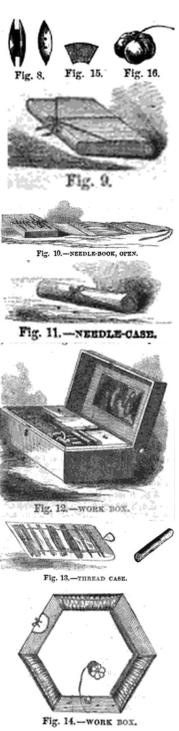
1-copyKatie has a standing work-basket of willow, with three compartments. She has various nice little contrivances to hold her work, among which are “crabs.” A crab ** like this is composed of three pieces of stiff pasteboard of an oval shape, two inches in width by three inches in length, neatly covered with silk, and sewed together at two of the edges. By a slight pressure at the ends it opens, and reveals a cozy little room large enough for small work, and convenient to carry  in a dress pocket. IN this crab, which is brown on the outside and blue within, I see Katie has a bunch of tape trimming, and a spool of thread, No. 50. In another gray and pink one there is some ruffling, narrow lace and 100 thread; while stowed away in the drab crab I discover her tatting shuttle, fig., 8. It is one Grandfather made from the centers of two old fine-tooth combs, placing a couple strips of ivory between this outside places, and riveting the whole firmly together. Katie says it is entirely owing to her supply of crabs that she always has a variety of light work ready for any emergency. Her needle-book, figure 9, although large is appropriate to her basket, which is large and roomy. It is of bronze morocco, bound and lined with blue, with leaves for needles at one end, and a place for the thimble in the other side of the broad flat cushion at the other end of the case, fig. 10,. There is a morocco pocket between the silk pocket and cushion.

My needle-case, fig. 11, is smaller, and therefore better suited to my work-box, fig. 12, where every inch of space is precious, and accordingly economized. It rolls up into quite a small compass and lies under the tray, or sometimes in the tray, beside my button-box. Between these and the cushion, is a narrow depressed division for knife, pencil, stiletto, buttons, tape, needle-book, etc. The scissors, tape-measure, emery, thimble, shuttle and pin-case belong in the division opposite the thread; while under the tray is a ball of welting cord, box of hooks and eyes, case of skeins of silk, fig., 13, scissors sharpener, sticks and roll of tape, papers of floss and French cotton, Afghan needles, a crab or two, and a dozen little bundles of work in various stages of development, besides a thousand and one other articles, which do not legitimately belong to the box, yet are most conveniently kept here.

Jennies’s work-box, fig. 14, which is a tidy little affair, is a hexagon of stiff pasteboard covered with silk—gray on the outside, and scarlet within. On three of the side pieces are fastened pockets of the same material with which the basket is lined. On one side a covered strip of thin paste board, fig. 15, is fastened for a thimble case over which hangs an emery, fig. 16, made from two round pieces of strong linen, stuffed with emery and wool, covered with scarlet silk. The tomato shape is produced by drawing double thread of green silk six times thought the center of the emery—each time passing over the surface at an angle of sixty degrees from the last thread. A tuft of green is fastened with the string to the center of one side of the emery to increase its resemblance to a tomato. Jennie made several such boxes for her little friends a few months ago, some of which were very delicate in color—light blue and salmon— sea green and gray—and were prettier than her’s though scarcely as well adapted as hers for daily use.


** Also known as a Button Keep or Balloon Bag.


Published in: on January 4, 2017 at 6:00 am  Leave a Comment  

New Year…. New Projects

As 2016 closes and 2017 begins, we all have new projects rolling around in our heads.


Projects Anew

The much neglected dress length stash, adventures in millinery,

I have a shy dress length of black tropical weight wool. While a reform dress or “bloomers” ensemble is very tempting, I keep envisioning wearing something like this done up in black wool and this pretty pink silk that was gifted me.

I was gifted a dress length of brown tropical wool from my Husband for Christmas. The insane temptation is something like this, with the black wool trim and soutash. There are far simpler options, such as this sacque/petti combination that would push the length of the wool, or….

I rediscovered a dress length of blue semi-sheer silk with paisley motif in November. I have to decide what to make with this. I do think it will be an earlier nineteenth century dress.

My own personal headwear often gets neglected. On my list for a couple years has been a replacement corded sunbonnet. I also want a couple caps that are suitable for when I am doing demonstrations in the village.

I am working on a pictorial wool rug using an early 19th century sewn technique. I plan to have this done by fall. It makes use of the needlework frame rescued from the end of the driveway this summer.

I know some are wondering about Sew Alongs. I am pondering a couple for the slower parts of the year. Among the ponderings… an apron?, a pocket?, a cap?. 

Stemming from one of 2016’s Sew Alongs, I want to make a pence jug . I can document one done in crochet, as mine will be. I have an incredible pair of handcrafted rings from a friend for another long purse as well. 

I will transition part of the fabric stash into a box, bin or something for Lily.

Shop Projects

The bolt of black silk has been waiting patiently. I am considering putting together a quilted petticoat kit. (two people have already asked for it if I do.) It could also make a few nice quilted shawls, either in finished or kit form. (SHOP)

I need to decide on whether to make something from the other silk bolts or to sell lengths/yardage. I can see some nice kerchiefs and fichus. 
Projects Continuing
Projects delayed, projects procrastinated, projects of length, projects to dig further into….

2016-05-10-19.41.29.jpg.jpeg

At the very top of my continued project list is learning more techniques for straw. I really enjoy making the leaves from split plait. You may have seen that I was trying to learn to make straw stars and ornaments for the Christmas tree. Those fussy little things told me how much there is for me to learn. Hopefully, this will lead to some unique straw millinery this year; unique, yet accurate.

I have a growing stash of silk net, cotton net, silk gauze and silk net laces all waiting to become veils. I will be working from the originals I own and this pin board of originals to create accurately shaped veils for both hats and bonnets. The vast majority of these will be for display and presentation. A few may find new homes. I hope to do further work on the  materials comparison for light control.

img_20161016_170623.jpg

I plan to finish lining and accessorizing the Shaker boxes early this winter. This will hopefully fit nicely in between winter and spring millinery. I really had hoped to have these done for Christmas 2016.

20160826_112808.jpg

I’ll continue to dabble in recreating pin cushions. I was so pleased with how interested museum visitors were with the strawberry emery cushions, I would love to do something similar for the village this next season. Plus, I hope to have a great announcement or two in this area for you this year.

Picture1The slippers of last spring…. They will be finished …. at some point. It is silly they are so low on the priority list. Yet, they take up half of a project tote.


Published in: on January 1, 2017 at 12:00 am  Comments (2)  

2016 Millinery Gallery 

Straw and Winter Millinery 

This slideshow requires JavaScript.

Published in: on December 29, 2016 at 8:52 pm  Leave a Comment  

Today’s Millinery – Last of the Year

One final winter bonnet for the year. 

Find it in my Etsy shop.


Published in: on December 11, 2016 at 11:47 am  Comments (3)  

From the Work Box – Sewing Birds

Recently, Janet Smith of the Button Baron shared their reproduction sewing bird on a Facebook group. Many people asked “what is it?” This made me think it would be nice to do a series looking at tools in the Work Box. I will start with the sewing bird.

Here is my sewing bird, an original patented in February 15th, 1853.

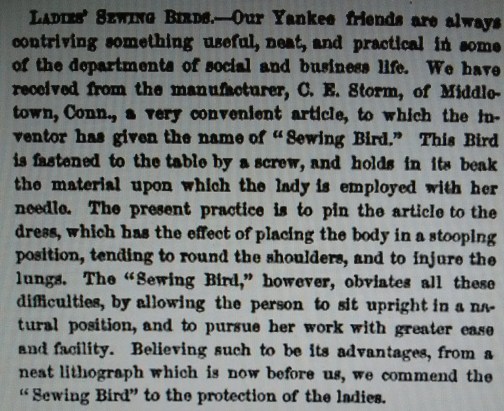
A sewing bird clamps to the work table. The bird is meant to hold one end of your work in its beak. Some, but not all, sewing birds come with a pin cushion either next to or on top of the bird.The Knight’s American Mechanical Dictionary (1881) illustrates and describes it here:

Godey’s Lady’s Book hints at the advent of sewing birds in 1852:


While being called sewing birds, birds were not the only figure adorning them . They were also made with different figures, such as dogs, butterflies, serpents, dragons and other birds. See the variety on this Pin board

Sewing birds came with and without pin cushions. The pin cushions could be found in front of, behind, below and above the bird itself. Some also had two pin cushions. (There are also sewing clamps with just pin cushions, not clamping birds.)

Just six years following the Godey’s mention, we see the quick popularity in this poem, The Sewing Bird (Arthur’s Home Magazine, 1858)


Additional Resources:

This article discusses the differences between some originals and some reproductions. (I have yet to dig deep enough into the construction of sewing birds to evaluate statements in this article.)

Here is an article about an original sewing bird at the Museum of the Grand Prairies.

This is an image of assorted sewing birds in the National Museum of American History collection. ***A must see***

Patents for sewing birds and improvements in sewing birds can be found from the 1850s on.

Published in: on December 9, 2016 at 6:10 pm  Comments (2)  

Year In Review

I have an awful time remembering what projects I do each year. Luckily, I started a list at the beginning of this year. Then, I forgot to keep writing them down.

Projects of 2016:

January
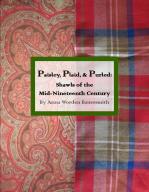
PPandP book coverTo start the year off, I launched Paisley, Plaid, & Purled: Shawls of the Mid-Nineteenth Century. My many, many year writing baby was finally in print. Well, E-print.
2016-01-31-14.21.16-1.jpg.jpeg

We also started the year with a Sew-Along. The first of the year being a work bag in cotton or silk. I had no idea how popular these would be.
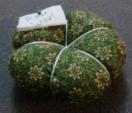
wpid-2015-11-17-18.16.54-1.jpg.jpegIt seems January was pretty busy. This is also when I started my pin cushion experiment. I took the same shape and size pin cushion, made of quilt weight cotton, and stuffed each with a different filling to see how each performed. This will be a continued experiment.

February
2016-01-21-17.50.57-1.jpg.jpeg

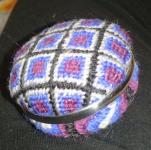
Going from February into January, the local historical Sew Along group worked on pin balls. Participants used a wide variety of researched techniques for their pin balls.

March
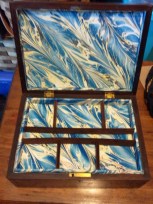
2016-03-30-10.25.47.jpg.jpegCome March and April, I was focused on preparing sewing boxes for a discussion during the 140th’s Civilian Seminar in the Greene  Gallery at GCV.
2016-04-02-11.07.57.jpg.jpeg

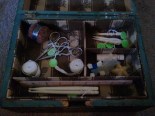
I lined two boxes, one for original tools and one for reproduction tools.I used hand marbled paper for the original sewing box. I used fabric for the box I was constructing a tray for.

April
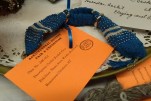
20161001_160937.jpgThe next Sew Along: A Purse began in March, but became a many month project for me. I made a crochet long purse, known as a miser purse.
2016-01-16-20.38.26-1.jpg.jpeg

I first made one for Cali. Then made the one for me. Both are silk with cut steel beads.

May

As the weather warmed, estate and yard sales began. Several local friends were looking for appropriate chairs. Inevitably, as I was photographing chairs, some came home with me. In a couple ways this is good because my well used chairs are getting loose and now, we almost have enough seats for Christmas.
img_20160623_132652.jpg

Galaxy arrived some time in May or June. It is kind of a blur. Clara joined the family in February.

June

June was pretty packed.This is when I fell behind on the purse project and way behind on the slipper project (see below.)
fb_img_1466298780905.jpg

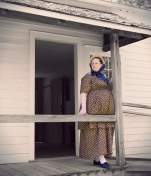
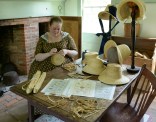
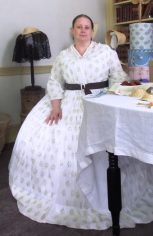
I decided I needed a dress appropriate for demonstrating sewing straw in. Something very much a work dress that could handle getting wet and I could be comfortable in.
wp-image-1099886474jpg.jpg

The dress got a test run at GCV’s War of 1812/Jane Austen event in June. I had a delightful day demonstrating the cottage industry, sewing straw plait into bonnet and hat forms.

July
wp-1472172521844.jpg

After the Regency era of June, was a switch to mid-Nineteenth century for July. I got to transform the museum’s Law Office into a Millinery for the Civil War weekend. This meant making the building obviously say Millinery – dressing the space with bonnet boxes, stands topped with bonnets and hats,  bringing in additional color. It was a great weekend.
2016-04-03-13.31.34-1.jpg.jpeg

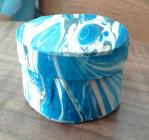
Somehow, I don’t have photos of just the boxes I worked on. Here is a mini-verion for Cali. I made a couple boxes. Then I recovered a number more in period appropriate papers. For next year, I really want to get to Cooperstown to buy a few of their boxes.

August
img_20160819_151408.jpg

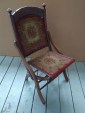
August was all about sewing, sewing, and sewing. I did break my “no more folding chairs” rule when I saw this chair in a yard sale listing.

August also saw Lily off. We spent much of the summer trying to visit a museum or site each week.

September

It was back to school in September. These transitions are usually difficult for me. I get in such a rhythm of heavy sewing through the day. Though I did have one project for October I was greatly enjoying….

October
img_20161001_145739.jpg

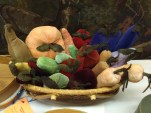
I had so much fun making my basket of vegetables in velvet. Some were cotton velvet, already dyed. Others were silk velvet, needing to be colored in chalk after I made them. I do wish more people were able to see this at the fair.

November
img_20161113_090134.jpg

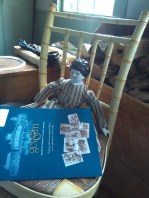
November was back to being busy again. First came the Domestic Skills Symposium at the Genesee Country Village and Museum. I lead a Sunday workshop on Millinery in Miniature with my helpful side-kick, Cali. Each participant made a doll scale hat while learning period appropriate straw sewing techniques.
fb_img_1479602151894.jpg

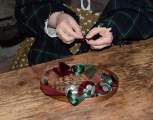
The following weekend was Preparing for the Holidays, back at the museum. This is when I was just amazed by how interested people were in the strawberry emery cushions I was making. I left completely thrilled and dumbfounded.

Decemberhood-pattern-promo-silk
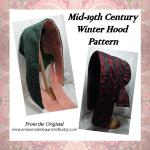
My big goal for December was launching my new Mid-Nineteenth Century Winter Hood Pattern. Drafted directly from an original hood in my growing collection, this pattern has two sets of directions in the information packed booklet.

Millinery, straw and winter, spanned the year. I had a few goals with straw  for this year. I wanted to explore fancier plaits, learn decorative manipulations for plait and learn to make straw motifs. I also wanted to dig further backward and forward in time. I didn’t get quite as far as I had hoped. But, I did expand quite a bit. Here is a gallery of this year’s millinery:

This slideshow requires JavaScript.

Projects Yet to Complete (Or start in some cases):

This year has more than its share of projects not yet finished. Here is just a few:

I had this whole plan to roll research on veils into making veils. I got as far as doing a good bit of research and even a materials comparison. I have yet to make more than the veils used for the July millinery.
img_20161016_170623.jpg

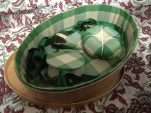
I have a box of Shaker boxes I meant to line and make sewing accessories for. So far, I have made this one and one that is a gift. I will hopefully get the others finished before it is time to buy some more. This really is one of the most convenient sewing boxes to have.

20160826_112808.jpg

I have an on-going pin cushion project. One part is the filling analysis. The other is making pin cushions from original directions or replicating originals. I thought I might do one a month…  Not so much. Next year.
Picture1The slippers that were started last spring have not been touched in months. Some time in the depths of winter, when my feet are cold, I will finish them just to have them done.
2016-05-10-19.41.29.jpg.jpeg

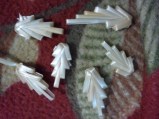
I had wanted to learn to make straw decorations and motifs. I got as far as learning to make leaves in the spring. Then I got so busy with bonnets and hats, I didn’t get back to it. This will definitely be explored more next year.


Next Year….

I will be doing a looking forward post soon(ish). I have dress lengths that have been long neglected. I also have some presentation/workshop topics churning around in my head.

 

Published in: on December 5, 2016 at 6:00 pm  Leave a Comment  

Baskets at Work

A-Tisket, A-Tasket…. While neither yellow, nor green, this year saw to the task of getting the right baskets.

As with many tasks and utilities, I am picky, very picky. I fussed and searched and fussed some more for just the right baskets. I had a list of what each basket’s duty would be: to house and carry wool, to carry and hold straw for demos, to carry the day’s or weekend’s food stuffs. Each also had to be well made, sound, accurate and pleasing to the eye. In the end, baskets have been matched with their tasks and I am shy only one: a large, round basket I eyed at the flea market but failed to go back for… the basket I see holding straw in progress and bonnets at museum demos.

The baskets at their tasks….

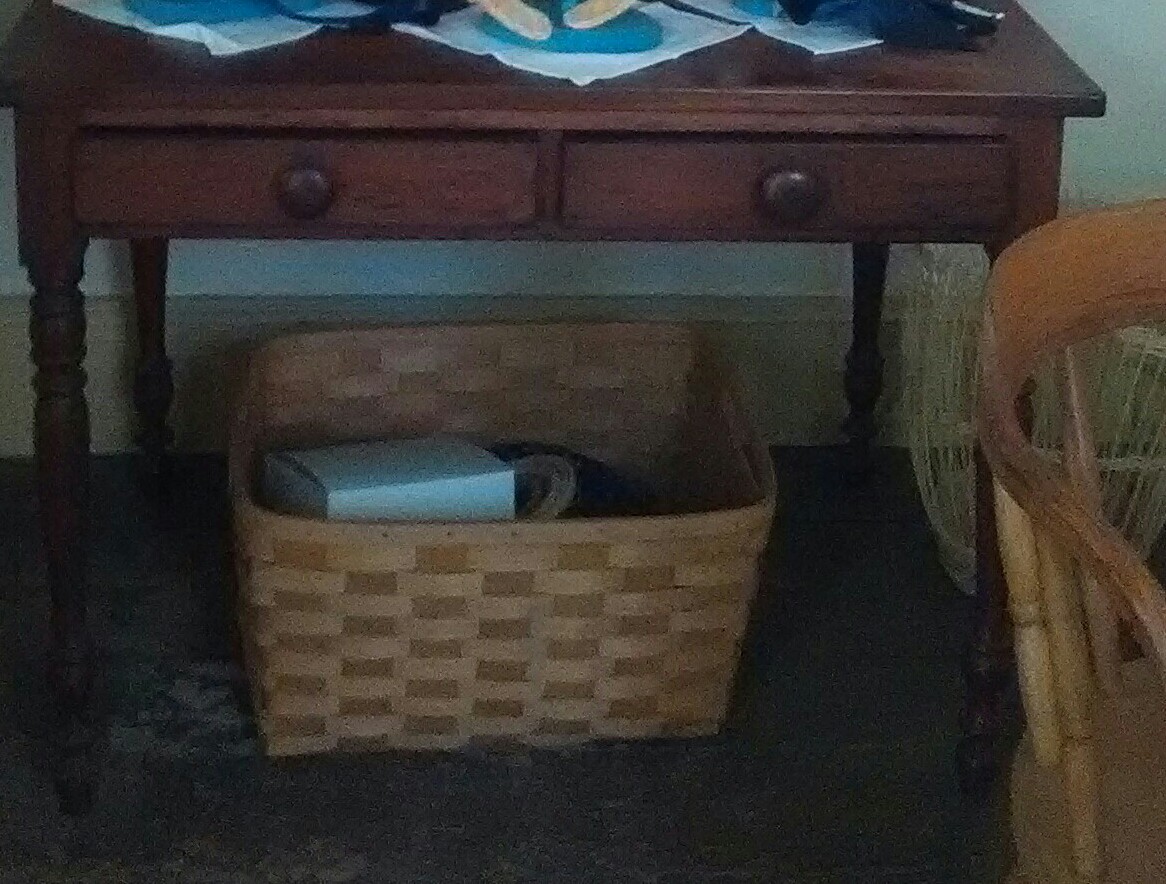
My largest basket is a rectangular one that serves nicely to carry small containers and stands into the millinery for set up. Here it is this past July under the desk in the Millinery Shop. It is in need of some tlc repairs due to cracked and broken areas from when I bought it. This large carrying basket is much like those we used in the 90s and 00s for carrying program materials about. Here is a similar basket at HSV.

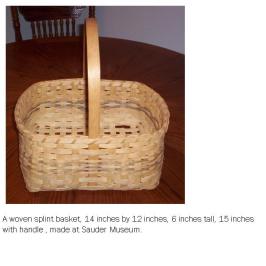
These next two baskets are “all purpose” baskets.  The larger, top is one that was Dad’s it was loose on the top. I am sure basket makers are cringing at my millinery repair using the straw plait. The bottom one is by the GCV’s basket maker. They are nice for carrying. As you can see, each nicely holds a project at home. They can also carry a day’s or weekend’s food into the village. As crocks, especially full crocks, and water can get heavy, neither are overly large. Here is an oval example at HSV, and a rectangular, non-Shaker example at the same.


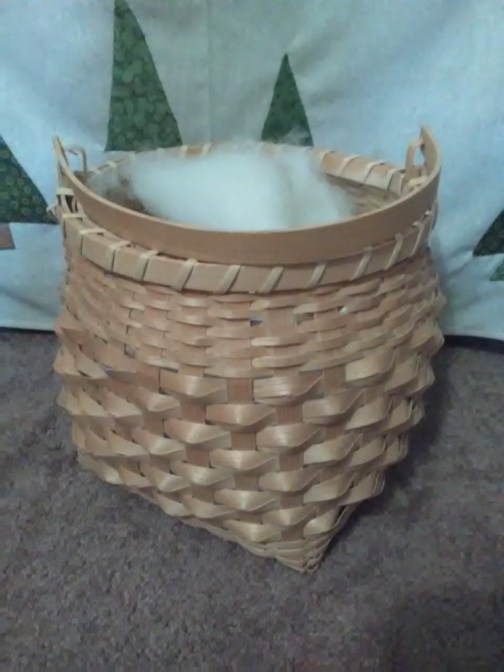
I have named this basket my wool basket as that is its task. When I am making hoods, I need a stash of wool easily at hand in an eye pleasing container. This moderatly sized basket fit that need nicely. Until I find the right straw holding basket, this may do double duty.  The shape, with the squared bottom, and round, belly bulging sides, seems to be a common shape. I do still need to look into the decorative shaping in the reed. Here are two examples from HSV showing handles that fold down like this: first one with a loop construction, second with a pivot construction.

The newest edition joined us this weekend. I saw this basket a few weeks ago at my favorite bakery while I was picking up treats for work. We chatted about how nice it would look filled with seasonal greens for a table center piece. Well, the basket took root and I just kept thinking about it. This basket is just over a foot tall, perfect for its task as table decor. After the holidays, I think it will continue to serve a decor or have a light task because I suspect it is a bit old. This basket is quite like this example from HSV.

Additional Random Thoughts…..

Clara’s Basket

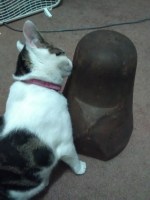
While Clara is not a box loving cat, she is a basket loving cat. This basket was part of a gift basket we won. While it isn’t strong enough to carry anything heavy, Clara declared it perfect for her.

[photo stuck in cyberspace]

Missing Basket?

While looking back through my posts for a previous article on baskets, I came across this photo. I forgot I had this basket. This was taken in my old apartment. I  wonder if I have this in storage still. It would be nice.

carrying-5

*There are a few, okay several, other baskets at use around the house. But, given their more modern aspects, I’ve not included those.

Videos of Interest on Baskets and Basket-making

Baskets from the Smithsonian

 Nantucket baskets (text):

 Baskets of the Appalachia

Traditional Oak Swill (England, longer video)


Published in: on December 4, 2016 at 8:09 pm  Comments (1)  

Why do I Love this Winter Hood?

The Saturday before Thanksgiving, I was at the Genesee Country Village and Museum for their Preparing for the Holidays event. As I arrived at the museum in the morning, it was a beautiful sixty degrees. A beautiful and unseasonably warm morning. 

Well, that was not to last. 

As mid day came, so did the wind. The wind blew and the temperature dropped. It felt more like plummeted. 

I needed to walk across the square to the bathroom. The warmth and sunshine were solidly replaced by chilly and grey. Brrrrrrrrr. On the way back, this odd mix of rain and icy sleety stuff not only fell from the sky, it blew around me as I walked back. 

Luckily, I had this hood on. The protection was impressive. The only ice  that hit my face was the ice that bounced up off my chest. While the wind wanted to blow off my shawl, this hood stayed put. The layers of wool and batting were warm, while the silk inside was oh-so-soft. 

I was very pleased. 

I believe you will be too. 

Visit my Etsy shop for your e-pattern.

Published in: on November 29, 2016 at 6:20 pm  Leave a Comment