“How much did a bonnet cost?”

This is one of the hardest questions for me to answer. Why? Because I don’t fully know.

Ideally, I would have a big pool of bills/receipts, an assortment of ledgers from many different milliners, and a few dozen diary entries to create a database of prices based on year, region, area, time of year, type of piece, etc.. Then, I would feel like I had a hint of an answer.

But, I don’t have that. I don’t think anyone has that.

I save every 19th century bill/receipt that comes up for sale. I have even bought a few. I note every diary entry.

I try really really hard not to cry at the auction in front of all those people when a dealer out bids me on the stack of ledgers with a milliner’s ledger in it.

Take a moment.

Yes. It happened. I saw them go out the door.

….

Diary entries like these from Caroline Richards of Canandaigua, NY give us a look at the prices she paid for her millinery:

Wednesday, 1854 – Ann Eliza is going down street with us this afternoon to buy us some new summer bonnets;. They are to be trimmed with blue and white and are to come to five dollars. We are going to Mr Stannard’s store also, to buy us some stockings.

April 12, 1856 — We went down town this morning and bought us some shaker bonnets; to wear to school. They cost $1 apiece and we got some green silk for capes to put on them. We fixed them ourselves and wore them to school and some of the girls liked them and some did not, but it makes no difference to me what they like, for I shall wear mine till it is worn out. …

 Saturday, 1854 – We got our new summer hats; from Mrs Freshour’s millinery and we wore them over to show to Aunt Ann and she said they were the very handsomest bonnets she had seen this year. 

Bills or receipts can show the price of items from particular stores. They can also show the variety of store types as well as methods of keeping track of sales. This bill from 1849 lists several items purchased:
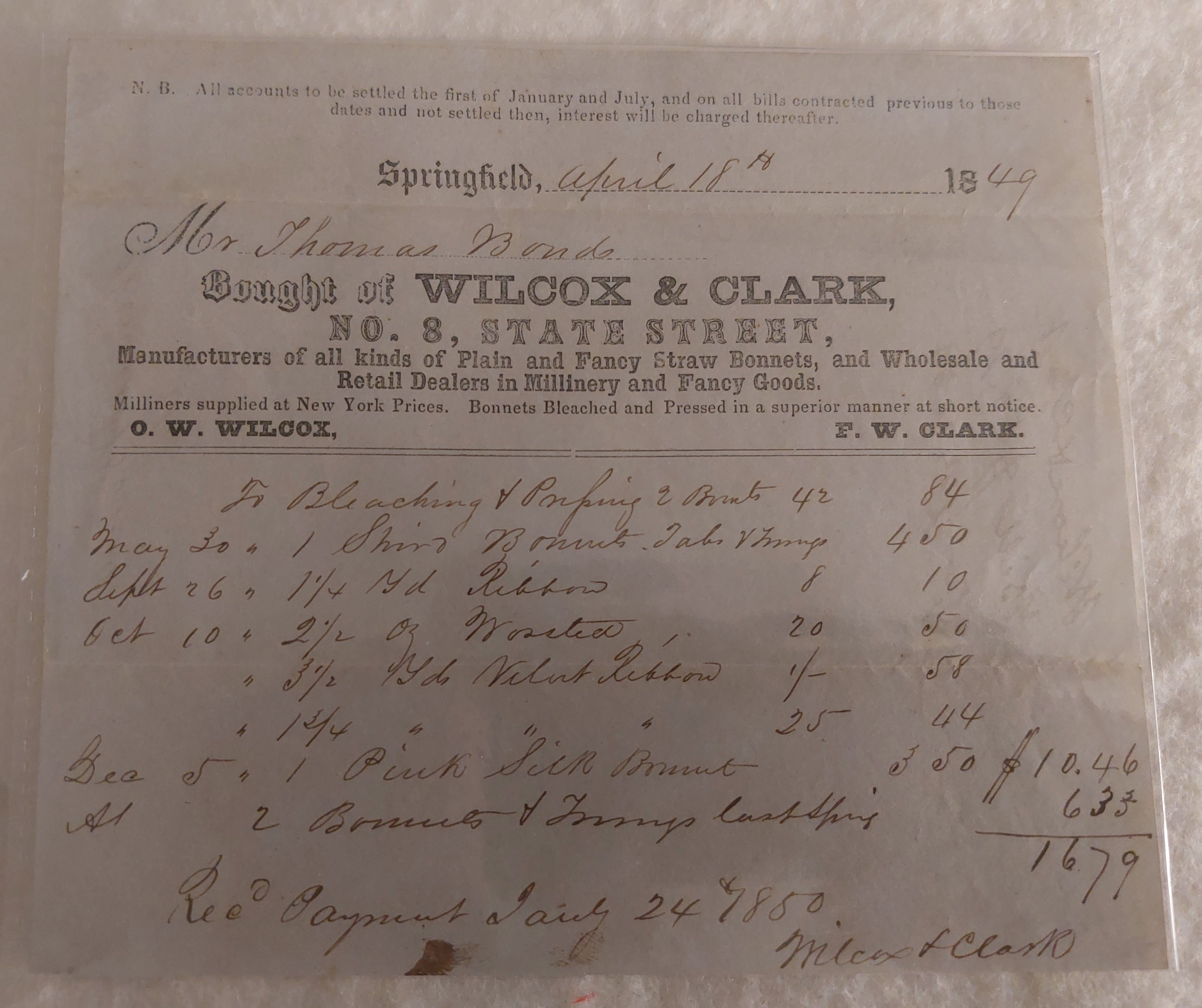
One trimmed bonnet cost $4.50 in May. A pink silk bonnet cost 43.50 in December. Two bonnets and trimmings “last spring” cost $6.35. (This bill also tells us the products and services this shop in Springfield provides, the frequency in which this family of an unknown number of women purchases bonnets, and the delay in payment from “last spring” to April, 1849 for this bill to January, 1850 for the payment.)

If I have to give a price, I can give a window for the mid century of as low as $1 for Shaker bonnets for school to $4.50 for a decorated silk bonnet. But, my answer has holes in that these examples span two different geographic regions and come from two different size cities.

So, the exploration continues…….


Do you enjoy reading my blog? Do you find it helpful? Please consider supporting through Patreon or  Sending a Tip.

Published in: on July 10, 2023 at 12:05 am  Leave a Comment  

When Straw Plait & Fanciful Utility Collide!

Making these workbags, they truly feel like a convergence of Fanciful Utility and Straw Millinery.

I made the Bonbon Baskets last year for Chocolate Weekend at GCVM.

I laugh a little when I think about how times I must have flipped by the illustrations of items made with straw while doing my research for Fanciful Utility.  The pages of Lady’s magazines and fancy work manuals are speckled with items made from straw – from slippers to bonbon baskets to workbags.

Many of the bags are made from the same plaited straw used for making millinery.  A few are made to resemble hats, while a few others are even made from hats.

The straw foundations for the bags, whether basket shaped or a disk, are made much the same way as a straw hat. The plait is hand sewn in a spiral, into the appropriate shape. Then, it is blocked into a more defined shape with the aide of a stiffener.

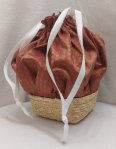
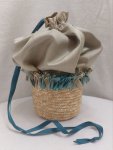
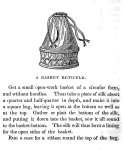
The bag/basket style workbag is similar to reticles found earlier in the century and constructed based a bag in An American Girl’s Book. It is essentially a silk bag with a straw basket for the bottom. The basket foundation can vary in size and shape. It shows up in various publications, calling for different materials. My tapered square basket makes for a very roomy bag capable of holding a good size project such as a knit scarf, shawl, or undersleeves.

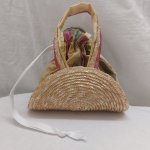
The folded disk workbag, that resembles a taco, is based on a pair of illustrations. One of these is described as a knitting bag, calling for an 8″×12″ straw foundation with pockets set inside. My first version is smaller, using the last of a straw hank. The center is a silk bag, which closes with a drawstring. The straw foundation is lined in silk with a pocket on each side. This size and construction would work well for carrying basic sewing tools: scissors, needles, threads, pins, thimble.

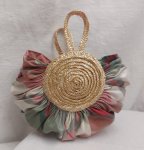
While researching for another potential program, I came across a description that was essentially a wild grass sewn as for making a hat, and made into a balloon style bag. This style bag can be rather roomy for its petite size.

I will be adding bags to my Etsy shop as I make them in between millinery. I will also be adding straw foundations for you to make your own workbags.

Published in: on July 9, 2023 at 3:55 pm  Leave a Comment  

Short Dresses Worn at Home

When I hear questions about what women wore around the house or farm to work, I often think back to Moore’s Rural New-Yorker. In 1861, an ongoing conversation between readers formed a column discussing dress as functional dress and over-dressing. The majority of those contributing to the conversation were rural New York residents, with some further away as well.

I forgot I had compiled many of these column clips into a document for easier reading. I titled it Following the question.

Given my recent reform dress, I thought it would be appropriate to bring the conversation forward to highlight the difference (& similarities) between the public aspect of fashionable reform dress and the functional aspect of practical attire some women chose to wear at home.

Moore’s Rural New-Yorker
January 5th, 1861
Over-dressing
“The over-dressing of American ladies in the streets, at hotels, and in the churches, is a subject remark among travelers from abroad, as well as sensible people at home.” Rural New Yorker
There is a foreign savor about your discourse, Mr. Celebs. The true sons of “Uncle Sam” do not sit in judgment against the wives and daughters of their own country. Hav’nt [sic] you been taking a jaunt in the Queen’s dominions, and been accustomed to the sight of those somber-colored satin dresses that last from one generation to another, and from thence drawn your conclusions? Doubtless you have encased yourself in an armor of impenetrable reserve while the “conflict of” charms is viewed afar off, and while good care is taken that your position is beyond the reach of “Cupid’s darts.” Who are the sensible people you speak or? Are there any who do not make obeisance to keeping up appearances , especially in dress? A few prodigies of excellence and economy may exist; but the torch of Diogenes would evidently be required to find them. Suppose the American Ladies are somewhat in advance of those on the other side of the “big pond,” is there any rule by which they can be judged? Is there any judging in matters of dress? Surely nothing is more capricious than taste.
But if fault exists in matters of dress, where does it originate? For what purpose do they array their dear little selves in the most becoming style? Is it for their own gratification alone? On whom do gentlemen lavish their unceasing attention at “the Springs,” at Newport, at the ball, and, if you please, at the little private party in your own circle? To whom do gentlemen solicit introductions? Is it the plainly-dressed, unpretentious young lady? Or is it that little butterfly of a coquette, made radiantly beautiful by silks and laces? If I am not mistaken, men seldom value a jewel unless it be handsomely set. Dress, or over-dress, has a semblance of wealth, and husbands are not unfrequently bought with the lustre of money alone, and the conclusion of the matter sometimes is, that they find themselves beautifully “sold.”
Personal beauty is worshiped next to mammon, but is rarely appreciated except it be assisted with elegance of dress, and often the chief attraction of the handsome face is dependent on some peculiarity of style, or shade of color in dress, which is made the subject of study by those who know the secret of their power in society. Indeed, the great wonder is that so much attention is paid to mental culture and general intelligence. Goodness and intelligence must receive the homage that is due for their sakes alone, before a reform in dress can be expected. Newspaperdom is not the path to this field of reform. Honestly, Mr. Celebs, does not an American woman possess more attractions for a better-half with her great fault of over-dressing, or, rather, her fault of trying to please, than any of those English ladies who possess such a keen relish for roast beef and porter? Would you like to be taken captive by any of those German beauties whose liking for lager bear is equal to that exhibited by Artemas Ward’s musician – or would you prefer a French lass to serve up frogs in your dish of fricassee, and keep you spending half your life at a “café?” – instead of a neat little American home, where the vine and shrubbery grow undisturbed, and where the sunshine can play hide and seek, and the dear wife, arrayed in the becoming dress you so dearly love to see, is ever ready to welcome you. Linda Bennett. Hammondsport, N.Y., 1860
We wonder if Linda is not indulging in a sly hit at the occupants of the Rural sanctum, – administering her castigation over the shoulders of the devoted “Celebe?” At all events, she comes to the defense of American ladies with true spirit and courage, – genuine feminine grit, – and while we must, with the most profound respect, acknowledge the ardor displayed, we beg leave to enter our protest at being thus summarily read out of either the Union Federal, or Union Matrimonial, For the first, – and we include that naughty little sister, Miss S. Carolina, – we cherish a devotion that will last while pulse beats or heart throbs, and latter, bless your dear heart, Linda, we love with all our powers of body and soul. We speak knowingly, too; for instead of “keeping beyond the reach of Cupid’s arrows,” one of the aforesaid weapons touched us delicious years agone, as those who compose “our own circle” at home, – the little ones who clamber upon our knees and dally with locks where the frosts of winter are somewhat thickly sown, – could testify. In Linda’s remarks relative to the male race, there is unfortunately, too much of truth; we think, however, that the cause of this moral delinquency is not rightly judged. As to the question of dress, and the modes of styles thereof, we do not consider ourselves competent critics, and will take the advice of witty writer she mentions: – “Never don’t do nothin’ which it isn’t your Fort.” Our correspondent has broached the subject, – the ladies have the matter in charge, – and we will be glad to have them discuss its influence upon their sex, in a philosophical and hygienic point of view, through the columns of the Rural.

Published in: on July 7, 2023 at 7:58 am  Leave a Comment  
Tags:

Independence Day & Reform Dress Reflections

I think my post-event adrenaline crash has hit, a day and a half later, due to stuff that needed to be done. But, I am determined to write this post before zoning out into straw sewing land or flat out falling asleep. (This will be a personal perspective post.)

Independence Day was Beautiful!

I was a little worried leading up to the event because my weather app kept calling for thunderstorms, and I had a whole new interpretation & activity to do. Luckily, no thunderstorms. It was all 🌞 sun! Okay. So, it was incredibly humid… 99% if my app is to be believed. Attendance was strong. Here is the view out the door of the seminary at visitors gathering in the village square for the Naturalization Ceremony.

The new interpretation & activity I was doing focused on civic voice, discussing what was important to people in the 19th-century, helping young visitors connect that with what is important to them now, and offering them a chance to share what is important to them. I had a major cram session the days leading up to events. I never studied like that for school.

All-in-all, I learned a lot from preparing for the interpretation and doing the activity. I look forward to future opportunities to discuss the issues important to people in the 19th-century.

I suspect, many of you want to know about the reform dress.

The focus on civic voice and issues of the 19th-century was the perfect opportunity for wearing a reform dress. I had wanted to make a reform dress for a few years but didn’t really have a reason to do so.

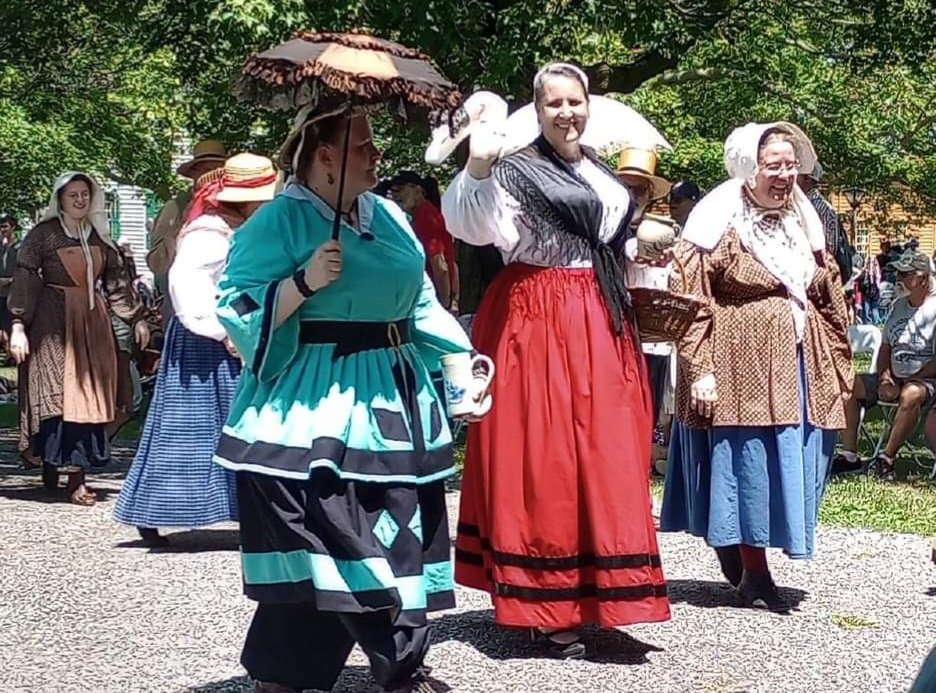
I wanted to make a reform dress that was fashionable 1850s to emphasize the public aspect of the attire, rather than the at-home functional or watercure, recreational aspects. This meant a V neckline, wider collar, open sleeves, basque bodice potentially. I also wanted to incorporate some of the comfort aspects in the ideology behind this attire. This meant the gathered, looser bodice and looser cut armscyes.

I had not quite 4 yards of teal tropical weight wool and what I thought was 2 yards of black tropical wool. As I began working, I discovered the teal had some sun fading on old folds and I had far, far less black than I thought. Luckily, I recently picked up a tote filled with end and damage cuts of wool suiting, including several pieces of black. I was able to piece together enough of the black pieces to make the underskirt, trousers, and trim.

Initially, I planned to do a pattern of diamonds around both skirts (I am calling the long teal basque a skirt in this case.) Black diamonds on teal. Teal diamonds on black. With June what it was, I got to a week before the event and knew I needed to change the trimming plan. I opted for the stripes with diamonds. I am pleased with how this came out. I would not have been pleased with the fussy diamonds appliqued quickly.

I was stuck on the sleeves for quite some time. I wanted a looser cut armscye, similar to travel attire, and an open sleeve for the 50s. But, I did not want to fuss with undersleeves. Luckily, evidence of open sleeves without undersleeves was shared with me. I cut my basic open sleeve. Then, on a whim, tried gatherers above the elbow. I Love this sleeve, both the look and feel of wearing them.

I finally made a hat for myself. Seven or eight years ago, I bought daisies for a hat for myself. They have been waiting all this time. I knew, despite illustrations showing both hats and bonnets, I wanted a hat for this outfit. I also know I wanted a slightly wider brim with a little something extra in the straw. I didn’t go as far as I planned on the brim width, again due to time. I trimmed it with two silk ribbons, daisies, and violets.

Now, let’s talk about the parade…..

I had not marched in the parade for several years. I became very sun sensitive while in New Mexico, like intense pukey migraine bad. Since returning, I’ve not participated in the parade. Instead, I would stand at the fence around Livingston and watch from the shade, wishing I could do the parade and sometimes trying to hold back tears. When several museum friends asked me if I was going to march in the parade, I replied I wasn’t sure. I was drawn. My reform dress deserved to be in the parade. Yet, I was scared of the sun.

At the very last minute, according to the seminary clock, I decided screw the migraine/nausea, I was doing the parade.

I grabbed my parasol and headed for the meadow.

(Photo courtesy of S.P.)

😀

There was a moment lining up that I realized the vast majority of the museum people there were younger and/or newer than me. Given that I was 11 when I first did this parade, that was quite the realization.

I am going to see if I can get Sue to write something about her ensemble. (Photo courtesy of A.H.D.)

It was just a couple times around the square….. but….. it really was a big deal for me. No head ache. No migraine. No faint feeling. No nausea.

Now, for some post-event thoughts on the details of my reform dress. I had planned to do an edited video. But, well, you know I am bad about going back and doing that.

Published in: on July 6, 2023 at 2:07 pm  Comments (1)  

Straw Workbags

Even since making the bonbon baskets, I have been wanting to make other items from straw. Luckily, lady’s magazines and fancy work manuals are speckled with projects, including workbags.

There are three different style workbags I want to make in straw.

The first style is this basket bag style. The base is a basket made of straw plait sewn to shape. The top is a silk bag that draws closed. The construction concept is seen in A Girl’s Own Book, by Lydia Child as well as other publications. The basket base is made with a variety of materials in each description.

For my first two of this style, I created a tapered square straw basket base. The bag tops are silk taffeta with drawstring closures. Both the basket and bag are lined with silk. I may have over engineered the process considering it was past 10pm when I finished the bag portions last night.

Both of these bags are available in my shop. I think I will be able to do one more. I have a smaller round version in mind as well. If there is interest, I will make a couple straw basket bases as well.

The next style is one I can’t help seeing as a taco. The straw base is a circle or oval in a taco shape with the silk bag set inside. I have a mini taco waiting as I write. I have two different ways of making this in mind.

The third style came to me as I was looking for something else yesterday. I already misplaced the image. It was a “duh” moment as I was reading a description of plaited grass/straw fibers being sewing into circles and used for the centers of what was essentially a Balloon Bag. Yes, the Balloon Bag for the sew along years ago. So, of course, I need to make one. I am not sure how well guaging silk onto straw will go. I may add a layer for strength.

Look forward to these styles in the next few days.

Many thanks to Joyce, ot the Time-Traveler’s Rabbit Hole, and Marna for their assistance in finding the examples in the thousands of pages of original publications.

Published in: on July 6, 2023 at 9:49 am  Comments (2)  

Measuring Your Head for Mid-19th Century Hats – Picking the Hat that Fits

There are two factors for finding a comfortable fit: Size and shape.

Size

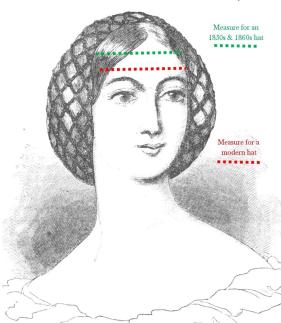
The difference in wear or placement means we measure for a mid-nineteenth century had differently than we do for a twentieth or twenty-first century hat. The modern hat is measured just above the eyebrow. (This is also where many of us measure for bonnets. We want to keep you on your toes.) For mid-nineteenth century, we measure higher, at the hair line. In this illustration, we can see the difference between where the two measurements would be.

measure

These higher, hairline measurements are often smaller than those taken at the eyebrow. A hat worn at this point can be slightly smaller to slightly larger for comfort. So, add and subtract an inch to your hairline measure.

For example: I am 22.5″ around at my eyebrows and 21.5″ at my hairline. The vast land of the internet tells me that the average woman’s head measures 22.5″ to 22 5/8″ around at the modern measuring point. So, I am about average. I comfortably wear a mid-nineteenth century hat that is 19.5″ to 21.5″

Here is my head with the tape showing where to measure. This is where I wear most CW era hats. This is the circumference of my head. My measurement is 21 1/2″. (Note: this is a full inch smaller than the modern measurement take lower.)

General guidelines I use:

  • Small = Less than 21″ at the hairline (crown less than 20″)
  • Average = 21″-22.5″ at the hairline (crown 20-21.5″)
  • Large = Greater than 22.5″ at the hairline (crown greater than 22″)

Shape

It is helpful to know whether your head is more round or more oval.When looking from above, some people have rounder heads while other have more oval heads. I have an average oval head. Very round hats don’t work for me without adding to the lining.

round ovalHat blocks can be more round or more oval with the same circumference. To illustrate: Both of these shapes to the right can have a circumference of 22.5″. Yet, the same hat would fit each head differently.

Published in: on July 1, 2023 at 12:05 am  Leave a Comment  

“How much did a bonnet cost?”

This is one of the hardest questions for me to answer. Why? Because I don’t fully know.

Ideally, I would have a big pool of bills/receipts, an assortment of ledgers from many different milliners, and a few dozen diary entries to create a database of prices based on year, region, area, time of year, type of piece, etc.. Then, I would feel like I had a hint of an answer.

But, I don’t have that. I don’t think anyone has that.

I save every 19th century bill/receipt that comes up for sale. I have even bought a few. I note every diary entry.

I try really really hard not to cry at the auction in front of all those people when a dealer out bids me on the stack of ledgers with a milliner’s ledger in it.

Take a moment.

Yes. It happened. I saw them go out the door.

….

Diary entries like these from Caroline Richards of Canandaigua, NY give us a look at the prices she paid for her millinery:

Wednesday, 1854 – Ann Eliza is going down street with us this afternoon to buy us some new summer bonnets;. They are to be trimmed with blue and white and are to come to five dollars. We are going to Mr Stannard’s store also, to buy us some stockings.

April 12, 1856 — We went down town this morning and bought us some shaker bonnets; to wear to school. They cost $1 apiece and we got some green silk for capes to put on them. We fixed them ourselves and wore them to school and some of the girls liked them and some did not, but it makes no difference to me what they like, for I shall wear mine till it is worn out. …

 Saturday, 1854 – We got our new summer hats; from Mrs Freshour’s millinery and we wore them over to show to Aunt Ann and she said they were the very handsomest bonnets she had seen this year. 

Bills or receipts can show the price of items from particular stores. They can also show the variety of store types as well as methods of keeping track of sales. This bill from 1849 lists several items purchased:

One trimmed bonnet cost $4.50 in May. A pink silk bonnet cost 43.50 in December. Two bonnets and trimmings “last spring” cost $6.35. (This bill also tells us the products and services this shop in Springfield provides, the frequency in which this family of an unknown number of women purchases bonnets, and the delay in payment from “last spring” to April, 1849 for this bill to January, 1850 for the payment.)

If I have to give a price, I can give a window for the mid century of as low as $1 for Shaker bonnets for school to $4.50 for a decorated silk bonnet. But, my answer has holes in that these examples span two different geographic regions and come from two different size cities.

So, the exploration continues…….


Do you enjoy reading my blog? Do you find it helpful? Please consider supporting through Patreon or  Sending a Tip.
Published in: on June 26, 2023 at 12:05 am  Leave a Comment  

“Do You Hand Sew All of It?”

In person, as a visitor watches, the question is usually “Are you hand sewing all of it?” or something about the stitches itself. Online, the question I get is about what kind of machine I am sewing with.

Straw plait millinery was hand sewn up until the invention of the straw sewing machine in the late 1860s. The first straw sewing machine was for sewing the bind edge of a bonnet or hat, not the whole body. The machine for sewing all of the straw came just a short time later. These machines came into common, but not universal use, in the 1870s. I say not universal use because some original pieces from the 1880s still show hand sewing for the construction.

I sew my straw millinery as they did in the nineteenth century up through the mid-century: by hand.

I use little stitches on the outside and long, half inch to inch long stitches on the inside.

To this day, I am still amazed by the visible stitches inside many straw bonnets. Here is an original bonnet I have in my TLC collection. The left photos is outside. The right photo is inside. Notice how you can barely, if at all, see the stitches on the outside, while on the inside the stitches are very visible.

From an artistic or craft standpoint, I find I have far more control over the straw when working by hand. I can adjust the tension, slightly curve, shape, or even fold the straw as I work. This allows me to create the shapes of each style including the height seen in an 1860’s spoon bonnet or the straw bavolet in an 1840s bonnet or the V point of a Regency or late century hat. This straw manipulation is the job of my left hand. So, both hands get tired, often very tired and sore, when I push them. I go through a lot of creams and visit my massage person regularly.


Do you enjoy reading my blog? Do you find it helpful? Please consider supporting through Patreon or  Sending a Tip.
Published in: on June 19, 2023 at 12:05 am  Leave a Comment  

“What is a Cottage Industry?”

A cottage industry at its simplest is product creation in the home.

Product creation in the home, cottage industry, simultaneously provides income for the home, ideally utilizing the resources immediately or locally available, and contributes to the economy of rural and developing areas. When the product created went from the home to a larger manufacturer, as was the case with sewing straw bonnets or hats, this was known as piece work. This is not to say home manufacturing solely occurs in rural or developing areas. Product development can also be done in urban homes, where it is often referred to as home manufacturing instead of cottage industry. In this case, the materials are often provided. Flower making or band-box making would be examples of this.

Straw plaiting and straw sewing as cottage industries in the 19th century were prominent in England and Italy in Europe, and in the New England through New York areas of the United States. (Some areas, such as Luton in England, continued plaiting well into the 20th century.) Straw cottage industry took fibers easily grown in these regions, commonly wheat and rye, and transformed them into money earning product. (more details in From Field to Fashion) The workflow differed between the US and England. In England, straw markets were the norm. Plaiters and sewers exchanged their goods for the best price of the day based on their materials and work. In the US, an industry representative would come to collect finished work in exchange for pay. (I did read a single passage saying a woman could take her work to the local dry goods store with the merchant acting as the industry representative. I need to find additional support for this to be sure of the actuality.) These pieces (bonnets and hats) would then go a factory to be wired and finally sized (blocked and stiffened.) At this point, they were ready to go to straw goods stores and millinery shops.

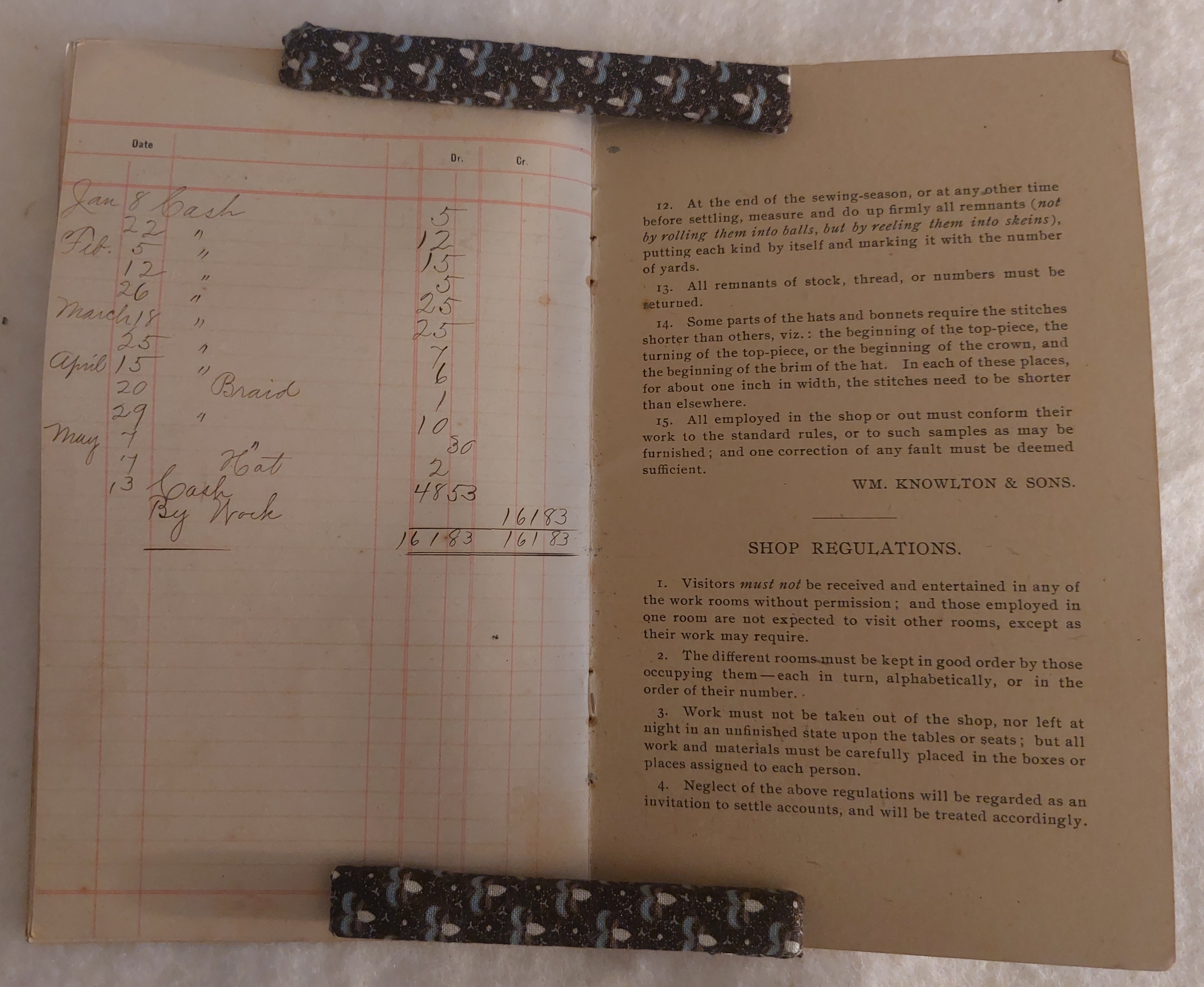
I used to think straw sewing as a cottage industry in the US faded out by the turn of the century. Then, I discovered this log book for tracking straw sewing from 1904. Likely, this sewing was done by machine. This is based on the year and by the number of pieces this person could get done in a month. The booklet gives directions for sewing and shop regulations inside each cover. The pages give space for tracking: Date – Block – Pattern – Goods – Price – Amount


Do you enjoy reading my blog? Do you find it helpful? Please consider supporting through Patreon or  Sending a Tip.

Published in: on June 12, 2023 at 12:05 am  Leave a Comment  

How They Wore Their Bonnets

A few years ago we looked at how some original women wore their bonnets perched on the backs of their heads as well as how we can also do so. If you missed it, the post was called Got Perch?

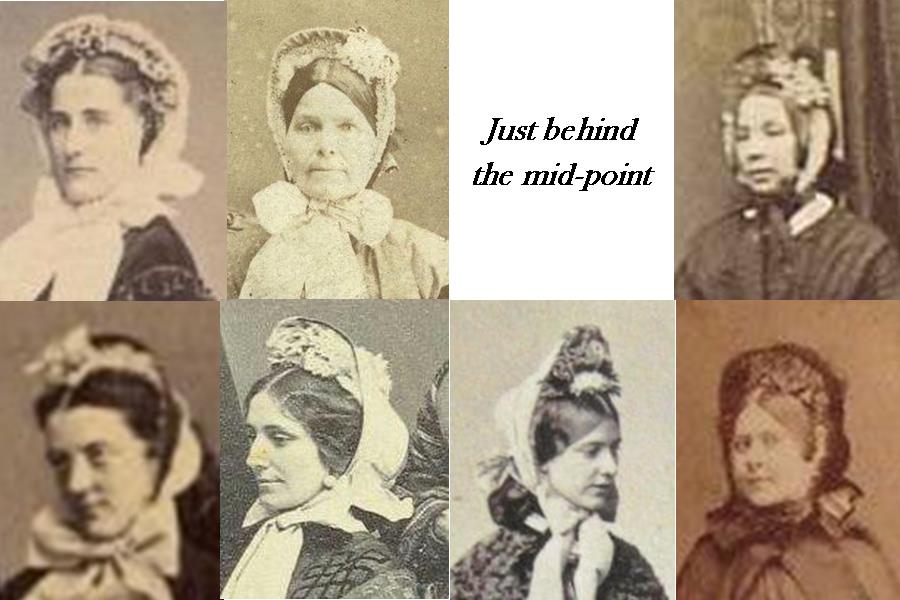
This was only one of several ways women wore their bonnets. Today, I would like to look further at how mid-century women wore their bonnets. Let us start with more examples of the bonnet being worn behind the mid-point of the head.

How did they close ups backYou will notice some variation in how far back the bonnet is worn. The two women on the lower left appear to have their bonnet furthest back among the group. These two also happen to have their bonnets angled more than the others. From the views/positions we have, the third woman from the left on the bottom row appears to have a nearly vertical position to the brim and tip. We can not say for certain with the other women; though I suspect the top left may also be nearly vertical. We can also see that most of these women have their flowers reaching further forward than the brim edge of the bonnet. The position of these flowers may help hold the bonnet in place. In the lower right, the flowers can be seen cupping the top of her head. Take a particularly close look at the woman on the lower left. There is a piece photographing white sitting below the flowers/decoration. This may or may not be a stay.

This next group of women are wearing their bonnets at or just forward of their mid-point.

How did they close ups mid forward 2

We see greater variety in the angle of which these bonnets are worn, seeing them worn nearly vertical, angled slightly forward and angled slightly backward. The bottom right and bottom left images show the further forward reach of the spoon bonnet while displaying noticeable difference in the depth, angle and shaping of the crown and tip. In the top left and top right images, we can see how the frill aids in holding the bonnet on.  Again, the flowers are aiding in securing the bonnet to the head. In the bottom row, third from the left, you can see the woman’s flowers reaching down over the hair line. (The lower right image could be considered as wearing her bonnet quite forward.)

In this next group, we see the bonnet worn quite forward of the mid-point.

How did they close ups full forward

Many will notice these women each look more mature. I do not know if this is a coincidence or if there is truly a connection between age and mode yet. I will look further into this. While these bonnets are worn further forward and a couple are rounder, the fashionable spoon shape is present. The bonnet with the daisies, second on the bottom row, demonstrates well how the flowers can hug the top of the head. In several cases, the flowers sit forward enough to reach to or even beyond the hair line. If there is a connection between age and this mode of wearing, there could be further speculation that this positioning of flowers could conceal a thinning part.

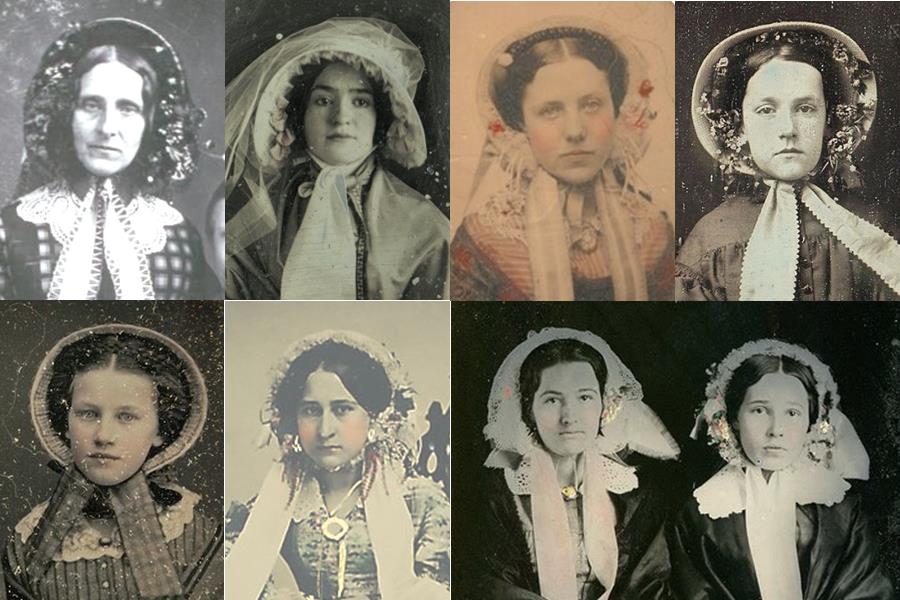
The following group was collected as I was looking at untied or partially tied bonnets. These are late 1840s through early 1850s examples. Each either has the ribbons simply looped over each other without a bow or completely untied. Many, if not most, of the women above would have worn their bonnets in this style ten to twenty years previous.

How did they close ups 40 50 not tied

Published in: on May 29, 2023 at 12:05 am  Comments (1)