12 Homemade Gifts of Christmas – Day 2

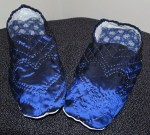
For the second day’s Homemade Gift, we have one of my husband’s and my favorites…. slippers. We love our slippers both for at home and at events.

When it comes to making slippers, you have lots of choices. In period magazines you can find embroidered slippers, quilted slippers, appliqued slippers, corded slippers, crochet slippers and even easy to make hospital slippers. This file has an assortment of slippers to start from.

The way I construct my slippers requires:

  •  An outer material either already decorated in the case of needlework, embroidery, and applique or not yet decorated in the case of quilted or corded.
  • An inner lining
  • An inter lining – either something supportive or batting
  • A sole – painted canvas, leather or cork
  • A sole lining
  • Insoles – two layers of soft wool

For the soles, I trace the wearer’s foot and adjust it to look period. If you don’t have a foot to work from because this is a surprise gift, use inexpensive insoles from the store as a guide.

Layer your uppers together, right sides together. Sew around the inner curved cut or the flat top of each slipper. Turn the pieces right side out. Baste the lower edges together. If you are doing a quilted slipper now is the time to do your quilting. This is also a good time to do your cording or braiding.

Layer your sole and sole lining together. Baste around the edge.

Line your uppers face down on your sole. Pin the front toe and the sides in place. Sew around the edge. Finish the edge with a whip stitch. Turn right side out.

Lay the two layers of insole wool together. Sew around leaving enough space to turn it right side out. Turn right side out and close. Insert into your slipper.

Wear inside.

Published in: on October 22, 2011 at 1:00 am  Comments (2)  
Tags:

On the 12th Day of Christmas, My True Love Made for Me….

I’m the first to admit I’m not the most musical. But, I just couldn’t resist making a list of 12 great 19th century gifts you can make for your loved ones. Here is a list with a little for her, a little for him and a little for the tree….

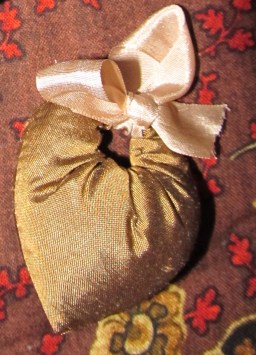
On The First Day….  Heart Shapped Pincushions (also make cute ornaments.
On the Second Day ….A Pair of Slippers
On the Third Day….. A Cuffs and Collar Set
   On the Fourth Day … A Pretty Ribbon Needle-book
 On the Fifth Day….  Lounging Cap.
 
On the Sixth Day….A Handkerchief
 
On the Seventh Day….   A Pocket.
On the Eigth Day…. A little purse
 On the Nineth Day…. A Set of Stationary
 
On the Tenth Day…. A Patchwork Ball to Play With
On the Eleventh Day…. A Book Marker
On the Twelfth Day….. It will be a surprise…. even to me….
https://annaworden.wordpress.com/?p=1984


Published in: on October 20, 2011 at 1:02 am  Comments (5)  
Tags:

The Newest “Must Have” Books for Your Christmas List

Whether shopping for the perfect gift for someone special or making your own wish list, there are some great new books out this fall that ought to be on your Christmas list.

For the needle-worker, seamstress and quilter, there is Fanciful Utility: Victorian Sewing Cases and Needle-books by Anna Worden Bauersmith. This book shows step-by-step how to make an assortment of well researched sewing cases, housewifes and needle-books. Filled with templates and color photographs, this book is sure to keep the hands busy all winter long.

Everyone who dresses for the Civil War era will want Dressing the Victorian Civil War Lady: A Guidebook to Dressing the 1860s by Joy Melcher of the Civil War Lady. This book is filled with original photos, illustrations and tips for interpreters, reenactors, seamstresses and stage costumers.If you love to dance, you will have to have the West Side Soldiers Aide Society’s release of  The Ball-Room Manual of Belfast, Maine from 1863. The facsimile book has page after page of period contra dances acceptable to “the Young, as well as the Old Folks at Home”.

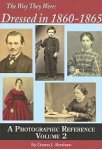
I was very excited to see this second volume available. The Way They Were: Dressed in 1860-1865, Volume 2 by Donna Abraham. Volume 2 takes a closer look at the details of the clothing women, men and children wore through newly published photographic images magnified for an indepth study.

The following books aren’t brand new, but if you don’t already have them, you should have them on your wish list:

Anyone making their own mid-century clothing, or just looking to understand it better should own The Dressmaker’s Guide by Elizabeth Stewart Clark.

Donna Abraham’s The Way They Were: Dressed in 1860-1865 is packed full of original CDV images. I just love this book as my copy is filled with notes and arrows.

What else is on my wish list? Well, I need to learn more about men’s clothing so I can make my husband a full set of civilian attire. (I also need to convince him this is a great idea.) With that in mind, on my wish list we find The Victorian Tailor by Jason Maclochlainn as well as Mr. Ruley’s digital version of Louis DeVere’s 1866 Handbook of Practical Cutting on the Centre Point System.

Article on Williams Clothiers on the Fit of Men’s Trousers

There is an excellent new article over on the Williams Clothiers notebook. “How to Wear Trousers Properly and Avoid Gaposis” includes numerous images and informative text. Take a look!

Published in: on September 18, 2011 at 5:12 pm  Leave a Comment  

Paisley Long Shawls

You know I Love paisley.

Elizabeth Aldridge is now offering Paisley long shawls, also known as scarf shawls. These lovely shawls are a silk and wool blend, 28″ wide and 70″ long. She has a variety to select from on her website. Just look under “Sundries”. I’m rather fond of the deep red one.

There are a couple ways you can take these shawls to make them bigger and more square.
One way is to take two shawls; trim off the border along one long side of each. Seam them together along the sides where the border was removed. This would give you a shawl roughly 70″ by 50″. You could do this with a third shawl adding it to the center. This could give roughly 70″x70″.
Another option is to take the borders off of these shawls and add them to a center square. You would need 2 shawls to go around a square wool shawl. (2 shawls = 4 borders.) You can attach the borders on all one side or on alternate corners for a turn-over shawl. (When it is folded, you will see both borders.

Adding ‘paisley’ borders to wool or cashmire centers was common in the mid-century. This happened in one of two ways. The borders were woven seperately. They could be sewn on the centers by a group of women then sold commercially or the borders could be sold/bought and sewn on at home.


Here is a great illustration of long shawls during the Regency era.

Here is a beautiful blue long shawl

For those thinking of piecing two or three of these shawls into a larger shawl, here is a 20s/30s shawl with the border added to the center.

This is a must-see 1815 English shawl in a brillian blue with floral motif

Published in: on August 25, 2011 at 6:51 pm  Leave a Comment  
Tags:

An Evening Chill in the Air

Have you noticed the chill in the air as evening sets in? I know it is still August. But, it is definitely there. While it may feel refreshing to fall asleep in this fresh cool air after many hot and humid nights, we all know this means even colder nights aren’t far behind. I’ll admit, this year I am particularly not looking forward to the colder weather coming in since I don’t exactly have my own home with my own favorite creature comforts. I am big, really big on my creature comforts, most of which come from what I’ve learned about how people kept warm in the 19th century. But, I digress.

With cold weather imminent, now is the time to make sure you are ready. After all, you don’t want to be left out in the cold without your cold weather wear.

Layers are the Key to Warmth. This means your 1) Underpinnings 2) Dress 3) Outerwear and 4) Accessories.

For your underpinnings, consider these:

For your dress, consider:

For outerwear, think beyond the cape that will let cold air in and encumber you arms. Consider:

Accessories help keep your hands and head warm. Consider these:

Published in: on August 22, 2011 at 12:22 pm  Leave a Comment  
Tags:

Basic Guidelines

For a few years now my “Basic Guidelines” brochure has been a favorite of several groups across the country. I often get emails asking if it can be used for a group the sender belongs to. Of course, I’m happy to share and feel honored that a group wants to use my guidelines for thier members. The printable brochure has been ideal for sharing with new members who undoubtably have many questions. I made a point to fill it with just enough resource links to be helpful but not quite overwhelming. It has been a few years since it has been updated with revised links. So, here it is in a text/post version with updated links. I will be updating the printable pdf as soon as I can.

What Do I Do at an Event?

The best thing you can do as a new person at an event is talk with people.

This is a great way to learn and make contacts. Some events will require you to stay in first person while others allow you to be yourself. Either way, talk, ask questions, learn.

Stay hydrated and eat small meals. The excitement of an event combined with often hot weather conditions can take a toll on your body. It is very important to stay well hydrated. If you are thirsty, you are already dehydrated. You will also find it easier to eat small meals. Heavy food can make some stomachs ill in the heat or wearing clothing you are not accustom to.

Attend informational sessions if they are available. Some events have lectures or presentations for you to attend. Bring a small pad of paper and a pencil to write down questions, points you want to double check, and references.

If the event is located on a historic location or at a museum, take the time to see their collections and what resources they have. It would be a shame to miss them.

At events where you will find yourself at you “home base”, whether that is a tent, house, or porch, be sure to bring something to do. This can be a small piece of needlework, knitting, a piece of sewing, or a book to read. Visitors are likely to ask questions. Tell them what you know and be comfortable saying “I don’t know” when you don’t.

Many new reenacters enjoy seeing what is available at an event, including sutler row. If you feel you really must go shopping please read “The Shopping Itch” first.

Give yourself some down-time to let everything sink in. Some find keeping a journal or writing a letter helpful.

Elizabeth Clark has written several articles concerning hygiene, event safety, and improving your experience:

http://www.thesewingacademy.com/wp-content/uploads/2011/04/2010Scentury.pdf

http://www.thesewingacademy.com/wp-content/uploads/2011/04/2010ChildSafety.pdf

http://www.thesewingacademy.com/wp-content/uploads/2011/04/2010ValueEvents.pdf  

What Do I Wear?

Your initial wardrobe should include foundation garments, underclothing, and a basic dress plus a few accessories.

Foundation garments:

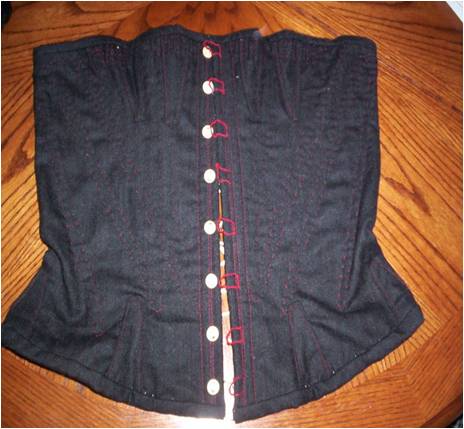
Corset – Your corset will need to be custom fitted for the best fit. You can also make your own corset. This garment is essential for providing you support and giving your dress the right shape. Consider Originals by Kay, Farthingales for sources

Cage Crinoline – A cage crinoline or a covered cage will land between your ankle and calf in length. The circumference will be between 90” and 120” with a round or elliptical bell shape, not a cone. Consider Originals by Kay or Needle & Thread for sources

Under Garments:

Drawers – Your drawers serve as you underwear. These are split and attached at the waist to a waistband. See http://www.thesewingacademy.com/wp-content/uploads/2011/04/2010Drawers.pdf for free directions to making your own.

Chemise – Your chemise is your upper undergarment. It protects you from your corset and your corset from you. See http://www.thesewingacademy.com/wp-content/uploads/2011/04/2010Chemise.pdf for free directions for making your own.

Modesty Petticoat – This petticoat is worn under your crinoline. The length will land around your lower calf.

Petticoats – You will want multiple petticoats. You will want two to go over your crinoline which are a couple inches longer than your crinoline. You will want one or two to wear with any dress not worn with a crinoline. These will be slightly longer than the modesty petticoat. See http://www.thesewingacademy.com/wp-content/uploads/2011/04/2010Petti.pdf or Skirting the Issue for directions for making petticoats.

Basic dress:

One Piece Dress. – You will want a one piece dress. If you choose a cotton print dress, look for one with a gathered bodice, gauged skirt, and long bishop or coat sleeves. To better understand each of these components read The Dressmaker’s Guide to Fit & Fashion and Who Wore What.

Accessories:

Boots/shoes – Accurately made boots and shoes will be an expensive investment initially. You will want a boot with a low ½ inch heal and a square toe which uses eyelets to lace up the front or side.

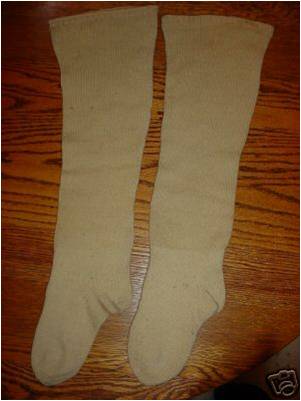
Stockings – Solid color cotton, wool, or silk stockings are acceptable. These should reach comfortably above the knee to be secured with a garter. Tight stockings will become uncomfortable and cause your legs to swell.

Head Covering – You will need a bonnet for sun protection or social situations. Please read “Types of Bonnets” and “Anatomy of a Bonnet”

Outerwear – You will want at least a shawl. You may want a coat depending on the weather.

Who am I? And What do I need to bring?

These two questions depend greatly on the “impression” you develop. This means creating a character or persona you will portray at an event. At most events you will be free to pick any person who fits into the event. At some

events you will have a person assigned to you that fits the research for that event.

Things to consider while you develop your persona include:

Event time and place – Each event is usually based on a specific town or battle location. Some locations were agriculturally based while others were more merchant or industrially based. This will give a context for your impression.

Economic classes were divided into poor, working class, upper working/merchant class, leisure class.

Employment – Financial status for women almost always depended on the employment of their husband, father, or son. A few women were employed as well. As the war progressed, a woman may have been increasingly effected by the state of her providers employment.

Leisure activities can be important for an impression. Activities such as sewing, knitting, embroidery can be depicted at events.

Social interaction can say a great deal about a woman’s impression. If financially able she may participate in a social movement, religious activity, or charitable acts.

Once you’ve developed who your character or persona is, you will need to decide what you accouterments you will bring reflecting that impression.

Eating utensils – You will need some thing to eat with. The dishes and utensils you choose can depict your social and financial status. Consider china or iron stone dishes.

Seating – Some choose to bring their own seating. If you are a poor or poorer working class person, you will not want to bring a fancy chair. Viceversa, if you are well off, you likely will not have a rude bench on your porch.

Accessories and Miscellaneous– Fashionable or comfortable women are more likely to have accessories such as a parasol or fashion bonnet. A working class woman may be shopping in town carrying a large market basket.

 IMPORTANT – Please pack your filed in Medical form in a location where it will be carried with you at all times.

What do I pack everything in?

Depending on the type of event you may need to pack everything you need in period appropriate boxes or luggage or you will be able to unpack your things from modern containers which remain in the car. For period containers and luggage consider these options:

Carpet bags – There were a variety of carpet bags and other handbags during the mid-century. Some were manufactured while other were handmade. These are easy to pack soft goods in such as clothing. They are easy to carry.

Trunks – Trunks vary in size and shape. Original pre-war trunks should be reproduced for use as most originals are delicate and valuable. Trunks are good for transporting most materials and give some protection against moisture. Large or heavy trunks can be difficult to transport.

Wooden packing Boxes – small to medium size reproduced boxes can be good for packing a variety of items and can protect against moisture. Depending on the wood and what is packed inside they can be heavy and difficult to carry. Construction should use period techniques.

Pasteboard boxes – Pasteboard boxes are nice for storing and transporting smaller items or those you want protected like a bonnet. These can be made with a base box, period wallpaper and interior paper. These are sensitive to moisture.

Cloth Sacks – Simple sacks or even pillowcases can be an easy way to carry soft goods. These are especially appropriate for a poorer impression

What do I need to sleep in?

You may choose to sleep on the ground, on a pallet, or on a cot. In either case you will want bedding appropriate for the weather. Items you may want to consider using:

Gum blanket or painted cloth – If you are sleeping directly on the ground, you will need a waterproof layer to keep the rest of your bedding from getting moist.

Bed ticking or feather bed – Whether you are sleeping on the ground or a cot, a bed ticking or feather bed will soften where you sleep. This item can be bulky to pack. A straw ticking can include insects and be a fire hazard.

Sheets – In variable to hot weather, sheet are comforting.

Wool blankets – Wool, layered under the bedding will reduce moisture.

Quilts – Be sure to choose period fabrics and piecing. A strip quilt is one of the easiest to make. The inside batting can be wool or cotton. A wool batted quilt as the top layer on a bed will also help with moisture.

What do I eat?

It is easier to bring period appropriate foods in period appropriate containers. This way you do not have to worry about hiding inaccuracies. Foods can include in season fruits and vegetables, dried fruits, dried vegetables, dried meats, breads, hard cheeses, dried beans, and period cookies. To store you food consider:

Tin works well for dry goods.

Crocks can keep things a bit cooler. Some have lids.

Fabric bags can carry fruit, vegetables, cookies, etc..

Parchment paper is good for wrapping cheese and meat.

For more ideas on bringing food that does not require a cooler along with a couple recipies, read “No Refrigeration Required” http://www.elizabethstewartclark.com/GAMC/LS/PDF/No%20Refrigeration.pdf

For recipes visit: http://digital.lib.msu.edu/projects/cookbooks/html/browse_date.html#1854

Where do I stay?

At most events in this area you will stay in a tent if you stay on site. There are several options for a tent. (Some events will require all civilian tents to blend in with military tents. This will limit your tent choices to correctly

made military wedge tents.) When choosing a tent to purchase consider how many people will stay in the tent, how much room you will need, how you will transport your tent, and how you will be able to set up a tent. Ridge

poles can be cut in half with a center connecter to enable them to fit in vehicles better.

Wedge tents – These are shaped like an “A”. These vary in height, width and length. They require two vertical poles and a ridge pole. They provide ample floor space with a reduced amount of standing space. Doors can be placed in the front or both the front and the back. Wedge tents are generally easy to set up with one or two people.

Wall tents – These tents have sides with walls ranging from 12” to 3 feet. These also vary in height, width, and length. Taller items can be placed along the walls and you will be able to stand in the entire tent. Wall tents require two vertical poles, a ridge pole, shorter side poles, and numerous ropes. It takes a minimum of three people to set this tent up.

Ground cloth – Tents come without floors. A ground cloth is cut the size of the interior of your tent. This can serve as your floor with minimal protection from moisture and dirt. Some choose to use carpeting instead.

Flies – Flies were originally used over top of the tent to shield it from the sun and rain or as a separate shelter. Many civilians choose to use as a sitting area in front of their tent. Depending on the set-up, a fly will need 2- 12 vertical poles, a ridge pole, and numerous ropes.

Published in: on August 18, 2011 at 8:02 am  Leave a Comment  

Keep it Simple…. Keep it in Budget

Whether sensitive to the economy, saving for a new home, planning for a child’s college or struggling with an income growing slower than idea, we all seem to be thinking about our budgets lately. At the same time we want to enjoy our hobby. This crazy hobby that at times can cost a pretty penny.

For many women enjoying the hobby means a new dress. The idea of a new dress can spark a myriad of tempting ideas dancing through our heads of fabrics, colors, prints, weaves, necklines, sleeves, trims and the like. Before we know it we may have a beautiful dress designed in our imagination that is anything but budget wise? So, how does a woman get that new dress while keeping with a budget?

Keep it simple… Keep it practical… Keep it versatile… Keep it in Budget

Are you asking “What does that mean?”

First, if you have read them, I want you to go read three articles. If you have read them, I want you to go back and read them again. These are Liz Clark’s Assembling the Best Bet Wardrobe and The Cost of Accuracy 2010 (where on page 3 you will find a guide on how to assemble a wardrobe for $20 a month) and my Anatomy of a Dress.  (If the links to Liz’s articles don’t work, they are here in her Compendium)

Now, let us look at that dress that is simple, practical, versatile and in Budget.

This dress isn’t the same for everyone. It needs to suit your age, roles, 19th century social status and kinds of events you attend. Your dress is the dress which will best suit a multitude of situations for you, the dress you can adjust the accessories on to change what it can be used for.

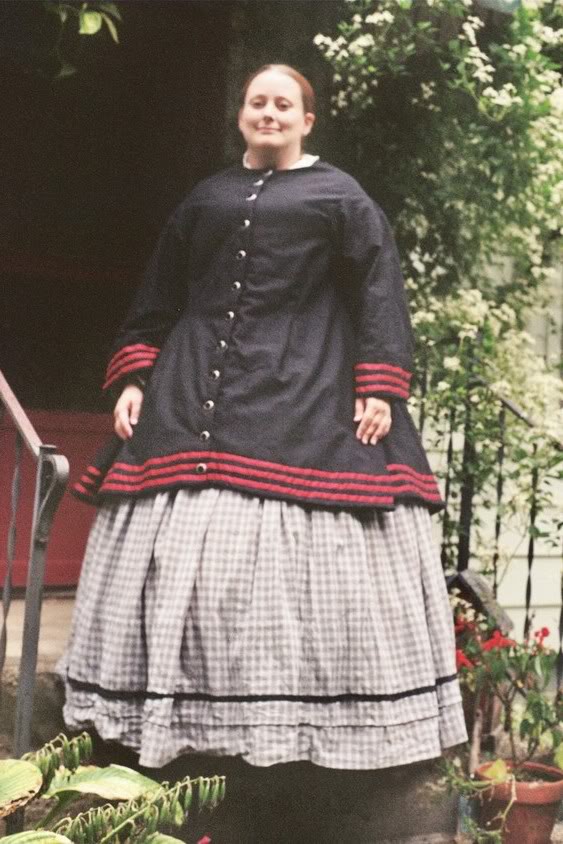
One of the most versatile dresses is a light weight wool dress, meaning tropical weight, nicely fitted for your body with a coat sleeve. This dress could be worn over a smaller skirt support for laboring purposes. Accessorize with a kerchief at the neckline, utilitarian cuffs and apron. If you have a work petticoat, you could pin your skirts up over it. For a look suitable for a woman of modest means going to town, add a crisp, yet simple collar and cuffs along with a Petersham ribbon belt with a mother of pearl buckle and a neck ribbon. Add a plaid wool shawl draped over your shoulders. For a well dressed look of a woman of moderate means, choose a delicate collar and cuffs with simply elegant embroidery for your personal linens. Accessorize with a Petersham ribbon belt closed with a gutta-percha, vulcanite, or cut steel buckle and a mass-marketed brooch at your neck. Select a nice shawl such as a bordered wool or European made Paisley, or opt for a delicate fichu. To achieve the look of a woman of comfortable means, replace your buckle a finer one possibly of gold or silver and your brooch with something like bog oak or other nicer piece.  Drape a silk or lace shawl over your shoulders; a delicate fichu will work as well.

A tropical wool dress may not suit everyone’s needs whether scenario based or personally based. This same premise can be applied to other dresses stretching their versatility. For some who need to be able to wash their dress on a regular basis or who are not ready to look into a tropical wool,  a cotton dress may be more appropriate.  For those who frequent warmer events or who have heat sensitivity, a sheer dress may be a better choice. In either case we can apply the concepts above with the tropical wool dress. A cotton dress made of a quality fabric in a period correct print (mind you quality can be found on a budget with smart shopping and wise saving) can be finished with personal linens in the same way. The accessories can be selected according to the situation as well. A sheer dress can also have its personal linens or accessories changed out to suit the occasion.

By changing out the personal linens and accessories on a single dress you really can go from one outfit to 3 or 4 outfits suitable for a wide variety of occasions.

Published in: on August 16, 2011 at 8:05 am  Leave a Comment  

Why This is Good…. Looking at Clothing

I have the preliminary versions of “Why This is Good…. Looking at Clothing” together.

There are two files – A smaller printable version and a larger Power Point. Each are attached in as PDFs for easy viewing. (Though it looks like the notes for the PP are not visible.)

Why This is a Good Impression – Printable Version

Why This is Good Impression Visual Extended Power Point 

You will notice in the smaller file there are specific types of impressions I want to add when I have the right images. These will be added to the larger PP as well.

If you submitted an image you do not see, this doesn’t necessarily mean it wasn’t up to par. More likely I either haven’t done those slides yet or it duplicates something I’ve already covered. It does seem the more I cover, the more I still need to cover.

If you are in an image you did not submit, feel flattered because someone thought you had a really great impression. If you want it removed, let me know.

Published in: on August 10, 2011 at 11:32 am  Comments (1)  

The Weather Outside is…. Drenching

With this soak-you-to-the-bone weather leading up to and likely through the weekend event,  I am thinking about ways to keep dry. As I think through my list, I realize most of them won’t happen because the bits and pieces needed are buried deep in storage. That doesn’t mean I can’t share them with you.

  • Reenacting events inevitably mean walking, likely through grass or even mud. With wool boots, I find my rubber over-shoes a must. They slip right over my boots covering up to about my ankle. Extant rubber over-shoes were found when the Steamboat Arabia was uncovered. Those made by Tingley seem to be the closest.
  • Just incase, still pack extra stockings or socks for everybody.
  • A wool coat can help keep the wet off of most of you. A long paletot gives you great flexibility in the arms while buttoning up the front to keep you dry.
  • If you don’t have a coat, consider the largest, plain or plaid wool shawl you have. Wrapping this around you will help keep you dry.
  • We talk a lot about parasols in reenacting but not much about umbrellas. Use an umbrella, a period umbrella of course.  
  • Skip the fashion bonnet. Instead opt for a sunbonnet or for a hood. Water can cause a bonnet to soften, warp and even run.
  • If you carry a bag, make sure it is water-resistant. You may want to try a pocket instead. A pocket hidden under layers of skirts can usually stay dryer than a bag carried out in the open. If you must carry medicines or modern technology put them inside painted canvas bags or zip-lock bags just incase.
  • For larger bags, choose one with a heavy carpet and good closure. If it has a leather or painted canvas bottom, even better. Leave the bandbox at ‘home’.
  • You will be happier with your tent if you have sod-flaps and overlapping doors. Also put down a good water barrier under your flooring. I find a wool rug helps control the moisture better than other fibers.
  • Inside your tent let wool rule. Wool rugs on the ground help keep the area more comfortable. Put a wool blanket layer over your cot or ticking first. Be sure it drapes almost to the ground on each side. This keeps the moisture from coming up from underneath. Make you bed how you prefer. Then cover it all with a wool quilt or blanket. This will keep the moisture from getting in during the day. If you are sensitive to a moist pillow, wrap it with an extra wool shawl during the day to keep it dry.
  • Don’t hang your clothes. Put them in a trunk or box with a layer of wool covering them to help keep moisture down. You may consider a layer of wool on the bottom as well.
  • As you settle in for the evening, light a candle or two (safely). Whether the candles really do help cut the moisture or not, they help psychologically.

What do you do if you do get drenched?

  • If you can lay or drape your dress flat that will be best. Hanging it can cause it to stretch under the weight of being wet. If you have a trim that can run, be sure to lay the dress so the fabric does not lay back on itself particularly the trim.
  • If your bonnet get damp, set it up on a hat/bonnet stand. If you don’t have on make-d0 with something like the back of a chair. Do not lay it on its side because it will warp.
  • If your bonnet gets particularly wet, try to blot the trimmings so there is no running water. If your flowers are pinned in or on, consider removing them so they will not run on the bonnet itself.
  • If your boots get wet inside, stuff them with newsprint or fabric to absorb the water. Do Not put them near the fire as they can be damaged. (most warranties do not cover fire damage)
  • If your corset gets wet, layer it inside material to press out any excess moisture. Drape it over the back of a chair to dry.


Published in: on August 9, 2011 at 12:42 pm  Leave a Comment  
Tags: