Website to blog transition part 2

Little bit by little bit…..


Getting ready for and Getting to Events:

Basic Guidelines for women

Event Prep Cheat Sheet – A helpful sheet to help you have the basics for an event.

Packing and Storing & Small Containers Hints for packing and storing your items inclucing small items.

Tents and Camping – Information on tents and camping

Creature Comforts –  those things that make life more comfortable at events.

Clothing and Millinery:

Anatomy of a Bonnet1 – The basic structure of a mid-century bonnet.

Making Bonnet Ribbons – A guide to making bonnet ribbons from fabric or narrower ribbons.

Godey’s Flowers  & Godey’s Scissor’s Case– These are directions for making various flowers from Godey’s I plan to eventually make. I’ll be adding more directions as I am able to scan more originals and as I attempt each flower.

Swatchcards Template – A template for swatch cards

The Shopping Itch –

Culture and material Culture:

Introductions – Hints on how to give basic introductions.

Books and Paper – Information on the sizes of paper and books.

Soldiers’ Aide Acquisition and Distribution Chart

Dining and Entertaining

Keeping Your Hands Busy – Needlework ideas for at events

Measures and Money

 Domestic Advice Manuals

 Etiquette and Manners Resources – A list of resources

Published in: on March 19, 2009 at 8:13 am  Leave a Comment  

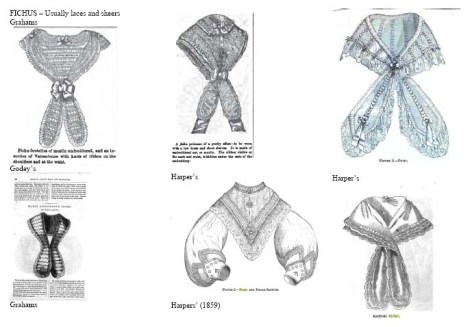
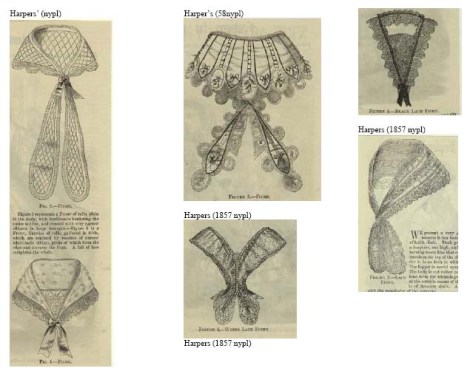
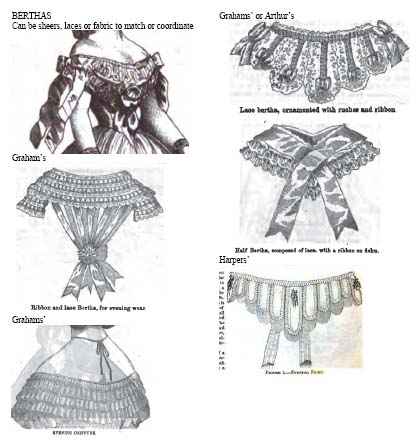
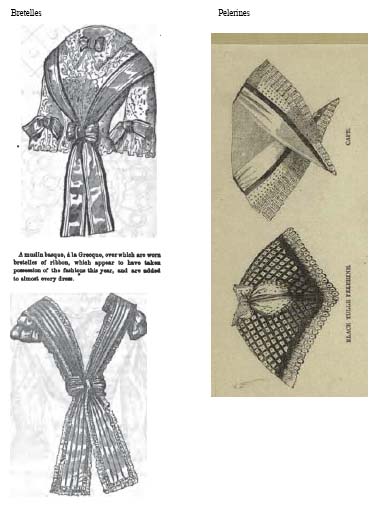
Frilly Fru-Fru – Fichus, Pelerines, Berthas, etc

There just simply isn’t enough frilly fru-fru out there in the reenacting world. I am referring to the neglect of those pretty accessories women wore during the mid-century such as fichus, bertha, pelerines and also headwear like caps.


Anna Allen has a lovely example of a fichu taken from a Godey’s illustration and directions

http://www.thegracefullady.com/civilwargowns/accessories_fichuri.htm This is another example of her’s http://www.thegracefullady.com/civilwargowns/ready-mades_netfichu.htm This fichu is very easy to make and fun to wear. [pictures of mine to come as soon as I get new camera batteries.]


Here http://thesewingacademy.org/index.php?topic=3226.msg55443#msg55443 Colleen Formby has a great example of a mantle based on an original.


untitled-1untitled-2untitled-3untitled-4 


The MET has several fichus, berthas, etc in their collection. Here are a couple examples:

 White cotton lace http://www.metmuseum.org/works_of_art/collection_database/all/fichu/objectview_enlarge.aspx?page=2&sort=0&sortdir=asc&keyword=fichu&fp=1&dd1=0&dd2=0&vw=1&collID=0&OID=80052043&vT=1


Mid-century lace

http://www.metmuseum.org/works_of_art/collection_database/all/fichu/objectview.aspx?page=5&sort=0&sortdir=asc&keyword=fichu&fp=1&dd1=0&dd2=0&vw=1&collID=0&OID=80052412&vT=1

British silk

http://www.metmuseum.org/works_of_art/collection_database/all/collar_bertha/objectview.aspx?page=4&sort=0&sortdir=asc&keyword=bertha&fp=1&dd1=0&dd2=0&vw=1&collID=0&OID=80052173&vT=1

French silk lace http://www.metmuseum.org/works_of_art/collection_database/all/cape_pelerine/objectview.aspx?page=2&sort=0&sortdir=asc&keyword=Pelerine&fp=1&dd1=0&dd2=0&vw=1&collID=0&OID=80052118&vT=1

Published in: on March 11, 2009 at 11:33 am  Leave a Comment  

Website to Blog Transition

I’ve discovered the visitation to this blog is much more frequent and consistent than my website. Between this and finding I can put pdf files up easily here, I plan to put more materials here. In the meantime, I thought it would be helpful to link back what is already on the website.

Information for From Field to Fashion: Straw Bonnets is available on the website.

To Net or not to Net is fairly popular, discussing hairnets of the mid-century. http://www.geocities.com/shadowofthesundial/netarticle.html

The original shawl article is available on the website at http://www.geocities.com/shadowofthesundial/earlyvictorianshawls.html. The E-book Early Victorian Shawls is available here https://annaworden.wordpress.com/2009/01/22/straw-bonnet-work-book-early-victorian-shawls/

I have a series resources in PDF format available here http://www.geocities.com/shadowofthesundial/list.html  including: Anatomy of a Dress – The basic structure of a mid-century dress.

Anatomy of a Bonnet – The basic structure of a mid-century bonnet.

Fringing shawls – A guide to fringing a wool fabric shawl.

Making Bonnet Ribbons – A guide to making bonnet ribbons from fabric or narrower ribbons.

Event Prep Cheat Sheet- A helpful sheet to help you have the basics for an event.

Introductions- Hints on how to give basic introductions.

Swatch cards template- A template for swatch cards

Transcription of ”Home” by Fergurson and Transcription of “Politeness” by Fergurson

Books and Paper- Information on the sizes of paper and books.

Flowers from Godey’s- These are directions for making various flowers from Godey’s I plan to eventually make. I’ll be adding more directions as I am able to scan more originals and as I attempt each flower.

Packing and Storing Small storage containers for packing and storing small items.

Tents and Camping –

Soldiers’ Aide – Acquisition and Distribution Chart –

Creature Comforts, those things that make life more comfortable at events.

Dining and Entertaining

Keeping your hands busy Needlework ideas for at events

Money and Measures

I am planning on updating and moving over all the Social Movements reading lists from the Social Movement Series in the Citizen’s Companion. For right now, those lists are here. http://www.geocities.com/shadowofthesundial/social.html  

I hope this makes accessing things easier for everyone. Thanks for visiting.

Published in: on March 3, 2009 at 1:33 pm  Leave a Comment  

Digital Collections

Here is a partial list of the digital collections I use

American Memory through the Library of Congress http://memory.loc.gov/amhome.html

Oxford Digital Library http://www.odl.ox.ac.uk/

New York Public Library http://www.nypl.org/

The Digital Book index (older) http://www.digitalbookindex.com/search001a.htm

Making of America through Cornell  http://cdl.library.cornell.edu/moa/

Making of America through Univ. Michigan http://quod.lib.umich.edu/m/moagrp/  Their library http://www2.lib.msu.edu/branches/dmc/digital.jsp#bdc

Cornell’s Division of Rare and Manuscript Collections (multiple accessible collections including http://dlxs.library.cornell.edu/m/mayantislavery/browse_L.html ) http://rmc.library.cornell.edu/collections/rmccollections.html

Texas Woman’s Univ. Library http://www.digitalbookindex.com/search001a.htm

Texas Tech Univ. (just changed site) http://lib-cms.tosm.ttu.edu/testsite/

Documenting the American South by UNC http://docsouth.unc.edu/

Kentuckiana Digital library http://kdl.kyvl.org/

Texas A&M Gee Library (oral histories and veteran interviews) http://www.tamu-commerce.edu/library/arc.htm and http://dmc.tamu-commerce.edu/cdm/landingpage/collection/uw 
Harvard VIA http://via.lib.harvard.edu/via/deliver/advancedsearch?_collection=via


And of course the ever expanding Google Books www.books.google.com their newspaper archive and patent index


Museums with online digital collections:

Met

Musee McCord

Henry Ford Costume Collection

Old Sturbridge Village

Victoria and Albert Museum

Ohio Historical Society’s Online Collection Catalog

Mann Library


Modern Journals

Oxford Journals http://www.oxfordjournals.org/subject/humanities/

Published in: on January 16, 2009 at 9:51 am  Comments (3)  

Hair Article – Alaina Zulli updates


Alaina Zulli has updated her hair article page. http://www.gothampatterns.com/hair.html#hairarticles . Her online article includes photographic examples as you read. She covers basic style, variations, short and side-parted hair, pomatum and hair oil recipes, accouterments and accessories, hair care, 19th c. articles, and men’s hair.

She also has a new blog http://gothampatternsphotos.wordpress.com/


Published in: on January 14, 2009 at 10:13 am  Leave a Comment  

Make the most of your local resources

Your local area may be filled with valuable resources for research. Within a minimal half hour radius of where I live I can find at least eight extant textile collections, a collection of ledgers, numerous diaries and letters, a long list of material culture collections, and many other useful collections along with the standard County Historian collections. This actually doesn’t include any of the resources in the city, which I can’t count off the top of my head. I suggest starting with a list of possible resources in your area. Then start networking to see who has what. Your list could include town or village historical societies, county historical societies, landmark societies, local libraries, county libraries, museum libraries, museum collections, and private collections. Don’t over look anything. The Jell-O Museum in a nearby town is adjacent to that town’s historical society and has a substantial collection of 19th century underclothing. When you make your list, be sure to write down the open times and contact information. Be prepared for some unusual or restrictive access times. The reading room which has ledgers I consult is open after work only on Tuesdays for about 45 minutes. That takes some strategic planning. Some places will make arrangements for you to look at a collection at specific times. For those places with continuous or rotating exhibits, consider paying a visit during their regular hours or a presentation program. This will let you get an idea of what they have out already and give you an opportunity to introduce your self in person. If the curator has the time while you are there, talk about what you are researching or interested in.

For your visit –

Some organizations have a fee for accessing their libraries or collections. If they do not ask for a fee, it is courteous to give a donation.

When looking at textile or material culture collections:

– Bring your own pair of clean white cotton gloves.

– Bring multiple pencils and a wire-free notebook

– Bring a camera that you can turn the flash off on.


When transcribing or taking notes from original books or letters:

– Bring your own pair of clean white cotton gloves.

– Bring multiple pencils and a wire-free notebook.

– Bring a laptop if allowed.

– Bring a stiff acid free paper for ease in page turning.


Published in: on January 5, 2009 at 2:17 pm  Comments (1)  

Group purchases

            Some items you can only buy in large quantity or are best bought in larger quantities. This can include straw plait, caning, buckram, tape, spools of ribbon, etc. The average person does not need 100 yards of plait (enough for 5 bonnets) or a full coil of reed (many, many bonnets) or a 50 yard spool of one ribbon. Chances are though, other people who live near you  or attend the same events may need the same items. You can get together to purchase the larger quantity and end up paying less by dividing the cost. Or, you can buy the larger quantity then trade for other items you may need. For example, Bevin and I have traded reed for buckram in order to each make caned bonnets. To find out who may want to split a purchase or trade resources, consider in-person networking, putting a note in a group’s newsletter, posting on a networking site or on a forum you are part of.

Published in: on January 5, 2009 at 11:41 am  Leave a Comment