Increasing Spectator & Civilian Interaction


Spectator friendly activities


·        Sewing – Invite spectators to try sewing and handiwork projects. If you are working on a treadle or hand-crank sewing machine, invite them to try the machine. If you are quilting, have an extra needle and thread started for them to try. If need be, you can remove the stitches at the end of the event.

·        Spinning and Weaving – If you are working with fibers, have a drop spindle or small loom on hand for them to try.

·        Knitting – Have an extra ball of yarn and a set of needles for spectators to try.

·        Food – Have them churn butter. (one of the few food relate activities that are allowable.)

·        Laundry – If doing a partial laundry impression without the hot water and caustic chemicals, spectators can participate. Scrubbing wet clothes and hanging them can be a favorite of children.

·        Games – Almost every child and many adults love to play with period games. If your children are playing, invite a visiting spectator family to play as well. This will give the adults plenty of question and answer time as well. Parlor games are fun and often new to adult spectators. Invite them to join your game of conundrums or tableax vivants.


Inviting Spectators to participate


·        It is important to offer an opportunity to try an activity to a spectator. Often they will be interested but to shy to ask.

·         


Potential Spectator Hazards

·        It is generally best not to have spectators handle original items outside of control situations with the proper surface and gloves.

·        Spectators should not be allowed to handle or taste food.

·        Spectators, though very interested, should not be allowed handle sharp or hot objects.

·        Spectators should not be allowed to handle loaded firearms.

·        Spectators should be kept a safe distance from fires.


Working with School Groups & Encouraging Student Interest


·        Younger spectators relate better to the character, personalities, and personal stories of people rather than facts, details and technical concepts.

·        Presenting a concept, event or series of events from the perspective of a character helps a student connect and develops a story-line.

·        Give students the opportunity to think critically and voice their perspectives on issues and events.

·        Link past events with present day experiences kids can relate to. Example – Soldiers’ aide groups gathering supplies for CW soldiers compared to student groups gathering items for care packages for soldiers.

·        Provoke curiosity and creativity.

·        Themes that can work well with students include

o       Choosing between different options, right and wrong

o       Dealing with pressure from peers and superiors

o       Needs, wants and problems solving – ex. How to provide food for your family if there wasn’t any available to purchase? What would a soldier do if he saw a cool stream of water during a hot day of marching?

o        

·         

·         


Tips for Teaching the Civil War

·        http://www.fredericksburg.com/CivilWar/Teaching/index_html

·         http://blog.teachthecivilwar.com/

·        http://www.civilwar.org/historyclassroom/hc_curriculum1.htm

·        Document analysis worksheets http://www.archives.gov/education/lessons/worksheets/

Published in: on March 21, 2009 at 9:02 am  Leave a Comment  
Tags:

Website to blog transition part 2

Little bit by little bit…..


Getting ready for and Getting to Events:

Basic Guidelines for women

Event Prep Cheat Sheet – A helpful sheet to help you have the basics for an event.

Packing and Storing & Small Containers Hints for packing and storing your items inclucing small items.

Tents and Camping – Information on tents and camping

Creature Comforts –  those things that make life more comfortable at events.

Clothing and Millinery:

Anatomy of a Bonnet1 – The basic structure of a mid-century bonnet.

Making Bonnet Ribbons – A guide to making bonnet ribbons from fabric or narrower ribbons.

Godey’s Flowers  & Godey’s Scissor’s Case– These are directions for making various flowers from Godey’s I plan to eventually make. I’ll be adding more directions as I am able to scan more originals and as I attempt each flower.

Swatchcards Template – A template for swatch cards

The Shopping Itch –

Culture and material Culture:

Introductions – Hints on how to give basic introductions.

Books and Paper – Information on the sizes of paper and books.

Soldiers’ Aide Acquisition and Distribution Chart

Dining and Entertaining

Keeping Your Hands Busy – Needlework ideas for at events

Measures and Money

 Domestic Advice Manuals

 Etiquette and Manners Resources – A list of resources

Published in: on March 19, 2009 at 8:13 am  Leave a Comment  

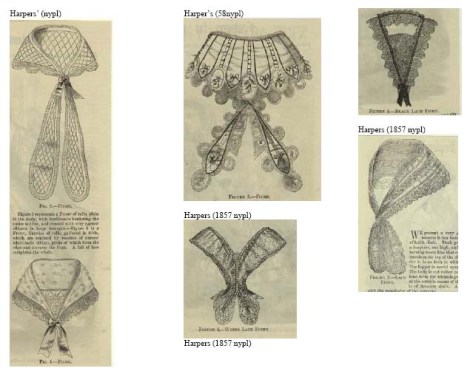
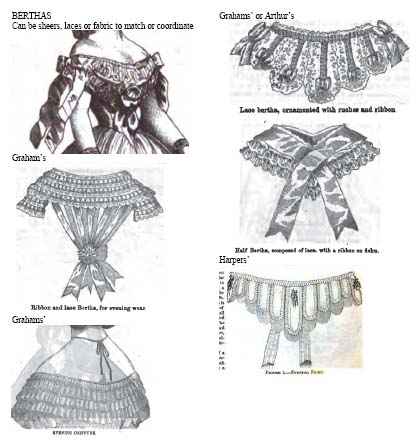
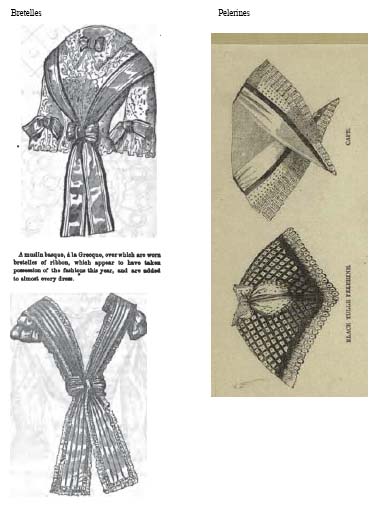
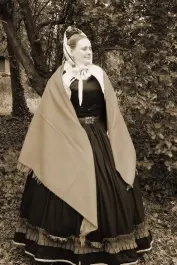
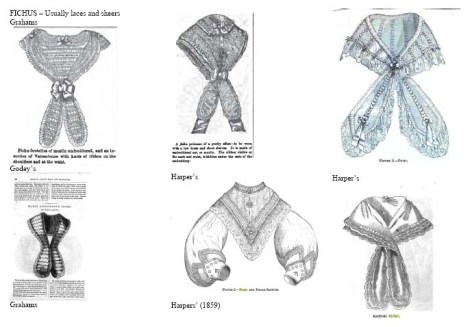
Frilly Fru-Fru – Fichus, Pelerines, Berthas, etc

There just simply isn’t enough frilly fru-fru out there in the reenacting world. I am referring to the neglect of those pretty accessories women wore during the mid-century such as fichus, bertha, pelerines and also headwear like caps.


Anna Allen has a lovely example of a fichu taken from a Godey’s illustration and directions

http://www.thegracefullady.com/civilwargowns/accessories_fichuri.htm This is another example of her’s http://www.thegracefullady.com/civilwargowns/ready-mades_netfichu.htm This fichu is very easy to make and fun to wear. [pictures of mine to come as soon as I get new camera batteries.]


Here http://thesewingacademy.org/index.php?topic=3226.msg55443#msg55443 Colleen Formby has a great example of a mantle based on an original.


untitled-1untitled-2untitled-3untitled-4 


The MET has several fichus, berthas, etc in their collection. Here are a couple examples:

 White cotton lace http://www.metmuseum.org/works_of_art/collection_database/all/fichu/objectview_enlarge.aspx?page=2&sort=0&sortdir=asc&keyword=fichu&fp=1&dd1=0&dd2=0&vw=1&collID=0&OID=80052043&vT=1


Mid-century lace

http://www.metmuseum.org/works_of_art/collection_database/all/fichu/objectview.aspx?page=5&sort=0&sortdir=asc&keyword=fichu&fp=1&dd1=0&dd2=0&vw=1&collID=0&OID=80052412&vT=1

British silk

http://www.metmuseum.org/works_of_art/collection_database/all/collar_bertha/objectview.aspx?page=4&sort=0&sortdir=asc&keyword=bertha&fp=1&dd1=0&dd2=0&vw=1&collID=0&OID=80052173&vT=1

French silk lace http://www.metmuseum.org/works_of_art/collection_database/all/cape_pelerine/objectview.aspx?page=2&sort=0&sortdir=asc&keyword=Pelerine&fp=1&dd1=0&dd2=0&vw=1&collID=0&OID=80052118&vT=1

Published in: on March 11, 2009 at 11:33 am  Leave a Comment  

Website to Blog Transition

I’ve discovered the visitation to this blog is much more frequent and consistent than my website. Between this and finding I can put pdf files up easily here, I plan to put more materials here. In the meantime, I thought it would be helpful to link back what is already on the website.

Information for From Field to Fashion: Straw Bonnets is available on the website.

To Net or not to Net is fairly popular, discussing hairnets of the mid-century. http://www.geocities.com/shadowofthesundial/netarticle.html

The original shawl article is available on the website at http://www.geocities.com/shadowofthesundial/earlyvictorianshawls.html. The E-book Early Victorian Shawls is available here https://annaworden.wordpress.com/2009/01/22/straw-bonnet-work-book-early-victorian-shawls/

I have a series resources in PDF format available here http://www.geocities.com/shadowofthesundial/list.html  including: Anatomy of a Dress – The basic structure of a mid-century dress.

Anatomy of a Bonnet – The basic structure of a mid-century bonnet.

Fringing shawls – A guide to fringing a wool fabric shawl.

Making Bonnet Ribbons – A guide to making bonnet ribbons from fabric or narrower ribbons.

Event Prep Cheat Sheet- A helpful sheet to help you have the basics for an event.

Introductions- Hints on how to give basic introductions.

Swatch cards template- A template for swatch cards

Transcription of ”Home” by Fergurson and Transcription of “Politeness” by Fergurson

Books and Paper- Information on the sizes of paper and books.

Flowers from Godey’s- These are directions for making various flowers from Godey’s I plan to eventually make. I’ll be adding more directions as I am able to scan more originals and as I attempt each flower.

Packing and Storing Small storage containers for packing and storing small items.

Tents and Camping –

Soldiers’ Aide – Acquisition and Distribution Chart –

Creature Comforts, those things that make life more comfortable at events.

Dining and Entertaining

Keeping your hands busy Needlework ideas for at events

Money and Measures

I am planning on updating and moving over all the Social Movements reading lists from the Social Movement Series in the Citizen’s Companion. For right now, those lists are here. http://www.geocities.com/shadowofthesundial/social.html  

I hope this makes accessing things easier for everyone. Thanks for visiting.

Published in: on March 3, 2009 at 1:33 pm  Leave a Comment  

Fan Dance

A recent post on the Sewing Academy brought up one of my pet peeves, the Fan Dance. This dance is popular at many of the north-eastern events. I love cotillions (dance games). But, most of the time I see this dance done, it isn’t done the way it is described in mid-century dance manuals. At events I see it danced in long lines rather than in a circle as described. I’ve seen the dance done in a circle. This format makes it far more fun for all involved.

Below are period versions of the fan dance.

From The Prompter by William DeGarmo (New York, Raymond & Caulon, Printers, 1865.)

“L’ÉVENTAIL–(THE FAN.)

“The first couple perform a Tour de Valse or Galop. The gentleman conductor seats his lady upon a chair in the centre of the room, and brings two gentlemen (one by each hand) in front of the lady, who offers to one of the two her fan, and dances with the other. The gentleman who receives the fan must follow the dancing couple round, fanning them at the same time.”


From American Dancing Master, and Ball-room Prompter by Elias Howe (Boston 1862)

The Fan–L’Eventail. (Waltz, Polka, or Mazourka Step.)

“Three chairs are placed in the middle of the room upon the same line. The two at the ends should be turned contrariwise to that in the centre, as in the figure of the Glass of Champagne. The first couple sets out in waltzing. The gentlemen seats his lady upon the centre chair, and seeks two other gentlemen, whom he places in the two other chairs. The lady offers her fan to one of the gentlemen at her side, and waltzes with the other. The gentleman with the fan must follow the waltzing couple, fanning them and hopping about the circle.”


From The Art of Dancing, by Edward Ferrero (New York, 1859)

“The Fan Three chairs are placed in the centre of the room on a line. The two at the extremities must be turned contrariwise to that in the centre. The first couple leads off in a waltz. The gentleman seats his lady on the centre chair, and gives her a fan; he proceeds to select two other gentlemen, whom he seats on the other two chairs. The lady offers the fan to one of the two gentlemen seated at her side, and waltzes with the other. The gentleman who holds the fan must follow the dancing couple, fanning them, while hopping on one leg.”


From The Drawing-Room Dances by Henri Cellarius (London, 1847)

“The Fan–L’Eventail. (Waltze, polka.)

Three chairs are placed in the middle of the room upon the same line. The two at the ends should be turned contrarywise to that in the centre, as in the figure of the Glass of Champagne. The first couple sets out in waltzing. The gentleman seats his lady upon the centre chair, and seeks two other gentlemen whom he places in the two other chairs. The lady offers her fan to one of the gentlemen at her side, and waltzes with the other. The gentleman with the fan must follow the waltzing couple, fanning them and hopping about the circle.”


Published in: on January 29, 2009 at 10:34 am  Leave a Comment  

“Politeness in Conversation” Excerpt from The Young Lady by Anna Fergurson

     Do not speak loud and long in company. This is a fault that young people are liable to commit. In the exuberance of their spirits, the voice is often raised to a high key, and some favorite topic is extended to an immoderate length, to the exclusion of all other conversation. This habit should be strictly guarded against. Those who indulge in it are liable to utter many things ridiculous and absurd, and to lay themselves open to the just censure of the wise and prudent. Loud laughter is also impolite, and is considered by many as an indication of an empty mind. I would by no means banish sociability and pleasantry from the friendly circle. But there should be a proper medium observed. The good sense of youth should teach them not to surpass, in these respects, certain bounds prescribed by propriety.

In a mixed company, avoid, if possible, all contentions and disputes, especially on exciting topics. If carried to any extent, they lead to exhibition of improper feelings, and generally cause the disputants, and the whole company, to become unhappy. There may be cases where this rule should be departed from; but such instances are extremely rare. As a general practice, the rule should be strictly adhered to.

Do not permit yourself, in company, to speak disrespectfully of one who is absent, if you can consistently avoid it. This practice is not only impolite, but it is ungenerous and unjust. If it becomes necessary to express opinions derogatory to the character fo the absent, speak in guarded language and with all the palliations that charity and forgiveness can suggest.

Avoid any exhibitions of anger or petulance. There are impolite and immodest especially so in females. They throw you off your guard, cause you to utter expressions extremely improper, and often ridiculous, and place you in circumstances very unpleasant. A guard should be placed upon the temper. Nothing is more to be avoided than the outbreakings of rage. Under their influence, evils are often committed, for which a whole after life of propriety can hardly atone.

Be cautious not to interrupt others when speaking. This plainly indicates a want of good breeding; and yet it is a very common practice with many. However anxious you may be to utter your views, remain silent until those who are speaking have concluded. Respect to them, and a desire to avoid confusion, as well as the rules of propriety, dictate a strict adherence to this precaution.

Do not bluntly deny the truth of the opinions expressed by those with whom you are conversing; and more especially if they are aged, or their opportunities for obtaining information have been superior to yours. If you differ from them, express your views in modest and respectful language, and with due deference to their mature experience. You should rather express the propriety of a different opinion than pertinaciously assert it.

Never indulge in ridiculing others in company. It is a vulgar and ungenerous practice, and indicates a narrow, uncultivated mind. All have their weaknesses and imperfections, – even those who possess the most shining talents, have their blemishes. “But what an absurd thing it is to pass over all the valuable characteristics of individuals, and fix our attention on their infirmities; to observe their imperfections more than their virtues, and to make use of them for the sport of others rather than for our own improvement.” “The littlest feeling of all, it is the delight in contemplating the littleness of other people.” Persons addicted to ridicule, are not usually distinguished for their own wisdom or good sense. Like critics who cut up a good publication, without being able to produce one themselves worth reading, so those most given to the ridicule of others, are themselves generally deficient in many of the valuable characteristics of human nature. “If the talent of ridicule where employed to laugh men out of vice and folly it might be of some use to the world; but, instead of this, we find that it is generally made use of to laugh men out of virtue and good sense, by attacking every thing that is solemn and serious, decent and praiseworthy, in human life.” If young people must indulge in ridicule, I pray to you act upon the reverse of this observation. Let your talent of ridicule be exercised only against immoral and vicious practices; against pride, folly, and every species of extravagance and sin.

Avoid ridiculing others on account of their appearance, or their plainness of dress. Some are naturally more awkward in their demeanor than others; and any ridicule on that account, will be at the expense of your good sense, in the eyes of the discriminating. All tastes do not agree in regard to dress. You claim the liberty of arraying yourself in such habiliments and style as your fancy dictates. You should be willing to grant the same privilege to others; and should no more imagine that you have the right of ridiculing them for not following your taste, then they have of ridiculing you for not imitating theirs. And by all means avoid ridiculing those, who, from poverty are unable to appear in attire as costly or as fashionable as that of the community in general. This is a cruel, ungenerous, unmanly practice. It is not only impolite, but it is really inhuman. It displays a selfish spirit, a shallow mind, and a heart devoid of the gentler susceptibilities of our nature. No individual, male or female, can justly lay the least claim to politeness of generosity, who exhibits a feeling so mean and brutal. Instead of basely indulging in the ridicule of the poor, you should be inclined to drop the tear of pity over their misfortunes, to commiserate their condition, to soothe them, and to reconcile them to their situations; and if possible, to do something, or to say something, that will shed a few rays of enjoyment into their hearts. Individuals possessing true politeness, will exhibit towards people in low circumstances, as to poverty, none but emotions of a kind, humane, generous character. And they will not judge of their worth by their poverty. But looking beyond the outward circumstances, to the qualities of the heart, they will honor and commend integrity, virtue, and purity, as readily when clothed in worn and humble garments, as when “arrayed in purple and fine linen.”

We will now briefly examine the affirmative of this subject, and notice a few characteristics that pertain to politeness. I have once remarked, that true politeness is an exhibition, through outward signs and tokens, of kind and friendly emotions towards those in your presence. Or, in other words, politeness is a desire to make those around you happy. A disposition to be pleasant and agreeable, therefore, is one of the first requisites of politeness. It is impossible for those who are morose and ill-tempered, to be polite. They may assume the outward form, the shadow, but the spirit of true politeness will be wanting. If, from misfortune, disappointment, vexations, difficulties, or illness, your feelings are in an unhappy or irritable state, you had far better refrain from mingling in company, while such is your condition, than to make others wretched by a display of your ill feelings. Strive, therefore, while you are in company, to be good-humored, cheerful, kindly disposed. With these feeling in full activity, you cannot well avoid being polite. And it is encouraging to know that, with every effort to entertain and exhibit these emotions, they will increase in stability and extent, until they become a second nature, and habitually pervade you minds.

Gratitude is another ingredient of politeness. What can appear more dishonorable or selfish, than an insensibility to proffered kindness? What more ill-bred or impolite? The uncultivated boor will, under the dictation of nature, return thanks for favors. And it surely becomes those who would improve their manners, not to be unmindful of this subject. Every attention which you receive from others, is an indication of the kindness which they cherish towards you. In this light they should be received and properly acknowledged.

Always attend to those who address you, and give due heed to their remarks. Inattention in this respect, is exceedingly rude, and indicates a lack of good breeding. Do not frequently change your posture by rising up, or sitting down, or walking about while another is speaking to you. It will be construed into a neglect of their words, or a desire to avoid their conversation. Whispering, and holding private discourse in company, is very improper and impolite.

Respect to the aged is another trait of politeness. It is extremely indecorous to make those advanced in years the subject of ridicule, derisions, or laughter. Gray hairs should ever be treated with deference and respect. The aged have long borne the burdens of life. They have administered to the welfare of society, and to the prosperity and enjoyment of those who are now young. It becomes your duty, as the palsy of age creeps upon them, incapacitating them for active duties and labors, to honor and reverence them, to cherish and support them, and to render the “downhill of life” as pleasant and agreeable as possible. No sight is more delightful than to behold the young assiduously engaged in respectful attentions to the aged; while there is no greater lack of politeness, no plainer indication of an unfeeling heart, than to treat the aged with neglect, disrespect, or harshness.

(Publication information: J.M. Fletcher: Nashua, N.H. 1850)

Published in: on January 24, 2009 at 9:30 am  Leave a Comment  

Digital Collections

Here is a partial list of the digital collections I use

American Memory through the Library of Congress http://memory.loc.gov/amhome.html

Oxford Digital Library http://www.odl.ox.ac.uk/

New York Public Library http://www.nypl.org/

The Digital Book index (older) http://www.digitalbookindex.com/search001a.htm

Making of America through Cornell  http://cdl.library.cornell.edu/moa/

Making of America through Univ. Michigan http://quod.lib.umich.edu/m/moagrp/  Their library http://www2.lib.msu.edu/branches/dmc/digital.jsp#bdc

Cornell’s Division of Rare and Manuscript Collections (multiple accessible collections including http://dlxs.library.cornell.edu/m/mayantislavery/browse_L.html ) http://rmc.library.cornell.edu/collections/rmccollections.html

Texas Woman’s Univ. Library http://www.digitalbookindex.com/search001a.htm

Texas Tech Univ. (just changed site) http://lib-cms.tosm.ttu.edu/testsite/

Documenting the American South by UNC http://docsouth.unc.edu/

Kentuckiana Digital library http://kdl.kyvl.org/

Texas A&M Gee Library (oral histories and veteran interviews) http://www.tamu-commerce.edu/library/arc.htm and http://dmc.tamu-commerce.edu/cdm/landingpage/collection/uw 
Harvard VIA http://via.lib.harvard.edu/via/deliver/advancedsearch?_collection=via


And of course the ever expanding Google Books www.books.google.com their newspaper archive and patent index


Museums with online digital collections:

Met

Musee McCord

Henry Ford Costume Collection

Old Sturbridge Village

Victoria and Albert Museum

Ohio Historical Society’s Online Collection Catalog

Mann Library


Modern Journals

Oxford Journals http://www.oxfordjournals.org/subject/humanities/

Published in: on January 16, 2009 at 9:51 am  Comments (3)  

Hair Article – Alaina Zulli updates


Alaina Zulli has updated her hair article page. http://www.gothampatterns.com/hair.html#hairarticles . Her online article includes photographic examples as you read. She covers basic style, variations, short and side-parted hair, pomatum and hair oil recipes, accouterments and accessories, hair care, 19th c. articles, and men’s hair.

She also has a new blog http://gothampatternsphotos.wordpress.com/


Published in: on January 14, 2009 at 10:13 am  Leave a Comment  

“Home”Excerpt from The Young Lady by Anna Fergurson

Let what will be said of the pleasures of society, there is after all, “no place like home.” How beautiful are the relationships of home! How exquisitely touching to feelings! All are linked to each other by the most intimate and endearing ties; – a power like that of electricity; so that one cannot enjoy pleasure, without the  others participating therein; one cannot sorrow, but all must mourn; nor one be honored, but all must share the joy.

And as home is that place which has the strongest ties upon the feelings, so it is the place in which woman has the power of exerting her influence in the greatest degree. This is her true and proper station; the duties of home are peculiarly hers; and let it not be thought that, in assigning home as the appropriate sphere for her action, we are assigning her a mean and an ignoble part. It is, in truth, far otherwise. The sphere of her operation may be a limited one; but as many rivers make up the ocean’s waters, so the conjunction of many homes makes up the world; and, therefore, in performing her duties at home, she is performing her part in the world at large; and as a man carries with him, through the world, those same habits and feelings he has gathered in his home – and as these habits and feelings are principally derived from the influence of woman – woman, in performing her home duties, takes a vast share in the concerns of community.

Equally to mothers and daughters is it true, that they should concern themselves in domestic economy; for, in so doing, they are performing their duties, adding to their own happiness, and making home a place where the feelings of a family meeting in  peace, harmony, and love.

A sister should share all the plans and prospects of her brother, striving to add to his happiness, and to contribute to his pleasures. She will often become his confident, – the keeper of his secrets; and, if she forfeit no his esteem, she will obtain a vast power as a monitress and adviser, so that she may guide him to honor, and stimulate his exertions to noble purposes; and home, to him, will be endued with a special charm, because made radiant with sister’s love.

To her sisters, also, she may prove a true friend, especially if the eldest. By nature she is endowed to teach, mentally and morally, those younger than herself. She seems to share one mind and one heart with the rest of her sisters, so that they seem to partake alike of joys and sorrows – joys and sorrows particularly their own, and such as no stranger intermeddles with. Thus, then, may she teach piety, virtue, compassion, and love; and by never letting a word of jealousy, envy, or ill-will, escape from her own lips, she thereby puts a seal upon the lips of others; and by her own gentleness of manner and speech, forbids every thing of rudeness or clamor; and attraction which neither wealth nor rank can purchase, – creating happy faces and contented hearts; and this is mantling both her own and her sister’s cheeks with beauty, – a beauty of worth and virtue, – a beauty which will last long after the tints of youth have faded, – that true beauty, which arises from purity of mind and goodness of heart.

So might woman, in various capacities, act upon home, and make it literally an oasis in the desert – a bright and peaceful spot in the midst of a dark and stormy world.

There is a moral beauty in the relationship of woman, at every period of her life; but this beauty displays itself nowhere so much as at home. That venerable woman, the representative of the past generation, who sits in the majesty of age before the fire, and who, after having seen her family settled in life, and closed her husband’s eyes, has come to die in the home of her daughter, – even in that grey-haired woman there is a moral beauty; a thousand hallowed associations are surrounding her, making her beautiful, though, her eye has lost its brightness, and wrinkles cover her cheek. And that fair-haired girl, who is kneeling at the old woman’s feet, is she not beautiful, as, in the simplicity of childhood, she awaiteth her evening blessing? And that matronly woman, who is nestling her sleeping babe to her bosom, how beautiful is she! beautiful though the tints of youth are fled. And the unconscious babe how beautiful is that! beautiful in its innocency and helplessness. All are beautiful! The decayed and the expanded flower, the blossom, and the bud, – all are beautiful. There is a moral sublimity and beauty which the most exquisitely tinted features could not give, and which neither age nor plainness of features can take away. Wherefore, then should women be so eager before the world, to display their charms, upon which the eye rests but for a moment, and then seeks for another, when, by the mere associations and links of home, there is a moral beauty upon which the mind can dwell, and experience the greater delight, the more it contemplates the entrancing picture?


It is not much the world can give

            With all its subtle art,

And gold or gems are not the things

            To satisfy the heart;

But O! if those who cluster round

            The altar, and the hearth,

Have gentle words and loving smiles,

            How beautiful is earth!

 (Publication information: J.M. Fletcher: Nashua, N.H. 1850)

Published in: on January 10, 2009 at 8:24 am  Comments (1)  

Women During the Civil War

This is the outline I use with our Women’s History class to discuss women during the war.

I         The status of women in the 1850s

A       Separate spheres – During much of the 1800s, an ideal was set where women and men maintained separate spheres of life. In this ideal of separate spheres, men centered in the public sphere of work and politics, while women centered in the private sphere of home and family. Granted, reality seldom reflects an ideal. The general idea was that a woman focus her attentions on the moral development of the family while caring for the home because she was unfit for the sullied public world of business and politics. This ideal played out differently in the varied parts of society as life in the 19th century developed. Factors such as socio-economic status, family philosophy, education and theology and regional industrialization greatly influenced a woman’s adherence to this separatist concept.

1        Most middle-class women’s lives were confined to the home. Their daily life consisted mostly of child rearing, maintaining the home, clothing the family and feeding the family. Leisure activity was directly related to the home such as sewing for the home’s or family’s needs. Socialization also took place in the home or church. Any influence they had on the public world was to be through their fathers, husbands, brothers, and sons.

2        Working class women’s lives included home and possibly work outside the home if she worked.


B       Legal rights of women – The legal rights of women were primarily governed by the states and therefore varied from state to state.

Right to own Real and personal property – A woman’s married status often determined her right to own real and personal property. In most states married women did not have the right to own real or personal property. This was because most States’ laws were based on English Common Law where a single woman maintained the same property rights as a man prior to marriage, while once married in a state of coverture, a woman’s legal identity combined with that of her husband. In the married state, her property, wages, and any inheritance became his to own, manage, and sell without her consent. She was unable to sign a contract, purchase or sell property, or sue without his participation. [An Economic Necessity: Women in Colonial America, Developed by Women in American Culture, Title IV, ESEA, Northfield, Minnesota]

a         Laws affecting the property rights of women.

·        Connecticut 1809 – Allowed women to write wills.

·        New York State’s Married Women’s Property Act passed April 7, 1848 gave women the right to continue ownership over property owned by her prior to marriage. This property was protected against being sold by the husband or used to settle his debts. The act also gave married women the right to own personal and real property acquired during the marriage as well as the right to receive by gift, grant or bequest property. Laws similar to this were passed in other states in the 1850s.

·        New York State’s Married Women’s Property Law passed in 1860 added to the 1848 Act, giving women legal control over their own wages, the ability to buy, sell or trade property and joint custody of children with their husband. It also gave women the right to sue and be sued. Elizabeth Cady Stanton and Susan B. Anthony helped get this law passed. (See Married Women’s Property Laws: Law Library of Congress http://memory.loc.gov/ammem/awhhtml/awlaw3/property_law.html . If you look for further information, search phrases from the law itself rather than the title, which will give you information on British laws more than the US.)

2        Rights to wages – In most states, a woman’s husband had legal rights to his wife’s wages. A single woman had sole control over her own money.

3        Types of jobs held by women

a         Basics

·        Women could earn money from home by doing piece work, taking in laundry, plaiting straw, selling eggs, etc.

·        Women were more likely to work outside of the home if they were single or if they lived in New England or the frontier.

b        Regional influences

·        Young women were more likely to work in New England areas where mill work was common.

·        Women were more likely to work as domestics in urban areas.

c         Jobs traditionally held by men to note due to later war influence

·        Nurses

·        Teachers


C       Social position of women

1        A Woman’s identity – Often a woman’s identity was defined by her relationship to a man. Prior to marriage she was identified through her father; during marriage through her husband; during widowhood through her son. This identity often included financial ability and social positioning.


II     Women during the Civil War

A       Women at home          

1        Family – Wives, Daughters, Mothers

2        Home responsibilities

3        Work/financial responsibilities


B       Women in the Community

1        Work/financial responsibilities

2        War/soldier support and Aide Societies

a         Aide Societies

·        Collecting materials

·        Raising funds

b        Emotional and religious support


C       Women participation

1        Nurses

a         Field Nurses

b        Hospital Nurses


2        Spies

a         Those accused

b        Those by chance

c         Those who were


3        Christian Commission

a          Formed November 16, 1861 (A Memorial Record of the New York Branch of the United States Christian Commission, 1866) by the Young Men’s Christian Association  – to promote “the spiritual good of the soldiers and incidentally their intellectual improvement and social and physical comfort.” (Annals of the United States Christian Commission, Moss, p. 107)

b        Ladies Christian Commission – Auxiliary to the USCC

·        Became official on May 4, 1864 (Founding document available at Google books)

c         Approx 5,000 delegates distributed over $6,000,000 worth of supplies – bibles, tracts, books, newspapers, hymnals, stationary & envelopes for letters, food, medical aid, clothing. (Christendom Anno Domini MDCCCCI, New York, 1902. p361)

d        Dietary Kitchens

e         Coffee Wagon – patented in 1863

f          Loan library


4        Local Aid Societies

a         Rochester Soldier’s Aid Society (annual reports available at Cornell University.)

·        The RSAS collected goods, clothing and food from the area, including Monroe, Ontario, and Livingston Counties. The goods were distributed through the Sanitary Commissions, Christian Commission, and directly.


5        Sanitary Commissions

a         The United States Sanitary Commission

The US Sanitary Commission was organized June 9, 1861 to combat the unhealthy, unsanitary conditions in military camps and hospitals. Diseases like malaria, dysentery, diarrhea and typhoid ran rampant at times. It is estimated that for every man killed in battle, two died from disease. The USSC worked with the Army Medical Department to improve sanitation and conditions for soldiers. This included the construction of well ventilated hospitals, the creation of a nursing corps, collection and organization of food, clothing, personal and medical supplies.

The USSC was run primarily by civilians. It was divided into three departments:

The Department of Preventative Services inspected camps and hospitals.

The Department of General Relief managed the supplies of food, clothing, bandages, furniture and medicines.

The Department of Special Relief included the development of Soldiers’ Homes providing shelter, food and medical care for soldiers.

b         New England Soldier’s Aid Society (Annual Report of the New-England Women’s Auxiliary Association) organized local contributions to the Sanitary Commission.


6        Women as soldiers

a         Women were not allowed in either military. Still, some followed husbands who were joining and some joined on their own.

b        Estimate 250 women served in the Confederate military.

c         Some were found during medical exams or after being injured.

d        Some were discovered when they were captured. Southern newspapers contain numerous accounts of women soldiers and spies who were captured.


III  Notable individuals during the Civil War


Harriet Beecher Stowe – Abolitionist who encouraged Northerners to aide slaves reach freedom.  Stowe was the author of Uncle Tom’s Cabin (1851) and A Key to Uncle Tom’s Cabin (1853). 
Clara Barton – Prior to the war she was a teacher in Massachusetts and the first woman to work in the US Patent Office. During the war she was a battlefield nurse. At the end of the war she helped identify missing and unknown soldiers.  She founded the American Red Cross in 1881.
Rose O’Neal Greenhow – Greenhow was a spy for the Confederacy during the early years of the war including the battle of Bull Run/Manassas. She traveled to Britain and France to rouse sympathies for the Confederacy. She died at sea in 1864.
Dr. Mary Edwards Walker – She became a doctor in June, 1855 when she graduated from Syracuse Medical College. She was an acting assistant surgeon in the US Patent Office Hospital, then a field surgeon for the US Army. She was the only woman to receive the Congressional Medal of Honor, for her service during the Civil War. She was a proponent of women’s rights and dress reform who wore Turkish trousers instead of common woman’s dress.

Mary Todd Lincoln – Wife of President Lincoln. She was born in Kentucky she was seen by many Northerners as possibly having Southern sympathies though she adamantly supported abolition.
Varnia Jefferson Davis – Wife of Jefferson Davis, Confederate President.
Harriet Tubman – Former Maryland slave who helped hundreds of slaves escape to freedom via the Underground Railroad through New York State. During the war she was a cook, a nurse and a spy for the Union. She worked with a network of former slaves who reported on Confederate camps and troop movements.
Pauline Cushman – At the beginning of the war she was an actress in Louisville. She became a spy for the Union army following Confederate troops.
Dorothea Lynde Dix– Dix was the Superintendent of Nurses for the Union Army. She was an advocate for prison reform and worked to improve conditions for the mentally ill.
Elizabeth Cady Stanton – One of the first leaders of the women’s rights and suffrage movements. She formed with Susan B. Anthony the National Woman Suffrage Association in 1869.

Sarah E. Thompson – Worked with her husband in the Greenville, Tennessee area organizing Union sympathizers.

Published in: on January 8, 2009 at 8:46 am  Leave a Comment  
Tags: