After hearing some ladies go on and on about never hearing of carpet before at this past weekend’s event, I just had to bring this article forward.
This is the rug and carpet article in the Citizen’s Companion a few years back. (I was going to eventually get around to a follow up post linking various examples of rugs and carpets. But, since the topic of braided rag rugs came up on the SA, I decided to put this up for now.)
“For, besides contributing to the adornment of a home and saving much labor of sweeping and scrubbing, they are great protections against cold and dampness, – and thus promote comfort and health. Hence “a bare floor,” has become almost a synonym for discomfort and untidiness; and the landable ambitions to furnish her domicile with floor coverings, – beautiful, if possible, as well as useful, – leads many a housekeeper to wonderful efforts in their manufacture….” (Hale)
By the mid-nineteenth century, floor coverings established a firm footing in English and American décor. Even a century before, this could not be said. In the mid 1700s only an estimated half of English homes had floor coverings most being floor clothes.[i] The mid nineteenth century American housewife had many options for her floor. Floors could be painted with an assortment of domestically made rugs softening or warming the room; floors could be covered with printed or painted floor clothes, ingrain carpet or a pile carpet. In the first half of the century American carpet and rug manufacture, a newer endeavor for most of the Western world, increased dramatically producing 13,285,921 yards of carpet worth $7,857,636 in 1860. The largest number of manufactures was in Pennsylvania (137) where carpet makers were mostly in small guild-like groupings, while the largest individual manufacturers were in Massachusetts producing one third of the carpets produced.[ii] According to Floor Coverings for Historic Buildings, 80 to 90 percent of carpeting manufactured in the United States during the 1850s and 1860s was ingrain carpet. Although manufacturing information may suggest manufactured carpets were more available in the New England and Middle Atlantic States, the Tariff of the Confederate States of America[iii] from August of 1861 lists numerous carpets to be taxed on page 6 including “carpets, carpeting, hearth-rugs, bed-sides, and other portions of carpeting, being either Aubusson, Brussels, ingrain, Saxony, Turkey, Venetian, Wilton, or any other similar fabric, not otherwise provided for; … matting, china or other floor matting, and mats made of flags, jute, or grass.” Vicki Betts’ database of southern newspapers during the war include advertisements for two and three ply ingrain, velvet, tapestry, Brussels, oil cloth, matting, Venetian, and English medallions, which are likely Axminsters.[iv] In addition to the US manufactured carpets, we imported $2,174,064 worth of carpets from England and $10,317 from France in 1859.[v]
Household management books and articles[vi] offered advice about how to decorate a house, the parlor, chambers, and dining areas cost effectively including the floor covering and which floor coverings suited which rooms best. Most authors maintain that purchasing a good quality carpet is cheapest in the end. Miss Leslie strongly argues against any carpet with any white in the design due to its rapid tendency to appear soiled, encouraging the selection of a carpet with a gradation of bright and dark tones of a single color or pair of colors (p174). Meanwhile, Beecher discourages carpets with black threads saying they are rotten (p302). More importance is put on floor coverings for the cold winter months to warm the room and floor than in the summer. Leslie and Beecher write about taking carpets up in the summer to store. Anne Hale describes straw mats as preferable in the summer because they remain cool and are easy to clean. Miss Leslie believes carpets add heat to a room and accumulates dust in the summer.
Numerous suggestions are made to protect a carpet. Smaller rugs or extra pieces of carpet are placed over higher traffic areas such as around the bed, doorways, or in front of the couch to protect the carpet beneath[vii]. A large woolen cloth or drugget cloth is suggested for under the table and chairs in the dinning area.[viii] Oil cloth upside down beneath the wash stand or basin protects from splashing water.[ix] Each author also gives advice for laying carpet to best preserve the floors and extend the life of the carpet. A lining as the lowest layer protects the floor. Layered between the lining and the carpet, both Leslie and Hale suggest straw or dried grasses and cotton batting or old quilts. These layers keep the dirt from rubbing against the underside of the carpet causing damage. Beecher disagrees with Hale and Leslie in regards to loose straw under a carpet because it wears the carpet in spots. She prefers the use of straw matting instead. All three women suggest using circles of leather through which the carpet tacks are placed toe prevent the tacks from damaging the carpet. Hale suggests having children cut the circles from old shoes and boots.
Types of floor coverings
“A nice American ingrain carpet is handsome enough for any American home; but if women have more money then they know what to do with, they can buy tapestry and velvet; which beautiful as they may be, require such careful usage to retain their good looks, even when of the very best of Brussels and Axminster, that it is much wiser to be satisfied with an ingrain and put the surplus money into pictures for the walls.” (Hale)
Flat Weave carpet
Flat weave carpet is a woven carpet with no pile. The carpet is flat like a woven piece of fabric with the weave of the fabric creating the design of the carpet.
Kidderminster or Ingrain Carpet
Ingrain carpet is a flat weave double or triple ply reversible carpet woven in Europe and the United States. This carpet is woven in strips which are laid side by side tacked down[x]. Strips ranged from 9 inches to 54 inches with 36 inches being the standard and most common width. Most domestic manuals discuss tacking carpet in place. Beecher details how to sew the strips together as I have seen most extant carpets. The pattern in a two-ply ingrain carpet is created by weaving two webs of weft and warp which inter lock at various points of the design. The pattern is created by the colors of the weft which come to the surfaces (front and back) of the carpet.
“The ingrain or double carpet is found to consist of two contiguous webs, intermingled with each other in such a manner to produce the pattern, each of these webs, if woven singly, would have a striped appearance, being partly coloured in the weft. One set of coloured stripes is thus imposed upon another: and in designing the colours of the pattern, no selection beyond what is afforded by the judicious arrangement of these stripes can be made. The full number of colors is thus very limited; and these can only be obtained where the weft transverses the warp of the same colour.” (The Art of Weaving)
Designs for ingrain carpet were most often simple, small geometrics during the use of the drawloom prior to the invention of the jacquard attachment[xi] . After the jacquard attachment, designs included complex geometrics, floral, and patriotic motifs. Colors were frequently bright and contrasting.
Triple or three ply carpet is similar except there are three sets of webs being woven to create the pattern. The third set of threads gives a greater variety to the color of the carpet. Period writings suggest most believed that three ply was a stronger more durable carpet than two-ply carpet.
Venetian Carpet
Venetian is a less expensive ingrain carpet often reserved for use in halls and on stairs[xii] as well as servants’ rooms and private sitting rooms. There were two types of Venetian carpet available, common and damask. Common Venetian carpets were colorfully striped. Damask Venetians were checked.
Venetian carpet was woven in narrow strips 18 inches to 36 inches wide. Venetian carpet was considered inferior to ingrain carpet in quality due to lower durability and limited design options. They were manufactured in both Europe and the United States with no confirmed historical connection with Venice, Italy.
List Carpet
List carpet was a manufactured and domestically made flat weave carpet using rag fabric for the weft over linen, wool, or cotton warp. This carpet was made on a simple loom in strips. The width of the carpet strips depended on the width of the loom. The carpets could be a single woven width or several narrower strips sewn together. The pattern of the carpet was either striped or checked depending on the colors of rags and weft threads. I suspect the US census report does not include or at least does not include all list carpet produced because other period sources indicate list or rag carpet manufactured in locations not included in the census. For example, the Official Catalogue of the New York Exhibition of the Industry of All Nations in 1853 lists a specimen of list carpet manufactured by John M. Nicholas in St. Louis, Missouri. I do not know if this discrepancy is due to the cottage nature of some of the list carpet manufacture or the type of carpet itself.
Pile Carpet
A pile carpet is a woven carpet with parts of the weave rising above the base of the carpet creating a soft or looped pile.
Brussels
Brussels carpet is a looped pile woven carpet. While the carpet is woven, worsted wool warp threads are held in loops by wires while linen or cotton warp and weft lock the loops in place. We only see the looped pile on the surface while the linen or cotton base is unseen. The design of the carpet is created with the various colored loops on the surface of the carpet.
“The Brussels carpet is distinguished from the common one by having a raised pile, and by the circumstance that the figures and colours are entirely produced from the warp. The pile is raised by inserting a wire between the body of the warp and the previously raised colouring threads. These threads descend and are fixed by the weft, which is of linen, two picks being given before the insertation of each wire, and these picks are called binders, and after a few repetitions of the process the wires are withdrawn, taking care that the wires be not drawn out too near the face of the cloth: otherwise the looped warp would become stretched, by recovering the position in which it was before the wires were inserted.” (The Art of Weaving)
Wilton
Wilton is a cut pile jacquard woven carpet made in the same way Brussels is made, except the looped piles are cut as the wires holding the loops are removed. At times the pile is longer than in Brussels. Wilton was referred to as having a velvet look and feel. But, Miss Leslie warns this carpet does not wear well, loosing its rich velvet-like appearance as bits of wool from the cut pile are swept away with each cleaning.
Brussels and Wilton were more expensive than ingrain, Brussels being the more costly of the two. Both were more common in wealthier homes and less common in average homes.[xiii]
Brussels and Wilton used the same designs, the difference being the looped or cut pile. Patterns included small to large florals, geometric grids combined with floral motifs, stars, ribbon and rope knot work, rosette medallions, diamonds, and flor-de-lies. Original body Brussels and Wilton carpet used only up to five colors to create the patterns of the carpets. Tapestry Brussels and tapestry velvet (Wilton) used a pre-printed thread dyed through the drum printing. This process allowed more than five colors in patterns. Floral designs could now be subtly shaded in ways not possible before. The disadvantage was that tapestry Brussels and velvet were less durable than the originals.
Axminster
Axminster is categorized in some period writings as a flat weave carpet, in others as a pile carpet. In the late eighteenth and early nineteenth centuries, Axminster referred to any English made knotted pile carpet which will be discussed later.[xiv] The Axminster carpets of the mid-nineteenth century were a chenille carpet woven flat in a whole piece with an overall design rather than in strips. They were made with a two step process developed by James Templeton. First chenille strips were woven with wool. These chenille strips were then woven into the carpet foundation. The chenille fur creates the pile and the pattern we see. The carpets could be woven in a single piece to fill a whole room. According to Winkler and Von Rosensteil, “Templeton’s ‘patent chenille Axminsters’ could be woven up to 33 feet wide; making them the first woven broadloom carpets.” This carpet was a more costly carpet due to its method of manufacture. Fewer were made as well.
Knotted Pile Carpet
Knotted pile carpets are made by knotting various colored tufts of fiber or yarns around the warp threads strung on a loom. A weft or set of wefts is woven across each set of knots to hold them in place. The knots are what we see on the face of the carpet producing the endless variety of designs. Knots can be either symmetrical or asymmetrical wrapping around two warps at a time. Knotted pile carpets can be distinguished from each other by looking at their design, motifs, fibers used, weaving technique, and knotting technique. Designs vary in the use of fields, medallions, and borders[xv]. Motives vary according to cultural traditions and decorative fashion. Fibers included wool, silk, cotton, linen, and hemp for the warp, wefts, and pile. Weaving and knotting technique varied with each location including even, semi-depressed, and fully depressed[xvi] warps and taut and sinuous wefts. In describing the Oriental style and European knotted pile carpets, I will focus mainly on the design and motifs since the fibers used and techniques for producing these carpets have changed over the centuries.
Oriental or Turkey Style Knotted Pile Carpets
“The Turkey carpet is the simplest in its texture of all carpets, and at the same time is almost unlimited in the choice of colours. Let us suppose ourselves seated at a common loom, and than immediately after having thrown a pick, we commence to tie on every thread of the warp a bunch of coloured worsted yarns, varying the colour according to our fancy. This completed, let two or three picks be thrown, and all well driven up; and another row of coloured worsteds tied one. It is clear that in this way we could produce any pattern and that no more of any colour is wanted than in sufficient to produce the required effect.”[xvii]
Before continuing to outline the many Oriental and Oriental style carpets that existed in the nineteenth century, I should emphasize that these particular carpets so popular among collectors and decorators now, are the least discussed carpets in period articles discussing house furnishing or carpets. Occasional mentions are made comparing Oriental styles with the numerous above described floor covering. This suggests this class of carpets were not the most common carpet rarely used by the working classes in the mid-century. Due to this, I will include only a very, very brief description of these carpets. Motifs listed are just as sample of what was used for those particular carpets.[xviii]
Oriental style carpets were and are classified by region of origin:
Persian carpets are one of the most diverse in design. This is due to the large geographic and varied tribes or villages in which they were made. Designs are arranged in both medallion and all-over patterns with motifs including diamonds, hexagons, octagons, palmettes[xix], sub bursts, rose groupings, botehs[xx], and animals. Pictorial carpets were also made. The colors differed from tradition to tradition.
Caucasian carpets were woven near the Black and Caspian Seas and the Caucasus Mountains. They were, and are still, woven by many tribes. Even though they were woven by many tribes, they maintained common designs and colors. Motifs included triangles, diamonds, stars and stylized, geometric animals such as dragons and scorpions. Colors included bright reds, greens, and blues.
Turkoman carpets come from Turkestan and Afganistan. They have smallish geometric motifs set in an all-over pattern in a center field and narrow, geometric borders. One common motif was the octagonal gul[xxi] which was often set in rows. Colors were deep shade of red, blue, brown and tan.
Indian carpets include Boteh, palmette, rosette, and leaf motifs. These are often set in vertical or horizontal rows in an all-over design. (Presently rugs made in India are woven in European, Chinese, and Turkoman styles.)
Chinese carpets were made since the eighteenth century although I do not have a documented Chinese carpet in a mid-nineteenth century US setting. The unique thing about Chinese carpets is the motives used have literal meanings such as happy marriage, luck, wealth, love, and fertility. These motifs can include stylized dragons, lotuses, bats, peones, birds, butterflies, and clouds. Borders were also distinctive using repeated geometric motifs.
European Knotted Pile Carpets
European knotted pile carpets were produced in France, Spain, Belgium, and Great Britain well prior to the nineteenth century. These elaborate carpets were commissioned by the nobility and wealthy merchants of the time for the floors of buildings.
Spanish carpets, the earliest knotted piles in Europe[xxii], had a Moorish and Muslim influence using a mixture of Islamic and Christian motifs as well as mimicking Turkey carpets. Designs were created with repeated geometric, stylized nature, and animal motives set with moderate borders, Lotto and Holbein[xxiii] designs created with a single warp knot and multiple wefts.
French carpets of Savonnerie and Aubusson (tapestry embroidery carpets) were at their height in the seventeenth and eighteenth centuries. Savonnerie carpets were woven, often by commission for royal residences and notable locations such as the Louvre in Paris. Designs often included naturalistic floral motifs, architectural motifs, and heraldic motifs including coats of arms. These carpets were often designed for specific rooms reflecting the room’s architecture and painting.
British carpets drew on French carpets because British manufactures took both designs and weavers from the famed French center of Savonnerie.[xxiv] British carpets were also designed by interior and architectural designers for specific buildings.[xxv] Designs included fans, floral wreaths, floral garlands.
Painted floor clothes
Floor clothes, or oil clothes as they became known, were both made domestically and manufactured. Floor clothes were an expensive item in the second half of the 1700s in the United States while they were increasing in popularity in both the US and England.[xxvi] As we reach the 1860s floor clothes become less costly but loose some favor due to the increasing popularity of woven carpets which were becoming more available and affordable. As this happened floor clothes move from the eighteenth century parlor to the nineteenth century kitchen and halls. Soon after, in 1863[xxvii] floor clothes lead to the invention and 1875 introduction of linoleum flooring.
A floor cloth is made by painting a section of canvas with several layers of paint. A good floor cloth had four to seven coats of oil based paint on both sides. The design was painted on either freehand or stenciled in the case of those domestically made or stamped if manufactured. The cloth is then covered with a clear varnish. As we see in the following passage from Hale, period authors suggested varnishing a floor cloth after it is laid down.
“Painted carpeting, by the multiplicity of its colors and designs, hides dust and stains, while rivaling in brightness and beauty the productions of the proudest looms, and is, therefore, desirable for chambers, dining rooms and halls – apartments where there is much stepping, but not constant occupation. If, however, canvass carpets are used for apartments what are constantly occupied, as they are deficient in warmth, they should have laid upon them rugs and mats, in plenty, – especially during winter. In selecting these carpets get only the well-hardened and thickly painted – such as are almost stout and stiff – all others are soon defaced. Varnish them immediately after they are laid; and, if they are subjected to much wear, varnish them every spring.”
Due to the many layers of paint, a well made floor cloth can be quite heavy. Designs included geometric grid patterns similar to those painted on floors. through the first half of the century. Within these grid designs were floral motifs. Natural designs such as stones, wood, or marble were also popular. Borders .could follow the rectangular shape of the floor cloth as if it were and area rug or follow the lines of a room more like a wall-to-wall carpet.
 Flat weave carpet, likely ingrain. (from author’s collection)
 Flat weave carpet, likely ingrain. (from the author’s collection)
 Flat weave carpet or painted floor-cloth with rose-floral motifs within a repeated octagon and diamond pattern. (from the author’s collection)
 Flat weave carpet or painted floor-cloth with a repeated octagon and diamond pattern. (from the author’s collection)
 Painted floor cloth or floor with a diagonal grid pattern. (from the author’s collection)
Domestic made rugs
“Every family could save old clothes enough in a few years, to make a rag carpet. I must acknowledge, however, in this case, that we got a great part of our stock from a friend. Mrs. Doolittle saw us at work one day and offered to give me a barrel full of old clothes, ‘just fit for carpet rags.’ She said she was sure she should be glad to get rid of them, though it grieved me to see such waste. There were coats that could not have cost less than $30 each, and pants, and boys’ clothes, and one fine cape that had been worn by the girls. With a great spot of paint on it; and the Whole so eaten by moths as to spoil them for anything but carpet rags. And then to think that every moth could have been kept away with a sixpence worth of camphor gum. And that spot of paint, if treated when fresh, with a little camphene, which is always the most convenient of anything where it is used, or with alcohol, or spirits of turpentine, could have been washed out with five minutes’ labor.”[xxviii]
Directions and advice for making rugs at home are found in many nineteenth century domestic manuals. Each one uses fabric scraps or recycled clothing to make the rug. There are extant examples of domestically made rugs similar to those described as well as some that are not described in written works. These latter rugs were either made following unwritten tradition or were developed without written support. One must see rug is the Caswell rug currently at the Metropolitan Museum of Art. This 13 foot by 12 foot rug was made with wool tambour embroidery. This overall design was made from 78 blocks, including a removable hearthstone, with floral arrangements, cats, dogs, fruit bowls, birds, sea shells, and a couple arm in arm. While this rug is an unusual example of mid-nineteenth century rug making in size and technique, it does show the time a woman was willing to devote to creating a floor covering.
Prior to the nineteenth century these domestically made were not used to cover the floor. Instead they were used to cover tables and chests. Bed rugs were made to cover beds. In the mid-nineteenth century these domestically made rugs varied in use depending on the size of the rug and the intent of the maker. Some, such as the Caswell rug (discussed later) covered entire floors. Others protected high traffic areas such as doorways or in front of the hearth or a sofa. Others were commemorative or decorative. It is this last category that seems to survive for us to see today. As we all know, most utilitarian textiles rarely survive for study.
Woven rag rugs
This was possibly the most common form of rag rug being made in the home and in some US carpet manufactures. Hale suggests thick pieces of wool were best. The fabric was cut in strips which were sewn together end to end. These long stripes, several yards long, were then rolled into balls for easier use. The fabric strips were then woven through warps of either fabric strips or thick threads. This could be done on a loom if one was available or on a quilting frame. To make smaller round rugs, a large barrel hoop could be wrapped in cloth and used to attach the strips to. The lengths of those woven on a loom, the carpets could be quite long. Looking at State and local Agricultural Society reports we see prizes for the best lengths of rag carpet woven. The typical listing shows carpets woven ten to fifteen yards in length.[xxix] In this passage below, we see a young lady planning a rag carpet for the parlor:
[quote] “So Lucy communicated to Emily a great project she had formed, which was no less than the making of a carpet for the front room, which was their parlor. Her father had often said he should so love to sit there of an evening if the floor only had a carpet on it, but that he could not bear the grating of a sanded floor.
”And you, Lucy, you a girl of fourteen years old, have undertaken to make a carpet, without your mother’s knowing it, too ; and without any time or any thing to make it of, that I can see!”
”What put me in mind of it,” said Lucy,” was an old great coat which a peddler[sic] gave me one warm day last summer, because he said it was too heavy for him to carry. It was an immense thing with capes and lining, and made twelve large balls. Since then, I have gathered up every rag which has been thrown aside, until now, I think I have almost enough; don’t you ?” and she raised a coverlet and showed a great number of balls made of cloths which had been cut into strips and sewed together.
“Yes,” said Emily,” I should think there was enough to make half a dozen carpets; but you have no bright, gay colors. You ought to have some white and red. I have seen a rag carpet made almost as handsome as the best ingrain.”
”Yes,” said Lucy, rather sorrowfully;” but I must take what I can get.”
“And I know what you can get,” said Emily. “Mother told me only yesterday, that I might give my two last winter scarlet frocks, which are almost worn out and are too small for me, with my old blue merino cloak, to whomsoever I chose ; and I choose to give them to you, and into your carpet they shall go. And don’t you remember, Lucy, how we used to amuse ourselves with looking over the paper rags in the loft of papa’s store, and how he let us take away whatever we liked ? I shall do it again and pick out some nice, long strips of white for you.” Lucy accepted Emily’s offer as frankly as it was made; and glad enough she was to get these pretty colors. Old Mrs. Potter had told her, when she privately consulted her about the weaving, that if she only had some gay colors she could weave in pretty little figures, which would make it look as handsome as a real, boughten carpet.”
“But how are you to pay for the warp and the weaving?” inquired Emily; “and how are you to get it made and put down without your father and mother knowing it?”
Lucy said that she had it all planned out, and that she would tell her one of these days.”[xxx] [end quote]
Braided rag rugs
Braided rag rugs were considered very durable. These were also made from strips of scrap cloth like that used for the woven rag rugs. In this case the strips are folded to hide the raw edges inside of the strip. The strips were sewn together end to end and often rolled into balls for ease of use and storage. The strips are braided in a variety of simple to complex braids which are then coiled as they are sewn into place. The Confederate Receipt Book gives this simple direction for making a braided mat:
“Cheap Door Mats — Cut any old woolen articles into long strips, from one to two inches broad. Braid three of these together, and sew the braid in gradually increasing circles till large enough.”
Braided rugs were most often circular or oval, though rectangles were possible. Hale describes braiding around a piece of purchased carpet which has been lined.
This next section of domestically made rugs, yarn sewn, shirred and hooked, is one covering several rugs constructed by attaching scraps of fabric to a base material. In creating these rugs the needle-worker was able to be creative and artistic. Designs ranged from geometrics to floral designs to full life scenes. The pictorial rugs often portrayed what the maker knew such as home, nautical or animal scenes. Patriotic scenes were also popular at various points (post Revolutionary War, during the War of 1812 and the Centennial). The designs were as vast as the makers. Most of these domestically made rugs seem to originate in the New England and North Atlantic States and Canada.[xxxi] One interesting note: although magazines such as Godey’s Lady’s Book and Peterson’s were filled with directions and illustrations for clothing, various forms of needlework, small sewing projects, purses, shoes, quilt patchwork, pillows, etc., directions for rugs, a domestic item, were not included. Instead, I had to look to the domestic advice books of Leslie, Beeton and Beecher for information on domestically made rugs.
Yarn Sewn rugs
Yarn sewn rugs were constructed on a base of homespun linen or grain bags. Two ply yarn was sewn in a running stitch leaving loops on the surface with the aid of a reed or quill. The loops could be cut on the surface creating a soft cut pile or left with a looped pile. Yarn sewn rugs were popularly made early in the nineteenth century, mostly between 1800 and 1840.[xxxii]
Shirred rugs
Shirred rugs are made by sewing strips or bits of fabric to a foundation fabric. The pieces of fabric are attached in a number of methods, chenille, folded-bias, pleated, and patch shirring.[xxxiii] In the chenille method half inch to 1 ½ inch wide strips of fabric are folded lengthwise and gathered down the center. These strips are sewn to at the base at the fold. The folded-bias method uses inch wide bias strips folded in half. The folded bias strips are sewn to the base closely together causing the strips to stand up. Pleated shirring also uses bias strips. In this method the strip is folded or pleated into a loop and sewn directly to the base at each loop. Knopp says this is the rarer shirring method. Patch shirring uses circles or squares of fabric bunched together. The center of the piece is sewn to the base close together causing them to support each other. Knopp notes the decline in interest in shirred rugs as hooked rugs became popular in the 1850s.
Hooked rugs
“Carpets and rugs of looped work are often very beautiful, and are the strongest of rag carpets.” (Hale)
Hooked rugs are made by pulling strips of cloth through a base fabric. They began being made sometime in the late 1840s. Initially the base was linen, tow, or homespun hemp. Burlap was used for rugs after the material started being made for sack.[xxxiv] Hale describes for us the period technique for pulling the cloth through the base:
“Hold a strip in your left hand under the cloth, and push the book held in your right hand between the threads of the cloth, and thus draw up the strip into a loop half an inch long. Make the loops as close as they will hold in the cloth. The work is very handsome with the loops upcut; but if they are sheared it is as beautiful as velvet. Soft woolen and old silk make the nicest pile. Carpet thrums, obtained at carpet mills, are next best. Old doeskin and broadcloth look very well, and, though they are extremely hard to loop, they are so durable that they are always desired. Cotton rags may be introduced, in small quantities; in fact any sort of rag that can be used in no other way is available for loop-work.”
The hook used is similar to a crochet or tambour hook set in a wood handle. (This hook is quite different from modern latch-hooks.) Initially many of these hooks were homemade. One hook shown in Turbayne’s book (p149) is obviously made from an early century fork. The base fabric could be set on a quilt frame or a homemade frame. (Embroidery frames do not hold the fabric taut enough to pull the hook through.) After the Civil War commercial patterns were printed and sold making hooked rugs very popular after the War.
Appliquéd rugs
Appliquéd rugs were often similar in visual design to shirred and hooked rugs despite the very different method of construction These rugs layered pieces of wool on top of each other often on a woolen ground. Some appliquéd rugs were made in blocks like quilts were made. Instead of using a single ground, multiple squares were appliquéd and sewn together. This method may have been used because the maker was familiar with block quilting or because it utilized smaller pieces for the ground.
Straw Matting
Mats woven from straw or grass were recommended for summer flooring. These can be made by hand or manufactured. Manufactured matting included. Canton and Indian matting were woven in strips. The edges were either turned under of bound with tape. Matting was less common in the nineteenth century than it was in the previous century. Hale suggests using Canton carpet, a straw matting, during the summer because they remain cool, are easily swept and do not retain dust.

Sample of sewn rug techniques for shirred rugs. From top to bottom bias-fold method; patch-shirred method – round patches on left, square patches on right; chenille method; pleated method
A Note from the Author
Many of us who reenact face the quandary of whether or not to take a floor covering to a historical event where we will not be staying in or presenting from a tent rather than a building. If we do decide to bring a floor covering for a temporary tent home, what kind to take?
Of course we would not take original carpeting of any kind.
Oriental or Turkey carpets are not appropriate for most people’s impressions.
Beyond that, I will admit I have mixed thoughts.
I have tried to consider what people would have taken with them at the time for traveling or for a refugee situation. I can not imagine unpacking a large carpet during a long distance journey. I also have trouble seeing an ingrain carpet or large floor cloth which is nailed to the floor with layers of materials underneath being removed for a quick retreat. If the refugee experience is a long-term one with time for real packing, the destination is likely to be a building else where not a tent. If these people did take the costly carpets from their homes, likely they would be packed for the entire journey.
When looking at the reality of mainstream reenacting where people use tents to live in for the weekend or present from tents, people are going to still want to bring a floor covering for comfort and protection from the environment. Reproduction ingrain or pile carpet appropriate for homes and other buildings costs a price most of us are not willing or able afford for an outdoor experience. Floor clothes, if made by hand, are a practical alternative in many ways. They are generally water-proof and relatively easy to clean. Some can be difficult to transport if they are large. To make a floor cloth, one needs a large enough well ventilated area to apply the layers of paint and varnish then allow the cloth to dry. List carpet, straw matting, or braided rugs are affordable but difficult to care for in wet or muddy conditions. Still a quandary.
PIECES/QUOTES TO SET OUT IN THE ARTICLE:
“Linings, whether of paper or cloth, add to the durability of a carpet. But if between them and the carpet is places a layer an inch thick of straw or dried grass (see that no sharp substances, or very stiff straws are among them, as they would cut and injure the carpet,) then the dust will sift down among the straw, which would have remained on cloth or paper to chafe and wear the web of the carpet. A layer of cotton batting or an old quilt, beneath the straw, gives elasticity to the carpet after the straw has become settled.” (Hale)
“An unpainted floor, without rugs or mats of some kind, is always a great trial to a housekeeper’s patience. It is almost impossible, with the most faithful scrubbing, to remove the traces of muddy tracks or slope from its blank surface (that sets even the shadow of a mark in the boldest relief;) and the most abject scouring is needed to keep the pitiless boards clearly clean.” (Hale)
Selecting a Carpet
Some of us may have the opportunity to decorate our own home of a building for historical interpretation with reproduction carpets, rugs, or other flooring. Helene Von Resenstiel and Gail Winkler, authors of Floor Coverings for Historic Buildings suggest looking at physical evidence from the building, specific documents pertaining to the building and prior owners, and general information about similar homes and families of the time from you are working towards. Documents you could consult include wills, inventories, auctions, newspaper accounts of sales, furnishing receipts, diaries, letters, business directories, local newspaper advertisements, paintings and photographs.
Resources
Bailey, Julia W.. “Oriental Carpets” The Magazine Antiques. Discovery: April 1995; pp578-583.
Beecher, Catharine Esther. Principles of Domestic Science. New York: J.B. Ford and Co., 1871.
———-. A Treatise on Domestic Economy: For the Use of Young Ladies at Home and at School. Boston: Webb, 1843.
Bell, T. F.. Jacquard Weaving and Designing. London: Longmans, Green, 1895.
Beeton, Isabella Mary. The Book of Household Management. London: Beeton, 1863. (Available at www.books.google.com)
Confederate Receipt Book: A Compilation of Over One Hundred Receipts, Adapted to the Times. Richmond: West and Johnston, 1863. (Available at docsouth.unc.edu.)
Depew, Chauncey M. Ed. One Hundred Years of American Commerce. New York: Haynes, 1895.
French, James A.. “The Home House Carpet” The Magazine Antiques. Discovery: June 2005; pp104-111.
Gilroy, Clinton G.. The Art of Weaving. New York: Baldwin, 1844.
Hale, Anne G.. “Domestic Economy; How to Make the Home Pleasant. Chapter XVII A Chat about Carpets” The New England Farmer. Boston: Eaton, 1869
Hashagen, Joanna. “The Bernard Castle Carpet Industry” The Magazine Antiques. Discovery: June 1998, pp868-875.
Johnson, Samuel, John Walker, and Robert S. Jameson. A Dictionary of the English Language. London: W. Pickering 1828.
Kopp, Joel and Kate Kopp. American Hooked and Sewn Rugs: Folk Art Underfoot. New York: Dover, 1985.
Kraak, Deborah E.. “Ingrain Carpets” The Magazine Antiques. Discovery: January 1996, pp182-191.
A Lady. The Workwoman’s Guide. London: Simpkin, Marshall and Co., 1840. (Available at
http://books.google.com/books?id=JCsBAAAAQAAJ&pg=PA1&dq=workwoman%27s+guide#PPA201,M1)
Leslie, Eliza. Miss Leslie’s House-Book; A manual of Domestic Economy. Philadelphia: Hart, 1850.
Manufactures of the United States in 1860; Compiled from the Original Returns of the Eighth Census. Washington: Government Printing Office, 1865.
Milanesi, Enza. The Bulfinch Guide to Carpets: How to Identify, Classify, and Evaluate Antique Oriental Carpets and Rugs. Boston: Little Brown, 1993.
New York Public Library Digital Collection – Numerous Carpet design illustrations and carpet illustrations.
Parkes, William. Domestic Duties; Or, Instructions to Young Married Ladies. New York: Harper, 1831.
Robinson, Solon. How to Live, Saving and Wasting, or Domestic Economy Illustrated. New York: Fowler & Wells, 1860.
Ross, Nancy L.. “Oriental Rugs: A Primer” Consumers’ Research Magazine. Discovery: April 1988; p 14.
Mrs. S. S. A “What Small Hands May Do. A Prize Article”. The Mother’s Assistant, Young Lady’s Friend and Family Manual Mrs. H. B. Pratt, William C. Brown, Editors, Boston: Stone & Pratt, 1851. p68-90.
Sarirn, Sophie. “The Floorcloth and Other Floor Coverings in the London Domestic Interior 1700-1800.” Journal of Design History. Oxford University Press, 2005.
Sherrill, Sarah B. Carpets and Rugs of Europe and America. New York: Abbeville, 1996.
Tariff of the Confederates States of America: Charleston: Evans & Cogswell, 1861. (available at docsouth.unc.edu.)
Turbayne, Jessie A. Hooked Rugs: History and the Continuing Tradition. West Chester, PA: Schiffer, 1991.
Von Rosensteil, Helene and Gail Caskey Winkler. Floor Coverings for Historic Buildings: A Guide to Selecting Reproductions. Washington, D.C.: Preservation Press, 1988.
Walker, Daniel. “The Fine-Weave Carpets of India” The Magazine Antiques. Discovery: December 1997, pp824-831.
Webster, Thomas and William Parkes. An Encyclopedia of Domestic Economy. New York: Harper, 1855.
Weeks, Jeanne G. Rugs and Carpets of Europe and the Western World. Philadelphia, Chilton Book, 1969.
Wheeler, Candace. How to Make Rugs. New York: Doubleday, 1902.
[i] Sophie Sarin “The Floorcloth and Other Floor Coverings in the London Domestic Interior 1700-1800.” (Journal of Design History. Oxford University Press, 2005. )
[ii] Manufactures of the United States in 1860; Compiled from the Original Returns of the Eighth Census. Washington: Government Printing Office, 1865. According to the census data, in 1850, there were 116 carpet factories in 9 states. This number increased to 213, in 1860 in 11 states: Maine (2), New Hampshire (2), Massachusetts (11), Rhode Island (1), Connecticut (3), New York (28), Pennsylvania (137), New Jersey (10), Maryland (8), Ohio (7), and Illinois (4). Values of the carped ranged from $.42/yard from Ohio to $.91/yard from Hew Hampshire. Keep in mind these values are factory values not retail sales values. The census does not indicate which type of carpets were produce in each state or factory.
[iii] available on docsouth.unc.edu
[iv] Vicki Betts’ database is available on her website at www.uttyler.edu/vbetts. Carpets are listed under various names or twists of names for selling points. Some advertisers categorize stair carpets separately. A few mentions of camp rugs are in the database that I haven’t firmly connected with research elsewhere. One advertiser in the October 3, 1861 and October 13, 1861 Memphis Daily Appeal lists manufacturing camp rugs. A passage in the November 12, 1861 Daily Chronicle and Sentinel describes camp rugs under oil or water-proof cloth as being made so it can be filled with straw like a bed ticking.
[v] Manufactures of the United States in 1860.
[vi] Catharine Esther Beecher, Principles of Domestic Science. New York: J.B. Ford and Co., 1871. Catharine Esther Beecher, A Treatise on Domestic Economy: For the Use of Young Ladies at Home and at School. Boston: Webb, 1843. Isabella Mary Beeton, The Book of Household Management. London: Beeton, 1863. (Available at www.books.google.com) Confederate Receipt Book: A Compilation of Over One Hundred Receipts, Adapted to the Times. Richmond: West and Johnston, 1863. (Available at docsouth.unc.edu.) Anne G. Hale, “Domestic Economy; How to Make the Home Pleasant. Chapter XVII A Chat about Carpets” The New England Farmer. Boston: Eaton, 1869. A Lady. The Workwoman’s Guide. London: Simpkin, Marshall and Co., 1840. (Available at http://books.google.com/books?id=JCsBAAAAQAAJ&pg=PA1&dq=workwoman%27s+guide#PPA201,M1) Eliza Leslie, Miss Leslie’s House-Book; A manual of Domestic Economy. Philadelphia: Hart, 1850. Thomas Webster and William Parkes. An Encyclopedia of Domestic Economy. New York: Harper, 1855.
[vii] Leslie, 178
[viii] Leslie 176, Beecher 305
[ix] Leslie 178
[x] Authors suggest using pieces of leather through which the carpet tacks are placed. Hale suggests having children cut up old shoe leather. This protects the carpet from wear caused be the metal tacks.
[xi] The jacquard loom was developed by Joseph Marie Jacquard in 1801. The jacquard loom used pasteboard cards punched with holes corresponding to the design of the carpet or fabric being woven. The punched holed in the card tell the loom which warp threads to raise and lower on each weft pass. The power loom was initially invented in 1784/5 by Edmund Cartwright and later improved by William Horrocks in 1813.
[xii] The life of stair carpeting was extended by the method in which it was attached. A length of carpet longer then needed to cover the stairs. The carpet would be applied to the floor turn excess under at the top and/or bottom of the stair case. After a period of time, the carpet would be pulled up and relayed changing the position of the carpet by using the excess length. This method adjusted the placement of the areas of most use on the edge of the steps.
[xiii] Eliza Leslie. Miss Leslie’s House-Book; A manual of Domestic Economy. Philadelphia: Hart, 1850, 173. The higher cost of Brussels and Wilton was due to the lesser length able to be produced daily and the larger amount of wool used in Brussels and Wilton than in ingrain.
[xiv] Axminster has had different meanings at different times. According to Sherril, the term Axminster was a general term which meant English knotted pile by the 1790s. In the later eighteenth century at Moorefield Axminster knotted pile was on of three quality classifications of knotted pile carpets, the higher being Turkey and Persia. As industrialization of carpet manufacture progressed, chenille Axminster was developed by James Templeton of Glasgow, Scotland in 1839. This version of Axminster is what was known predominately in the mid-century. Presently, Axminster appears to be a manufactured carpet used in business and hospitality locations.
[xv] Most knotted pile carpets include a field and multiple borders. Many also included a center or corner medallion.
[xvi] Depressed and semi-depressed warps can help identify a carpet because they leave the backside of the carpet with a ridged or slightly ridged appearance.
[xvii] Clinton G Gilroy, The Art of Weaving. (New York: Baldwin, 1844, page 215.)
[xviii] There are numerous books available on Oriental or Turkey carpets. My brief descriptions are synopsizes of the descriptions in Julia Bailey’s “Oriental Carpets” The Magazine Antiques.( Discovery: April 1995; pp578-58), The Bulfinch Guide to Carpets: How to Identify, Classify, and Evaluate Antique Oriental Carpets and Rugs.( Boston: Little Brown, 1993), and ______________________________
[xix] A palmette motif is a stylized palm leaf.
[xx] A boteh motif is either stylized or natural cone which developed from fruit and floral designs. We most commonly relate it to the tear-drop shape in paisley designs.
[xxi] The gul motif is an octagon shape which means flower in Persian or possibly family or tribe in ancient Turkish.
[xxii] According to Sherril, p29-57, Spanish knotted pile carpets began as early as the thirteenth century.
[xxiii] A Holbien design is an eight-sided geometric motif with an interior reflecting the eight sides in a floral or star pattern. This motif, along with other named carpet motives, is named after a European artist who often depicted carpets with this motif in his paintings. (Sherrill, 18).
[xxiv] British weavers from Moorefield in the late eighteenth century learned from weavers who ran away from the French carpet center of Savonnerie. The French weavers passed down technique and design to the British weavers. The Savonnerie weavers developed their techniques and design from a seventeenth century interest in Turkey carpets.
[xxv] The well known William Morris designs are from the last quarter of the nineteenth century.
[xxvi] Sophie Sarirn provides an outstanding look at the changing popularity of 18th century British floor coverings with a focus on floor clothes in her article “The Floorcloth and Other Floor Coverings in the London Domestic Interior 1700-1800.” (Journal of Design History. Oxford University Press, 2005) She also includes a nice description of what designs were used for floor clothes.
[xxvii] Von Rosensteil.
[xxviii] Solon Robinson How to Live, Saving and Wasting, or Domestic Economy Illustrated. (New York: Fowler & Wells, 1860.)
[xxix] Agricultural Society reports looked at include those for Ohio, New York, and Pennsylvania for the years between 1855 and 1861.
[xxx] Mrs. S. S. A “What Small Hands May Do. A Prize Article”(The Mother’s Assistant, Young Lady’s Friend and Family ManualMrs. H. B. Pratt, William C. Brown, Editors, Boston: Stone & Pratt, 1851. p68-90)
[xxxi] This could be due to a combination of climate, cultural, and industrial influences. In these areas cold long winters made for many winter bound months with long nights. Woolen mills were more abundant in these areas as well.
[xxxii] Knopp
[xxxiii] An additional method used in New England at the end of the 19th century and beginning of the 20th century sews wide lengths of knitted yarn to a base. Knopp.
[xxxiv] When reading secondary sources one will see there is much debate about the actual beginnings of hooked rugs including dates, materials and origin of techniques. Knopp cites a list of modern authorities stating hooked rugs are indigenous to North America (p39). Others, such as W. W. Kent, writing in the 1930s and 1940s, believe a form of hooking fibers through a cloth base can be traced back to the 6th century. Turbayne discusses briefly a technique in 18th century Britain called ‘thrumming’ where scrap yarns are poked through a base cloth from the back.
The dates for the beginning of the use of burlap is also undetermined due to the two decade range of time when it began being used in various parts of the world.




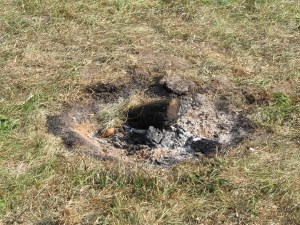 Please take a look at these photos and
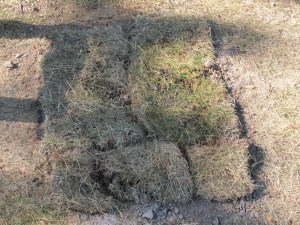 consider what each will look like in a week or a month while visitors walk by.




 If I Had My Own Blue Box: