12 Homemade Gifts of Christmas – Day 4

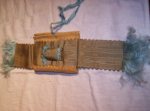
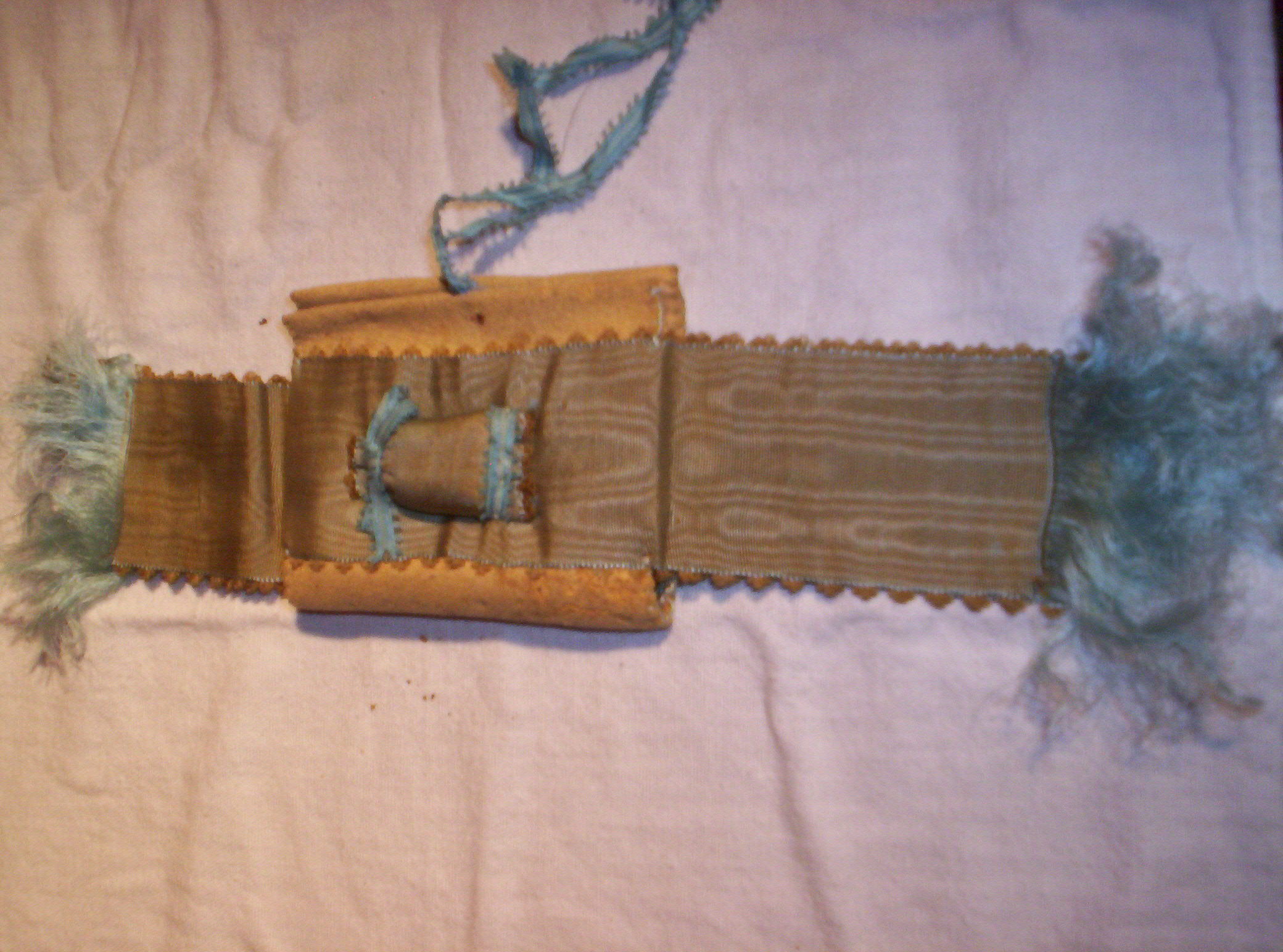
For the fourth day we have a cute little needle-book. Of course I had to include one.

This needle-book is based on an original I had. I think it would look great done up in festive colors.

You will need:
1 piece of thickly, firmly felted wool cut to 4″x3″
2 pieces of thin, tropical weight page wool cut to 3.5″x2.5″
2 pieces of silk moire ribbon 1/5″ wide, each 12″-14″ long
A 1-2″ scrap of the same ribbon
A narrow, 1/8″ to 1/4″ ribbon – A few inches for the sachet and 10-12″ for the closure ties.
A tiny bit of wool batting
Embroidery thread
The colors of the ribbon and wools should coordinate or compliment

Fold the thicker wool in half to make a 3″x2″ book cover.
Fold the needle page in half to make a pair 2.5″x1.75″. Bind the folds together. Blanket stitch along the raw edges. Attach to the fold of the cover.
Fold one ribbon in half draping it over the front cover of the book facing down. Sew along the edge of the ribbon on each side (through the ribbon, wool, ribbon). Continue to sew 2″ to 3″ past the edge of the book. Repeat on the opposite side of the ribbon.
Drape the other ribbon over the back side of the book facing up (The original faces up. It could work with both facing down as well). Sew along the edges of the ribbon as you did with the front cover.
Fringe the bottom edge of each ribbon.
With the ribbon scrap, batting and narrow ribbon, make a tiny 1/2″ wide sachet. Fill it with the batting and tie closed with the ribbon. Fringe the top of the ribbons just a bit. Attach to the front cover of the book.

Ta-da! A cute needle-book

Published in: on October 24, 2011 at 1:07 am  Leave a Comment  
Tags:

12 Homemade Gifts of Christmas – Day 3

For the third Homemade Gift we have a basic essential of every mid-19th century wardrobe – a collar and cuffs. Just about any woman would love a nice set of cuffs and collar.

You can make a classic simple set with nice rolled hems or a more elaborate set with beautiful embroidery or edging. Here are some images of cuffs and collars from CDVs. For more inspiration, here are illustrations from period magazines.

**Special Tip – If you own Elizabeth Stewart Clark’s  Dressmaker’s Guide use her directions for making a collar.

Published in: on October 23, 2011 at 1:06 am  Leave a Comment  
Tags:

12 Homemade Gifts of Christmas – Day 2

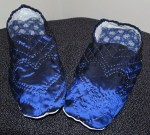
For the second day’s Homemade Gift, we have one of my husband’s and my favorites…. slippers. We love our slippers both for at home and at events.

When it comes to making slippers, you have lots of choices. In period magazines you can find embroidered slippers, quilted slippers, appliqued slippers, corded slippers, crochet slippers and even easy to make hospital slippers. This file has an assortment of slippers to start from.

The way I construct my slippers requires:

  •  An outer material either already decorated in the case of needlework, embroidery, and applique or not yet decorated in the case of quilted or corded.
  • An inner lining
  • An inter lining – either something supportive or batting
  • A sole – painted canvas, leather or cork
  • A sole lining
  • Insoles – two layers of soft wool

For the soles, I trace the wearer’s foot and adjust it to look period. If you don’t have a foot to work from because this is a surprise gift, use inexpensive insoles from the store as a guide.

Layer your uppers together, right sides together. Sew around the inner curved cut or the flat top of each slipper. Turn the pieces right side out. Baste the lower edges together. If you are doing a quilted slipper now is the time to do your quilting. This is also a good time to do your cording or braiding.

Layer your sole and sole lining together. Baste around the edge.

Line your uppers face down on your sole. Pin the front toe and the sides in place. Sew around the edge. Finish the edge with a whip stitch. Turn right side out.

Lay the two layers of insole wool together. Sew around leaving enough space to turn it right side out. Turn right side out and close. Insert into your slipper.

Wear inside.

Published in: on October 22, 2011 at 1:00 am  Comments (2)  
Tags:

On the 12th Day of Christmas, My True Love Made for Me….

I’m the first to admit I’m not the most musical. But, I just couldn’t resist making a list of 12 great 19th century gifts you can make for your loved ones. Here is a list with a little for her, a little for him and a little for the tree….

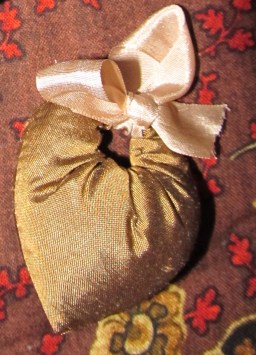
On The First Day….  Heart Shapped Pincushions (also make cute ornaments.
On the Second Day ….A Pair of Slippers
On the Third Day….. A Cuffs and Collar Set
   On the Fourth Day … A Pretty Ribbon Needle-book
 On the Fifth Day….  Lounging Cap.
 
On the Sixth Day….A Handkerchief
 
On the Seventh Day….   A Pocket.
On the Eigth Day…. A little purse
 On the Nineth Day…. A Set of Stationary
 
On the Tenth Day…. A Patchwork Ball to Play With
On the Eleventh Day…. A Book Marker
On the Twelfth Day….. It will be a surprise…. even to me….
https://annaworden.wordpress.com/?p=1984


Published in: on October 20, 2011 at 1:02 am  Comments (5)  
Tags:

“Our Dictionary of Needlework”

 Have you ever stumbled across something and instantly thought “everyone should see this”? That is what happened when I scrolled over Peterson’s Magazine’s 1858 series called “Our Dictionary of Needlework”. The odd thing is I’ve gone through this edition countless times looking for shawls, hoods, needle-books, etc., yet it didn’t stand out until today.

So, of course I had to put the year long series into a single file for everyone…..

Our Dictionary of Needlework” from Peterson’s 1858

If there is a video at the end of this post, it is an advertisement. My apologies for the inconvenience.

Published in: on October 5, 2011 at 11:54 am  Comments (1)  

The Newest “Must Have” Books for Your Christmas List

Whether shopping for the perfect gift for someone special or making your own wish list, there are some great new books out this fall that ought to be on your Christmas list.

For the needle-worker, seamstress and quilter, there is Fanciful Utility: Victorian Sewing Cases and Needle-books by Anna Worden Bauersmith. This book shows step-by-step how to make an assortment of well researched sewing cases, housewifes and needle-books. Filled with templates and color photographs, this book is sure to keep the hands busy all winter long.

Everyone who dresses for the Civil War era will want Dressing the Victorian Civil War Lady: A Guidebook to Dressing the 1860s by Joy Melcher of the Civil War Lady. This book is filled with original photos, illustrations and tips for interpreters, reenactors, seamstresses and stage costumers.If you love to dance, you will have to have the West Side Soldiers Aide Society’s release of  The Ball-Room Manual of Belfast, Maine from 1863. The facsimile book has page after page of period contra dances acceptable to “the Young, as well as the Old Folks at Home”.

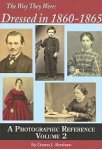
I was very excited to see this second volume available. The Way They Were: Dressed in 1860-1865, Volume 2 by Donna Abraham. Volume 2 takes a closer look at the details of the clothing women, men and children wore through newly published photographic images magnified for an indepth study.

The following books aren’t brand new, but if you don’t already have them, you should have them on your wish list:

Anyone making their own mid-century clothing, or just looking to understand it better should own The Dressmaker’s Guide by Elizabeth Stewart Clark.

Donna Abraham’s The Way They Were: Dressed in 1860-1865 is packed full of original CDV images. I just love this book as my copy is filled with notes and arrows.

What else is on my wish list? Well, I need to learn more about men’s clothing so I can make my husband a full set of civilian attire. (I also need to convince him this is a great idea.) With that in mind, on my wish list we find The Victorian Tailor by Jason Maclochlainn as well as Mr. Ruley’s digital version of Louis DeVere’s 1866 Handbook of Practical Cutting on the Centre Point System.

Article on Williams Clothiers on the Fit of Men’s Trousers

There is an excellent new article over on the Williams Clothiers notebook. “How to Wear Trousers Properly and Avoid Gaposis” includes numerous images and informative text. Take a look!

Published in: on September 18, 2011 at 5:12 pm  Leave a Comment  

How to Dress for a Photographer

This is a guest post thanks to Jenna Theissen. She shared this piece from the May 27th, 1865 edition of  All the Year Round, Weekly Gazette & Comet out of Baton Rouge, Louisiana. Thank you to Jenna for sharing this interesting piece of information.

A lady or gentleman, having made up her or his mind to be photographed, naturally considers, in the first place, how to be dressed so as to show off to the best advantage. This is by no means such an important matter as many might imagine. Le me offer a few words of advice touching dress. Orange color, for certain optical reasons, if photographically dark. Blue is white; other shades or tones of color are proportionally dark or lighter as they contain more or less of these colors. the progressive scale of photographic color commences with the lightest. The order starts thus: White, light-blue, violet, pink, mauve, dark-blue, lemon, blue green, leather-bound, drab, cerise, magenta, yellow-green, dark-brown, purple, red, amber, maroon, orange, dead-black.


Complexion has to be much considered in connection with dress. Blondes can wear much lighter colors than brunettes; the latter always present better pictures in dark dresses, but neither look well in positive white. Violent contrast of colors should be especially guarded against. In photography brunettes possess a great advantage over the fairer sisters. The lovely goelden tresses lose all their transparent brilliancy, and are represented black; whilst the bonnie blue theme of rapture to the poet, is misery to the photographer; for is put entirely out. The simplest and most effective way of removing the yellow color from the hair is to powder it nearly white, is is thus brought to about the same photographic tint as in nature. The same rule, of course, applies to the complexions. A freckle quite invisible at a distance is, on account of it’s yellow color, rendered most painfully off tint when photographed. The puff box must be called inot the assistance of art. Here let me intrude one word of general advice. Blue, as we have seen is the most readily affected by light, and yellow the beast! It, therefore, you would keep your complexion clear and free from the tan freckles whilst taking your delightful rambles as the seaside, discard by all means the blue veil, and substitute a dark green or yellow one in its stead. Blue tulle oiler, no more obstruction to the actinic rays of the sun then white. Half a yard of yellow net though perhaps not so becoming, will be more efficacious and sonsderably chaper then a quart of kalydor.

This additional piece comes from the reverse side of a card from Flynn’s Gallery in Salem, N.Y.


“Some simple facts concerning Color will be useful to many, especially ladies, when deciding how to dress for a Photographic picture. Dark brown, dark green, maroon and plaind black goods, without gloss, will take a rich black color. Silks of the same will take considerably lighter, because they are glossy. Snuff-brown, dark blue, drab, scarlet, cherry, dark orange, crimson and slate, will take a very rich look. Violet, blue, purple, pink and magenta, will take very light and should be used dressing for photographs. The prevailing style of Plaids will take well. The hair should never be very wet or glossy.”


Published in: on September 13, 2011 at 8:54 am  Leave a Comment  

A Practical Look at Winter Clothing

I’m sure you’ve noticed my focus on being prepared for cool and colder weather as of late. It may seem a bit early since it is just now Labor Day, but for some of us the cold fall and colder winter weather will be here soon.

In my browsings I stumbled across this 1859 magazine published out of Buffalo, NY called The Home Monthly with a practical take on winter clothing:  

Winter Clothing – Style and Material

We do now propose keeping our readers in the latest Parisian style, for we have no Genio Scott, Genin or Brodie to consult, and we hardly think we shall fail of our purpose without them. We do not choose to cater to fastidious fondness for the very latest pattern, and encourage ladies in exhausting their entire time with thoughts in the “where-withal shall we be clothed.”

Every lady ought to be dressed well, if not her purse will permit, but that does not mean to cast off a garment, because something later than that has appeared in the fashionable world, and that too with no regard to the better uses to which such expenditures could be put. But of course we need not mention this, for that sort of woman would scarcely read a magazine without fashion plates.

To dress meanly with no reason for so doing, and above all, to make religion an excuse for shabbiness, as Timothy Titcomb says, is abominable. It lessens our usefulness. We should be as beautiful as we can make ourselves, but that is not accomplished by any means in following the rule of fashion plates.

Merinos, and all wool Delaines are the most sensible as well as most durable of all materials for out-door wear at this season. Cut with pointed basques on slender figures, and trimmed neatly, with a dainty cambric collar and sleeves, and you have a costume suited to all ordinary occasions for winter wear. One’s own taste and length of purse should be the guide for extraordinary ones. Large plaids on small people, stripes on very tall ones; and Bayedere on short persons, are all equally unbecoming. Indeed, all conspicuous patterns weary the wearer who has refined taste, as well as the beholder. Above all thinks, consult, if possible, in an indirect way those you love best as to color, &c., provided your complexion will permit a choice.

The prettiest and most serviceable bonnet for winter is a black velvet. It admits of remodeling, and can be worn with propriety with any colored outer garment, and any color about the face.

The loose sacque or raglan of ladies’ cloth, is exceedingly convenient, as well as pretty and inexpensive for a cloak, as not trimming is required – nothing but a binding neatly stitched on.

The same material to be used for children’s wear, both boys and girls. Pretty wool cheques are cheap and durable for girl’s winter dresses, and boy’s coatees for the house. Above all things, don’t let them be made too short at the top and bottom of the garment. Many a mother’s pride has been gratified by the praise bestowed upon the fair neck and rounded limbs of her child, and after her heart has been broken, while laying them from her sight forever. Which will your choose?

Dress them warmly and let them out into the frosty, fresh air to grow rounder and fairer, albeit no one but yourself see how fair. We did not purpose saying this much, but it is written. Quarterly we will endeavor to suggest whatever is worthy of mention among the novelties of the season, always keeping our peculiar views of substantiality and beauty side by side.

New Materials

The challies which are offered at very reasonable prices this fall, are pretty, and seem likely to be the most durable of any commone dress goods that we find. They are nearly all in bayadere stripes – some of them high colored, but where warmth and durability are required we think they will be found very desirable. There is also a new material of Angola wool for dresses – heavier than wool delanes or merinos, which we judge to be very desirable for these qualities, viz: strength and durability, unless the satin stripe that adorns it should be found to fray out. – Dresses of this material can be bought in New York at $6, the pattern. This comes the nearest to ladies’ cloth of anything we have seen. The high-colored printed cashmeres – merino styles – are offered as low as six shillings per yard, while we found recently at Stewart’s the best colors of printed French merinos at a dollar per yard. The bright chintz, patterned, all wool delaines are offered lower than ever before. But no delaine can be as cheap as a good merino at least to those who wear their dresses out. We are glad to see more durable material for dresses coming into market. Much time and labor in dress-making will be saved by those who emply these materials. It is also a saving of expense, for the cost of making and trimming a dress of good, and of worthless material is very nearly the same. Every lady, then, should feel that time and labor are wasted in the making up of flimsy material and even if her means should be at first seem too limited to purchase that which is better, she should make a special effort to save up “capital to economise with”.
Published in: on September 5, 2011 at 9:03 am  Comments (1)  
Tags:

Paisley Long Shawls

You know I Love paisley.

Elizabeth Aldridge is now offering Paisley long shawls, also known as scarf shawls. These lovely shawls are a silk and wool blend, 28″ wide and 70″ long. She has a variety to select from on her website. Just look under “Sundries”. I’m rather fond of the deep red one.

There are a couple ways you can take these shawls to make them bigger and more square.
One way is to take two shawls; trim off the border along one long side of each. Seam them together along the sides where the border was removed. This would give you a shawl roughly 70″ by 50″. You could do this with a third shawl adding it to the center. This could give roughly 70″x70″.
Another option is to take the borders off of these shawls and add them to a center square. You would need 2 shawls to go around a square wool shawl. (2 shawls = 4 borders.) You can attach the borders on all one side or on alternate corners for a turn-over shawl. (When it is folded, you will see both borders.

Adding ‘paisley’ borders to wool or cashmire centers was common in the mid-century. This happened in one of two ways. The borders were woven seperately. They could be sewn on the centers by a group of women then sold commercially or the borders could be sold/bought and sewn on at home.


Here is a great illustration of long shawls during the Regency era.

Here is a beautiful blue long shawl

For those thinking of piecing two or three of these shawls into a larger shawl, here is a 20s/30s shawl with the border added to the center.

This is a must-see 1815 English shawl in a brillian blue with floral motif

Published in: on August 25, 2011 at 6:51 pm  Leave a Comment  
Tags: